REVIEW 2 major objections 5 minor 29 references
Natural orbital functional for multiplets
T0 review · 2 major / 5 minor · reviewed 2026-08-14 · deepseek-v4-flash
Pith's one-line read A natural orbital functional for any spin multiplet conserves total spin and reproduces first-row transition-metal ionization potentials to 6.5 kcal/mol mean absolute error when combined with a modified MP2 correction.
desk verdict Genuine extension of PNOF7 to arbitrary spin multiplets with correct spin algebra and a real IP benchmark, but the (2,2)-positivity claim is asserted without proof and the multiple-solution ambiguity needs addressing. read the letter →
The pith
A machine-rendered reading of the paper's core claim, the machinery that carries it, and where it could break.
The reading
What carries the argument
The key machinery is the reconstructed ensemble 2RDM defined by Eqs. (19)-(21), expressed through the occupation numbers $n_p$, the pairing subspaces $\Omega_g$, and the functions $\Phi_p=\sqrt{n_p(1-n_p)}$. Its intrasubspace $\alpha\beta$ blocks are carried by the matrix $\Pi$, while the intersubspace $\alpha\beta$ blocks contain exchange integrals when one subspace lies in $\Omega_I$. The load-bearing identity is Eq. (26): the reconstruction yields $\langle\hat{S}^2\rangle = (N_I/2)(N_I/2+1)$ for a mixed state of maximum multiplicity, which is what makes the functional spin-conserving. This 2RDM serves both as the static correlation functional (PNOF7 for multiplets) and as the reference for a modified MP2 that adds dynamic correlation without double counting.
What would settle it
Compute the eigenvalues of the $D$, $Q$, and $G$ matrices built from Eqs. (19)-(21) for a small multiplet (for example, a triplet with $N_{II}=6$ and $N_I=2$ in a modest basis); a negative eigenvalue would disprove the (2,2)-positivity claim. Alternatively, compare the reconstructed $\langle\hat{S}^2\rangle$ for a mixed state against an explicitly spin-projected ensemble wavefunction for the same natural orbitals.
Extended reading notes
Core claim
On the paper's own terms, the central discovery is that a 2RDM reconstruction based on natural orbital occupation numbers can represent a maximum-multiplicity spin multiplet as a mixed state without breaking spin symmetry. The orbital space is split into a singly occupied subspace $\Omega_I$ and an electron-paired subspace $\Omega_{II}$; intrasubspace $\alpha\beta$ blocks use the pairing matrix $\Pi$, while new intersubspace $\alpha\beta$ terms are proportional to $\Phi_p\Phi_r$ with $\Phi_p=\sqrt{n_p(1-n_p)}$. Inserting these blocks into the standard expression for $\langle\hat{S}^2\rangle$ gives exactly $(N_I/2)(N_I/2+1)$, the value for total spin $S=N_I/2$, so the functional is spin-conserving. The resulting PNOF7 functional for multiplets retains static and intrapair dynamic correlation, and the NOF-MP2 extension recovers the remaining inter-subspace dynamic correlation. Tested on first-row transition-metal atoms, the method reproduces ionization potentials Sc-Zn with a mean absolute error of 6.5 kcal/mol relative to experiment.
Load-bearing premise
The claim that the reconstructed 2RDM fulfills the (2,2)-positivity N-representability conditions is stated but not demonstrated; only the total spin expectation value is verified, and if any $D$, $Q$, or $G$ matrix had a negative eigenvalue the energy could become non-variational or unphysical.
Editorial extensions
If this is right
- Systems with any total spin $S$ can be treated while conserving spin, without restricting to the high-spin component or breaking spin symmetry.
- PNOF7 recovers non-dynamic and intrapair dynamic correlation, and NOF-MP2 supplies the remaining inter-subspace dynamic correlation without double-counting.
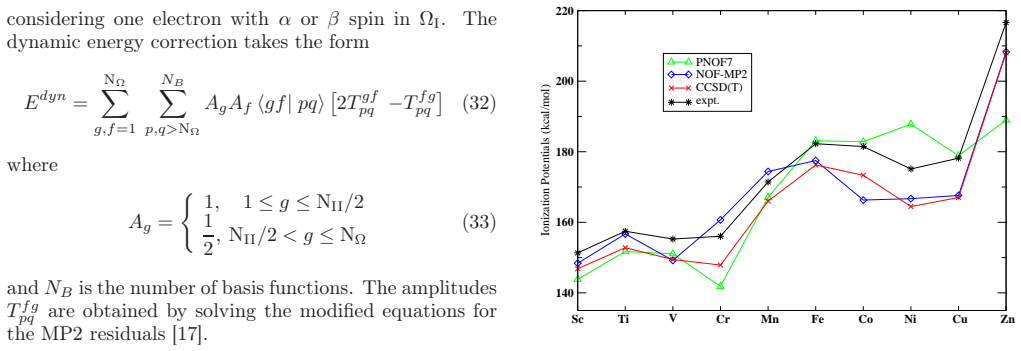
- First-row transition-metal ionization potentials from Sc to Zn are reproduced with a mean absolute error of 6.5 kcal/mol using a triple-zeta basis, close to CCSD(T) benchmark values.
- The ensemble formulation applies to mixed states of maximum multiplicity, so a ground state of given $S$ is described as a weighted sum of all its $2S+1$ components.
Reading between the lines
- If the (2,2)-positivity claim survives numerical testing, the functional would be variational, making it a practical low-cost route to geometries and dynamics on open-shell and high-spin systems.
- Because the ensemble automatically averages over all spin projections, the method may extend naturally to spin-state energetics and magnetic properties, such as spin gaps in transition-metal complexes.
- The pairing ansatz in $\Omega_{II}$ is not essential to the multiplet construction, so other singlet NOF approximations could likely be lifted to multiplets in the same way.
- The two coexisting solutions reported for Co, Ni, and Cu systems (one static-dominated, one dynamic-dominated) suggest a useful extension would be a criterion, based on occupation numbers or an ensemble weight, for selecting the physical state.
Signed reviews
Editorial analysis
A structured set of objections, weighed in public.
Referee Report
Summary. The manuscript proposes a natural orbital functional (PNOF7) for spin multiplets of maximum spin multiplicity. The author reconstructs the ensemble two-particle reduced density matrix (2RDM) from natural occupation numbers by splitting the orbital space into singly occupied orbitals (Ω_I) and singlet-coupled pairs (Ω_II), with new inter-subspace alpha-beta contributions proportional to Φ_p = sqrt(n_p(1-n_p)). The paper shows that this reconstruction yields the ensemble expectation value <S^2> = S(S+1), asserts that it satisfies the (2,2)-positivity conditions, and extends the NOF-MP2 method to multiplets. Ionization potentials of the first-row transition-metal atoms Sc–Zn are computed with a cc-pVTZ basis and compared with CCSD(T) and experiment, reporting a mean absolute error of 6.5 kcal/mol for NOF-MP2.
Significance. If correct, this is a useful step toward spin-adapted natural orbital functionals: the multiplet ensemble treatment differs from earlier NOFs that target only the high-spin component or break spin symmetry, and the NOF-MP2 extension provides a practical way to add dynamic correlation. The <S^2> derivation in Eqs. (22)–(26) is explicit and appears internally consistent, and the transition-metal IP benchmark is a genuine parameter-free prediction rather than a fit. However, the central (2,2)-positivity claim is asserted without proof, and the IP benchmark contains a multiple-solution ambiguity; both issues need to be resolved before the central claims can be accepted.
major comments (2)
- [Abstract and Section II, Eqs. (19)–(26)] The claim that the reconstructed 2RDM in Eqs. (19)–(21) satisfies the (2,2)-positivity conditions (D, Q, G ≥ 0) is stated in the abstract and Section I, but it is nowhere proved or numerically tested. Section II verifies only the ensemble expectation value of S^2 (Eqs. (22)–(26)); no argument is given for positivity of the new inter-subspace alpha-beta terms in Eq. (21), which differ from the singlet PNOF7 reconstruction and are essential to the multiplet energy in Eq. (29). Because the reconstructed 2RDM is not the exact ensemble average of the pure multiplet components, positivity is not inherited from the pure-state 2RDMs and must be demonstrated directly. This is load-bearing: without D, Q, G ≥ 0, the functional may be non-variational and the NOF-MP2 reference built on it lacks a guaranteed N-representable 2RDM.
- [Section IV, text after Fig. 2 and Table I] The NOF-MP2 benchmark is not fully determined. For the neutral atoms Co, Ni, Cu and for the Co and Ni ions, the calculation yields two solutions, and the energetically preferred solution changes between the PNOF7 and NOF-MP2 levels. The paper reports one set of PNOF7-MP2 IPs but does not specify an a priori criterion for selecting between the two stationary points. Consequently, the reported MAE of 6.5 kcal/mol is not attributable to a single well-defined method unless a selection rule is stated, such as always choosing the lowest NOF-MP2 root after solving the PNOF7 equations.
minor comments (5)
- [Section IV, text and Table I] The text states that the MAE with respect to experiment is 7.9 and 7.6 kcal/mol for PNOF7 and CCSD(T), respectively, but Table I reports a CCSD(T) MAE of 7.3 kcal/mol; the text and table should be reconciled.
- [Abstract and Section IV] The abstract says that the obtained values agree with CCSD(T) and experiment, but the PNOF7 IPs for Ni and Zn deviate from CCSD(T) by about 23 and 19 kcal/mol, respectively; the agreement statement should be qualified to the NOF-MP2 results or to the overall MAE.
- [Eq. (34)] The sentence 'Cter_p is not considered if the orbital is below NΩ' is unclear; the intended domain of Cter_p should be stated explicitly, since Eq. (34) appears to define it for p > NΩ only.
- [Figure 1 caption] The caption describes the arrows as 'alpha (↓) or beta (↑)', which is the reverse of the usual spin convention; please clarify or correct the labeling.
- [General] There are several typographical errors in the affiliations and abstract ('Donos tia', 'E uskadi', 'an y', 'tw o-particle') and the reference [20] author name appears as 'Paunez' rather than 'Pauncz'.
Circularity Check
No circularity: the multiplet NOF is a new ansatz benchmarked against external CCSD(T)/experimental data; self-citations are not load-bearing.
full rationale
The central derivation is self-contained against external benchmarks. Equations (19)-(21) define a new 2RDM reconstruction for multiplets, with an explicit ansatz for inter-subspace alpha-beta contributions, and the ionization potentials in Section IV are genuine predictions: no parameter is fitted to the experimental IPs. The <S^2> check in Eqs. (22)-(26) is an internal consistency verification of an ansatz that is parameterized by the chosen number of unpaired electrons (NI = 2S); it confirms the intended spin structure rather than supplying independent evidence, but this is not a circular prediction. The paper cites the author's own prior PNOF7 and NOF-MP2 work for the singlet machinery and for the general two-index reconstruction, but the multiplet extension is a new construction and the numerical comparison uses external CCSD(T) and experimental values. The abstract's claim that the reconstructed 2RDM fulfills (2,2)-positivity conditions is asserted without proof for the new inter-subspace alpha-beta terms; that is a genuine gap in evidence and a correctness risk, but it is not circularity because no step reduces a claimed result to its own input by definition or by a fitted parameter. No circular step was found.
Assumptions & free parameters
free parameters (1)
- N_g (maximum orbitals per subspace) =
maximum allowed by the cc-pVTZ basis set
assumptions (5)
- domain assumption The ground state of interest is the highest-spin multiplet, and the ensemble is formed by equiprobable weights over all Sz projections.
- domain assumption The two-index cumulant reconstruction of the 2RDM in terms of the 1RDM (ref [22]) is valid for the multiplet case.
- ad hoc to paper The 2RDM ansatz (19)-(21) is (2,2)-positive.
- domain assumption Real spatial orbitals are assumed, so L_pq = K_pq.
- domain assumption The NOF-MP2 double-counting avoidance functions C_p (Eq. 34) correctly separate static and dynamic correlation in the multiplet ensemble.
Cite this review
Pith. "Pith review of Natural orbital functional for multiplets." pith.science (2026). https://pith.science/paper/LQM44MUP
@misc{pith2026190805501,
  author       = {Pith},
  title        = {Pith review of: Natural orbital functional for multiplets},
  year         = {2026},
  howpublished = {\url{https://pith.science/paper/LQM44MUP}},
  note         = {Machine review of arXiv:1908.05501}
}
read the original abstract
A natural orbital functional for electronic systems with any value of the spin is proposed. This energy functional is based on a new reconstruction for the two-particle reduced density matrix (2RDM) of the multiplet, that is, of the mixed quantum state that allows all possible spin projections. The mixed states of maximum spin multiplicity are considered. This approach differs from the methods routinely used in electronic structure calculations that focus on the high-spin component or break the spin symmetry. In the ensemble, there are no interactions between electrons with opposite spins in singly occupied orbitals, as well as new inter-pair alpha-beta-contributions are proposed in the 2RDM. The proposed 2RDM fulfills (2,2)-positivity necessary N-representability conditions and guarantees the conservation of the total spin. The NOF for multiplets is able to recover the non-dynamic and the intrapair dynamic electron correlation. The missing dynamic correlation is recovered by the NOF-MP2 method. Calculation of ionization potentials of the first-row transition-metal atoms is presented as test case. The values obtained agree with those reported at the coupled cluster singles and doubles level of theory with perturbative triples and experimental data.
Figures
Reference graph
Works this paper leans on
-
[1]
Kohn and L
W. Kohn and L. Sham, Phys. Rev. 140, A1133 (1965)
1965
-
[2]
T. L. Gilbert, Phys. Rev. B 12, 2111 (1975)
1975
-
[3]
S. M. Valone, J. Chem. Phys. 73, 1344 (1980)
1980
-
[4]
Levy, Proc
M. Levy, Proc. Natl. Acad. Sci. USA 76, 6062 (1979)
1979
-
[5]
D. R. Rohr and K. Pernal, J. Chem. Phys. 135, 074104 (2011)
work page 2011
-
[6]
R. A. Donnelly, J. Chem. Phys. 71, 2874 (1979)
1979
-
[7]
on the reconstructed 2RDM. Therefore, we are deal- ing with approximate 1RDM methods, where the 2RDM continues to play a dominant, albeit hidden, role [8]. In most applications, the spectral decomposition of the 1RDM is used to express it in terms of the naturals or- bitals (NOs) and their occupation numbers (ONs). In this representation, the energy expre...
-
[8]
Piris, in Many-body approaches at different scales: a tribute to N
M. Piris, in Many-body approaches at different scales: a tribute to N. H. March on the occasion of his 90th birthday, edited by G. G. N. Angilella and C. Amovilli (Springer, New York, 2018), chap. 22, pp. 283–300
work page 2018
Show all 29 references
-
[9]
D. A. Mazziotti, Phys. Rev. Lett. 108, 263002 (2012)
2012
-
[10]
Lathiotakis, N
N. Lathiotakis, N. Helbig, and E. Gross, Phys. Rev. A 72, 030501(R) (2005)
2005
-
[11]
Goedecker and C
S. Goedecker and C. Umrigar, Phys. Rev. Lett. 81, 866 (1998)
1998
-
[12]
Piris, J
M. Piris, J. M. Matxain, X. Lopez, and J. M. Ugalde, J. Chem. Phys. 131, 021102 (2009)
2009
-
[13]
Leiva and M
P. Leiva and M. Piris, Int. J. Quantum Chem. 107, 1 (2007)
2007
-
[14]
Quintero-Monsebaiz, I
R. Quintero-Monsebaiz, I. Mitxelena, M. Rodríguez- Mayorga, A. Vela, and M. Piris, J. Phys. Condens. Mat- ter 31, 165501 (2019)
2019
-
[15]
Piris, J
M. Piris, J. M. Matxain, X. Lopez, and J. M. Ugalde, J. Chem. Phys. 132, 031103 (2010)
2010
-
[16]
Piris, Phys
M. Piris, Phys. Rev. Lett. 119, 063002 (2017)
2017
-
[17]
R. E. Thomas, G. H. Booth, and A. Alavi, Phys. Rev. Lett. 114, 033001 (2015)
2015
-
[18]
A. J. Coleman, Rev. Mod. Phys. 35, 668 (1963)
1963
-
[19]
Piris, Phys
M. Piris, Phys. Rev. A 98, 022504 (2018)
2018
-
[20]
Paunez, The Construction of Spin Eigenfunctions: an exercise book (Springer Science+Business Media, LLC, New York, 2000), ISBN 978-1-4613-6925-7
R. Paunez, The Construction of Spin Eigenfunctions: an exercise book (Springer Science+Business Media, LLC, New York, 2000), ISBN 978-1-4613-6925-7
2000
-
[21]
Piris, Adv
M. Piris, Adv. Chem. Phys. 134, 387 (2007)
2007
-
[22]
Piris, Int
M. Piris, Int. J. Quantum Chem. 106, 1093 (2006)
2006
-
[23]
Piris, in Theoretical and Quantum Chemistry at the Dawn of the 21st Century , edited by T
M. Piris, in Theoretical and Quantum Chemistry at the Dawn of the 21st Century , edited by T. Chakraborty and R. Carbó-Dorca (Apple Academic Press, New Jer- sey, 2018), chap. 22, pp. 593–620
2018
-
[24]
Piris, J
M. Piris, J. Math. Chem. 25, 47 (1999)
1999
-
[25]
Piris, J
M. Piris, J. M. Matxain, X. Lopez, and J. M. Ugalde, J. Chem. Phys. 133, 111101 (2010)
2010
-
[26]
yields the NOs by an iterative diagonalization pro- cedure, in which orbitals are not constrained to remain fixed along the orbital optimization process. III. THE NOF-MP2 METHOD The weakness of approach (21) is the absence of the inter-subspace dynamic electron correlation sinc...
-
[27]
Mitxelena, M
I. Mitxelena, M. Rodríguez-Mayorga, and M. Piris, Eur. Phys. J. B 91, 109 (2018)
2018
-
[28]
Piris and J
M. Piris and J. M. Ugalde, J. Comput. Chem. 30, 2078 (2009)
2009
-
[29]
N. B. Balabanov and K. A. Peterson, J. Chem. Phys. 123, 064107 (2005)
2005
Reviewed August 14, 2026 · model on record in the stance chip above.
Discussion (0). Continue with ORCID to comment.