REVIEW 2 major objections 4 minor 35 references
Distributed Rate Control in Downlink NOMA Networks with Reliability Constraints
T0 review · 2 major / 4 minor · reviewed 2026-08-14 · deepseek-v4-flash
Pith's one-line read A two-user downlink NOMA group can meet per-user reliability targets using only average received powers, with a simple optimal decoding order and closed-form power splits.
desk verdict Equal-rate analysis is solid, but the maximum-sum-rate optimality claims are internally inconsistent and should not be cited as-is. read the letter →
The pith
A machine-rendered reading of the paper's core claim, the machinery that carries it, and where it could break.
The reading
What carries the argument
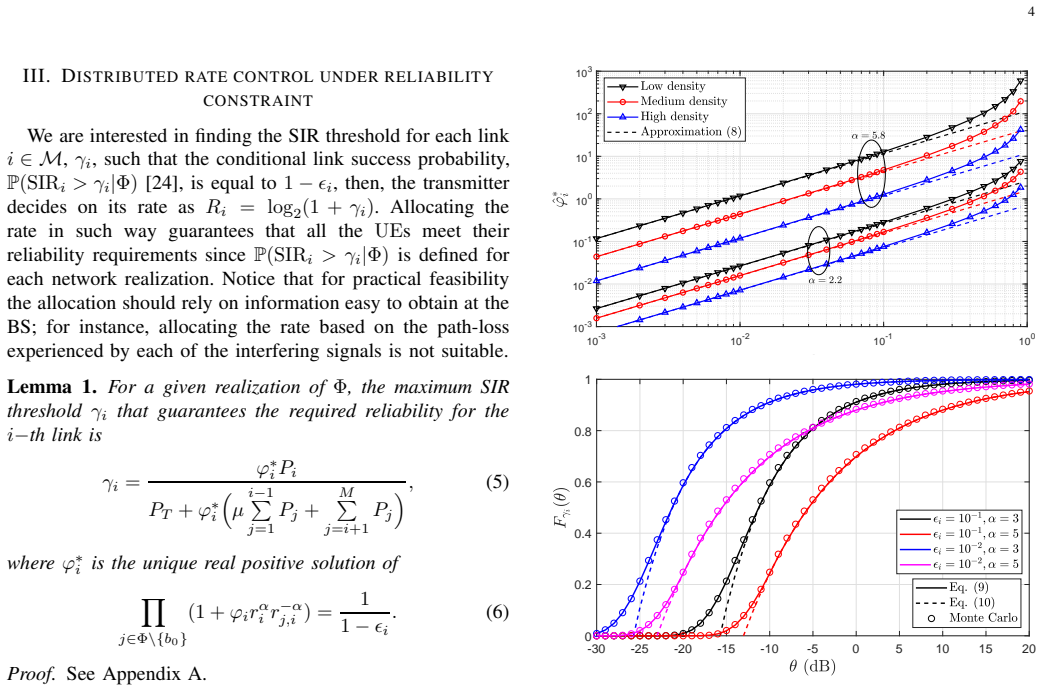
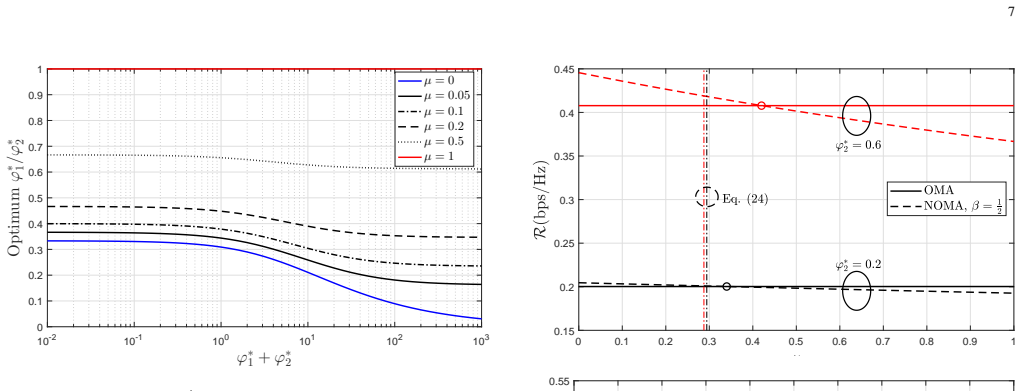
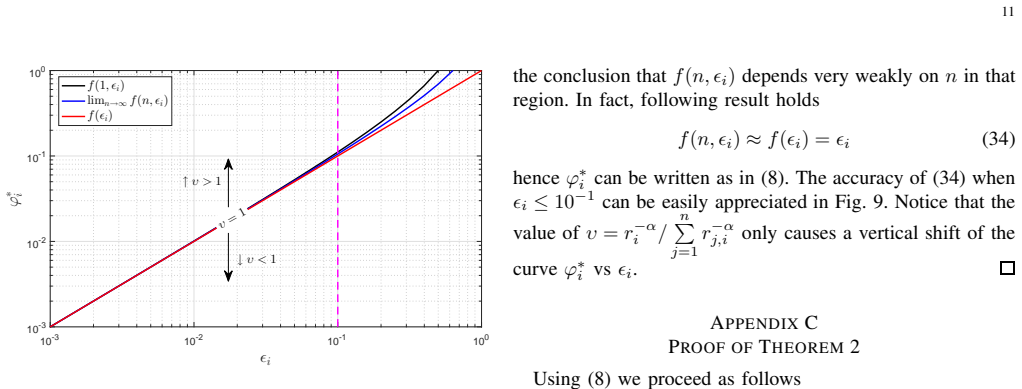
The load-bearing object is the standalone reliability-constrained SIR threshold $\phi_i^*$, defined as the unique positive solution of $\prod_{j \in \Phi \setminus \{b_0\}} (1+\phi_i r_i^\alpha r_{j,i}^{-\alpha}) = (1-\epsilon_i)^{-1}$ and approximated by $r_i^{-\alpha}/\sum_{j\ne b_0} r_{j,i}^{-\alpha}$ over $\epsilon_i$ for small $\epsilon_i$. This scalar converts an intractable instantaneous interference topology into one number per user: the average desired-signal-to-average-interference power ratio divided by the target error probability. For the sum-rate objective the argument is carried by the arithmetic-geometric-mean identity (Proposition 1), which replaces the product $(1+\gamma_1)(1+\gamma_2)$ by $\left[1+(\gamma_1+\gamma_2)/2\right]^2$; because the resulting $\bar\gamma=\gamma_1+\gamma_2$ is convex in $\beta$, the maximum sits at an endpoint, $\beta=1/2$ or $\beta=1$, which yields the closed-form threshold (22) and the NOMA-versus-OMA condition (24).
What would settle it
Numerically maximize the exact sum-rate objective $(1+\gamma_1)(1+\gamma_2)$ over $\beta \in [1/2,1]$ for a grid of $(\phi_1^*,\phi_2^*,\mu)$ values, and compare the maximizing $\beta$ and the sign of the comparison with OMA against Eqs. (22) and (24); any feasible grid point with an interior optimum or a sign mismatch would refute the universal optimality claim.
Extended reading notes
Core claim
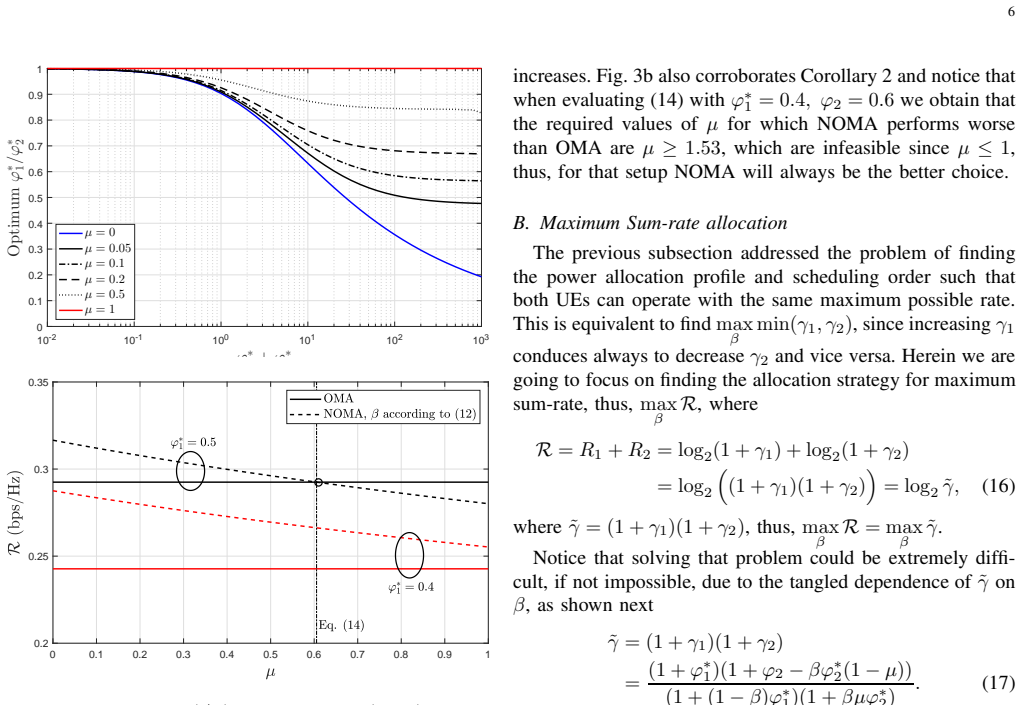
The central claim is that, in a Poisson-deployed multi-cell downlink with Rayleigh fading and interference-limited operation, reliability-constrained NOMA rate control reduces to ranking and power-splitting based on $\phi_i^*$, the SIR threshold user $i$ would need if it occupied the channel alone. For target error probabilities $\epsilon_i \le 10^{-1}$, $\phi_i^*$ is accurately the average desired-to-average-interference power ratio divided by $\epsilon_i$ (Eq. (8)). The paper proves that the optimal decoding order is $\phi_2^* \ge \phi_1^*$: the user with the largest $\epsilon_i$ times the average power ratio should be decoded first. With that ordering, the power split $\beta$ that makes the two users' transmission rates equal is Eq. (12), and the split that maximizes the approximately evaluated sum rate is Eq. (22). NOMA outperforms equal-resource OMA when the SIC residual fraction $\mu$ is below Eq. (14) for equal rates, and for sum-rate maximization it always wins at $\mu=0$ and generically wins below Eq. (24).
Load-bearing premise
For the sum-rate claims, the paper replaces the true objective $(1+\gamma_1)(1+\gamma_2)$ with the arithmetic-geometric-mean upper bound $\left[1+(\gamma_1+\gamma_2)/2\right]^2$ and does not prove that maximizing the bound gives the same power split or the same NOMA-versus-OMA comparison as maximizing the true objective.
Editorial extensions
If this is right
- A serving base station can meet per-user error budgets with a two-user NOMA group using only long-term average received powers and the target error probabilities, with no CSI feedback from users.
- The optimal decoding order is fixed by $\phi_i^*$: decode first the user with the largest $\epsilon_i$ times the average desired-to-interference power ratio, i.e., the smallest $\phi_i^*$.
- With equal-rate targets, NOMA beats equal-partition OMA exactly for $\mu$ below the closed-form bound in Eq. (14).
- With sum-rate maximization, NOMA always beats that OMA baseline at $\mu=0$ and, under the approximation, beats it almost surely for $\mu$ below Eq. (24).
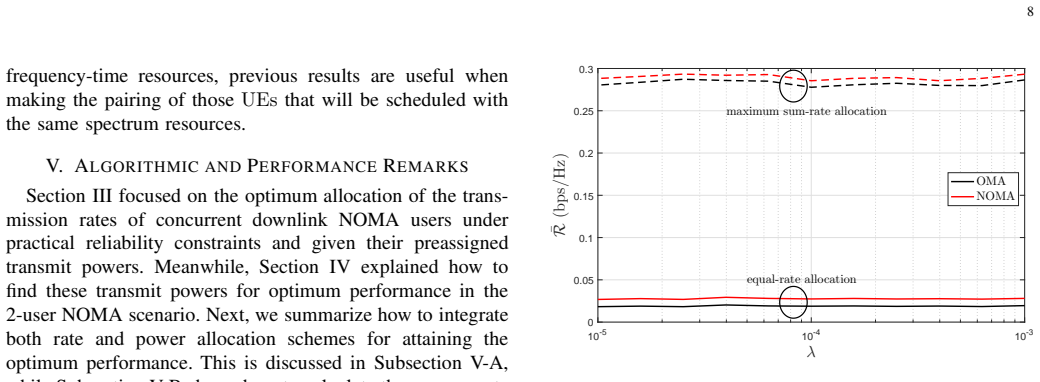
- The average allocated rate under this rule is independent of the base-station density $\lambda$, so the same rate-control calculation remains valid as the network densifies.
Reading between the lines
- This suggests a testable scheduling heuristic: pair users with strongly contrasted values of $\epsilon_i \times$ (average desired-to-interference power ratio), because these are exactly the pairs for which the NOMA-over-OMA gain is largest, while near-equal values favor OMA.
- The exact-sum-rate behaviour could deviate from Eq. (22) if the AM-GM approximation changes the location of the optimum; a direct numerical check over a $(\phi_1^*,\phi_2^*,\mu)$ grid would tell whether the closed-form thresholds need an error bound.
- The same ranking-by-$\phi_i^*$ device may extend to $M>2$ users via ordered SIC, but the paper's proofs cover only the two-user case; extending the distribution theorem and the thresholds to larger groups is an open problem.
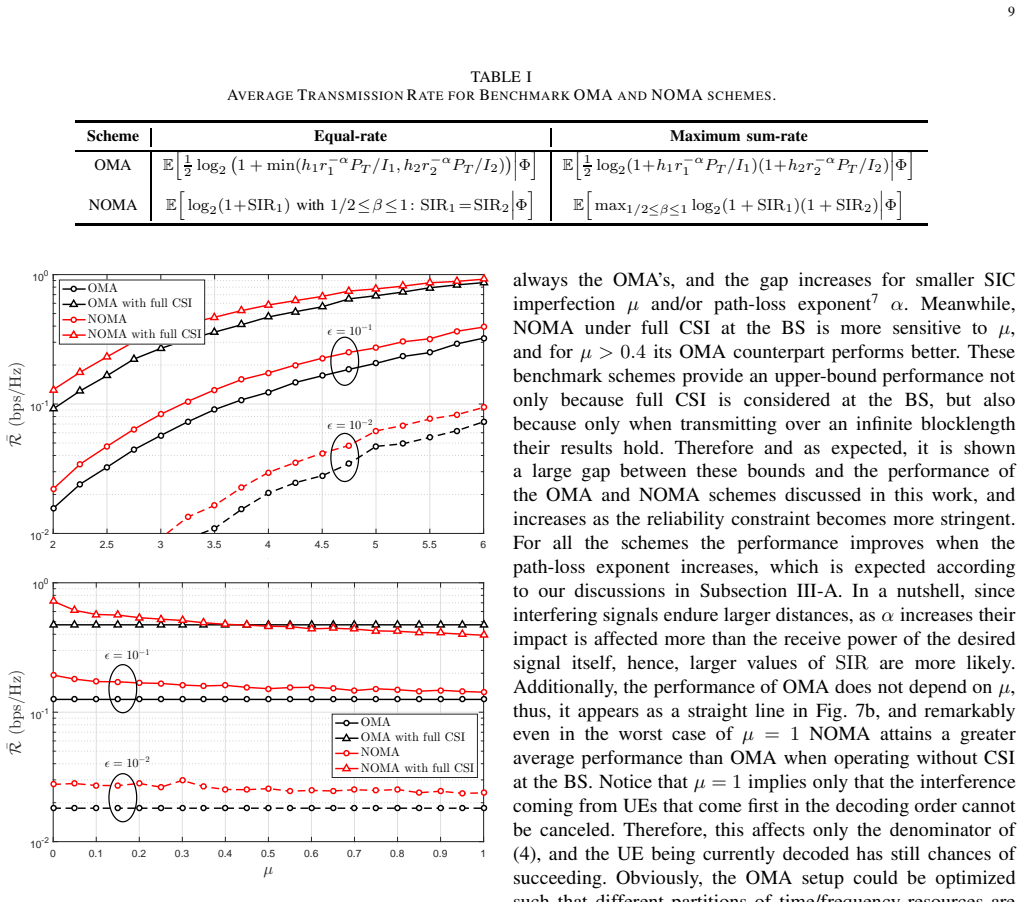
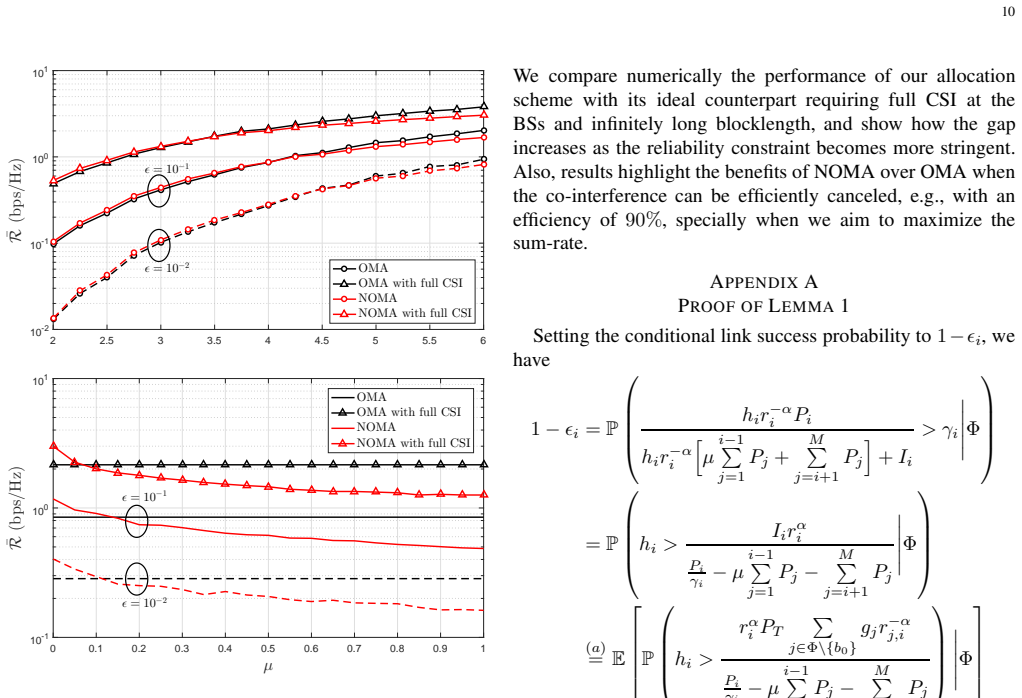
- Because the numerical gap to the infinite-blocklength, full-CSI benchmark grows as $\epsilon$ shrinks, a finite-blocklength version of this distributed rule would likely need to add a channel-dispersion penalty to $\gamma_i$; the paper leaves that extension implicit.
Signed reviews
Editorial analysis
A structured set of objections, weighed in public.
Referee Report
Summary. The paper proposes a distributed rate-control scheme for downlink NOMA under per-link reliability constraints, using only topological information (average desired and interfering powers) and target error probabilities rather than instantaneous CSI at the base station. It derives the SIR threshold formula in Lemma 1, a small-error-probability approximation in Theorem 1, the distribution of the allocated threshold in Poisson cellular networks in Theorem 2, and then focuses on the two-user case. For equal-rate allocation, Theorem 3 gives the power split, Corollary 1 gives the optimal decoding order, and Corollary 2 gives the condition under which NOMA beats OMA. For maximum sum-rate allocation, Proposition 1 introduces an AM-GM approximation, Theorem 4 gives a power-splitting rule, and Theorem 5 gives an OMA-comparison threshold. The claimed optimal ordering is that the user with the larger product of target error probability and average-signal-to-average-interference ratio should be decoded last.
Significance. The equal-rate part of the paper is a solid, analytically traceable contribution: the derivations in Lemmas 1 and 3, Theorem 3, and Corollaries 1 and 2 are careful, and the small-epsilon approximation in Theorem 1 is numerically supported. The distribution result in Theorem 2 is also useful, as it gives a density-independent characterization of the allocated SIR threshold. However, the maximum-sum-rate claims as printed are not valid: Theorem 4 contains an algebraic error in its endpoint comparison, and Proposition 1 replaces the true objective by an AM-GM upper bound without proving that the approximation preserves the argmax or the sign of the NOMA-versus-OMA comparison. Because the power-splitting rule (22) is used in Algorithm V-A and in the Section VI simulations, the maximum-sum-rate numerical results may be based on a suboptimal beta*. The equal-rate results are not affected by these errors, so the paper can likely be repaired, but the maximum-sum-rate contribution requires substantive rework.
major comments (2)
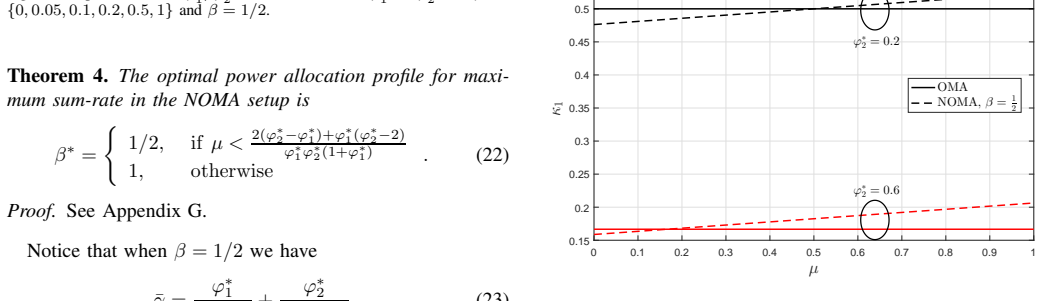
- [Appendix G and Theorem 4, Eq. (22)] The threshold in Theorem 4 is algebraically wrong. Solving the comparison gamma_bar(1/2) > gamma_bar(1) from Eq. (51) gives mu < [2(phi2* - phi1*) + phi1*(phi2* - 2 phi1*)] / [phi1* phi2* (1 + phi1*)], not the printed mu < [2(phi2* - phi1*) + phi1*(phi2* - 2)] / [phi1* phi2* (1 + phi1*)]. The error is the factor phi1*(phi2* - 2) in the numerator, which should be phi1*(phi2* - 2 phi1*). For example, with (phi1*, phi2*, mu) = (0.1, 0.2, 0.95), the printed threshold is approximately 0.909, so Eq. (22) returns beta* = 1; direct evaluation gives gamma_bar(1/2) = 0.1389 > gamma_bar(1) = 0.1, and the exact objective (1 + gamma1)(1 + gamma2) is approximately 1.1433 at beta = 1/2 versus 1.1 at beta = 1. Since Algorithm V-A and the Section VI maximum-sum-rate simulations use Eq. (22), the reported maximum-sum-rate results may rest on a strictly suboptimal beta*.
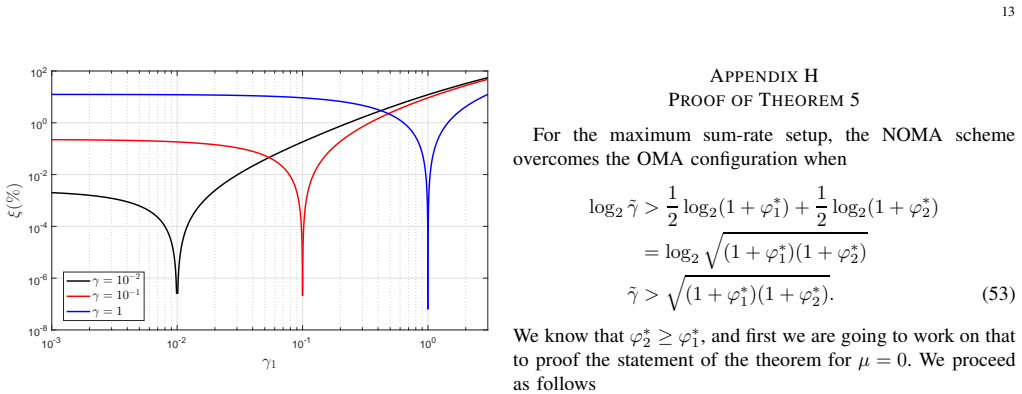
- [Proposition 1, Eq. (21), and Appendix F; Theorem 5] The maximum-sum-rate claims are not robust to the AM-GM approximation (21). The paper gives the pointwise relative-error formula (48), but that formula is a function of gamma1 and gamma2, which themselves depend on beta; no proof is supplied that maximizing the approximation [1 + gamma_bar/2]^2 preserves the argmax over beta or preserves the sign of the comparison with OMA. The algebraic error in Theorem 4 is a concrete manifestation of the risk: the printed rule selects the wrong endpoint even when both the exact objective and the approximation prefer beta = 1/2. Consequently, Theorem 5's condition (24), which is derived through the same approximation, is not established as stated. The theorem statements should be revised to either prove preservation of the argmax and of the OMA comparison, or explicitly present the results as approximate scheduling rules supported by numerical checks rather than as optimality claims.
minor comments (4)
- [Appendix F heading] The heading of Appendix F reads "PROOF OF COROLLARY 1", but the appendix proves Proposition 1; the heading should be corrected.
- [Theorem 2, Eqs. (9)-(10)] The notation "zi(theta) > 1 ≦ zi(theta) <= 1" between the two displayed equations is confusing; it should be spelled out, for example, "for zi(theta) > 1 use (9), and for zi(theta) <= 1 use (10)".
- [Section V-A, step 3] In the algorithmic summary, step 3 says beta is given by "(3) and (22)" for equal-rate and maximum sum-rate allocations, respectively; Eq. (3) is the interference definition, so the equal-rate reference should be Eq. (12).
- [Theorem 4 statement] Theorem 4 is stated as the optimal power allocation for maximum sum-rate, but the proof maximizes the approximate objective gamma_bar rather than the exact sum-rate objective; the statement should be qualified accordingly.
Circularity Check
No significant circularity: the main claims are derived from the stated reliability model, and self-citations are contextual rather than load-bearing.
full rationale
The paper's derivation chain is self-contained. Lemma 1 solves the conditional reliability constraint P(SIR_i > gamma_i | Phi) = 1 - epsilon_i directly for gamma_i, yielding (5)-(6); Theorem 1's approximation phi*_i approx (r_i^{-alpha} / sum_j r_{j,i}^{-alpha}) / epsilon_i is an AM-GM simplification of (6) rather than a fitted parameter or an assumed conclusion. Corollary 1 follows by algebra from the equal-rate expression (13), and Theorem 3's beta formula is the explicit solution of the quadratic gamma1 = gamma2. The sum-rate analysis is explicitly approximate: Proposition 1 uses the AM-GM bound (1+gamma1)(1+gamma2) <= [1 + (gamma1+gamma2)/2]^2, and Theorem 5 is qualified as 'almost surely' with a relative-error formula (48). Whether maximizing the bound preserves the true argmax is a legitimate correctness concern, but it is not circular: the bound is derived from the true objective, and no target result is embedded in the assumptions. The self-citations [25], [26] appear in the introduction as context ('closely related to the one we first proposed') and are not used as evidence for any theorem; Theorem 2's Laplace-transform machinery is cited to external results [34], [35]. No fitted input is relabeled as a prediction, and no uniqueness claim is imported from the authors' prior work.
Assumptions & free parameters
assumptions (7)
- domain assumption Base stations form a homogeneous Poisson point process with density λ; each UE associates with the nearest BS.
- domain assumption The system is interference-limited; thermal noise is neglected.
- domain assumption Rayleigh fading with unit-mean exponential power on desired and interfering links, and standard path-loss r^{-α}.
- domain assumption SIC always succeeds in removing previously decoded NOMA signals, leaving only a residual fraction µ of their power (error propagation).
- ad hoc to paper The approximation ϕ*_i ≈ ǫ_i · r_i^{-α}/Σ_j r_{j,i}^{-α} (Theorem 1) is accurate for ǫ_i ≤ 1e-1 and is used in place of the exact root of Eq. (6).
- ad hoc to paper The AM-GM approximation (1+γ1)(1+γ2) ≈ [1+(γ1+γ2)/2]^2 preserves the optimal β and the sign of the NOMA-vs-OMA comparison for maximum sum-rate.
- domain assumption The OMA baseline uses equal time/frequency partition between the two UEs; unequal resource splits are not considered.
Cite this review
Pith. "Pith review of Distributed Rate Control in Downlink NOMA Networks with Reliability Constraints." pith.science (2026). https://pith.science/paper/IO2XSCGF
@misc{pith2026190805513,
  author       = {Pith},
  title        = {Pith review of: Distributed Rate Control in Downlink NOMA Networks with Reliability Constraints},
  year         = {2026},
  howpublished = {\url{https://pith.science/paper/IO2XSCGF}},
  note         = {Machine review of arXiv:1908.05513}
}
read the original abstract
Non-orthogonal multiple access (NOMA) has been identified as a promising technology for future wireless systems due to its performance gains in spectral efficiency when compared to conventional orthogonal schemes (OMA). This gain can be easily translated to an increasing number of served users, but imposes a challenge in the system reliability which is of vital importance for new services and applications of coming cellular systems. To cope with these issues we propose a NOMA rate control strategy that makes use only of topological characteristics of the scenario and the reliability constraint. We attain the necessary conditions so that NOMA overcomes the OMA alternative, while we discuss the optimum allocation strategies for the 2-user NOMA setup when operating with equal rate or maximum sum-rate goals. In such scenario we show that the user with the largest target error probability times the ratio between the average receive signal power and the average interference power, should be scheduled to be decoded first for optimum performance. We compare numerically the performance of our allocation scheme with its ideal counterpart requiring full CSI at the BSs and infinitely long blocklength, and show how the gap increases as the reliability constraint becomes more stringent. Results also evidence the benefits of NOMA when the co-interference can be efficiently canceled, specially when the goal is to maximize the sum-rate.
Figures
Figures from the paper (7 more)
Reference graph
Works this paper leans on
-
[1]
Non-orthogonal multiple access (NOMA) for cel lular future radio access,
Y . Saito, Y . Kishiyama, A. Benjebbour, T. Nakamura, A. Li , and K. Higuchi, “Non-orthogonal multiple access (NOMA) for cel lular future radio access,” in IEEE V eh. Tech. Conf. (VTC Spring), June 2013, pp. 1–5
work page 2013
-
[2]
Non-orthogonal m ultiple access (NOMA) for future radio access,
R. Razavi, M. Dianati, and M. A. Imran, “Non-orthogonal m ultiple access (NOMA) for future radio access,” in 5G Mobile Communications. Springer, 2017, pp. 135–163. 14
work page 2017
-
[3]
Application of non-orthogonal multiple access in LT E and 5G networks,
Z. Ding, Y . Liu, J. Choi, Q. Sun, M. Elkashlan, C. L. I, and H . V . Poor, “Application of non-orthogonal multiple access in LT E and 5G networks,” IEEE Communications Magazine , vol. 55, no. 2, pp. 185– 191, February 2017
work page 2017
-
[4]
Non-orthogon al multiple access: A unified perspective,
Q. Wang, R. Zhang, L. L. Y ang, and L. Hanzo, “Non-orthogon al multiple access: A unified perspective,” IEEE Wireless Commun. , vol. 25, no. 2, pp. 10–16, April 2018
work page 2018
-
[5]
Powe r-domain non-orthogonal multiple access (NOMA) in 5G systems: Poten tials and challenges,
S. M. R. Islam, N. Avazov, O. A. Dobre, and K. s. Kwak, “Powe r-domain non-orthogonal multiple access (NOMA) in 5G systems: Poten tials and challenges,” IEEE Commun. Surv. and Tut. , vol. 19, no. 2, pp. 721–742, Secondquarter 2017
work page 2017
-
[6]
Energy-efficient resource allocation in NOMA heter ogeneous networks,
H. Zhang, F. Fang, J. Cheng, K. Long, W. Wang, and V . C. M. Leung, “Energy-efficient resource allocation in NOMA heter ogeneous networks,” IEEE Wireless Commun. , vol. 25, no. 2, pp. 48–53, April 2018
work page 2018
-
[7]
D. Wan, M. Wen, F. Ji, H. Y u, and F. Chen, “Non-orthogonal m ultiple access for cooperative communications: Challenges, oppor tunities, and trends,” IEEE Wireless Commun. , vol. 25, no. 2, pp. 109–117, April 2018
work page 2018
-
[8]
M. S. Ali, E. Hossain, and D. I. Kim, “Coordinated multipo int trans- mission in downlink multi-cell NOMA systems: Models and spe ctral efficiency performance,” IEEE Wireless Commun. , vol. 25, no. 2, pp. 24–31, April 2018
work page 2018
Show all 35 references
-
[9]
On the performanc e of non-orthogonal multiple access in 5G systems with randomly deployed users,
Z. Ding, Z. Y ang, P . Fan, and H. V . Poor, “On the performanc e of non-orthogonal multiple access in 5G systems with randomly deployed users,” IEEE Signal Processing Letters , vol. 21, no. 12, pp. 1501–1505, Dec 2014
2014
-
[10]
Impact of user pairing on 5G nonorthogonal multiple-access downlink transmissions,
Z. Ding, P . Fan, and H. V . Poor, “Impact of user pairing on 5G nonorthogonal multiple-access downlink transmissions,” IEEE Trans. on V eh. Tech., vol. 65, no. 8, pp. 6010–6023, Aug 2016
2016
-
[11]
Uplink nonorthog onal multiple access in 5G systems,
N. Zhang, J. Wang, G. Kang, and Y . Liu, “Uplink nonorthog onal multiple access in 5G systems,” IEEE Commun. Lett., vol. 20, no. 3, pp. 458–461, March 2016
2016
-
[12]
An optimization p erspective of the superiority of NOMA compared to conventional OMA,
Z. Chen, Z. Ding, X. Dai, and R. Zhang, “An optimization p erspective of the superiority of NOMA compared to conventional OMA,” IEEE Trans. on Sig. Process. , vol. 65, no. 19, pp. 5191–5202, Oct 2017
2017
-
[13]
A game theory b ased power control algorithm for future MTC NOMA networks,
K. Kang, Z. Pan, J. Liu, and S. Shimamoto, “A game theory b ased power control algorithm for future MTC NOMA networks,” in IEEE Annual Cons. Commun. Net. Conf. (CCNC) , Jan 2017, pp. 203–208
2017
-
[14]
Ener gy-efficient non-orthogonal transmission under reliability and finite b locklength constraints,
Y . Xu, C. Shen, T. Chang, S. Lin, Y . Zhao, and G. Zhu, “Ener gy-efficient non-orthogonal transmission under reliability and finite b locklength constraints,” in 2017 IEEE Globecom W orkshops (GC Wkshps) , Dec 2017, pp. 1–6
2017
-
[15]
On the perf ormance of non-orthogonal multiple access in short-packet communica tions,
Y . Y u, H. Chen, Y . Li, Z. Ding, and B. Vucetic, “On the perf ormance of non-orthogonal multiple access in short-packet communica tions,” IEEE Commun. Lett. , vol. 22, no. 3, pp. 590–593, March 2018
2018
-
[16]
Signal processing for MIMO-NOMA: Present and future challenges,
Y . Huang, C. Zhang, J. Wang, Y . Jing, L. Y ang, and X. Y ou, “ Signal processing for MIMO-NOMA: Present and future challenges,” IEEE Wireless Commun., vol. 25, no. 2, pp. 32–38, April 2018
2018
-
[17]
Modeling and a nalysis of uplink non-orthogonal multiple access in large-scale cell ular networks using Poisson cluster processes,
H. Tabassum, E. Hossain, and J. Hossain, “Modeling and a nalysis of uplink non-orthogonal multiple access in large-scale cell ular networks using Poisson cluster processes,” IEEE Trans. on Commun. , vol. 65, no. 8, pp. 3555–3570, Aug 2017
2017
-
[18]
Aggregation and resource scheduling in machine-type comm unication networks: A stochastic geometry approach,
O. L. A. L ´ opez, H. Alves, P . H. J. Nardelli, and M. Latva- aho, “Aggregation and resource scheduling in machine-type comm unication networks: A stochastic geometry approach,” IEEE Trans. on Wireless Commun., vol. 17, no. 7, pp. 4750–4765, July 2018
2018
-
[19]
Hybrid resource scheduling for aggregation in mas sive machine- type communication networks,
——, “Hybrid resource scheduling for aggregation in mas sive machine- type communication networks,” Ad Hoc Networks , vol. 94, p. 101932, 2019
2019
-
[20]
Non-orthogonal multi ple access for high-reliable and low-latency V2X communications in 5G systems,
B. Di, L. Song, Y . Li, and G. Y . Li, “Non-orthogonal multi ple access for high-reliable and low-latency V2X communications in 5G systems,” IEEE J. on Selec. Areas in Commun. , vol. 35, no. 10, pp. 2383–2397, Oct 2017
2017
-
[21]
Stochastic geome try based performance study on 5G non-orthogonal multiple access sch eme,
Z. Zhang, H. Sun, R. Q. Hu, and Y . Qian, “Stochastic geome try based performance study on 5G non-orthogonal multiple access sch eme,” in IEEE Global Commun. Conf. (GLOBECOM) , Dec 2016, pp. 1–6
2016
-
[22]
Non- orthogonal multiple access in large-scale heterogeneous n etworks,
Y . Liu, Z. Qin, M. Elkashlan, A. Nallanathan, and J. A. Mc Cann, “Non- orthogonal multiple access in large-scale heterogeneous n etworks,” IEEE J. on Selec. Areas in Commun. , vol. 35, no. 12, pp. 2667–2680, Dec 2017
2017
-
[23]
Meta distribut ion of SIR in large-scale uplink and downlink NOMA networks,
M. Salehi, H. Tabassum, and E. Hossain, “Meta distribut ion of SIR in large-scale uplink and downlink NOMA networks,” IEEE Transactions on Communications, vol. 67, no. 4, pp. 3009–3025, April 2019
2019
-
[24]
Distributed rate contro l for high reliability in poisson bipolar networks,
S. S. Kalamkar and M. Haenggi, “Distributed rate contro l for high reliability in poisson bipolar networks,” in IEEE Global Commun. Conf. (GLOBECOM), Dec 2017, pp. 1–6
2017
-
[25]
Rate contro l under finite blocklength for downlink cellular networks with reliabili ty constraints,
O. L. A. L ´ opez, H. Alves, and M. Latva-Aho, “Rate contro l under finite blocklength for downlink cellular networks with reliabili ty constraints,” in Int. Symp. on Wireless Commun. Syst. (ISWCS) , Aug 2018, pp. 1–6
2018
-
[26]
Joint power control and rate allocation enabling ultra-reliability and energy effi ciency in SIMO wireless networks,
O. L. A. L ´ opez, H. Alves, and M. Latva-aho, “Joint power control and rate allocation enabling ultra-reliability and energy effi ciency in SIMO wireless networks,” IEEE Transactions on Communications , vol. 67, no. 8, pp. 5768–5782, Aug 2019
2019
-
[27]
On distances in uniformly random networks ,
M. Haenggi, “On distances in uniformly random networks ,” IEEE Tran. on Inf. Theory , vol. 51, no. 10, pp. 3584–3586, Oct 2005
2005
-
[28]
Non-orthogonal multi ple access with SIC error propagation in downlink wireless MIMO networ ks,
H. Sun, B. Xie, R. Q. Hu, and G. Wu, “Non-orthogonal multi ple access with SIC error propagation in downlink wireless MIMO networ ks,” in IEEE V eh. Tech. Conf. (VTC-Fall), Sept 2016, pp. 1–5
2016
-
[29]
A unified framework for numerical ly inverting Laplace transforms,
J. Abate and W. Whitt, “A unified framework for numerical ly inverting Laplace transforms,” INFORMS Journal on Computing , vol. 18, no. 4, pp. 408–421, 2006
2006
-
[30]
The meta distribution of the SIR in Poisson bipolar and cellular networks,
M. Haenggi, “The meta distribution of the SIR in Poisson bipolar and cellular networks,” IEEE Trans. on Wireless Commun. , vol. 15, no. 4, pp. 2577–2589, April 2016
2016
-
[31]
Downlink and uplink non-o rthogonal multiple access in a dense wireless network,
Z. Zhang, H. Sun, and R. Q. Hu, “Downlink and uplink non-o rthogonal multiple access in a dense wireless network,” IEEE J. on Selec. Areas in Commun. , vol. 35, no. 12, pp. 2771–2784, Dec 2017
2017
-
[32]
Proportional fairness-based power allocation and user set selection for downlink NOMA systems ,
F. Liu, P . M¨ ah¨ onen, and M. Petrova, “Proportional fairness-based power allocation and user set selection for downlink NOMA systems ,” in IEEE Int. Conf. on Commun. (ICC) , May 2016, pp. 1–6
2016
-
[33]
Channel coding rate in the finite blocklength regime,
Y . Polyanskiy, H. V . Poor, and S. V erdu, “Channel coding rate in the finite blocklength regime,” IEEE Tran. on Inf. Theory , vol. 56, no. 5, pp. 2307–2359, May 2010
2010
-
[34]
SIR asymptotics in poisson c ellular networks without fading and with partial fading,
R. K. Ganti and M. Haenggi, “SIR asymptotics in poisson c ellular networks without fading and with partial fading,” in IEEE Int. Conf. on Commun. (ICC) , May 2016, pp. 1–5
2016
-
[35]
The performance of successive interfer- ence cancellation in random wireless networks,
X. Zhang and M. Haenggi, “The performance of successive interfer- ence cancellation in random wireless networks,” IEEE Transactions on Information Theory , vol. 60, no. 10, pp. 6368–6388, Oct 2014
2014
Reviewed August 14, 2026 · model on record in the stance chip above.
Discussion (0). Continue with ORCID to comment.