REVIEW 4 major objections 5 minor 59 references
Magnetic proximity in a van der Waals heterostructure of magnetic insulator and graphene
T0 review · 4 major / 5 minor · reviewed 2026-08-14 · deepseek-v4-flash
Pith's one-line read The paper claims that graphene on the ferromagnetic insulator Cr2Ge2Te6 develops an out-of-plane proximity exchange field, seen as shifted and asymmetric Hanle spin-precession curves and as perpendicular spin lifetimes about 3.9 times…
desk verdict First spin-transport evidence for out-of-plane proximity exchange in graphene/CGT, but the mT-scale fitted exchange field is not reconciled with DFT, and the stray-field control is too rough to fully rule out edge magnetism. read the letter →
The pith
A machine-rendered reading of the paper's core claim, the machinery that carries it, and where it could break.
The reading
What carries the argument
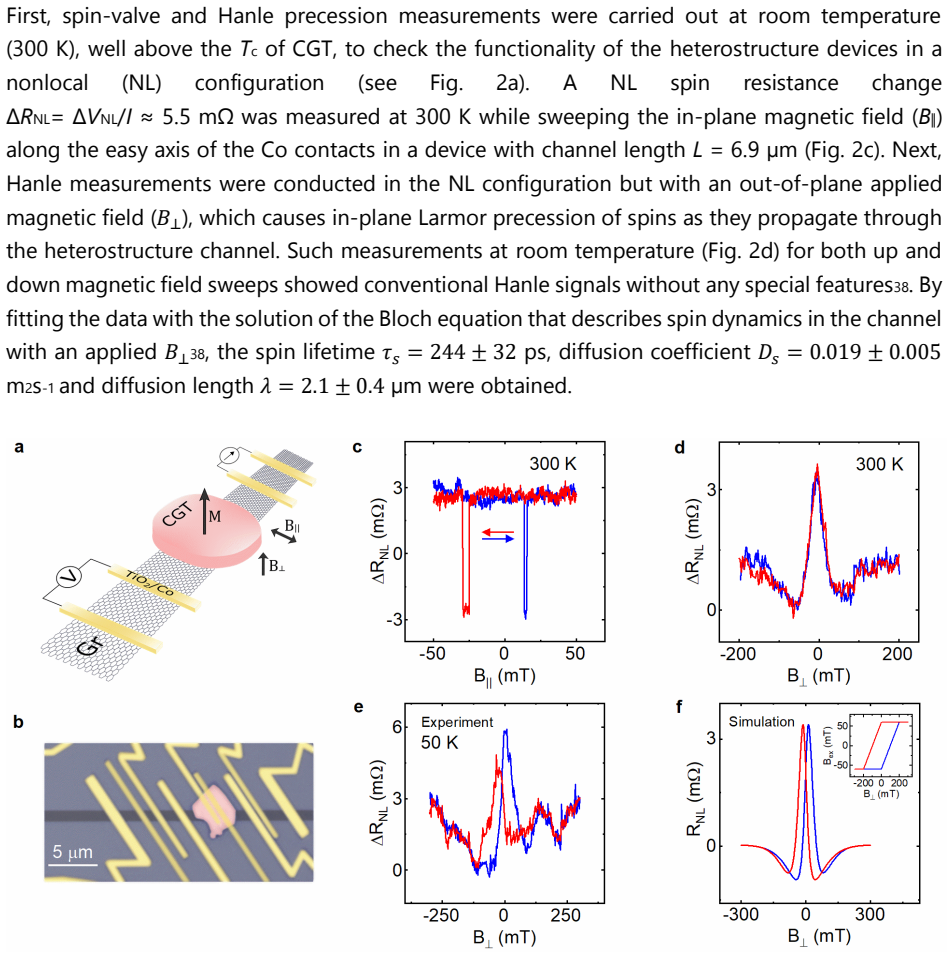
The load-bearing object is the nonlocal Hanle spin-precession signal, analyzed with a solution of the Bloch equation for a channel with two regions: bare graphene and graphene under CGT. In the covered region, the perpendicular field entering the Larmor precession frequency is $B_\perp + B_\mathrm{ex}$, where $B_\mathrm{ex}$ is the proximity exchange field; hysteresis in $B_\mathrm{ex}$ shifts the Hanle peaks between sweep directions, and the finite length of the covered region makes the central peak asymmetric. A second piece of machinery is the low-energy Hamiltonian for graphene near the Dirac points, with sublattice-resolved exchange coupling $\lambda_\mathrm{ex}^A$, $\lambda_\mathrm{ex}^B$ and spin-orbit terms; fitting this to DFT bands yields the ferromagnetic exchange splitting $(\lambda_\mathrm{ex}^A + \lambda_\mathrm{ex}^B)/2 \approx 4.4$ to $4.6$ meV and the spin-orbit parameters $\lambda_R$ and $\lambda_{VZ}$.
What would settle it
Fabricate the same device geometry but insert a thin hexagonal boron nitride spacer between graphene and CGT: the stray magnetic field of the flake stays nearly the same, while direct exchange proximity is cut off. If the Hanle peak shift and asymmetry disappear in the spacer device, the proximity-exchange reading is correct; if they persist unchanged, stray fields are the dominant cause.
Extended reading notes
Core claim
The central claim is that in a van der Waals heterostructure of graphene and the ferromagnetic insulator Cr2Ge2Te6, the graphene acquires a proximity-induced ferromagnetic exchange interaction with an out-of-plane easy axis. This is inferred from nonlocal Hanle spin precession: below the magnetic ordering temperature, the Hanle peaks for opposite field sweep directions are shifted relative to each other and the central peak is asymmetric, features that simulations reproduce only when the CGT-covered part of the channel experiences an exchange field $B_\mathrm{ex}$ perpendicular to the graphene plane. The same heterostructure shows a spin-lifetime anisotropy $\tau_\perp/\tau_\parallel \approx 3.9$, which the paper interprets as evidence of a proximity-induced anisotropic spin texture. Density functional theory calculations support the picture by giving a ferromagnetic exchange splitting of roughly 4.4 to 4.6 meV in the graphene layer, alongside a Rashba spin-orbit coupling of 0.253 meV and a valley-Zeeman coupling of 0.113 meV.
Load-bearing premise
The argument stands on the premise that the Hanle peak shifts and asymmetry are dominated by a proximity exchange field in the CGT-covered graphene, with stray fields from the flake contributing only a small correction, while the fitted exchange field of a few tens of millitesla is taken at face value even though the DFT exchange splitting corresponds to an exchange field tens of tesla, roughly a thousand times larger.
Editorial extensions
If this is right
- Below about 165 K, graphene partially covered by CGT should act as a spin-transport channel with a built-in out-of-plane exchange field, modifying spin precession even at zero applied field.
- The spin relaxation in such a channel becomes anisotropic, with perpendicular spins living roughly 3.9 times longer than in-plane spins; this anisotropy is a measurable fingerprint of a proximity-modified spin texture.
- If the exchange and spin-orbit parameters can be tuned through the van der Waals gap, flake overlap, or double-sided coverage, the same platform could be pushed toward spin filtering and the quantum anomalous Hall state.
- Hanle peak splitting and asymmetry provide a nonlocal electrical probe of interfacial magnetism that works down to small exchange fields.
Reading between the lines
- The tens-of-millitesla exchange field fitted from the Hanle data is about a thousand times smaller than the field corresponding to the DFT exchange splitting of roughly 4.5 meV, so the measured devices likely have a much weaker effective interface than the ideal DFT stack; thickness- and twist-angle-dependent studies could test this directly.
- If stray fields were the real cause of the Hanle shift, the effect should scale with flake volume and edge configuration, so an hBN-spacer control device would cleanly separate stray-field effects from genuine exchange proximity.
- The persistence of the signal above the bulk Curie temperature hints at interface- or surface-driven magnetic order, so local magnetometry on the same flakes could identify which region of the CGT is actually magnetically active.
- The sign change of the DFT exchange splitting between the two supercells suggests that twist angle and strain control the proximity effect, making it a tunable parameter rather than a fixed material property.
Signed reviews
Editorial analysis
A structured set of objections, weighed in public.
Referee Report
Summary. The manuscript reports nonlocal spin-transport measurements on graphene–Cr2Ge2Te6 van der Waals heterostructures. Below about 165 K, the Hanle spin-precession signals develop a hysteretic peak splitting and an asymmetry, which the authors attribute to an out-of-plane proximity-induced exchange field in the CGT-covered part of the graphene channel. The paper also reports a spin-lifetime anisotropy r = τ⊥/τ∥ ≈ 3.9 at B⊥ = 2.5 T, and supports the interpretation with DFT calculations yielding an exchange splitting of about 4.4–4.6 meV and with spin-orbit coupling parameters extracted from model fits. The manuscript includes temperature-dependent measurements, two devices with different CGT/graphene overlap, and extensive supplementary modeling.
Significance. If the exchange-field attribution survives closer scrutiny, this is a significant advance: it would demonstrate proximity-induced out-of-plane ferromagnetic exchange in graphene using a van der Waals magnetic insulator, with implications for spin filtering and topological states. The paper has real strengths: systematic temperature dependence of the Hanle features, a two-device overlap comparison, explicit discussion of stray fields, and DFT calculations with low-energy model fits. It is also candid about ambiguities, noting that the anisotropy could arise from SOC, exchange fluctuations, or both, and that the DFT exchange sign changes with supercell size. However, the quantitative foundation for the central claim is weak: the exchange field is a fitted parameter with a sixfold spread, the stray-field exclusion rests on a channel-averaged comparison, and the fitted mT-scale B_ex is not reconciled with the DFT meV-scale splitting.
major comments (4)
- [Supplementary note 2] The stray-field exclusion is not load-bearing in its current form. The comparison of a channel-averaged B_s,eff with B_exch,eff assumes that the Hanle signal depends on the mean field, but the nonlocal spin signal is a nonlinear functional of the local field along each spin trajectory; with only about 60% channel overlap, edge stray fields that change sign across each edge can generate peak shifts and asymmetries similar to those attributed to B_ex. The estimate also uses B_exch = 30 mT, a fitted value from Supplementary note 4, so it cannot independently establish that exchange dominates. A position-dependent stray-field calculation fed through the same Bloch-equation model is needed before the exchange attribution is secure.
- [Supplementary note 4 / Fig. 2e] The quantitative content of the central claim is not settled. The four fits in Supplementary note 4 give B_ex = 33, 42, 58, and 209 mT depending on fitting constraints, a spread of more than a factor of six, and the fitting procedure uses B_ex as an input to generate the same Hanle curves from which it is then extracted. Moreover, these fitted mT-scale fields are three to four orders of magnitude smaller than the DFT exchange splitting of 4.4–4.6 meV, which corresponds to a spin-precession field of tens of tesla; the manuscript offers no reconciliation of this discrepancy.
- [Main text, anisotropic spin relaxation / Supplementary note 6] The abstract and summary overstate the anisotropy result relative to the paper's own analysis. Supplementary note 6 derives τ_c = 4 ps from the measured r = 3.9 and then calculates r(B⊥ = 0) ≈ 1.002, explicitly concluding that the large anisotropy in Fig. 4d is driven by the external field and may not be intrinsic to the graphene/CGT interface; the main text similarly states that it is unclear whether SOC, exchange fluctuations, or a combination dominates. The claims of a 'proximity-induced anisotropic spin texture' and of an intrinsic larger perpendicular lifetime should be qualified or removed.
- [Supplementary note 5] The DFT support for the proximity exchange is weaker than presented: the exchange splitting changes sign between the 218-atom and 80-atom supercells, and the SOC parameters are obtained from a smaller cell with about 4% strain in CGT. This sign ambiguity and strain sensitivity are acknowledged in the supplement, but they mean the DFT calculations cannot independently confirm the direction or even the existence of a ferromagnetic exchange in the experimental system.
minor comments (5)
- [Summary] The Summary section contains a typo: 'existance' should be 'existence'.
- [Main text, anisotropic spin relaxation] The typesetting of the anisotropy ratio 'Δ𝑅NL⊥ Δ𝑅NL∥⁄ ∼ 10' and of the formula for r is difficult to parse; please clarify the notation and place the formula on a single line.
- [Supplementary note 1] Equation (S1) is described as derived in reference 2 of the supplement, but the derivation is not reproduced; since this equation underlies all simulations, the authors should either include the derivation or ensure the companion paper (ref. 39 of the main text) is publicly available.
- [Supplementary note 2] The statement that B_exch is a constant depending only on magnetization and interface properties is not obviously consistent with the strong temperature dependence of the Hanle features in Fig. 3; a sentence explaining how B_exch is expected to vary with temperature would help.
- [Supplementary note 5] In the 218-atom supercell fit, the values λ_ex^A = 4.556 meV and λ_ex^B = 4.558 meV are almost identical, so the sublattice-resolved exchange term is essentially a uniform exchange; this near-degeneracy and its implications for the model should be commented on.
Circularity Check
Stray-field exclusion in Supplementary note 2 uses the very exchange field fitted from the Hanle data, so the claim that exchange dominates is partially circular.
-
fitted input called prediction
[Supplementary note 2 (stray-field section), relying on Supplementary note 4 fits of Eq. (S1); main text paragraph 'The CGT flake can induce ferromagnetism...']
"Here B_exch = 30 mT is taken as a constant since its value depends only on the magnetization of the flake and interface properties between graphene and CGT. The magnitude of B_exch is taken in accordance with our estimates (Supplementary note 4). ... effective contribution of exchange field is at least 10 times bigger than from stray fields even for the lower limit of the estimate of B_exch = 30 mT. Thus, one can conclude that the observed Hanle signals are mainly shaped by the applied external and induced exchange fields in the graphene channel."
The 30 mT exchange field used to compute B_exch,eff comes from fitting the same Hanle curves with a Bloch-equation model (Eq. S1) that already attributes the peak shift to B_ex and contains no stray-field term; Supplementary note 4 reports fitted B_ex values of 33-209 mT. The stray-field exclusion is therefore not an independent check: the fitted B_ex absorbs any stray-field-induced peak shift, and the comparison B_exch,eff vs B_s,eff is a comparison of the fitted parameter with an idealized stray-field estimate. The conclusion that exchange, not stray fields, shapes the Hanle signal is built into the value used to demonstrate it.
full rationale
The paper's central claim is not self-definitional: the low-temperature Hanle peak shift and asymmetry, the temperature dependence, the overlap-dependence of the asymmetry, and the DFT exchange splitting are empirical or independent inputs, and the Hanle fits are standard model fitting. The one load-bearing circular step is the stray-field exclusion in Supplementary note 2, where the fitted exchange field (B_exch = 30 mT, from Supplementary note 4) is used as the reference value to conclude that exchange dominates over stray fields. That comparison cannot establish the uniqueness of the exchange interpretation, because the fit already assumed the exchange field and omitted stray fields. Supplementary note 6 also calibrates tau_c from the measured r = 3.9 and then uses the model to compute r(0) ≈ 1; this is a self-consistency check rather than an independent prediction, but it is not the paper's main load-bearing claim and the paper explicitly leaves the anisotropy mechanism unresolved. The DFT calculation provides independent evidence for proximity exchange, although the 4.4-4.6 meV splitting is orders of magnitude larger than the fitted millitesla-scale B_ex, an inconsistency that is a correctness risk rather than circularity. Overall, the derivation is partially circular at one key step, giving a score of 6.
Assumptions & free parameters
free parameters (4)
- Bex (proximity exchange field) =
33 to 209 mT depending on fit constraints
- Spin transport parameters (tau, tau_H, D, D_H, C) =
tau 121 to 1990 ps, tau_H 10 to 106 ps, D 0.042 to 0.246 m2/s, D_H 0.04 to 0.11 m2/s
- tau_c (exchange fluctuation correlation time) =
4 ps
- Low-energy Hamiltonian parameters from DFT fits (v_F, Delta, lambda_exA, lambda_exB, lambda_R, lambda_I) =
lambda_ex = 4.4 to 4.6 meV, lambda_R = 0.253 meV, lambda_VZ = 0.113 meV
assumptions (7)
- domain assumption The inhomogeneous Bloch equation for spin diffusion and precession (Eq. S1) describes nonlocal Hanle signals in the graphene/CGT channel.
- domain assumption A proximity exchange field Bex and a stray field Bs add linearly to the applied perpendicular field: B_total = B_ext + B_s + B_ex.
- domain assumption CGT has perpendicular magnetic anisotropy with bulk Curie temperature near 65 K, as measured by SQUID.
- domain assumption The graphene/CGT interface is clean and unoxidized, so the proximity interaction is not obscured by interfacial contamination.
- domain assumption DFT with GGA+U and vdW corrections captures the proximity exchange and spin-orbit coupling in the heterostructure.
- domain assumption Exchange fluctuations can be modeled by a Lorentzian spectrum with a single correlation time tau_c.
- domain assumption The graphene channel is homogeneous outside the CGT-covered region, with a single effective Bex inside it.
Cite this review
Pith. "Pith review of Magnetic proximity in a van der Waals heterostructure of magnetic insulator and graphene." pith.science (2026). https://pith.science/paper/DYCVUKWI
@misc{pith2026190805524,
  author       = {Pith},
  title        = {Pith review of: Magnetic proximity in a van der Waals heterostructure of magnetic insulator and graphene},
  year         = {2026},
  howpublished = {\url{https://pith.science/paper/DYCVUKWI}},
  note         = {Machine review of arXiv:1908.05524}
}
read the original abstract
Engineering two-dimensional material heterostructures by combining the best of different materials in one ultimate unit can offer a plethora of opportunities in condensed matter physics. Here, in the van der Waals heterostructures of the ferromagnetic insulator Cr2Ge2Te6 and graphene, our observations indicate an out-of-plane proximity-induced ferromagnetic exchange interaction in graphene. The perpendicular magnetic anisotropy of Cr2Ge2Te6 results in significant modification of the spin transport and precession in graphene, which is ascribed to the proximity-induced exchange interaction. Furthermore, the observation of a larger lifetime for perpendicular spins in comparison to the in-plane counterpart suggests the creation of a proximity-induced anisotropic spin texture in graphene. Our experimental results and density functional theory calculations open up opportunities for the realization of proximity-induced magnetic interactions and spin filters in 2D material heterostructures and can form the basic building blocks for future spintronic and topological quantum devices.
Figures


Reference graph
Works this paper leans on
-
[1]
Wang, J. & Zhang, S.-C. Topological states of condensed matter. Nat. Mater. 16, 1062–1067 (2017)
work page 2017
-
[2]
He, Q. L. et al. Chiral Majorana fermion modes in a quantum anomalous Hall insulator–superconductor structure. Science. 357, 294–299 (2017)
work page 2017
-
[3]
Qiao, Z. et al. Quantum anomalous Hall effect in graphene proximity coupled to an antiferromagnetic insulator. Phys. Rev. Lett. 112, 116404 (2014)
work page 2014
-
[4]
Qiao, Z. et al. Quantum Anomalous Hall Effect in Graphene from Rashba and Exchange Effects. Phys. Rev. B 82, 161414 (2010)
work page 2010
-
[5]
Roche, S. et al. Graphene spintronics: the European Flagship perspective. 2D Mater. 2, 030202 (2015)
work page 2015
-
[6]
Yang, H. X. et al. Proximity Effects Induced in Graphene by Magnetic Insulators : First-Principles Calculations on Spin Filtering and Exchange-Splitting Gaps. Phys. Rev. Lett. 110, 046603 (2013)
work page 2013
-
[7]
Hallal, A., Ibrahim, F., Yang, H., Roche, S. & Chshiev, M. Tailoring magnetic insulator proximity effects in graphene: first-principles calculations. 2D Mater. 4, 025074 (2017)
work page 2017
-
[8]
Zhong, D. et al. Van der Waals engineering of ferromagnetic semiconductor heterostructures for spin and valleytronics. 1–7 (2017)
work page 2017
Show all 59 references
-
[9]
& Brataas, A
Haugen, H., Huertas-Hernando, D. & Brataas, A. Spin transport in proximity-induced ferromagnetic graphene. Phys. Rev. B 77, 115406 (2008)
2008
-
[10]
Yang, H. et al. Significant Dzyaloshinskii-Moriya interaction at graphene-ferromagnet interfaces due to Rashba effect. Nat. Mater. 17, 605–609 (2018)
2018
-
[11]
& Barnaś, J
Dyrdał, A. & Barnaś, J. Anomalous, spin, and valley Hall effects in graphene deposited on ferromagnetic substrates. 2D Mater. 4, 034003 (2017)
2017
-
[12]
& Shi, J
Wang, Z., Tang, C., Sachs, R., Barlas, Y. & Shi, J. Proximity-induced ferromagnetism in graphene revealed by the anomalous Hall effect. Phys. Rev. Lett. 114, 016603 (2015)
2015
-
[13]
Tang, C. et al. Approaching quantum anomalous Hall effect in proximity-coupled YIG/graphene/h-BN sandwich structure. APL Mater. 6, 026401 (2018)
2018
-
[14]
Wei, P. et al. Strong interfacial exchange field in the graphene/EuS heterostructure. Nat. Mater. 15, 711–716 (2016)
2016
-
[16]
C., Kaverzin, A
Leutenantsmeyer, J. C., Kaverzin, A. A., Wojtaszek, M. & Van Wees, B. J. Proximity induced room temperature ferromagnetism in graphene probed with spin currents. 2D Mater. 4, 014001 (2017)
2017
-
[17]
Gong, C. et al. Discovery of intrinsic ferromagnetism in two-dimensional van der Waals crystals. Nature 546, 265–269 (2017)
2017
-
[18]
Huang, B. et al. Layer-dependent ferromagnetism in a van der Waals crystal down to the monolayer limit. Nature 546, 270–273 (2017)
2017
-
[19]
Tan, C. et al. Hard magnetic properties in nanoflake van der Waals Fe3GeTe2. Nat. Commun. 9, 1554 (2018)
2018
-
[20]
Wang, Z. et al. Electric-field control of magnetism in a few-layered van der Waals ferromagnetic semiconductor. Nat. Nanotechnol. 13, 554–559 (2018)
2018
-
[21]
Huang, B. et al. Electrical control of 2D magnetism in bilayer CrI3. Nat. Nanotechnol. 13, 544–548 (2018)
2018
-
[22]
Jiang, S., Li, L., Wang, Z., Mak, K. F. & Shan, J. Controlling magnetism in 2D CrI3 by electrostatic doping. Nat. Nanotechnol. 13, 549–553 (2018)
2018
-
[23]
Klein, D. R. et al. Probing magnetism in 2D van der Waals crystalline insulators via electron tunneling. Science. 360, 1218–1222 (2018)
2018
-
[24]
Song, T. et al. Giant tunneling magnetoresistance in spin-filter van der Waals heterostructures. Science. 360, 1214–1218 (2018)
2018
-
[25]
Wang, Z. et al. Very large tunneling magnetoresistance in layered magnetic semiconductor CrI3. Nat. Commun. 9, 2516 (2018)
2018
-
[26]
Wang, Z. et al. Tunneling Spin Valves Based on Fe3GeTe2/hBN/Fe3GeTe2 van der Waals Heterostructures. Nano Lett. 18, 4303–4308 (2018)
2018
-
[27]
Ghazaryan, D. et al. Magnon-assisted tunnelling in van der Waals heterostructures based on CrBr3. Nat. Electron. 1, 344–349 (2018)
2018
-
[28]
Alegria, L. D. et al. Large anomalous Hall effect in ferromagnetic insulator-topological insulator 13 heterostructures. Appl. Phys. Lett. 105, 1–5 (2014)
2014
-
[29]
Wu, Y. et al. Néel-type skyrmion in WTe2/Fe3GeTe2 van der Waals heterostructure. arXiv:1907.11349 (2019)
2019 arXiv
-
[30]
& Yang, Z
Zhang, J., Zhao, B., Yao, Y. & Yang, Z. Robust quantum anomalous Hall effect in graphene-based van der Waals heterostructures. Phys. Rev. B 92, 165418 (2015)
2015
-
[31]
& Fabian, J
Zollner, K., Gmitra, M. & Fabian, J. Electrically tunable exchange splitting in bilayer graphene on monolayer Cr2X2Te6 with X = Ge, Si, and Sn. New J. Phys. 20, 073007 (2018)
2018
-
[32]
Zhang, J. et al. Strong magnetization and Chern insulators in compressed graphene/CrI3 van der Waals heterostructures. Phys. Rev. B 97, 085401 (2017)
2017
-
[33]
Xing, W. et al. Electric field effect in multilayer Cr2Ge2Te6: a ferromagnetic 2D material. 2D Mater. 4, 024009 (2017)
2017
-
[34]
& André, G
Carteaux, V., Brunet, D., Ouvrard, G. & André, G. Crystallographic, magnetic and electronic structures of a new layered ferromagnetic compound Cr2Ge2Te6. J. Phys. Condens. Matter 7, 69–87 (1995)
1995
-
[35]
& Yang, J
Li, X. & Yang, J. CrXTe3 (X = Si, Ge) nanosheets: two dimensional intrinsic ferromagnetic semiconductors. J. Mater. Chem. C 2, 7071–7076 (2014)
2014
-
[36]
J., Ji, H., Cava, R
Tian, Y., Gray, M. J., Ji, H., Cava, R. J. & Burch, K. S. Magneto-elastic coupling in a potential ferromagnetic 2D atomic crystal. 2D Mater. 3, 025035 (2016)
2016
-
[37]
, Meyer, J
Ferrari, A. ., Meyer, J. C., Scardaci, C., Casiraghi, C. & Lazzeri, M. Raman Spectrum of Graphene and Graphene Layers. Phys. Rev. Lett. 97, 187401 (2006)
2006
-
[40]
Hahn, E. L. & Abragam, A. Pulsed Magnetic Resonance: NMR, ESR, and Optics. (Clarendon, 1992)
1992
-
[41]
& Zutic, I
Fabian, J., Matos-Abiaguea, A., Ertlera, C., Stano, P. & Zutic, I. Semiconductor Spintronics. Acta Phys. Slovaca 57, 565–907 (2007)
2007
-
[43]
Raes, B. et al. Determination of the spin-lifetime anisotropy in graphene using oblique spin precession. Nat. Commun. 7, 11444 (2016)
2016
-
[44]
W., Garcia, J
Cummings, A. W., Garcia, J. H., Fabian, J. & Roche, S. Giant Spin Lifetime Anisotropy in Graphene Induced by Proximity Effects. Phys. Rev. Lett. 119, 206601 (2017)
2017
-
[45]
H., Vila, M., Cummings, A
Garcia, J. H., Vila, M., Cummings, A. W. & Roche, S. Spin transport in graphene/transition metal dichalcogenide heterostructures. Chem. Soc. Rev. 47, 3359–3379 (2018)
2018
-
[46]
Inhomogeneous Electron Gas
Honenberg, P. Inhomogeneous Electron Gas. Phys. Rev. 136, B864–B871 (1964)
1964
-
[47]
Giannozzi, P. et al. QUANTUM ESPRESSO : a modular and open-source software project for quantum simulations of materials. J. Phys. Condens. Matter 21, 395502 (2009)
2009
-
[48]
& Joubert, D
Kresse, G. & Joubert, D. From ultrasoft pseudopotentials to the projector augmented-wave method. Phys. Rev. B 59, 1758–1775 (1999)
1999
-
[49]
P., Burke, K
Perdew, J. P., Burke, K. & Ernzerhof, M. Generalized Gradient Approximation Made Simple. Phys. Rev. Lett. 77, 3865–3868 (1996)
1996
-
[50]
Semiempirical GGA-Type Density Functional Constructed with a Long-Range Dispersion Correction
Grimme, S. Semiempirical GGA-Type Density Functional Constructed with a Long-Range Dispersion Correction. J. Comput. Chem. 27, 1787–1799 (2006)
2006
-
[51]
Anisotropic spin relaxation in graphene -CGT insulator heterostructures
Barone, V. et al. Role and Effective Treatment of Dispersive Forces in Materials : Polyethylene and Graphite Crystals as Test Cases. J. Comput. Chem. 30, 934–939 (2008). 1 Supplementary information Magnetic proximity in a van der Waals heterostructure of magnetic insulator and...
2008
-
[52]
J., Ji, H., Cava, R
Tian, Y., Gray, M. J., Ji, H., Cava, R. J. & Burch, K. S. Magneto -elastic coupling in a potential ferromagnetic 2D atomic crystal. 2D Mater. 3, 025035 (2016)
2016
-
[53]
Cummings, A. W. Probing magnetism via spin dynamics in graphene/2D -ferromagnet heterostructures. arXiv:1906.09568 (2019)
2019 arXiv
-
[54]
& André, G
Carteaux, V., Brunet, D., Ouvrard, G. & André, G. Crys tallographic, magnetic and electronic structures of a new layered ferromagnetic compound Cr 2Ge2Te6. J. Phys. Condens. Matter 7, 69– 87 (1995)
1995
-
[55]
& Hesjedal, T
Engel-Herbert, R. & Hesjedal, T. Calculation of the magnetic stray field of a uniaxial magnetic domain. J. Appl. Phys. 97, 074504 (2005)
2005
-
[56]
Ringer, S. et al. Measuring anisotropic spin relaxation in graphene. Phys. Rev. B 97, 205439 (2018)
2018
-
[57]
M., Groenveld, C., Dankert, A
Kamalakar, V. M., Groenveld, C., Dankert, A. & Dash, S. P. Long distance spin communication in chemical vapour deposited graphene. Nat. Commun. 6, 6766 (2015)
2015
-
[58]
& Yang, J
Li, X. & Yang, J. CrXTe 3 (X = Si, Ge) nanosheets: two dimensional intrinsic ferromagnetic semiconductors. J. Mater. Chem. C 2, 7071–7076 (2014)
2014
-
[59]
Casto, L. D. et al. Strong spin-lattice coupling in CrSiTe3. Appl. Phys. Lett. Mater. 3, 041515 (2015)
2015
-
[60]
& Yang, Z
Zhang, J., Zhao, B., Yao, Y. & Yang, Z. Robust quantum anomalous Hall effect in graphene -based van der Waals heterostructures. Phys. Rev. B 92, 165418 (2015)
2015
-
[61]
& Burkard, G
David, A., Rakyta, P., Kormányos, A. & Burkard, G. Induced spin-orbit coupling in twisted graphene – transition metal dichalcogenide heterobilayers: Twistronics meets spintronics. Phys. Rev. B 100, 085412 (2019)
2019
-
[62]
M., Swartz, A
McCreary, K. M., Swartz, A. G., Han, W., Fabian, J. & Kawakami, R. K. Magnetic moment formation in graphene detected by scattering of pure spin currents. Phys. Rev. Lett. 109, 186604 (2012)
2012
-
[63]
Singh, S. et al. Strong Modulation of Spin Currents in Bilayer Graphene by Static and Fluctuating Proximity Exchange Fields. Phys. Rev. Lett. 118, 187201 (2017)
2017
Reviewed August 14, 2026 · model on record in the stance chip above.
Discussion (0). Continue with ORCID to comment.