REVIEW 3 major objections 7 minor 17 references
Sample-efficient Deep Reinforcement Learning with Imaginary Rollouts for Human-Robot Interaction
T0 review · 3 major / 7 minor · reviewed 2026-08-14 · deepseek-v4-flash
Pith's one-line read This paper claims that an online-learned stochastic environment model can generate imaginary rollouts that let a robot solve a gesture-guided puzzle with far fewer real interactions.
desk verdict A sensible latent-space model-based RL architecture with an honest write-up, but the headline sample-efficiency gains are confounded by unequal controller update counts between the augmented agent and the baseline. read the letter →
The pith
A machine-rendered reading of the paper's core claim, the machinery that carries it, and where it could break.
The reading
What carries the argument
The load-bearing mechanism is the learned latent-space environment model M, composed of an MDN transition predictor, a reward predictor, and a terminal-state predictor, all operating in the 8-dimensional latent space of a variational autoencoder instead of in raw pixel space. The MDN models the conditional distribution of the next latent state $p(z_{t+1}|z_t,a_t)$ as a mixture of five Gaussians, which is what lets imaginary rollouts remain realistic in closed loop despite stochastic observations. The controller is updated once per timestep on a batch of 64 real transitions and once on a batch of 64 imaginary transitions, with model-generated rollouts switched on only after about 1000 episodes so that early erroneous predictions do not mislead learning.
What would settle it
Disable the imaginary-rollout branch entirely by setting the start episode for model use beyond the training horizon while keeping everything else identical, including the pretrained encoder and controller updates on the real-memory batch. If the success rate at 2000 episodes does not drop back toward the baseline deep Q-network level, the reported speedup is not produced by the learned model.
Extended reading notes
Core claim
The central discovery is that synthetic transitions generated by a learned model are most valuable during the early phase of learning, and that a probabilistic model is required for this to work. The paper proposes a three-component architecture: a pretrained variational autoencoder encoder acting as the vision module; an environment model made of a mixture density network for next-state prediction, a reward network, and a terminal-state network; and a deep Q-network controller trained on both real and imaginary transitions. The environment model is learned online from real transitions and then run in closed loop to produce imaginary rollouts of depth 10 and breadth 3. Because the environment's observable dynamics are stochastic even when the underlying dynamics are deterministic, the mixture-of-Gaussians output prevents prediction error from compounding in closed-loop rollouts. On the puzzle task this yields the reported performance gains, and the learned model also supports planning by generating optimal action sequences from the initial image alone.
Load-bearing premise
The learning shortcut works only if the model the agent builds from real experience is accurate enough that its invented next states resemble what would actually happen; if early real data are too sparse or the compressed image representation drops task-relevant detail, the imagined experiences will mislead the controller.
Editorial extensions
If this is right
- Fewer real robot interactions are needed to reach a given success rate, lowering time, wear, and safety burden in human-robot interaction.
- The performance gap over the baseline shrinks as training episodes grow, so imaginary rollouts are an early-training accelerator rather than a replacement for real experience.
- A trained controller plus environment model can generate full optimal action plans from a single observed image, enabling one-shot execution without further interaction.
- The stochastic formulation handles environments whose observed states vary randomly even when underlying dynamics are deterministic, a common situation in human-robot interaction.
- Because reward and dynamics are learned by separate networks, the dynamics model can in principle be reused across tasks that share the same environment but differ in goals.
Reading between the lines
- Because only the image encoder is pretrained and the environment model is task-agnostic, the same architecture should transfer to similar robot tasks with different goals simply by swapping the reward predictor.
- A natural next experiment is to replace the fixed rollout depth and breadth with an uncertainty-gated controller, such as an ensemble of environment models; the paper's account predicts this would further improve early-training gains.
- The larger relative gain on the harder task suggests the benefit scales with how much harder the policy is than the environment dynamics, so long-horizon human-robot interaction tasks with unchanged physics should show even larger early advantages.
- The model's reported 75% accuracy on never-seen terminal-state transitions suggests the latent dynamics may encode local physical rules rather than memorized episodes; testing a variant where the correct action depends on history would reveal whether the memoryless-state assumption is the limiting factor.
Signed reviews
Editorial analysis
A structured set of objections, weighed in public.
Referee Report
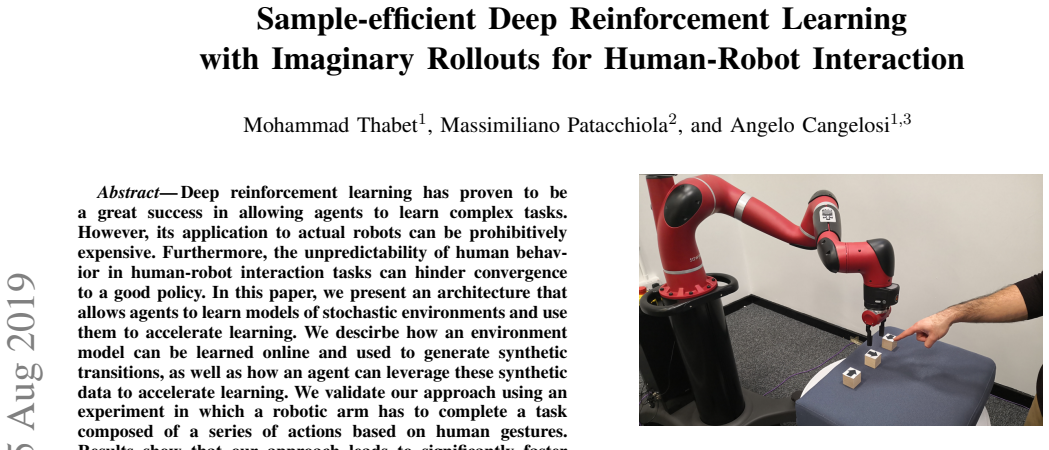
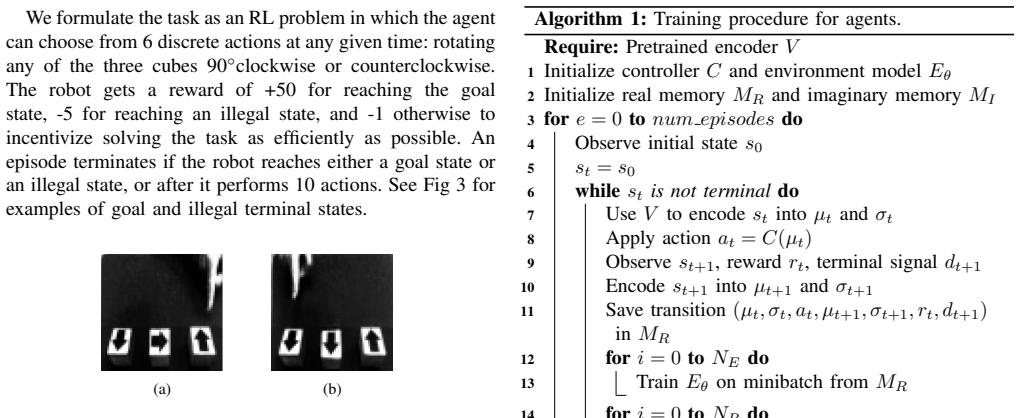
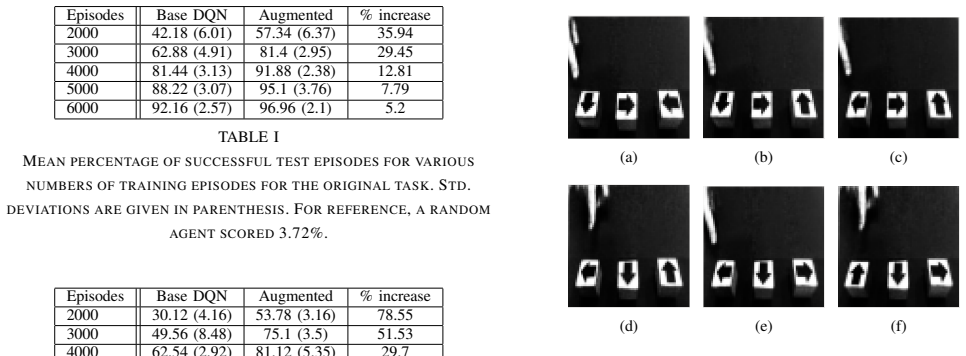
Summary. The paper proposes an architecture for sample-efficient deep reinforcement learning in human-robot interaction settings. A variational autoencoder compresses raw images into a low-dimensional latent state, an environment model composed of a mixture density network plus reward and terminal predictors learns the stochastic observable dynamics online, and a DQN controller is trained on both real transitions and synthetic imaginary rollouts generated by the learned model. The approach is evaluated on a simulated robotic puzzle task with stochastic visual observations, reporting that the augmented agent outperforms a baseline DQN at equal episode counts, with 35.9% higher success at 2000 episodes on the original task and 78.5% on a harder variant. The paper also demonstrates using the learned model to generate optimal plans for a real Sawyer robot and reports generalization of the dynamics model to unseen states.
Significance. If the sample-efficiency claim holds, the architecture is a meaningful step toward reducing real-world interaction costs in HRI, and the planning and generalization demonstrations are practically relevant. The paper provides a detailed algorithm, shares several negative results (e.g., instability with higher update rates), and addresses the challenge of stochastic observable dynamics in a principled way. However, the main comparison is confounded by an unequal number of gradient updates between the augmented agent and the baseline, so the headline improvements cannot currently be attributed to the imaginary rollouts. The significance is therefore conditional on additional control experiments.
major comments (3)
- [Section V.B.3 and Algorithm 1] The central comparison is confounded because the augmented agent receives more gradient updates per environment step than the baseline. Algorithm 1 sets NR=1 and NI=1, so the augmented controller is updated once on a real minibatch and once on an imaginary minibatch at each timestep, while the baseline DQN, described in Section V.C as sharing all hyperparameters, is trained only on real transitions and is not reported to perform two updates per timestep. At equal episode counts, the augmented agent therefore performs roughly twice as many optimization steps. The reported improvements at 2000 episodes (35.9% and 78.5%) could be explained by the larger number of gradient updates rather than by the content of the synthetic transitions. Please add a control condition in which the baseline DQN performs two (or more) gradient updates on real data per timestep, or reduce the augmented agent's update count to match the baseline, and report whether the performance gap persists.
- [Section V.C, Tables I and II] The results are averaged over only 5 agents per condition, and no significance tests, confidence intervals, or effect sizes are reported. At 2000 episodes in Table I, the means are 42.18 vs 57.34 with standard deviations of 6.01 and 6.37; with n=5, this difference may be within sampling variability. The headline claims of 35.9% and 78.5% improvement rely on differences at this sample size. Please report paired significance tests across seeds, confidence intervals, and ideally more than 5 seeds to establish that the observed differences are statistically reliable.
- [Section V.C, 'Generating Plans'] The claim that 'the generated plans for all successful runs were optimal' is not verifiable as stated. The number of optimal actions for each initial state is not defined, and no method for determining optimality is described. If optimality was checked by exhaustive search over the 192-macrostate graph, that should be stated explicitly; otherwise the claim is unsupported. Please provide the optimality criterion and the verification procedure.
minor comments (7)
- [Algorithm 1 and Section V.B.3] The action-selection policy used to generate imaginary rollouts for controller training is not specified. The text says the controller selects actions, but it is unclear whether rollouts use the current epsilon-greedy policy, a fully greedy policy, or random actions. Please clarify, since this affects the distribution of the synthetic data.
- [Section V.C, 'Model Generalization'] The generalization test reports that the model 'correctly predicted the next state' 75% of the time, but the correctness criterion is not defined. Please specify whether correctness was determined by exact latent-space matching, a distance threshold, visual inspection, or another method.
- [Section V.C, 'Generating Plans'] The plan-execution demonstration reports 17/20 successful runs, but the failures are not analyzed. Please report why the three runs failed (e.g., model prediction errors, controller errors, or execution errors) to help interpret the reliability of the planning result.
- [Section V.B.3] The statement that 'updating the controller more often led to worse performance' is not accompanied by data. Please provide the relevant comparison or a reference to supplementary material.
- [Throughout] There are numerous typographical errors, including 'descirbe' in the abstract, 'reinfrocement' in Section III.A, 'dimentional' in Section V.B.1, 'distibution' in Section V.B.2, 'tranisitons' in Section V.C, and 'involivng' in the conclusion. A careful proofreading pass is needed.
- [Figure 4] In Figure 4(c), the y-axis label is not described in the text. Please add a caption or label that makes clear what quantity is plotted.
- [Section V.B.1] The statement that 'increasing β yields more efficient compression of the inputs and leads to learning independent and disentangled features' is attributed to [16], but the paper reports β=4 as best without showing sensitivity. Please provide a small sensitivity analysis or state that other values were explored.
Circularity Check
No significant circularity: the synthetic-data speedup is an empirical comparison against an independent baseline, not a self-referential derivation.
full rationale
No circular step is present. The paper's central claim—that imaginary rollouts from an online-learned environment model M accelerate DQN learning in a simulated HRI task—is evaluated empirically against a baseline DQN trained only on real transitions, with shared architecture and hyperparameters (Section V.C). The environment model is trained from real transitions stored in MR (Algorithm 1, lines 12–13) and is then used to generate synthetic transitions on which the controller is updated (lines 14–20); there is no step where a target result defines the model, a fitted constant is renamed as a prediction, or a self-citation is used as the load-bearing justification. The VAE, MDN, reward predictor, and terminal-state predictor are grounded in cited external methods (Equations 4 and 5), and the reported speedup is measured against an independent baseline rather than against a quantity constructed from the method's own outputs. The strongest identifiable concern is experimental rather than circular: the augmented agent performs an extra controller update on imaginary data per timestep while the baseline is reported as updated only on real data, so the speedup may partly reflect a larger number of gradient updates. That is a comparison confound, not a reduction of the claim to its inputs, and therefore does not raise the circularity score.
Assumptions & free parameters
free parameters (6)
- VAE KL weight beta =
4
- Imaginary rollout start episode Istart =
1000
- Imaginary rollout depth ID and breadth IB =
depth 10, breadth 3
- Controller update counts NR and NI =
1 and 1
- MDN mixture components =
5
- Imaginary memory size =
3000
assumptions (5)
- domain assumption The environment is Markovian and fully represented by the current input image.
- domain assumption Environment dynamics are easier to learn than the optimal policy.
- domain assumption The VAE latent space is a sufficient statistic for control.
- domain assumption Sampling from the VAE posterior during training is a valid data augmentation.
- domain assumption Synthetic images composed from fragments faithfully represent real robot observations.
Cite this review
Pith. "Pith review of Sample-efficient Deep Reinforcement Learning with Imaginary Rollouts for Human-Robot Interaction." pith.science (2026). https://pith.science/paper/W2KDK4SB
@misc{pith2026190805546,
  author       = {Pith},
  title        = {Pith review of: Sample-efficient Deep Reinforcement Learning with Imaginary Rollouts for Human-Robot Interaction},
  year         = {2026},
  howpublished = {\url{https://pith.science/paper/W2KDK4SB}},
  note         = {Machine review of arXiv:1908.05546}
}
read the original abstract
Deep reinforcement learning has proven to be a great success in allowing agents to learn complex tasks. However, its application to actual robots can be prohibitively expensive. Furthermore, the unpredictability of human behavior in human-robot interaction tasks can hinder convergence to a good policy. In this paper, we present an architecture that allows agents to learn models of stochastic environments and use them to accelerate learning. We descirbe how an environment model can be learned online and used to generate synthetic transitions, as well as how an agent can leverage these synthetic data to accelerate learning. We validate our approach using an experiment in which a robotic arm has to complete a task composed of a series of actions based on human gestures. Results show that our approach leads to significantly faster learning, requiring much less interaction with the environment. Furthermore, we demonstrate how learned models can be used by a robot to produce optimal plans in real world applications.
Figures

Figures from the paper (3 more)


Reference graph
Works this paper leans on
-
[1]
Playing atari with deep reinforcement learning,
V . Mnih, K. Kavukcuoglu, D. Silver, A. Graves, I. Antonoglou, D. Wierstra, and M. Riedmiller, “Playing atari with deep reinforcement learning,” arXiv preprint arXiv:1312.5602 , 2013
arXiv 2013
-
[2]
End-to-end training of deep visuomotor policies,
S. Levine, C. Finn, T. Darrell, and P. Abbeel, “End-to-end training of deep visuomotor policies,” The Journal of Machine Learning Research, vol. 17, no. 1, pp. 1334–1373, 2016
2016
-
[3]
Imagination- augmented agents for deep reinforcement learning,
S. Racani `ere, T. Weber, D. Reichert, L. Buesing, A. Guez, D. J. Rezende, A. P. Badia, O. Vinyals, N. Heess, Y . Li,et al., “Imagination- augmented agents for deep reinforcement learning,” in Advances in neural information processing systems , 2017, pp. 5690–5701
work page 2017
-
[4]
Uncertainty-driven imagination for continuous deep reinforcement learning,
G. Kalweit and J. Boedecker, “Uncertainty-driven imagination for continuous deep reinforcement learning,” in Conference on Robot Learning, 2017, pp. 195–206
work page 2017
-
[5]
Recurrent world models facilitate policy evolution,
D. Ha and J. Schmidhuber, “Recurrent world models facilitate policy evolution,” in Advances in Neural Information Processing Systems , 2018, pp. 2455–2467
work page 2018
-
[6]
Model-based value estimation for efficient model-free reinforcement learning,
V . Feinberg, A. Wan, I. Stoica, M. I. Jordan, J. E. Gonzalez, and S. Levine, “Model-based value estimation for efficient model-free reinforcement learning,” arXiv preprint arXiv:1803.00101 , 2018
arXiv 2018
-
[7]
Sample- efficient reinforcement learning with stochastic ensemble value expan- sion,
J. Buckman, D. Hafner, G. Tucker, E. Brevdo, and H. Lee, “Sample- efficient reinforcement learning with stochastic ensemble value expan- sion,” in Advances in Neural Information Processing Systems , 2018, pp. 8234–8244
work page 2018
-
[8]
Continuous control with deep reinforce- ment learning,
T. P. Lillicrap, J. J. Hunt, A. Pritzel, N. Heess, T. Erez, Y . Tassa, D. Silver, and D. Wierstra, “Continuous control with deep reinforce- ment learning,” arXiv preprint arXiv:1509.02971 , 2015
arXiv 2015
Show all 17 references
-
[9]
Deep reinforcement learn- ing for robotic manipulation with asynchronous off-policy updates,
S. Gu, E. Holly, T. Lillicrap, and S. Levine, “Deep reinforcement learn- ing for robotic manipulation with asynchronous off-policy updates,” in 2017 IEEE International Conference on Robotics and Automation (ICRA). IEEE, 2017, pp. 3389–3396
2017
-
[10]
Data- efficient deep reinforcement learning for dexterous manipulation,
I. Popov, N. Heess, T. Lillicrap, R. Hafner, G. Barth-Maron, M. Ve- cerik, T. Lampe, Y . Tassa, T. Erez, and M. Riedmiller, “Data- efficient deep reinforcement learning for dexterous manipulation,” arXiv preprint arXiv:1704.03073 , 2017
2017 arXiv
-
[11]
Robot gains social intelligence through multimodal deep reinforcement learn- ing,
A. H. Qureshi, Y . Nakamura, Y . Yoshikawa, and H. Ishiguro, “Robot gains social intelligence through multimodal deep reinforcement learn- ing,” in 2016 IEEE-RAS 16th International Conference on Humanoid Robots (Humanoids) . IEEE, 2016, pp. 745–751
2016
-
[12]
R. S. Sutton and A. G. Barto, Reinforcement learning: An introduction. MIT press, 2018
2018
-
[13]
Auto-encoding variational bayes,
D. P. Kingma and M. Welling, “Auto-encoding variational bayes,” in International Conference on Learning Representations , 2014
2014
-
[14]
Mixture density networks,
C. M. Bishop, “Mixture density networks,” Citeseer, Tech. Rep., 1994
1994
-
[15]
A syntactic approach to robot imitation learning using probabilistic activity grammars,
K. Lee, Y . Su, T.-K. Kim, and Y . Demiris, “A syntactic approach to robot imitation learning using probabilistic activity grammars,” Robotics and Autonomous Systems , vol. 61, no. 12, pp. 1323–1334, 2013
2013
-
[16]
beta-vae: Learning basic visual concepts with a constrained variational framework,
I. Higgins, L. Matthey, A. Pal, C. Burgess, X. Glorot, M. Botvinick, S. Mohamed, and A. Lerchner, “beta-vae: Learning basic visual concepts with a constrained variational framework,” in International Conference on Learning Representations , 2017
2017
-
[17]
Robot program- ming by demonstration,
A. Billard, S. Calinon, R. Dillmann, and S. Schaal, “Robot program- ming by demonstration,” Springer handbook of robotics , pp. 1371– 1394, 2008
2008
Reviewed August 14, 2026 · model on record in the stance chip above.
Discussion (0). Continue with ORCID to comment.