REVIEW 4 major objections 5 minor 14 references
Coupled Self-Consistent RPA Equations for Even and Odd Particle Numbers. Tests with Solvable Models
T0 review · 4 major / 5 minor · reviewed 2026-08-14 · deepseek-v4-flash
Pith's one-line read This paper claims that single-particle occupation probabilities can be obtained self-consistently from an odd-number RPA equation coupled to the even SCRPA equations, and that the coupled system reproduces exact solutions of the Lipkin…
desk verdict A genuinely new coupling scheme for self-consistent occupancies, honestly presented and well benchmarked, though the admitted Q|Z>=0 approximation remains unquantified. read the letter →
The pith
A machine-rendered reading of the paper's core claim, the machinery that carries it, and where it could break.
The reading
What carries the argument
The central object is the coupled 'eo-SCRPA' system: the even SCRPA eigenvalue problem (9), whose amplitudes $X,Y$ describe collective particle-hole excitations, and the odd RPA problem (14), whose eigenvectors $x^\mu_h$, $x^\rho_p$ are the weights of adding or removing one particle. The load-bearing link is the inversion (17), which rewrites the particle-hole operators of the Hamiltonian in terms of the RPA phonons $Q^\dagger$, and the killing condition (8), $Q|Z\rangle=0$, which lets every correlation function be evaluated by commuting $Q$ to the vacuum until it annihilates the correlated ground state. Occupation numbers then reduce to the simple sums (18)--(19) of odd-RPA amplitudes, closing the nonlinear system.
What would settle it
For the Lipkin model at, say, $N=20$ and coupling near $\chi=1$, take the exact ground state and the $Q$ operator from the converged eo-SCRPA solution and compute $\langle Z|Q^\dagger Q|Z\rangle$; if this norm is not far below one, the commuting-to-vacuum evaluation underlying equations (18)--(19) is invalid and the reported accuracy is accidental. A similar check on the Hubbard ring would compare eo-SCRPA occupancies with the exact reduced density matrices.
Extended reading notes
Core claim
The central claim is that the single-particle occupation numbers that enter self-consistent RPA need not be supplied externally: they emerge from a companion RPA eigenvalue equation built from odd-particle-number excitations, and the two equation sets are coupled because both are evaluated in the same correlated ground state. Concretely, the even SCRPA equation (9) determines the RPA amplitudes $X,Y$, while the odd equation (14) determines amplitudes $x,U$ whose squared components give the hole and particle occupancies through (18)--(19). The paper reports that in the Lipkin model and the six-site half-filled Hubbard ring this coupled scheme reproduces exact occupancies, excitation energies, and ground-state energies very well; in the Lipkin model it is exact for $N=4$ and improves on earlier ways of fixing occupancies.
Load-bearing premise
The load-bearing premise is that the even-RPA destruction operator $Q$ exactly annihilates the correlated ground state, $Q|Z\rangle=0$, meaning the ground state contains no RPA excitations; the paper states this is only approximately true, yet every correlation function in the coupled equations is evaluated by commuting $Q$ to the vacuum, and if the residual is not small the whole self-consistency loop is uncontrolled.
Editorial extensions
If this is right
- The same calculation yields even excitation energies, odd addition and removal energies ($\lambda_\pm$), occupation numbers, and the ground-state energy through the one-particle Green's function, so a single eo-SCRPA run replaces several separate approximations.
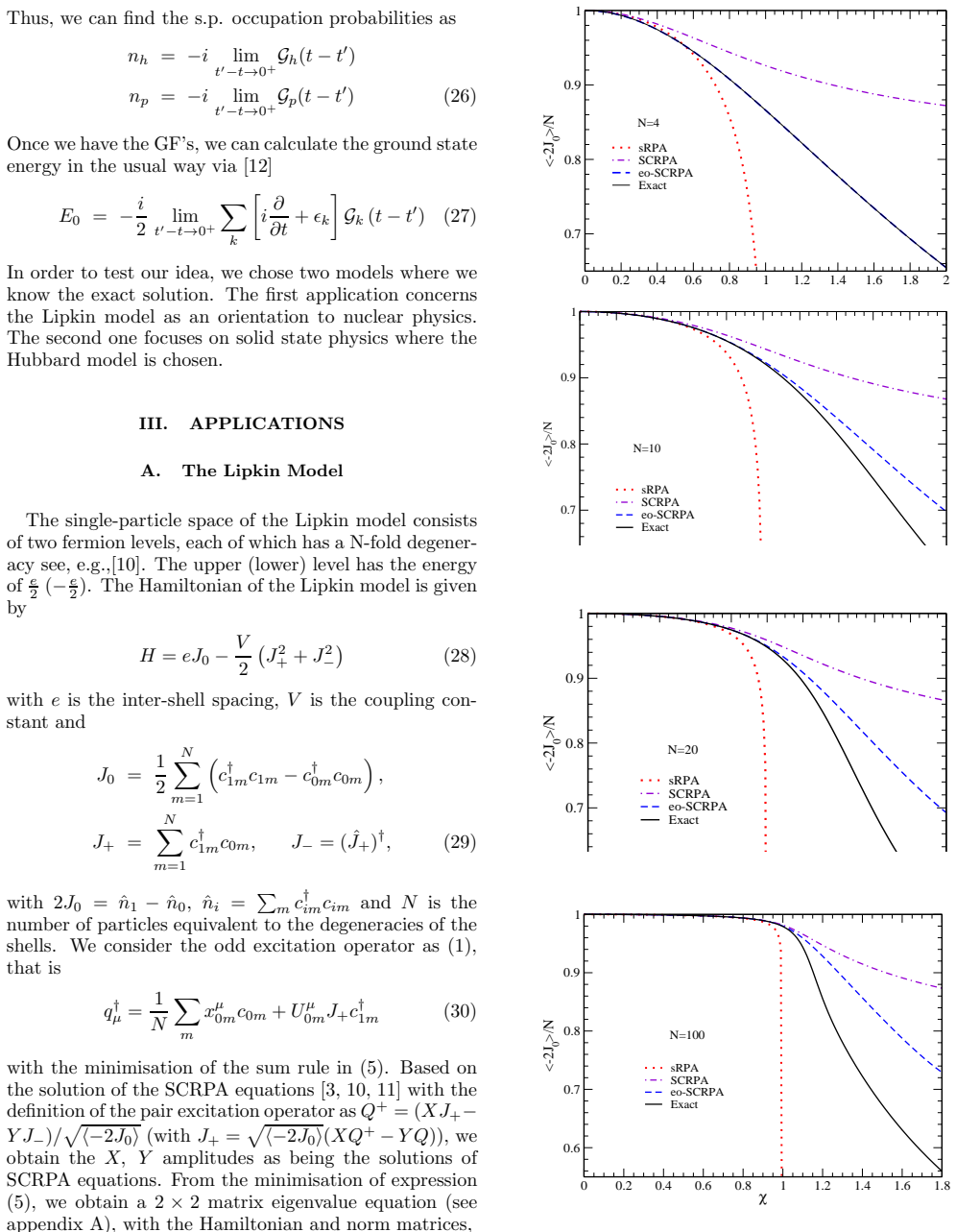
- In the Lipkin model eo-SCRPA gives the exact result for $N=4$ and tracks the exact solution up to and slightly beyond the critical coupling, where standard RPA breaks down.
- In the six-site half-filled Hubbard ring, occupation numbers, excitation energies, and ground-state energy agree well with exact results for interaction strengths up to about $U/t \sim 3$.
- The coupled equations are nonlinear in occupancies and in the $X,Y$ amplitudes, so the method requires no external occupation input; the only input is the Hamiltonian and the mean-field basis.
Reading between the lines
- Because the odd equation can be rewritten as a Dyson equation for the one-particle Green's function, a natural extension the paper does not report is momentum-resolved spectral functions for the Hubbard chain; those are already implied by the self-consistent occupancies and excitation poles.
- The systematically larger gain in the Lipkin model than in the Hubbard ring suggests that the main error source is the over-completeness or Pauli violation of the collective phonon basis; measuring the norm of $Q|Z\rangle$ on exact ground states of larger Lipkin samples would predict where the method degrades.
- The authors call the exact $N=4$ Lipkin result a lucky accident; if the same exactness appears for other small integrable systems such as pairing models, it may reflect a hidden constraint rather than chance.
Signed reviews
Editorial analysis
A structured set of objections, weighed in public.
Referee Report
Summary. The paper proposes a coupled self-consistent RPA scheme, called eo-SCRPA, in which the even-particle SCRPA equations for the correlated ground state and an odd-particle RPA equation for single-particle motion are solved self-consistently from the same correlated vacuum. The new ingredient is the calculation of single-particle occupation numbers from the odd-RPA amplitudes, Eqs. (18)--(19). The authors derive the general coupled equations (9) and (14), evaluate all correlation functions by commuting the even-RPA destruction operator Q to the vacuum using the assumption Q|Z>=0, and then test the scheme on the Lipkin model and a six-site Hubbard ring at half filling. The reported occupancies, excitation energies, and ground-state energies agree well with exact diagonalization across a range of couplings, with the Lipkin N=4 case reproduced exactly.
Significance. If the scheme is valid, it provides a parameter-free method to obtain correlated occupation numbers within the SCRPA framework, addressing a long-standing closure problem. The paper contains detailed derivations and benchmarks against two exact solvable models, with machine-checkable equations and no fitted parameters. The numerical agreement is encouraging and goes beyond earlier Catara-method results. However, the theoretical foundation rests on the uncontrolled assumption Q|Z>=0, which the authors themselves state is not exactly fulfilled, and on additional truncations in the three-body matrix D. A quantitative estimate of these errors is needed before the method can be regarded as a reliable predictive tool.
major comments (4)
- [Sec. II, Eq. (8)] The assumption Q|Z>=0 is load-bearing: all correlation functions entering A, B, C, and D are evaluated by commuting Q to the right and dropping Q|Z>, yet the text explicitly states that Q does not exactly kill the CCD ground state. No estimate of ||Q|Z>|| or of the induced error in the two- and three-body correlations is given. Because the self-consistency loop couples occupancies (18)--(19) with the amplitudes of (9) and (14), a small residual could be amplified. I request a quantitative check in the solvable models, for example by computing <Z|Q†Q|Z>/<Z|Z> from the converged SCRPA solution, or by comparing the occupancies obtained with and without the killing condition.
- [Sec. II, Eq. (14) and Fig. 1] The three-body matrix D is evaluated by retaining only those terms where a particle state of the triplet operator connects to the interaction, with the remaining density operator taken diagonal. The authors justify the discarded terms as 'supposedly less important' and 'probably small,' but no measure of their magnitude is provided. This truncation is part of the equations solved in the applications, so its accuracy is load-bearing for the numerical agreement. I ask for a comparison of the full D, or at least an estimate of the neglected terms, in the small test systems.
- [Sec. III.A, after Eq. (A6)] The main text states that <J0J0> is factorized as <J0>^2, while Appendix A also offers the Casimir relation (A7) for the same quantity. It is not clear which version was used to produce Figs. 2--7. If the factorization is used, the results depend on an additional uncontrolled approximation; if the Casimir relation is used, the presentation should say so. Please clarify and, if feasible, show the sensitivity of the results to this choice.
- [Sec. II, Eqs. (18)--(19)] The derivation of the single-particle occupation numbers from the odd-RPA amplitudes assumes that {a†_h, q†_{h,\mu}} = x^\mu_h with all U terms vanishing, and that the odd operators form a complete set for one-hole excitations. Neither a completeness relation analogous to Eq. (17) nor a derivation of the anticommutator simplification is provided. Without this, the central new expression for n_h and n_p is an assumption. I request either a derivation or a reference establishing the completeness of the odd-RPA operators.
minor comments (5)
- [Throughout] There are several typos, including 'Hatree Fock' in the Fig. 8 caption, 'perfoment' in Sec. II, 'full-fill' in Eq. (4), and 'the the' in Sec. II ('We should also say the the formal expressions').
- [Eq. (B9)] The two commutator equations for [Q_\nu, \hat n_k] are written with identical expressions except for a sign; one of them should presumably be for the Hermitian conjugate or for a different index. Please correct.
- [Eq. (B10)] The first term on the right-hand side appears to be missing the \nu' dependence: it should be X_i^\nu X_i^{\nu'} - Y_i^\nu Y_i^{\nu'}, not X_i X_i - Y_i Y_i, unless a delta function is intended.
- [Eq. (17)] The inversion should specify that the sum over \nu runs over all RPA modes and that the completeness of the X,Y amplitudes is required for the relation to hold.
- [Sec. IV] The conclusion states that the equations 'should be solvable with modern computers for realistic problems' but provides no complexity estimate; a brief statement of the scaling with system size would be useful.
Circularity Check
No significant circularity: the coupled eo-SCRPA equations are solved self-consistently and checked against exact models; no prediction reduces to a fitted input.
full rationale
The paper's central claim is that the odd-particle-number RPA equation (14), when solved together with the even SCRPA equation (9), yields single-particle occupancies through Eqs. (18)-(19). These occupancies are then fed back into the A and B matrices of Eq. (9), making the scheme a coupled, non-linear fixed-point problem. Nothing in this chain is a parameter fitted to the quantities later compared with exact results: the Lipkin and Hubbard benchmarks in Figs. 2-11 are external checks, not inputs to the equations. The only explicitly stated approximation is Eq. (8), Q|Z>=0, which the text itself admits is not exact: 'the even particle number equation (SCRPA) is the only point where the approach is not entirely consistent.' This is an accuracy limitation, not a circular reduction, because the paper does not use the target observables to enforce Q|Z>=0. The self-citations to [3] and [9] provide prior derivations of SCRPA and odd-RPA structures, but the present work re-derives the needed matrix elements and introduces the coupling of the two sectors; the cited results are not equivalent to the paper's conclusion that the coupled scheme reproduces the solvable models. Therefore no circular step is exhibited.
Assumptions & free parameters
assumptions (5)
- domain assumption The ground state has the coupled-cluster doubles form |Z> = exp(1/4 Z a†p a†p' a_h a_h') |HF>, and the odd operators q_mu are chosen to satisfy q_mu|Z>=0 via eq. (4).
- ad hoc to paper Q|Z>=0 is assumed (Eq. 8) although the text states Q does not exactly kill the CCD ground state.
- ad hoc to paper Only selected terms are retained in the three-body matrix D: terms where particle states connect to the interaction, with the remaining density operator taken as diagonal (Section II, Fig. 1).
- ad hoc to paper In the Lipkin model, <J0J0> is factorized as <J0>^2 in the main text, optionally replaced by the Casimir relation (A7).
- standard math The RPA amplitudes form a complete orthonormal set, so the inversion (17) can be used to express particle-hole operators.
Cite this review
Pith. "Pith review of Coupled Self-Consistent RPA Equations for Even and Odd Particle Numbers. Tests with Solvable Models." pith.science (2026). https://pith.science/paper/PFJB6TGB
@misc{pith2026190805606,
  author       = {Pith},
  title        = {Pith review of: Coupled Self-Consistent RPA Equations for Even and Odd Particle Numbers. Tests with Solvable Models},
  year         = {2026},
  howpublished = {\url{https://pith.science/paper/PFJB6TGB}},
  note         = {Machine review of arXiv:1908.05606}
}
read the original abstract
Coupled equations for even and odd particle number correlation functions are set up via the equation of motion method. For the even particle number case this leads to self-consistent RPA (SCRPA) equations already known from the literature. From the equations of the odd particle number case the single particle occupation probabilities are obtained in a self-consistent way. This is the essential new procedure of this work. Both, even and odd particle number cases are based on the same correlated vacuum and, thus, are coupled equations. Applications to the Lipkin model and the 1D Hubbard model give very good results.
Figures


Figures from the paper (7 more)




Reference graph
Works this paper leans on
-
[1]
D. S. Delion, P. Schuck, J. Dukelsky PRC 72, 064305 (2005)
work page 2005
-
[2]
D. S. Sch¨ afer and P. Schuck, Phys. Rev. B 59, (1999) 1712-1733
work page 1999
-
[3]
but it kills it to very good approximation as studies of model cases have shown [3]. Therefore the even par- ticle number equation (SCRPA) is the only point where the approach is not entirely consistent though the the- ory remains very performent as we will see below in the Application section. We, thus, will henceforth always suppose that Q|Z⟩ = 0 . (8) ...
- [4]
- [5]
- [6]
-
[7]
D. J. Rowe, Phys. Rev. 175 (1968) 1283
work page 1968
-
[8]
Catara, G
F. Catara, G. Piccitto, M. Sambataro, and N. Van Giai, Phys. Rev. B 54, 17536 (1996)
1996
Show all 14 references
-
[9]
Jemai, P
M. Jemai, P. Schuck, J. Dukelsky, and R. Bennaceur, Phys. Rev. B 71, 085115 (2005)
2005
-
[10]
Tohyama, P
M. Tohyama, P. Schuck, Phys. Rev. C 87, 044316 (2013)
2013
-
[11]
P. Ring, P. Schuck, The Nuclear Many–Body Problem , Springer, Berlin 1980
1980
-
[12]
Jemai and P
M. Jemai and P. Schuck, Phys. At. Nucl., Vol. 74, No. 8, (2011) 1139-1146
2011
-
[13]
A. L. Fetter and J. D. Walecka, Quantum Theory of Many-Particle Systems McGraw-Hill, New York, 1971
1971
-
[14]
Hubbard, Proc
J. Hubbard, Proc. Roy. Soc. A 240, 539 (1957); 243, 336 (1958); 276, 238 (1963)
1957
Reviewed August 14, 2026 · model on record in the stance chip above.
Discussion (0). Continue with ORCID to comment.