REVIEW 4 major objections 5 minor 16 references
Towards multi-sequence MR image recovery from undersampled k-space data
T0 review · 4 major / 5 minor · reviewed 2026-08-14 · deepseek-v4-flash
Pith's one-line read The paper claims that a single MIMO blind recovery model, trained on randomly sampled masks and then fine-tuned on the selected masks, recovers multiple MR sequences better than independently recovering each sequence, and that the model's…
desk verdict Solid multi-sequence MRI recovery paper with a novel blind-search idea, but the search validation is post hoc and the test set is too small to fully trust the efficiency numbers. read the letter →
The pith
A machine-rendered reading of the paper's core claim, the machinery that carries it, and where it could break.
The reading
What carries the argument
The load-bearing mechanism is the blind recovery model (BRM): a MIMO CNN built from Residual Dense Blocks that takes the undersampled images of all sequences, concatenated along the channel dimension, and outputs the recovered images for all sequences at once. It is trained by data augmentation over masks, drawing each sequence's undersampling factor λ uniformly from [1, k], so the model learns to handle a continuum of sampling profiles rather than one fixed mask. This trained BRM is then reused as a loss-based oracle: exhaustive search over candidate mask combinations (Eq. 5) requires only forward passes, not retraining, after which the chosen masks are used to fine-tune the model (Eq. 6). The dense residual connections let the network share anatomical information across sequences.
What would settle it
Train dedicated models for the strategy the BRM search ranks best and for the one it ranks worst under a fixed time budget; if the dedicated model performs worse on the BRM-best strategy than on the BRM-worst strategy, the surrogate ranking fails. A cheaper check: compare BRM-predicted losses against the measured PSNR of dedicated models across several strategies, which must be monotonically related for the paper's claim to hold.
Extended reading notes
Core claim
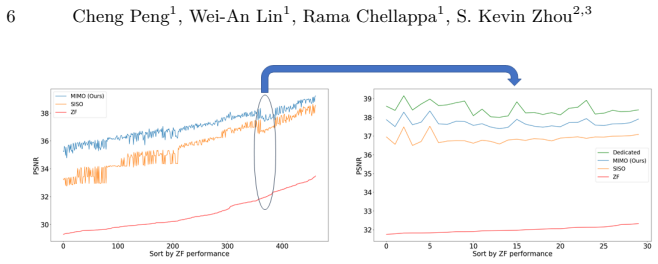
On the paper's own terms, the discovery is that a MIMO blind recovery model—trained once with masks drawn randomly across a continuous range of undersampling factors on every sequence—serves both as a multi-sequence reconstructor and as a surrogate quality estimator for sampling-strategy search. Because the model has seen many masks, its loss on a candidate strategy predicts the performance of a dedicated model trained specifically for that strategy (the reported Pearson correlation is 0.85, versus -0.33 for the zero-filled input, in the tested range). Using this loss, the paper selects a near-optimal set of per-sequence undersampling factors under a fixed time budget (for example, 75% time reduction), then fine-tunes the model on those masks. Across real and simulated three-sequence data, the resulting pipeline beats recovering each sequence independently, and the chosen strategy consistently samples T2 most heavily.
Load-bearing premise
The search step assumes that a model trained on random masks ranks candidate sampling strategies in the same order that models dedicated to each strategy would; the paper validates this only on a post hoc range of sampling factors, so the top-ranked strategy could be suboptimal for the dedicated model.
Editorial extensions
If this is right
- A single trained model replaces the need to train a separate network for each candidate sampling strategy, cutting the search cost from training $F^S$ models to $F^S$ forward passes.
- The MIMO model consistently outperforms per-sequence SISO models on both real and simulated data in the reported settings, so multi-sequence recovery can be done with one network instead of several.
- The search procedure yields an interpretable allocation rule: within a time budget, the model tends to allocate more samples to the sequence with the best contrast (T2), and reallocates toward T1 when T1 acquisition is fast (time ratios 2:3:6).
- The framework is agnostic to the underlying sampling pattern (low-pass or random) and extends beyond three sequences by treating additional sequences like extra image channels.
Reading between the lines
- Since the surrogate ranking only needs forward passes, the same scheme could optimize other acquisition parameters (e.g., number of excitations or slice spacing) provided the mask distribution covers them.
- The method's reliance on co-registered sequences suggests a testable boundary: if sequences are not aligned, the benefit of MIMO over SISO may shrink, because the network's cross-sequence sharing depends on shared anatomy.
- A natural next test is to run the BRM loss on low-resolution scout images of a specific patient to personalize the sampling strategy on the fly, rather than using a fixed policy found on a population.
Signed reviews
Editorial analysis
A structured set of objections, weighed in public.
Referee Report
Summary. The paper addresses multi-sequence MR image recovery from undersampled k-space data under an overall acquisition-time budget. It formulates a constrained optimization over sampling masks and a recovery network (Eq. (2)), argues that joint optimization is combinatorial, and proposes a blind recovery model (BRM) trained with randomly sampled masks. The trained BRM is then used as a surrogate to search for good sampling strategies via Eq. (5), and the selected strategy is used for fine-tuning via Eq. (6). The authors compare a single multi-input multi-output (MIMO) BRM with per-sequence single-input single-output (SISO) models and with dedicated per-strategy models, on a private real T1/T2/FLAIR dataset and on simulated BraTS data. Table 1 reports the top three strategies found by the search for several acquisition-time settings and shows consistent MIMO-over-SISO PSNR/SSIM improvements.
Significance. If the results hold, the paper makes a useful contribution: it is one of the first to cast multi-sequence undersampling as a joint optimization of masks and recovery network, and the idea of using a randomly trained BRM as a surrogate to avoid training many dedicated models is practically appealing. The paper's strengths include the explicit constrained formulation, the effort to validate the surrogate with dedicated models, and the consistent MIMO-over-SISO advantage across the twelve rows of Table 1. However, the evaluation currently has serious statistical and selection issues: the search surrogate is validated only on a post hoc selected subrange, the top strategies are chosen and evaluated on the same test set, and the real-data test set is very small. These issues affect the central claim that the proposed search reliably identifies good sampling strategies, so the paper needs substantial revision before the conclusions can be accepted.
major comments (4)
- [§3 (Main results), Eq. (5), Fig. 2] The load-bearing claim is that the loss of the blind recovery model in Eq. (5) ranks sampling strategies the way dedicated models would. The only evidence is the Pearson correlation coefficient of 0.85 between "Dedicated" and "MIMO" in Fig. 2 (versus -0.33 for ZF), but that coefficient is computed on a subrange of sampling factors the authors selected after plotting the test-set scatter, specifically where ZF performance "does not correlate well." A correlation on a post hoc subrange does not establish top-K ranking fidelity, which is what Eq. (5) requires if the top three strategies in Table 1 are to be trusted. Please pre-specify the candidate range, report Spearman correlation or top-K agreement over the full candidate set, and evaluate the ranking on a validation set rather than the test set.
- [§3 (Main results), Table 1] The top-three sampling strategies in Table 1 are selected by running the trained models on the test set (the text says "We run the trained models on the test set, and plot the reconstruction performances... top-three performing sampling strategies"), and the same test-set numbers are then reported as the results. This is selection on the test set: the reported PSNR/SSIM values are maxima over hundreds of candidates and are therefore optimistically biased. Please perform the selection on the validation split and use the test set only for final evaluation; if that is not possible, explicitly quantify the selection bias by reporting, for example, the mean and maximum performance across the candidate grid.
- [§3 (Datasets; Main results)] No error bars or significance tests are provided. The real-data split is 17:1:2 on 20 patients, so the real-data evaluation rests on about two patients even after treating each channel as a separate image, because patients are the independent units. The MIMO-vs-SISO differences in Table 1, such as 39.24 vs 38.57 dB in the first row, are small and could be within inter-patient variability. Please report per-patient or per-slice standard deviations and bootstrapped confidence intervals, and state clearly how many patients are in the test set.
- [§2.3, Eq. (6)] Because the same BRM is used as the search surrogate in Eq. (5) and as the initialization for fine-tuning in Eq. (6), the final "MIMO (tuned)" numbers are not independent evidence that the selected masks are near-optimal for a model trained specifically for those masks. The comparison with 30 dedicated models is the appropriate control, but it is computed only in the post hoc subrange discussed above. Please report dedicated-model PSNR/SSIM for the exact λ values shown in Table 1, or otherwise justify that fine-tuning from the BRM attains dedicated-model performance.
minor comments (5)
- [Eqs. (2) and (4)] The notation fθ(IMs) is inconsistent with the multi-sequence architecture shown in Fig. 1, where the network takes all three undersampled images as input. Please write the input as a tuple, e.g., fθ(IM1,...,IMS), or explicitly define that MIMO inputs are implicit.
- [§2.1, Eq. (4)] The sampling distribution p(C) is not defined. The text says λs is sampled randomly from [1,k], but the candidate set C used in Eq. (5) and the measure over masks should be specified precisely, since the search cost depends on |C|.
- [§3 (Acquisition time and undersampling settings)] The choice of random versus low-pass sampling is made per dataset after seeing which performs better. Please state whether this choice is fixed before the search procedure and whether the mask family is held fixed across all compared strategies; otherwise the search space is not fully specified.
- [§3 (Evaluation metrics)] Because the L1 objective in Eq. (2) sums across sequences with different dynamic ranges, the search may be dominated by high-intensity sequences such as T2. Please report per-sequence PSNR/SSIM for the selected strategies and discuss whether equal weighting of the sequence losses is appropriate.
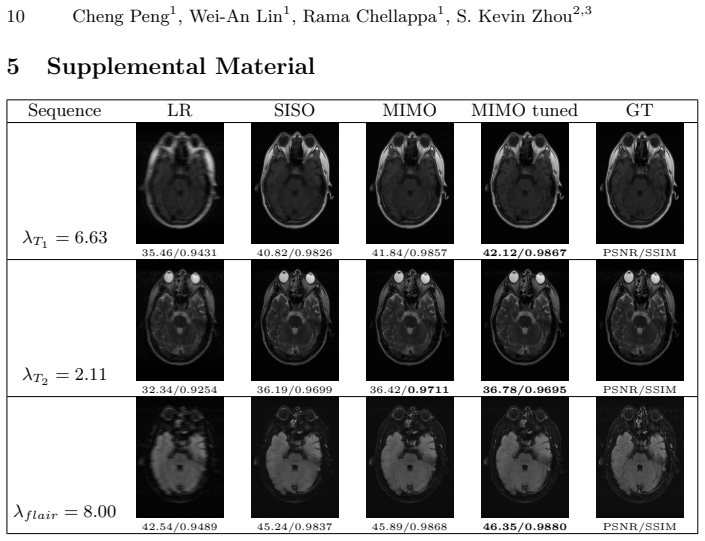
- [Supplemental Material] The supplemental figures all carry the caption "Fig. 2"; please renumber them and refer to them correctly from the main text.
Circularity Check
No significant circularity: the BRM-based sampling-strategy search is validated against separately trained dedicated models and the MIMO-vs-SISO comparison is an independent empirical benchmark.
full rationale
The paper's derivation chain is not circular. The blind recovery model (BRM) is trained in Eq. (4) on randomly sampled masks, then Eq. (5) uses the trained BRM's loss to rank candidate sampling strategies, and Eq. (6) fine-tunes the BRM on the selected masks. This is a legitimate two-stage pipeline rather than a definitional identity: the final reported numbers come from models fine-tuned for specific masks, while the search stage is validated against separately trained dedicated models shown in Fig. 2. The MIMO-vs-SISO recovery comparison is an empirical benchmark on real and simulated data, not a consequence of the search formulation. Citations [12, 3] are external prior work supporting cross-sequence correlation, not load-bearing self-citations, and no uniqueness theorem is invoked. The main methodological weakness is the post hoc selection of a sampling-factor range before computing the Pearson correlation of 0.85, and the use of test-set performance to select the top strategies reported in Table 1; however, these are statistical validity and selection-bias concerns, not circularity. They do not make any predicted quantity equivalent to its input by construction.
Assumptions & free parameters
free parameters (4)
- Network weights θ =
trained via Adam, LR 0.0001, momentum 0.5
- Maximum undersampling factor k =
8
- Acquisition time ratios t_T1:t_T2:t_FLAIR =
(1:1:1), (1:4:6), (2:3:6)
- Sampling pattern per dataset =
random for real data, low-pass for simulated
assumptions (4)
- domain assumption Co-registered multi-sequence MRI images share underlying anatomy that a joint CNN can exploit.
- domain assumption Undersampling with 1D Cartesian masks along the phase encoding direction is the relevant acquisition model.
- ad hoc to paper The BRM trained with random masks has a loss that ranks sampling strategies similarly to dedicated models.
- domain assumption The L1 loss in image domain is a valid proxy for clinically relevant recovery quality.
Cite this review
Pith. "Pith review of Towards multi-sequence MR image recovery from undersampled k-space data." pith.science (2026). https://pith.science/paper/SDSRSPGC
@misc{pith2026190805615,
  author       = {Pith},
  title        = {Pith review of: Towards multi-sequence MR image recovery from undersampled k-space data},
  year         = {2026},
  howpublished = {\url{https://pith.science/paper/SDSRSPGC}},
  note         = {Machine review of arXiv:1908.05615}
}
read the original abstract
Undersampled MR image recovery has been widely studied for accelerated MR acquisition. However, it has been mostly studied under a single sequence scenario, despite the fact that multi-sequence MR scan is common in practice. In this paper, we aim to optimize multi-sequence MR image recovery from undersampled k-space data under an overall time constraint while considering the difference in acquisition time for various sequences. We first formulate it as a constrained optimization problem and then show that finding the optimal sampling strategy for all sequences and the best recovery model at the same time is combinatorial and hence computationally prohibitive. To solve this problem, we propose a blind recovery model that simultaneously recovers multiple sequences, and an efficient approach to find proper combination of sampling strategy and recovery model. Our experiments demonstrate that the proposed method outperforms sequence-wise recovery, and sheds light on how to decide the undersampling strategy for sequences within an overall time budget.
Figures


Figures from the paper (2 more)

Reference graph
Works this paper leans on
-
[1]
Lustig, M., Donoho, D., Pauly, J.M.: Sparse mri: The application of compressed sensing for rapid mr imaging. Magnetic Resonance in Med. 58(6) (2007) 1182–95
work page 2007
-
[2]
IEEE TMI 30(5) (2011) 1028–41 8 Cheng Peng 1, Wei-An Lin1, Rama Chellappa 1, S
Ravishankar, S., Bresler, Y.: MR image reconstruction from highly undersampled k-space data by dictionary learning. IEEE TMI 30(5) (2011) 1028–41 8 Cheng Peng 1, Wei-An Lin1, Rama Chellappa 1, S. Kevin Zhou 2,3 Sequence LR SISO MIMO MIMO tuned GT λT1 = 6.63 34.38/0.9371 42.42/0.9883 44.60/0.9920 45.50/0.9940 PSNR/SSIM λT2 = 2.11 29.74/0.8903 36.25/0.9734 ...
work page 2011
-
[3]
Huang, J., Chen, C., Axel, L.: Fast multi-contrast MRI reconstruction. In: MIC- CAI. (2012) 281–288
work page 2012
-
[4]
In: SampTA, IEEE (2015) 287–291
Hirabayashi, A., Inamuro, N., et al.: Compressed sensing MRI using sparsity in- duced from adjacent slice similarity. In: SampTA, IEEE (2015) 287–291
work page 2015
-
[5]
Senel, L.K., Kilic, T., et al.: Statistically segregated k-space sampling for acceler- ating multiple-acquisition mri. IEEE Trans. Medical Imaging (2019)
work page 2019
-
[6]
Gozcu, B., Mahabadi, R.K., et al.: Learning-based compressive MRI. IEEE Trans. Med. Imaging 37(6) (2018) 1394–1406
work page 2018
-
[7]
Gong, E., et al.: Promise: Parallel-imaging and compressed-sensing reconstruction of multicontrast imaging using sharable information. Mag. Res. in Med. 73 (2015)
work page 2015
-
[8]
Schlemper, J., Caballero, J., et al.: A deep cascade of convolutional neural networks for dynamic MR image reconstruction. IEEE TMI 37(2) (2018) 491–503
work page 2018
Show all 16 references
-
[9]
IEEE TMI 37 (2018) 1310–21
Yang, G., Yu, S., et al.: DAGAN: deep de-aliasing generative adversarial networks for fast compressed sensing MRI reconstruction. IEEE TMI 37 (2018) 1310–21
2018
-
[10]
IEEE TMI 37 (2018) 1488–97
Quan, T.M., et al.: Compressed sensing MRI reconstruction using a generative adversarial network with a cyclic loss. IEEE TMI 37 (2018) 1488–97
2018
-
[11]
Magnetic resonance in medicine 80(2) (2018) 619–632
Bilgic, B., Kim, T.H., et al.: Improving parallel imaging by jointly reconstructing multi-contrast data. Magnetic resonance in medicine 80(2) (2018) 619–632
2018
-
[12]
In: MICCAI
Xiang, L., Chen, Y., et al.: Ultra-fast t2-weighted MR reconstruction using com- plementary t1-weighted information. In: MICCAI. (2018) 215–223
2018
-
[13]
CoRR abs/1802.08797 (2018)
Zhang, Y., Tian, Y., Kong, Y., Zhong, B., Fu, Y.: Residual dense network for image super-resolution. CoRR abs/1802.08797 (2018)
2018 arXiv
-
[14]
CoRR abs/1608.06993 (2016)
Huang, G., Liu, Z., Weinberger, K.Q.: Densely connected convolutional networks. CoRR abs/1608.06993 (2016)
2016 arXiv
-
[15]
IEEE Trans
Menze, B.H., Jakab, A., et al.: The multimodal brain tumor image segmentation benchmark (BRATS). IEEE Trans. Med. Imaging 34(10) (2015) 1993–2024 Towards multi-sequence MR image recovery from undersampled k-space data 9
2015
-
[16]
Scientific data 4 (2017) 10 Cheng Peng 1, Wei-An Lin1, Rama Chellappa 1, S
Bakas, S., et al.: Advancing the cancer genome atlas glioma MRI collections with expert segmentation labels and radiomic features. Scientific data 4 (2017) 10 Cheng Peng 1, Wei-An Lin1, Rama Chellappa 1, S. Kevin Zhou 2,3 5 Supplemental Material Sequence LR SISO MIMO MIMO tuned...
2017
Reviewed August 14, 2026 · model on record in the stance chip above.
Discussion (0). Continue with ORCID to comment.