REVIEW 4 major objections 5 minor 29 references
A blockchain-based user-centric emission monitoring and trading system for multi-modal mobility
T0 review · 4 major / 5 minor · reviewed 2026-08-14 · deepseek-v4-flash
Pith's one-line read This paper claims that a blockchain ledger can track each traveller's trip-level carbon emissions as tradeable tokens, extending emission trading from fuel purchases to shared rides and public transport.
desk verdict A useful prototype of a trip-level emission token ledger with an honest but unvalidated emission oracle and an over-claimed trading feature. read the letter →
The pith
A machine-rendered reading of the paper's core claim, the machinery that carries it, and where it could break.
The reading
What carries the argument
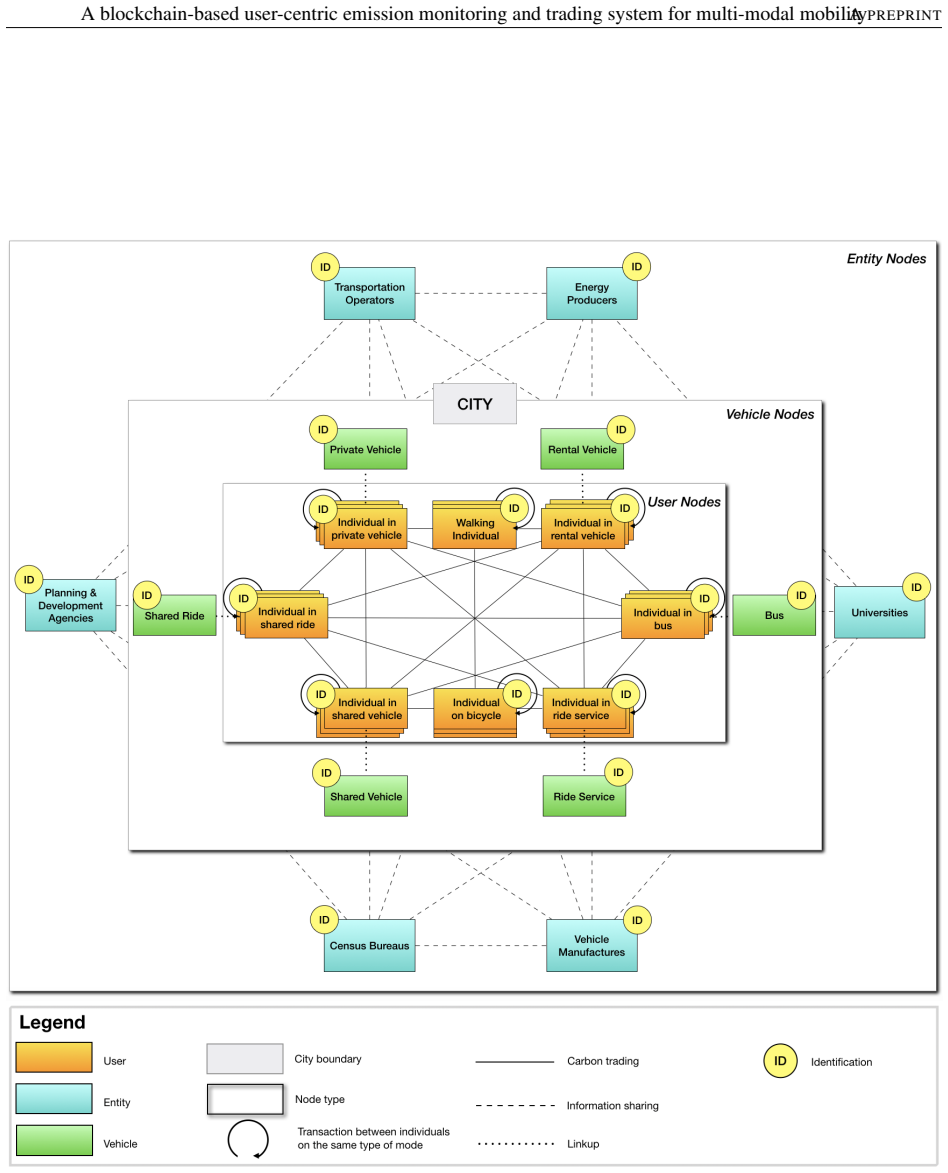
The cBSMD framework — a layered blockchain architecture extended from a mobility data-market with an added application layer for emission trading — is the central object. Its load-bearing mechanism is the carbon token: each trip is converted into an amount of CO2e, priced at the current greenhouse-gas price, and this amount is debited from the traveller's token wallet in a transaction that is validated by active nodes and written to the ledger. The per-trip emission attribution (distance, average speed, fleet-average emission factors, passenger or seat division) is what makes the ledger user-centric rather than vehicle-centric.
What would settle it
Take a sample of real trips and compare each trip's actual on-board-diagnostics (OBD-II) CO2e emissions with the paper's average-speed/fleet-factor estimate; if the per-trip errors flip a meaningful share of travellers' end-of-day token balances from surplus to deficit, the ledger's accounting would not support the paper's claim of an accurate user-centric footprint.
Extended reading notes
Core claim
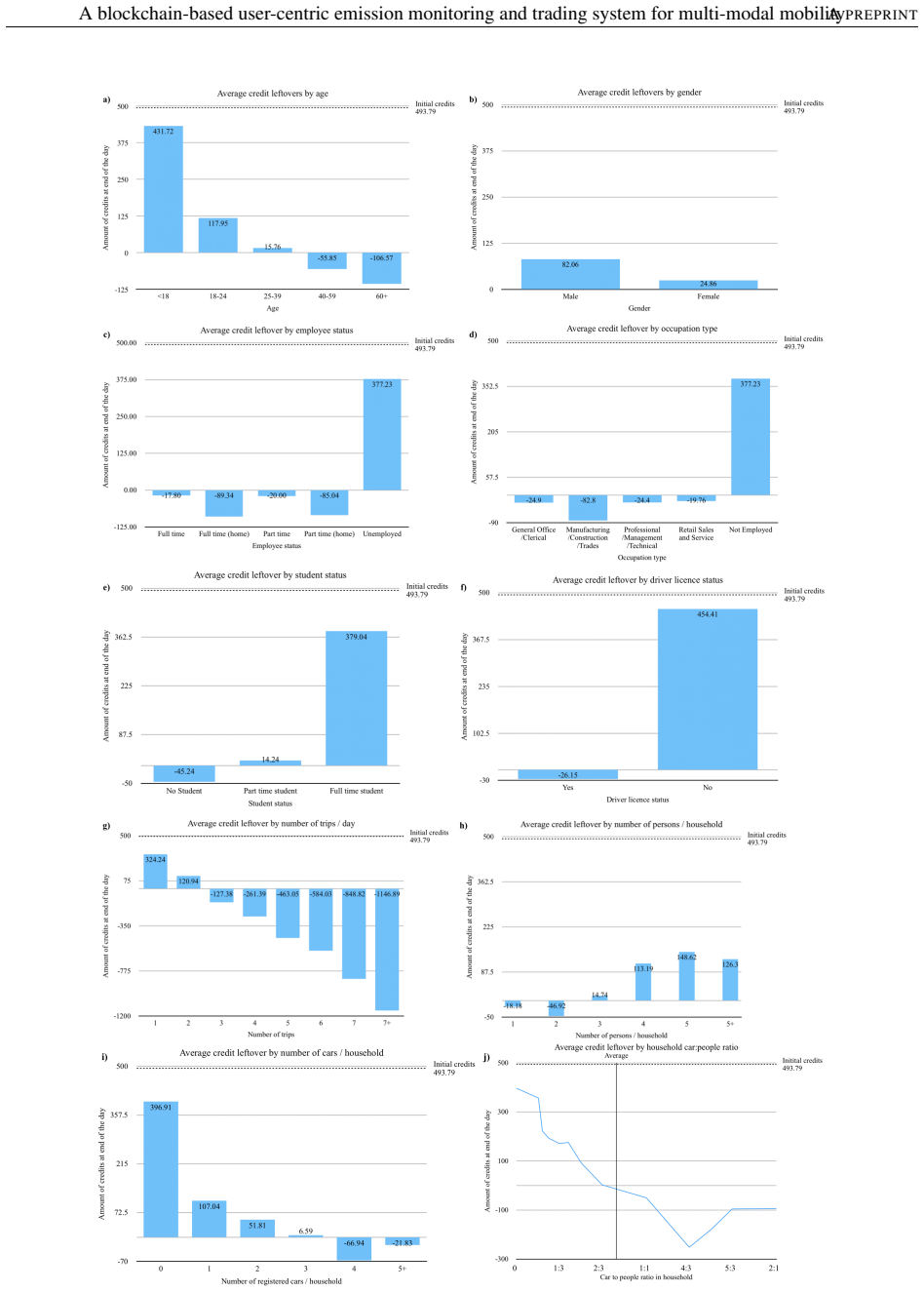
The central claim is that a public-closed blockchain framework, called cBSMD, can serve as both a monitoring and a trading system for personal greenhouse gas emissions from multi-modal travel. Emissions are computed per trip from distance, average speed, and fleet-average carbon-dioxide-equivalent (CO2e) factors; car emissions are divided among passengers, and bus emissions are charged per seat, so each user's ledger entry reflects their individual share. Tokens are allocated equally at the start of the day, spent when a trip ends, and can be purchased or sold when balances fall short or exceed actual emissions. The implementation on a permissioned blockchain platform with a Byzantine-fault-tolerant consensus is exercised in a simulation of 3,186 travellers, and the resulting token balances are analysed by age, gender, household size, employment status, and trip patterns.
Load-bearing premise
The token ledger is only as meaningful as the per-trip emission estimate: the paper derives emissions from average speed, distance, and fleet-average CO2e factors per mile rather than from actual vehicle telemetry, so if those estimates misattribute emissions, token balances will not represent true individual carbon footprints.
Editorial extensions
If this is right
- Emission trading can be extended from fuel purchases and vehicle registration to concrete trips, including shared rides, car-sharing, and public transport, because the ledger records emissions at the individual traveller level.
- A regulator could enforce a declining cap simply by changing the number of tokens distributed at the start of each period, making the cap-and-trade mechanism operational at the person scale.
- Travel behaviour that lowers emissions becomes directly rewarded: users who shift to walking, cycling, or fuller vehicles accumulate surplus tokens they can sell.
- The ledger can double as a verifiable record of individual, service-level, and system-wide emission performance, supporting monitoring, reporting, and verification for research or policy.
- Sociodemographic analysis of token balances can identify which population groups over-consume their allowance and where targeted incentives or alternative allocations are needed.
Reading between the lines
- Extending beyond the paper: the same per-trip ledger could support congestion or peak-hour pricing by adding a time-of-day multiplier to token costs, since every debit already carries a timestamp.
- The equal per-user token allocation used in the case study is a distributional choice; an alternative allocation that accounts for household size, regional needs, or transit access would change surpluses and deficits markedly, and the framework does not by itself determine which allocation is fair.
- If per-trip emissions were instead read from on-board diagnostics, the ledger's balances would become genuinely accurate; the paper's speed-and-fleet-factor model is an approximation whose error may correlate with driving style, vehicle age, and congestion.
- The simulation treats users as passive spenders rather than strategic traders, so real-world price discovery, token hoarding, and gaming of the system remain untested.
Signed reviews
Editorial analysis
A structured set of objections, weighed in public.
Referee Report
Summary. The paper proposes cBSMD, a user-centric emission trading system for multi-modal mobility built as an extension of the BSMD blockchain framework. It introduces CO2e tokens, describes a layered architecture, implements token transactions on Hyperledger Iroha, and reports a 24-hour case study of 3,186 travellers from Oakville, Ontario, in which trip-level emissions are converted to tokens under an average per-user budget. The case study analyzes token leftovers by sociodemographic and trip attributes. The stated contributions are the framework design, the implementation, and the case-study demonstration.
Significance. If the claims were fully supported, the paper would be a useful step toward trip- and user-level carbon accounting in transport, extending prior conceptual blockchain ETS work with an actual prototype and a transparent token conversion. The open-source implementation and the explicit token definition (CO2e amount, 20 CAD per tonne, scaling factor 100) are strengths, as is the clear description of the transaction lifecycle and the YAC consensus mechanism. The case study also provides a reproducible template for exploring allocation distributions. However, the current evidence does not support the full breadth of the abstract: the implemented system covers only token debit transactions, not buying or selling between users, and the emission oracle feeding the ledger is unvalidated. These gaps limit the significance of the demonstration.
major comments (4)
- [Abstract, §3, §5] The abstract states that the system allows for 'an emission trading action' and demonstrates purchase and sale of tokens, but Section 3 says 'only token transactions are implemented' and Section 5 concedes that the case study 'did not include any ETS market setting and rules.' No buy or sell transaction between users is implemented or simulated. The central claim of a 'trading system' is therefore not demonstrated beyond single-wallet token debits; either implement the trading action or revise the claims to distinguish protocol capability from demonstrated functionality.
- [§3, §4.1] The case study reports negative token leftovers (e.g., -45.24 for non-students), but Section 3 states that transaction validation checks whether the user has enough tokenized credits for paying the trip. With an average allocation of 493.79 tokens and no trading or purchase mechanism, users with negative balances could not complete their later trips. The simulation therefore appears to compute theoretical token needs rather than a consistent ledger state. This inconsistency undermines the claim that the cap is enforced and needs either a purchase mechanism, a penalty rule, or an explicit redefinition of the exercise as an off-ledger needs assessment.
- [§2.4, §4] The trip-level emission values are unvalidated. Emissions are computed from travel distance, average speed, Ontario fleet-average CO2e factors per mile, and passenger counts or a fixed 50.55 average bus seats, with car emissions divided by passenger count. Section 2.4 itself states that accurate GHG monitoring would require OBD-II data and LBS-validated start and end locations. No comparison with OBD-II, portable emission measurements, or an independent model is provided, and no sensitivity or uncertainty analysis is reported. Since token balances are a linear function of these estimates, systematic mode- or occupancy-dependent bias would directly distort the ledger and any cap enforcement; at minimum, an uncertainty analysis and a strong caveat in the abstract are needed.
- [§4] The 'cap' is set equal to the day's total estimated emissions, and each user receives the average budget, so no aggregate scarcity exists by construction; the paper notes 'without considering any reduced cap.' A demonstration of an emission trading system needs either a cap below current emissions or a scenario in which scarcity induces trading. Otherwise the case study illustrates an average allocation, not a cap-and-trade outcome.
minor comments (5)
- [§4.1] Figure 4 and Figure 5 report averages without standard deviations or confidence intervals, and phrases such as 'This is caused by' imply causal inference from observational averages; please report dispersion and either perform a formal test or use weaker language.
- [§2.4] The sentence 'the OBD system could be used to implicit a accurate GHG monitoring and tradings system' is garbled and should be rewritten.
- [§4] The text says 'the average speed was calculated through travel distance and speed'; this should say from distance and travel time.
- [§3] The ledger name appears as 'cBSDM' in one place, inconsistent with 'cBSMD' elsewhere in the manuscript.
- [Throughout] There are numerous typographical and grammatical errors (e.g., 'incentive' used as a verb, 'consenus', 'Hyperledeger', 'there surplus', 'ration' for 'ratio'); a careful proofreading pass is needed.
Circularity Check
No material circularity: token balances are a defined rescaling of input emission estimates, and the only self-reference is the same-data cap, which makes aggregate leftovers an accounting identity.
-
other
[Section 4, Case study (token conversion and cap-allocation paragraphs; results in Section 4.1)]
"In order to turn the GHG emission amount per trip into the GHG consumption per user, the GHG emission data was divided by number of passengers and average bus seats respectively. Furthermore, the amount of GHG emission per user was multiplied by the current CO2e price, 20 CAD per tonne (in Ontario, Canada) as well as with a factor of 100 to increase the scale of the final token and to avoid too many decimals respectively. For this exercise, the cap in the system is determined with the total amount of emitted GHG of trips which start and end in Oakville. ..."
Token debits are a fixed linear rescaling of trip-level emission estimates, the cap is defined as the sum of those same estimates, and the uniform per-user allocation is that sum divided by the number of travellers. Hence aggregate token supply equals aggregate token demand by construction, and every end-of-day leftover or deficit in Section 4.1 is exactly the user's deviation from the mean emission estimate. The reported surplus/deficit analysis is therefore a restatement of the input emission distribution rather than an independent prediction of the trading system. This is a mild self-consistency identity, not a circular derivation of the framework itself.
full rationale
The paper's contribution is a blockchain-based ETS demonstration and ledger implementation, not a predictive model fitted to data. Token values are defined as a fixed price-times-quantity rescaling of estimated trip GHG, so token consumption is proportional to emissions by definition; this is an implementation convention rather than a circular prediction. The only mild self-reference is that the cap and the uniform per-user token budget are both computed from the same trip-emission totals, making the sum of end-of-day leftovers exactly zero and group-level surpluses/deficits a restatement of per-capita emission inequality. Since the paper explicitly says the case study 'did not include any ETS market setting and rules,' this accounting identity is not presented as an empirical test or externally falsifiable forecast. The load-bearing unvalidated element is the emission oracle: Section 2.4 concedes that accurate GHG monitoring requires OBD-II data and LBS-validated trip start/end locations, while Section 4 uses average-speed, fleet-average CO2e factors and an average bus seat number. That is a validation gap, not circularity. Self-citation of the earlier BSMD work [15] is architectural inheritance and is not used to justify the ETS claim; the Iroha-based token-transaction implementation is described concretely and the results report ledger throughput and latency. Overall, the central derivation is self-contained, with only the minor same-data cap identity preventing a score of zero.
Assumptions & free parameters
free parameters (2)
- CO2e price =
20 CAD per tonne
- Token scaling factor =
100
assumptions (4)
- domain assumption Trip emissions can be approximated by average speed, distance, and fleet-average CO2e factors per mile
- domain assumption Per-passenger and per-seat allocation of emissions is valid
- domain assumption The blockchain stack provides the claimed security and throughput properties
- domain assumption The cap equals total emitted GHG of trips starting and ending in Oakville, and tokens are allocated uniformly
invented entities (1)
-
Carbon token (CO2e token)
Cite this review
Pith. "Pith review of A blockchain-based user-centric emission monitoring and trading system for multi-modal mobility." pith.science (2026). https://pith.science/paper/HRFSUW4K
@misc{pith2026190805629,
  author       = {Pith},
  title        = {Pith review of: A blockchain-based user-centric emission monitoring and trading system for multi-modal mobility},
  year         = {2026},
  howpublished = {\url{https://pith.science/paper/HRFSUW4K}},
  note         = {Machine review of arXiv:1908.05629}
}
read the original abstract
Since the transport sector accounts for one of the highest shares of greenhouse gases (GHG) emissions, several existing proposals state the idea to control the by the transportation sector caused GHG emissions through an Emission Trading Systems (ETS). However, most existing approaches integrate GHG emissions through the fuel consumption and car registration, limiting the tracing of emissions in more complex modes e.g. shared vehicles, shared rides and even public transportation. This paper presents a new design of a user-centric ETS and its implementation as a carbon Blockchain framework for Smart Mobility Data-market (cBSMD). The cBSMD allows for the seamless transactions of token-equivalent GHG emissions when realizing a trip, or an emission trading action as well as the transaction of individual, service or system-wide emission performance data. We demonstrate an instance of the cBSMD implementation for the transactions of an ETS where all travellers receive a certain amount of emission credits in the form of tokens, linked to the GHG price and a total emission cap. Travellers use their tokens each time they emit GHG when travelling in a multi-modal network, purchase tokens for a given trip when they have an insufficient token amount or sell when having a surplus of tokens due to a lower amount of emitted GHG. This instance of cBSMD is then applied to a case-study of 24hours of mobility of 3,186 travellers from Oakville, Ontario, Canada, where we showcase different cBSMD transactions and analyze token usage and emission performance.
Figures


Figures from the paper (2 more)

Reference graph
Works this paper leans on
-
[1]
Eu emissions trading system (eu ets), 2008
European Commission. Eu emissions trading system (eu ets), 2008. https://ec.europa.eu/clima/ policies/ets_en
work page 2008
-
[2]
Application of blockchain in carbon trading
Yuting Pan, Xiaosong Zhang, Yi Wang, Junhui Yan, Shuonv Zhou, Guanghua Li, and Jiexiong Bao. Application of blockchain in carbon trading. Energy Procedia, 158:4286–4291, February 2019
work page 2019
-
[3]
Transportation energy data book: Edition 36.2
Stacy C Davis and Robert G Boundy. Transportation energy data book: Edition 36.2 . Oak Ridge National Laboratory, 2019. https://tedb.ornl.gov
work page 2019
-
[4]
Sources of greenhouse gas emissions, 2017
United States Environmental Protection Agency. Sources of greenhouse gas emissions, 2017. https://www. epa.gov/ghgemissions/sources-greenhouse-gas-emissions
work page 2017
-
[5]
Greenhouse gas emissions by ipcc source sector, eu28, 2016
EEA. Greenhouse gas emissions by ipcc source sector, eu28, 2016. https://ec.europa.eu/eurostat/ statistics-explained/, 2016. Accessed: 2019-07-25
work page 2016
-
[6]
Climate Change 2007: Mitigation
IPCC. Climate Change 2007: Mitigation. Contribution of Working Group III to the Fourth Assessment Report of the Inter-governmental Panel on Climate Change. Cambridge University Press, Cambridge, United Kingdom and New York, NY , USA, first edition, 2017
work page 2007
-
[7]
Cities and climate change : An urgent agenda
World Bank. Cities and climate change : An urgent agenda. urban development series;knowledge papers no. 10. Technical report, World Bank, Washington, DC, 2010
work page 2010
-
[8]
Backgrounder: Fuel charge rates in listed provinces and territories, nov 2018
Department of Finance Canada. Backgrounder: Fuel charge rates in listed provinces and territories, nov 2018. https://www.fin.gc.ca/n18/data/18-097_1-eng.asp
work page 2018
Show all 29 references
-
[9]
Road transport in the eu emissions trading system: An engineering perspective
Peter Mock, Uwe Tietge, John German, and Anup Bandivadekar. Road transport in the eu emissions trading system: An engineering perspective. Technical report, International Council on Clean Transportation, San Fran- cisco, USA, 2014
2014
-
[10]
Designing emissions trading scheme for the transport sector – solutions and out- comes
Ivan Iankov and Rocco Zito. Designing emissions trading scheme for the transport sector – solutions and out- comes. In 31st Australasian Transport Research Forum, ATRF ’08, 2008
2008
-
[11]
Tailpipe trading: How to include road transport in the eu emissions trading scheme
Tony Grayling, Tim Gibbs, and Ben Castle. Tailpipe trading: How to include road transport in the eu emissions trading scheme. Technical report, Institute for Public Policy Research, London, United Kingdom, 2006
2006
-
[12]
Transportation and domestic greenhouse gas emis- sions trading
Steve Winkelman, Tim Hargrave, and Christine Vanderlan. Transportation and domestic greenhouse gas emis- sions trading. Technical report, Center for Clean Air Policy, Washington, DC, 2000
2000
-
[13]
Tradable permits in transport
Leo Dobes. Tradable permits in transport. Technical report, Bureau of transport and communications economics, Canberra, Australia, 1998
1998
-
[14]
Blockchain technology in business and information systems research
Roman Beck, Michel Avital, Matti Rossi, and Jason Bennett Thatcher. Blockchain technology in business and information systems research. Business & Information Systems Engineering, 59(6):381–384, November 2017
2017
-
[15]
A multi-layered blockchain framework for smart mobility data-markets
David L ´opez and Bilal Farooq. A multi-layered blockchain framework for smart mobility data-markets. CoRR, abs/1906.06435, 2019. http://arxiv.org/abs/1906.06435
1906 arXiv
-
[16]
Blockchain - disruption der verwaltung? eine technologie zur neugestaltung der verwaltungsprozesse
Marcus Dapp, Dian Balta, and Helmut Krcmar. Blockchain - disruption der verwaltung? eine technologie zur neugestaltung der verwaltungsprozesse. Technical report, Konrad Adenauer Stiftung, 2017
2017
-
[17]
Blockchain based decentralized management of demand response programs in smart energy grids
Claudia Pop, Tudor Cioara, Marcel Antal, Ionut Anghel, Ioan Salomie, and Massimo Bertoncini. Blockchain based decentralized management of demand response programs in smart energy grids. Sensors, 18(2):162, Jan- uary 2018
2018
-
[18]
An indie, off-the-grid, blockchain-traded solar power market comes to brooklyn
Clinton Nguyen. An indie, off-the-grid, blockchain-traded solar power market comes to brooklyn. Vice, March 2016
2016
-
[19]
Block-vn: A distributed blockchain based vehic- ular network architecture in smart city
Pradip Kumar Sharma, Seo Yeon Moon, and Jong Hyuk Park. Block-vn: A distributed blockchain based vehic- ular network architecture in smart city. Journal of Information Processing Systems, 13(1):184–195, 2017
2017
-
[20]
Parksen white paper: Creating green, smart & connected cities
Parksen Parking. Parksen white paper: Creating green, smart & connected cities. Technical report, Parksen Parking, Amsterdam, Netherlands, 2018
2018
-
[21]
Blockchain and the eu ets: An architecture and a prototype of a decentralized emission trading system based on smart contracts
Florian Liss. Blockchain and the eu ets: An architecture and a prototype of a decentralized emission trading system based on smart contracts. Master’s thesis, Technische Universitt Mnchen, Munich, Germany, jan 2018
2018
-
[22]
Blockchain-based emissions trading system for the road transport sector
Wenxiang Li, Luqi Wang, Zuegang (Jeff) Ban, and Ye Li. Blockchain-based emissions trading system for the road transport sector. In Transportation Research Board, editor, Transportation Research Board 98th Annual Meeting, page 7, Washintong, DC, jan 2019. Transportation Researc...
2019
-
[23]
Special Report: The integrity and implementation of the EU ETS (pursuant to Article 287(4), second subparagraph, TFEU)
European Court of Auditors. Special Report: The integrity and implementation of the EU ETS (pursuant to Article 287(4), second subparagraph, TFEU). European Union, Luxembourg, 2015. 14 A blockchain-based user-centric emission monitoring and trading system for multi-modal mobil...
2015
-
[24]
Sustainability of bitcoin and blockchains
Harald Vranken. Sustainability of bitcoin and blockchains. Current Opinion in Environmental Sustainability , 28:1–9, October 2017
2017
-
[25]
Yuan and F
Y . Yuan and F. Wang. Towards blockchain-based intelligent transportation systems. In2016 IEEE 19th Interna- tional Conference on Intelligent Transportation Systems (ITSC), pages 2663–2668, Nov 2016
2016
-
[26]
Christopher Frey, Alper Unal, Nagui M
H. Christopher Frey, Alper Unal, Nagui M. Rouphail, and James D. Colyar. On-road measurement of vehicle tailpipe emissions using a portable instrument. Journal of the Air & Waste Management Association, 53(8):992– 1002, August 2003
2003
-
[27]
Y AC: BFT consen- sus algorithm for blockchain
Fedor Muratov, Andrei Lebedev, Nikolai Iushkevich, Bulat Nasrulin, and Makoto Takemiya. Y AC: BFT consen- sus algorithm for blockchain. CoRR, abs/1809.00554, 2018
2018 arXiv
-
[28]
Practical byzantine fault tolerance
Miguel Castro and Barbara Liskov. Practical byzantine fault tolerance. InProceedings of the Third Symposium on Operating Systems Design and Implementation, OSDI ’99, pages 173–186, Berkeley, CA, USA, 1999. USENIX Association
1999
-
[29]
Changes in parents’ participation in domestic tasks and care for children from 1986 to 2015
Patricia Houle, Martin Turcotte, and Michael Wendt. Changes in parents’ participation in domestic tasks and care for children from 1986 to 2015. Technical report, Statistics Canada, Canada, 2017. 15
1986
Reviewed August 14, 2026 · model on record in the stance chip above.
Discussion (0). Continue with ORCID to comment.