REVIEW 3 major objections 5 minor 21 references
Tracing Player Knowledge in a Parallel Programming Educational Game
T0 review · 3 major / 5 minor · reviewed 2026-08-14 · deepseek-v4-flash
Pith's one-line read This paper claims that combining a machine-learning classifier of problem-solving strategy with hand-authored domain rules can trace which of 21 parallel-programming skills a player has mastered, in real time, from in-game telemetry alone.
desk verdict Plausible new combination of strategy prediction and domain rules for knowledge tracing in an educational game, but the strategy-to-mastery mapping is unvalidated and the headline MSE result only holds on the self-report dataset. read the letter →
The pith
A machine-rendered reading of the paper's core claim, the machinery that carries it, and where it could break.
The reading
What carries the argument
The load-bearing object is the per-window strategy prediction and the update rule that turns it into a knowledge vector. The paper defines three problem-solving strategies: trial-and-error, sequential thinking, and parallel thinking, and trains a classifier on 65 telemetry features computed over sliding time windows. A trial-and-error prediction is treated as a failed attempt at every skill required by the current level, parallel thinking as a success on all of them, and sequential thinking as a 0.5 signal. Domain rules, such as a semaphore placed to block a critical section, supply additional direct success detections. These signals are combined by $p(s_i)=(ML_{s_i}(F)+R_{s_i}(F))/(I_{s_i}(F)+R_{s_i}(F))$, the average of machine-learning and rule evidence for skill $s_i$ over the play-through.
What would settle it
Record think-aloud sessions in which coders label, for each time window, both the global strategy and whether each individual skill was successfully applied. If windows labeled trial-and-error frequently contain correct application of at least one of the level's skills, or windows labeled parallel thinking contain errors on a skill, then the mapping that converts strategy predictions into per-skill success or failure signals is wrong, and the reported mean-squared error no longer measures knowledge tracing.
Extended reading notes
Core claim
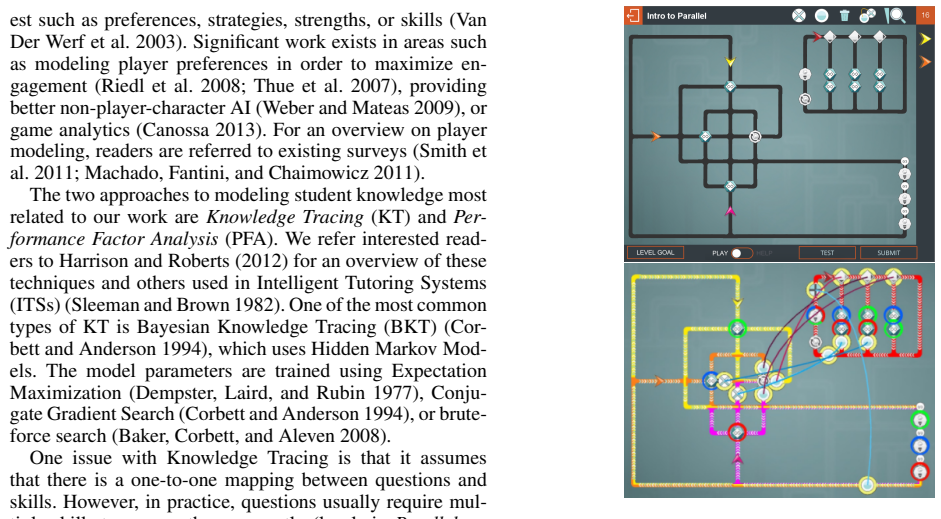
The central claim is that the integrated pipeline of feature extraction from time windows, strategy classification, domain rules, and knowledge tracing can predict the likelihood that a student has mastered each skill needed to play Parallel, a puzzle game about semaphores, signals, and race conditions. With a 30-second window, the best classifier plus rules yields a mean-squared error of 0.0811 on data from 17 students playing 395 levels, better than machine learning alone at 0.0917 or rules alone at 0.1244, and close to the 0.0655 error of an idealized performance-factor-analysis model given ground-truth skill applications. On the think-aloud dataset, combining machine learning with rules beats either component alone, though only one classifier comes close to the always-predict-mastery baseline.
Load-bearing premise
The load-bearing premise is that a predicted 'trial and error' strategy means the player failed to apply every skill in the current level and 'parallel thinking' means the player succeeded at all of them; if a player can be experimenting while already understanding one of those skills, the mastery estimates are biased.
Editorial extensions
If this is right
- In Parallel, the resulting mastery vector can drive procedural content generation, so each player's next level can practice exactly the skills the model judges them weak on.
- The same time-window strategy classifier could be reused for other games that log rich telemetry, since it does not require the game to know when a skill is applied.
- Because the machine-learning-plus-rules error is close to the idealized performance-factor-analysis lower bound, replacing the averaging step with a trained performance-factor-analysis model is a plausible route to further gains.
- Rules and classifier can be improved independently; the largest per-skill gap in the classroom data was only 0.04, so tuning rules for individual skills has clear headroom.
Reading between the lines
- A testable extension the paper does not run is to collect per-skill ground truth within think-aloud sessions instead of global strategy labels, then check whether the trial-and-error-to-failure mapping distorts mastery estimates for students who experiment on one subproblem while already understanding another.
- The always-predict-1 baseline's strength on the think-aloud dataset suggests the hand-annotated ground truth is skewed toward 'knows'; future evaluations should weight toward detecting non-mastery, which is the signal adaptive level generation most needs.
- The strategy classifier's accuracy itself is modest, so the knowledge-tracing gain probably comes mostly from the domain rules and the averaging; isolating each component's contribution would clarify where future effort belongs.
- The 21-skill chain elicited via cognitive task analysis may transfer to other puzzle games where solution steps are visible but not labeled, and the pipeline could be evaluated with only the domain-rule module to see how much supervised labels add.
Signed reviews
Editorial analysis
A structured set of objections, weighed in public.
Referee Report
Summary. This paper introduces a player-knowledge-modeling pipeline for the educational game Parallel. Telemetry is split into time windows; a supervised classifier labels each window as trial-and-error, sequential, or parallel thinking; hand-authored domain rules detect concrete skill applications; and Equation 3 averages these signals into a mastery probability per skill. The authors evaluate the strategy classifier on think-aloud data (Dataset A), then evaluate skill-mastery MSE on Dataset A and on a classroom dataset (Dataset B) whose ground truth is weekly student self-assessment. They report a best MSE of 0.0811 (J48 + rules, tau=30) on Dataset B, beating random and 'always predict 1' baselines, and an MSE of 0.0938 on Dataset A, which does not beat the 'always predict 1' baseline (0.0895). They also compare against PFA under idealized conditions.
Significance. The idea of using predicted problem-solving strategy as a proxy for skill-level success is novel and relevant, and the paper provides a useful decomposition of a difficult modeling problem into feature extraction, strategy classification, and knowledge tracing. The use of real telemetry from two deployments and the explicit PFA upper-bound comparison are strengths. However, the contribution is currently not established at the level claimed: the central mapping in Step 2 is unvalidated, and the only objective ground-truth experiment fails to outperform a constant predictor. The paper would be significant if the mapping were validated or if the claims were restricted accordingly.
major comments (3)
- [Step 2: Skill Success/Failure Detection] The conversion from ML(f) to per-skill evidence in Equation 3 is the load-bearing component of the pipeline, but it is not tested. The 55.63% accuracy in Table 2 is agreement with strategy labels, not with skill mastery. For skills with no rule in Table 1—for instance 'Understand the use of semaphores,' 'Use diverters,' and 'Prevent starvation'—p(si) is exactly the average of the unvalidated ML values. The authors' justification that 'the high predictive accuracy reported in our experiments' validates the assumption is insufficient. I request an experiment that compares the Step 2 skill-success/failure output against the per-skill ground truth in Dataset A, or a per-window annotation of skill application.
- [Experimental Evaluation, Experiments 3] Table 4 shows that on Dataset A, the only data with expert-annotated skill mastery, the best ML+R result (0.0938) does not beat the 'always predict 1' baseline (0.0895). The authors themselves write that this makes results 'not very meaningful.' Because the abstract and conclusions claim low MSE, the paper must either present Dataset B as self-report evidence only, or provide additional objective validation. In addition, the MSE values in Tables 3 and 4 are point estimates without per-student variance or significance tests; the 0.0811 versus 0.1383 margin on 17 students could be within noise. Report per-student MSE and a paired test.
- [Domain Knowledge Rules] The domain rules in Table 1 are said to be hand-authored by observing video recordings of students playing the game, while Dataset A ground truth was annotated from think-aloud/video transcripts. If the same sessions or annotators informed both, the rules and the ground truth may be correlated, inflating results on Dataset A. The manuscript should state whether rule authoring and annotation used disjoint data and annotators, and should test rule performance on held-out sessions.
minor comments (5)
- [Results, Experiment 1] The phrase 'high predictive accuracy' overstates 55.63% accuracy for a three-way classification problem; consider reporting per-class precision and recall, since the strategy classes may be imbalanced.
- [Step 3: Knowledge Tracing] Equation 3 is undefined when I_si(F)+R_si(F) equals zero, i.e., when a skill is never involved in a level and no rule fires; specify a default value in that case.
- [Step 2: Skill Success/Failure Detection] The text contains a typo, 'the high predictive accuracy reported in out experiments,' which should be corrected.
- [Experimental Evaluation, Experiment 4] The PFA comparison uses only skills with binary ground truth and injects that ground truth into the input, so the resulting MSE of 0.0655 is an upper-bound oracle; the Conclusions' claim that the approach is 'very close' to PFA should be quantified, since the gap is 0.0283 MSE on Dataset A.
- [Tables 3 and 4] The 'always predict 1' baseline differs between datasets (0.1383 versus 0.0895), so the MSE values across tables should not be compared directly without noting the different ground-truth distributions.
Circularity Check
No significant circularity found: the skill-mastery predictions are benchmarked against external self-report ground truth on Dataset B, and the strategy-to-skill mapping is an untested assumption rather than a definitional reduction.
full rationale
The paper's derivation chain is not circular in the sense required by the review rules. The machine-learning component is trained on manually annotated problem-solving strategy labels, not on the skill-mastery ground truth itself, and the headline result (MSE 0.0811 on Dataset B, Table 3) is evaluated against students' self-reported understanding, which is external to the training annotations. The domain knowledge rules in Table 1 were hand-authored from observing gameplay and could correlate with the Dataset A manual skill annotations, but the authors themselves discount Dataset A skill-prediction results ('results on it concerning student skill prediction not very meaningful') and the main claim rests on Dataset B. The most important weakness is Step 2's 'strong assumption' that trial-and-error implies failure on all level skills and parallel thinking implies success on all of them; the paper's statement that 'the high predictive accuracy reported in out experiments shows, however, that this assumption works in practice' conflates strategy-classification accuracy with validation of the strategy-to-mastery mapping. That is a validity gap, not a circular reduction: the strategy labels, the rule firings, and the Dataset B survey ground truth are obtained independently, and Equation 3 is not definitionally identical to any ground-truth construction. Self-citations (Ontañón et al. 2017; Valls-Vargas, Zhu, and Ontañón 2017) describe the game and future work and are not load-bearing for the knowledge-tracing claim. No uniqueness theorem or ansatz is imported via self-citation, and no fitted parameter is renamed as a prediction. Therefore no circular step meets the evidentiary bar, and the appropriate finding is no significant circularity.
Assumptions & free parameters
free parameters (2)
- time window size tau =
10, 20, 30 seconds; best at 30
- sequential thinking mapping value =
0.5
assumptions (4)
- domain assumption The three identified problem-solving strategies (trial and error, sequential thinking, parallel thinking) are exhaustive and mutually exclusive.
- domain assumption When the player is in trial-and-error mode, they fail all skills in the current level.
- domain assumption When the player is in parallel-thinking mode, they succeed on all skills in the current level.
- domain assumption Self-reported surveys in Dataset B reflect true skill mastery.
Cite this review
Pith. "Pith review of Tracing Player Knowledge in a Parallel Programming Educational Game." pith.science (2026). https://pith.science/paper/VX76OZMF
@misc{pith2026190805632,
  author       = {Pith},
  title        = {Pith review of: Tracing Player Knowledge in a Parallel Programming Educational Game},
  year         = {2026},
  howpublished = {\url{https://pith.science/paper/VX76OZMF}},
  note         = {Machine review of arXiv:1908.05632}
}
read the original abstract
This paper focuses on "tracing player knowledge" in educational games. Specifically, given a set of concepts or skills required to master a game, the goal is to estimate the likelihood with which the current player has mastery of each of those concepts or skills. The main contribution of the paper is an approach that integrates machine learning and domain knowledge rules to find when the player applied a certain skill and either succeeded or failed. This is then given as input to a standard knowledge tracing module (such as those from Intelligent Tutoring Systems) to perform knowledge tracing. We evaluate our approach in the context of an educational game called "Parallel" to teach parallel and concurrent programming with data collected from real users, showing our approach can predict students skills with a low mean-squared error.
Figures

Reference graph
Works this paper leans on
-
[1]
Baker, R. S. J. d.; Corbett, A. T.; and Aleven, V. 2008. More accurate student modeling through contextual estimation of slip and guess probabilities in bayesian knowledge tracing. In Woolf, B. P.; A \"i meur, E.; Nkambou, R.; and Lajoie, S., eds., Intelligent Tutoring Systems , 406--415. Berlin, Heidelberg: Springer Berlin Heidelberg
work page 2008
-
[2]
Canossa, A. 2013. Meaning in gameplay: Filtering variables, defining metrics, extracting features and creating models for gameplay analysis. In Game Analytics . Springer. 255--283
work page 2013
-
[3]
Cen, H.; Koedinger, K.; and Junker, B. 2006. Learning factors analysis--a general method for cognitive model evaluation and improvement. In International Conference on Intelligent Tutoring Systems , 164--175. Springer
work page 2006
-
[4]
Corbett, A. T., and Anderson, J. R. 1994. Knowledge tracing: Modeling the acquisition of procedural knowledge. User modeling and user-adapted interaction 4(4):253--278
work page 1994
-
[5]
Dempster, A. P.; Laird, N. M.; and Rubin, D. B. 1977. Maximum likelihood from incomplete data via the em algorithm. Journal of the royal statistical society. Series B (methodological) 1--38
work page 1977
-
[6]
Downey, A. 2008. The little book of semaphores . Green Tea Press
work page 2008
-
[7]
Eibe Frank, M. A. H., and Witten, I. H. 2016. The WEKA Workbench . Morgan Kaufmann, fourth edition
work page 2016
-
[8]
Gong, Y.; Beck, J. E.; and Heffernan, N. T. 2010. Comparing knowledge tracing and performance factor analysis by using multiple model fitting procedures. In International conference on intelligent tutoring systems , 35--44. Springer
work page 2010
Show all 21 references
-
[9]
Harrison, B., and Roberts, D. L. 2012. A review of student modeling techniques in intelligent tutoring systems. In Eighth Artificial Intelligence and Interactive Digital Entertainment (AIIDE) Conference
2012
-
[10]
Horn, B.; Cooper, S.; and Deterding, S. 2017. Adapting cognitive task analysis to elicit the skill chain of a game. In Proceedings of the Annual Symposium on Computer-Human Interaction in Play , 277--289. ACM
2017
-
[11]
C.; Fantini, E
Machado, M. C.; Fantini, E. P.; and Chaimowicz, L. 2011. Player modeling: Towards a common taxonomy. In 16th International Conference on Computer Games , 50--57. IEEE
2011
-
[12]
K.; Char, B.; Freed, E.; Furqan, A.; Howard, M.; Nguyen, A.; Patterson, J.; and Valls-Vargas, J
Onta \ n \'o n, S.; Zhu, J.; Smith, B. K.; Char, B.; Freed, E.; Furqan, A.; Howard, M.; Nguyen, A.; Patterson, J.; and Valls-Vargas, J. 2017. Designing visual metaphors for an educational game for parallel programming. In Proceedings of the 2017 CHI Conference Extended Abstrac...
2017
-
[13]
I.; Cen, H.; and Koedinger, K
Pavlik Jr, P. I.; Cen, H.; and Koedinger, K. R. 2009. Performance factors analysis--a new alternative to knowledge tracing. Online Submission
2009
-
[14]
O.; Stern, A.; Dini, D.; and Alderman, J
Riedl, M. O.; Stern, A.; Dini, D.; and Alderman, J. 2008. Dynamic experience management in virtual worlds for entertainment, education, and training. International Transactions on Systems Science and Applications, Special Issue on Agent Based Systems for Human Learning 4(2):23--42
2008
-
[15]
Sleeman, D., and Brown, J. S. 1982. Intelligent tutoring systems . London: Academic Press
1982
-
[16]
M.; Lewis, C.; Hullet, K.; and Sullivan, A
Smith, A. M.; Lewis, C.; Hullet, K.; and Sullivan, A. 2011. An inclusive view of player modeling . In Proceedings of the 6th International Conference on Foundations of Digital Games . ACM Press
2011
-
[17]
Thue, D.; Bulitko, V.; Spetch, M.; and Wasylishen, E. 2007. Interactive Storytelling: A Player Modelling Approach . Proceedings of the Third Artificial Intelligence and Interactive Digital Entertainment Conference Associatio(July):43--48
2007
-
[18]
Valls-Vargas, J.; Zhu, J.; and Onta\ n \' o n, S. 2017. Graph grammar-based controllable generation of puzzles for a learning game about parallel programming. In Proceedings of the 12th International Conference on the Foundations of Digital Games , FDG '17, 7:1--7:10. New York...
2017
-
[19]
W.; Postma, E.; and Van Den Herik, J
Van Der Werf, E.; Uiterwijk, J. W.; Postma, E.; and Van Den Herik, J. 2003. Local move prediction in go. In Computers and Games . Springer. 393--412
2003
-
[20]
G., and Mateas, M
Weber, B. G., and Mateas, M. 2009. A data mining approach to strategy prediction . CIG2009 - 2009 IEEE Symposium on Computational Intelligence and Games 140--147
2009
-
[21]
N.; Spronck, P.; Loiacono, D.; and Andr \'e , E
Yannakakis, G. N.; Spronck, P.; Loiacono, D.; and Andr \'e , E. 2013. Player modeling. In Dagstuhl Follow-Ups , volume 6. Schloss Dagstuhl-Leibniz-Zentrum fuer Informatik
2013
Reviewed August 14, 2026 · model on record in the stance chip above.
Discussion (0). Continue with ORCID to comment.