REVIEW 3 major objections 6 minor 21 references
Simple, Reversible Gradient Seebeck Coefficient Measurement System for 300-600K
T0 review · 3 major / 6 minor · reviewed 2026-08-14 · deepseek-v4-flash
Pith's one-line read The paper reports an in-house Seebeck coefficient measurement system for 300-600 K whose results match a commercial ZEM-3 instrument to within 7 percent at high temperature, with about 2 percent variance.
desk verdict Solid low-cost Seebeck rig with plausible ±7% agreement against ZEM-3, but the accuracy claim is not yet an uncertainty budget. read the letter →
The pith
A machine-rendered reading of the paper's core claim, the machinery that carries it, and where it could break.
The reading
What carries the argument
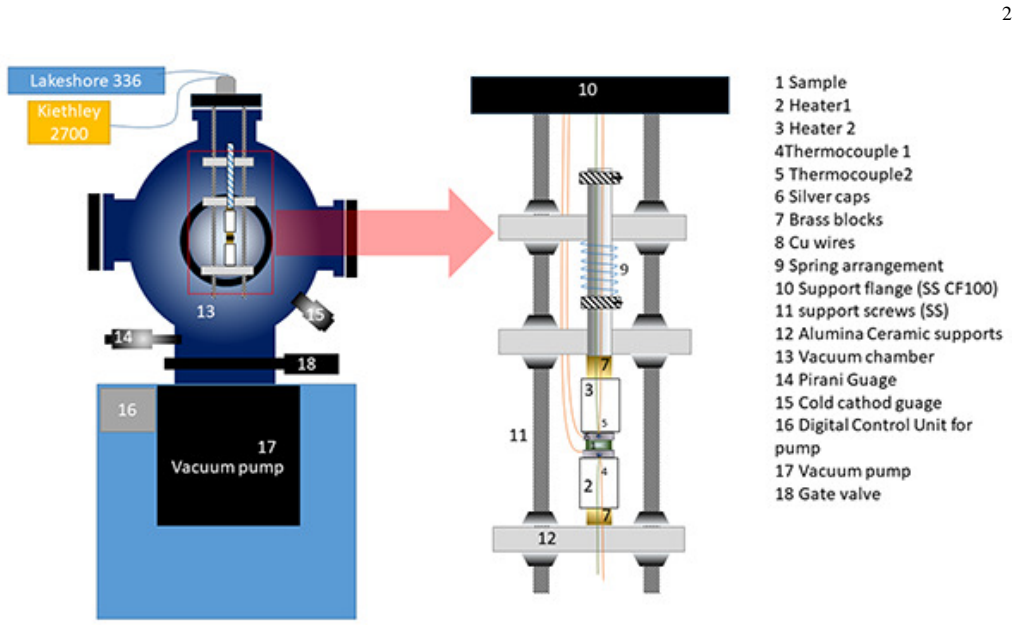
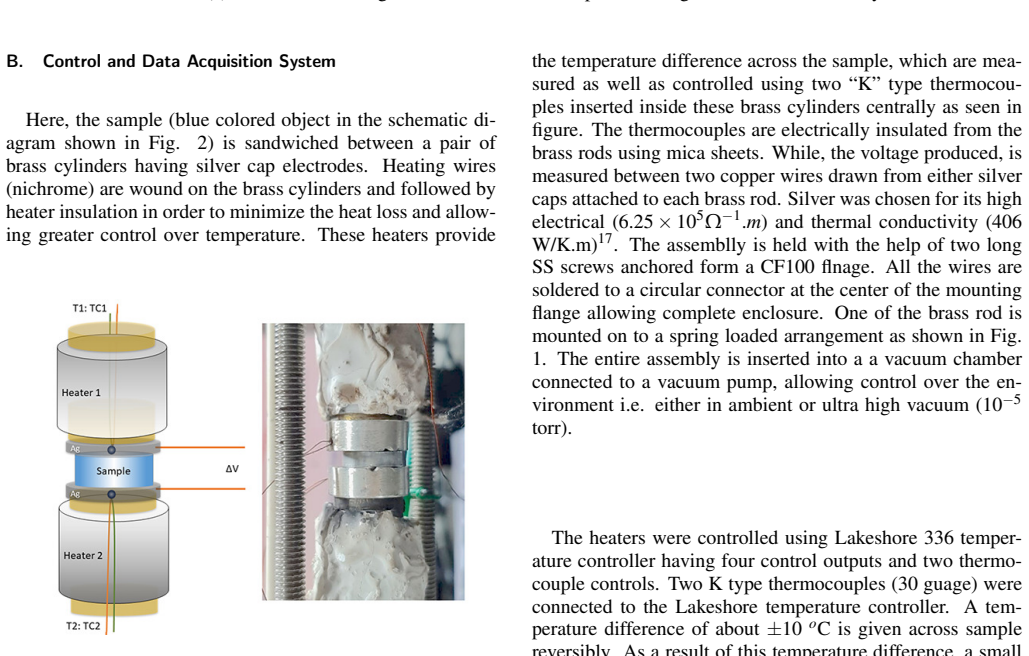
The load-bearing geometry is a sample sandwiched between two brass cylinders capped with silver electrodes, each wound with its own nichrome heater and each holding a K-type thermocouple in its center; copper wires attached to the silver caps serve as voltage leads. The voltage is modeled by Eqs. (3)-(4) as the integral of the sample's Seebeck coefficient plus a correction for the copper wire's own Seebeck contribution, and the differential readout makes any constant offset from thermocouple or contact inhomogeneity cancel out of the slope. Silver caps provide high thermal and electrical conductivity so the sample faces are assumed to reach the block temperature, and reversing the gradient gives two opposite-polarity readings for each temperature. This combination is what lets a roughly one-fifth-cost instrument approach commercial accuracy.
What would settle it
Measure a reference sample of known Seebeck coefficient at two different thicknesses or two different contact pressures while keeping the nominal temperature difference the same; if the extracted coefficient changes by more than the claimed uncertainty, the thermocouple temperature difference is not the true sample temperature difference and the central assumption fails.
Extended reading notes
Core claim
The central claim is that a simple, low-cost Seebeck measurement system can match a commercial hot-walled instrument in the 300-600 K range. The authors show that applying a reversible temperature difference of about 5-8 K across a sample pressed between two brass heater blocks with silver cap electrodes, and recording the thermovoltage as one side cools in a quasi-steady-state differential scheme, recovers the Seebeck coefficient from the slope of voltage against temperature difference. Calibration against a commercial ZEM-3 system using p-type Bi2Te3 and a half-Heusler alloy (Zr0.75Ti0.25NiSn0.97Si0.03) gives agreement within 7 percent at high temperature and a variance of about 2 percent. The design avoids a hot-walled chamber, so the sample sits under a large temperature difference rather than a small one, which the authors argue is closer to real thermoelectric operation.
Load-bearing premise
The load-bearing premise is that the silver cap's flat surface and the sample surface sit at the same temperature, so the thermocouple temperature difference equals the true temperature difference across the sample; if the contacts resist heat flow, a hidden temperature drop systematically skews every Seebeck value.
Editorial extensions
If this is right
- A laboratory can screen thermoelectric materials in the 300-600 K range at about one fifth of the cost of a commercial system, with agreement to roughly 7 percent at high temperature.
- Samples as thin as 2 mm and about 3-12 mm across can be measured, covering geometries that are difficult for commercial systems requiring tall samples.
- Because the chamber can be evacuated or filled with dry nitrogen, measurements can distinguish intrinsic Seebeck values from oxygen-induced changes in air-sensitive materials.
- The large reversible temperature difference and slope-based readout make the measurement closer to real generator operating conditions than small-gradient hot-walled methods.
Reading between the lines
- A natural test of the thermal-equilibrium assumption would be to measure samples of different thickness or thermal conductivity; if the apparent Seebeck coefficient shifts, the contact temperature drop is biasing the results.
- If the calibration holds, the same hardware could likely be recalibrated toward the design's upper limit of about 650 K, which would cover more oxides and alloys.
- Because the accuracy is defined relative to ZEM-3 reference data, an independent check against a certified reference material or direct surface-temperature measurement would separate the instrument's own error from the commercial system's bias.
Signed reviews
Editorial analysis
A structured set of objections, weighed in public.
Referee Report
Summary. The manuscript reports the design, construction, and calibration of an in-house Seebeck coefficient measurement system operating from 300 to 600 K. The system uses two brass cylinders with resistive heaters, silver caps as electrodes, and K-type thermocouples for temperature measurement; a reversible temperature gradient is applied and the Seebeck voltage is measured with copper wires. The authors derive a correction for the Seebeck contribution of the copper wires using literature data. The system is validated against a commercial ULVAC ZEM-3 instrument using two calibration samples, p-type Bi2Te3 and a half-Heusler alloy. The authors report a repeatability (variance) of up to ±2% and an accuracy of up to 7% at high temperature, defined as the deviation from the ZEM-3 reference data. The paper is a technical note aimed at demonstrating that a low-cost system (~20% of commercial cost) can provide comparable thermoelectric characterization in a limited temperature range.
Significance. If the accuracy claim is substantiated, the system would be a useful low-cost alternative for routine Seebeck characterization, particularly for chalcogenides and oxides. The design avoids a hot-walled chamber, facilitates reversible gradient measurements, and includes environment control. The explicit correction for the wire Seebeck contribution and the use of quasistatic differential measurements are good practices. However, the evidence for the accuracy claim is currently incomplete, resting on a single unverified thermal-equilibrium assumption and a two-sample comparison against a reference with comparable uncertainty.
major comments (3)
- [Section III, first paragraph] The accuracy claim of up to ±7% rests on the assumption, stated in Section III, that 'the sample and silver cap’s flat surface are in thermal equilibrium.' The thermocouples are embedded in the brass cylinders or silver caps, not attached to the sample surfaces. Any contact resistance at the sample-cap interfaces will produce a temperature gradient in the silver caps and a difference between the measured ΔT and the actual ΔT across the sample. Since the Seebeck coefficient is computed as ΔV/ΔT, a systematic overestimate of ΔT leads to a systematic underestimate of S. The two calibration samples compared with ZEM-3 cannot isolate this bias, because the deviation is of the same order as the claimed accuracy and the reference measurement involves similar contact assumptions. The authors should test this assumption directly, for example by using samples with different thicknesses or thermal conductivities, varying the spring pressure, or attaching thermocouples to the sample surfaces.
- [Section III B, Eq. (4) and Fig. 6] The claimed accuracy of ±7% is defined as the difference between the measured Seebeck coefficient and the ZEM-3 reference value, but no uncertainty budget is presented. The reference instrument itself has an uncertainty of comparable magnitude (as the authors note), and only two samples are used for validation. A proper accuracy claim requires propagation of all relevant uncertainties, including K-type thermocouple accuracy (typically ±1.5 K or 0.4%), voltmeter resolution, the uncertainty in the literature Cu Seebeck values used in the correction, and the stability of the temperature difference. For ΔT ≈ 10 K, a ±1.5 K thermocouple error alone gives a relative error of order 10% in ΔT, which directly propagates to S. The reported ±2% variance is a repeatability measure and must be distinguished from accuracy; the paper should provide a complete uncertainty analysis and error bars on the data in Fig. 4.
- [Section IV, Summary] The generalization of the accuracy claim to the entire 300–600 K range is based on only two materials, one with a high Seebeck coefficient (Bi2Te3) and one with a lower value (half-Heusler). While this is a reasonable start, the claim that the system offers 'similar accuracy to commercial systems' would be strengthened by validating on additional materials with different thermal conductivities and Seebeck magnitudes, and by reporting the temperature-dependent error separately for each sample rather than as a single maximum of ±7%.
minor comments (6)
- [Throughout] The manuscript contains many typographical and grammatical errors (e.g., 'temprature', 'cofficient', 'thye', 'assemblly', 'flnage', 'meausured', 'corrosponding') and should be carefully proofread before resubmission.
- [Section II B] The placement of the thermocouples is described inconsistently: in Section II B they are said to be inserted into the brass cylinders centrally, while in Section III they are described as placed in the silver caps. Please clarify the exact mounting location.
- [Eq. (3)] Equation (3) is typeset with confusing integration limits and the silver integrals appear as T1 to T1 and T2 to T2; this makes the derivation difficult to follow. Please rewrite with clear limits and define all temperatures (Ta, Tb, T1, T2) in the text.
- [Fig. 4] No error bars are shown in Fig. 4. Given that the reported variance is ±2%, error bars or shaded uncertainty bands should be included so the agreement with the reference data can be assessed visually.
- [Section III A] The sentence 'The statistical varition in the data shown, is normally same as the size of the legend in Fig 4' is unclear; please state the standard deviation of repeated measurements explicitly.
- [Section I] The introduction claims the system is 'much closer to real time thermoelectric applications conditions' because it lacks a hot-walled chamber; this claim is not justified or quantified. Please either elaborate or remove.
Circularity Check
No significant circularity: the instrument is validated against externally supplied ZEM-3 reference data and uses literature copper Seebeck values; no fitted parameter is renamed as a prediction.
full rationale
The paper's central claim is that the in-house Seebeck system reproduces reference values of Bi2Te3 and half-Heusler samples within ±7% at high temperature. The derivation chain is S = -ΔV/ΔT, with ΔV corrected for the Cu wire Seebeck using literature values (Eq. 4 and Fig. 5). No parameter is fitted to the reference data; the reference samples and their ZEM-3 data were supplied by external groups (Prof. Satish Vitta for half-Heusler; Prof. Arun Umarji and Rajasekhar for Bi2Te3), so the benchmark is not self-generated. The paper does cite prior work for method choices (Martin et al., Mackey et al., De Boor and Müller), but these are standard instrumental-practice citations, not load-bearing self-citations and not used to forbid alternatives. The unverified assumption of thermal equilibrium between the silver caps and sample is a real measurement-accuracy risk, but it is not a circular step: the measured ΔT is not defined in terms of the predicted S, and the comparison to ZEM-3 is an external check rather than a tautology. Thus no circularity is present; score 0.
Assumptions & free parameters
assumptions (6)
- domain assumption K-type thermocouples are linear with a Seebeck coefficient of about 40 µV/K over 300-600 K.
- domain assumption The silver caps and the sample surfaces are in thermal equilibrium, so thermocouple temperatures equal sample surface temperatures.
- domain assumption The connector temperatures T_a and T_b are equal, so the copper lead contribution can be computed with a common reference temperature.
- domain assumption Literature values for the Seebeck coefficient of copper wires (from refs 18 and 19) accurately describe the actual wires used.
- domain assumption The reference Seebeck values for Bi2Te3 and half-Heusler samples measured on a commercial ZEM-3 system are accurate enough to serve as calibration standards.
- standard math The sample is homogeneous and the Seebeck coefficient depends only on local temperature, so Eq. 2 applies.
Cite this review
Pith. "Pith review of Simple, Reversible Gradient Seebeck Coefficient Measurement System for 300-600K." pith.science (2026). https://pith.science/paper/ZMTR7D7Q
@misc{pith2026190805636,
  author       = {Pith},
  title        = {Pith review of: Simple, Reversible Gradient Seebeck Coefficient Measurement System for 300-600K},
  year         = {2026},
  howpublished = {\url{https://pith.science/paper/ZMTR7D7Q}},
  note         = {Machine review of arXiv:1908.05636}
}
read the original abstract
An in-house Seebeck coefficient measurement system has been developed which can measure the thermoemf (Seebeck coefficient) of the sample, under large temperature difference, in the temperature range 300-600 K. Unlike majority of reported instrumental designs, the system does not have a hot walled chamber and hence is much closer to real time thermoelectric applications conditions. The system consists of two brass blocks supported heaters. These heaters are placed on either side of the sample through silver caps, thus allows individual temperature control. A reversible temperature gradient is applied across the sample and the measurement is carried out in quasi-static direct current mode. Hence, a more accurate Seebeck coefficient measurement is obtained.
Figures

Figures from the paper (3 more)


Reference graph
Works this paper leans on
-
[1]
author author T. M. \ Tritt \ and\ author M. Subramanian ,\ @noop journal journal MRS bulletin \ volume 31 ,\ pages 188 ( year 2006 ) NoStop
work page 2006
-
[2]
author author J. R. \ Sootsman , author D. Y. \ Chung , \ and\ author M. G. \ Kanatzidis ,\ @noop journal journal Angewandte Chemie International Edition \ volume 48 ,\ pages 8616 ( year 2009 ) NoStop
work page 2009
-
[3]
author author G. D. \ Mahan ,\ @noop journal journal APL Materials \ volume 4 ,\ pages 104806 ( year 2016 ) NoStop
work page 2016
-
[4]
author author J. He \ and\ author T. M. \ Tritt ,\ @noop journal journal Science \ volume 357 ,\ pages eaak9997 ( year 2017 ) NoStop
work page 2017
-
[5]
author author K. A. \ Borup , author J. De Boor , author H. Wang , author F. Drymiotis , author F. Gascoin , author X. Shi , author L. Chen , author M. I. \ Fedorov , author E. M \"u ller , author B. B. \ Iversen , et al. ,\ @noop journal journal Energy & Environmental Science \ volume 8 ,\ pages 423 ( year 2015 ) NoStop
work page 2015
-
[6]
author author C. Wood , author A. Chmielewski , \ and\ author D. Zoltan ,\ @noop journal journal Review of scientific instruments \ volume 59 ,\ pages 951 ( year 1988 ) NoStop
work page 1988
-
[7]
author author S. Singh \ and\ author S. K. \ Pandey ,\ @noop journal journal Measurement \ volume 102 ,\ pages 26 ( year 2017 ) NoStop
work page 2017
-
[8]
author author A. Mishra , author S. Bhattacharjee , \ and\ author S. Anwar ,\ @noop journal journal Measurement \ volume 68 ,\ pages 295 ( year 2015 ) NoStop
work page 2015
Show all 21 references
-
[9]
Burkov , author A
author author A. Burkov , author A. Heinrich , author P. Konstantinov , author T. Nakama , \ and\ author K. Yagasaki ,\ @noop journal journal Measurement Science and Technology \ volume 12 ,\ pages 264 ( year 2001 ) NoStop
2001
-
[10]
Dasgupta \ and\ author A
author author T. Dasgupta \ and\ author A. Umarji ,\ @noop journal journal Review of scientific instruments \ volume 76 ,\ pages 094901 ( year 2005 ) NoStop
2005
-
[11]
Zhu , author H
author author Q. Zhu , author H. S. \ Kim , \ and\ author Z. Ren ,\ @noop journal journal Review of Scientific Instruments \ volume 88 ,\ pages 094902 ( year 2017 ) NoStop
2017
-
[12]
Martin , author T
author author J. Martin , author T. Tritt , \ and\ author C. Uher ,\ @noop journal journal Journal of Applied Physics \ volume 108 ,\ pages 14 ( year 2010 ) NoStop
2010
-
[13]
Iwanaga , author E
author author S. Iwanaga , author E. S. \ Toberer , author A. LaLonde , \ and\ author G. J. \ Snyder ,\ @noop journal journal Review of Scientific Instruments \ volume 82 ,\ pages 063905 ( year 2011 ) NoStop
2011
-
[14]
Gunes , author M
author author M. Gunes , author M. Parlak , \ and\ author M. Ozenbas ,\ @noop journal journal Measurement Science and Technology \ volume 25 ,\ pages 055901 ( year 2014 ) NoStop
2014
-
[15]
Kumar ,\ @noop journal journal arXiv preprint arXiv:1906.08023 \ ( year 2019 ) NoStop
author author A. Kumar ,\ @noop journal journal arXiv preprint arXiv:1906.08023 \ ( year 2019 ) NoStop
1906 arXiv
-
[16]
Ponnambalam , author S
author author V. Ponnambalam , author S. Lindsey , author N. Hickman , \ and\ author T. M. \ Tritt ,\ @noop journal journal Review of scientific instruments \ volume 77 ,\ pages 073904 ( year 2006 ) NoStop
2006
-
[17]
author author A. P. \ Kharote \ and\ author D. Ramachandran ,\ @noop journal journal ECS Journal of Solid State Science and Technology \ volume 6 ,\ pages N3001 ( year 2017 ) NoStop
2017
-
[18]
Cusack \ and\ author P
author author N. Cusack \ and\ author P. Kendall ,\ @noop journal journal Proceedings of the physical society \ volume 72 ,\ pages 898 ( year 1958 ) NoStop
1958
-
[19]
Guan , author H
author author A. Guan , author H. Wang , author H. Jin , author W. Chu , author Y. Guo , \ and\ author G. Lu ,\ @noop journal journal Review of Scientific Instruments \ volume 84 ,\ pages 043903 ( year 2013 ) NoStop
2013
-
[20]
Mackey , author F
author author J. Mackey , author F. Dynys , \ and\ author A. Sehirlioglu ,\ @noop journal journal Review of Scientific Instruments \ volume 85 ,\ pages 085119 ( year 2014 ) NoStop
2014
-
[21]
De Boor \ and\ author E
author author J. De Boor \ and\ author E. M \"u ller ,\ @noop journal journal Review of scientific instruments \ volume 84 ,\ pages 065102 ( year 2013 ) NoStop
2013
Reviewed August 14, 2026 · model on record in the stance chip above.
Discussion (0). Continue with ORCID to comment.