REVIEW 4 major objections 7 minor 45 references
A Bayesian Choice Model for Eliminating Feedback Loops
T0 review · 4 major / 7 minor · reviewed 2026-08-14 · deepseek-v4-flash
Pith's one-line read The paper presents the Dirichlet-Luce model, a Bayesian choice model in which the posterior marginal of an option that was never presented remains exactly equal to its prior, eliminating the negative bias that drives feedback loops.
desk verdict Sound fairness lemma in a Luce-based choice model, but the title oversells and the sample-complexity claim needs proof; worth refereeing. read the letter →
The pith
A machine-rendered reading of the paper's core claim, the machinery that carries it, and where it could break.
The reading
What carries the argument
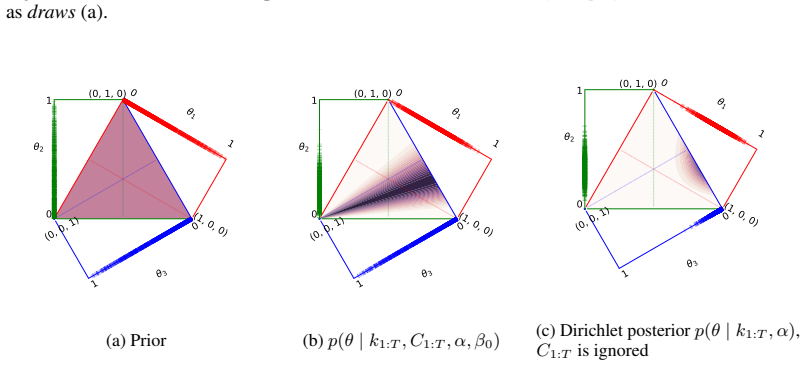
The load-bearing object is the generalized Dirichlet family $$p(\$\theta$ \mid \$\alpha$, \$\beta$) \propto \prod_k \$theta_k^{{\alpha_k - 1}}$ \prod_{C \in \mathcal{C}} \left(\sum_{\kappa \in C} \theta_\kappa\right)^{-\$\beta$(C)},$$ with consistency $\sum_C \beta(C) = \sum_k \alpha_k$; it reduces to the ordinary Dirichlet when $\beta$ is placed only on the full set $[K]$. This family carries the argument because the denominator factors for each presentation $C$ are the mechanism that removes negative bias: an option absent from $C$ never appears in the sums, so its marginal stays untouched. The same family makes sequential Monte Carlo weight updates $O(L)$ and supports the Thompson-sampling presentation of top $L$ sampled options.
What would settle it
Run a direct numerical check of the invariance claim: present only options 1 and 2 many times, keep option 3 never presented, and verify at every step that the posterior marginal of $\theta_3$ remains exactly the prior Beta marginal; any deviation disproves Lemma 3. More behaviorally, simulate a user with a Condorcet cycle (A preferred to B, B to C, C to A) and check whether the Thompson-sampling presentation mechanism's cumulative regret grows linearly rather than sublinearly, indicating that the single-transitive-preference assumption cannot capture the feedback.
Extended reading notes
Core claim
The central discovery is the Dirichlet-Luce posterior $$p(\$\theta$ \mid k_{1:T}, C_{1:T}, \$\alpha$, \$\beta$) \propto \prod_{k} \$theta_k^{{\alpha_k + y_k - 1}}$ \prod_{C \in \mathcal{C}} \left(\sum_{\kappa \in C} \theta_\kappa\right)^{-\mu(C)-\$\beta$(C)},$$ which accounts for limited exposure by putting each presentation's sum into the denominator. The paper proves (Lemma 3) that when an option is absent from every presentation, its posterior marginal is exactly its prior Beta marginal, independent of all observed choices; this is what makes the model fair to unpresented and cold-start options. The same construction gives a family whose normalization is Carlson's $R$ function, for which exact inference is intractable but Monte Carlo sampling is efficient. The paper argues these properties translate into an online presentation algorithm: sample a preference vector from the posterior, present its top $L$ options, observe the chosen item, and update.
Load-bearing premise
The load-bearing premise is that each user is governed by one fixed preference vector satisfying Luce's choice axiom, so all choices are stochastically transitive; if real users are intransitive or context-dependent, the model treats their conflicting choices as random noise and the fairness and regret guarantees no longer describe their behavior.
Editorial extensions
If this is right
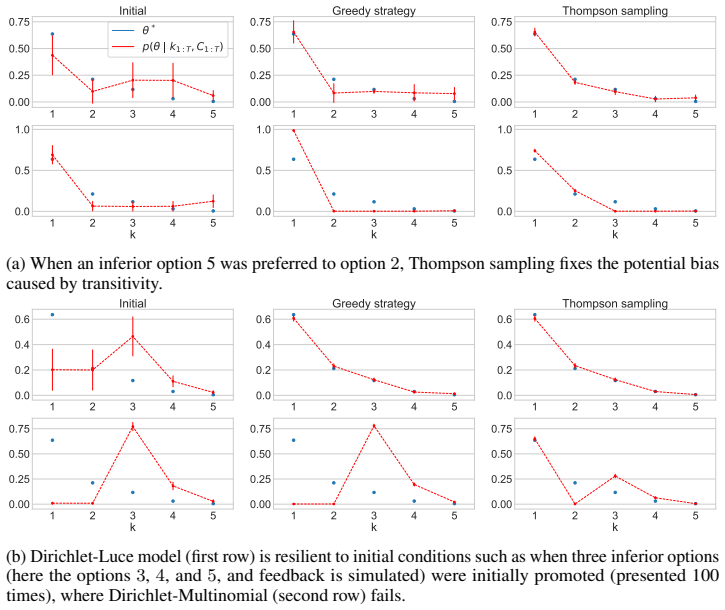
- Never-presented options, including newly added ones, keep their prior preference distribution, so cold-start items are neither downranked nor upranked by choices involving other options.
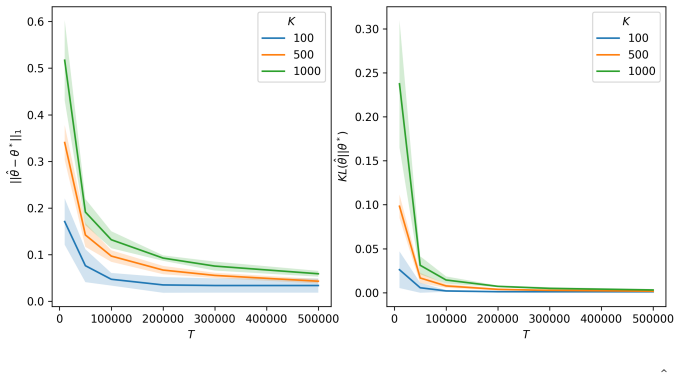
- Preference recovery is sample-efficient: under a transitive preference assumption, accurate estimates require on the order of $O(K \log K)$ unique pairwise presentations, matching stochastic ranking algorithms.
- The Thompson-sampling presentation mechanism achieves lower cumulative regret than TopRank for $L$-wise presentations and than Double Thompson Sampling for pairwise duels in simulated Plackett-Luce and cyclic preference settings.
- The model can be reused as a building block in recommender systems and other interactive personalization pipelines to avoid filter-bubble effects.
Reading between the lines
- A testable extension is a mixture of Dirichlet-Luce components: the paper notes that cyclical or multi-modal preferences can be captured as mixtures, which would let the same machinery model users who switch between transitive preference states.
- The invariance property suggests a broader design principle: if a choice model's likelihood factors over options in the numerator and controls each presented subset's denominator, cold-start neutrality follows automatically; this could be transplanted to collaborative filtering.
- Because the model is misspecified under intransitive preferences, real deployments might need a diagnostic that checks whether observed choices are consistent with a single transitive preference vector; the paper's treatment of conflicting choices implies such a diagnostic could be based on how much posterior mass is placed on random draws versus stable structure.
Signed reviews
Editorial analysis
A structured set of objections, weighed in public.
Referee Report
Summary. The paper introduces the Dirichlet-Luce model, a Bayesian choice model in which the likelihood is a restricted multinomial conditioned on presented subsets and the prior is a generalized Dirichlet density with presentation pseudo-counts. The authors show that the posterior marginal of an option that was never presented equals its prior marginal (Lemma 3, Appendix A.1.3), and they argue this makes the model fair to cold-start and underrepresented options. They then propose a Thompson-sampling presentation mechanism with sequential Monte Carlo inference, and report synthetic experiments showing lower cumulative regret than TopRank (for L-wise presentations) and Double Thompson Sampling (for pairwise duels), including one cyclic-preference scenario. The paper claims that the model is practical because accurate preference estimates are obtained from O(K log K) unique presentations, and that it eliminates feedback loops.
Significance. If the advertised claims held in their strongest form, the paper would be a valuable contribution: the invariance property in Lemma 3 is a genuine and non-obvious consequence of the Dirichlet-Luce posterior, and the SMC-based Thompson sampling mechanism is a sensible way to operationalize it. The proof of Lemma 3 is correct, and the model provides a clean Bayesian treatment of choice under limited exposure. The significance is reduced, however, by the gap between what is proved and what is advertised: the O(K log K) sample-complexity claim is a heuristic supported only by an analogy and a synthetic experiment; the regret results are purely empirical and lack theoretical bounds; and the 'eliminating feedback loops' language in the title and abstract is stronger than the formal results, which are conditional on a static Luce-preference model.
major comments (4)
- [Abstract; Section 3, 'Preference Learning'] The abstract and the bullet list claim that 'Dirichlet-Luce posterior inference achieves pairwise preference aggregation upon collecting statistics for O(K log K) unique pairs.' No sample-complexity theorem is stated or proved. The argument in Section 3 is an analogy with stochastic ranking algorithms, and the evidence is the empirical demonstration in Figure 1 that θ* can be recovered from Merge-Rank-generated comparisons. This is a heuristic observation about a specific active-sampling procedure, not a property of the Dirichlet-Luce model in general. Since the 'practical' claim in the abstract rests on this point, please either provide a formal sample-complexity bound (e.g., PAC-style posterior concentration) or explicitly label the O(K log K) statement as an empirical finding and remove it from the bullet list of model properties.
- [Title; Abstract; Section 4] The title and abstract claim that the model eliminates feedback loops and that the resulting system is 'free of feedback loops.' What is formally proved (Lemma 3, Appendix A.1.3) is marginal invariance for never-presented options under a single static preference vector satisfying Luce's axiom. Section 4 itself concedes that presented but rarely chosen options can still suffer transitivity-induced negative bias ('the mean preference estimate of θ2 will still decrease'), and the proposed Thompson-sampling remedy is heuristic. No regret bound, bias bound, or convergence guarantee is provided for the online presentation mechanism. The contribution should be reframed as reducing negative bias toward unpresented options under the Luce/static-preference regime, and the feedback-loop language should be reserved for what is actually demonstrated.
- [Section 3, 'Conflicting Choices'] The paper acknowledges that the likelihood depends only on the sufficient statistics μ(C) and y_k, and therefore discards all associations between specific choices and specific presentations. Consequently, Lemma 3's 'fairness' statement is about the posterior of a latent parameter θ in a model that is misspecified for context-dependent or intransitive users; it does not by itself establish fair treatment of cold-start items in real interactive systems. The abstract's unqualified 'fair' claim and the 'Fair Cold-Start' discussion in Section 3 are only justified inside the stochastic-transitivity regime. Please state this condition explicitly at the point of the claims, and address what the cyclic experiment in Figure 5c does and does not show (average-case improvement with high variance, no formal degradation bound).
- [Section 6, 'L-wise Presentations'] The comparison with TopRank does not specify how TopRank's interaction protocol is aligned with the paper's presentation-and-feedback model. The regret definition in Section 6 measures the top-N options 'included in the presentation,' but TopRank is a ranking algorithm; if its feedback model or evaluation differs from the restricted-multinomial choice model used for the simulated user, the cumulative-regret comparison may not be apples-to-apples. Please state the exact protocol: how TopRank's ranking is converted to a presentation, which feedback it receives, and how the learner's subset reward is computed in each round. This is needed to validate the central empirical claim of low regret in the L-wise setting.
minor comments (7)
- [Section 2] The notation uses C both for the set of all non-empty subsets and for a particular presentation C_t; please use a different symbol (e.g., a calligraphic C) to avoid confusion.
- [Section 3, 'Preference Learning'] The statement that 'the posterior is log-concave with respect to log-preferences' is given without proof or reference; please provide a brief argument or a citation.
- [Section 3, Eq. (2)] The consistency condition ∑_C β(C) = ∑_k α_k is introduced as a requirement; please justify why it is needed beyond the reduction to the Dirichlet prior at β=β0, and discuss what happens when it is violated.
- [Section 6, Figure 5 caption] The caption refers to the proposed algorithm as 'JTS,' which is not defined anywhere in the paper; please name it consistently (e.g., 'Dirichlet-Luce Thompson sampling').
- [Section 6; Appendix A.4] The number of simulation runs and key hyperparameter settings for the proposed algorithm (number of particles N, resampling threshold, Metropolis proposal parameters) are not reported for Figures 4 and 5; please add these details to the supplementary material.
- [Appendix A.3, Algorithm 2] The move step proposes θ̂_j uniformly on (0, r), which can have very low acceptance probability for peaked posteriors; please report the empirically observed acceptance rate or justify the choice of proposal.
- [Section 3, 'Conflicting Choices'] The sentence 'Cyclical choice behavior can be modeled as a mixture of preferences θ' is presented as future work, but the paper does not discuss how the posterior invariance property would extend to a mixture; please add a sentence clarifying that the current formal results do not cover the mixture case.
Circularity Check
No circularity: the central fairness property is proved from the model's likelihood and prior, and the bandit comparisons use external baselines.
full rationale
The paper's fairness claim (Lemma 3, Appendix A.1.3) is derived from the Dirichlet-Luce posterior (Eq. 3). For an option l that never appears in any presentation, the likelihood factorizes so that θ_l enters only through the Dirichlet prior; the proof integrates out the remaining coordinates and shows the marginal is Beta(α_1, Σ_{j≠1} α_j), identical to the prior. This is a mathematical consequence of the model, not an input defined in terms of the target claim. The bandit results compare Dirichlet-Luce Thompson sampling against external baselines (TopRank, DTS) on simulated feedback, with no parameter fitted to the metric being reported. The sample-complexity statement O(K log K) is supported by analogy to stochastic ranking and by the Merge-Rank experiment (Fig. 1); it is an empirical overstatement rather than a circular reduction, since the experiment does not fit a parameter and then predict it. No load-bearing self-citations are present; references to Davidson-Solomon, Dickey, Jiang et al., and Hankin are prior-art attributions. Consequently, no step of the derivation reduces by construction to its inputs.
Assumptions & free parameters
free parameters (2)
- α (Dirichlet concentration parameters) =
not specified; assumed flat prior (α=1) in experiments
- β (presentation pseudo-counts) =
β0([K])=sum_k α_k, 0 otherwise
assumptions (4)
- domain assumption User choices are generated by a static preference vector θ under Luce's choice axiom (Plackett-Luce restricted multinomial).
- domain assumption Stochastic transitivity: a single θ implies preferences are transitive in expectation.
- ad hoc to paper The consistency condition sum_C β(C) = sum_k α_k.
- standard math Monte Carlo sampling (SMC, Metropolis-within-Gibbs) approximates the posterior.
Cite this review
Pith. "Pith review of A Bayesian Choice Model for Eliminating Feedback Loops." pith.science (2026). https://pith.science/paper/ZYXUTCRP
@misc{pith2026190805640,
  author       = {Pith},
  title        = {Pith review of: A Bayesian Choice Model for Eliminating Feedback Loops},
  year         = {2026},
  howpublished = {\url{https://pith.science/paper/ZYXUTCRP}},
  note         = {Machine review of arXiv:1908.05640}
}
read the original abstract
Self-reinforcing feedback loops in personalization systems are typically caused by users choosing from a limited set of alternatives presented systematically based on previous choices. We propose a Bayesian choice model built on Luce axioms that explicitly accounts for users' limited exposure to alternatives. Our model is fair---it does not impose negative bias towards unpresented alternatives, and practical---preference estimates are accurately inferred upon observing a small number of interactions. It also allows efficient sampling, leading to a straightforward online presentation mechanism based on Thompson sampling. Our approach achieves low regret in learning to present upon exploration of only a small fraction of possible presentations. The proposed structure can be reused as a building block in interactive systems, e.g., recommender systems, free of feedback loops.
Figures


Figures from the paper (6 more)



Reference graph
Works this paper leans on
-
[1]
Random U tility T heory for S ocial C hoice
Hossein Azari, David Parks, and Lirong Xia. Random U tility T heory for S ocial C hoice. In Advances in Neural Information Processing Systems, pages 126--134, 2012
work page 2012
-
[2]
Rank A nalysis of I ncomplete B lock D esigns: I
Ralph Allan Bradley and Milton E Terry. Rank A nalysis of I ncomplete B lock D esigns: I. the M ethod of P aired C omparisons. Biometrika, 39 0 (3/4): 0 324--345, 1952
work page 1952
-
[3]
Top-k S election based on A daptive S ampling of N oisy P references
R \'o bert Busa-Fekete, Balazs Szorenyi, Weiwei Cheng, Paul Weng, and Eyke H \"u llermeier. Top-k S election based on A daptive S ampling of N oisy P references. In International Conference on Machine Learning, pages 1094--1102, 2013
work page 2013
-
[4]
u llermeier, and Bal \'a zs Sz \
R \'o bert Busa-Fekete, Eyke H \"u llermeier, and Bal \'a zs Sz \"o r \'e nyi. Preference-based R ank E licitation using S tatistical M odels: T he C ase of M allows. In Proceedings of The 31st International Conference on Machine Learning, volume 32, 2014
work page 2014
-
[5]
Appell F unctions and M ultiple A verages
BC Carlson. Appell F unctions and M ultiple A verages. SIAM Journal on Mathematical Analysis, 2 0 (3): 0 420--430, 1971
work page 1971
-
[6]
A S equential P article F ilter M ethod for S tatic M odels
Nicolas Chopin. A S equential P article F ilter M ethod for S tatic M odels. Biometrika, 89 0 (3): 0 539--552, 2002
work page 2002
-
[7]
Click M odels for W eb S earch
Aleksandr Chuklin, Ilya Markov, and Maarten de Rijke. Click M odels for W eb S earch. Synthesis Lectures on Information Concepts, Retrieval, and Services, 7 0 (3): 0 1--115, 2015
work page 2015
-
[8]
Deep N eural N etworks for Y ou T ube R ecommendations
Paul Covington, Jay Adams, and Emre Sargin. Deep N eural N etworks for Y ou T ube R ecommendations. In Proceedings of the 10th ACM Conference on Recommender Systems, New York, NY, USA, 2016
work page 2016
Show all 45 references
-
[9]
An E xperimental C omparison of C lick P osition- B ias M odels
Nick Craswell, Onno Zoeter, Michael Taylor, and Bill Ramsey. An E xperimental C omparison of C lick P osition- B ias M odels. In Proceedings of the 2008 I nternational C onference on W eb S earch and D ata M ining , pages 87--94. ACM, 2008
2008
-
[10]
A B ayesian A pproach to P aired C omparison E xperimentation
Roger R Davidson and Daniel L Solomon. A B ayesian A pproach to P aired C omparison E xperimentation. Biometrika, 60 0 (3): 0 477--487, 1973
1973
-
[11]
Multiple H ypergeometric F unctions: P robabilistic I nterpretations and S tatistical U ses
James M Dickey. Multiple H ypergeometric F unctions: P robabilistic I nterpretations and S tatistical U ses. Journal of the American Statistical Association, 78 0 (383): 0 628--637, 1983
1983
-
[12]
Bayesian M ethods for C ensored C ategorical D ata
James M Dickey, Jhy-Ming Jiang, and Joseph B Kadane. Bayesian M ethods for C ensored C ategorical D ata. Journal of the American Statistical Association, 82 0 (399): 0 773--781, 1987
1987
-
[13]
Maximum S election and R anking under N oisy C omparisons
Moein Falahatgar, Alon Orlitsky, Venkatadheeraj Pichapati, and Ananda Theertha Suresh. Maximum S election and R anking under N oisy C omparisons. In International Conference on Machine Learning, pages 1088--1096, 2017
2017
-
[14]
Sampling-based A pproaches to C alculating M arginal D ensities
Alan E Gelfand and Adrian FM Smith. Sampling-based A pproaches to C alculating M arginal D ensities. Journal of the American Statistical Association, 85 0 (410): 0 398--409, 1990
1990
-
[15]
Adaptive R ejection M etropolis S ampling within G ibbs S ampling
Wally R Gilks, NG Best, and KKC Tan. Adaptive R ejection M etropolis S ampling within G ibbs S ampling. Journal of the Royal Statistical Society: Series C (Applied Statistics), 44 0 (4): 0 455--472, 1995
1995
-
[16]
Thompson S ampling for C omplex O nline P roblems
Aditya Gopalan, Shie Mannor, and Yishay Mansour. Thompson S ampling for C omplex O nline P roblems. In Proceedings of the 31st International Conference on International Conference on Machine Learning, pages 100--108, 2014
2014
-
[17]
Bayesian I nference for P lackett- L uce R anking M odels
John Guiver and Edward Snelson. Bayesian I nference for P lackett- L uce R anking M odels. In P roceedings of the 26th A nnual I nternational C onference on M achine learning , pages 377--384. ACM, 2009
2009
-
[18]
A G eneralization of the D irichlet D istribution
Robin KS Hankin. A G eneralization of the D irichlet D istribution. Journal of Statistical Software, 33 0 (11): 0 1--18, 2010
2010
-
[19]
Active R anking U sing P airwise C omparisons
Kevin G Jamieson and Robert Nowak. Active R anking U sing P airwise C omparisons. In Advances in Neural Information Processing Systems, pages 2240--2248, 2011
2011
-
[20]
Degenerate F eedback L oops in R ecommender S ystems
Ray Jiang, Silvia Chiappa, Tor Lattimore, Andras Agyorgy, and Pushmeet Kohli. Degenerate F eedback L oops in R ecommender S ystems. In Proceedings of the 2019 AAAI/ACM Conference on AI, Ethics, and Society, 2019
2019
-
[21]
Computation of C arlson's M ultiple H ypergeometric F unction R for B ayesian A pplications
Thomas J Jiang, Joseph B Kadane, and James M Dickey. Computation of C arlson's M ultiple H ypergeometric F unction R for B ayesian A pplications. Journal of Computational and Graphical Statistics, 1 0 (3): 0 231--251, 1992
1992
-
[22]
Regret L ower B ound and O ptimal A lgorithm in D ueling B andit P roblem
Junpei Komiyama, Junya Honda, Hisashi Kashima, and Hiroshi Nakagawa. Regret L ower B ound and O ptimal A lgorithm in D ueling B andit P roblem. In Conference on Learning Theory, pages 1141--1154, 2015
2015
-
[23]
Bandit A lgorithms
Tor Lattimore and Csaba Szepesv \'a ri. Bandit A lgorithms . Cambridge (to appear), 2019
2019
-
[24]
Toprank: A P ractical A lgorithm for O nline S tochastic R anking
Tor Lattimore, Branislav Kveton, Shuai Li, and Csaba Szepesvari. Toprank: A P ractical A lgorithm for O nline S tochastic R anking. In Advances in Neural Information Processing Systems, pages 3949--3958, 2018
2018
-
[25]
An A lternative B ayesian A pproach to the B radley- T erry M odel for P aired C omparisons
Tom Leonard. An A lternative B ayesian A pproach to the B radley- T erry M odel for P aired C omparisons. Biometrics, pages 121--132, 1977
1977
-
[26]
Causal I nference for R ecommendation
Dawen Liang, Laurent Charlin, and David M Blei. Causal I nference for R ecommendation. In UAI Workshop on Causation: Foundation to Application, 2016
2016
-
[27]
Variational A utoencoders for C ollaborative F iltering
Dawen Liang, Rahul G Krishnan, Matthew D Hoffman, and Tony Jebara. Variational A utoencoders for C ollaborative F iltering. In Proceedings of the 2018 World Wide Web Conference on World Wide Web, pages 689--698. International World Wide Web Conferences Steering Committee, 2018
2018
-
[28]
Learning to R ank for I nformation R etrieval
Tie-Yan Liu. Learning to R ank for I nformation R etrieval. Foundations and Trends in Information Retrieval , 3 0 (3): 0 225--331, 2009
2009
-
[29]
Ducan Luce
R. Ducan Luce. Individual C hoice B ehavior . Wiley, 1959
1959
-
[30]
Active L earning for T op- k R ank A ggregation from N oisy C omparisons
Soheil Mohajer, Changho Suh, and Adel Elmahdy. Active L earning for T op- k R ank A ggregation from N oisy C omparisons. In International Conference on Machine Learning, pages 2488--2497, 2017
2017
-
[31]
Radford M. Neal. Slice S ampling. The Annals of Statistics, 31 0 (3): 0 705--767, 2003
2003
-
[32]
The F ilter B ubble: W hat the I nternet is hiding from you
Eli Pariser. The F ilter B ubble: W hat the I nternet is hiding from you . Penguin UK, 2011
2011
-
[33]
The A nalysis of P ermutations
Robin L Plackett. The A nalysis of P ermutations. Applied Statistics, pages 193--202, 1975
1975
-
[34]
Transitivity of P references
Michel Regenwetter, Jason Dana, and Clintin P Davis-Stober. Transitivity of P references. Psychological Review, 118 0 (1): 0 42, 2011
2011
-
[35]
Battle of B andits
Aadirupa Saha and Aditya Gopalan. Battle of B andits. In Proceedings of the Thirty-Forth Conference on Uncertainty in Artificial Intelligence, UAI, pages 06--10, 2018
2018
-
[36]
Human I nteraction with R ecommendation S ystems
Sven Schmit and Carlos Riquelme. Human I nteraction with R ecommendation S ystems. In Proceedings of the 21th International Conference on Artificial Intelligence and Statistics, 2018
2018
-
[37]
Intransitive C ycles: R ational C hoice or R andom E rror? an A nswer based on E stimation of E rror R ates with E xperimental D ata
Barry Sopher and Gary Gigliotti. Intransitive C ycles: R ational C hoice or R andom E rror? an A nswer based on E stimation of E rror R ates with E xperimental D ata. Theory and decision, 35 0 (3): 0 311--336, 1993
1993
-
[38]
Multi-dueling B andits with D ependent A rms
Yanan Sui, Vincent Zhuang, Joel W Burdick, and Yisong Yue. Multi-dueling B andits with D ependent A rms. In Proceedings of the Thirty-Forth Conference on Uncertainty in Artificial Intelligence, UAI, 2017
2017
-
[39]
Advancements in D ueling B andits
Yanan Sui, Masrour Zoghi, Katja Hofmann, and Yisong Yue. Advancements in D ueling B andits. In IJCAI, pages 5502--5510, 2018
2018
-
[40]
o r \'e nyi, R \'o bert Busa-Fekete, Adil Paul, and Eyke H \
Bal \'a zs Sz \"o r \'e nyi, R \'o bert Busa-Fekete, Adil Paul, and Eyke H \"u llermeier. Online R ank elicitation for P lackett-luce: A D ueling B andits A pproach. In Advances in Neural Information Processing Systems, pages 604--612, 2015
2015
-
[41]
On the L ikelihood that O ne U nknown P robability E xceeds A nother in V iew of the E vidence of T wo S amples
William R Thompson. On the L ikelihood that O ne U nknown P robability E xceeds A nother in V iew of the E vidence of T wo S amples. Biometrika, 25 0 (3/4): 0 285--294, 1933
1933
-
[42]
Double T hompson S ampling for D ueling B andits
Huasen Wu and Xin Liu. Double T hompson S ampling for D ueling B andits. In Advances in Neural Information Processing Systems, pages 649--657, 2016
2016
-
[43]
Collaborative C ompetitive F iltering: L earning R ecommender using C ontext of U ser C hoice
Shuang-Hong Yang, Bo Long, Alexander J Smola, Hongyuan Zha, and Zhaohui Zheng. Collaborative C ompetitive F iltering: L earning R ecommender using C ontext of U ser C hoice. In Proceedings of the 34th international ACM SIGIR conference on Research and development in Informatio...
2011
-
[44]
The R elationship between luce's C hoice A xiom, T hurstone's T heory of C omparative J udgment, and the D ouble E xponential D istribution
John I Yellott Jr. The R elationship between luce's C hoice A xiom, T hurstone's T heory of C omparative J udgment, and the D ouble E xponential D istribution. Journal of Mathematical Psychology, 15 0 (2): 0 109--144, 1977
1977
-
[45]
The k-armed D ueling B andits P roblem
Yisong Yue, Josef Broder, Robert Kleinberg, and Thorsten Joachims. The k-armed D ueling B andits P roblem. Journal of Computer and System Sciences, 78 0 (5): 0 1538--1556, 2012
2012
Reviewed August 14, 2026 · model on record in the stance chip above.
Discussion (0). Continue with ORCID to comment.