REVIEW 2 major objections 4 minor 72 references
Electromagnetic full-$f$ gyrokinetics in the tokamak edge with discontinuous Galerkin methods
T0 review · 2 major / 4 minor · reviewed 2026-08-14 · deepseek-v4-flash
Pith's one-line read An energy-conserving discontinuous Galerkin scheme brings electromagnetic effects to full-f gyrokinetic simulations of the tokamak edge and delivers the first nonlinear electromagnetic gyrokinetic turbulence simulation on open field lines.
desk verdict First nonlinear electromagnetic full-f gyrokinetic simulation on open field lines, with a clean cancellation-avoiding scheme; the main caveat is that the energy-conservation proof does not cover the non-orthogonal geometry of the headline run. read the letter →
The pith
A machine-rendered reading of the paper's core claim, the machinery that carries it, and where it could break.
The reading
What carries the argument
The load-bearing object is the generalized Ohm's law obtained by differentiating the parallel Ampère equation and substituting the gyrokinetic equation: $$\left(-\nabla_\$perp^{2}$ + \sum_s \frac{\mu_0 $q_s^{2}$}{m_s} \int dw\, J f_s\right)\frac{\partial A_\parallel}{\partial t} = \mu_0 \sum_s q_s \int dw\, v_\parallel \frac{\partial (J f_s)^\star}{\partial t}.$$ Because the $\partial A_\parallel/\partial t$ term appears explicitly in the symplectic gyrokinetic equation, the scheme can first advance the distribution function partially, then solve for $\partial A_\parallel/\partial t$, then complete the update. In the discrete weak form, the quadrature-free modal DG integration makes the coefficient of $\partial A_\parallel/\partial t$ on the left and the right exactly equal, so the spurious term that would scale with $\hat\beta/(k_\perp^2\rho_s^2)$ cancels identically. Around this core sit two further mechanisms: a discrete Hamiltonian that is continuous across cell interfaces, enforced by finite-element solves for $\phi$ and a parallel smoothing projection, which yields discrete energy conservation; and an $A_\parallel$ that is allowed to be discontinuous along the field line, which permits exact cancellation of $E_\parallel$ in the MHD limit.
What would settle it
One decisive test is to rerun the helical open-field-line case with a time-dependent nonlinear polarization density in the quasi-neutrality equation: if the roughly 40% reduction in radial particle transport and the enhanced intermittency vanish, those physical conclusions rest on the linearized-polarization assumption rather than on the numerical scheme itself. A second check is to repeat the kinetic Alfvén wave benchmark at $\hat\beta/k_\perp^2\rho_s^2 = 10^5$ and verify that no anomalous damping appears beyond what the paper reports.
Extended reading notes
Core claim
The paper's central claim is that the symplectic formulation of electromagnetic gyrokinetics, discretized with a discontinuous Galerkin method, makes full-f electromagnetic turbulence simulations in the edge both stable and affordable. By deriving Ohm's law directly from the gyrokinetic equation and computing the discrete integrals exactly with a quadrature-free modal DG scheme, the two large terms that must cancel in Ampère's law are made to cancel analytically, so the cancellation problem does not arise even at $\hat\beta/k_\perp^2\rho_s^2 = 10^5$. The authors prove that the discrete system conserves particle number and total energy provided the discrete Hamiltonian is continuous across cell interfaces, which they arrange by solving the quasi-neutrality equation with a continuous finite-element method. Allowing $A_\parallel$ to be discontinuous along the magnetic field is what lets the scheme reproduce the MHD limit with almost zero parallel electric field, since a piecewise-constant $\partial\phi/\partial z$ can be cancelled by a piecewise-constant $\partial A_\parallel/\partial t$. The nonlinear helical open-field-line simulation then shows blobs stretching and bending magnetic field lines, with partial sheath line-tying, and the electromagnetic case differs markedly from electrostatics in transport and fluctuation statistics.
Load-bearing premise
The quasi-neutrality equation fixes the linearized polarization density $n_0$ as constant in time, which the paper itself flags as questionable in the scrape-off layer, where density fluctuations are large; if this approximation fails there, the electrostatic potential and the nonlinear results built on it, including the reduced transport and intermittency comparisons, would change.
Editorial extensions
If this is right
- Electromagnetic effects can be added to full-f edge gyrokinetic simulations at roughly 25% extra wall-clock time, making routine electromagnetic edge studies feasible.
- The scheme reproduces both kinetic Alfvén wave and kinetic ballooning mode dispersion relations, including the MHD-like regime with $E_\parallel \approx 0$, because $A_\parallel$ may be discontinuous along the field.
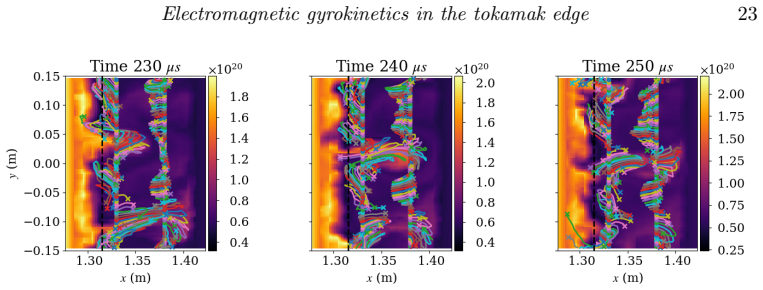
- The first nonlinear electromagnetic gyrokinetic simulation on open field lines shows that propagating blobs bend and stretch magnetic field lines and that sheath boundary conditions allow only partial line-tying.
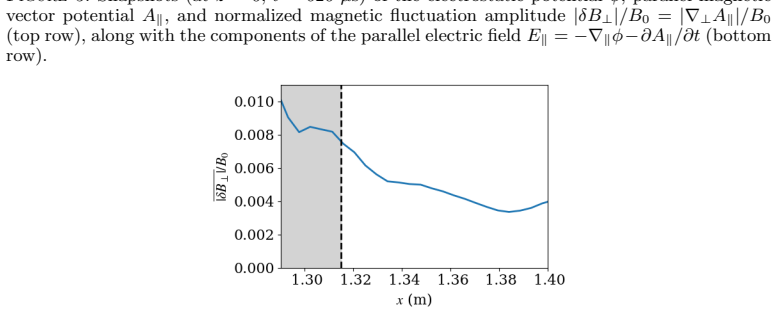
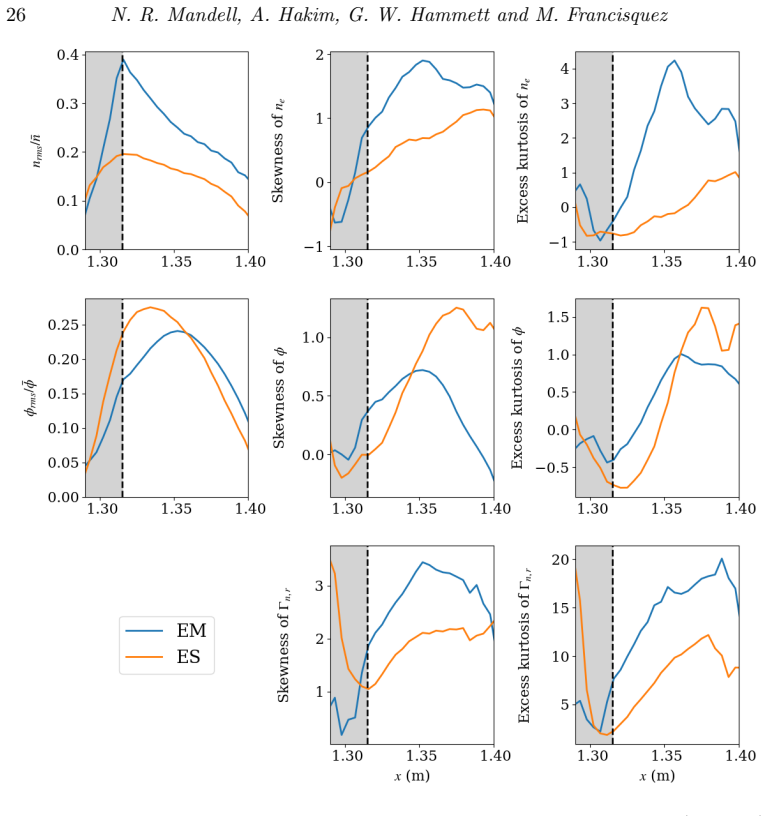
- Electromagnetic turbulence in the open-field-line model transports about 40% less radial particle flux than electrostatics, with shallower scrape-off-layer profiles and higher-amplitude, more intermittent density fluctuations.
- The discrete system conserves particle number and total energy in the continuous-time limit, so energy balance errors in future simulations can be attributed to time discretization, sources, and wall losses.
Reading between the lines
- The linearized-polarization assumption is structurally separate from the scheme: replacing $n_0$ by a time-dependent polarization density would test whether the reduced transport and enhanced intermittency are physics or approximation artifacts.
- The cancellation-free property depends on exact analytic integration of the discrete integrands; any future extension to non-orthogonal or sheared field-aligned coordinates must preserve that exactness, otherwise a residual $C_N - C_J$ term could reappear.
- Because the energy-conservation proof requires only continuity of the Hamiltonian, not of $A_\parallel$, the same splitting may scale to whole-device full-f modeling, combining this electromagnetic edge capability with core simulations once X-point and gyroaveraging extensions are added.
- The stronger intermittency and lower flux in the electromagnetic case imply a concrete, testable difference: blob sizes and propagation velocities in the scrape-off layer should differ measurably between electrostatic and electromagnetic regimes, both in higher-fidelity simulations and in experiments.
Signed reviews
Editorial analysis
A structured set of objections, weighed in public.
Referee Report
Summary. This paper presents a discontinuous Galerkin (DG) scheme for the full-f electromagnetic gyrokinetic system in the long-wavelength limit, using the symplectic (v_parallel) formulation and solving a generalized Ohm's law for dA_parallel/dt. The authors prove discrete particle and energy conservation (Propositions 1 and 2), give an explicit time-stepping algorithm, and argue that exact quadrature in their modal DG scheme avoids the Ampere cancellation problem. Linear benchmarks for the kinetic Alfven wave and the kinetic ballooning mode agree with analytic dispersion relations, including a case with beta_hat/(k_perp^2 rho_s^2) = 10^5. The paper then presents a nonlinear electromagnetic simulation in a helical open-field-line system with NSTX-like parameters, reports the first nonlinear electromagnetic gyrokinetic simulation on open field lines, and compares it with an electrostatic simulation, finding reduced transport and more intermittent density fluctuations in the electromagnetic case.
Significance. If the claims are substantiated, the paper is significant for gyrokinetic edge/SOL modeling: it offers a continuum scheme that addresses the Ampere cancellation problem and extends full-f gyrokinetic simulations to electromagnetic fluctuations on open field lines. Strengths include the explicit discrete conservation proofs for the idealized geometry and boundary conditions, the clean linear benchmarks including an extreme cancellation-stress case, the exact quadrature argument in Appendix C showing CN = CJ identically, and the modest computational cost of the nonlinear run. However, the central 'energy-conserving scheme' claim is not established for the geometry and boundary conditions of the headline nonlinear simulation, and the physical conclusions depend on a linearized polarization-density approximation whose validity in the SOL is acknowledged as questionable. These issues are load-bearing for the paper's strongest claims and should be addressed before publication.
major comments (2)
- [Section 3.1 footnote; Section 3.2; Section 6] The energy conservation theorem (Proposition 2) is not applicable to the nonlinear helical-geometry simulation. The footnote immediately after the continuity statement in Section 3.1 concedes that in a general non-orthogonal field-aligned geometry, B*·∇z contains A_parallel,h, which is discontinuous in z, so the characteristic speed dot_R_h·∇z is discontinuous across z cell interfaces and the surface terms in the energy proof do not vanish. The nonlinear run of Section 6 explicitly uses the non-orthogonal helical field-aligned coordinates described at the beginning of that section, and the scheme deliberately takes A_parallel,h discontinuous in z. In addition, Proposition 2 assumes periodic or zero-f boundary conditions, whereas the nonlinear run uses conducting-sheath boundary conditions in z. Therefore the 'energy-conserving scheme' claim is not established for the simulation presented as the paper's headline result. The authors state that non-orthogonal geometry will be addressed in a separate paper; to keep the claim in this paper, they should either extend the proof, or restrict the claim to geometries and boundary conditions it covers and provide a numerical energy-conservation diagnostic for the nonlinear run.
- [Section 2.1, Eqs. (2.11)-(2.12)] The quasi-neutrality equation uses a linearized polarization density with n0 constant in time, an approximation the authors acknowledge is questionable in the SOL where density fluctuations are large (text following Eq. 2.11). The nonlinear electromagnetic results in Figures 9-11 depend on the electrostatic potential through this equation, so the approximation is load-bearing for the physical conclusions about reduced transport and intermittency. The paper should either test the sensitivity of the conclusions to this assumption, for example by comparing with a nonlinear polarization model, or explicitly frame the transport and intermittency comparisons as conditional on the linearized-polarization approximation.
minor comments (4)
- [Section 1, first paragraph after the duplication] The sentence 'Meanwhile, some continuum δf core codes avoided the cancellation problem completely (Rewoldt et al. 1987; Kotschenreuther et al. 1995), while others had to address somewhat minor issues resulting from it (Jenko 2000; Candy & Waltz 2003).' appears twice verbatim in the Introduction; one copy should be removed.
- [Section 5.1, near Eq. (5.5)] In the kinetic Alfven wave benchmark the perpendicular dimensions are replaced by k_perp in the field equations, so the test does not exercise the two-dimensional FEM solve or the Pz smoothing operation. This is stated, but it would be helpful to note explicitly in Section 5.1 that the full perpendicular discretization is only tested in the KBM benchmark and the nonlinear run.
- [Section 3.2, proof of Proposition 2] In the sentence 'since ψ∈V_p^h and H_h∈V̅_p^h⊂V_p^h', the condition should presumably be that H_h lies in the continuous subspace V̅_p^h; the current notation 'V_p^h⊂V_p^h' appears to contain a typo and should be clarified.
- [Figure 2 and accompanying text] The caption and text state that the amplitude of E_parallel,h is approximately 10^-9 without giving units; adding units (or normalizing by a reference field) would improve interpretability.
Circularity Check
No circularity: energy conservation, cancellation avoidance, and benchmarks are independently demonstrated; however, the exact energy proof does not cover the non-orthogonal helical geometry of the nonlinear run, a scope gap the paper itself discloses.
full rationale
The paper's derivation chain does not reduce to its inputs. Proposition 2 proves discrete energy conservation by explicit computation of dWHh/dt, dWEh/dt and dWBh/dt (Eqs. 3.20-3.27), with the Hamiltonian-continuity requirement stated and used rather than assumed; the reference to Hakim et al. (2019) Proposition 3.2 is a template, and the proof is reproduced in the text. The cancellation-avoidance claim is supported by an analytic semi-discrete calculation in Appendix C: CN and CJ are defined in Eqs. (C.14)-(C.15) and equal by construction, which is exactly the mechanism being claimed, not a fitted result. Linear benchmarks are checked against independent analytic dispersion relations from Fried & Conte and Kim et al. (1993); the KBM comparison modifies the FLR terms in a disclosed way to match the long-wavelength model, but the simulation still must reproduce the resulting dispersion relation, so it is an external benchmark rather than a circular test. The nonlinear simulation is a demonstration and comparison, not a prediction generated by its own inputs. The manuscript flags a real scope gap: the footnote in Section 3.1 states that in a general non-orthogonal field-aligned geometry B*·∇z contains A∥h, which can be discontinuous in z, so the characteristic speed ˙Rh·∇z is discontinuous and the surface-term cancellation used in the energy proof no longer holds. Section 6's helical geometry is explicitly non-orthogonal, and the paper says this will be addressed separately. This is a limitation on the exact energy-conservation claim for the headline run, but it is not circularity: the proof does not assume its conclusion, and the limitation does not make any benchmark or prediction identical to an input. The constant-in-time linearized polarization density (Eqs. 2.11-2.12) is likewise an acknowledged physical approximation, not a fitted parameter disguised as a result. Overall score 2, reflecting only a minor, non-load-bearing self-citation to the group's earlier DG framework.
Assumptions & free parameters
free parameters (3)
- Source particle rate multiplier =
10x the source rate used in Shi et al. 2019
- Collision frequency multiplier =
0.1x physical value
- Source floor =
0.1x peak source rate
assumptions (6)
- domain assumption Long-wavelength (drift-kinetic) limit: gyroaveraging of the electrostatic potential is neglected and higher-order Hamiltonian terms are dropped.
- domain assumption Linearized polarization density n0 is constant in time.
- domain assumption The approximation b-hat dot (curl b-hat) approx 0, so B*_parallel approx B.
- domain assumption Neglect of parallel compressional magnetic perturbations: delta B = delta B_perp.
- domain assumption Discrete Hamiltonian continuity is required for energy conservation; the FEM solve plus Pz smoothing achieves this.
- ad hoc to paper For pv=1, the provisional dA_parallel/dt from Eq. (3.13) gives the correct upwind direction most of the time.
Cite this review
Pith. "Pith review of Electromagnetic full-$f$ gyrokinetics in the tokamak edge with discontinuous Galerkin methods." pith.science (2026). https://pith.science/paper/45QCCSFZ
@misc{pith2026190805653,
  author       = {Pith},
  title        = {Pith review of: Electromagnetic full-$f$ gyrokinetics in the tokamak edge with discontinuous Galerkin methods},
  year         = {2026},
  howpublished = {\url{https://pith.science/paper/45QCCSFZ}},
  note         = {Machine review of arXiv:1908.05653}
}
abstract
We present an energy-conserving discontinuous Galerkin scheme for the full-$f$ electromagnetic gyrokinetic system in the long-wavelength limit. We use the symplectic formulation and solve directly for $\partial A_\parallel/\partial t$, the inductive component of the parallel electric field, using a generalized Ohm's law derived directly from the gyrokinetic equation. Linear benchmarks are performed to verify the implementation and show that the scheme avoids the Amp\`ere cancellation problem. We perform a nonlinear electromagnetic simulation in a helical open-field-line system as a rough model of the tokamak scrape-off layer using parameters from the National Spherical Torus Experiment (NSTX). This is the first published nonlinear electromagnetic gyrokinetic simulation on open field lines. Comparisons are made to a corresponding electrostatic simulation.
Figures


Figures from the paper (8 more)




Reference graph
Works this paper leans on
-
[1]
, " * write output.state after.block = add.period write newline
ENTRY address author booktitle chapter edition editor howpublished institution journal key month note number organization pages publisher school series title type volume year eprint label extra.label sort.label short.list INTEGERS output.state before.all mid.sentence after.sentence after.block FUNCTION init.state.consts #0 'before.all := #1 'mid.sentence ...
-
[2]
write newline
" write newline "" before.all 'output.state := FUNCTION n.dashify 't := "" t empty not t #1 #1 substring "-" = t #1 #2 substring "--" = not "--" * t #2 global.max substring 't := t #1 #1 substring "-" = "-" * t #2 global.max substring 't := while if t #1 #1 substring * t #2 global.max substring 't := if while FUNCTION word.in bbl.in capitalize " " * FUNCT...
-
[3]
Arnold, D. N. & Awanou, G. 2011 The serendipity family of finite elements . Found. Comput. Math. 11 (3), 337--344
work page 2011
- [4]
-
[5]
Beer, M. A. , Cowley, S. C. & Hammett, G. W. 1995 Field--aligned coordinates for nonlinear simulations of tokamak turbulence . Phys. Plasmas 2 (7), 2687--2700
work page 1995
-
[6]
Bernard, T. N. , Shi, E. L. , Gentle, K. W. , Hakim, A. , Hammett, G. W. , Stoltzfus-Dueck, T. & Taylor, E. I. 2019 Gyrokinetic continuum simulations of plasma turbulence in the Texas Helimak . Phys. Plasmas 26 (4), 042301
work page 2019
-
[7]
Brizard, A. J. & Hahm, T. S. 2007 Foundations of nonlinear gyrokinetic theory . Rev. Mod. Phys. 79 , 421--468
work page 2007
-
[8]
Cagas, P. , Hakim, A. , Juno, J. & Srinivasan, B. 2017 Continuum kinetic and multi--fluid simulations of classical sheaths . Phys. Plasmas 24 (2), 022118
work page 2017
Show all 72 references
-
[9]
& Waltz, R
Candy, J. & Waltz, R. E. 2003 An Eulerian gyrokinetic-- Maxwell solver . J. Comput. Phys. 186 (2), 545--581
2003
-
[10]
& Chacon, L
Chen, G. & Chacon, L. 2015 A multi-dimensional, energy- and charge-conserving, nonlinearly implicit, electromagnetic Vlasov--Darwin particle-in-cell algorithm . Comp. Phys. Comm. 197 , 73--87
2015
-
[11]
& Parker, S
Chen, Y. & Parker, S. 2001 Gyrokinetic turbulence simulations with kinetic electrons . Phys. Plasmas 8 (5), 2095--2100
2001
-
[12]
& Parker, S
Chen, Y. & Parker, S. E. 2003 A f particle method for gyrokinetic simulations with kinetic electrons and electromagnetic perturbations . J. Comput. Phys. 189 (2), 463--475
2003
-
[13]
& Shu, C.-W
Cockburn, B. & Shu, C.-W. 1998 The Runge--Kutta discontinuous Galerkin method for conservation laws V : multidimensional systems . J. Comput. Phys. 141 (2), 199--224
1998
-
[14]
& Shu, C.-W
Cockburn, B. & Shu, C.-W. 2001 Runge--Kutta discontinuous Galerkin methods for convection--dominated problems . J. Sci. Comput. 16 (3), 173--261
2001
-
[15]
Cohen, R. H. & Xu, X. Q. 2008 Progress in kinetic simulation of edge plasmas . Contrib. Plasma Phys. 48 (1-3), 212--223
2008
-
[16]
Cummings, J. C. 1994 Gyrokinetic simulation of finite--beta and self--sheared--flow effects on pressure--gradient instabilities . PhD thesis, Princeton University
1994
-
[17]
Dimits, A. M. , Bateman, G , Beer, M. A. , Cohen, B. I. , Dorland, W. , Hammett, G. W. , Kim, C. , Kinsey, J. E. , Kotschenreuther, M. , Kritz, A. H. & Lao, L. L. 2000 Comparisons and physics basis of tokamak transport models and turbulence simulations . Phys. Plasmas 7 (3), 969--983
2000
-
[18]
Dorf, M. A. , Dorr, M. R. , Hittinger, J. A. , Cohen, R. H. & Rognlien, T. D. 2016 Continuum kinetic modeling of the tokamak plasma edge . Phys. Plasmas 23 (5), 056102
2016
-
[19]
, Jenko, F
Dorland, W. , Jenko, F. , Kotschenreuther, M. & Rogers, B. N. 2000 Electron temperature gradient turbulence . Phys. Rev. Lett. 85 (26), 5579
2000
-
[20]
Dougherty, J. P. 1964 Model Fokker--Planck equation for a plasma and its solution . Phys. Fluids 7 (11), 1788--1799
1964
-
[21]
Durran, D. R. 2010 Numerical methods for fluid dynamics: With applications to geophysics\/ . Springer Science & Business Media
2010
-
[22]
, Bernard, T
Francisquez, M. , Bernard, T. N. , Mandell, N. R. , Hammett, G. W. & Hakim, A. 2020 Conservative discontinuous Galerkin scheme of a simplified gyrokinetic Fokker--Planck operator. Manuscript in progress
2020
-
[23]
, Zhu, B
Francisquez, M. , Zhu, B. & Rogers, B. N. 2017 Global 3D Braginskii simulations of the tokamak edge region of IWL discharges . Nucl. Fusion 57 (11), 116049
2017
-
[24]
Fried, B. D. & Conte, S. D. 1961 The plasma dispersion function: the Hilbert transform of the Gaussian \/ . Academic Press
1961
-
[25]
, Shu, C.-W
Gottlieb, S. , Shu, C.-W. & Tadmor, E. 2001 Strong stability--preserving high--order time discretization methods . SIAM Rev. 43 (1), 89--112
2001
-
[26]
, Lang, J
Hager, R. , Lang, J. , Chang, C.-S. , Ku, S. , Chen, Y. , Parker, S. E. & Adams, M. F. 2017 Verification of long wavelength electromagnetic modes with a gyrokinetic--fluid hybrid model in the XGC code . Phys. Plasmas 24 (5), 054508
2017
-
[27]
Hahm, T. S. , Lee, W. W. & Brizard, A. 1988 Nonlinear gyrokinetic theory for finite--beta plasmas . Phys. Fluids 31 (7), 1940--1948
1988
-
[28]
, Hammett, G
Hakim, A. , Hammett, G. W. , Shi, E. L. & Mandell, N. R. 2019 Discontinuous Galerkin schemes for a class of Hamiltonian evolution equations with applications to plasma fluid and kinetic problems, arXiv:arXiv: 1908.01814
2019 arXiv
-
[29]
, K \"o nies, A
Hatzky, R. , K \"o nies, A. & Mishchenko, A. 2007 Electromagnetic gyrokinetic PIC simulation with an adjustable control variates method . J. Comput. Phys. 225 (1), 568--590
2007
-
[30]
, Ida, M
Idomura, Y. , Ida, M. , Kano, T. , Aiba, N. & Tokuda, S. 2008 Conservative global gyrokinetic toroidal full--f five-dimensional Vlasov simulation . Comp. Phys. Comm. 179 (6), 391--403
2008
-
[31]
, Tokuda, S
Idomura, Y. , Tokuda, S. & Kishimoto, Y. 2003 Global gyrokinetic simulation of ion temperature gradient driven turbulence in plasmas using a canonical Maxwellian distribution . Nucl. Fusion 43 (4), 234
2003
-
[32]
2000 Massively parallel Vlasov simulation of electromagnetic drift--wave turbulence
Jenko, F. 2000 Massively parallel Vlasov simulation of electromagnetic drift--wave turbulence . Comp. Phys. Comm. 125 (1-3), 196--209
2000
-
[33]
& Dorland, W
Jenko, F. & Dorland, W. 2001 Nonlinear electromagnetic gyrokinetic simulations of tokamak plasmas . Plasma Phys. Control. Fusion 43 (12A), A141
2001
-
[34]
, Bottino, A
Jolliet, S. , Bottino, A. , Angelino, P. , Hatzky, R. , Tran, T.-M. , Mcmillan, B. F. , Sauter, O. , Appert, K. , Idomura, Y. & Villard, L. 2007 A global collisionless PIC code in magnetic coordinates . Comp. Phys. Comm. 177 (5), 409--425
2007
-
[35]
, Tran, T
Jost, G. , Tran, T. M. , Cooper, W. A. , Villard, L. & Appert, K. 2001 Global linear gyrokinetic simulations in quasi--symmetric configurations . Phys. Plasmas 8 (7), 3321--3333
2001
-
[36]
, Hakim, A
Juno, J. , Hakim, A. , TenBarge, J. , Shi, E. & Dorland, W. 2018 Discontinuous Galerkin algorithms for fully kinetic plasmas . J. Comput. Phys. 353 , 110--147
2018
-
[37]
Kim, J. Y. , Horton, W. & Dong, J. Q. 1993 Electromagnetic effect on the toroidal ion temperature gradient mode . Phys. Fluids B 5 (11), 4030--4039
1993
-
[38]
, Gurchenko, A
Korpilo, T. , Gurchenko, A. D. , Gusakov, E. Z. , Heikkinen, J. A. , Janhunen, S. J. , Kiviniemi, T. P. , Leerink, S. , Niskala, P. & Perevalov, A. A. 2016 Gyrokinetic full--torus simulations of ohmic tokamak plasmas in circular limiter configuration . Comp. Phys. Comm. 203 , 128--137
2016
-
[39]
, Rewoldt, G
Kotschenreuther, M. , Rewoldt, G. & Tang, W. M. 1995 Comparison of initial value and eigenvalue codes for kinetic toroidal plasma instabilities . Comp. Phys. Comm. 88 (2-3), 128--140
1995
-
[40]
, Chang, C.-S
Ku, S. , Chang, C.-S. & Diamond, P. H. 2009 Full--f gyrokinetic particle simulation of centrally heated global ITG turbulence from magnetic axis to edge pedestal top in a realistic tokamak geometry . Nucl. Fusion 49 (11), 115021
2009
-
[41]
, Chang, C.-S
Ku, S. , Chang, C.-S. , Hager, R. , Churchill, R. M. , Tynan, G. R. , Cziegler, I. , Greenwald, M. , Hughes, J. , Parker, S. E. , Adams, M. F. & D'Azevedo, E. 2018 a\/ A fast low--to--high confinement mode bifurcation dynamics in the boundary-plasma gyrokinetic code XGC1 . Phy...
2018
-
[42]
, Hager, R
Ku, S. , Hager, R. , Chang, C.-S. , Kwon, J. M. & Parker, S. E. 2016 A new hybrid-- Lagrangian numerical scheme for gyrokinetic simulation of tokamak edge plasma . J. Comput. Phys. 315 , 467--475
2016
-
[43]
, Sturdevant, B
Ku, S.-H. , Sturdevant, B. , Hager, R. , Chang, C.-S. , Chacon, L. & Chen, G. 2018 b\/ Fully implicit particle--in--cell simulation of gyrokinetic electromagnetic modes in XGC1 without the cancellation issue. In APS Meeting Abstracts\/
2018
-
[44]
Kunkel, W. B. & Guillory, J. U. 1966 Interchange stabilization by incomplete line-tying. In Phenomena in Ionized Gases, Volume II, VII International Conference\/ , p. 702
1966
-
[45]
, Ohana, N
Lanti, E. , Ohana, N. , Tronko, N. , Hayward-Schneider, T. , Bottino, A. , McMillan, B. F. , Mishchenko, A. , Scheinberg, A. , Biancalani, A. , Angelino, P. & Brunner, S. 2019 ORB5 : a global electromagnetic gyrokinetic code using the PIC approach in toroidal geometry . Comput...
2019
-
[46]
Lee, W. W. 1987 Gyrokinetic particle simulation model . J. Comput. Phys. 72 (1), 243--269
1987
-
[47]
& Bernstein, I
Lenard, A. & Bernstein, I. B. 1958 Plasma oscillations with diffusion in velocity space . Phys. Rev. 112 (5), 1456
1958
-
[48]
, Hahm, T
Lin, Z. , Hahm, T. S. , Lee, W. W. , Tang, W. M. & White, R. B. 2000 Gyrokinetic simulations in general geometry and applications to collisional damping of zonal flows . Phys. Plasmas 7 (5), 1857--1862
2000
-
[49]
& Shu, C.-W
Liu, J.-G. & Shu, C.-W. 2000 A high--order discontinuous Galerkin method for 2D incompressible flows . J. Comput. Phys. 160 (2), 577--596
2000
-
[50]
, Hatzky, R
Mishchenko, A. , Hatzky, R. & K \"o nies, A. 2004 Conventional f--particle simulations of electromagnetic perturbations with finite elements . Phys. Plasmas 11 (12), 5480--5486
2004
-
[51]
, K \"o nies, A
Mishchenko, A. , K \"o nies, A. , Kleiber, R. & Cole, M. 2014 Pullback transformation in gyrokinetic electromagnetic simulations . Phys. Plasmas 21 (9), 092110
2014
-
[52]
, Told, D
Pan, Q. , Told, D. , Shi, E. L. , Hammett, G. W. & Jenko, F. 2018 Full--f version of GENE for turbulence in open--field--line systems . Phys. Plasmas 25 (6), 062303
2018
-
[53]
Parker, S. E. , Lee, W. W. & Santoro, R. A. 1993 a\/ Gyrokinetic simulation of ion temperature gradient driven turbulence in 3D toroidal geometry . Phys. Rev. Lett. 71 (13), 2042
1993
-
[54]
Parker, S. E. , Procassini, R. J. , Birdsall, C. K. & Cohen, B. I. 1993 b\/ A suitable boundary condition for bounded plasma simulation without sheath resolution . Journal of Computational Physics 104 (1), 41--49
1993
-
[55]
Peeters, A. G. , Camenen, Y. , Casson, F. J. , Hornsby, W. A. , Snodin, A. P. , Strintzi, D. & Szepesi, G. 2009 The nonlinear gyro--kinetic flux tube code GKW . Comp. Phys. Comm. 180 (12), 2650--2672
2009
-
[56]
, Tang, W
Rewoldt, G. , Tang, W. M. & Hastie, R. J. 1987 Collisional effects on kinetic electromagnetic modes and associated quasilinear transport . Phys. Fluids 30 (3), 807--817
1987
-
[57]
Reynders, J. V. W. 1993 Gyrokinetic simulation of finite--beta plasmas on parallel architectures . PhD thesis, Princeton University
1993
-
[58]
, Halpern, F
Ricci, P. , Halpern, F. D. , Jolliet, S. , Loizu, J. , Mosetto, A. , Fasoli, A. , Furno, I. & Theiler, C. 2012 Simulation of plasma turbulence in scrape--off layer conditions: the GBS code, simulation results and code validation . Plasma Phys. Control. Fusion 54 (12), 124047
2012
-
[59]
Ryutov, D. D. 2006 The dynamics of an isolated plasma filament at the edge of a toroidal device . Phys. Plasmas 13 (12), 122307
2006
-
[60]
1997 Three--dimensional computation of drift Alfv \'e n turbulence
Scott, B. 1997 Three--dimensional computation of drift Alfv \'e n turbulence . Plasma Phys. Control. Fusion 39 (10), 1635
1997
-
[61]
Shi, E. L. 2017 Gyrokinetic continuum simulation of turbulence in open--field--line plasmas . PhD thesis, Princeton University
2017
-
[62]
Shi, E. L. , Hammett, G. W. , Stoltzfus-Dueck, T. & Hakim, A. 2017 Gyrokinetic continuum simulation of turbulence in a straight open--field--line plasma . J. Plasma Phys. 83 (3), 905830304
2017
-
[63]
Shi, E. L. , Hammett, G. W. , Stoltzfus-Dueck, T. & Hakim, A. 2019 Full--f gyrokinetic simulation of turbulence in a helical open--field--line plasma . Phys. Plasmas 26 (1), 012307
2019
-
[64]
2002 A survey of strong stability preserving high order time discretizations
Shu, C.-W. 2002 A survey of strong stability preserving high order time discretizations . In Collected lectures on the preservation of stability under discretization\/ , pp. 51--65 . SIAM Philadelphia, PA
2002
-
[65]
2009 Discontinuous Galerkin methods: general approach and stability
Shu, C.-W. 2009 Discontinuous Galerkin methods: general approach and stability . In Numerical solutions of partial differential equations\/ (ed. G. Russo C.-W. Shu S. Bertoluzza, S. Falletta ) , pp. 149--195 . Birkh \"a user Basel
2009
-
[66]
Startsev, E. A. & Lee, W. W. 2014 Finite-- simulation of microinstabilities . Phys. Plasmas 21 (2), 022505
2014
-
[67]
, Ghendrih, P
Tamain, P. , Ghendrih, P. , Tsitrone, E. , Grandgirard, V. , Garbet, X. , Sarazin, Y. , Serre, E. , Ciraolo, G. & Chiavassa, G. 2010 TOKAM-3D: A 3D fluid code for transport and turbulence in the edge plasma of tokamaks . J. Comput. Phys. 229 (2), 361--378
2010
-
[68]
, Hakim, A
Wang, L. , Hakim, A. H. , Bhattacharjee, A. & Germaschewski, K. 2015 Comparison of multi--fluid moment models with particle--in--cell simulations of collisionless magnetic reconnection . Phys. Plasmas 22 (1), 012108
2015
-
[69]
& Sugama, H
Watanabe, T.-H. & Sugama, H. 2005 Velocity--space structures of distribution function in toroidal ion temperature gradient turbulence . Nucl. Fusion 46 (1), 24
2005
-
[70]
Xu, G. S. , Naulin, V. , Fundamenski, W. , Rasmussen, J. J. , Nielsen, A. H. & Wan, B. N. 2010 Intermittent convective transport carried by propagating electromagnetic filamentary structures in nonuniformly magnetized plasma . Phys. Plasmas 17 (2), 022501
2010
-
[71]
, Umansky, M
Xu, X. , Umansky, M. , Dudson, B. & Snyder, P. 2008 Boundary plasma turbulence simulations for tokamaks . Comm. in Comput. Phys 4 (5), 949--979
2008
-
[72]
, Francisquez, M
Zhu, B. , Francisquez, M. & Rogers, B. N. 2017 Global 3D two--fluid simulations of the tokamak edge region: Turbulence, transport, profile evolution, and spontaneous e b rotation . Phys. Plasmas 24 (5), 055903
2017
Reviewed August 14, 2026 · model on record in the stance chip above.
Discussion (0). Continue with ORCID to comment.