REVIEW 3 major objections 5 minor 2 references
CLOTHO: Directed Test Generation for Weakly Consistent Database Systems
T0 review · 3 major / 5 minor · reviewed 2026-08-14 · deepseek-v4-flash
Pith's one-line read CLOTHO automatically generates tests that expose serializability anomalies in Java applications on weakly consistent databases.
desk verdict Solid end-to-end tool for detecting and replaying serializability anomalies on weakly consistent DBs, but the completeness claim needs a proof or a softening. read the letter →
The pith
A machine-rendered reading of the paper's core claim, the machinery that carries it, and where it could break.
The reading
What carries the argument
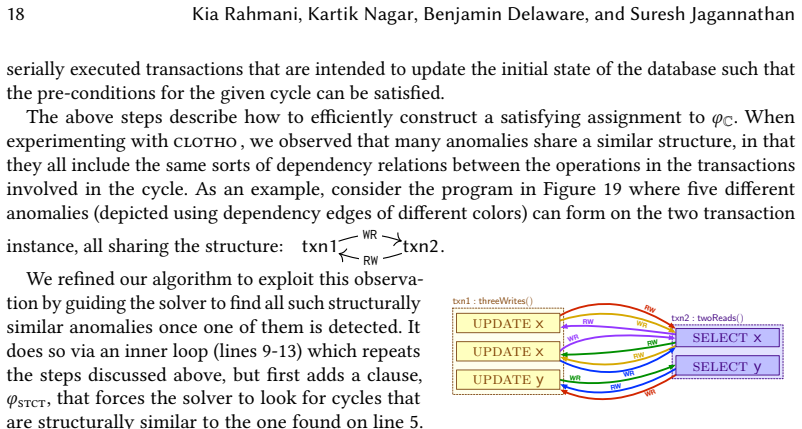
The load-bearing object is the dependency graph over query instances in an abstract execution, whose cycle is the anomaly. Edges are WR (a query reads a value another wrote), WW (one write overwrites another), RW (a read is later overwritten), and ST (same transaction); serializability holds exactly when this graph is acyclic. CLOTHO parameterizes the graph with weak-consistency constraints expressed as axioms on arbitration and visibility, encodes the existence of a cycle of length at most maxc among at most maxt concurrent transactions after at most maxp serial transactions as a satisfiability query, and feeds it to an off-the-shelf SMT solver. The satisfying assignment fixes record values, transaction parameters, partitions, and arbitration order, which the front-end compiler and test administrator turn into replayable schedules with induced network partitions.
What would settle it
Run CLOTHO with small bounds on a curated program whose only anomaly requires a dependency cycle longer than the configured maximum; if it reports no anomaly, the bounded decomposition assumption is violated. Alternatively, exhaustively enumerate all interleavings of a small program under a weak-consistency simulator and compare the anomaly set with CLOTHO's output for the same bounds, since any missing anomaly would refute the in-bounds completeness claim.
Extended reading notes
Core claim
On its own terms, the paper's discovery is that serializability anomalies in database-backed programs can be detected and concretely manifested by reducing them to bounded dependency cycles in abstract executions. CLOTHO models each transaction as queries over an abstract representation with read and write effects and two relations, arbitration and visibility; consistency guarantees are first-order logic constraints on these relations. A history is serializable exactly when the dependency graph of its final state is acyclic, so an anomaly is a cycle built from read-write, write-write, read-anti-dependency, and same-transaction edges. CLOTHO searches for independent anomalies, a serial prefix plus a small concurrent non-serializable core, by querying an SMT solver, then translates satisfying assignments into concrete tests. The paper reports that on industry-standard benchmarks these tests automatically replayed over 80 percent of detected anomalies on a real weakly consistent datastore, and that every consistency requirement in the TPC-C specification is broken by at least one detected anomaly, while a tuned random testing tool violated only 14 of 21 requirements.
Load-bearing premise
Every serializability anomaly can be decomposed into a serial execution prefix followed by a shorter non-serializable core with at most the user-chosen number of concurrent transactions and dependency-cycle length; the paper states this decomposition as an observation in Section 4.1, without proof, so anomalies requiring an unbounded tail could be missed despite the completeness claim.
Editorial extensions
If this is right
- Within the user-supplied bounds (serial prefix size, concurrent transaction count, and cycle length), the search is complete: no bounded serializability anomaly is missed.
- Every abstract anomaly comes with concrete replay data, and the paper shows automatic replay worked for over 80 percent of detected anomalies on a real weakly consistent datastore, with manual edits covering the rest.
- Because the consistency specification is a parameter, the same detector can be re-targeted to different weak consistency guarantees by swapping the database constraints.
- Focusing on internal serializability anomalies filters out executions whose final state is still reachable by some serializable execution, leaving developers with anomalies that diverge the database state.
- On the TPC-C benchmark, length-4 anomaly cycles already cover all twelve specification invariants, so the bounded search is practically relevant for standard OLTP workloads.
Reading between the lines
- A consequence the paper leaves implicit is that the practical guarantee is bug-finding within bounds, not full validation; users should size the cycle and prefix bounds to the anomaly classes they care about.
- The internal-versus-external distinction could serve as a triage rule in other concurrency bug detectors: ignore cycles whose read effects do not influence later writes unless final-state divergence is the target.
- One could run the same pipeline under several consistency specifications on a single application to see which anomalies disappear as the model is strengthened; the paper does not report such a comparison.
- The replay cases that required manual edits suggest that operation-level scheduling and row-order effects sit at the edge of the encoding, so extending the front end to those cases is a natural next step.
Signed reviews
Editorial analysis
A structured set of objections, weighed in public.
Referee Report
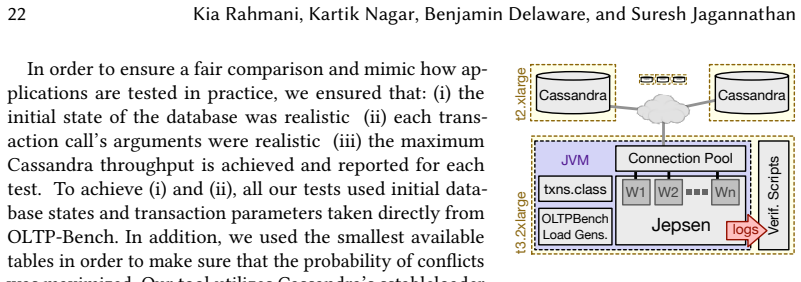
Summary. The paper describes CLOTHO, a testing framework that statically searches for serializability anomalies in database-backed Java applications intended to run on weakly consistent replicated stores, and then automatically replays the discovered anomalies on concrete database systems such as Cassandra. The approach compiles Java/JDBC programs into an abstract representation (AR), encodes bounded searches for dependency cycles as first-order logic formulas, uses an SMT solver to enumerate cycles, and generates test configurations (transaction parameters, schedules, partitions, initial database state) that are executed by a Docker-based replay environment. The evaluation on OLTP-Bench applications reports anomalies in five of seven benchmarks, automatic replay of over 80 percent of detected anomalies on Cassandra, and a comparison with a Jepsen-based random testing framework on the TPC-C benchmark.
Significance. If its claims hold, CLOTHO is a valuable end-to-end tool: it connects a static bounded search for serializability anomalies to concrete, replayable executions on real weakly consistent database systems. The paper's main practical contribution is the full pipeline, including the front-end compiler, the SMT encoding, and the test administration framework, and the experiments credibly show that the tool can find and manifest real anomalies in several established benchmarks. The machine-generated test configurations and the openly available tool are also strengths. However, the paper's strongest theoretical claim, namely the bounded-completeness guarantee stated in Section 8, is not supported by the material in Sections 4 and 5. In addition, the random-testing comparison in Section 7.2 partly relies on invariants that were defined after examining CLOTHO's own output, which weakens the claimed empirical advantage over undirected testing.
major comments (3)
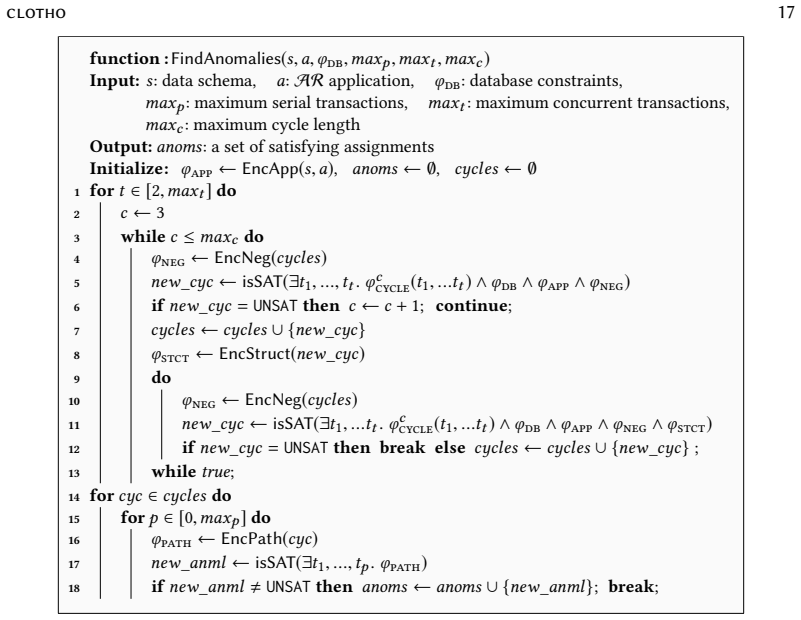
- [§4.1, Eq. (1), Algorithm 1 (Fig. 18)] The bounded-completeness claim depends on an unproved structural assumption. Section 4.1 states that any execution history containing a serializability anomaly can be decomposed into a serial execution history followed by a smaller non-serializable history, and the search shape in Eq. (1) is restricted to i serially executed transactions followed by j concurrent transactions whose queries form a single dependency cycle of length k. Algorithm 1 at lines 14-18 builds anomalies only in this shape. No proof is given that every anomalous history, within the stated bounds, has such a normal form. In particular, a history in which setup transactions must be interleaved with the transactions forming the cycle, or a history whose minimal dependency cycle uses more than maxc query nodes, is invisible to the search. The claim in Section 8 that 'no anomaly within the given bounds is missed' is therefore unsupported. Please either prove the decomposition for the AR semantics, or restate the completeness claim as applying only to the serial-prefix-plus-single-cycle shape.
- [§5, Eq. (1)] The paper does not state or prove a correctness theorem relating satisfiability of the formula φC to the existence of an anomalous execution in the operational semantics of Section 3. The text says the formula 'is designed such that' a satisfying assignment can be used to reconstruct an anomalous execution, but the required equivalence is not formalized. In particular, the direction that every bounded anomaly is represented by some satisfying assignment is exactly what the completeness discussion in Section 8 relies on, yet no such theorem appears, and the reference to the extended version [Rahmani et al. 2019] is not a substitute in the submitted manuscript. A precise theorem and proof, or an explicit retreat to an empirical claim, are needed.
- [§7.2, Table 3] The comparison with random testing is partly circular. The ncr1-ncr7 invariants are described as having been 'identified after examining the serializability anomalies generated by clotho' (Section 7.2). Using invariants derived from CLOTHO's own output as the yardstick for random testing means the random tester is asked to rediscover the specific anomalies CLOTHO was designed to find; its failure to violate those invariants does not establish that CLOTHO is generally more effective at finding real bugs. The non-circular part of the comparison is the twelve official TPC-C consistency requirements, and the paper should report the random-testing results on those requirements separately, or define the ncr invariants before running either tool.
minor comments (5)
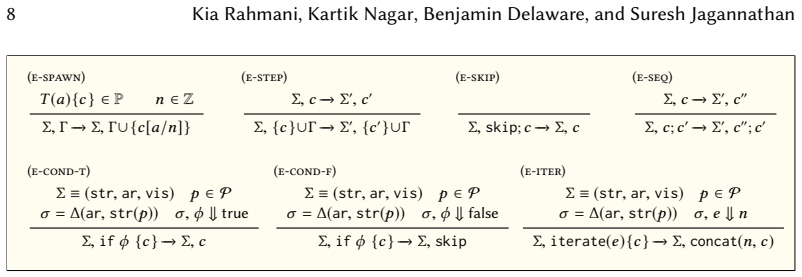
- [§3.2 and Fig. 7] The system state tuple is described as (str, ar, vis) in the text, but several reduction rules write (str, vis, ar); please make the notation consistent.
- [§7.1, Table 2] The 80 percent automatic replay claim is not directly visible in Table 2; the table would be easier to interpret if it included the total number of anomalies and the auto-replay percentage, or if the percentage were derived explicitly from the Auto Replay and Man. Replay columns.
- [§4.2] The distinction between external and internal serializability is introduced through examples, but the rd+ notion of 'unused read effects' is defined only informally. A formal characterization of when a read effect does not affect control flow or later writes would make the default filtering decision reproducible.
- [Global] There are several typos and small infelicities: 'representaiton' in the Fig. 5 caption, 'serializabilty' in the Section 4 heading, 'Jepson' for 'Jepsen' in Section 7.2, and 'unserializable' where 'non-serializable' is used elsewhere.
- [§7.1] For the non-automatic replays, the paper reports that manual intervention consists of specifying loop boundaries and fixing the row insertion order. Since these are encoding-level mismatches, a brief discussion of whether they also affect the completeness or soundness of the static search would help the reader assess the practical impact.
Circularity Check
Core serializability criterion is independent; mild evaluation circularity in ncr-based random-testing comparison.
-
other
[Section 7.2 ('Comparison with Random Testing'), Table 3 and preceding paragraph.]
"In addition to crs, we identified seven new consistency requirements (ncr1-ncr7) that should also be preserved by any serializable execution of TPC-C. We identified these invariants after examining the serializability anomalies generated by clotho."
The ncr1-ncr7 invariants used as the oracle for the random-testing comparison were selected after inspecting CLOTHO's own anomaly outputs. Random testing is then scored against these invariants ('our random testing framework was only able to violate 14 out of 21 (67%) requirements'), so the comparison metric is, in part, derived from the tool under test. This makes the conclusion that CLOTHO is more reliable than random testing partly an artifact of evaluation design rather than an independent measure. The central anomaly-detection criterion itself is not affected: it rests on the external Adya dependency-cycle characterization, not on the ncr invariants.
full rationale
CLOTHO's central detection machinery is not circular: serializability is reduced to dependency cycles via Adya et al. [2000], an external criterion; the FOL encoding and search algorithm are evaluated by replaying anomalies on Cassandra, an external benchmark; and the strength of the approach does not depend on a self-citation chain. The self-citations to the extended version [Rahmani et al. 2019] and to [Nagar and Jagannathan 2018] provide additional details/prior technique but are not used as a uniqueness theorem or as the sole justification of the main result. The main caveat is Section 4.1's observation that anomalous histories decompose into a serial prefix plus a smaller non-serializable history; this is asserted without proof and is load-bearing for the bounded-completeness claim in Section 8 ('no anomaly within the given bounds is missed'). That is a soundness/completeness risk, not an input-output circularity, so it does not raise the circularity score. The only true circular element is the choice of ncr1-ncr7 for the random-testing comparison, giving a modest score of 2.
Assumptions & free parameters
free parameters (1)
- maxc (maximum dependency cycle length) =
4
assumptions (4)
- domain assumption An execution is serializable iff its dependency graph is acyclic
- ad hoc to paper Every serializability anomaly can be decomposed into a serial execution history followed by a non-serializable history
- domain assumption Weak consistency guarantees can be specified as first-order constraints over visibility and arbitration relations
- domain assumption Read effects that do not affect control flow or later writes are benign (rd+)
invented entities (1)
-
rd+ (unused read effects)
Cite this review
Pith. "Pith review of CLOTHO: Directed Test Generation for Weakly Consistent Database Systems." pith.science (2026). https://pith.science/paper/JJLKWR2N
@misc{pith2026190805655,
  author       = {Pith},
  title        = {Pith review of: CLOTHO: Directed Test Generation for Weakly Consistent Database Systems},
  year         = {2026},
  howpublished = {\url{https://pith.science/paper/JJLKWR2N}},
  note         = {Machine review of arXiv:1908.05655}
}
read the original abstract
Relational database applications are notoriously difficult to test and debug. Concurrent execution of database transactions may violate complex structural invariants that constraint how changes to the contents of one (shared) table affect the contents of another. Simplifying the underlying concurrency model is one way to ameliorate the difficulty of understanding how concurrent accesses and updates can affect database state with respect to these sophisticated properties. Enforcing serializable execution of all transactions achieves this simplification, but it comes at a significant price in performance, especially at scale, where database state is often replicated to improve latency and availability. To address these challenges, this paper presents a novel testing framework for detecting serializability violations in (SQL) database-backed Java applications executing on weakly-consistent storage systems. We manifest our approach in a tool named CLOTHO, that combines a static analyzer and a model checker to generate abstract executions, discover serializability violations in these executions, and translate them back into concrete test inputs suitable for deployment in a test environment. To the best of our knowledge, CLOTHO is the first automated test generation facility for identifying serializability anomalies of Java applications intended to operate in geo-replicated distributed environments. An experimental evaluation on a set of industry-standard benchmarks demonstrates the utility of our approach.
Figures
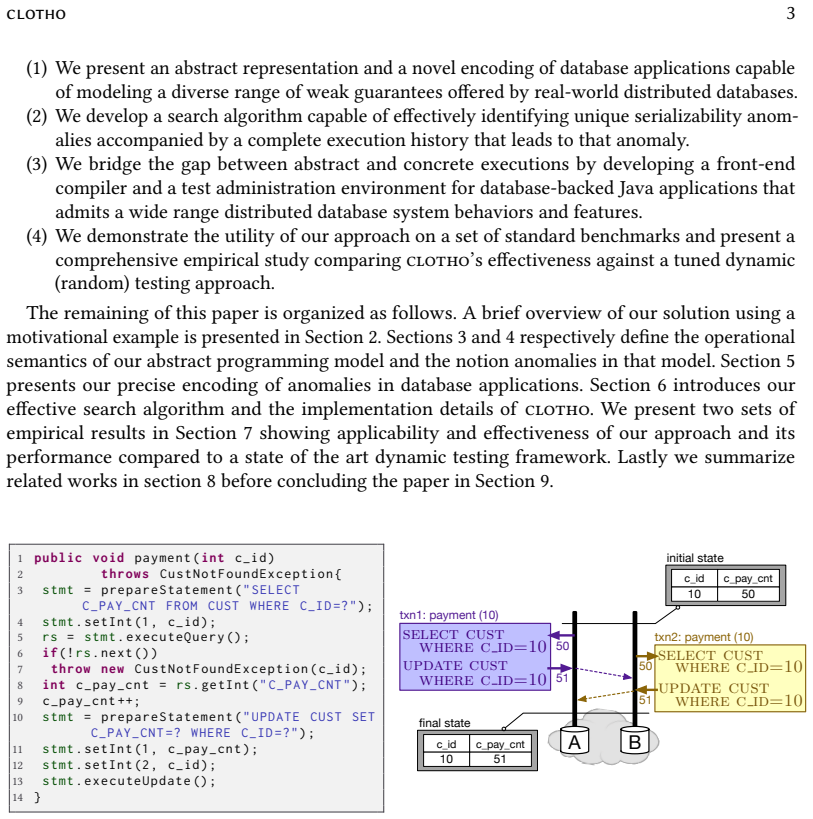


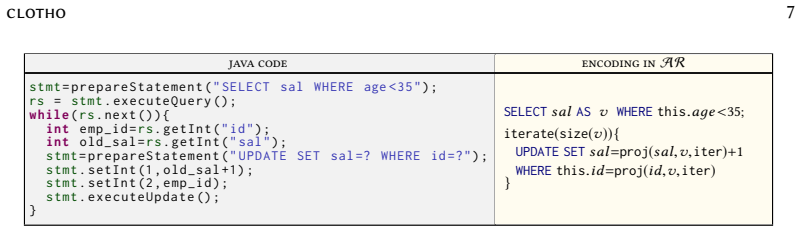
Figures from the paper (18 more)




Reference graph
Works this paper leans on
-
[2010]
http://www.tpc.org/tpc_documents_current_versions/pdf/tpc-c_v5.11.0.pdf
TPC-C Benchmark. http://www.tpc.org/tpc_documents_current_versions/pdf/tpc-c_v5.11.0.pdf. Online; Accessed 20 April 2018. Atul Adya. 1999. Weak Consistency: A Generalized Theory and Optimistic Implementations for Distributed Transactions . Ph.D. Dissertation. Cambridge, MA, USA. AAI0800775. Atul Adya, Barbara Liskov, and Patrick E. O’Neil. 2000. Generaliz...
-
[2015]
https://doi.org/10.4230/LIPIcs.CONCUR.2015.58 Andrea Cerone and Alexey Gotsman
58–71. https://doi.org/10.4230/LIPIcs.CONCUR.2015.58 Andrea Cerone and Alexey Gotsman. 2016. Analysing Snapshot Isolation. In Proceedings of the 2016 ACM Symposium on Principles of Distributed Computing, PODC 2016, Chicago, IL, USA, July 25-28, 2016 . 55–64. https://doi.org/10.1145/2933057. 2933096 Andrea Cerone, Alexey Gotsman, and Hongseok Yang. 2017. A...
arXiv 2005
Reviewed August 14, 2026 · model on record in the stance chip above.
Discussion (0). Continue with ORCID to comment.