REVIEW 4 major objections 5 minor 72 references
Progressive Cross-camera Soft-label Learning for Semi-supervised Person Re-identification
T0 review · 4 major / 5 minor · reviewed 2026-08-14 · deepseek-v4-flash
Pith's one-line read The paper claims that a semi-supervised person re-identification network can generate its own cross-camera supervision from a person-level affinity matrix and nearly match fully supervised methods using only within-camera labels.
desk verdict A solid, honest semi-supervised Re-ID paper for the intra-camera-label setting; the near-supervised claim only holds on Market1501 against dated baselines, but the method is a real contribution despite a couple of reproducibility gaps. read the letter →
The pith
A machine-rendered reading of the paper's core claim, the machinery that carries it, and where it could break.
The reading
What carries the argument
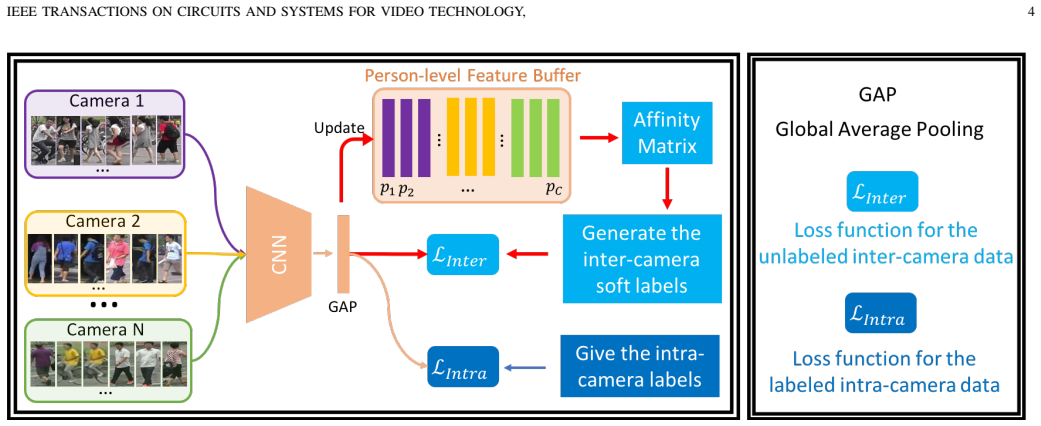
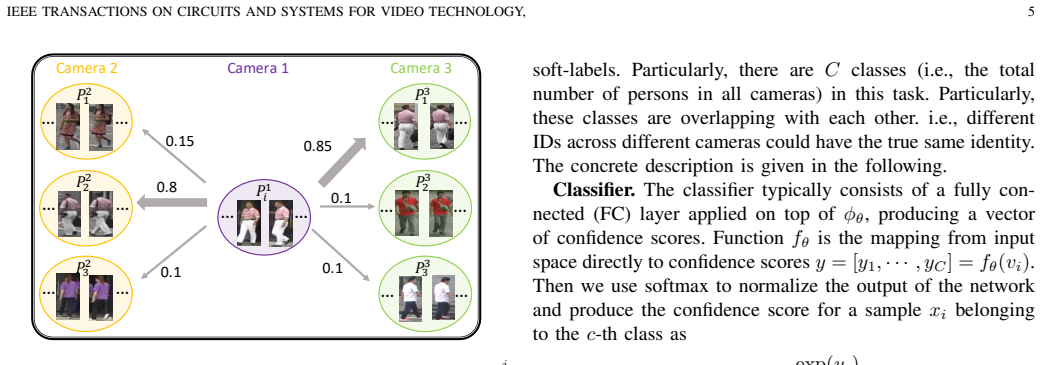
The central object is the person-level affinity matrix of Eq. (4), built from a running buffer of person-level features updated by Eq. (3). A Gaussian kernel scores cross-camera person pairs, same-camera pairs are set to zero, and each person keeps only its $k$ nearest neighbors, so each row of the matrix is a soft distribution over candidate identities in other cameras. The framework converts these soft-labels into gradients through the weighted cross-entropy loss (Eq. (8)) and the weighted triplet loss (Eq. (9)), and it alternates between updating the network and refreshing the affinity matrix (Algorithm 1), which is what makes the soft-labels progressive.
What would settle it
Run PCSL on Market1501 with the same pipeline but replace each person's $k$ nearest cross-camera neighbors in the affinity matrix with $k$ randomly selected cross-camera persons, keeping every other setting fixed. If mAP stays near the reported 69.4, the soft-label signal is not what carries the method; if it falls toward the intra-camera-only baseline of 34.4, the nearest-neighbor assumption is doing the work.
Extended reading notes
Core claim
On its own terms, the central claim is that cross-camera identity relationships can be recovered without labels and then used as training signal. The cross-camera soft-label for each person is a row of an affinity matrix $A$ with entries $a_{i,j}=\exp(-\|p_i-p_j\|_2^2/\sigma^2)$ when persons $i$ and $j$ are from different cameras and $p_i$ is among $p_j$'s $k$ nearest neighbors, and zero otherwise. These soft-labels feed two losses: a weighted cross-entropy loss $L_{WC}$ that treats each cross-camera class with weight proportional to its affinity, and a weighted triplet loss $L_{WT}$ that pulls an anchor toward randomly selected positive cross-camera neighbors and pushes it away from the hardest same-camera negative. The positive loop runs by refreshing the person-feature buffer each iteration and recomputing the affinity matrix each epoch. The paper reports PCSL-C at 69.4 mAP / 87.0 Rank-1 on Market1501 against 69.0 / 86.5 for the supervised A3M, with consistent gains on DukeMTMC-reID, MSMT17, MARS and DukeMTMC-SI-Tracklet.
Load-bearing premise
The method assumes that the $k$ nearest cross-camera persons in the current feature space are usually the true same identity, and that training on those soft-labels improves the model more than it locks in mistakes.
Editorial extensions
If this is right
- A deployment on a new camera network needs only within-camera identities, obtainable by tracking, to reach near-supervised re-identification accuracy.
- Because the method does not use labeled source domains or GAN-generated images, it removes those data-generation costs from the training pipeline.
- The framework accepts both classification-style and metric-learning-style losses on the same soft-labels, and the better choice depends on the dataset: classification works best on Market1501, MSMT17 and MARS, while the triplet variant works best on the Duke datasets.
- The affinity matrix quality rises during training, so final accuracy is coupled to continued improvement of the soft-labels rather than to a fixed initial guess.
- The same person-level buffer and soft-label machinery transfers from image datasets to video tracklet datasets, giving one recipe for both modalities.
Reading between the lines
- Beyond the paper, the affinity matrix's confidence (for example, its entropy or precision@$k$) could be used as a gate for when to start trusting cross-camera soft-labels, adding an error-correction mechanism the paper does not provide.
- Not claimed by the paper: the framework suggests a fully unsupervised extension in which intra-camera identities are first inferred by tracking or clustering and then the same progressive loop runs; the paper's robustness experiments hint that single-camera-only identities are handled gracefully, but this is an extrapolation.
- The complementary behavior of the two losses is a testable basis for selecting the loss adaptively per epoch or per dataset difficulty, rather than fixing one variant in advance.
- If the $k$-nearest-neighbor assumption is the true engine, then improving the affinity matrix itself (for example, replacing the global mean-based $\sigma^2$ with local density estimates) should transfer directly into re-identification accuracy.
Signed reviews
Editorial analysis
A structured set of objections, weighed in public.
Referee Report
Summary. The paper proposes PCSL, a progressive cross-camera soft-label learning framework for semi-supervised person re-identification, where only within-camera identity labels are available. A person-level feature buffer is maintained and an affinity matrix over cross-camera person pairs is computed via a Gaussian kernel on the buffer features (Eq. (4)); the resulting row-normalized weights are used as soft labels in either a weighted cross-entropy loss (Eq. (8)) or a weighted triplet loss (Eq. (9)). The two stages are alternated so that soft labels and features are progressively refined. Experiments are reported on Market1501, DukeMTMC-reID, MSMT17, MARS, and DukeMTMC-SI-Tracklet, with large gains over unsupervised baselines and competitive performance with supervised methods on Market1501 (PCSL-C at 69.4 mAP versus A3M at 69.0 mAP).
Significance. If the results hold, the paper provides a practically important result: near-supervised person re-identification performance can be achieved without cross-camera identity labels, which are the most expensive annotations to collect. The empirical basis is unusually broad for this area, with five benchmarks, comparisons to a large set of unsupervised, semi-supervised, and supervised methods, component ablations, parameter sensitivity curves, and carefully constructed robustness experiments. The paper is also honest about the potential noise in its soft labels. However, the main claims are weakened by reproducibility issues (the affinity construction is underspecified), by hyperparameter selection on the evaluation datasets themselves, and by the absence of error bars on the headline numbers. These are load-bearing because the central claim is a numerical performance claim stated to within a few tenths of a point, and because the near-supervised result depends on a self-training loop without an explicit error-correction mechanism.
major comments (4)
- [III-C, Eq. (4)] The definition of the affinity matrix is circular as written. Eq. (4) defines each element a_ij using sigma^2, and the text immediately states that sigma^2 is set as the mean value of all elements in the affinity matrix A. Since A itself depends on sigma^2, the construction is not well posed. Please specify the exact computation: for example, compute sigma^2 from the raw pairwise distances before constructing A, or define a fixed-point iteration and state how it is initialized and how many iterations are used. Without this clarification, Eq. (4) cannot be reproduced from the paper.
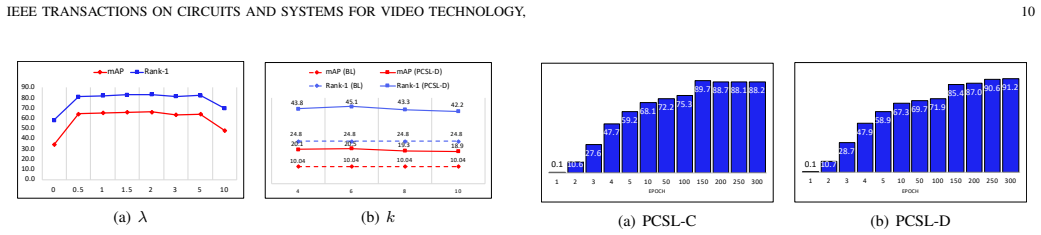
- [IV-A and IV-F, Fig. 5] The main hyperparameters lambda and k are tuned on evaluation datasets that are also used for the headline results. Fig. 5(a) selects lambda on Market1501 and Fig. 5(b) selects k on MSMT17, after which the authors set lambda=1 and k=6 for all other datasets. This makes the reported improvements over baselines not fully independent, and it is especially concerning for small margins such as the 69.4 versus 69.0 mAP comparison with A3M in Table V. Please use a held-out validation split for hyperparameter selection, or report the full performance range across lambda and k on all datasets, and provide repeated-run statistics for the main tables.
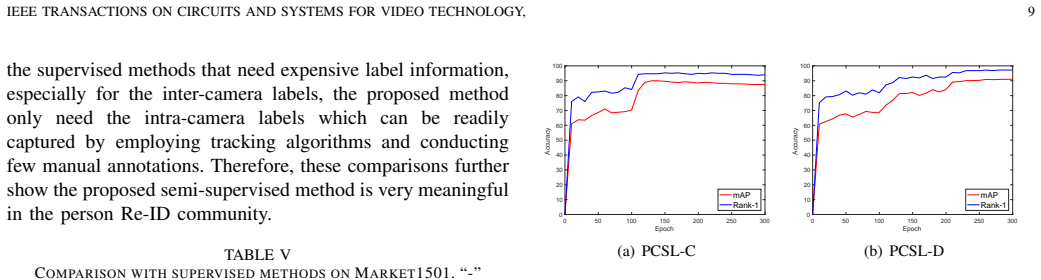
- [IV-F, Fig. 6 and Table X discussion] The progressive loop has no explicit error-correction mechanism, and the authors themselves note in the discussion of Table X that the selected positive samples may be true negatives. The empirical affinity-quality curves in Fig. 6 are a useful safeguard, but they are only reported on Market1501 and they measure overall rank-1/mAP of the affinity matrix rather than the precision of the specific k nearest cross-camera neighbors that are used as training targets. To support the load-bearing claim that the loop improves rather than reinforces errors, please report the precision of selected cross-camera positives over training (or precision@k of the affinity matrix) on all datasets, and compare the progressive scheme against a fixed-affinity baseline that does not update soft labels.
- [IV-D and abstract] The abstract and introduction claim competitive performance with respect to deep supervised Re-ID methods, but the supervised comparison is only presented on Market1501 (Table V). Since the contribution is claimed to narrow the gap to supervised performance, the evidence would be substantially stronger if supervised or strong published baselines were also reported on DukeMTMC-reID, MSMT17, and at least one video dataset, or if the claim were explicitly restricted to Market1501. The current evidence does not establish that the near-supervised claim transfers across the five datasets used for the unsupervised comparisons.
minor comments (5)
- [III-D and III-C, Eq. (3)] The text says the person-level feature buffer is updated at the t-th iteration, but Algorithm 1 updates the buffer once per epoch. Please make the iteration/epoch terminology consistent and specify the initialization of P before the first update.
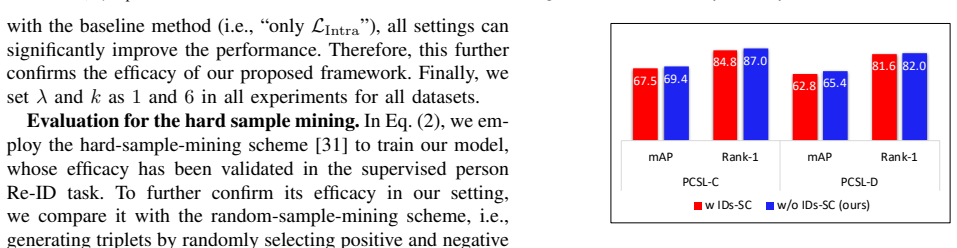
- [IV-C, text above Table III] The name "PCSP-C" should be "PCSL-C"; similarly, the caption of Fig. 4 refers to "PCPL-C" and "PCPL-D" and should read "PCSL-C" and "PCSL-D".
- [V] In the Conclusion, "the proposed method has a completive performance" should read "competitive performance".
- [IV-F, first paragraph] The text "as shown in Table XI in this response letter" reads like part of a response to reviewers rather than a journal paper. Please rephrase it as a normal experimental section, and consider moving the extensive robustness data to supplementary material.
- [Table XI] The table contains typographical errors in the labels: "singel-25" should be "single-25" and "mulitple-all" should be "multiple-all".
Circularity Check
No central circularity: benchmark claims are externally grounded; Eq. (4) has a minor self-referential sigma-squared definition.
-
self definitional
[Section III-C, Eq. (4) and the following sentence on sigma^2]
"ai,j = { exp(−‖pi−pj‖2/2σ2), if φc(pi)≠φc(pj)∧pi∈Nk(pj); 0, otherwise (4) ... Particularly, as reported in the literature [49], to incorporate the local density structure, we set σ2 as the mean value of all elements in the affinity matrix A."
Eq. (4) defines A using σ^2, and σ^2 is then defined as the mean of A, making A only a fixed-point solution of its own defining equation. This is a genuine self-definitional step in the soft-label construction. It is not load-bearing for the paper's central benchmark claims, since test mAP/CMC are measured against held-out labels and the paper independently checks affinity quality against ground truth (Fig. 6) and ablates against only-LIntra (Table VI).
full rationale
The strongest claim of the paper is empirical: PCSL approaches supervised Re-ID accuracy on five benchmarks. That claim is tested against external baselines and held-out labels, so it is not equivalent to the training objective by construction. The inter-camera soft-labels are generated from the current features and then used to train those same features, which is a self-training loop, but the paper does not present this loop as an independent prediction; it is the algorithm. Independent support is provided by the ablation in Table VI (PCSL vs. only-LIntra), the affinity-quality curves in Fig. 6 that use ground-truth IDs, and the admission in Section IV-F that selected positives can be true negatives, which is an honest limitation rather than a hidden assumption. The only self-citations ([23], [66]) are related-work or technique references and are not load-bearing; no uniqueness theorem is imported. The one specific self-referential point is the definition of σ^2 as the mean of the affinity matrix it defines in Eq. (4), which makes the construction a fixed-point equation. This is a technical flaw worth flagging, but it does not make the measured benchmark results circular. Overall circularity is minor.
Assumptions & free parameters
free parameters (4)
- lambda (loss trade-off) =
1
- k (nearest neighbors) =
6
- sigma squared (Gaussian kernel width) =
Mean of all affinity matrix elements
- triplet margin m =
0.3
assumptions (5)
- domain assumption Intra-camera labels are correct and complete: every within-camera ID corresponds to exactly one identity, and different IDs in the same camera are different people.
- domain assumption k-nearest-neighbor similarity in feature space reflects true cross-camera identity relationships.
- domain assumption The person-level feature buffer P (Eq. (3)) accurately represents a person by averaging image features.
- ad hoc to paper The progressive loop converges to better features rather than drifting into error self-reinforcement.
- domain assumption A ResNet-50 pretrained on ImageNet provides a useful initial representation for person features.
Cite this review
Pith. "Pith review of Progressive Cross-camera Soft-label Learning for Semi-supervised Person Re-identification." pith.science (2026). https://pith.science/paper/2N2W6RZH
@misc{pith2026190805669,
  author       = {Pith},
  title        = {Pith review of: Progressive Cross-camera Soft-label Learning for Semi-supervised Person Re-identification},
  year         = {2026},
  howpublished = {\url{https://pith.science/paper/2N2W6RZH}},
  note         = {Machine review of arXiv:1908.05669}
}
read the original abstract
In this paper, we focus on the semi-supervised person re-identification (Re-ID) case, which only has the intra-camera (within-camera) labels but not inter-camera (cross-camera) labels. In real-world applications, these intra-camera labels can be readily captured by tracking algorithms or few manual annotations, when compared with cross-camera labels. In this case, it is very difficult to explore the relationships between cross-camera persons in the training stage due to the lack of cross-camera label information. To deal with this issue, we propose a novel Progressive Cross-camera Soft-label Learning (PCSL) framework for the semi-supervised person Re-ID task, which can generate cross-camera soft-labels and utilize them to optimize the network. Concretely, we calculate an affinity matrix based on person-level features and adapt them to produce the similarities between cross-camera persons (i.e., cross-camera soft-labels). To exploit these soft-labels to train the network, we investigate the weighted cross-entropy loss and the weighted triplet loss from the classification and discrimination perspectives, respectively. Particularly, the proposed framework alternately generates progressive cross-camera soft-labels and gradually improves feature representations in the whole learning course. Extensive experiments on five large-scale benchmark datasets show that PCSL significantly outperforms the state-of-the-art unsupervised methods that employ labeled source domains or the images generated by the GAN-based models. Furthermore, the proposed method even has a competitive performance with respect to deep supervised Re-ID methods.
Figures

Figures from the paper (4 more)

Reference graph
Works this paper leans on
-
[1]
K. Chen, C. Lai, P. Lee, C. Chen, and Y . Hung, “Adaptive learning for target tracking and true linking discovering across multiple non- overlapping cameras,” IEEE Transactions on Multimedia (TMM) , 2011
work page 2011
-
[2]
R. Zhang, L. Lin, R. Zhang, W. Zuo, and L. Zhang, “Bit-scalable deep hashing with regularized similarity learning for image retrieval and person re-identification,” IEEE Transactions on Image Processing (TIP), 2015
work page 2015
-
[3]
Personal clothing retrieval on photo collections by color and attributes,
X. Wang, T. Zhang, D. Tretter, and Q. Lin, “Personal clothing retrieval on photo collections by color and attributes,” IEEE Transactions on Multimedia (TMM), 2013
work page 2013
-
[4]
Scalable person re-identification: A benchmark,
L. Zheng, L. Shen, L. Tian, S. Wang, J. Wang, and Q. Tian, “Scalable person re-identification: A benchmark,” in International Conference on Computer Vision (ICCV) , 2015
work page 2015
-
[5]
Learning deep feature representations with domain guided dropout for person re-identification,
T. Xiao, H. Li, W. Ouyang, and X. Wang, “Learning deep feature representations with domain guided dropout for person re-identification,” in IEEE Conference on Computer Vision and Pattern Recognition (CVPR), 2016
work page 2016
-
[6]
A multi-task deep network for person re-identification,
W. Chen, X. Chen, J. Zhang, and K. Huang, “A multi-task deep network for person re-identification,” in Proceedings of the Thirty-First Conference on Artificial Intelligence (AAAI) , 2017
work page 2017
-
[7]
Beyond part models: Person retrieval with refined part pooling (and a strong convolutional baseline),
Y . Sun, L. Zheng, Y . Yang, Q. Tian, and S. Wang, “Beyond part models: Person retrieval with refined part pooling (and a strong convolutional baseline),” in European Conference on Computer Vision (ECCV) , 2018
work page 2018
-
[8]
Re-identification with consistent attentive siamese networks,
M. Zheng, S. Karanam, Z. Wu, and R. J. Radke, “Re-identification with consistent attentive siamese networks,” inIEEE Conference on Computer Vision and Pattern Recognition (CVPR) , 2019
work page 2019
Show all 72 references
-
[9]
Unsupervised person re- identification: clustering and fine-tuning,
H. Fan, L. Zheng, C. Yan, and Y . Yang, “Unsupervised person re- identification: clustering and fine-tuning,” ACM Transactions on Mul- timedia Computing, Communications, and Applications (TOMM) , 2018
2018
-
[10]
Generalizing a person retrieval model hetero-and homogeneously,
Z. Zhong, L. Zheng, S. Li, and Y . Yang, “Generalizing a person retrieval model hetero-and homogeneously,” in European Conference on Computer Vision (ECCV) , 2018
2018
-
[11]
Domain adaptation through synthesis for unsupervised person re-identification,
S. Bak, P. Carr, and J.-F. Lalonde, “Domain adaptation through synthesis for unsupervised person re-identification,” in European Conference on Computer Vision (ECCV) , 2018
2018
-
[12]
Transferable joint attribute- identity deep learning for unsupervised person re-identification,
J. Wang, X. Zhu, S. Gong, and W. Li, “Transferable joint attribute- identity deep learning for unsupervised person re-identification,” arXiv, 2018
2018
-
[13]
Unsupervised cross-dataset person re-identification by transfer learning of spatial-temporal patterns,
J. Lv, W. Chen, Q. Li, and C. Yang, “Unsupervised cross-dataset person re-identification by transfer learning of spatial-temporal patterns,” in IEEE Conference on Computer Vision and Pattern Recognition (CVPR) , 2018
2018
-
[14]
Attribute-aware attention model for fine-grained representation learning,
K. Han, J. Guo, C. Zhang, and M. Zhu, “Attribute-aware attention model for fine-grained representation learning,” in ACM Multimedia Conference on Multimedia (MM) , 2018
2018
-
[15]
Deeply-learned part-aligned representations for person re-identification,
L. Zhao, X. Li, Y . Zhuang, and J. Wang, “Deeply-learned part-aligned representations for person re-identification,” in International Conference on Computer Vision (ICCV) , 2017
2017
-
[16]
Pose-driven deep convolutional model for person re-identification,
C. Su, J. Li, S. Zhang, J. Xing, W. Gao, and Q. Tian, “Pose-driven deep convolutional model for person re-identification,” in International Conference on Computer Vision (ICCV) , 2017
2017
-
[17]
Pose invariant embedding for deep person re-identification,
L. Zheng, Y . Huang, H. Lu, and Y . Yang, “Pose invariant embedding for deep person re-identification,” IEEE Transactions on Image Processing (TIP), 2019
2019
-
[18]
Spindle net: Person re-identification with human body region guided feature decomposition and fusion,
H. Zhao, M. Tian, S. Sun, J. Shao, J. Yan, S. Yi, X. Wang, and X. Tang, “Spindle net: Person re-identification with human body region guided feature decomposition and fusion,” in IEEE Conference on Computer Vision and Pattern Recognition (CVPR) , 2017
2017
-
[19]
Gmmcp tracker: Glob- ally optimal generalized maximum multi clique problem for multiple object tracking,
A. Dehghan, S. Modiri Assari, and M. Shah, “Gmmcp tracker: Glob- ally optimal generalized maximum multi clique problem for multiple object tracking,” in IEEE Conference on Computer Vision and Pattern Recognition (CVPR), 2015
2015
-
[20]
Non-markovian globally consistent multi-object tracking,
A. Maksai, X. Wang, F. Fleuret, and P. Fua, “Non-markovian globally consistent multi-object tracking,” in International Conference on Com- puter Vision (ICCV) , 2017
2017
-
[21]
Multi-task mid-level feature align- ment network for unsupervised cross-dataset person re-identification,
S. Lin, H. Li, C. Li, and A. C. Kot, “Multi-task mid-level feature align- ment network for unsupervised cross-dataset person re-identification,” in British Machine Vision Conference (BMVC) , 2018
2018
-
[22]
Cam- era adversarial transfer for unsupervised person re-identification,
G. Delorme, X. Alameda-Pineda, S. Lathuili `ere, and R. Horaud, “Cam- era adversarial transfer for unsupervised person re-identification,” arXiv, 2019
2019
-
[23]
A novel unsupervised camera-aware domain adaptation framework for person re- identification,
L. Qi, L. Wang, J. Huo, L. Zhou, Y . Shi, and Y . Gao, “A novel unsupervised camera-aware domain adaptation framework for person re- identification,” arXiv, 2019
2019
-
[24]
Regularization with stochastic transformations and perturbations for deep semi-supervised learning,
M. Sajjadi, M. Javanmardi, and T. Tasdizen, “Regularization with stochastic transformations and perturbations for deep semi-supervised learning,” in Advances in Neural Information Processing Systems (NIPS), 2016
2016
-
[25]
Semi-supervised learning with ladder networks,
A. Rasmus, M. Berglund, M. Honkala, H. Valpola, and T. Raiko, “Semi-supervised learning with ladder networks,” in Advances in neural information processing systems (NIPS) , 2015
2015
-
[26]
Mean teachers are better role mod- els: Weight-averaged consistency targets improve semi-supervised deep learning results,
A. Tarvainen and H. Valpola, “Mean teachers are better role mod- els: Weight-averaged consistency targets improve semi-supervised deep learning results,” in Advances in neural information processing systems (NIPS), 2017
2017
-
[27]
Deep co-training for semi-supervised image recognition,
S. Qiao, W. Shen, Z. Zhang, B. Wang, and A. Yuille, “Deep co-training for semi-supervised image recognition,” in European Conference on Computer Vision (ECCV) , 2018
2018
-
[28]
Pseudo-label: The simple and efficient semi-supervised learning method for deep neural networks,
D.-H. Lee, “Pseudo-label: The simple and efficient semi-supervised learning method for deep neural networks,” in International Conference on Machine Learning Workshop (ICMLW) , 2013
2013
-
[29]
Transduc- tive semi-supervised deep learning using min-max features,
W. Shi, Y . Gong, C. Ding, Z. MaXiaoyu Tao, and N. Zheng, “Transduc- tive semi-supervised deep learning using min-max features,” inEuropean Conference on Computer Vision (ECCV) , 2018
2018
-
[30]
Label propagation for deep semi-supervised learning,
A. Iscen, G. Tolias, Y . Avrithis, and O. Chum, “Label propagation for deep semi-supervised learning,” inIEEE Conference on Computer Vision and Pattern Recognition (CVPR) , 2019
2019
-
[31]
In defense of the triplet loss for person re-identification,
A. Hermans, L. Beyer, and B. Leibe, “In defense of the triplet loss for person re-identification,” arXiv, 2017
2017
-
[32]
Person re-identification by local maximal occurrence representation and metric learning,
S. Liao, Y . Hu, X. Zhu, and S. Z. Li, “Person re-identification by local maximal occurrence representation and metric learning,” in IEEE conference on computer vision and pattern recognition (CVPR) , 2015
2015
-
[33]
Unsupervised cross-dataset transfer learning for person re- identification,
P. Peng, T. Xiang, Y . Wang, M. Pontil, S. Gong, T. Huang, and Y . Tian, “Unsupervised cross-dataset transfer learning for person re- identification,” in IEEE Conference on Computer Vision and Pattern Recognition (CVPR), 2016
2016
-
[34]
Cross-scenario transfer person reidentification,
X. Wang, W. Zheng, X. Li, and J. Zhang, “Cross-scenario transfer person reidentification,” IEEE Transactions on Circuits and Systems for Video Technology (TCSVT), 2016
2016
-
[35]
Cross-domain person reidenti- fication using domain adaptation ranking svms,
A. J. Ma, J. Li, P. C. Yuen, and P. Li, “Cross-domain person reidenti- fication using domain adaptation ranking svms,” IEEE Transactions on Image Processing (TIP) , 2015
2015
-
[36]
Unsupervised joint subspace and dictionary learning for enhanced cross-domain person re- identification,
L. Qi, J. Huo, X. Fan, Y . Shi, and Y . Gao, “Unsupervised joint subspace and dictionary learning for enhanced cross-domain person re- identification,” IEEE Journal of Selected Topics in Signal Processing (JSTSP), 2018
2018
-
[37]
Cross-view asymmetric metric learning for unsupervised person re-identification,
H. Yu, A. Wu, and W. Zheng, “Cross-view asymmetric metric learning for unsupervised person re-identification,” in International Conference on Computer Vision (ICCV) , 2017
2017
-
[38]
Person transfer gan to bridge domain gap for person re-identification,
L. Wei, S. Zhang, W. Gao, and Q. Tian, “Person transfer gan to bridge domain gap for person re-identification,” in IEEE Conference on Computer Vision and Pattern Recognition (CVPR) , 2018
2018
-
[39]
Image- image domain adaptation with preserved self-similarity and domain- dissimilarity for person reidentification,
W. Deng, L. Zheng, G. Kang, Y . Yang, Q. Ye, and J. Jiao, “Image- image domain adaptation with preserved self-similarity and domain- dissimilarity for person reidentification,” in IEEE Conference on Com- puter Vision and Pattern Recognition (CVPR) , 2018
2018
-
[40]
Imitating targets from all sides: An unsupervised transfer learning method for person re-identification,
J. Tian, Z. Teng, R. Li, Y . Li, B. Zhang, and J. Fan, “Imitating targets from all sides: An unsupervised transfer learning method for person re-identification,” arXiv, 2019
2019
-
[41]
Invariance matters: Exemplar memory for domain adaptive person re-identification,
Z. Zhong, L. Zheng, Z. Luo, S. Li, and Y . Yang, “Invariance matters: Exemplar memory for domain adaptive person re-identification,” arXiv, 2019
2019
-
[42]
Person re-identification by unsupervisedl1 graph learning,
E. Kodirov, T. Xiang, Z. Fu, and S. Gong, “Person re-identification by unsupervisedl1 graph learning,” in European Conference on Computer Vision (ECCV), 2016
2016
-
[43]
Unsupervised data association for metric learning in the context of multi-shot person re-identification,
F. M. Khan and F. Bremond, “Unsupervised data association for metric learning in the context of multi-shot person re-identification,” in Inter- national Conference on Advanced Video and Signal Based Surveillance (AVSS), 2016
2016
-
[44]
Robust anchor embedding for unsupervised video person re-identification in the wild,
M. Ye, X. Lan, and P. C. Yuen, “Robust anchor embedding for unsupervised video person re-identification in the wild,” in European Conference on Computer Vision (ECCV) , 2018
2018
-
[45]
Stepwise metric promotion for unsu- pervised video person re-identification,
Z. Liu, D. Wang, and H. Lu, “Stepwise metric promotion for unsu- pervised video person re-identification,” in International Conference on Computer Vision (ICCV) , 2017
2017
-
[46]
Dynamic label graph matching for unsupervised video re-identification,
M. Ye, A. J. Ma, L. Zheng, J. Li, and P. C. Yuen, “Dynamic label graph matching for unsupervised video re-identification,” in International Conference on Computer Vision (ICCV) , 2017
2017
-
[47]
Deep association learning for un- supervised video person re-identification,
Y . Chen, X. Zhu, and S. Gong, “Deep association learning for un- supervised video person re-identification,” in British Machine Vision Conference (BMVC), 2018. IEEE TRANSACTIONS ON CIRCUITS AND SYSTEMS FOR VIDEO TECHNOLOGY , 14
2018
-
[48]
Unsupervised person re-identification by deep learning tracklet association,
M. Li, X. Zhu, and S. Gong, “Unsupervised person re-identification by deep learning tracklet association,” in European Conference on Computer Vision (ECCV) , 2018
2018
-
[49]
Unsupervised tracklet person re-identification,
M. Li, X. Zhu, S. Gong, and S. Gong, “Unsupervised tracklet person re-identification,” IEEE Transactions on Pattern Analysis and Machine Intelligence (TPAMI), 2019
2019
-
[50]
Hierarchical gaussian descriptor for person re-identification,
T. Matsukawa, T. Okabe, E. Suzuki, and Y . Sato, “Hierarchical gaussian descriptor for person re-identification,” inIEEE Conference on Computer Vision and Pattern Recognition (CVPR) , 2016
2016
-
[51]
Learning a discriminative null space for person re-identification,
L. Zhang, T. Xiang, and S. Gong, “Learning a discriminative null space for person re-identification,” in IEEE Conference on Computer Vision and Pattern Recognition (CVPR) , 2016
2016
-
[52]
Large scale metric learning from equivalence constraints,
M. Koestinger, M. Hirzer, P. Wohlhart, P. M. Roth, and H. Bischof, “Large scale metric learning from equivalence constraints,” in IEEE Conference on Computer Vision and Pattern Recognition (CVPR), 2012
2012
-
[53]
An asymmetric dis- tance model for cross-view feature mapping in person re-identification,
Y .-C. Chen, W.-S. Zheng, J.-H. Lai, and P. Yuen, “An asymmetric dis- tance model for cross-view feature mapping in person re-identification,” IEEE Transactions on Circuits and Systems for Video Technology (TCSVT), 2016
2016
-
[54]
Svdnet for pedestrian retrieval,
Y . Sun, L. Zheng, W. Deng, and S. Wang, “Svdnet for pedestrian retrieval,” in International Conference on Computer Vision (ICCV) , 2017
2017
-
[55]
Personnet: Person re-identification with deep convolutional neural networks,
L. Wu, C. Shen, and A. v. d. Hengel, “Personnet: Person re-identification with deep convolutional neural networks,” arXiv, 2016
2016
-
[56]
Gated siamese convolutional neural network architecture for human re-identification,
R. R. Varior, M. Haloi, and G. Wang, “Gated siamese convolutional neural network architecture for human re-identification,” in European Conference on Computer Vision (ECCV) , 2016
2016
-
[57]
A siamese long short-term memory architecture for human re-identification,
R. R. Varior, B. Shuai, J. Lu, D. Xu, and G. Wang, “A siamese long short-term memory architecture for human re-identification,” in European Conference on Computer Vision (ECCV) , 2016
2016
-
[58]
Features for multi-target multi-camera tracking and re-identification,
E. Ristani and C. Tomasi, “Features for multi-target multi-camera tracking and re-identification,” in IEEE Conference on Computer Vision and Pattern Recognition (CVPR) , 2018
2018
-
[59]
Deep adaptive feature embedding with local sample distributions for person re-identification,
L. Wu, Y . Wang, J. Gao, and X. Li, “Deep adaptive feature embedding with local sample distributions for person re-identification,” Pattern Recognition (PR), 2018
2018
-
[60]
Learning deep context-aware features over body and latent parts for person re-identification,
D. Li, X. Chen, Z. Zhang, and K. Huang, “Learning deep context-aware features over body and latent parts for person re-identification,” in IEEE Conference on Computer Vision and Pattern Recognition (CVPR), 2017
2017
-
[61]
Mutual exclusivity loss for semi-supervised deep learning,
M. Sajjadi, M. Javanmardi, and T. Tasdizen, “Mutual exclusivity loss for semi-supervised deep learning,” in International Conference on Image Processing (ICIP), 2016
2016
-
[62]
Temporal ensembling for semi-supervised learn- ing,
S. Laine and T. Aila, “Temporal ensembling for semi-supervised learn- ing,” in International Conference on Learning Representations (ICLR) , 2017
2017
-
[63]
Virtual adversarial training: a regularization method for supervised and semi-supervised learning,
T. Miyato, S.-i. Maeda, S. Ishii, and M. Koyama, “Virtual adversarial training: a regularization method for supervised and semi-supervised learning,” IEEE transactions on pattern analysis and machine intelli- gence (TPAMI), 2018
2018
-
[64]
Deep residual learning for image recognition,
K. He, X. Zhang, S. Ren, and J. Sun, “Deep residual learning for image recognition,” inIEEE Conference on Computer Vision and Pattern Recognition (CVPR), 2016
2016
-
[65]
Imagenet: A large- scale hierarchical image database,
J. Deng, W. Dong, R. Socher, L. Li, K. Li, and F. Li, “Imagenet: A large- scale hierarchical image database,” in IEEE Conference on Computer Vision and Pattern Recognition (CVPR) , 2009
2009
-
[66]
Maskreid: A mask based deep ranking neural network for person re-identification,
L. Qi, J. Huo, L. Wang, Y . Shi, and Y . Gao, “Maskreid: A mask based deep ranking neural network for person re-identification,” arXiv, 2018
2018
-
[67]
Unlabeled samples gener- ated by GAN improve the person re-identification baseline in vitro,
Z. Zheng, L. Zheng, Y . Yang, and Y . Yang, “Unlabeled samples gener- ated by GAN improve the person re-identification baseline in vitro,” in International Conference on Computer Vision (ICCV) , 2017
2017
-
[68]
Unsupervised person re-identification by soft multilabel learning,
H.-X. Yu, W.-S. Zheng, A. Wu, X. Guo, S. Gong, and J.-H. Lai, “Unsupervised person re-identification by soft multilabel learning,” in IEEE Conference on Computer Vision and Pattern Recognition (CVPR) , 2019
2019
-
[69]
MARS: A video benchmark for large-scale person re-identification,
L. Zheng, Z. Bie, Y . Sun, J. Wang, C. Su, S. Wang, and Q. Tian, “MARS: A video benchmark for large-scale person re-identification,” in European Conference on Computer Vision (ECCV) , 2016
2016
-
[70]
Object detection with discriminatively trained part-based mod- els,
P. F. Felzenszwalb, R. B. Girshick, D. McAllester, and D. Ra- manan, “Object detection with discriminatively trained part-based mod- els,” IEEE transactions on pattern analysis and machine intelligence (TPAMI), 2009
2009
-
[71]
Person re-identification by local maximal occurrence representation and metric learning,
S. Liao, Y . Hu, X. Zhu, and S. Z. Li, “Person re-identification by local maximal occurrence representation and metric learning,” in IEEE Conference on Computer Vision and Pattern Recognition (CVPR), 2015
2015
-
[72]
A discriminatively learned cnn em- bedding for person reidentification,
Z. Zheng, L. Zheng, and Y . Yang, “A discriminatively learned cnn em- bedding for person reidentification,” ACM Transactions on Multimedia Computing, Communications, and Applications (TOMM) , 2018
2018
Reviewed August 14, 2026 · model on record in the stance chip above.
Discussion (0). Continue with ORCID to comment.