REVIEW 3 major objections 3 minor 1 cited by
Calculation Rules and Cancellation Rules for Strong Hom-Schemes
T0 review · 3 major / 3 minor · reviewed 2026-08-14 · deepseek-v4-flash
Pith's one-line read The paper proves that, for finite posets, the strongest Hom-scheme relation cancels a common direct summand: comparability of Q+R and Q+S forces comparability of R and S.
desk verdict The cancellation theorems are real extensions of a Campo's own strong Hom-scheme program, with Theorem 4 (direct-sum cancellation for I-schemes) as the highlight; but Proposition 6 has a genuine well-definedness gap and the paper leans on an unpublished companion for a load-bearing lemma. read the letter →
The pith
A machine-rendered reading of the paper's core claim, the machinery that carries it, and where it could break.
The reading
What carries the argument
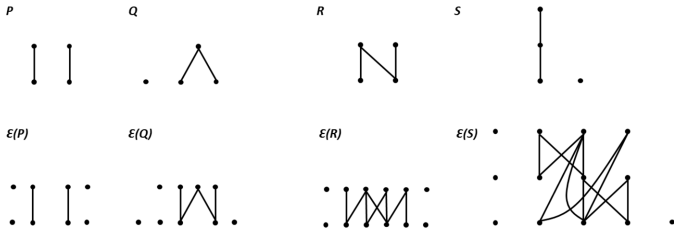
The central object is the strong Hom-scheme: a choice, for every finite poset $P$, of a one-to-one map $\rho_P$ from $\mathcal{H}(P,R)$ to $\mathcal{H}(P,S)$, with two refined versions. A G-scheme requires the connectivity classes $G_{\rho(\xi)}(x)$ to equal $G_\xi(x)$ for every $x$; an I-scheme requires preservation of the order on the exploded-view system $\mathcal{E}(R)$, built from triples $(x,\downarrow^\circ x,\uparrow^\circ x)$, and Theorem 1 from an earlier paper reduces I-schemes to one-to-one homomorphisms $\epsilon : \mathcal{E}(R) \to \mathcal{E}(S)$. The cancellation proofs push such an embedding of $\mathcal{H}(P,R)$ (or $\mathcal{E}(R)$) into the composite poset through the given scheme, and use two set-theoretic iteration lemmas: Lemma 5, which says an injective map on a finite set $A\cup B$ into $A\cup C$ must eventually send every $b\in B$ into $C$, and Lemma 8, an analogous return-to-starting-point lemma for product constructions. These iterations are what turn membership in the larger hom-set into membership in the smaller one.
What would settle it
Generate finite posets up to a few elements and, for every certified pair $Q+R \sqsubseteq_I Q+S$, test whether the iterated action of the EV-homomorphism $\epsilon$ on $\mathcal{E}(R)$ lands in $\mathcal{E}(S)$; Lemma 5 says it must, so any certified pair where the induced map $\mathcal{E}(R) \to \mathcal{E}(S)$ is not one-to-one refutes Theorem 4. For the unproved ordinal-sum case, a single finite triple $Q,R,S$ with $Q\oplus R \sqsubseteq Q\oplus S$ but $\#\mathcal{H}(P,R) > \#\mathcal{H}(P,S)$ for some $P$ would settle it.
Extended reading notes
Core claim
The paper's core claim is Theorem 4: for finite posets $Q,R,S$ with pairwise disjoint carriers, $Q+R \sqsubseteq_I Q+S$ implies $R \sqsubseteq_I S$. Here $\sqsubseteq_I$ is the relation "there exists a strong image-controlled Hom-scheme", meaning there is a one-to-one family of maps $\mathcal{H}(P,R) \to \mathcal{H}(P,S)$ for every finite $P$ that additionally preserves the exploded-view (EV) order between homomorphisms. The same cancellation is proved for the weaker relations $\sqsubseteq$ and $\sqsubseteq_G$. For ordinal sums and products the situation is conditional: $Q\oplus R \sqsubseteq_G Q\oplus S$ implies $R \sqsubseteq_G S$, and $Q\times R \sqsubseteq_G Q\times S$ implies $R \sqsubseteq_G S$ provided the scheme satisfies a constancy-preservation condition, with analogous but stronger side conditions for I-schemes; the plain Hom-scheme case $Q\oplus R \sqsubseteq Q\oplus S$ remains unproved.
Load-bearing premise
The ordinal-sum cancellation rule for G-schemes rests on a characterization of $R \sqsubseteq_G S$ by a fiber-counting inequality that is quoted from a preprint listed as 'in preparation' and is not proved in this paper; if that characterization fails, Theorem 5 loses its foundation.
Editorial extensions
If this is right
- Direct-sum cancellation is unconditional for all three relations: a common direct-summand $Q$ can be removed from both sides of $R \preceq S$ for $\preceq \in \{\sqsubseteq, \sqsubseteq_G, \sqsubseteq_I\}$.
- The calculation rules make the three relations compatible with duality: $R^d \preceq S^d$ whenever $R \preceq S$, and with direct sums: $R_1+R_2 \preceq S_1+S_2$ whenever $R_j \preceq S_j$, in all three variants.
- For ordinary Hom-schemes and G-schemes, ordinal sums and products are monotone: $R_1\oplus R_2 \preceq S_1\oplus S_2$ and $R_1\times R_2 \preceq S_1\times S_2$ follow from $R_j \preceq S_j$.
- The cancellation results turn a one-sided global inequality $Q\odot R \preceq Q\odot S$ into the structural conclusion $R \preceq S$: unconditionally for $\odot = +$, and under the stated side conditions for $\odot = \oplus$ and $\odot = \times$.
- The equivalence (16) says $H(Q,R) \sqsubseteq H(Q,S)$ for every finite $Q$ is exactly equivalent to $R \sqsubseteq S$, so the family of hom-posets carries no extra information beyond the original relation.
Reading between the lines
- Not pursued in the paper, but direct-sum cancellation suggests the finite-poset monoid under $+$ is cancellative for $\sqsubseteq_I$; if so, $\sqsubseteq_I$ could be studied componentwise on connected posets, simplifying any computational check of the relation.
- The open case $Q\oplus R \sqsubseteq Q\oplus S$ may well be false in general; the proof gap suggests looking for counterexamples where $R$ and $S$ differ only in strict-homomorphism counts, since the ordinal sum with a suitably tall $Q$ can hide those differences.
- The same set-theoretic iteration used here would apply to other categories of finite structures with an "exploded view" construction, so a natural testable extension is to ask whether analogous cancellation rules hold for graphs or digraphs with defined neighbourhood systems.
Signed reviews
Editorial analysis
A structured set of objections, weighed in public.
Referee Report
Summary. The paper studies three increasingly restrictive notions of strong Hom-schemes between finite posets—plain, G, and I—and asks whether the associated preorders R⊑S, R⊑G S, and R⊑I S are compatible with direct sums, ordinal sums, products, and duality, and whether cancellation rules hold. It proves duality and monotonicity results, a direct-sum cancellation rule for all three notions, ordinal-sum cancellation rules for G- and I-schemes under additional hypotheses, and product cancellation rules under additional hypotheses. It also explicitly states that a cancellation rule for Q⊕R⊑Q⊕S was not obtained. The main technical devices are the EV-system E(P), the maps α_{P,ξ}, and iterative applications of Hom-schemes to push embeddings from R into Q⊙R to embeddings from S into Q⊙S.
Significance. The intended results are nontrivial and, if correct, would provide a useful toolbox for comparing finite posets via homomorphism counts under regularity conditions. The set-theoretic lemmas (Lemma 5 and Lemma 8) are clean, and the iterative constructions in Sections 8 and 9 are inventive. The paper is also commendably explicit about the one cancellation rule it could not prove. However, the current version contains a false claim in Proposition 6, an unproved external dependence in Theorem 5, and an incomplete final step in Theorem 4; these issues need to be resolved before the results can be accepted as stated.
major comments (3)
- [Section 7, Theorem 4] The final step of the proof of Theorem 4 is incomplete. After constructing E:E(R)→E(S), the proof defines, for each x∈P, the value η^{n(αξ(x))}(ξ)(x) and asserts that E fulfills the requirement of Theorem 1. But Theorem 1 requires a single homomorphism η(ξ) with α_{η(ξ)}(x)=E(αξ(x)) for every x. If n(αξ(x)) varies with x, the pointwise definition τ(ξ)(x)=E(αξ(x))_1 is a patchwork of different iterates of η, and the equality α_{τ(ξ)}(x)=E(αξ(x)) is not established. The gap can be repaired: since α_{P,ξ} is stated in Section 4 to be a homomorphism, αξ(K) is connected in E(R) for each connectivity component K of P, and the argument used to show that E is order-preserving implies that n is constant on each connectivity component of E(R). This constancy argument should be written out explicitly; without it, the proof as printed is not complete.
- [Section 5, Proposition 6(14)] The proof of R⊑S ⇒ H(Q,R)⊑G H(Q,S) defines τ_P(ξ)=ρ_Q∘ξ. For this to be a well-defined element of H(P,H(Q,S)), the map ρ_Q:H(Q,R)→H(Q,S) must preserve the pointwise order on homomorphism sets: if ξ(x)≤ξ(y) in H(Q,R), then ρ_Q(ξ(x))≤ρ_Q(ξ(y)) in H(Q,S). Strong Hom-schemes as defined in Definition 4 are only required to be injective componentwise; no monotonicity with respect to the pointwise order is imposed. Thus the composition ρ_Q∘ξ need not be a homomorphism, and the statement (14) is not justified and appears false under the paper's definitions. This also affects the equivalence (16). Please either add an order-preservation hypothesis to the definition or to the statement, or withdraw (14) and repair the consequences for (16).
- [Section 8, Theorem 5] The proof of the ordinal-sum cancellation rule for G-schemes depends entirely on [3, Lemma 4], quoted as 'As proven in [3, Lemma 4]', which asserts that R⊑G S is equivalent to #Γ_{P,R}(ξ)≤#Γ_{P,S}(ξ) for every P and every ξ∈H(P,R). This lemma is not stated or proved in the present paper, and reference [3] is listed as 'in preparation'. Since the counting argument in Theorem 5 (and part of the surrounding theory) rests on this characterization, the proof is not self-contained. The authors should include a complete statement and proof of this lemma, or clearly delimit Theorem 5 as conditional on an external result that is not yet available.
minor comments (3)
- [Throughout] There are numerous typographical errors and stylistic slips, including 'poests', 'containes', 'homomorphimss', and 'be setting' instead of 'by setting'. A careful proofreading pass is needed.
- [Section 1 and Section 4] Reference [3] is cited as 'in preparation' and is used for Theorem 2 and Lemma 4. The reader cannot verify these results; please update the reference status or include the needed statements in the paper.
- [Section 6] The notation ⊙∈{+,⊕,×} is used in the introductory paragraphs before it is formally introduced; please define all operators at first use.
Circularity Check
No definitional circularity, but the proof of Theorem 5 is carried by an unproved equivalence quoted from the author's own in-preparation paper [3], so the G-scheme cancellation chain is load-bearing self-citation.
-
self citation load bearing
[Section 8, proof of Theorem 5, immediately before equation (18)]
"As proven in [3, Lemma 4], R⊑G S is equivalent to #ΓP,R(ξ)≤ #ΓP,S(ξ) for all ξ∈H(P,R),P∈P."
The final step of the proof of Q⊕R⊑G Q⊕S ⇒ R⊑G S is not a construction of a G-scheme from the hypothesis; it is an appeal to a characterization of R⊑G S. That characterization is quoted from the author's own paper [3], which is listed in the references as 'in preparation' and is not stated or proved in the present paper. Thus the conclusion R⊑G S is reached only by substituting an unverified self-cited equivalence. The Γ-counting inequality established in the proof is not the same as the hypothesis, so this is not definitional circularity, but the derivation chain is load-bearing on a self-citation that is not independently established.
full rationale
Most of the paper's derivation is not circular. The direct-sum cancellations for plain and G-schemes (Theorem 3) are direct cardinality arguments; the I-scheme proofs (Theorems 4, 6, and 9) attempt to construct E(R)→E(S) or τ from the assumed scheme, using Theorem 1 of [2] and Lemma 4 of [2] as lemmas rather than as the target conclusion. The cancellation conclusions do not appear among the hypotheses, so the central claims are not assumed. However, the paper is not self-contained for the G-scheme results: Theorem 2 (from [3]) is used in Proposition 4 and Theorem 3, and Theorem 5 explicitly invokes [3, Lemma 4] as the step that turns the Γ-counting inequality into R⊑G S. Since [3] is 'in preparation', that step is a load-bearing self-citation. This is a reproducibility/self-containment problem rather than a definitional circularity, and the stronger I-scheme cancellation results retain independent content. There is also a separate correctness gap in Theorem 4's final verification of condition (12), where the pointwise exponent n(αξ(x)) is not shown to yield a single homomorphism τ(ξ); that gap is a correctness concern, not a circularity.
Assumptions & free parameters
assumptions (5)
- ad hoc to paper Theorem 1 of [2]: R⊑_I S iff there exists a one-to-one homomorphism ϵ:E(R)→E(S) with α_{P,η(ξ)}(x)=ϵ(α_{P,ξ}(x)) for all P, ξ, x.
- ad hoc to paper Theorem 2 of [3]: R⊑_G S iff #S(P,R)≤#S(P,S) for all P (equivalently all connected P).
- ad hoc to paper Lemma 4 of [3]: R⊑_G S iff #Γ_{P,R}(ξ)≤#Γ_{P,S}(ξ) for every P and every ξ∈H(P,R).
- standard math Decomposition formulas H(P,A⊕B)≃Σ_{U∈U(P)}H(X\U,A)×H(U,B) and the strict analogue.
- domain assumption Finite posets can be replaced by isomorphic copies with disjoint carriers in direct and ordinal sums without changing the relations.
Cite this review
Pith. "Pith review of Calculation Rules and Cancellation Rules for Strong Hom-Schemes." pith.science (2026). https://pith.science/paper/RXMACHLO
@misc{pith2026190805681,
  author       = {Pith},
  title        = {Pith review of: Calculation Rules and Cancellation Rules for Strong Hom-Schemes},
  year         = {2026},
  howpublished = {\url{https://pith.science/paper/RXMACHLO}},
  note         = {Machine review of arXiv:1908.05681}
}
abstract
Let ${\cal H}(A,B)$ denote the set of homomorphisms from the poset $A$ to the poset $B$. In previous studies, the author has started to analyze what it is in the structure of finite posets $R$ and $S$ that results in $# {\cal H}(P,R) \leq # {\cal H}(P,S)$ for every finite poset $P$, if additional regularity conditions are imposed. In the present paper, it is examined if this relation (with or without regularity conditions) is compatible with the operations of order arithmetic and if cancellation rules hold.
Figures

Forward citations
Cited by 1 Pith paper
-
Strong G-schemes and strict homomorphisms
For finite posets R and S, a strong G-scheme exists from R to S if and only if #S(P,R) ≤ #S(P,S) for every finite poset P.
Reference graph
Works this paper leans on
-
[3]
a Campo: Strong G-schemes and strict homomorphisms
F. a Campo: Strong G-schemes and strict homomorphisms. In preparation
-
[1]
a Campo: Relations between powers of Dedekind numbers and expo- nential sums related to them
F. a Campo: Relations between powers of Dedekind numbers and expo- nential sums related to them. J. Int. Seq. 21 (2018), Article 18.4.4
2018
-
[2]
a Campo: About Generalized One-to-One Mappings between Sets of Order Homomorphisms
F. a Campo: About Generalized One-to-One Mappings between Sets of Order Homomorphisms. arXiv:1906.11758v2 [math.CO]
arXiv 1906
-
[4]
Lov´ asz: Operations with structures
L. Lov´ asz: Operations with structures. Acta Math. Acad. Sci. Hungar. 18 (1967), 321–328. 21
work page 1967
Reviewed August 14, 2026 · model on record in the stance chip above.
Discussion (0). Continue with ORCID to comment.