REVIEW 5 minor 23 references
Strong G-schemes and strict homomorphisms
T0 review · 0 major / 5 minor · reviewed 2026-08-14 · deepseek-v4-flash
Pith's one-line read For finite posets, the strong G-scheme preorder is exactly the strict-homomorphism count preorder.
desk verdict A sound and genuine result in finite poset combinatorics: the equivalence between strong G-schemes and strict homomorphism inequalities is new and the proof survives scrutiny, though its significance is modest and its dependence on earlier arXiv preprints is a minor concern. read the letter →
The pith
A machine-rendered reading of the paper's core claim, the machinery that carries it, and where it could break.
The reading
What carries the argument
The load-bearing object is the quotient partition G(ξ) of a homomorphism ξ: P → Q: its blocks are the connected components Gξ(x) of the preimage $ξ^{{-1}}$(ξ(x)) containing x. Every homomorphism factors as ξ = ιξ ∘ πξ, with πξ collapsing each block to a point and ιξ a strict homomorphism from the quotient poset G(ξ) to Q. The key counting lemma states that for a fixed quotient G(ξ), the homomorphisms from P to T sharing that quotient are in bijection with the strict homomorphisms from G(ξ) to T, so #Γ_{P,T}(ξ) = #S(G(ξ),T). This identity converts the strict-count inequality for the arbitrary test poset G(ξ) into the fiberwise injectivity needed to build a strong G-scheme.
What would settle it
Enumerate all pairs of finite connected posets up to, say, eight points and compute #S(P,R) and #S(P,S) for all connected P up to the same size; a pair where the inequalities all hold but an explicit search for a strong G-scheme finds none would refute the theorem, while a reversed inequality would show R ⊑_G S fails.
Extended reading notes
Core claim
The paper's main theorem states that for finite posets R and S the following are equivalent: a strong G-scheme from R to S exists; #S(P,R) ≤ #S(P,S) for every finite poset P; and #S(Q,R) ≤ #S(Q,S) for every connected finite poset Q. A strong G-scheme is a family of injective maps from the homomorphism sets H(P,R) into H(P,S), one family member for each isomorphism type P, that preserves the connected-component structure of each homomorphism's preimage fibers. The paper thereby reduces a regular injective comparison of all homomorphism sets to a plain numerical comparison of strict-homomorphism counts. An immediate consequence is that #S(P,R) = #S(P,S) for all finite P forces R ≅ S; the paper further derives a finite-check sufficient condition for the preorder and a construction method for posets T with P + Q ⊑_G P|A + T for convex A.
Load-bearing premise
The proof imports from earlier work the fact that a homomorphism is strict exactly when every point is isolated within the connected component of its own preimage, together with a lemma on when those components grow; the equivalence between strong G-schemes and strict-homomorphism count inequalities breaks if these imported facts fail.
Editorial extensions
If this is right
- The preorder on finite posets defined by strong G-schemes is the same as pointwise comparison of the sequences (#S(P,R))_P, so all structural facts about the G-scheme preorder can be read off strict-homomorphism counts.
- To decide R ⊑_G S, only connected test posets need to be checked; disconnected P factor as products over components.
- If all finite posets P give #S(P,R) = #S(P,S), then R and S are isomorphic; this refines the classical homomorphism-count cancellation result to strict maps.
- A finite certificate suffices in many cases: Theorem 2 reduces the infinite check to a finite set of connected posets, embedding counts, and distributors.
- Theorem 3 constructs new pairs P + Q ⊑_G P|A + T whenever A is convex in P, giving a systematic source of nontrivial strong G-schemes.
Reading between the lines
- The quotient factorization suggests defining the strict-homomorphism profile of a poset as the vector of counts #S(P,·) over connected P; the paper shows this profile completely determines the G-scheme preorder, so it may serve as a complete invariant analogous to homomorphism-count profiles elsewhere.
- Because Theorem 1 makes the G-scheme relation a cardinality comparison, finite-precision obstructions can be sought by computing strict counts only, which is plausible for computer enumeration; the paper does not address complexity or bounds.
- A testable extension is to ask whether the same strict-count characterization holds for other relational structures whose fibers have a connectivity notion, such as graphs with zigzag-connected fibers under graph homomorphisms; the paper does not claim this.
Signed reviews
Editorial analysis
A structured set of objections, weighed in public.
Referee Report
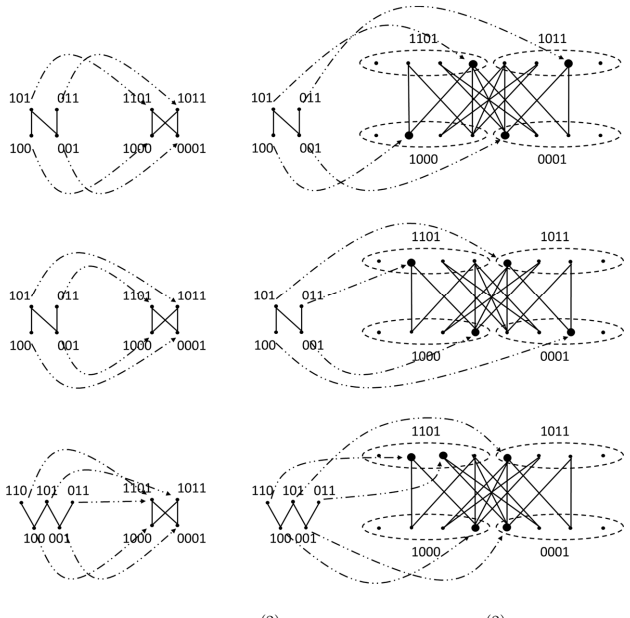
Summary. The paper studies the preorder R ⊑_G S defined by the existence of a strong G-scheme from R to S. The main result, Theorem 1, characterizes R ⊑_G S by the strict-homomorphism-counting inequalities #S(P,R) ≤ #S(P,S) for all finite posets P, and equivalently for all connected finite posets P. The proof factorizes a homomorphism ξ through G(ξ), the partition of the carrier into connected components of the fibers of ξ. Corollary 1 shows G(ξ) is a poset with a strict natural map to the target; Lemma 5 identifies the fiber Γ_{P,T}(ξ) with the set S(G(ξ),T) of strict homomorphisms, which yields the hard direction (2)⇒(1) of Theorem 1. Corollary 3 deduces that equality of all strict-homomorphism counts forces isomorphism. Theorem 2 provides a sufficient condition for R ⊑_G S based on finitely many connected posets and distributors, and Section 5 applies it to two examples and develops Theorem 3, a construction for posets P+Q and T with P+Q ⊑_G P|A + T, where A is convex in P, plus a strong I-scheme strengthening when A is an antichain.
Significance. If Theorem 1 is correct, it is a clean structural characterization: the seemingly more complicated G-scheme preorder is equivalent to a monotonicity condition on strict homomorphism counts, and equality of those counts is a new proof that a finite poset is determined up to isomorphism by the cardinals #S(P,·). The reduction to connected posets and the finite criterion in Theorem 2 are useful tools. I checked the central proof carefully: the quotient construction in Corollary 1 is sound, the bijection in Lemma 5 is valid, and the use of Lemma 4 transfers the inequalities exactly as claimed. The paper is not fully self-contained, since two load-bearing facts are quoted from the author's earlier preprint [5], namely the strictness criterion Gξ(x)={x} and Lemma 2; these are elementary and are used consistently, so I do not regard the dependence as a correctness risk, only as a presentation issue.
minor comments (5)
- [Section 2.2 / Definition 2 and Theorem 1] The criterion "ξ is strict iff Gξ(x)={x}" is quoted from [5, Corollary 3] and is used in the first step of the proof of Theorem 1; because this fact is load-bearing for the main equivalence, please include a short proof or at least a fully explicit statement so that the dependence on an external preprint is transparent.
- [Lemma 4] Lemma 4 is stated for all P∈P, but the G-scheme in Definition 3 is defined only on the representation system P_r; the proof should explicitly invoke that every finite poset is isomorphic to a representative in P_r and that the sets Γ_{P,R}(ξ) and Γ_{P,S}(ξ) are invariant under such isomorphisms.
- [Theorem 3 proof] In the embedding-counting inequality at the end of the proof, the step #Emb(E,A') + #(F1∪F2) ≥ #F1 + #F2 is compressed; it follows by inclusion-exclusion from the injection F1∩F2 → Emb(E,A') constructed in the preceding sentence, and that derivation should be written out explicitly.
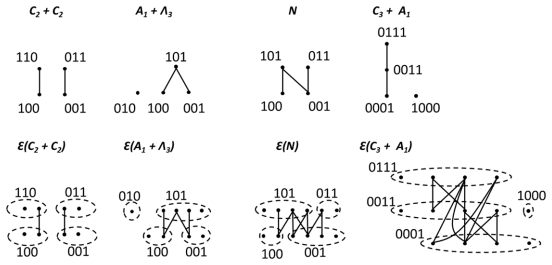
- [Section 5.1] The sentence "the two outer ones in E(C3;0011)" is not self-explanatory; please annotate Figure 6 or describe the two points explicitly so the claimed distinguishing property can be checked without reading the figure labels in a particular way.
- [Throughout] There are several typographical slips that should be corrected, including "dubble-N" for double-N in Section 2.1, "poests" in the introduction, "fullfills" in Section 5.1, and the German-size remnants "Größe 60%" and "Größe 45%" in the figure captions.
Circularity Check
No significant circularity: Theorem 1 is proven by a self-contained factorization argument; self-citations are independent prior lemmas, not inputs in disguise.
full rationale
The central result, Theorem 1, is not assumed from prior work but is proven here. The key implication (2)⇒(1) proceeds by factorizing a homomorphism ξ through the quotient poset G(ξ) of its connected Gξ-fibers. Lemma 5 establishes a genuine bijection between Γ_{P,T}(ξ), the homomorphisms sharing the same fiber partition as ξ, and strict homomorphisms S(G(ξ),T), and this bijection is verified rather than postulated. The strict-homomorphism inequality (2) is then applied to the finite poset G(ξ), which is legitimate because (2) ranges over all finite posets. The only imported facts are [5, Corollary 3] (strictness is equivalent to singleton Gξ-fibers) and [5, Lemma 1] (a technical comparison of fiber partitions); both are elementary, parameter-free statements whose assumptions do not include Theorem 1, and neither is equivalent to the target inequality. Corollary 3 uses the self-cited antisymmetry of ⊑G from [5], but this is a prior result about G-schemes, not the strict-homomorphism cardinality equality being derived, so its use is a normal reliance on earlier work rather than a circular reduction. No equation in the paper is shown by construction to be identical to an input, and no fitted parameter is renamed as a prediction. The proof is self-contained in its main derivation, and the self-citations identified are not load-bearing in a way that would make the conclusion equivalent to its premises.
Assumptions & free parameters
assumptions (5)
- domain assumption A homomorphism xi in H(P,Q) is strict iff G_xi(x) = {x} for all x in P.
- domain assumption If G_xi(x) is a subset of G_zeta(x), then G_xi(x) is a proper subset iff there exist a,b in G_zeta(x) with a < b and xi(a) < xi(b).
- standard math Lovasz factorization: for connected P, #I_Q(P,T) = #So_r(P,Q) * #Emb(Q,T), where I_Q(P,T) is the set of strict homomorphisms with image isomorphic to Q.
- domain assumption The G-scheme relation is a partial order on the representation system Pr.
- domain assumption E(P+Q) = E(P) + E(Q) for EV-systems.
Cite this review
Pith. "Pith review of Strong G-schemes and strict homomorphisms." pith.science (2026). https://pith.science/paper/52LTLFX6
@misc{pith2026190806897,
  author       = {Pith},
  title        = {Pith review of: Strong G-schemes and strict homomorphisms},
  year         = {2026},
  howpublished = {\url{https://pith.science/paper/52LTLFX6}},
  note         = {Machine review of arXiv:1908.06897}
}
abstract
Let $\mathfrak{P}_r$ be a representation system of the non-isomorphic finite posets, and let ${\cal H}(P,Q)$ be the set of order homomorphisms from $P$ to $Q$. For finite posets $R$ and $S$, we write $R \sqsubseteq_G S$ iff, for every $P \in \mathfrak{P}_r$, a one-to-one mapping $\rho_P : {\cal H}(P,R) \rightarrow {\cal H}(P,S)$ exists which fulfills a certain regularity condition. It is shown that $R \sqsubseteq_G S$ is equivalent to $\# {\cal S}(P,R) \leq \# {\cal S}(P,S)$ for every finite posets $P$, where ${\cal S}(P,Q)$ is the set of strict order homomorphisms from $P$ to $Q$. In consequence, $\# {\cal S}(P,R) = \# {\cal S}(P,S)$ holds for every finite posets $P$ iff $R$ and $S$ are isomorphic. A sufficient condition is derived for $R \sqsubseteq_G S$ which needs the inspection of a finite number of posets only. Additionally, a method is developed which facilitates for posets $P + Q$ (direct sum) the construction of posets $T$ with $P + Q \sqsubseteq_G A + T$, where $A$ is a convex subposet of $P$.
Figures


Figures from the paper (6 more)




Reference graph
Works this paper leans on
-
[5]
Generalized One-to-One Mappings between Homomorphism Sets of Digraphs
F. a Campo: About generalized one-to-one mappings between sets of order homomorphisms. arXiv:1906.11758v2 [math.CO]
work page Pith review arXiv 1906
-
[1]
C. Bergman, R. McKenzie, and Z. Nagy: How to cancel a linearly ordered exponent. Coll. Math. Soc. J. Bolyai 29 (1977), 87–93
work page 1977
-
[2]
Birkhoff: An Extended arithmetic
G. Birkhoff: An Extended arithmetic. Duke Math. J. 3 (1937), 311–316
work page 1937
-
[3]
Birkhoff: Generalized arithmetic
G. Birkhoff: Generalized arithmetic. Duke Math. J. 9 (1942), 283–302
work page 1942
-
[4]
a Campo: Relations between powers of Dedekind numbers and expo- nential sums related to them
F. a Campo: Relations between powers of Dedekind numbers and expo- nential sums related to them. J. Int. Seq. 21 (2018), Article 18.4.4
work page 2018
-
[6]
Calculation Rules and Cancellation Rules for Strong Hom-Schemes
F. a Campo: Calculation rules and cancellation rules for strong Hom- schemes. arXiv:1908.05681 [math.CO]
work page Pith review arXiv 1908
-
[7]
M. M. Day: Arithmetic of ordered sets. Trans. Amer. Math. Soc.58 (1945), 1–43
work page 1945
-
[8]
D. Duffus: Powers of ordered sets. Order 1 (1984), 83–92. 22
work page 1984
Show all 23 references
-
[9]
Duffus, B
D. Duffus, B. J´ onsson, and I. Rival: Structure results for function lattices. Can. J. Math. 30 (1978), 392–400
1978
-
[10]
Duffus and I
D. Duffus and I. Rival: A logarithmic property for exponents of partially ordered sets. Can. J. Math. 30 (1978), 797–807
1978
-
[11]
Duffus and R
D. Duffus and R. Wille: A theorem on partially ordered sets of order- preserving mappings. Proc. Amer. Math. Soc. 76 (1979), 14–16
1979
-
[12]
J. D. Farley: The automorphism group of a function lattice: A problem of J´ onsson and McKenzie.Algebra Universalis 36 (1996), 8–45
1996
-
[13]
Hashimoto: On the product decomposition of partially ordered sets
J. Hashimoto: On the product decomposition of partially ordered sets. Math. Japonicae 1 (1948), 120–123
1948
-
[14]
Hashimoto: On direct product decomposition of partially ordered sets
J. Hashimoto: On direct product decomposition of partially ordered sets. Ann. of Math. 54 (1951), 315–318
1951
-
[15]
J´ onsson: The arithmetic of ordered sets
B. J´ onsson: The arithmetic of ordered sets. In: I. Rival (eds) Ordered Sets. NATO Advanced Study Institutes Series (Series C — Mathematical and Physical Sciences) 83 (1982)
1982
-
[16]
J´ onsson: Powers of partially ordered sets: the automorphism group
B. J´ onsson: Powers of partially ordered sets: the automorphism group. Math. Scand. 51 (1982), 121–141
1982
-
[17]
J´ onsson and R
B. J´ onsson and R. McKenzie: Powers of partially ordered sets: Cancellation and refinement properties. Math. Scand. 51 (1982), 87–120
1982
-
[18]
Lov´ asz: Operations with structures
L. Lov´ asz: Operations with structures. Acta Math. Acad. Sci. Hungar. 18 (1967), 321–328
1967
-
[19]
Lov´ asz: On the cancellation law among finite relational structures
L. Lov´ asz: On the cancellation law among finite relational structures. Pe- riod. Math. Hungar. 1 (1971), 145–156
1971
-
[20]
McKenzie: Arithmetic of finite ordered sets: Cancellation of exponents, I
R. McKenzie: Arithmetic of finite ordered sets: Cancellation of exponents, I. Order 16 (1999), 313–333
1999
-
[21]
McKenzie: Arithmetic of finite ordered sets: Cancellation of exponents, II
R. McKenzie: Arithmetic of finite ordered sets: Cancellation of exponents, II. Order 17 (2000), 309–332
2000
-
[22]
McKenzie: The zig-zag property and exponential cancellation of ordered sets
R. McKenzie: The zig-zag property and exponential cancellation of ordered sets. Order 20 (2003), 185–221
2003
-
[23]
Wille: Cancellation and refinement results for function lattices
R. Wille: Cancellation and refinement results for function lattices. Houston J. Math. 6 (1980), 431–437. 23
1980
Reviewed August 14, 2026 · model on record in the stance chip above.
Discussion (0). Continue with ORCID to comment.