REVIEW 3 major objections 4 minor 57 references
Signatures of Dipolar Dark Matter on Indirect Detection
T0 review · 3 major / 4 minor · reviewed 2026-08-14 · deepseek-v4-flash
Pith's one-line read Dipole dark matter with equal electric and magnetic moments survives cosmological bounds only if its dipole moment is below 0.44×10^-16 e cm and its mass is near 500 GeV.
desk verdict Routine dipole-DM constraint update, but the headline numbers don't follow from the paper's own equations. read the letter →
The pith
A machine-rendered reading of the paper's core claim, the machinery that carries it, and where it could break.
The reading
What carries the argument
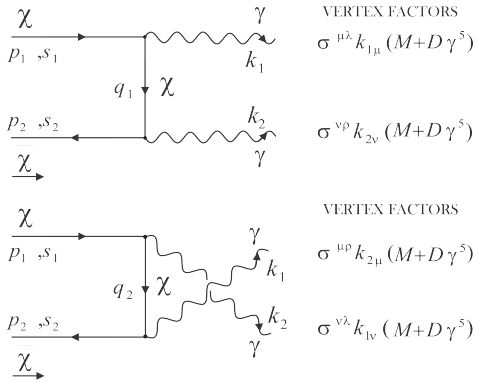
$M_{16}=M/10^{-16}$ e cm is the dimensionless magnetic dipole moment and $f=D_{16}/M_{16}$ the electric-to-magnetic ratio. The central formula is the thermally averaged cross-section $$\langle\sigma_{\rm ann}v_{\rm rel}\rangle = \tilde c_0\, m_{\rm GeV}^2\, M_{16}^4\left[6(1+$6f^{2}$+$f^{4}$)+\frac{6}{x}(3+$2f^{2}$+$3f^{4}$)\right]\,{\rm $cm^{3}$\,$s^{{-1}}$}$$ with $\tilde c_0=1.71423\times10^{-30}$ and $x\simeq22$. It is obtained from the effective dipole operator $\mathcal{L}=-\frac{i}{2}\bar\chi\sigma^{\mu\nu}(M+D\gamma_5)\chi F_{\mu\nu}$ by evaluating the $t$- and $u$-channel amplitudes for $\chi\bar\chi\to\gamma\gamma$ and expanding in the non-relativistic limit, with $\langle v^2_{\rm rel}\rangle=6/x$. Because the bracket $H(f,x)$ is order one, mass and dipole moment control the magnitude of the annihilation rate, which is what allows relic-density and CMB constraints to be converted into direct bounds on $M_{16}$ and $m_\chi$.
What would settle it
Perform a dedicated search for a gamma-ray line at $E_\gamma=m_\chi\simeq500$ GeV in a dark-matter-dominated target; a non-detection at an effective cross-section of order $2.7\times10^{-25}$ cm$^3$ s$^{-1}$ would exclude the equal-moment point $M_{16}^*=0.44$. Alternatively, compute the $t$- and $u$-channel amplitudes for $\chi\bar\chi\to\gamma Z$ and $\chi\bar\chi\to\gamma H$; if either cross-section is comparable to $\gamma\gamma$, the CMB bound used in the paper no longer yields the same allowed mass range.
Extended reading notes
Core claim
The paper claims that the parameter space of dipole dark matter is closed off from above. For the $\gamma\gamma$ annihilation channel and $f\equiv D_{16}/M_{16}\sim 1$, the thermally averaged cross-section scales as $\langle\sigma v\rangle \propto m_\chi^2 M_{16}^4 H(f,x)$. Requiring this to match the observed relic abundance fixes a lower bound on mass for each dipole moment, while the CMB energy-injection bound fixes an upper bound. These bounds meet at $M_{16}^*=0.44$ and $m_\chi^*\approx 500$ GeV, so models with $M_{16}>0.44$ are excluded, and the only surviving equal-moment models sit in a narrow band around 500 GeV. More generally, allowing $f$ to vary relaxes the cutoff and broadens the allowed mass window.
Load-bearing premise
The load-bearing assumption is that dark matter is a single thermal relic whose freeze-out is described by the standard relation $\Omega h^2\simeq 3\times10^{-26}/\langle\sigma_{\rm ann}v_{\rm rel}\rangle$ at decoupling $x=22$, with $\chi\bar\chi\to\gamma\gamma$ the only relevant annihilation channel; if another channel dominates or the thermal history differs, the quoted 0.44 cutoff and 500 GeV window shift.
Editorial extensions
If this is right
- If the equal-moment case is the one nature realizes, dipole dark matter annihilates to a sharp gamma-ray line at $E_\gamma=m_\chi\simeq500$ GeV, a direct observable signature.
- For $f=1$, any magnetic dipole moment above $0.44\times10^{-16}$ e cm is ruled out by the combination of relic density and CMB data, independent of mass.
- For masses of order $10^2$ GeV, the required electric dipole moment is about $10^{-16}$ e cm, placing the model in a range that accelerator and direct-detection experiments could in principle probe.
- Allowing $D_{16}\neq M_{16}$ (free $f$) relaxes the mass and dipole constraints substantially, so the 500 GeV window is specific to the $f\approx1$ assumption.
- The paper's Table II gives a ladder of allowed electric-dipole ranges for masses from 6 GeV to 20 TeV, so the surviving parameter space is not a single point but a sequence of narrow windows.
Reading between the lines
- If the $\chi\bar\chi\to\gamma Z$ and $\chi\bar\chi\to\gamma H$ channels are not negligible, the quoted bounds would shift; computing those amplitudes is a direct test the paper leaves for future work.
- The assumed freeze-out parameter $x=22$ is a standard shortcut; solving the full Boltzmann equation would check whether $M_{16}^*=0.44$ and $m_\chi^*\simeq500$ GeV survive without that assumption.
- Because the same dipole operator also generates spin-dependent scattering with nuclei, direct-detection experiments could independently confirm or exclude the surviving equal-moment region.
- Since the required annihilation rate at $m_\chi\simeq500$ GeV is near $2.7\times10^{-25}$ cm$^3$ s$^{-1}$, a gamma-ray line search at that energy with upcoming telescopes is a practical, near-term test.
Editorial analysis
A structured set of objections, weighed in public.
Referee Report
Summary. The manuscript studies a Dirac fermion dark-matter candidate with magnetic and electric dipole moments. It computes the χχ→γγ annihilation cross section and its thermal average, then uses the standard relic-abundance relation (Eq. 1) together with CMB energy-injection constraints (Sec. III A) to constrain the dipole moments and the dark-matter mass. For f ≡ D16/M16 ≈ 1, the authors claim an upper cutoff M16^* ≈ 0.44 (in units of 10^-16 e cm) and an allowed mass window around 500 GeV, and they present posterior distributions for mχ from a χ² analysis against the Planck cold-dark-matter density. The central quantitative claims are currently not reproducible from the paper's own equations: Eq. (14) does not follow from Eq. (13), and Eq. (17) evaluated at the quoted best-fit values gives a relic abundance that is inconsistent with the quoted Planck value.
Significance. The paper addresses a relevant question and provides an explicit analytic expression for the χχ→γγ cross section in the dipole dark-matter model, together with a simple pipeline for translating relic-density and CMB line constraints into bounds on (mχ, M16, f). The derivation of the thermally averaged cross section is presented in sufficient detail to be checked, and the use of publicly available cosmological constraints is a strength. If the final numbers were reliable, M16^* ≈ 0.44 and mχ ∼ 500 GeV would be useful targets for indirect-detection searches. However, because the printed equations are internally inconsistent, the headline results cannot be trusted as they stand; the paper would be significant after a corrected derivation and rerun of the affected figures.
major comments (3)
- [III A, Eqs. (13) and (14)] Equation (14) does not follow algebraically from Eq. (13). Solving 2.5×10^-25 = \tilde c0 (m_low/GeV)^2 M16^4 H(f) with \tilde c0 = 1.71423×10^-30 gives m_low/GeV = 381.9/(M16^2 sqrt(H(f))), not the printed expression (1.95×10^-15/M16)^2 H(f)^-1/2. For f = 1 and x = 22, H = 48(1+1/22) = 50.18, so the correct lower mass at M16 = 0.44 is approximately 279 GeV, and combining this with Eq. (16) gives an intersection at M16^* ≈ 0.66 and m ≈ 126 GeV, rather than M16^* = 0.44 and m ≈ 500 GeV. Because the cutoff and the 500 GeV window are the paper's headline results, the central claims are not reproducible from the manuscript's own formulas.
- [III B, Eq. (17) and Fig. 6] For f = 1, Eq. (17) gives ⟨σv⟩ = 48 \tilde c0 m_GeV^2 M16^4 (1+1/x). At the claimed values M16 = 0.44, mχ = 500 GeV and x = 22, this yields ⟨σv⟩ ≈ 8.1×10^-25 cm^3/s, and Eq. (1) gives Ωcdm h^2 ≈ 3×10^-26 / (8.1×10^-25) ≈ 0.037, which is about a factor of three below the Planck value 0.12 quoted in the paper. Thus the statement that mχ^* ∼ 500 GeV is consistent with the relic density at the cutoff dipole moment is inconsistent with the paper's own formulas; the relic-abundance-only mass at M16 = 0.44 is approximately 280 GeV. This discrepancy must be resolved and Figs. 2, 5, and 6 recomputed.
- [III A, Eq. (15)] The CMB constraint is introduced through the fitted line fe⟨σannvrel⟩ = (4×10^-28 cm^3 s^-1) m_GeV with no uncertainty band and no statement of the range or data used for the fit. The sharp cutoff M16^* is obtained from the equality of this fitted line with the relic-abundance line, so the absence of an uncertainty on Eq. (15) makes the headline cutoff numerically underdetermined. In addition, the numerical coefficient in Eq. (16), (5.84)^4, corresponds to inserting fe ≈ 0.2 in the derivation, but the text never makes this choice explicit.
minor comments (4)
- [Abstract] The abstract in the manuscript text states that an electric dipole moment ∼ 10^-16 e cm is required for small masses, mχ ≤ 10 GeV, while the arXiv abstract and the conclusions state masses of O(10^2) GeV with m^* ∼ 500 GeV; these statements should be reconciled with the final results.
- [II A, text after Eq. (2)] The sentence beginning 'For low energies such that γ-energy and DDM mass relation Eγ/mχ...' is incomplete and should be rephrased to state the intended relation between Eγ and mχ.
- [III B, Fig. 4 caption and text] The caption says the plot shows the residual abundance for D16 = 3, while the surrounding text describes f = 0, 1, 2 with M16 running between 1 and 3; the caption and text should be made consistent about the parameter values actually plotted.
- [References and overall text] Some references are incomplete or redundant, e.g. Ref. [6] lacks journal information and Refs. [7] and [9] appear identical; a careful bibliography cleanup is needed.
Circularity Check
No significant circularity: the analysis constrains a first-principles cross-section with external cosmological data.
full rationale
The paper's central chain is self-contained: the annihilation cross-section is computed analytically from the effective Lagrangian in Eq. (2), and the resulting thermally averaged cross-section is then compared with external constraints (the standard relic-density relation Eq. (1), the Planck cold-dark-matter density, and the CMB energy-injection bounds taken from Refs. [50,51]). The parameters M16 and m_chi are not defined in terms of the claimed outputs; instead, the measured relic abundance and the CMB limits are used as data to constrain the model parameters. The quoted cut-off M*16=0.44 and the ~500 GeV mass window are presented as the intersection of two independently motivated bounds, not as quantities fitted to reproduce themselves. There are no load-bearing self-citations: the cited upper bound D16=M16<=3 comes from Sigurdson et al. [22], and the CMB constraints come from Kawasaki/Nakayama/Sekiguchi and Masi, none of which are the present authors. The use of the same relic-density measurement both to draw the lower bound and to compute a posterior distribution is ordinary parameter inference, not circular prediction. I note for completeness that there appear to be algebraic inconsistencies in the printed equations, particularly Eq. (14) relative to Eq. (13), but those are correctness concerns, not circularity, and do not change the fact that the derivation is not equivalent to its inputs by construction.
Assumptions & free parameters
free parameters (3)
- Magnetic dipole moment M16 (M in units of 10^-16 e cm) =
Constrained range; f = 1 cutoff M16* = 0.44; general models up to M16 ~ 3
- Electric dipole moment D16 (D in units of 10^-16 e cm), encoded through f = D16/M16 =
f = 1 for Table II; f = 0.8, 1.0, 1.2 shown in Figure 5; f = 0, 1, 2 in Figure 4
- Freeze-out parameter x = mχ/T at decoupling =
22
assumptions (4)
- domain assumption Standard thermal freeze-out and the relation Ω h^2 ≈ 3 x 10^-26 / <σann vrel> with x = 22
- domain assumption The γγ annihilation channel is the most relevant cosmological channel
- domain assumption Validity of the effective dipole Lagrangian Eq. (2) at the relevant energies
- ad hoc to paper The fitted CMB limit fe<σann vrel> = 4 x 10^-28 m_GeV represents the constraints of Refs. [50,51]
Cite this review
Pith. "Pith review of Signatures of Dipolar Dark Matter on Indirect Detection." pith.science (2026). https://pith.science/paper/KVRA34IP
@misc{pith2026190805695,
  author       = {Pith},
  title        = {Pith review of: Signatures of Dipolar Dark Matter on Indirect Detection},
  year         = {2026},
  howpublished = {\url{https://pith.science/paper/KVRA34IP}},
  note         = {Machine review of arXiv:1908.05695}
}
abstract
In this work we study the annihilation of fermionic dark matter, considering it as a neutral particle with non-vanishing magnetic ($M$) and electric ($D$) dipole moments. Effective cross section of the process $\chi \overline{\chi} \rightarrow \gamma \gamma$ is computed starting from a general form of the coupling $\chi \overline{\chi} \gamma$ in the framework of an extension of the Standard Model. By taking into account the annihilation of dark matter pairs into mono-energetic photons, we found that for masses of $O(10^2)$ GeV, an electric dipole moment $\sim 10^{-16}\, \textrm{e cm}$ is required to satisfy the current relic density inferences. Additionally, in order to pin down models viable to describe the physics of dark matter in the early Universe, we also constrain our model according to recent measurements of the temperature anisotropies of the cosmic microwave background radiation, and report constraints to the electric and magnetic dipole moments for a range of masses within our model.
Figures


Figures from the paper (3 more)


Reference graph
Works this paper leans on
-
[1]
General Case: D⁄=M In this section we study the regions of the DDM space of parameters inside wide ranges of values of mχ. Naturally, the purpose is to identify the regions of highest likelihood in accordance to the latest bounds to the DM relative density inferred from Planck. Before that, with the aim of getting an idea of the extent sensitivity of Ωcdm...
-
[2]
Equal electric and magnetic dipole moments f = 1 Now let us consider, that D16 =M16 under the assumption that both electrical and magnetic dipole moments are the same order of magnitude. Therefore, the annihilation effective cross-section expression by the relative thermally averaged speed for the process χχ→γγ is: ⟨σannvrel⟩ =48˜c0m2 GeVD4 16 [ 1 + 1 x ] ...
-
[3]
Zwicky, Helv
F. Zwicky, Helv. Phys. Acta 6, 110 (1933), [Gen. Rel. Grav.41,207(2009)]
1933
-
[4]
V. C. Rubin, J. Burley, A. Kiasatpoor, B. Klock, G. Pease, E. Rutscheidt, and C. Smith, Phys 67, 491 (1962)
work page 1962
-
[5]
P. J. E. Peebles, Nat. Astron. 1, 0057 (2017), arXiv:1701.05837 [astro-ph.CO]
work page Pith review arXiv 2017
-
[6]
Roos, Journal of Modern Physics 3, 1152 (2012)
M. Roos, Journal of Modern Physics 3, 1152 (2012)
work page 2012
-
[7]
Bergstr¨ om, Reports on Progress in Physics 63, 793 (2000)
L. Bergstr¨ om, Reports on Progress in Physics 63, 793 (2000)
work page 2000
- [8]
Show all 57 references
-
[10]
Fornengo, 36th COSPAR Scientific Assembly Beijing, China, July 16-23, 2006, Adv
N. Fornengo, 36th COSPAR Scientific Assembly Beijing, China, July 16-23, 2006, Adv. Space Res. 41, 2010 (2008), arXiv:astro-ph/0612786 [astro-ph]
2008 arXiv
-
[11]
Jungman, M
G. Jungman, M. Kamionkowski, and K. Griest, Phys. Rept. 267, 195 (1996), arXiv:hep-ph/9506380 [hep-ph]
1996 arXiv
-
[12]
M. S. Turner, BNL Workshop: Axions 1989:0001-38, Phys. Rept. 197, 67 (1990)
1990
-
[13]
L. Hui, J. P. Ostriker, S. Tremaine, and E. Witten, Phys. Rev. D95, 043541 (2017)
2017
-
[14]
G. D. Starkman, A. Gould, R. Esmailzadeh, and S. Dimopoulos, Phys. Rev. D 41, 3594 (1990)
1990
-
[15]
E. D. Carlson, M. E. Machacek, and L. J. Hall, The Astrophysical Journal 398, 43 (1992)
1992
-
[16]
D. N. Spergel and P. J. Steinhardt, Phys. Rev. Lett. 84, 3760 (2000)
2000
-
[17]
Gould, B
A. Gould, B. T. Draine, R. W. Romani, and S. Nussinov, Phys. Lett. B238, 337 (1990)
1990
-
[18]
Davidson, S
S. Davidson, S. Hannestad, and G. Raffelt, JHEP 05, 003 (2000), arXiv:hep-ph/0001179 [hep-ph]
2000 arXiv
-
[19]
S. L. Dubovsky, D. S. Gorbunov, and G. I. Rubtsov, JETP Lett. 79, 1 (2004), [Pisma Zh. Eksp. Teor. Fiz.79,3(2004)], arXiv:hep-ph/0311189 [hep-ph]
2004 arXiv
-
[20]
J. H. Heo, Phys. Lett. B693, 255 (2010), arXiv:0901.3815 [hep-ph]
2010 arXiv
-
[21]
J. H. Heo, Phys. Lett. B702, 205 (2011), arXiv:0902.2643 [hep-ph]
2011 arXiv
-
[22]
Masso, S
E. Masso, S. Mohanty, and S. Rao, Phys. Rev. D80, 036009 (2009), arXiv:0906.1979 [hep-ph]
2009 arXiv
-
[23]
Profumo and K
S. Profumo and K. Sigurdson, Phys. Rev. D75, 023521 (2007), arXiv:astro-ph/0611129 [astro-ph]
2007 arXiv
-
[24]
Sigurdson, M
K. Sigurdson, M. Doran, A. Kurylov, R. R. Caldwell, and M. Kamionkowski, Phys. Rev. D 70, 083501 (2004)
2004
-
[25]
Barger, W.-Y
V. Barger, W.-Y. Keung, and D. Marfatia, Phys. Lett. B696, 74 (2011)
2011
-
[26]
Lattanzi and J
M. Lattanzi and J. I. Silk, Phys. Rev. D79, 083523 (2009)
2009
-
[27]
Bringmann and C
T. Bringmann and C. Weniger, Phys. Dark Univ. 1, 194 (2012). 18
2012
-
[28]
Petricca et al
F. Petricca et al. (CRESST), in (TAUP 2017) Sudbury, Ontario, Canada, July 24-28, 2017 (2017) arXiv:1711.07692 [astro-ph.CO]
2017 arXiv
-
[29]
A. H. Abdelhameed et al. (CRESST), (2019), arXiv:1904.00498 [astro-ph.CO]
2019 arXiv
-
[30]
Alfonsi (XENON), 37th Int
M. Alfonsi (XENON), 37th Int. Conf. on High Enegy Phys. (ICHEP 2014): Valencia, Spain, July 2-9, 2014, Nucl. Part. Phys. Proc. 273-275, 373 (2016)
2016
-
[31]
Essig, T
R. Essig, T. Volansky, and T.-T. Yu, Phys. Rev. D96, 043017 (2017), arXiv:1703.00910 [hep-ph]
2017 arXiv
-
[32]
Agnese et al
R. Agnese et al. (SuperCDMS), Phys. Rev. D92, 072003 (2015), arXiv:1504.05871 [hep-ex]
2015 arXiv
-
[33]
S. J. Witte and G. B. Gelmini, JCAP 1705, 026 (2017), arXiv:1703.06892 [hep-ph]
2017 arXiv
-
[34]
Bernabei et al., in 18th Lomonosov Conf
R. Bernabei et al., in 18th Lomonosov Conf. on Elem. Part. Phys.: Moscow, Russia, August 24-30, 2017 (2019) pp. 318–327
2019
-
[35]
Adhikari et al
G. Adhikari et al. (COSINE-100, The Sogang Phenomenology Group), JCAP 1906, 048 (2019), arXiv:1904.00128 [hep-ph]
2019 arXiv
-
[36]
S. Baum, K. Freese, and C. Kelso, Phys. Lett. B789, 262 (2019), arXiv:1804.01231 [astro-ph.CO]
2019 arXiv
-
[37]
C. E. Aalseth et al. (CoGeNT), Phys. Rev. D88, 012002 (2013), arXiv:1208.5737 [astro-ph.CO]
2013 arXiv
-
[38]
J. H. Davis, C. McCabe, and C. Boehm, JCAP 1408, 014 (2014), arXiv:1405.0495 [hep-ph]
2014 arXiv
-
[39]
C. E. Aalseth et al. (CoGeNT), (2014), arXiv:1401.3295 [astro-ph.CO]
2014 arXiv
-
[40]
A. U. Abeysekara et al., Astropart. Phys. 50-52, 26 (2013), arXiv:1306.5800 [astro-ph.HE]
2013 arXiv
-
[41]
E. W. Kolb and M. S. Turner, Front. Phys. 69, 1 (1990)
1990
-
[42]
Bergstrm, Reports on Progress in Physics 63, 793 (2000)
L. Bergstrm, Reports on Progress in Physics 63, 793 (2000)
2000
- [43]
-
[44]
Anninos, Living Reviews in Relativity 1 (2001), 10.12942/lrr-2001-2
P. Anninos, Living Reviews in Relativity 1 (2001), 10.12942/lrr-2001-2
2001 doi
-
[45]
Arkani-Hamed, D
N. Arkani-Hamed, D. P. Finkbeiner, T. R. Slatyer, and N. Weiner, Phys. Rev. D 79, 015014 (2009)
2009
-
[46]
Padmanabhan and D
N. Padmanabhan and D. P. Finkbeiner, Phys. Rev. D 72, 023508 (2005)
2005
-
[47]
Funk, Sackler Colloquium: Dark Matter Universe: On the Threshhold of Discovery Irvine, (2013), 10.1073/pnas.1308728111, [Proc
S. Funk, Sackler Colloquium: Dark Matter Universe: On the Threshhold of Discovery Irvine, (2013), 10.1073/pnas.1308728111, [Proc. Nat. Acad. Sci.112,2264(2015)], arXiv:1310.2695 [astro-ph.HE]
2013 arXiv
-
[48]
(HAWC Collaboration), Phys
Abeysekara et al. (HAWC Collaboration), Phys. Rev. D 90, 122002 (2014)
2014
-
[49]
J. D. Wells, (1994), arXiv:hep-ph/9404219 [hep-ph]
1994 arXiv
- [50]
-
[51]
Drees, H
M. Drees, H. Iminniyaz, and M. Kakizaki, Phys. Rev. D 76, 103524 (2007)
2007
-
[52]
Masi, European Physical Journal Plus 130, 69 (2015)
N. Masi, European Physical Journal Plus 130, 69 (2015)
2015
-
[53]
Kawasaki, K
M. Kawasaki, K. Nakayama, and T. Sekiguchi, Phys. Lett. B756, 212 (2016)
2016
-
[54]
M. S. Madhavacheril, N. Sehgal, and T. R. Slatyer, Phys. Rev. D89, 103508 (2014)
2014
-
[55]
Kanzaki, M
T. Kanzaki, M. Kawasaki, and K. Nakayama, Prog. Theor. Phys. 123, 853 (2010)
2010
-
[56]
Barreiro, O
T. Barreiro, O. Bertolami, and P. Torres, Phys. Rev. D78, 043530 (2008), arXiv:0805.0731 [astro-ph]
2008 arXiv
-
[57]
Steigman, B
G. Steigman, B. Dasgupta, and J. F. Beacom, Phys. Rev. D86, 023506 (2012), arXiv:1204.3622 [hep- ph]. 19
2012 arXiv
-
[58]
C. L. Bennett, D. Larson, J. L. Weiland, N. Jarosik, G. Hinshaw, N. Odegard, K. M. Smith, R. S. Hill, B. Gold, M. Halpern, E. Komatsu, M. R. Nolta, L. Page, D. N. Spergel, E. Wollack, J. Dunk- ley, A. Kogut, M. Limon, S. S. Meyer, G. S. Tucker, and E. L. Wright, The Astrophysi...
2013
Reviewed August 14, 2026 · model on record in the stance chip above.
Discussion (0). Continue with ORCID to comment.