REVIEW 2 major objections 5 minor 57 references
Large n limit for the product of two coupled random matrices
T0 review · 2 major / 5 minor · reviewed 2026-08-14 · deepseek-v4-flash
Pith's one-line read The limiting density of squared singular values of a coupled random matrix product equals the second component of a three-measure equilibrium minimizer, with Meijer-G, sine, and Airy kernels at hard edge, bulk, and soft edge.
desk verdict A substantial, well-executed RH analysis of coupled random matrix products; the main convergence and hard-edge results look right, but a circular dependency in Proposition 3.5 must be fixed and the sine/Airy claims qualified. read the letter →
The pith
A machine-rendered reading of the paper's core claim, the machinery that carries it, and where it could break.
The reading
What carries the argument
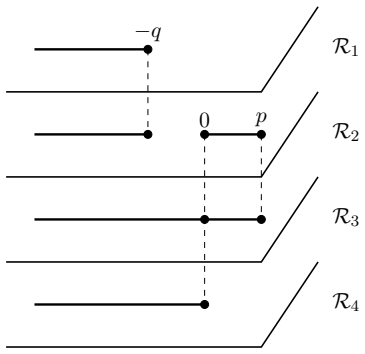
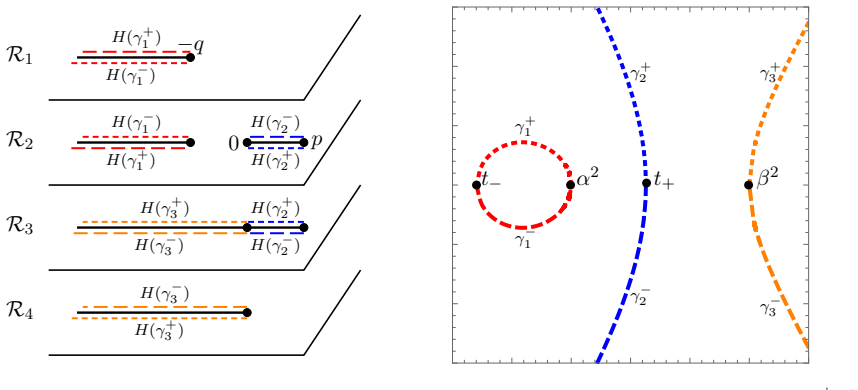
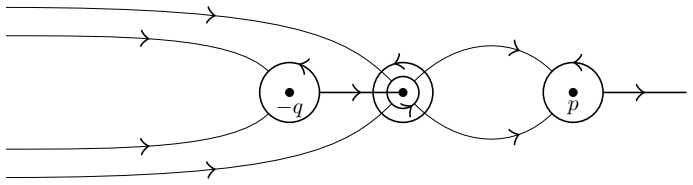
The argument is carried by three interlocking constructions. First, the vector equilibrium problem: three measures of total masses $1/2, 1, 1/2$ interacting through $I(\nu_1)+I(\nu_2)+I(\nu_3)-I(\nu_1,\nu_2)-I(\nu_2,\nu_3)$, with the upper constraint $\nu_1\le\sigma$ for the singular density $\alpha/(\pi\sqrt{|x|})$ and the external field $2(\beta-\alpha)\sqrt{x}$ on $\nu_2$; the paper proves existence, uniqueness, and the one-cut structure of its minimizer using an iterative balayage argument together with a convexity criterion. Second, the four-sheeted Riemann surface glued across the three supports, which is shown to have genus $0$: its rational uniformization $z=t/h(t)^2$, $\xi=h(t)$ rewrites the spectral curve as a quartic, and the origin is an index-3 branch point whose only integer-compatible ramification forces the $x^{-2/3}$ singularity of the density. Third, the $4\times 4$ Riemann-Hilbert problem that encodes the correlation kernel from mixed-type multiple orthogonal polynomials with modified Bessel weights, analyzed by steepest descent along $Y\to X\to T\to S\to R$: the global parametrix is built from the uniformization, the parametrices at $p$ and $-q$ are Airy kernels, and the parametrix at the origin wraps the Meijer-G model problem for chains of coupled positive-definite matrices, matched with the two-circle technique of a fixed outer circle and a shrinking inner one.
What would settle it
Run the model: generate $X_1,X_2$ from (1.1) with fixed $\alpha<\beta$ (for instance $\alpha=1$, $\beta=2$) at large $n$, form $X_1X_2$, and histogram the squared singular values scaled by $n^2$; then compare with $d\mu_2/dx$ computed either numerically from the vector equilibrium problem or directly from the parametric formula $x=t/h(t)^2$, $d\mu_2/dx=\pi i\,h(t)$ for $t\in\gamma^-_2$. A mismatch in the bulk, a wrong edge $p$, or a missing $x^{-2/3}$ divergence at the origin would refute Theorem 2.3. A cheaper check: solve the quartic discriminant (3.61) and verify that its two real roots equal the closed-form endpoints (2.10) and (2.8).
Extended reading notes
Core claim
The central claim, Theorem 2.3, is that the correlation kernel $K_n$ of the determinantal point process formed by the squared singular values of $\hat{Y}=X_1X_2$ satisfies, uniformly for $x$ in compact subsets of $(0,\infty)$, $$\lim_{n\to\infty} nK_n($n^{2}$x, $n^{2}$x) = \frac{d\mu_2}{dx}(x),$$ where $(\mu_1,\mu_2,\mu_3)$ is the unique minimizer of the energy $\mathcal{E}(\nu_1,\nu_2,\nu_3)=I(\nu_1)+I(\nu_2)+I(\nu_3)-I(\nu_1,\nu_2)-I(\nu_2,\nu_3)+2(\beta-\alpha)\int\sqrt{x}\,d\nu_2(x)$ over triples with $|\nu_1|=|\nu_3|=1/2$, $|\nu_2|=1$, constraint $\nu_1\le\sigma$ on $\mathbb{R}_-$ with $d\sigma/dx=\alpha/(\pi\sqrt{|x|})$, and $\nu_2$ supported on $\mathbb{R}_+$. The minimizer is structurally rigid: $\operatorname{supp}(\sigma-\mu_1)=(-\infty,-q]$, $\operatorname{supp}\mu_2=[0,p]$ with the explicit algebraic endpoints (2.10) and (2.8), densities with square-root vanishing at $p$ and $-q$ and an $x^{-2/3}$ blow-up at the origin, and $\mu_3$ equal to half the balayage of $\mu_2$ onto the negative axis. The Cauchy-transform combinations $\xi_1,\ldots,\xi_4$ of these measures are the four branches of the spectral curve $\xi^4-\frac{\alpha^2+\beta^2}{z}\xi^2+\frac{\alpha^2-\beta^2}{z^2}\xi+\frac{\alpha^2\beta^2}{z^2}=0$, rationally parametrized by $(z,\xi)=(t/h(t)^2,h(t))$ with $h(t)=\frac{t^2-(\alpha^2+\beta^2)t+\alpha^2\beta^2}{\beta^2-\alpha^2}$, which yields an explicit parametric formula for the density $d\mu_2/dx$. At the hard edge, Theorem 2.4 identifies the scaled kernel limit as the universal Meijer-G kernel $\mathcal{K}_{\nu,\kappa}$, independent of $\alpha,\beta$; the sine and Airy limits in the bulk and at the soft edge are stated as further consequences of the same asymptotic analysis.
Load-bearing premise
Everything rests on the equilibrium minimizer having a one-cut shape — one interval starting at the origin for the positive-axis measure and one unbounded interval of saturation for the negative-axis constraint — a structure the paper derives from a convexity computation together with a classical potential-theory criterion; if any admissible pair $\alpha<\beta$ produced a gap in the support or a second contact interval, the global parametrix and the main convergence statement would fail as written.
Editorial extensions
If this is right
- The zeros of the average characteristic polynomial of $\hat{Y}^*\hat{Y}$, scaled by $n^2$, accumulate according to $\mu_2$, and the empirical law of the squared singular values converges weakly to the same measure.
- The hard-edge scaling limit is the universal Meijer-G kernel at every fixed coupling $\alpha<\beta$, with the explicit microscopic scale $1/(n(\beta^2-\alpha^2))$; this extends the previously known hard-edge results from specially tuned couplings to the full admissible range.
- In the bulk of the spectrum the sine kernel governs, and at the soft edge $x=p$ the Airy kernel governs; the paper states these as consequences of the steepest descent analysis with all ingredients present, although the endpoint details are not written out.
- The spectral curve yields an explicit parametric formula for the limiting density — the graph of $d\mu_2/dx$ is $(t/h(t)^2,\pi i\,h(t))$ along the contour $\gamma^-_2$ — so the density can be evaluated numerically without solving any variational problem.
- As the coupling parameter moves across its range, the model interpolates between the Laguerre-type regime and the product-of-two-Ginibre regime, and the theorem supplies the limiting density along the entire interpolation path rather than only at the endpoints.
Reading between the lines
- The equilibrium scheme (constraint on the left, external field on the right, free third measure) is presumably the template for longer chains of coupled products: any chain of measures with alternating interaction signs gives the same formal energy, and a genus-zero uniformization should again yield explicit densities. This extrapolation is ours, not the paper's.
- The $x^{-2/3}$ blow-up at the hard edge is forced by an index-3 branch point, a mechanism that does not depend on the Bessel weights; if that reading is correct, the same exponent should appear at any hard edge where three sheets of a spectral curve meet, with a third-order Meijer-G kernel as the microscopic limit.
- Because $\mu_3$ is the half-balayage of $\mu_2$, the whole minimizer is determined by $\mu_2$ and the single endpoint $q$; a practical consequence is that the constrained equilibrium problem can be treated numerically as a one-function problem on $[0,p]$.
Signed reviews
Editorial analysis
A structured set of objections, weighed in public.
Referee Report
Summary. The paper studies the squared singular values of the product X1 X2 of two coupled rectangular complex Gaussian matrices in the confluent case where the coupling matrix has a single singular value alpha < beta. The squared singular values form a determinantal point process whose correlation kernel Kn is expressed through mixed-type multiple orthogonal polynomials associated with modified Bessel functions. The authors introduce a vector equilibrium problem for three measures with an upper constraint on the first measure and an external field on the second, prove existence, uniqueness, and structural properties of the minimizer (Theorem 2.1), identify an explicit algebraic spectral curve of genus zero (Theorem 2.2), and then perform a Deift/Zhou steepest descent analysis of an associated 4x4 Riemann-Hilbert problem. This yields the main results: the limiting bulk density of the squared singular values is the second component of the equilibrium measure (Theorem 2.3), and the hard-edge scaling limit is the Meijer-G kernel (Theorem 2.4). The proof occupies most of the paper, with global, Airy, and Meijer-G parametrices, including a recent double-matching technique of Kuijlaars and Molag.
Significance. If correct, the paper resolves an open question raised by Akemann and Strahov by treating alpha and beta as independent parameters rather than coupled ones, and it extends the hard-edge results of Liu. The vector equilibrium formulation is natural and the explicit spectral curve with closed-form endpoints p and q is a concrete and valuable output. The four-sheeted Riemann surface and its rational uniformization are carefully developed, and the discriminant computations are explicit and checkable. The proof is technically substantial: the origin parametrix construction follows the Kuijlaars-Molag strategy with two matching conditions, and the auxiliary estimates in Lemmas 10.7, 10.12, and 12.1 are useful and clearly stated. The central results are falsifiable, and no free parameters are fitted to the limiting data. The main weakness is a circularity in the written order of the proof of the strict variational inequality (3.42), which feeds into the exponential decay estimates needed for the Riemann-Hilbert analysis.
major comments (2)
- [Sections 3.4-3.7, Proposition 3.5 and Remark 3.8] The proof of the strict inequality (3.42) in Proposition 3.5 cites 'Remark 3.8 below', and Remark 3.8 is established after Theorem 2.1 using the discriminant of the spectral curve (2.16), i.e., after Theorem 2.2. Theorem 2.2 is proved in Section 3.6 using Proposition 3.7, which in turn relies on the support assertions of Proposition 3.5. On inspection, Theorem 2.2 does not appear to use the strict inequality (3.42) itself; the dependency chain passes through (3.38), (3.39), (3.41), and (3.43), as the footnote in Proposition 3.5 states. Nevertheless, the written order is circular, and since (3.42) is used in Proposition 4.3 and then in Lemma 11.2 to obtain exponential decay of the jumps, the proof of Theorem 2.3 is incomplete as written. The authors should either prove the nonvanishing of xi_1 - xi_2 on (-q,0) directly, or restructure the presentation so that the spectral curve and the discriminant are derived before the strict part of Proposition 3.5, without invoking (3.42) in that derivation.
- [Section 12.1, proof of Theorem 2.3] The proof of Theorem 2.3 fully computes the limit only for x,y in a fixed compact subinterval (delta, p-delta) of the bulk. The theorem, however, claims uniform convergence on every compact subset of (0, infinity), which includes the soft edge x = p and the region x > p. These cases are dismissed with brief statements that they 'can be handled similarly' with an Airy parametrix or by the exponential decay of phi_2. Given that Theorem 2.3 is the central result, the endpoint and outside-support estimates should be written out, or the theorem statement should be narrowed to match the proof as presented.
minor comments (5)
- [Section 3.4, proof of Proposition 3.5] The text says 'supp mu_3 = R_+' in the paragraph after (3.38), but the support of mu_3 should be R_- as stated in Theorem 2.1(c) and elsewhere; this is a typo.
- [Section 5, definition of sigma_3] The display defining sigma_3 as the matrix [[0,1],[-1,0]] is not the standard third Pauli matrix and is inconsistent with the subsequent use of z^{a sigma_3} as a diagonal matrix. It should be diag(1,-1).
- [Abstract and Section 2.4] The abstract promises local Sine and Airy universality results, but these are not stated as formal theorems and the text explicitly says the details are omitted. The authors should either state these results as theorems with proofs or soften the abstract and the discussion in Section 2.4.
- [Lemma 3.2 and Proposition 3.4] Lemma 3.1 establishes monotonicity, not strict monotonicity, yet the proof of Lemma 3.2 refers to a 'strictly increasing' quotient. The argument works with non-strict monotonicity, but the wording should be corrected.
- [Figure 2 caption] The caption mentions arcs gamma_k^+- for k = 1,2,3,4, but only k = 1,2,3 are defined.
Circularity Check
No significant circularity: the vector equilibrium problem is model-defined, the steepest descent proof is self-contained, and the Proposition 3.5/Remark 3.8 forward reference is not a cycle.
full rationale
The vector equilibrium problem (2.6) is defined directly from the model parameters α and β and the constraints (E1)-(E4); it is not fitted to the limiting correlation kernel, and existence/uniqueness is cited to external sources [9,34]. Theorem 2.3 is obtained through an independent Deift/Zhou steepest descent analysis of the 4x4 RH problem, with the final identification n K_n(n^2 x, n^2 x) → dµ2/dx coming from the Sokhotski-Plemelj formula, not from a fitted parameter renamed as a prediction. The only potentially suspicious dependency is Proposition 3.5's invocation of 'Remark 3.8 below' to prove the strict inequality (3.42). Tracing the dependency chain shows this is an expositional forward reference rather than a circle: Proposition 3.5 first establishes the support structure (3.38) and the equalities (3.39), (3.41), (3.43) without using (3.42); Theorem 2.2 and Theorem 2.1 are proved from those support and equality statements, not from (3.42); and Remark 3.8 follows from Theorem 2.2/2.1 and the discriminant (3.61). The footnote in Proposition 3.5 explicitly says the nonvanishing argument relies on the equalities and not on the corresponding inequalities. Thus the dependency graph is acyclic once the strict inequality is isolated. The self-citation to Zhang [57] supplies the RH characterization of the biorthogonal ensemble from prior work, but the large-n asymptotics, parametrices, and limiting formulas are derived in the present paper; the hard-edge comparison with Liu [42] in Theorem 2.4 is made only after K∞ is shown to be independent of α and β, so it serves as an external benchmark rather than a circular reduction.
Assumptions & free parameters
assumptions (5)
- domain assumption The coupled matrix model (1.1) is well defined for alpha < beta and M >= L >= n, and the squared singular values form the biorthogonal ensemble (2.3).
- standard math Existence and uniqueness of the minimizer of the vector equilibrium problem (2.6) follows from standard constrained potential theory.
- standard math The correlation kernel admits the RH Problem 2.5 and the representation (2.23) via mixed-type multiple orthogonal polynomials associated with modified Bessel functions.
- domain assumption n is assumed even so that n1 = n2 = n/2.
- standard math Standard Airy and Meijer-G local parametrices exist with the stated matching properties.
Cite this review
Pith. "Pith review of Large n limit for the product of two coupled random matrices." pith.science (2026). https://pith.science/paper/GKCX75RA
@misc{pith2026190805708,
  author       = {Pith},
  title        = {Pith review of: Large n limit for the product of two coupled random matrices},
  year         = {2026},
  howpublished = {\url{https://pith.science/paper/GKCX75RA}},
  note         = {Machine review of arXiv:1908.05708}
}
abstract
For a pair of coupled rectangular random matrices we consider the squared singular values of their product, which form a determinantal point process. We show that the limiting mean distribution of these squared singular values is described by the second component of the solution to a vector equilibrium problem. This vector equilibrium problem is defined for three measures with an upper constraint on the first measure and an external field on the second measure. We carry out the steepest descent analysis for a 4 $\times$ 4 matrix-valued Riemann-Hilbert problem, which characterizes the correlation kernel and is related to mixed type multiple orthogonal polynomials associated with the modified Bessel functions. A careful study of the vector equilibrium problem, combined with this asymptotic analysis, ultimately leads to the aforementioned convergence result for the limiting mean distribution, an explicit form of the associated spectral curve, as well as local Sine, Meijer-G and Airy universality results for the squared singular values considered.
Figures
Figures from the paper (2 more)
Reference graph
Works this paper leans on
-
[42]
Liu, Singular values for products of two coupled random matrices: hard edge phase transition, Constr
D.-Z. Liu, Singular values for products of two coupled random matrices: hard edge phase transition, Constr. Approx. 47 (2018), 487–528
work page 2018
-
[57]
L. Zhang, Mixed type multiple orthogonal polynomials associated with the modified Bessel functions and products of two coupled random matrices, J. Approx. Theory 213 (2017), 92–119. 79
work page 2017
-
[1]
G. Akemann, P. H. Damgaard, J. C. Osborn and K. Splittorff, A new chiral two-matrix theory for Dirac spectra with imaginary chemical potential, Nucl. Phys. B 766 (2007), 34–76. 75
work page 2007
-
[2]
G. Akemann and J. R. Ipsen, Recent exact and asymptotic results for products of inde- pendent random matrices, Acta Phys. Polon. B 46 (2015), 1747–1784
work page 2015
-
[3]
G. Akemann, J. R. Ipsen and M. Kieburg, Products of rectangular random matrices: Sin- gular values and progressive scattering, Phys. Rev. E 88 (2013), 052118 13 pp
work page 2013
-
[4]
G. Akemann, M. Kieburg and L. Wei, Singular value correlation functions for products of Wishart random matrices, J. Phys. A: Math. Theor. 46 (2013), 275205 22 pp
work page 2013
-
[5]
G. Akemann and E. Strahov, Product matrix processes for coupled multi-matrix models and their hard edge scaling limits, Ann. Henri Poincar´ e 19 (2018), 2599–2649
work page 2018
-
[6]
G. Akemann and E. Strahov, Hard edge limit of the product of two strongly coupled random matrices, Nonlinearity 29 (2016), 3743–3776
work page 2016
Show all 57 references
-
[7]
Akemann and E
G. Akemann and E. Strahov, Dropping the independence: singular values for products of two coupled random matrices, Comm. Math. Phys. 345 (2016), 101–140
2016
-
[8]
A. I. Aptekarev, P. M. Bleher and A. B. J. Kuijlaars, Large n limit of Gaussian random matrices with external source. II, Comm. Math. Phys. 259 (2005), 367–389
2005
-
[9]
Beckermann, V
B. Beckermann, V. Kalyagin, A. Matos and F. Wielonsky, Equilibrium problems for vector potentials with semidefinite interaction matrices and constrained masses, Constr. Approx. 37 (2013), 101-134
2013
-
[10]
Balogh and M
F. Balogh and M. Bertola, Regularity of a vector potential problem and its spectral curve, J. Approx. Theory 161 (2009), 353-370
2009
-
[11]
Bertola and T
M. Bertola and T. Bothner, Universality conjecture and results for a model of several coupled positive-definite matrices, Comm. Math. Phys. 337 (2015), 1077–1141
2015
-
[12]
Bertola, B
M. Bertola, B. Eynard and J. Harnad, Differential systems for biorthogonal polynomials appearing in 2-matrix models and the associated Riemann-Hilbert problem, Comm. Math. Phys. 243 (2003), 193-240
2003
-
[13]
Bertola, B
M. Bertola, B. Eynard and J. Harnad, Semiclassical orthogonal polynomials, matrix models and isomonodromic tau functions, Comm. Math. Phys. 263 (2006), 401-437
2006
-
[14]
Bertola, M
M. Bertola, M. Gekhtman and J. Szmigielski, Cauchy-Laguerre two-matrix model and the Meijer-G random point field, Comm. Math. Phys. 326 (2014), 111–144
2014
-
[15]
P. M. Bleher and A. B. J. Kuijlaars. Large n limit of Gaussian random matrices with external source, part III: double scaling limit, Comm. Math. Phys. 270 (2007), 481–517
2007
-
[16]
P. M. Bleher and A. B. J. Kuijlaars, Large n limit of Gaussian random matrices with external source. I, Comm. Math. Phys. 252 (2004), 43–76
2004
-
[17]
Borodin, Biorthogonal ensembles, Nucl
A. Borodin, Biorthogonal ensembles, Nucl. Phys. B 536 (1999), 704–732
1999
-
[18]
Bougerol and J
P. Bougerol and J. Lacroix, Products of random matrices with applications to Schr¨ odinger operators (P. Huber and M. Rosenblatt, eds.), Progress in probability and statistics, vol. 8, Birkh¨ auser, Boston, 1985
1985
-
[19]
Burda, A
Z. Burda, A. Jarosz, G. Livan, M. A. Nowak and A. Swiech, Eigenvalues and singular values of products of rectangular Gaussian random matrices, Phys. Rev. E 82 (2010), 061114; - the extended version Acta Phys. Polon. B 42 (2011), 939–985. 76
2010
-
[20]
Crisanti, G
A. Crisanti, G. Paladin and A. Vulpiani, Products of Random Matrices in Statistical Physics, Springer Series in Solid-State Sciences 104, Springer, Heidelberg 1993
1993
-
[21]
Daems and A
E. Daems and A. B. J. Kuijlaars, Multiple orthogonal polynomials of mixed type and non-intersecting Brownian motions, J. Approx. Theory 146 (2007), 91–114
2007
-
[22]
Deift, Orthogonal polynomials and random matrices: a Riemann-Hilbert approach, Courant Lecture Notes 3
P. Deift, Orthogonal polynomials and random matrices: a Riemann-Hilbert approach, Courant Lecture Notes 3. New York University, 1999
1999
-
[23]
Deift, T
P. Deift, T. Kriecherbauer, K. T.-R. McLaughlin, S. Venakides and X. Zhou, Uniform asymptotics for polynomials orthogonal with respect to varying exponential weights and applications to universality questions in random matrix theory. Comm. Pure Appl. Math. 52 (1999), 1335–1425
1999
-
[24]
Delvaux, A
S. Delvaux, A. B. J. Kuijlaars, P. Rom´ an and L. Zhang, Non-intersecting squared Bessel paths with one positive starting and ending point, J. Anal. Math. 118 (2012), 105–159
2012
-
[25]
P. D. Dragnev, Constrained energy problems for logarithmic potentials, Ph.D. Thesis, University of South Florida, Tampa, FL, 1997
1997
-
[26]
P. D. Dragnev and A. B. J. Kuijlaars, Equilibrium problems associated with fast decreasing polynomials, Proc. Amer. Math. Soc. 127 (1999), 1065–1074
1999
-
[27]
P. D. Dragnev and E. B. Saff, Constrained energy problems with applications to orthogonal polynomials of a discrete variable, J. Anal. Math. 72 (1997), 223–259
1997
-
[28]
Duits and A
M. Duits and A. B. J. Kuijlaars, Universality in the two matrix model: a Riemann-Hilbert steepest descent analysis, Comm. Pure Appl. Math. 62 (2009), 1076–1153
2009
-
[29]
Duits, A
M. Duits, A. B. J. Kuijlaars and M. Y. Mo, The Hermitian two matrix model with an even quartic potential, Mem. Amer. Math. Soc. 217 (2012), no. 1022, v+105 pp
2012
-
[30]
A. S. Fokas, A. R. Its and A. V. Kitaev, The isomonodromy approach to matrix models in 2D quantum gravity, Comm. Math. Phys. 147 (1992), 395–430
1992
-
[31]
P. J. Forrester, Eigenvalue statistics for product complex Wishart matrices, J. Phys. A: Math. Theor. 47 (2014), 345202
2014
-
[32]
P. J. Forrester and M. Kieburg, Relating the Bures measure to the Cauchy two-matrix model, Comm. Math. Phys. 342 (2016), 151–187
2016
-
[33]
Furstenberg and H
H. Furstenberg and H. Kesten, Products of random matrices, Ann. Math. Stat. 31 (1960), 457–469
1960
-
[34]
Hardy and A
A. Hardy and A. B. J. Kuijlaars, Weakly admissible vector equilibrium problems, J. Approx. Theory 164 (2012), 854–868
2012
-
[35]
A. B. J. Kuijlaars, Universality, in the Oxford handbook of random matrix theory, pages 103–134, Oxford Univ. Press, Oxford, 2011
2011
-
[36]
A. B. J. Kuijlaars, A. Mart´ ınez-Finkelstein and F. Wielonsky, Non-intersecting squared Bessel paths and multiple orthogonal polynomials for modified Bessel weights, Comm. Math. Phys. 286 (2009), 217–275
2009
-
[37]
A. B. J. Kuijlaars and L. Molag, The local universality of Muttalib-Borodin biorthogonal ensembles with parameter θ = 1/2, Nonlinearity 32 (2019), 3023–3081. 77
2019
-
[38]
A. B. J. Kuijlaars and D. Stivigny, Singular values of products of random matrices and polynomial ensembles, Random Matrices Theory Appl. 3 (2014), 1450011 22 pp
2014
-
[39]
A. B. J. Kuijlaars and A. Tovbis, The supercritical regime in the normal matrix model with cubic potential, Adv. Math. 283 (2015), 530–587
2015
-
[40]
A. B. J. Kuijlaars and L. Zhang, Singular values of products of Ginibre random matrices, multiple orthogonal polynomials and hard edge scaling limits, Comm. Math. Phys. 332 (2014), 759–781
2014
-
[41]
N. S. Landkof, Foundations of modern potential thoery. Grundlehren der mathematischen Wissenschaften, 180. Springer-Verlag, Berlin, 1997
1997
-
[43]
Wang and L
D.-Z Liu, D. Wang and L. Zhang, Bulk and soft-edge universality for singular values of products of Ginibre random matrices, Ann. Inst. Henri Poincar´ e - Prob. Stat. 52 (2016), 1734–1762
2016
-
[44]
Mart´ ınez-Finkelstein and G
A. Mart´ ınez-Finkelstein and G. L. F. Silva, Spectral curves, variational problems, and the hermitian matrix model with external source, arXiv:1907.08108, 2019, 75 pp
1907 arXiv
-
[45]
M. L. Mehta, Random Matrices, 3rd ed., Elsevier/Academic Press, Amsterdam, 2004
2004
-
[46]
Miranda, Algebraic Curves and Riemann Surfaces, vol
R. Miranda, Algebraic Curves and Riemann Surfaces, vol. 5 of Graduate Studies in Math- ematics, American Mathematical Society, Providence, RI, 1995
1995
-
[47]
N. I. Muskhelishvili, Singular integral equations: Boundary problems of functions theory and their applications to mathematical physics, Revised translation from the Russian, edited by J. R. M. Radok, Wolters-Noordhoff Publishing, Groningen, 1972, xii+7–447
1972
-
[48]
Neuschel, Plancherel-Rotach formulae for average characteristic polynomials of products of Ginibre random matrices and the Fuss-Catalan distribution, Random Matrices Theory Appl
T. Neuschel, Plancherel-Rotach formulae for average characteristic polynomials of products of Ginibre random matrices and the Fuss-Catalan distribution, Random Matrices Theory Appl. 3 (2014), 1450003 18 pp
2014
-
[49]
F. W. J. Olver, D. W. Lozier, R. F. Boisvert and C. W. Clark, editors, NIST Handbook of Mathematical Functions, Cambridge University Press, Cambridge 2010. Print companion to [DLMF]
2010
-
[50]
J. C. Osborn, Universal results from an alternate random matrix model for QCD with a baryon chemical potential, Phys. Rev. Lett. 93 (2004), 222001–222004
2004
-
[51]
Pommerenke, Univalent functions - With a chapter on quadratic differentials by Gerd Jensen, Vandenhoeck & Ruprecht, G¨ ottingen, 1975
C. Pommerenke, Univalent functions - With a chapter on quadratic differentials by Gerd Jensen, Vandenhoeck & Ruprecht, G¨ ottingen, 1975
1975
-
[52]
Ransford, Potential theory in the complex plane, London Mathematical Society Student Texts, 28, Cambridge University Press, Cambridge, 1995
T. Ransford, Potential theory in the complex plane, London Mathematical Society Student Texts, 28, Cambridge University Press, Cambridge, 1995
1995
-
[53]
E. B. Saff and V. Totik, Logarithmic potentials with external field. Grundlehren der math- ematischen Wissenschaften, 316. Springer, Berlin, 1997
1997
-
[54]
J. R. Sendra, F. Winkler and S. P´ erez-D´ ıaz, Rational algebraic curves: a computer algebra approach, Algorithms and Computation in Mathematics, vol. 22, Springer, Berlin, 2008. 78
2008
-
[55]
Tsuji, Potential theory in modern function theory
M. Tsuji, Potential theory in modern function theory. 2nd edition, Chelsea, New York, 1975
1975
-
[56]
Van Assche, J
W. Van Assche, J. S. Geronimo and A. B. J. Kuijlaars, Riemann-Hilbert problems for multiple orthogonal polynomials, in Special functions 2000: current perspective and future directions (J. Bustoz et al., eds.), Kluwer Acad. Publ., Dordrecht, 2001, pp. 23–59
2000
Reviewed August 14, 2026 · model on record in the stance chip above.
Discussion (0). Continue with ORCID to comment.