REVIEW 2 major objections 5 minor 27 references
Generalized Gaussian Multiterminal Source Coding in the High-Resolution Regime
T0 review · 2 major / 5 minor · reviewed 2026-08-14 · deepseek-v4-flash
Pith's one-line read A single conjectured formula characterizes the high-resolution rate gap in generalized Gaussian multiterminal source coding, and the paper proves it for up to three sources.
desk verdict A clean conjecture for the high-resolution gap in Gaussian multiterminal source coding, verified for L≤3, with a proof sound in outline but with a sketched lower-bound step; the stress-test factor-inversion concern is a misreading. read the letter →
The pith
A machine-rendered reading of the paper's core claim, the machinery that carries it, and where it could break.
The reading
What carries the argument
The argument rests on exact semidefinite-programming characterizations of the sum rate for Gaussian multiterminal coding, obtained in earlier work for the relevant topologies. The load-bearing asymptotic identity is the expansion of the error-covariance matrix $D=(\Theta+\Xi^{-1})^{-1}$ when the auxiliary matrix $\Xi$ is small: $D=\Xi-\Xi\Theta\Xi+o(d^2)$ in the relevant entries. Setting the diagonal of $D$ to $d+o(d)$ forces the off-diagonal entries to $-\theta_{i,j}d^2+o(d^2)$, giving $\det D=d^L-\bigl(\sum_{(i,j)\in E(\mathcal{S})}\theta_{i,j}^2\bigr)d^{L+2}+o(d^{L+2})$. Since the centralized rate is $r_{\mathcal{C}}(d)=\frac{1}{2}\log(\det\Gamma/d^L)$, the logarithm of this determinant produces exactly the conjectured half-times-squares gap.
What would settle it
Take the four-source fully distributed system $\mathcal{S}=\{\{1\},\{2\},\{3\},\{4\}\}$ with a covariance matrix whose precision matrix has nonzero off-diagonal entries. Solve the sum-rate SDP from [12] at decreasing distortion $d$ and compare $r_{\mathcal{S}}(d)-r_{\mathcal{C}}(d)$ with $\frac{1}{2}\sum_{1\le i<j\le 4}\theta_{i,j}^2d^2$; a coefficient mismatch would refute Conjecture 1. For a direct check of the three-source proof, compute the SDP minimizer $D^*$ in Lemma 2 for a concrete $\Gamma$ with large $\theta_{1,2}$ and verify whether $d^*_{1,2}=-\theta_{1,2}d^2+o(d^2)$ and $d^*_{\ell,\ell}=d+o(d)$.
Extended reading notes
Core claim
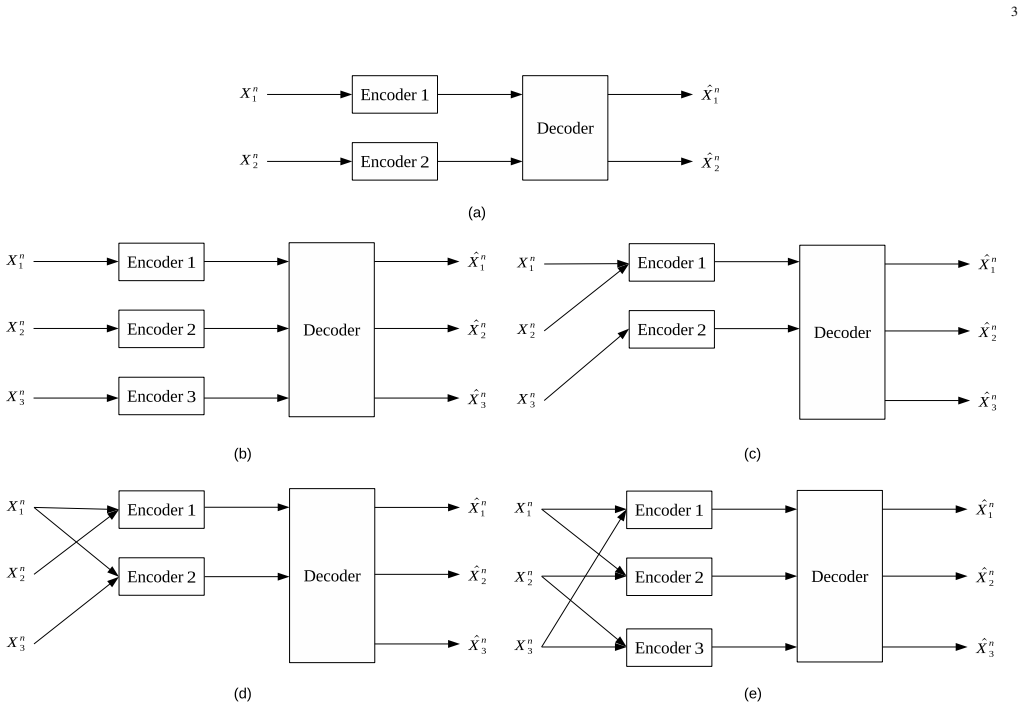
The central claim is Conjecture 1: for any cover $\mathcal{S}$ of $\{1,\ldots,L\}$, $r_{\mathcal{S}}(d)-r_{\mathcal{C}}(d)=\frac{1}{2}\sum_{(i,j)\in E(\mathcal{S})}\theta_{i,j}^2d^2+o(d^2)$, where $E(\mathcal{S})$ is the set of source pairs never contained together in any encoder's subset. Theorem 1 establishes this for $L\le 3$. The proof covers all five non-redundant covers up to relabeling: the two-source distributed system, the three-source fully distributed system, and the three-source systems with encoder subsets $\{\{1,2\},\{3\}\}$, $\{\{1,2\},\{1,3\}\}$, and $\{\{1,2\},\{1,3\},\{2,3\}\}$. In the last case the gap is actually $o(d^2)$, so the fully paired three-encoder system matches centralized coding through second order.
Load-bearing premise
In the lower-bound halves of the three-source proofs, the optimizer of the semidefinite program is assumed to have error-covariance diagonal entries $d+o(d)$ and off-diagonal entries $-\theta_{i,j}d^2+o(d^2)$; if some positive-definite covariance produced an optimizer with a different asymptotic shape, the claimed second-order gap would not follow from these arguments.
Editorial extensions
If this is right
- For $L\le 3$, the high-resolution rate-distortion function of every generalized Gaussian multiterminal system is explicitly $r_{\mathcal{C}}(d)+\frac{1}{2}\sum_{(i,j)\in E(\mathcal{S})}\theta_{i,j}^2d^2+o(d^2)$, with no hidden dependence on the topology beyond the set $E(\mathcal{S})$.
- Systems whose encoder subsets cover every pair of sources pay no second-order penalty: the gap is $o(d^2)$, and for the three-source fully paired system the paper shows the rates are equal for all small $d$.
- The gap depends only on the squared entries of the precision matrix, not on the individual variances $\gamma_{i,i}$ or on the signs of the correlations.
- Because the sum of $\theta_{i,j}^2$ over $E(\mathcal{S})$ decreases when a cover is refined, the formula reproduces the known ordering $r_{\mathcal{C}}\le r_{\mathcal{S}}\le r_{\mathcal{S}'}$ for dominating covers $\mathcal{S}'$.
- A full proof for arbitrary $L$ would reduce high-resolution multiterminal coding to computing a graph-theoretic quantity from the encoder hypergraph and the precision matrix.
Reading between the lines
- If the conjecture holds for all $L$, the second-order penalty is governed only by conditional dependencies between sources that no encoder sees together: pairs with $\theta_{i,j}=0$, which are conditionally independent given the other sources, contribute nothing, tying the formula to Gaussian graphical models.
- The same $d^2$ scaling suggests that the next-order $o(d^2)$ term may admit a systematic expansion in terms of triples of sources or cycles in the encoder hypergraph; the exact $L=3$ formulas in the paper could calibrate such an expansion before tackling $L=4$.
- A numerical test for $L=4$ is immediately available: the SDP characterizations extend to arbitrary covers, so one can compute $r_{\mathcal{S}}(d)$ at small $d$ for randomly chosen precision matrices and compare the fitted quadratic coefficient with the conjectured expression.
Signed reviews
Editorial analysis
A structured set of objections, weighed in public.
Referee Report
Summary. The paper proposes Conjecture 1: for any generalized Gaussian multiterminal source coding system in the high-resolution regime, the gap between the distributed sum rate r_S(d) and the centralized rate r_C(d) is asymptotically (1/2) times the sum over pairs (i,j) that never appear together in any encoder of theta_{i,j}^2 d^2, plus o(d^2). The main result, Theorem 1, verifies this conjecture for L <= 3. The proof reduces to five non-redundant covers up to relabeling, and uses exact semidefinite-programming characterizations from prior work (Wang-Chen-Wu, Wang-Chen, Oohama) together with high-resolution determinant expansions. The upper-bound directions are tied to published exact characterizations; the lower-bound tightness arguments in Lemmas 2 and 3 rely on asserted asymptotic structure of the optimal distortion covariance matrix D*.
Significance. If the result is correct, it gives a remarkably clean topology-dependent formula for the high-resolution behavior of a problem whose exact solution is generally not available in closed form, and it unifies the known two-terminal and three-terminal cases. The conjecture is falsifiable and the consistency checks with cover domination and equivalence are valuable. The proof strategy is sound in outline: it reduces to a small list of covers and leverages existing exact characterizations rather than assuming the conjecture. The paper is honest that the full conjecture is open for L > 3. However, the manuscript contains a load-bearing notational/sign error in the displayed exact rate formulas, and the lower-bound proofs in Lemmas 2 and 3 omit the key asymptotic derivation of the optimizer D*. Both issues are fixable, but they must be addressed before the proof can be considered complete.
major comments (2)
- [Section III-A, Lemma 1; Section III-D, Lemma 4; Appendix B near Eq. (33)] The displayed exact rate formulas place the factor (1 + sqrt(1 + 4 theta^2 d1 d2)) in the denominator, i.e., r = (1/2) log( det(Gamma) / (2 d1 d2 (1 + sqrt(...))) ). For independent sources (theta=0) and d1=d2=d, this gives r = (1/2) log( det(Gamma) / (4 d^2) ), which is (1/2) log 4 below r_C(d) = (1/2) log( det(Gamma) / d^2 ) and violates the fundamental inequality r_S(d) >= r_C(d) in Eq. (3). The subsequent algebra in Section III-A and Eq. (23) treats the factor as if it were in the numerator, and only that version yields the claimed positive O(d^2) gap. The same inverted-factor pattern appears in the auxiliary expression r-tilde in Appendix B near Eq. (33). Please correct the factor placement systematically and re-derive the expansions; the intended asymptotic result is evidently recoverable.
- [Section III-B, after Eq. (14), and Section III-C, after Eq. (21)] The lower-bound tightness arguments are incomplete at a load-bearing point. The sentences 'It can be shown by leveraging (10) and (11) that xi*_{ell,ell}=d+o(d), ..., and d*_{i,j}=-theta_{i,j} d^2 + o(d^2)' assert exactly the asymptotic structure of the optimizer needed to obtain det(D*) = d^3 - (sum theta^2) d^5 + o(d^5). No derivation is displayed, and this asymptotic structure is essential for the lower bound. Please supply the missing argument or cite a specific lemma from a prior paper that proves it.
minor comments (5)
- [Fig. 1 caption] The caption contains a typo: 'wi th with L sources' should be 'with L sources'.
- [Section III-B and III-C] The word 'wich' appears twice ('wich is contradictory'); it should be 'which'.
- [Appendix C, definition of U_{2,3}] In the branch theta_{1,2} > 0 of the definition of U_{2,3}, the noise variable is written N_{1,2}; it should be N_{2,3}.
- [Section III-D, after Eq. (23)] The displayed closed-form optimizer for the convex problem is garbled: the variables d^2 and d1 appear to be misplaced in the fraction. Please rewrite the expression and verify that it leads to the stated asymptotics (24) and (25).
- [Section III-D and III-E] The statements 'For any d sufficiently close to 0, we can choose alpha_ell such that ...' in the proofs of Lemmas 4 and 5 would benefit from a brief continuity or monotonicity argument showing that the desired distortion values are simultaneously attainable.
Circularity Check
No significant circularity: the asymptotic conjecture is checked against independent exact characterizations, not assumed in its own proof.
full rationale
Conjecture 1 is not used as a premise in its verification. For each cover the proof reduces to exact rate-distortion characterizations from prior published work ([12, Thms 5/6], [15, Thm 9], [16, Thms 8/9], and the Wagner-Tavildar-Viswanath two-terminal result [2]) plus standard determinant expansions and convex optimization. These cited results are exact, parameter-free, peer-reviewed, and their assumptions do not include the conjectured asymptotic gap; several are co-authored by the present authors, but under Rule 4 that self-citation is independent support and does not raise the circularity score. The asymptotic estimates for the SDP optimizers in Lemmas 2 and 3 are asserted tersely ('It can be shown by leveraging (10) and (11)'), which is a completeness/correctness concern, not a circular reduction. The algebraic factor-placement inconsistency flagged in the skeptical reading (displayed formulas placing 1+sqrt(1+4θ²d²) in the denominator while the expansions place it in the numerator) is an internal-consistency/soundness issue, not circularity. No step exhibits Eq. X = Eq. Y by construction or a fitted parameter renamed as a prediction.
Assumptions & free parameters
assumptions (6)
- domain assumption Sources are zero-mean Gaussian with positive definite covariance matrix Gamma, i.i.d. over time, and distortion is mean squared error.
- standard math Reverse water-filling formula for centralized Gaussian rate-distortion, Eq. (6)-(7).
- domain assumption Exact sum-rate-distortion characterizations for quadratic Gaussian two-terminal and multiterminal source coding from prior work, specifically Theorems 5 and 6 of [12], Theorems 8 and 9 of [16], and Theorem 9 of [15].
- domain assumption Existence, for small d, of a positive definite matrix Xi with prescribed diagonal entries of D or with d_{1,2}=0, as guaranteed by Theorem 8 of [16].
- standard math Matrix expansion D = Xi - Xi Theta Xi + higher-order terms for small Xi, Eq. (11).
- standard math Hadamard's inequality and arithmetic-geometric mean bounds used in determinant estimates.
Cite this review
Pith. "Pith review of Generalized Gaussian Multiterminal Source Coding in the High-Resolution Regime." pith.science (2026). https://pith.science/paper/AQIWESKE
@misc{pith2026190805713,
  author       = {Pith},
  title        = {Pith review of: Generalized Gaussian Multiterminal Source Coding in the High-Resolution Regime},
  year         = {2026},
  howpublished = {\url{https://pith.science/paper/AQIWESKE}},
  note         = {Machine review of arXiv:1908.05713}
}
read the original abstract
A conjectural expression of the asymptotic gap between the rate-distortion function of an arbitrary generalized Gaussian multiterminal source coding system and that of its centralized counterpart in the high-resolution regime is proposed. The validity of this expression is verified when the number of sources is no more than 3.
Figures

Reference graph
Works this paper leans on
-
[1]
T. Cover and J. A. Thomas, Elements of Information Theory . New Y ork: Wiley, 1991
work page 1991
-
[2]
Rate region of the quadratic Gaussian two-encoder source-coding problem,
A. B. Wagner, S. Tavildar, and P . Viswanath, “Rate region of the quadratic Gaussian two-encoder source-coding problem,” IEEE Trans. Inf. Theory , vol. 54, no. 5, pp. 1938–1961, May 2008
work page 1938
-
[3]
Gaussian multiterminal source coding,
Y . Oohama, “Gaussian multiterminal source coding,” IEEE Trans. Inf. Theory, vol. 43, no. 6, pp. 1912–1923, Nov. 1997
work page 1912
-
[4]
The rate-distortion function for the quadra tic Gaussian CEO problem,
Y . Oohama, “The rate-distortion function for the quadra tic Gaussian CEO problem,” IEEE Trans. Inf. Theory , vol. 44, no. 3, pp. 1057-1070, May 1998
work page 1998
-
[5]
Rate region of the quadratic Gaussian CEO problem,
V . Prabhakaran, D. Tse, and K. Ramchandran, “Rate region of the quadratic Gaussian CEO problem,” in Proc. IEEE Int. Symp. Inform. Theory (ISIT) , Chicago, IL, USA, Jun./Jul. 2004, p. 117
work page 2004
-
[6]
J. Chen, X. Zhang, T. Berger, and S. B. Wicker, “An upper bo und on the sum-rate distortion function and its corresponding rate al location schemes for the CEO problem,” IEEE J. Sel. Areas Commun. , vol. 22, no. 6, pp. 977–987, Aug. 2004
work page 2004
-
[7]
Y . Oohama, “Rate-distortion theory for Gaussian multit erminal source coding systems with several side informations at the decode r,” IEEE Trans. Inf. Theory , vol. 51, no. 7, pp. 25772593, Jul. 2005
work page 2005
-
[8]
Successive Wyner-Ziv coding sche me and its application to the quadratic Gaussian CEO problem,
J. Chen and T. Berger, “Successive Wyner-Ziv coding sche me and its application to the quadratic Gaussian CEO problem,” IEEE Trans. Inf. Theory, vol. 54, no. 4, pp. 1586–1603, Apr. 2008
work page 2008
Show all 27 references
-
[9]
A semicontinuity theorem and it s application to network source coding,
J. Chen and A. B. Wagner, “A semicontinuity theorem and it s application to network source coding,” in Proc. IEEE Int. Symp. Inform. Theory (ISIT), Toronto, Canada, Jul. 6 - 11, 2008, pp. 429–433
2008
-
[10]
Robust distributed source codin g,
J. Chen and T. Berger, “Robust distributed source codin g,” IEEE Trans. Inf. Theory , vol. 54, no. 8, pp. 3385–3398, Aug. 2008
2008
-
[11]
The Gaussi an many-help- one distributed source coding problem,
S. Tavildar, P . Viswanath, and A. B. Wagner, “The Gaussi an many-help- one distributed source coding problem,” IEEE Trans. Inf. Theory , vol. 56, no. 1, pp. 564-581, Jan. 2010
2010
-
[12]
On the sum rate of Gaussian mu ltiter- minal source coding: New proofs and results,
J. Wang, J. Chen, and X. Wu, “On the sum rate of Gaussian mu ltiter- minal source coding: New proofs and results,” IEEE Trans. Inf. Theory , vol. 56, no. 8, pp. 3946–3960, Aug. 2010. 9
2010
-
[13]
On the generalized Gaussian CEO pr oblem,
Y . Y ang and Z. Xiong, “On the generalized Gaussian CEO pr oblem,” IEEE Trans. Inf. Theory , vol. 58, no. 6, pp. 3350–3372, Jun. 2012
2012
-
[14]
A new sufficient conditi on for sum- rate tightness in quadratic Gaussian multiterminal source coding,
Y . Y ang, Y . Zhang, and Z. Xiong, “A new sufficient conditi on for sum- rate tightness in quadratic Gaussian multiterminal source coding,” IEEE Trans. Inf. Theory , vol. 59, no. 1, pp. 408–423, Jan. 2013
2013
-
[15]
V ector Gaussian two-terminal sour ce coding,
J. Wang and J. Chen, “V ector Gaussian two-terminal sour ce coding,” IEEE Trans. Inf. Theory , vol. 59, no. 6, pp. 3693–3708, Jun. 2013
2013
-
[16]
V ector Gaussian multiterminal sou rce coding,
J. Wang and J. Chen, “V ector Gaussian multiterminal sou rce coding,” IEEE Trans. Inf. Theory , vol. 60, no. 9, pp. 5533–5552, Sep. 2014
2014
-
[17]
Indirect and direct Gaussian distributed s ource coding problems,
Y . Oohama, “Indirect and direct Gaussian distributed s ource coding problems,” IEEE Trans. Inf. Theory , vol. 60, no. 12, pp. 7506–7539, Dec. 2014
2014
-
[18]
Robust distribut ed com- pression of symmetrically correlated Gaussian sources,
Y . Wang, L. Xie, X. Zhang, and J. Chen, “Robust distribut ed com- pression of symmetrically correlated Gaussian sources,” IEEE Trans. Commun., vol. 67, pp. 2343–2354, Mar. 2019
2019
-
[19]
Generalized Gaussi an multiterminal source coding and probabilistic graphical models,
J. Chen, F. Etezadi, and A. Khisti, “Generalized Gaussi an multiterminal source coding and probabilistic graphical models,” in Proc. IEEE Int. Symp. Inform. Theory (ISIT) , Aachen, Germany, Jun. 25 - 30, 2017, pp. 719–723
2017
-
[20]
Generali zed Gaussian multiterminal source coding: The symmetric case,
J. Chen, L. Xie, Y . Chang, J. Wang, and Y . Wang, “Generali zed Gaussian multiterminal source coding: The symmetric case,” arXiv:1 710.04750
-
[21]
Multiterminal source coding wi th high reso- lution,
R. Zamir and T. Berger, “Multiterminal source coding wi th high reso- lution,” IEEE Trans. Inf. Theory , vol. 45, no. 1, pp. 106–117, Jan. 1999
1999
-
[22]
Asymptoti c rate-distortion analysis of symmetric remote Gaussian sou rce coding: centralized encoding vs. distributed encoding,
Y . Wang, L. Xie, S. Zhou, M. Wang, and J. Chen, “Asymptoti c rate-distortion analysis of symmetric remote Gaussian sou rce coding: centralized encoding vs. distributed encoding,” Entropy, vol. 21(2), 213, pp. 1–14, Feb. 2019
2019
-
[23]
Multiterminal source coding,
T. Berger, “Multiterminal source coding,” in The Information Theory Approach to Communications (CISM International Centre for Mechanical Sciences), vol. 229, G. Longo, Ed. New Y ork, NY , USA: Springer-V erlag, 1978, pp. 171–231
1978
-
[24]
Multiterminal source coding,
S.-Y . Tung, “Multiterminal source coding,” Ph.D. diss ertation, School Electr. Eng., Cornell Univ., Ithaca, NY , USA, 1978
1978
-
[25]
Successi ve coding in multiuser information theory,
X. Zhang, J. Chen, S. B. Wicker, and T. Berger, “Successi ve coding in multiuser information theory,” IEEE Trans. Inf. Theory , vol. 53, no. 6, pp. 2246–2254, Jun. 2007
2007
-
[26]
A strong entropy power inequality,
T. A. Courtade, “A strong entropy power inequality,” IEEE Trans. Inf. Theory, vol. 64, no. 4, pp. 2173–2192, Apr. 2018
2018
-
[27]
A monotone path proof of an extremal result for long Markov chains,
J. Wang and J. Chen, “A monotone path proof of an extremal result for long Markov chains,” Entropy, vol. 21(3), 276, pp. 1–12, Mar. 2019
2019
Reviewed August 14, 2026 · model on record in the stance chip above.
Discussion (0). Continue with ORCID to comment.