REVIEW 3 major objections 5 minor 59 references
Excitation of Tumbling in Phobos and Deimos
T0 review · 3 major / 5 minor · reviewed 2026-08-14 · deepseek-v4-flash
Pith's one-line read Impact-triggered tumbling can explain the low orbital eccentricities of Phobos and Deimos without an early high-eccentricity phase.
desk verdict A useful, honest numerical study that turns Wisdom's tumbling-damping speculation into a concrete mechanism, but the quantitative Deimos claim rests on a clearly flagged rheological extrapolation. read the letter →
The pith
A machine-rendered reading of the paper's core claim, the machinery that carries it, and where it could break.
The reading
What carries the argument
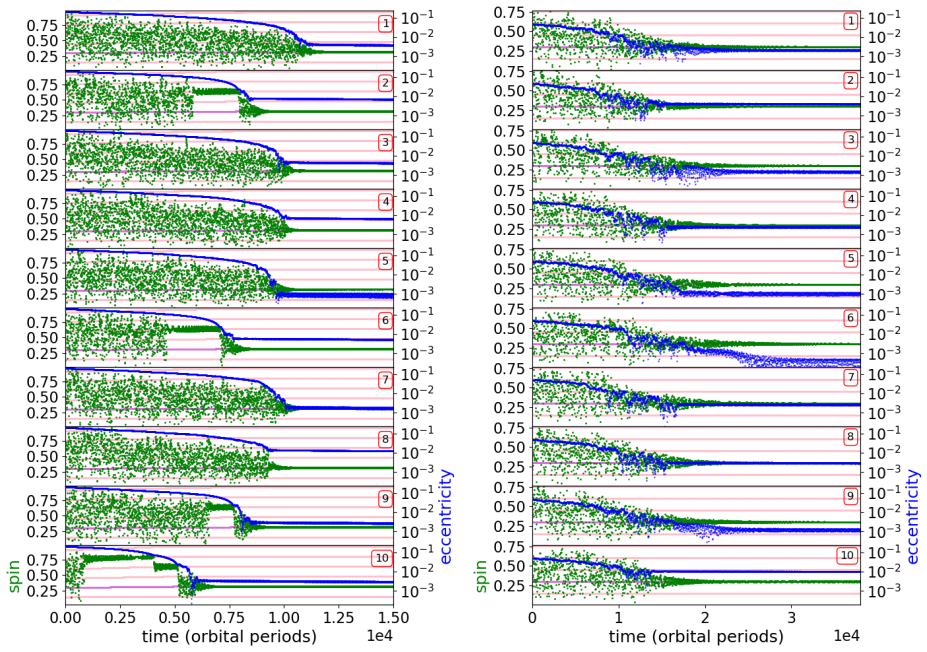
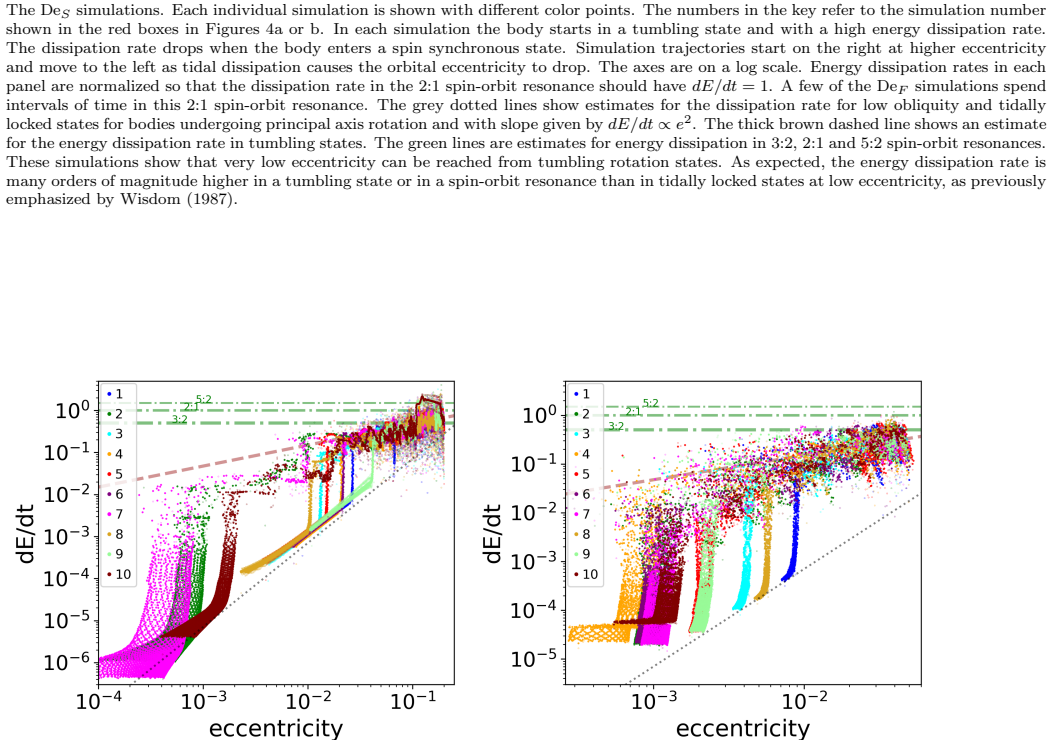
The paper's central object is the mass-spring model: a moon is represented by a few dozen point masses connected by damped springs, so tidal deformation, torque, heat, and eccentricity damping arise self-consistently from the viscoelastic response of the resolved body. The analytical idea that carries the argument is the chaotic-zone volume estimate from the classic spin-orbit problem. Near the spin-synchronous separatrix, the 3:2 resonance perturbation strength is proportional to eccentricity, giving a chaotic zone width in energy proportional to $e$ and a phase-space volume proportional to $\sqrt{e}$; because this volume shrinks so weakly, a dissipating tumbling body is almost as likely to leave the chaotic zone at one decade of eccentricity as at the next, which explains why simulations lock at very low eccentricity. The simulations also calibrate the dissipation-rate contrast: while tumbling the mean rate is approximately $\dot E_{\rm wob} = A_w C_e n e$ with $A_w \approx 7$–14, one to six orders of magnitude above the locked-state rate $7 C_e n e^2$ at low eccentricity.
What would settle it
Measure the frequency-dependent tidal quality factor of plausible Phobos and Deimos material, or run a high-frequency Maxwell or Andrade simulation of the same mass-spring configurations: if at the real moons' tidal frequencies the tumbling-state dissipation rate is less than roughly a thousand times the locked-state rate, Deimos's eccentricity could not have been damped in the age of the Solar system, and the impact-tumbling explanation would fail.
Extended reading notes
Core claim
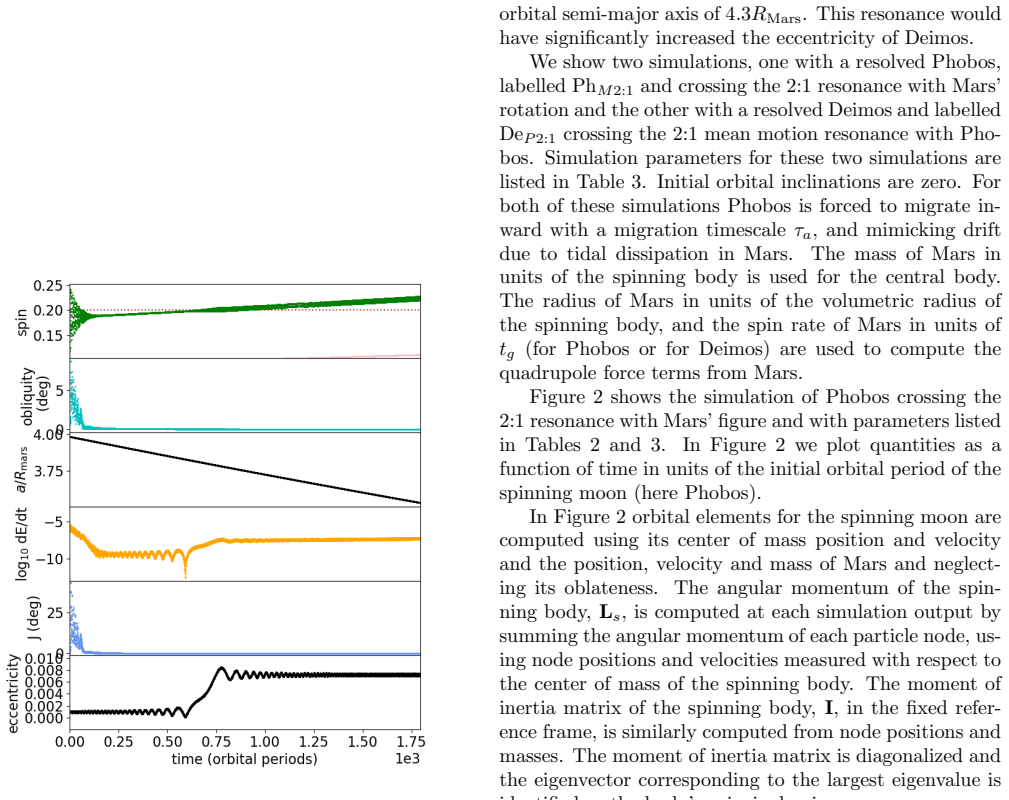
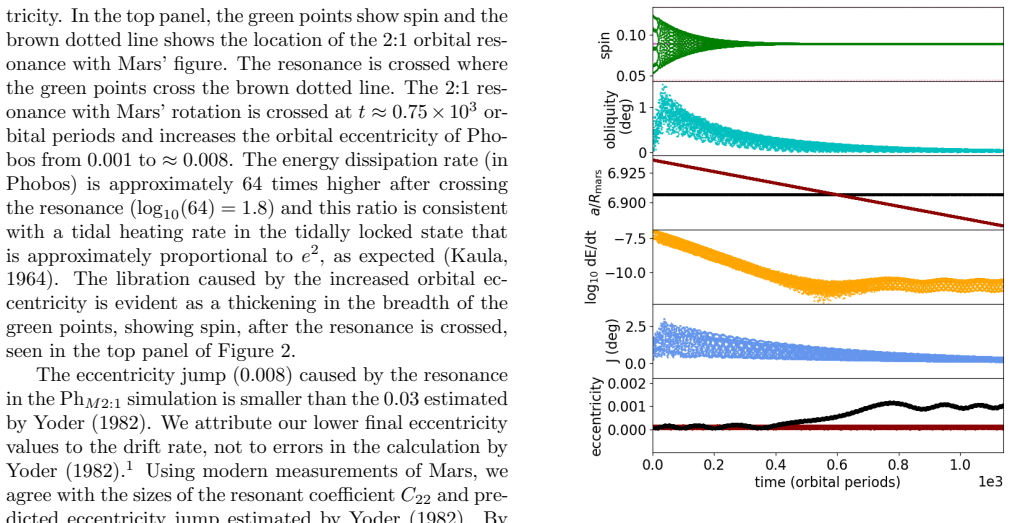
The central claim is that the low eccentricities of Phobos and Deimos could in part be due to spin excitation by nearly catastrophic impacts rather than tidal evolution following orbital resonance excitation. In the simulations, an initially tidally locked Phobos crossing the 2:1 spin-orbit resonance with Mars, and an initially locked Deimos crossing the 2:1 mean-motion resonance with Phobos, both remain locked; the resonances raise eccentricity by only a small amount and do not excite tumbling. Simulations started in a tumbling state, by contrast, remain tumbling for thousands of orbital periods, and the elevated tidal dissipation during that time substantially reduces the orbital eccentricity. The paper attributes the tendency to drop into spin-synchronous rotation at very low eccentricity to the insensitivity of the tumbling chaotic zone volume to eccentricity: in the classic spin-orbit problem the chaotic zone volume scales roughly as the square root of eccentricity, so a body is only about three times more likely to escape the chaotic zone per decade of eccentricity decrease. After entering spin-synchronous rotation, long-lived non-principal axis rotation can keep dissipation elevated further. With estimates of impactor fluxes, the paper concludes that sub-catastrophic impacts of roughly 0.7 km (Phobos) and 0.2 km (Deimos) projectiles were likely frequent enough to have excited such tumbling.
Load-bearing premise
The load-bearing assumption is that the tumbling-versus-locked boost in tidal dissipation measured at the simulations' low tidal frequencies still holds at the much higher tidal frequencies of the real moons, so that Deimos's eccentricity can actually be damped within the age of the Solar system.
Editorial extensions
If this is right
- Crossing the 2:1 spin-orbit resonance with Mars or the 2:1 mean-motion resonance between Phobos and Deimos does not excite tumbling, so these resonance crossings cannot be the mechanism that set the moons' spins or eccentricities.
- A single tumbling episode can damp a moon's eccentricity to values below the current ones within tens of millions of years, even for Deimos, whose locked-state eccentricity damping time is about $10^{12}$ years.
- Sub-catastrophic impacts of the size that formed Stickney crater on Phobos are frequent enough on billion-year timescales to have excited tumbling in both moons.
- When a tumbling body falls into spin-synchronous rotation, it can remain in long-lived non-principal axis rotation, keeping tidal dissipation elevated and making standard locked-state tidal formulas underestimates of the eccentricity damping.
- The broad, low range of eccentricities at which simulated moons lock is consistent with a tumbling chaotic-zone volume that shrinks only as $\sqrt{e}$, implying that tumbling bodies often reach very low eccentricity before becoming locked.
Reading between the lines
- If impact-triggered tumbling is a general satellite mechanism, other small, heavily cratered moons on nearly circular orbits should show a 'reset' eccentricity set by their last tumbling episode, not by their formation; a survey correlating cratering ages with eccentricities across small satellites would test this.
- Because the chaotic-zone volume shrinks as $\sqrt{e}$, tumbling should persist even at extremely low eccentricity, so small moons observed currently tumbling may be in this long-lived state rather than freshly impacted.
- The high-frequency rheology assumption could be checked directly with laboratory measurements of frequency-dependent dissipation in rocky and icy regolith; if the tumbling-to-locked dissipation ratio drops at high frequency, the mechanism would apply only to moons with different internal dissipation.
- If such tumbling episodes reset eccentricity after the last big impact, Phobos need not have recently crossed Deimos's orbit, which would make the moons' current near-circular, low-inclination orbits a natural outcome of formation in a circumplanetary disk rather than capture.
Signed reviews
Editorial analysis
A structured set of objections, weighed in public.
Referee Report
Summary. The paper investigates whether past episodes of chaotic tumbling could explain the present low orbital eccentricities of Phobos and Deimos. Using mass-spring viscoelastic simulations of the spinning bodies, the authors first show that adiabatic crossing of the 2:1 resonance with Mars' rotating figure and of the 2:1 Phobos–Deimos mean-motion resonance does not excite tumbling in a tidally locked moon. They then simulate initially tumbling Phobos- and Deimos-like bodies with exaggerated tidal forcing and find that tumbling persists for thousands of orbital periods and can damp eccentricity to very low values before the body falls into the spin-synchronous state. The tendency to reach low eccentricity is attributed to the weak (square-root) dependence of the chaotic zone volume on eccentricity. The authors also report long-lived non-principal-axis rotation in the spin-synchronous state and conclude that sub-catastrophic impacts could have excited tumbling episodes, so that impact-driven tumbling, rather than tidal evolution following resonance excitation, may in part explain the low eccentricities.
Significance. If the central scenario is correct, the paper offers a physically self-consistent mechanism that resolves a long-standing problem: Deimos's eccentricity damping timescale in the tidally locked state is longer than the Solar-system age, yet its current eccentricity is extremely small. The work extends Wisdom (1987)'s speculation with direct numerical experiments in which tidal dissipation, torque, and orbital evolution arise from the internal spring damping rather than being imposed through the standard constant-Q or constant-phase-lag formulas. The strengths of the paper are its explicit calibration of the simulations against analytic tidal formulas (Eqs. 19–23), its reproduction of the chaotic-zone behavior predicted by the conservative spin-orbit problem (Eq. 17–18), and its honest delineation of several caveats, including the statement in Section 6 that sensitivity to rheology was neglected. The principal weakness is that the quantitative claim for Deimos depends on an untested rheological extrapolation and on simulation parameters far from the real moons' values, so the result is plausible but not yet established.
major comments (3)
- [§4.1 (text after Eq. 23)] The load-bearing step for the Deimos eccentricity-damping claim is the assertion that 'the ratio of dissipation rates, between spin-synchronous and tumbling, would be similar for the high frequency limit as for the low frequency limit.' The simulations are in the low-frequency Kelvin–Voigt regime, with Kd~10^-5 (Tables 2 and 4, §4.3), whereas Table 1 gives Kd~10^-9 for Deimos and the text notes that the moons may be in the opposite limit (chi>>1). Section 6 explicitly states that 'sensitivity to rheology was neglected.' The Deimos timescale estimate in §4.1 rests on a factor of ~5 orders of magnitude in the dissipation-rate ratio at e=0.003; if the true high-frequency ratio is two or more orders of magnitude smaller, the required tumbling duration would exceed the age of the Solar system, and the abstract's closing explanation for Deimos's low eccentricity would collapse. This is not a mere uncertainty but an unsupported internal step: the authors need either an analytic derivation of the high-frequency ratio or simulations or measurements in that regime.
- [§4, Table 4 and §4.3 (Eq. 26)] The simulations use a significantly inflated radius (a/R=48 versus 830 for Phobos and 3778 for Deimos) and a correspondingly reduced central mass, with the statement that this 'should not significantly affect the dynamics... primarily sensitive to the body axis ratios.' However, the relative rate of eccentricity damping to spin evolution is governed by Ke (Eq. 26), and the paper itself states that the PhS simulations have Ke about 10^3 times that of Phobos and the DeS simulations about 10^6 times that of Deimos. The observed outcomes—including the duration of tumbling and the distribution of eccentricities at lock-in—could depend on this mismatch. Because the central scenario is an extrapolation from a regime where eccentricity damping is artificially fast, the authors should either run simulations with Ke closer to realistic values or provide a scaling argument showing that the qualitative behavior is unchanged when the ratio of the eccentricity-damping rate to the spin-dissipation rate is reduced by orders of magnitude.
- [§3, DeP 2:1 simulation (Table 3)] The negative conclusion that crossing the 2:1 Phobos–Deimos mean-motion resonance does not excite Deimos's spin is based on a simulation in which Phobos's mass is enhanced by a factor of 100, and the drift rate imposed is not demonstrated to satisfy the adiabatic criterion for the enhanced resonance. Because a stronger resonance requires a slower drift rate for adiabatic passage, the simulation may be testing a non-adiabatic crossing, where the eccentricity kick is suppressed. The later analytic estimate of adiabaticity uses real masses and drift rates, not the simulation's values. To support the abstract's claim that such resonance crossings 'do[es] not excite tumbling,' the simulation should be run at a drift rate that is adiabatic for the enhanced-mass system, or the conclusion should be explicitly qualified as applying to the simulated non-adiabatic crossing only.
minor comments (5)
- [§4.1 (Figs. 6 and 7)] The brown lines in Figures 6 and 7 are fits with Aw=14 and Aw=7, but the paper does not describe how these coefficients were obtained or what their scatter is; a brief fitting procedure or an estimate of the uncertainty would be helpful.
- [§3, text near Eqs. (12)–(14)] The symbol tau_an in the eccentricity-jump estimate is not defined explicitly; it should be written as the product tau_a n to avoid confusion with a single parameter.
- [Abstract and §3] The abstract states that 'crossing of a spin-orbit resonance with Mars or a mean motion resonance with each other does not excite tumbling,' but the paper tests only two specific resonances (the 2:1 Mars-figure resonance and the 2:1 Phobos–Deimos resonance). The statement should be qualified to 'the tested resonances' to avoid over-generalization.
- [§5] The estimate of impact rates relies on scaling from asteroid 433 Eros using cross-sectional areas, but the authors do not discuss the uncertainty in the cratering scaling or the effect of Mars's gravity focusing on impactor flux; a brief caveat would be appropriate.
- [Introduction] The reference 'Efroimsky, private communication' is not a citable source; it should either be replaced with a published reference or removed from the formal text.
Circularity Check
No significant circularity: the central claim is produced by the mass-spring simulations and checked against independent analytic tidal formulas; the main caveat is an acknowledged rheological extrapolation, not a circular reduction.
full rationale
The paper's derivation chain is self-contained rather than circular. The central result, that tumbling bodies can remain tumbling for thousands of orbits and substantially damp their orbital eccentricity, is a measured outcome of the mass-spring simulations: dissipation comes from damping in the springs, and the enhanced dissipation while tumbling emerges from the dynamics rather than being imposed as an input. The simulations are calibrated against independent analytic expressions: Equation 19 is the standard Kaula/Cassen tidally locked dissipation formula, Equations 21 and 22 are standard spin-down estimates, and Wisdom (1987) provides the prior prediction that tumbling enhances dissipation by orders of magnitude. The brown fit lines Ẏwob(e) = AwCene are summaries of the simulation data, not fitted parameters that are then renamed as predictions; the qualitative conclusions do not depend on the particular Aw values. The paper's self-citations (Quillen et al. 2016a,b, 2017, 2019a,b; Frouard et al. 2016) support the code and earlier validation, but the novel claim is demonstrated in this paper and compared with an independent external prediction by Wisdom (1987). No uniqueness theorem is imported from the authors' prior work, and no known result is merely renamed. The main legitimate concern is the extrapolation in Section 4.1 that the tumbling-to-synchronous dissipation ratio is similar in the high-frequency limit, and the Section 6 admission that 'sensitivity to rheology was neglected.' That is an acknowledged, untested assumption about real Phobos and Deimos, and it is a correctness/robustness risk, but it is not a circular reduction: the paper does not define tumbling dissipation in terms of the high-frequency ratio, nor does it fit that ratio from the data it later 'predicts.' Therefore the appropriate finding is no significant circularity.
Assumptions & free parameters
free parameters (6)
- Central mass ratio M*/M =
10^4
- Spring damping parameter gamma_s =
0.1 (F series), 0.01 (S series)
- Tumbling-state dissipation coefficient Aw =
14 (Deimos simulations), 7 (Phobos simulations)
- Phobos mass enhancement =
100x
- Initial eccentricities =
0.2 and 0.05
- Migration timescale tau_a =
|tau_a|^-1 tg = 2e-6 (Phobos), 1e-7 (Deimos)
assumptions (6)
- domain assumption The mass-spring network with N ~ 40 nodes and random springs adequately represents the viscoelastic continuum response of Phobos and Deimos for spin-orbit and tumbling dynamics.
- domain assumption The ratio of energy dissipation rates between tumbling and spin-synchronous states is similar in the low-frequency (simulated) and high-frequency (real Phobos and Deimos) tidal regimes.
- domain assumption Mars's rotating quadrupole gravity field (C20, C22, S22) and Phobos/Deimos mutual gravity are the only perturbations needed to test the two strongest resonance crossings; secular spin resonances, the Sun, and other planets are negligible.
- ad hoc to paper The chaotic zone volume of the tumbling state scales with the square root of eccentricity, as estimated from the classic single-angle spin-orbit problem.
- domain assumption Impactor flux scaling from 433 Eros (Richardson et al. 2005) to Phobos and Deimos by cross-section ratio gives realistic impact rates for sub-catastrophic spin excitation.
- standard math Spin-orbit resonance overlap criteria (Wisdom et al. 1984; Wisdom 1987) and the dissipationless spin-orbit Hamiltonian (Eq. 24) describe the conservative dynamics underlying the tumbling chaotic zone.
Cite this review
Pith. "Pith review of Excitation of Tumbling in Phobos and Deimos." pith.science (2026). https://pith.science/paper/A7KNDR5H
@misc{pith2026190805720,
  author       = {Pith},
  title        = {Pith review of: Excitation of Tumbling in Phobos and Deimos},
  year         = {2026},
  howpublished = {\url{https://pith.science/paper/A7KNDR5H}},
  note         = {Machine review of arXiv:1908.05720}
}
read the original abstract
Mass-spring model simulations are used to investigate past spin states of a viscoelastic Phobos and Deimos. From an initially tidally locked state, we find crossing of a spin-orbit resonance with Mars or a mean motion resonance with each other does not excite tumbling in Phobos or Deimos. However, once tumbling our simulations show that these moons can remain so for an extended period and during this time their orbital eccentricity can be substantially reduced. We attribute the tendency for simulations of an initially tumbling viscoelastic body to drop into spin-synchronous state at very low eccentricity to the insensitivity of the tumbling chaotic zone volume to eccentricity. After a tumbling body enters the spin synchronous resonance, it can exhibit long lived non-principal axis rotation and this too can prolong the period of time with enhanced tidally generated energy dissipation. The low orbital eccentricities of Phobos and Deimos could in part be due to spin excitation by nearly catastrophic impacts rather than tidal evolution following orbital resonance excitation.
Figures

Figures from the paper (6 more)




Reference graph
Works this paper leans on
-
[1]
Beauge, C., Michtchenko, T. A., Ferraz-Mello, S., 2006. Planetary migration and extrasolar planets in the 2/1 mean-motion resonance. Monthly Notices of the Royal Astronomical Society, 365, 1160--1170
work page 2006
-
[2]
Bills, B. G., Neumann, G. A., Smith, D. E., Zuber, M. T., 2005. Improved estimate of tidal dissipation within Mars from MOLA observations of the shadow of Phobos . Journal of Geophysical Research 110, E07004
work page 2005
- [3]
-
[4]
Canup, R. M., Salmon, J., 2018. Origin of Phobos and Deimos by the impact of a Vesta-to-Ceres sized body with Mars . Science Advances 4, eaar6887
work page 2018
-
[5]
Cassen , P., Peale , S. J., Reynolds , R. T., Nov 1980. Tidal dissipation in Europa: A correction . Geophysics Research Letters 7 (11), 987--988
work page 1980
-
[6]
Tables of the developments of functions in the theory of elliptic motion
Cayley, A., 1859. Tables of the developments of functions in the theory of elliptic motion. Memoirs of the Royal Astronomical Society 29, 191--306
-
[7]
Orbital history of the Martian satellites with inferences on their origin
Cazenave, A., Dobrovolskis, A., Lago, B., 1980. Orbital history of the Martian satellites with inferences on their origin. Icarus 44, 730--744
work page 1980
-
[8]
Stability and Chaos in Celestial Mechanics
Celletti, A., 2010. Stability and Chaos in Celestial Mechanics. Springer-Verlag: Berlin and Praxis Publishing Ltd, Chichester, UK
work page 2010
Show all 59 references
-
[9]
Dynamics of the conservative and dissipative spin--orbit problem
Celletti, A., Froeschl\'e, C., Lega, E., 2007. Dynamics of the conservative and dissipative spin--orbit problem. Planetary and Space Science 55, 889--899
2007
-
[10]
Transient times, resonances and drifts of attractors in dissipative rotational dynamics
Celletti, A., Lhotka, C., 2014. Transient times, resonances and drifts of attractors in dissipative rotational dynamics. Communications in Nonlinear Science and Numerical Simulations 19, 3399--3411
2014
-
[11]
Regions of nonexistence of invariant tori for spin-orbit models
Celletti, A., MacKay, R., 2007. Regions of nonexistence of invariant tori for spin-orbit models. Chaos 17, 043119
2007
-
[12]
Mercury 's capture into the 3/2 spin-- orbit resonance as a result of its chaotic dynamics
Correia, A., Laskar, J., 2004. Mercury 's capture into the 3/2 spin-- orbit resonance as a result of its chaotic dynamics. Nature 429, 848--850
2004
-
[13]
A., 2011
Craddock, R. A., 2011. Are Phobos and Deimos the result of a giant impact? Icarus 211 (2), 1150--1161
2011
-
[14]
Tidal evolution of asteroidal binaries
Efroimsky, M., 2015. Tidal evolution of asteroidal binaries. ruled by viscosity. ignorant of rigidity. Astronomical Journal 150, 98--109
2015
-
[15]
V., Feb 2013
Efroimsky , M., Makarov , V. V., Feb 2013. Tidal friction and tidal lagging. Applicability limitations of a popular formula for the tidal torque. Astrophysical Journal 764 (1), 26
2013
-
[16]
R., Paolicchi, P., Cellino, A., Zappala, V., 1992
Farinella, P., Davis, D. R., Paolicchi, P., Cellino, A., Zappala, V., 1992. Asteroid collisional evolution: An integrated model for the evolution of asteroid rotation rates. Astronomy and Astrophysics 253, 604--614
1992
-
[17]
K., 1998
Farinella, P., Vokrouhlicky, D., Hartmann, W. K., 1998. Meteorite delivery via Yarkovsky orbital drift. Icarus 132, 378--387
1998
-
[18]
Tides in a body librating about a spin-orbit resonance: generalisation of the Darwin-Kaula theory
Frouard, J., Efroimsky, M., 2017. Tides in a body librating about a spin-orbit resonance: generalisation of the Darwin-Kaula theory. Celestial Mechanics and Dynamical Astronomy 129, 177--214
2017
-
[19]
C., Efroimsky, M., Giannella, D., 2016
Frouard, J., Quillen, A. C., Efroimsky, M., Giannella, D., 2016. Numerical simulation of tidal evolution of a viscoelastic body modelled with a mass-spring network. Monthly Notices of the Royal Astronomical Society 458, 2890--2901
2016
-
[20]
G., Mazarico, E., Neumann, G
Genova, A., Goossens, S., Lemoine, F. G., Mazarico, E., Neumann, G. A., Smith, D. E., Zuber, M. T., 2016. Seasonal and static gravity field of Mars from MGS , Mars Odyssey and MRO radio science. Icarus 272, 228--245
2016
-
[21]
D., Nicholson, P., Rand, P., 1996
Gladman, B., Quinn, D. D., Nicholson, P., Rand, P., 1996. Synchronous locking of tidally evolving satellites. Icarus 122, 166--192
1996
-
[22]
On the eccentriicty of satellite orbits in the solar system
Goldreich, P., 1963. On the eccentriicty of satellite orbits in the solar system. Monthly Notices of the Royal Astronomical Society 126, 257--268
1963
-
[23]
Inclination of satellite orbits about an oblate spinning planet
Goldreich, P., 1965. Inclination of satellite orbits about an oblate spinning planet. Astronomical Journal 70, 5--9
1965
-
[24]
Spin-orbit coupling in the solar system
Goldreich, P., Peale, S., 1966. Spin-orbit coupling in the solar system. Astronomical Journal 71, 425
1966
-
[25]
W., 1979
Harris, A. W., 1979. Asteroid rotation rates II . a theory for the collisional evolution of rotation rates. Icarus 40 (1), 145--153
1979
-
[26]
Asteroid rotation excitation by subcatastrophic impacts
Henych, T., Pravec, P., 2013. Asteroid rotation excitation by subcatastrophic impacts. Monthly Notices of the Royal Astronomical Society 432 (2), 1623--1631
2013
-
[27]
J., Minton, D
Hesselbrock, A. J., Minton, D. A., 2017. An ongoing satellite--ring cycle of Mars and the origins of Phobos and Deimos . Nature Geoscience 10 (4), 266--269
2017
-
[28]
Mars/Moon cratering rate ratio estimates
Ivanov, B., 2001. Mars/Moon cratering rate ratio estimates. Space Science Reviews 96, 87--104
2001
-
[29]
Tidal dissipation by solid friction and the resulting orbital evolution
Kaula, M., 1964. Tidal dissipation by solid friction and the resulting orbital evolution. Reviews of Geophysics 2, 661--684
1964
-
[30]
On the orbital evolution of the Martian satellites
Lambeck, K., 1979. On the orbital evolution of the Martian satellites. Journal of Geophysical Research 84, 5651--5657
1979
-
[31]
A long-term numerical solution for the insolation quantities of the Earth
Laskar, J., P.Robutel, Joutel, F., Gastineau, M., Correia, A., Levrard, B., 2004. A long-term numerical solution for the insolation quantities of the Earth . Astronomy and Astrophysics 428, 261--285
2004
-
[32]
V., 2014
Melnikov, A. V., 2014. Conditions for appearance of strange attractors in rotational dynamics of small planetary satellites. Cosmic Research 52 (6), 461--471
2014
-
[33]
D., Dermott, S
Murray, C. D., Dermott, S. F., 1999. Solar System Dynamics. Cambridge University Press
1999
-
[34]
J., Wyatt, M
Mustill, A. J., Wyatt, M. C., 2011. A general model of resonance capture in planetary systems: first- and second-order resonances. Monthly Notices of the Royal Astronomical Society 413 (Issue 1), 554--572
2011
-
[35]
V., 1976
Neukum, G., Wise, D. V., 1976. Mars : A standard crater curve and possible new time scale. Science 194, 1381--1387
1976
-
[36]
P., Greenberg, R., 2005
O'Brien, D. P., Greenberg, R., 2005. The collisional and dynamical evolution of the Main Belt and NEA size distributions. Icarus 178, 179--212
2005
-
[37]
Rotation histories of the natural satellites
Peale, S., 1977. Rotation histories of the natural satellites. In: Burns, J. A. (Ed.), IAU Colloq. 28: Planetary Satellites. University of Arizona, Tucson, pp. 87--112
1977
-
[38]
J., Cassen, P., 1978
Peale, S. J., Cassen, P., 1978. Contribution of tidal dissipation to lunar thermal history. Icarus 36 (245-269)
1978
-
[39]
The tumbling spin state of (99942) Apophis
Pravec, P., Scheirich, P., D urech, J., Pollock, J., Ku s nir \'a k, P., Hornoch, K., Gal \'a d, A., Vokrouhlick \'y , D., Harris, A., Jehin, E., Manfroid, J., Opitom, C., Gillon, M., Colas, F., Oey, J., Vra s til, J., Reichart, D., Ivarsen, K., Haislip, J., LaCluyze, A., 2014...
2014
-
[40]
C., 2006
Quillen, A. C., 2006. Reducing the probability of capture into resonance. Monthly Notices of the Royal Astronomical Society 365, 1367--1382
2006
-
[41]
C., Giannella, D., Shaw, J
Quillen, A. C., Giannella, D., Shaw, J. G., Ebinger, C., 2016 a . Crustal failure on icy moons from a strong tidal encounter. Icarus 275, 267--280
2016
-
[42]
C., Kueter-Young, A., Frouard, J., Ragozzine, D., 2016 b
Quillen, A. C., Kueter-Young, A., Frouard, J., Ragozzine, D., 2016 b . Tidal spin down rates of homogeneous triaxial viscoelastic bodies. Monthly Notices of the Royal Astronomical Society 463, 1543--1553
2016
-
[43]
C., Martini, L., Nakajima, M., 2019 a
Quillen, A. C., Martini, L., Nakajima, M., 2019 a . Near/far side asymmetry in the tidally heated Moon . Icarus 329, 182--196
2019
-
[44]
C., Nichols-Fleming, F., Chen, Y.-Y., Noyelles, B., 2017
Quillen, A. C., Nichols-Fleming, F., Chen, Y.-Y., Noyelles, B., 2017. Obliquity evolution of the minor satellites of Pluto and Charon . Icarus 293, 94--113
2017
-
[45]
C., Wagner, K
Quillen, A. C., Wagner, K. J., S \'a nchez, P., 2019 b . Simulations of wobble damping in viscoelastic rotators. Monthly Notices of the Royal Astronomical Society 485 (1), 725--738
2019
-
[46]
C., Zhao, Y., Chen, Y., Sanchez, P., Nelson, R
Quillen, A. C., Zhao, Y., Chen, Y., Sanchez, P., Nelson, R. C., Schwartz, S. R., 2019 c . Impact excitation of a seismic pulse and vibrational normal modes on asteroid Bennu and associated slumping of regolith. Icarus 319, 312--333
2019
-
[47]
R., Head, J
Ramsley, K. R., Head, J. W., 2019. Origin of Phobos' grooves: Testing the Stickney crater ejecta model. Planetary and Space Science 165, 137--147
2019
-
[48]
J., Melosh, H
Richardson, J. J., Melosh, H. J., Greenberg, R. J., O'Brien, D. P., 2005. The global effects of impact-induced seismic activity on fractured asteroid surface morphology. Icarus 179, 325--349
2005
-
[49]
The origin of the Martian moons revisited
Rosenblatt, P., 2011. The origin of the Martian moons revisited. Astronomy and Astrophysics Review 19, 44
2011
-
[50]
M., Terao-Dunseath, M., Trinh, A., Hyodo, R., Genda, H., Toupin, S., Jul 2016
Rosenblatt, P., Charnoz, S., Dunseath, K. M., Terao-Dunseath, M., Trinh, A., Hyodo, R., Genda, H., Toupin, S., Jul 2016. Accretion of Phobos and Deimos in an extended debris disc stirred by transient moons. Nature Geoscience 9 (8), 581--583
2016
-
[51]
I., 2012
Shevchenko, I. I., 2012. Width of the chaotic layer: Maxima due to marginal resonances. Physical Review E 85 (6), 066202
2012
-
[52]
F., 1966
Singer, S. F., 1966. On the origin of the Martian satellites Phobos and Deimos . In: Dollfus, A. (Ed.), Moons and Planets . North-Holland, Amsterdam, pp. 317--321
1966
-
[53]
Szeto, A. M. K., 1983. Orbital evolution and origin of the Martian satellites. Icarus 55, 133--168
1983
-
[54]
C., 1999
Thomas, P. C., 1999. Large craters on small objects: Occurrence, morphology, and effects. Icarus 142 (1), 89--96
1999
-
[55]
J., 1979
Weidenschilling, S. J., 1979. A possible origin for the grooves of Phobos . Nature 282, 697--698
1979
-
[56]
Rotational dynamics of irregularly shaped natural satellites
Wisdom, J., 1987. Rotational dynamics of irregularly shaped natural satellites. Astronomical Journal 94 (5), 1350--1360
1987
-
[57]
J., Mignard, F., 1984
Wisdom, J., Peale, S. J., Mignard, F., 1984. The chaotic rotation of Hyperion . Icarus 58, 137--152
1984
-
[58]
Diagrammatic theory of transition of pendulum-like systems
Yoder, C., 1979. Diagrammatic theory of transition of pendulum-like systems. Celestial Mechanics 19, 3--29
1979
-
[59]
F., Mar 1982
Yoder , C. F., Mar 1982. Tidal rigidity of Phobos . Icarus 49 (3), 327--346
1982
Reviewed August 14, 2026 · model on record in the stance chip above.
Discussion (0). Continue with ORCID to comment.