REVIEW 3 major objections 4 minor 51 references
Scalable generation of multi-photon entangled states by active feed-forward and multiplexing
T0 review · 3 major / 4 minor · reviewed 2026-08-14 · deepseek-v4-flash
Pith's one-line read A switchable fiber-loop memory called the quantum interference buffer multiplexes 21 probabilistic pair sources, giving a ninefold rate increase for four-photon GHZ states with no loss of fidelity.
desk verdict First experimental demonstration of entangled-state source multiplexing with a loop buffer; the nine-fold four-photon GHZ gain is solid, but the exponential scaling to 12 photons rests on a loss-only model that the HOM data contradict. read the letter →
The pith
A machine-rendered reading of the paper's core claim, the machinery that carries it, and where it could break.
The reading
What carries the argument
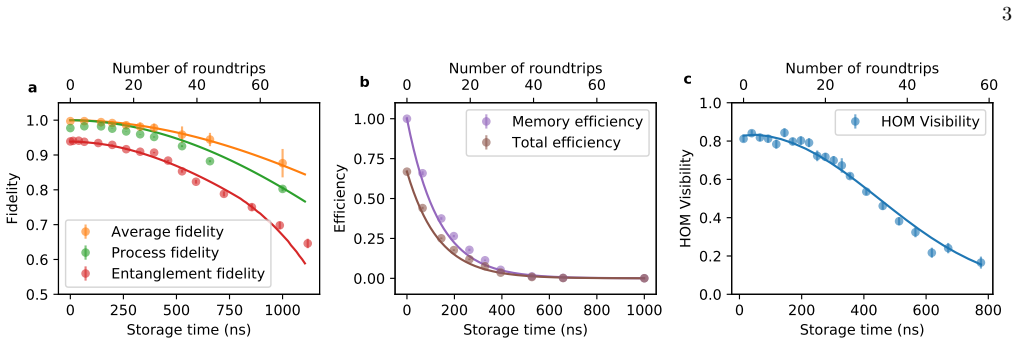
The quantum interference buffer (QIB) is the central mechanism: an all-optical, polarization-insensitive loop memory whose core is a Sagnac interferometer connected to a retroreflective delay line, with an electro-optic modulator acting as a fast programmable polarization beam splitter. It toggles among three operations: store-release (an incoming photon enters the loop and any stored photon exits), buffer (the stored photon keeps cycling and outside light passes through), and interference (stored and fresh photons meet at a PBS-like interaction and exit with 50% probability each). The buffer stores a polarization qubit for up to 1 µs with a measured per-roundtrip efficiency of $(90.57\pm0.06)\%$, synchronized to the laser clock at 13.16 ns per roundtrip. This single device performs the jobs that a spatial multiplexer would need $N$ sources and $N$ quantum memories to do, which is what converts the generation probability from $p^N$ to roughly $p(pM)^{N-1}$.
What would settle it
Measure the Hong-Ou-Mandel visibility of a photon stored for more than 1 microsecond against a fresh photon at the pump power used for GHZ generation; if the visibility falls below the asymmetric-loss model shown in Fig. 2c, the exponential enhancement predicted for 12-photon GHZ states will not be reached.
Extended reading notes
Core claim
The central claim is that source multiplexing can be applied to polarization-entangled photonic states, not just single photons, using a single optical device that stores, releases, and interferes qubits on demand. The device is an all-optical, polarization-insensitive buffer built from a Sagnac loop, a delay line, and an electro-optic switch driven by detection feed-forward; it can act as a memory, a beam splitter, or a transparent channel as needed. With this device the authors multiplex 21 effective Bell-pair sources and observe a ninefold increase in the generation rate of four-photon GHZ states, with fidelity almost independent of the number of sources. Their scaling model says the enhancement factor is roughly $M^{N-1}$ for $N$ pair sources and $M$ storage roundtrips, so the advantage grows exponentially with the size of the target state.
Load-bearing premise
The projected exponential gain for larger states assumes that a photon can be stored for many more roundtrips than the demonstrated microsecond and still remain indistinguishable enough to interfere, but the experiments tested storage only up to about 1 µs and produced only four-photon GHZ states.
Editorial extensions
If this is right
- With 21 multiplexed sources the four-photon GHZ rate rises ninefold, and with 11 sources the rate grows 6.7 times while the fidelity drops by only about 3%.
- For a fixed fourfold detection rate, multiplexed operation reaches that rate at lower pump power, suppressing multi-pair emission and raising state fidelity by up to five percentage points.
- The model projects that 12-photon GHZ states would be produced up to $10^5$ times faster with the QIB than by stitched probabilistic sources, corresponding to roughly 100 detected states per second under current efficiencies.
- Because each fusion step becomes more probable, the rate improvement is exponential in photon number; the same QIB architecture also extends to linear cluster states and one-dimensional tensor network states of bond dimension two.
Reading between the lines
- If the scaling holds, the same single-loop architecture could serve as a continuous 'entanglement factory' for measurement-based quantum computing, since it outputs a stream of post-selected clusters rather than one-shot coincidences.
- The bottleneck for even larger states may be indistinguishability rather than loss: the paper's own HOM data show visibility dropping to 24.1% after 671 ns of storage at high pump power, so the exponential model's asymmetric-loss assumption will need revision if two-photon coherence decays faster than that model.
- A direct test of the exponential claim is to measure 6- or 8-photon GHZ rates; the enhancement factor should grow as roughly $M^{N-1}$, so the rate gain from adding sources should outpace the extra roundtrip loss.
- Because the QIB is all-optical and wavelength-flexible, the same multiplexing strategy could be transplanted to other wavelengths and integrated photonic platforms, though the current demonstration operates around a telecommunications wavelength.
Signed reviews
Editorial analysis
A structured set of objections, weighed in public.
Referee Report
Summary. The manuscript introduces the quantum interference buffer (QIB), a fibre-loop device that stores polarization qubits, multiplexes many heralded entangled-photon-pair sources, and implements a time-multiplexed linear-optical network for interfering stored and freshly generated photons. The authors characterize polarization-qubit storage, memory efficiency, and Hong-Ou-Mandel interference after storage, and they demonstrate generation of four-photon GHZ states with a rate that increases with the number of multiplexed sources, reaching a nine-fold enhancement for 21 effective sources while the state fidelity remains roughly constant. They derive a rate model predicting an exponential enhancement of the generation probability with the number of photons and, in the Discussion and Fig. S6, extrapolate to a factor up to 1e5 (or 1e6 in Fig. S5) for 12-photon GHZ states. The supplementary material provides detailed descriptions of the QIB operation, the GHZ and cluster-state protocols, the rate derivation, simulations, timing electronics, loss budget, and additional data.
Significance. If the demonstrated rate enhancement could be extended to larger states without severe degradation of the stitching interference, this would be a significant step towards practical multi-photon entanglement generation. The core experimental result is solid: the nine-fold enhancement is a direct ratio of measured four-fold rates with Poissonian error bars and no accidental-count subtraction, and the storage efficiency, fidelity, and HOM data are reported in detail. The QIB's noise performance (mu1 = 2.2e-6) and high storage fidelity are notable. However, the paper's headline claim that the enhancement 'scales exponentially with the photon number' rests on a rate-only model that treats storage as a scalar loss and does not include the measured storage-time-dependent degradation of interference visibility; the extrapolation to 12-photon GHZ states is therefore not yet supported as a claim about usable entangled-state rate and fidelity.
major comments (3)
- [S4 (Eqs. S25-S26) and Fig. S6] The predicted exponential enhancement for larger states, including the 12-photon estimate of up to 100 detected states per second, is derived from a rate model in which each roundtrip enters only through the scalar transmission eta = 0.9057 and each fusion is treated as an ideal interference event. The measured HOM visibility degrades strongly with storage time: (94.5 +/- 1.8)% at 13 ns low power, (81.2 +/- 1.6)% at 13 ns high power, (53.6 +/- 1.7)% at 408 ns, and (24.1 +/- 2.7)% at 671 ns (Fig. S7). Since a 12-photon GHZ state requires five successive fusions and photons may spend tens of roundtrips in the buffer, the low-visibility fusions would directly degrade the coherence of the final state. The rate model should be extended to include a storage-time-dependent interference visibility, or the extrapolation should be explicitly presented as an upper bound on heralded success events assuming ideal coherence, not as the expected rate of high-fidelity 12-photon GHZ states.
- [Fig. 2c and Fig. S8] The main text states that the decrease of HOM visibility with storage time is 'fully explained by the imbalanced losses between the stored and the freshly generated photon,' but the caption of Fig. S8 attributes the reduced four-photon GHZ coherence to 'imperfect HOM interference and a small phase in the loop.' This is an internal inconsistency: the phase error directly affects the interferometric stitching step and is not captured by the loss-only model used for the rate predictions in Section S4. The claimed absence of detrimental effects from multiplexing should be qualified to the demonstrated four-photon regime, and the extrapolation to larger states needs to account for these interference errors.
- [Fig. 3a] The text says that 'the state fidelity stays basically constant as a function of the number of multiplexed sources,' but the reported fidelity data and the figure caption cover only up to 11 sources ('For up to 11 sources, the fidelity drops by only 3%'), while the nine-fold rate enhancement is quoted for 21 sources. Please clarify whether the fidelity was measured at 21 sources and report the value if so; as written, the constancy claim is not supported for the full multiplexing range.
minor comments (4)
- [Discussion and Fig. S5] The numbers for the 12-photon enhancement are inconsistent: the Discussion says a factor of up to 10^5, while Fig. S5 states 'a factor of one million is easily achievable'; please align these values.
- [S1 and S6] There are several typographical errors, including 'the the quantum interference buffer' in the supplement, 'all-optical poarization-insensitive memory' in the main text, 'a rise and fall time aroud5 ns' in S6, and 'eluded to' instead of 'alluded to' in S1.
- [Methods and S6] The timing budget is hard to follow: the text says the QIB roundtrip time is 13.16 ns, but S6 states that 'for the GHZ states with 11 multiplexed sources, only 600 ns is required.' Please clarify how the 600 ns figure relates to the roundtrip time and the number of effective sources.
- [Fig. S5 caption] The claim 'For 2N = 12 photons a factor of one million is easily achievable' appears to conflict with the main-text estimate of 10^5 for the same state size; please reconcile the two statements.
Circularity Check
No significant circularity: the nine-fold rate enhancement is a measured ratio, and the larger-state predictions follow from independently measured parameters.
full rationale
The derivation chain is not circular. The central nine-fold enhancement is a directly measured ratio of fourfold coincidence rates (Fig. 3a: 'up to a maximum nine times increase for 21 sources as compared to the minimum two sources needed for four-photon GHZ'), not a parameter fitted to reproduce the target. The supporting rate model in Sec. S4 derives the multiplexed probability from first principles: Eq. (S23) sums geometric series over M attempts with pair probability p, and Eq. (S25) inserts the roundtrip efficiency eta = 0.9057 extracted from the independent storage-efficiency measurement in Fig. 2b. Neither p nor eta is defined in terms of the target GHZ rate, and the model is not calibrated against the measured four-photon enhancement before being used for larger states. The Discussion's expected 'factor of up to 10^5 for 12-photon GHZ states' and Fig. S6's 12-photon rate are forward extrapolations from these measured parameters, plus external efficiency values from Ref. [6]; the prediction is therefore not its own input. The self-citations (source characterization in Ref. [26], quantum-walk time-multiplexing in Refs. [21-23], tensor-network framework in Ref. [30]) provide context and are not used as uniqueness theorems or to forbid alternatives; no load-bearing argument reduces to a self-citation. The only substantive scientific caveat is that the rate model treats storage as a scalar loss eta and does not propagate the measured HOM-visibility degradation at longer storage times (Fig. S7: V = 24.1% at 671 ns) into the coherence of larger GHZ states. That is an assumption about correctness, not a circular reduction.
Assumptions & free parameters
free parameters (4)
- Roundtrip efficiency of QIB =
90.57% +/- 0.06% (from Fig. 2b fit)
- Pair generation probability p =
0.01 to 0.03 (Fig. 3b)
- Maximum number of roundtrips M (sources) =
up to 20 (21 sources)
- Quarter-wave plate angle error =
0.27 degrees
assumptions (4)
- standard math Linear optical components (PBS, HWP, EOM) follow the standard unitary mode transformations given in Section S1.
- domain assumption The pair source produces a two-photon state |HH>+|VV> with probability p and negligible multi-pair emission at low pump power; multi-pair events are removed by post-selection.
- domain assumption Feed-forward latency is compensated by a 1.7 microsecond fiber delay so that herald decisions arrive before the stored photon reaches the QIB switch.
- domain assumption The roundtrip loss budget (PBS, EOM, 9 mirrors, end mirror) fully accounts for memory efficiency, aside from small mode-matching effects at long storage times.
invented entities (1)
-
Quantum interference buffer (QIB)
independent evidence
Cite this review
Pith. "Pith review of Scalable generation of multi-photon entangled states by active feed-forward and multiplexing." pith.science (2026). https://pith.science/paper/CSWIWQDH
@misc{pith2026190805722,
  author       = {Pith},
  title        = {Pith review of: Scalable generation of multi-photon entangled states by active feed-forward and multiplexing},
  year         = {2026},
  howpublished = {\url{https://pith.science/paper/CSWIWQDH}},
  note         = {Machine review of arXiv:1908.05722}
}
abstract
Multi-photon entangled states of light are key to advancing quantum communication, computation, and metrology. Current methods for building such states are based on stitching together photons from probabilistic sources. The probability of $N$ such sources firing simultaneously decreases exponentially with $N$, imposing severe limitations on the practically achievable number of coincident photons. We tackle this challenge with a quantum interference buffer (QIB), which combines three functionalities: firstly, it stores polarization qubits, enabling the use of polarization-entangled states as resource; secondly, it implements entangled-source multiplexing, greatly enhancing the resource-state generation rates; thirdly, it implements time-multiplexed, on-demand linear optical networks for interfering subsequent states. Using the QIB, we multiplex 21 Bell-state sources and demonstrate a nine-fold enhancement in the generation rate of four-photon GHZ states. The enhancement scales exponentially with the photon number; larger states benefit more strongly. Multiplexed photon entanglement and interference will find diverse applications in quantum photonics, allowing for practical realisations of multi-photon protocols.
Figures


Reference graph
Works this paper leans on
-
[1]
If EOM eom1 is turned on to act as half-wave plate at 45◦, performing a polarization swap, but eom2 is turned off, then fast PBS effects a PBS transforma- tion between the incoming light (‘in’) and the light stored in the buffer (‘from’). Specifically, the hor- izontal and vertical polarizations see the different transformations: |Hin⟩→| Hto⟩, |Hfrom⟩→| Hout⟩,...
-
[2]
If both the EOMs are turned on to perform polar- ization swaps, then the fast PBS effects an identity transformation between the input and the output modes. In other words, the light from the delay line is directed back to the delay line and the light from the physical input is emitted “unchanged” from the output: |Hin⟩→| Hout⟩, |Hfrom⟩→| Hto⟩, |Vin⟩→| Vou...
-
[3]
(S3) The light stored in the QIB is released and the input light enters the QIB
The final function is the store-release function, wherein light from the input ports of the fast PBS is swapped into the output ports without any change in the polarization: |Hin⟩→| Hto⟩, |Hfrom⟩→| Hout⟩, |Vin⟩→| Vto⟩, |Vfrom⟩→| Vout⟩. (S3) The light stored in the QIB is released and the input light enters the QIB. Table I summarizes these three functions ...
-
[4]
Preci- sion limits in quantum metrology with open quantum systems,
Jan F. Haase, Andrea Smirne, Jan Ko lody´ nski, Rafa l Demkowicz-Dobrza´ nski, and Susana F. Huelga, “Preci- sion limits in quantum metrology with open quantum systems,” Quantum Measurements and Quantum Metrol- ogy 5 (2018), 10.1515/qmetro-2018-0002
-
[5]
Observation of three-photon Greenberger-Horne-Zeilinger entanglement,
Dik Bouwmeester, Jian-Wei Pan, Matthew Daniell, Har- ald Weinfurter, and Anton Zeilinger, “Observation of three-photon Greenberger-Horne-Zeilinger entanglement,” Phys. Rev. Lett. 82, 1345–1349 (1999)
work page 1999
-
[6]
Han-Sen Zhong, Yuan Li, Wei Li, Li-Chao Peng, Zu-En Su, Yi Hu, Yu-Ming He, Xing Ding, Weijun Zhang, Hao Li, Lu Zhang, Zhen Wang, Lixing You, Xi-Lin Wang, Xiao Jiang, Li Li, Yu-Ao Chen, Nai-Le Liu, Chao-Yang Lu, and Jian-Wei Pan, “12-photon entanglement and scalable scat- tershot boson sampling with optimal entangled-photon pairs from parametric down-conve...
work page 2018
-
[7]
Enhancing multiphoton rates with quantum memories,
J. Nunn, N. K. Langford, W. S. Kolthammer, T. F. M. Champion, M. R. Sprague, P. S. Michelberger, X.-M. Jin, D. G. England, and I. A. Walmsley, “Enhancing multiphoton rates with quantum memories,” Phys. Rev. Lett. 110, 133601 (2013)
work page 2013
-
[8]
Teleportation and dense coding with genuine multipartite entanglement,
Ye Yeo and Wee Kang Chua, “Teleportation and dense coding with genuine multipartite entanglement,” Phys. Rev. Lett. 96, 060502 (2006)
work page 2006
Show all 51 references
-
[9]
Multi-partite entanglement can speed up quantum key distribution in networks,
Michael Epping, Hermann Kampermann, Chiara Macchi- avello, and Dagmar Bruß, “Multi-partite entanglement can speed up quantum key distribution in networks,” New J. Phys. 19, 093012 (2017)
2017
-
[10]
Why I am optimistic about the silicon- photonic route to quantum computing,
Terry Rudolph, “Why I am optimistic about the silicon- photonic route to quantum computing,” APL Photon. 2, 030901 (2017). 10 0 2 4 6 Time (ps) 0 200 400 FWHM = 1238fs t = 13ns V = (81.2 ±1.6)% b 0.0 0.1 0.2 Time (ps) 0 50Fourfolds per second FWHM = 36fs t = 408ns V = (53.6 ±1...
2017
-
[11]
Measurement-based quantum computation on cluster states,
Robert Raussendorf, Daniel E. Browne, and Hans J. Briegel, “Measurement-based quantum computation on cluster states,” Phys. Rev. A 68, 022312 (2003)
2003
-
[12]
Quantum optical metrol- ogy – the lowdown on high-n00n states,
Jonathan P. Dowling, “Quantum optical metrol- ogy – the lowdown on high-n00n states,” Contemporary Physics 49, 125–143 (2008), https://doi.org/10.1080/00107510802091298
2008 doi
-
[13]
Tailoring single-photon and multiphoton probabilities of a single- photon on-demand source,
A. L. Migdall, D. Branning, and S. Castelletto, “Tailoring single-photon and multiphoton probabilities of a single- photon on-demand source,” Phys. Rev. A 66, 053805 (2002)
2002
-
[14]
Quantum-memory-assisted multi-photon generation for efficient quantum information processing,
Fumihiro Kaneda, Feihu Xu, Joseph Chapman, and Paul G. Kwiat, “Quantum-memory-assisted multi-photon generation for efficient quantum information processing,” Optica 4, 1034–1037 (2017)
2017
-
[15]
Mul- tiphoton entanglement and interferometry,
Jian-Wei Pan, Zeng-Bing Chen, Chao-Yang Lu, Harald Weinfurter, Anton Zeilinger, and Marek ˙Zukowski, “Mul- tiphoton entanglement and interferometry,” Rev. Mod. Phys. 84, 777–838 (2012)
2012
-
[16]
Multiparticle entanglement purification pro- tocols,
M Murao, MB Plenio, Sandu Popescu, V Vedral, and PL Knight, “Multiparticle entanglement purification pro- tocols,” Physical Review A 57, R4075 (1998)
1998
-
[17]
AFC in Nd 30 MHz ∼10 % not stated not stated 0.999
-
[18]
swAFC in Eu ∼1 MHz ∼4 % at 500 µs not stated 0.275 0.885
-
[19]
EIT in Cs 2.5 MHz ∼69 % ∼15 µs 7.2· 10−4 0.977
-
[20]
Comparison of performance benchmarks of state of the art atomic memories for polarization qubits and our QIB
EIT in Rb ∼0.4 MHz 86 % 3 µs 1.7· 10−3 0.996 This work QIB 0.52 THz 91 % 131 ns 2.2· 10−6 0.997 TABLE II. Comparison of performance benchmarks of state of the art atomic memories for polarization qubits and our QIB. The abbreviation swAFC signifies the full spin-wave storage pr...
-
[21]
Fully device-independent conference key agreement,
J´ er´ emy Ribeiro, Gl´ aucia Murta, and Stephanie Wehner, “Fully device-independent conference key agreement,” Phys. Rev. A 97, 022307 (2018)
2018
-
[22]
Active temporal and spatial multiplexing of photons,
Gabriel J. Mendoza, Raffaele Santagati, Jack Munns, Elizabeth Hemsley, Mateusz Piekarek, Enrique Mart´ ın- L´ opez, Graham D. Marshall, Damien Bonneau, Mark G. Thompson, and Jeremy L. O’Brien, “Active temporal and spatial multiplexing of photons,” Optica 3, 127–132 (2016)
2016
-
[23]
Resource-efficient fibre-integrated temporal multiplexing of heralded single photons,
R. A. Hoggarth, R. J. A. Francis-Jones, and P. J. Mosley, “Resource-efficient fibre-integrated temporal multiplexing of heralded single photons,” J. Opt. 19, 125503 (2017)
2017
-
[24]
Realization of reliable solid-state quantum memory for photonic polarization qubit,
Z.-Q. Zhou, W.-B. Lin, M. Yang, C.-F. Li, and G.-C. Guo, “Realization of reliable solid-state quantum memory for photonic polarization qubit,” Phys. Rev. Lett. 108, 190505 (2012). 11 5 10 15 20 Number of sources 0.5 0.6 0.7 0.8 0.9 1.0 a Population Fidelity Coherence Detector ...
2012
-
[25]
Multiplexed on-demand storage of po- larization qubits in a crystal,
C. Laplane, P. Jobez, J. Etesse, N. Timoney, N. Gisin, and M. Afzelius, “Multiplexed on-demand storage of po- larization qubits in a crystal,” New. J. Phys. 18, 013006 (2016)
2016
-
[26]
Highly-efficient quantum memory for polarization qubits in a spatially- multiplexed cold atomic ensemble,
Pierre Vernaz-Gris, Kun Huang, Mingtao Cao, Alexan- dra S. Sheremet, and Julien Laurat, “Highly-efficient quantum memory for polarization qubits in a spatially- multiplexed cold atomic ensemble,” Nature Communica- tions 9, 363 (2018)
2018
-
[27]
Efficient quantum memory for single- photon polarization qubits,
Yunfei Wang, Jianfeng Li, Shanchao Zhang, Keyu Su, Yiru Zhou, Kaiyu Liao, Shengwang Du, Hui Yan, and Shi-Liang Zhu, “Efficient quantum memory for single- photon polarization qubits,” Nature Photonics (2019), 10.1038/s41566-019-0368-8
2019 doi
-
[28]
Pho- tons walking the line: A quantum walk with adjustable coin operations,
A. Schreiber, K. N. Cassemiro, V. Potoˇ cek, A. G´ abris, P. J. Mosley, E. Andersson, I. Jex, and Ch. Silberhorn, “Pho- tons walking the line: A quantum walk with adjustable coin operations,” Phys. Rev. Lett. 104, 050502 (2010)
2010
-
[29]
A 2d quantum walk simulation of two- particle dynamics,
Andreas Schreiber, Aur´ el G´ abris, Peter P. Rohde, Kaisa Laiho, Martin ˇStefaˇ n´ ak, V´ aclav Potoˇ cek, Craig Hamilton, Igor Jex, and Christine Silber- horn, “A 2d quantum walk simulation of two- particle dynamics,” Science 336, 55–58 (2012), https://science.sciencemag.org...
2012
-
[30]
Probing measurement-induced effects in quantum walks via recurrence,
Thomas Nitsche, Sonja Barkhofen, Regina Kruse, Linda Sansoni, Martin ˇStefaˇ n´ ak, Aur´ el G´ abris, V´ aclav Potoˇ cek, Tam´ as Kiss, Igor Jex, and Chris- tine Silberhorn, “Probing measurement-induced effects in quantum walks via recurrence,” Sci- ence Advances 4 (2018), 10.1...
2018 doi
-
[31]
Resource efficient source of multiphoton polarization entanglement,
E. Megidish, T. Shacham, A. Halevy, L. Dovrat, and H. S. Eisenberg, “Resource efficient source of multiphoton polarization entanglement,” Phys. Rev. Lett. 109, 080504 (2012)
2012
-
[32]
Simple source for large linear cluster photonic states,
Y. Pilnyak, N. Aharon, D. Istrati, E. Megidish, A. Retzker, and H. S. Eisenberg, “Simple source for large linear cluster photonic states,” Phys. Rev. A 95, 022304 (2017)
2017
-
[33]
High-performance source of spec- trally pure, polarization entangled photon pairs based on hybrid integrated-bulk optics,
Evan Meyer-Scott, Nidhin Prasannan, Christof Eigner, Viktor Quiring, John M. Donohue, Sonja Barkhofen, and Christine Silberhorn, “High-performance source of spec- trally pure, polarization entangled photon pairs based on hybrid integrated-bulk optics,” Opt. Express 26, 32475– ...
2018
-
[34]
Towards a periodic deterministic source of arbitrary single- photon states,
Evan Jeffrey, Nicholas A. Peters, and Paul G. Kwiat, “Towards a periodic deterministic source of arbitrary single- photon states,” New J. Phys. 6, 100 (2004)
2004
-
[35]
Solid state spin-wave quantum memory for time-bin qubits,
Mustafa G¨ undo˘ gan, Patrick M. Ledingham, Kutlu Kut- luer, Margherita Mazzera, and Hugues de Riedmat- ten, “Solid state spin-wave quantum memory for time-bin qubits,” Phys. Rev. Lett. 114, 230501 (2015)
2015
-
[36]
Use of two-photon light for absolute cal- 12 ibration of photoelectric detectors,
D N Klyshko, “Use of two-photon light for absolute cal- 12 ibration of photoelectric detectors,” Sov. J. Quantum Electron. 10, 1112 (1980)
1980
-
[37]
Proposal for quan- tum simulation via all-optically-generated tensor network states,
I. Dhand, M. Engelkemeier, L. Sansoni, S. Barkhofen, C. Silberhorn, and M. B. Plenio, “Proposal for quan- tum simulation via all-optically-generated tensor network states,” Phys. Rev. Lett. 120, 130501 (2018)
2018
-
[38]
Demonstration of blind quantum computing,
Stefanie Barz, Elham Kashefi, Anne Broadbent, Joseph F. Fitzsimons, Anton Zeilinger, and Philip Walther, “Demonstration of blind quantum computing,” Science 335, 303–308 (2012)
2012
-
[39]
Experimental entanglement of a six-photon symmetric Dicke state,
Witlef Wieczorek, Roland Krischek, Nikolai Kiesel, Patrick Michelberger, G´ eza T´ oth, and Harald Weinfurter, “Experimental entanglement of a six-photon symmetric Dicke state,” Phys. Rev. Lett. 103, 020504 (2009)
2009
-
[40]
Generation and applications of an ultrahigh-fidelity four-photon Greenberger-Horne-Zeilinger state,
Chao Zhang, Yun-Feng Huang, Cheng-Jie Zhang, Jian Wang, Bi-Heng Liu, Chuan-Feng Li, and Guang-Can Guo, “Generation and applications of an ultrahigh-fidelity four-photon Greenberger-Horne-Zeilinger state,” Optics Express, Opt. Express 24, 27059–27069 (2016)
2016
-
[41]
Cluster-state quantum computation,
M. A. Nielsen, “Cluster-state quantum computation,” Rep. Math. Phys. 57, 147–161 (2006)
2006
-
[42]
Demonstration of an all-optical quantum controlled-NOT gate,
J. L. O’Brien, G. J. Pryde, A. G. White, T. C. Ralph, and D. Branning, “Demonstration of an all-optical quantum controlled-NOT gate,” Nature 426, 264–267 (2003)
2003
-
[43]
Linear optics controlled- phase gate made simple,
Nikolai Kiesel, Christian Schmid, Ulrich Weber, Rupert Ursin, and Harald Weinfurter, “Linear optics controlled- phase gate made simple,” Phys. Rev. Lett. 95 (2005)
2005
-
[44]
QuTiP: An open-source Python framework for the dynamics of open quantum systems,
J. R. Johansson, P. D. Nation, and Franco Nori, “QuTiP: An open-source Python framework for the dynamics of open quantum systems,” Comput. Phys. Commun. 183, 1760–1772 (2012)
2012
-
[45]
QuTiP 2: A Python framework for the dynamics of open quan- tum systems,
J. R. Johansson, P. D. Nation, and Franco Nori, “QuTiP 2: A Python framework for the dynamics of open quan- tum systems,” Comput. Phys. Commun. 184, 1234–1240 (2013)
2013
-
[46]
Quantum process fidelity bounds from sets of input states,
Karl Mayer and Emanuel Knill, “Quantum process fidelity bounds from sets of input states,” Phys. Rev. A 98 (2018), 10.1103/physreva.98.052326
2018 doi
-
[47]
A simple formula for the average gate fidelity of a quantum dynamical operation,
Michael A. Nielsen, “A simple formula for the average gate fidelity of a quantum dynamical operation,” Phys. Lett. A 303, 249–252 (2002)
2002
-
[48]
Fidelity of single qubit maps,
Mark D. Bowdrey, Daniel K. L. Oi, Anthony J. Short, Konrad Banaszek, and Jonathan A. Jones, “Fidelity of single qubit maps,” Phys. Lett. A 294, 258–260 (2002)
2002
-
[49]
General teleportation channel, singlet frac- tion, and quasidistillation,
Micha l Horodecki, Pawe l Horodecki, and Ryszard Horodecki, “General teleportation channel, singlet frac- tion, and quasidistillation,” Phys. Rev. A 60, 1888–1898 (1999)
1999
-
[50]
Relative multiplexing for minimising switching in linear-optical quantum computing,
Mercedes Gimeno-Segovia, Hugo Cable, Gabriel J Men- doza, Pete Shadbolt, Joshua W Silverstone, Jacques Car- olan, Mark G Thompson, Jeremy L O’Brien, and Terry Rudolph, “Relative multiplexing for minimising switching in linear-optical quantum computing,” New Journal of Physics ...
2017
-
[51]
Experimental ten-photon entanglement,
Xi Lin Wang, Luo Kan Chen, W. Li, H. L. Huang, C. Liu, C. Chen, Y. H. Luo, Z. E. Su, D. Wu, Z. D. Li, H. Lu, Y. Hu, X. Jiang, C. Z. Peng, L. Li, N. L. Liu, Yu Ao Chen, Chao Yang Lu, and Jian-wei Pan, “Experimental ten-photon entanglement,” Phys. Rev. Lett. 117, 1–6 (2016)
2016
Reviewed August 14, 2026 · model on record in the stance chip above.
Discussion (0). Continue with ORCID to comment.