REVIEW 3 major objections 6 minor 13 references
Persistent Surveillance With Energy-Constrained UAVs and Mobile Charging Stations
T0 review · 3 major / 6 minor · reviewed 2026-08-14 · deepseek-v4-flash
Pith's one-line read A partition-then-stagger strategy makes the maximum revisit time of a patrol exactly the cycle period divided by the number of teams.
desk verdict A clean constructive strategy with a correct age bound under its assumptions, but the 'equivalence' to the general optimization problem is an overclaim that needs reframing. read the letter →
The pith
A machine-rendered reading of the paper's core claim, the machinery that carries it, and where it could break.
The reading
What carries the argument
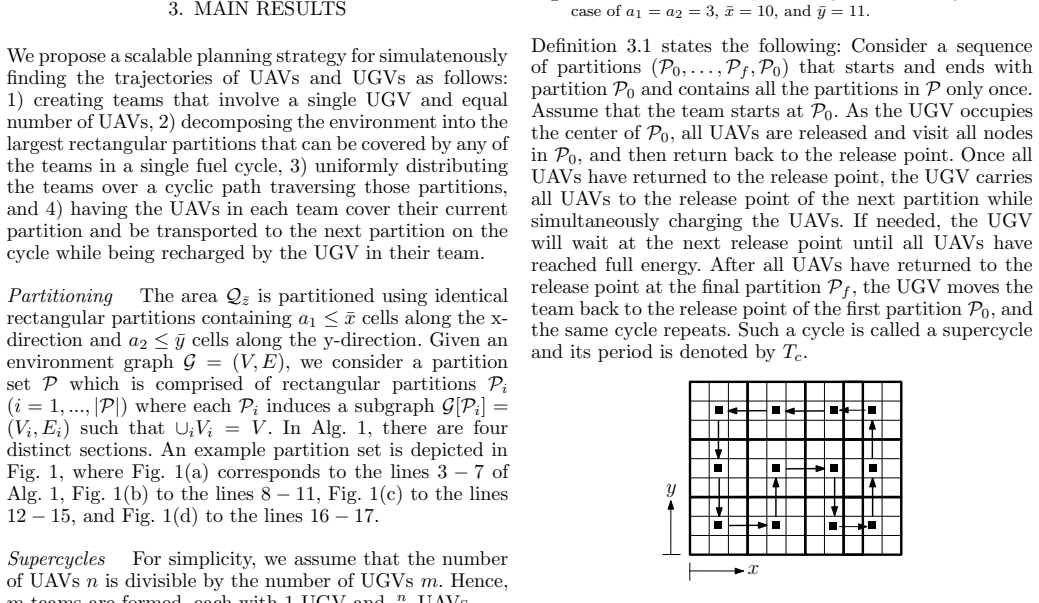
The supercycle: a closed sequence of partition visits in which a team's UGV carries its drones between partition centers while recharging them, and the drones cover each rectangle during one fuel cycle. The period is $T_c = |P| \frac{\Delta_e}{\beta^-} + \sum_i \max\left(\frac{\|c_{i+1} - c_i\|}{u_G^{\max}}, \frac{\Delta_e}{\beta^+}\right)$, and the load-bearing interval between consecutive partitions is $\Delta t_i = \frac{\Delta_e}{\beta^-} + \max\left(\frac{\|c_{i+1} - c_i\|}{u_G^{\max}}, \frac{\Delta_e}{\beta^+}\right)$. The deployment protocol Algorithm 4 staggers identical teams by $T_c/m$, and the Dantzig-Fulkerson-Johnson algorithm supplies both the shortest Hamiltonian cycle through partition centers and the minimum-distance visiting route within each subpartition.
What would settle it
Simulate the proposed algorithm with two teams on a small grid where the optimal partition has a node that belongs to only one cell, and record arrival times at that node. If, after time $T_c$, the gaps between consecutive visits are not exactly $T_c/2$, or if any drone's energy reaches zero, the central claim is false. A second test: replace the unlimited simultaneous charging model with a single-drone charger and recompute (14); if the measured maximum age exceeds $T_c/m$, the assumption is load-bearing.
Extended reading notes
Core claim
Proposition 3.3 states that given a supercycle of period $T_c$ over a partition set, $m$ UAV-UGV teams released $T_c/m$ apart achieve a maximum age $ar{T}(t) = T_c/m$ for all $t \ge T_c$. The argument rests on Lemma 3.1, which ensures at least one node belongs to a single partition and is therefore visited only once per supercycle; each team visits that node once per cycle, so the staggered teams visit it every $T_c/m$. The paper also claims that minimizing $T_c$ over rectangle dimensions $(a_1, a_2)$ under the fuel constraint is equivalent to the original age-minimization problem (11), so the best rectangle size is found by enumerating partition dimensions and checking feasibility.
Load-bearing premise
The ground vehicles are assumed to have unlimited energy and to be able to charge any number of drones at once, even while driving; if charging is single-drone or the UGV itself runs out of fuel, the cycle timing and the $T_c/m$ age guarantee break.
Editorial extensions
If this is right
- Any rectangular convex environment can be patrolled indefinitely with a finite, computable maximum age, independent of environment size relative to drone range, as long as each partition rectangle fits within one fuel cycle.
- Adding more teams (larger $m$) linearly reduces the guaranteed maximum age from $T_c$ to $T_c/m$, without changing the per-team partition size.
- The planning problem reduces to enumerating rectangle dimensions $(a_1, a_2)$ and running a feasibility check, so the method scales to large grids in practice.
- Identical teams are interchangeable: the same supercycle can be reused by any number of teams, with only the time offset changing.
- The age guarantee holds exactly after one supercycle period $T_c$, providing a clear bound on the transient time before the steady-state maximum age is reached.
Reading between the lines
- If UGV energy were finite or charging were limited to one drone at a time, the $T_c/m$ guarantee would degrade; a natural extension would modify the inter-partition interval to include a charging-queue term, leading to a larger effective $T_c$.
- The rectangle-partition assumption could generalize to other convex cells; the same staggered-supercycle argument should transfer as long as each cell contains a node visited once per supercycle.
- The claimed equivalence between minimizing $T_c$ and solving the original age-minimization problem holds only within the proposed strategy class; for non-rectangular partitions or heterogeneous teams, a different trajectory might yield a lower maximum age.
- A direct empirical test is to run Algorithm 4 on a grid where charging time dominates travel time; the observed inter-visit gaps at the single-partition node should be exactly $T_c/m$ by construction, which would confirm the timing model.
Signed reviews
Editorial analysis
A structured set of objections, weighed in public.
Referee Report
Summary. The paper addresses persistent surveillance of a rectangular grid by n energy-constrained UAVs whose energy is replenished by m UGVs acting as mobile charging stations. Age is defined as the time between consecutive visits to a node, and the objective in Problem 1 is to minimize the long-term maximum age over all vehicle trajectories and control inputs. The paper proposes a scalable strategy that partitions the grid into equal rectangles, forms m homogeneous teams (one UGV and n/m UAVs each), has each team follow a supercycle of partition visits defined by a Hamiltonian cycle on partition centers, and deploys the m teams with a uniform time shift of Tc/m. The main analytical results are Proposition 3.1 (single-team maximum age equals Tc), Proposition 3.2 (UAVs are energy-safe), and Proposition 3.3 (m-team maximum age equals Tc/m). The paper then optimizes the partition dimensions (a1,a2) by minimizing Tc subject to the energy constraint (18), claiming this optimization is equivalent to Problem 1. A numerical example with 3 UGVs and 15 UAVs yields (a1,a2)=(16,16), Tc=2306, and a reported minimum long-term maximum age of 768.6.
Significance. If the claims hold, the paper provides a constructive, scalable planning method for persistent surveillance with mobile charging stations, with explicit formulas for the supercycle period and the resulting age bound. The proof of the age bound for the constructed schedule is straightforward and correct under the stated assumptions, and the use of a Hamiltonian cycle over partitions plus time-shifted identical teams is a clean and implementable idea. The paper also makes a falsifiable prediction (maximum age equals Tc/m) and offers a finite-dimensional search over partition sizes. However, the claimed equivalence of the partition-size optimization to the general age-minimization problem (11) is not established; the strategy restricts to a narrow class of rectangular partitions and uniform teams, so the optimality claim is at best with respect to that class. With the equivalence claim corrected or proven, the paper would be a solid contribution to planning for energy-constrained persistent surveillance.
major comments (3)
- [Section 3, after Proposition 3.1] The assertion that minimizing Tc(a1,a2) subject to (18) is 'equivalent to (11)' is unsupported. Problem (11) optimizes over all initial positions pA(0), pG(0) and all control inputs uA, uG satisfying (1)-(8), whereas Algorithm 3 restricts to identical rectangular partitions, a single-team Hamiltonian supercycle, homogeneous teams, and uniformly time-shifted deployment of those teams. No argument shows that an optimal solution of (11) lies in this restricted class, and no lower bound is provided. Consequently, the 'minimum long-term maximum age' reported in Section 4 (Tc/m = 768.6) is only a minimum within the proposed strategy class. Please either prove the equivalence or a lower bound, or revise the claim to state that the optimization is over the class of strategies defined by Algorithms 1-4.
- [Section 2.2, Eq. (5)] Equation (5) imposes emergency landing by setting uA_i(t) = [0, 0, -uA_max] whenever zA_i(t) >= uA_max * e_i(t) / beta^-. This condition depends on altitude rather than on a critical energy threshold; as written, a UAV at low altitude with zero remaining energy does not satisfy the condition, so the constraint does not enforce emergency landing when energy is depleted. Please correct the inequality or state the intended critical-energy condition explicitly.
- [Section 2.2, before Eq. (8)] The assumptions that UGVs have unlimited energy and can simultaneously charge any number of UAVs while moving are load-bearing for the main results: the supercycle period Tc in Eq. (14) and hence the age bound Tc/m in Proposition 3.3 depend on the charging interval max(||c_{i+1}-c_i||/uG_max, Delta_e/beta^+) in Eq. (13). These assumptions are stated but not justified, and no relaxation is discussed. The paper should explicitly delineate the scope of the age guarantee and comment on how the results would change if charging were serial, if charging required the UGV to be stationary, or if UGV energy were finite.
minor comments (6)
- [Section 2.1] The sentence 'The vector of zeros with the is denoted by 0' is incomplete; it should state that the zero vector is denoted by 0.
- [Eq. (12)] The condition 't in union_i (t_out_{i,j}, t_in_{i+1,j})' uses the index j without quantifying it; please clarify the meaning, for example by writing the union over i for each fixed supercycle index j.
- [Algorithm 4] The input list of Algorithm 4 includes 'q(0)' while the rest of the algorithm and paper use pG(0); please make the notation consistent.
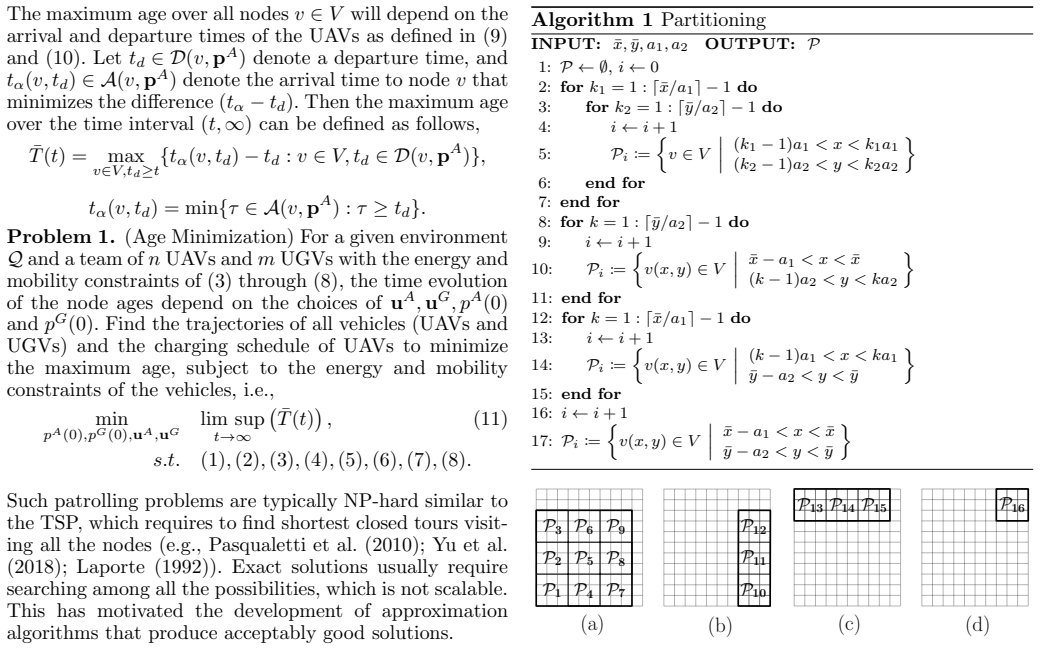
- [Section 4 and Algorithm 1] When a1 or a2 does not divide xbar or ybar, Algorithm 1 creates edge partitions with fewer than a1 x a2 cells; the paper should state explicitly whether Delta_e in (17) is computed for the full a1 x a2 partition as a conservative upper bound for all partitions.
- [Section 4] The simulation text calls (16,16) 'the optimal partition dimensions' and the corresponding age 'a minimum long-term maximum age' without qualification; as noted in Major Comment 1, these should be qualified as optimal within the proposed rectangular-partition strategy unless the equivalence to Problem 1 is proven.
- [Abstract] The phrase 'We show some results related to the safety and performance of the proposed strategy' is vague; please state the specific results, e.g., energy safety (Proposition 3.2) and the maximum-age bound Tc/m (Proposition 3.3).
Circularity Check
Restricted partition-size optimization is asserted to be 'equivalent to (11)' without proof, so the claimed global optimality is self-referential.
-
other
[Section 3, paragraph immediately after Proposition 3.1 (formulation of the reduced optimization problem)]
"Considering that Tc will be equivalent to the maximum age in the limit t → ∞, we formulate an optimization problem that will be equivalent to (11). The choice of (a1,a 2) defines P, and therefore Tc. The goal is to minimize Tc over all pairs (a1,a 2) subject to the energy limitations of the UAVs, min a1,a2 Tc(a1,a 2), s.t. (18)."
Problem 1, Eq. (11), optimizes limsup of the maximum age over all initial conditions and control inputs pA(0), pG(0), uA, uG subject to (1)–(8). The new problem restricts decisions to the grid dimensions (a1,a2) and then constructs trajectories by Algorithm 3. The only link between the two objectives is that, under the proposed strategy, Tc equals the maximum age (Prop. 3.1) and the maximum age is Tc/m (Prop. 3.3). Therefore minimizing Tc over (a1,a2) is exactly the internal performance optimization of this particular strategy. Calling this 'equivalent to (11)' asserts, without proof, that an optimal solution of (11) lies in the rectangular-partition/uniform-team supercycle class.
full rationale
The constructive core of the paper is not circular. Definition 3.1 and Eq. (14) define the supercycle period Tc; Lemma 3.1 establishes a node visited only once per supercycle; Propositions 3.1 and 3.3 compute the maximum age as Tc and then Tc/m under the time-shifted deployment protocol. These are direct consequences of the definitions and assumptions, not fitted predictions, and no self-citation is load-bearing in that derivation. The circularity is localized to the transition from Proposition 3.1 to the reduced optimization problem. The paper states that minimizing Tc over partition dimensions subject to (18) is 'equivalent to (11)', but Problem 1 optimizes over all trajectories and control inputs, while the reduced problem only chooses a1 and a2 and then fixes trajectories via Algorithms 2 and 3. No proof is given that the optimal solution of the general problem lies within this strategy class, so the 'equivalence' identifies the original age-minimization problem with the paper's own restricted problem. If the claim were weakened to 'optimal within the proposed strategy class', the circularity would disappear. Because the central theoretical age guarantee is honest, but the global optimality claim rests on an unproved self-referential equivalence, a moderate score is appropriate.
Assumptions & free parameters
free parameters (1)
- partition dimensions (a1, a2) =
16 x 16 in the simulation; searched over all a1 <= 48 and a2 <= 32 in Algorithm 3
assumptions (5)
- domain assumption Unlimited UGV energy and ability to charge any number of UAVs simultaneously, including while transporting them.
- domain assumption Single-integrator dynamics, constant discharge rate beta-, constant charge rate beta+, and identical homogeneous vehicles.
- standard math DFJ algorithm returns exact optimal Hamiltonian tours for the partition centers and for each UAV's node set.
- domain assumption The environment is a convex obstacle-free rectangular box and the patrol area is a flat rectangle discretized into d-by-d cells.
- domain assumption The number of UAVs n is divisible by the number of UGVs m, so m identical teams of n/m UAVs can be formed.
Cite this review
Pith. "Pith review of Persistent Surveillance With Energy-Constrained UAVs and Mobile Charging Stations." pith.science (2026). https://pith.science/paper/VTAIU4G4
@misc{pith2026190805727,
  author       = {Pith},
  title        = {Pith review of: Persistent Surveillance With Energy-Constrained UAVs and Mobile Charging Stations},
  year         = {2026},
  howpublished = {\url{https://pith.science/paper/VTAIU4G4}},
  note         = {Machine review of arXiv:1908.05727}
}
read the original abstract
We address the problem of achieving persistent surveillance over an environment by using energy-constrained unmanned aerial vehicles (UAVs), which are supported by unmanned ground vehicles (UGVs) serving as mobile charging stations. Specifically, we plan the trajectories of all vehicles and the charging schedule of UAVs to minimize the long-term maximum age, where age is defined as the time between two consecutive visits to regions of interest in a partitioned environment. We introduce a scalable planning strategy based on 1) creating UAV- UGV teams, 2) decomposing the environment into optimal partitions that can be covered by any of the teams in a single fuel cycle, 3) uniformly distributing the teams over a cyclic path traversing those partitions, and 4) having the UAVs in each team cover their current partition and be transported to the next partition while being recharged by the UGV. We show some results related to the safety and performance of the proposed strategy.
Figures

Figures from the paper (1 more)

Reference graph
Works this paper leans on
-
[1]
Aksaray, D., Vasile, C., and Belta, C. (2016). Dynamic routing of energy-aware vehicles with temporal logic constraints. In IEEE Int. Conference on Robotics and Automation (ICRA), 3141–3146
work page 2016
-
[2]
Aksaray, D., Leahy, K., and Belta, C. (2015). Distributed multi-agent persistent surveillance under temporal logic constraints. IFAC-PapersOnLine, 48(22), 174–179. Cort´ es, J., Mart´ ınez, S., Karatas, T., and Bullo, F. (2004). Coverage control for mobile sensing networks. IEEE Trans. on Robotics and Automation , 20(2), 243–255
work page 2015
-
[3]
Dantzig, G., Fulkerson, R., and Johnson, S. (1954). Solu- tion of a large-scale traveling-salesman problem. J. of operations research society of America, 2(4), 393–410
work page 1954
-
[4]
Derenick, J., Michael, N., and Kumar, V. (2011). Energy- aware coverage control with docking for robot teams. In IEEE Int. Conf. on Intelligent Robots and Systems (IROS), 3667–3672
work page 2011
-
[5]
Elmaliach, Y., Agmon, N., and Kaminka, G.A. (2009). Multi-robot area patrol under frequency constraints. Annals of Mathematics and Artificial Intelligence , 57(3- 4), 293–320
work page 2009
-
[6]
Laporte, G. (1992). The traveling salesman problem: An overview of exact and approximate algorithms. Euro- pean Journal of Operational Research, 59(2), 231–247
work page 1992
-
[7]
Litus, Y., Zebrowski, P., and Vaughan, R.T. (2009). A distributed heuristic for energy-efficient multirobot mul- tiplace rendezvous. IEEE Trans. on Robotics , 25(1), 130–135
work page 2009
-
[8]
Mathew, N., Smith, S.L., and Waslander, S.L. (2015). Mul- tirobot rendezvous planning for recharging in persistent tasks. IEEE Trans. on Robotics, 31(1), 128–142
work page 2015
Show all 13 references
-
[9]
and Kroo, I
Nigam, N. and Kroo, I. (2008). Persistent surveillance us- ing multiple unmanned air vehicles. In IEEE Aerospace Conf., 1–14
2008
-
[10]
Pasqualetti, F., Franchi, A., and Bullo, F. (2010). On optimal cooperative patrolling. In IEEE Conf. on Decision and Control (CDC) , 7153–7158
2010
-
[11]
Pimenta, L., Kumar, V., Mesquita, R.C., and Pereira, G. (2008). Sensing and coverage for a network of heterogeneous robots. In IEEE Conf. on Decision and Control, 3947–3952
2008
-
[12]
and Rinner, B
Scherer, J. and Rinner, B. (2016). Persistent multi- uav surveillance with energy and communication con- straints. In IEEE Int. Conference on Automation Sci- ence and Engineering (CASE) , 1225–1230. Yazıcıo˘ glu, A.Y., Egerstedt, M., and Shamma, J.S. (2017). Communication-free...
2016
-
[13]
Yu, K., Budhiraja, A.K., and Tokekar, P. (2018). Al- gorithms for routing of unmanned aerial vehicles with mobile recharging stations and for package delivery. In IEEE Int. Conf. on Robotics and Automation (ICRA) , 1–5
2018
Reviewed August 14, 2026 · model on record in the stance chip above.
Discussion (0). Continue with ORCID to comment.