REVIEW 4 major objections 6 minor 26 references
Microparticle transport networks with holographic optical tweezers and cavitation bubbles
T0 review · 4 major / 6 minor · reviewed 2026-08-14 · deepseek-v4-flash
Pith's one-line read Random hops carry a laser-heated microbead across n optical traps in time that grows as n^2.
desk verdict A nice experimental platform for barrier-free microparticle transport, but the headline n^2 scaling claim rests on a mislabeled observable and no quantitative fits. read the letter →
The pith
A machine-rendered reading of the paper's core claim, the machinery that carries it, and where it could break.
The reading
What carries the argument
The mechanism is an effective optical potential shaped like a Lennard-Jones potential, attractive at long range and repulsive at short range: the trapping laser both holds the bead and heats it until a cavitation bubble explodes, generating the random vapor-propelled hops that move the particle between beams. The graph-theoretic comparison is random walks on connected graphs, using the known results that regular graphs have cover and commute times proportional to $n^{2}$ while all connected graphs have an $n^{3}$ upper bound; the weighted adjacency matrix of observed transits encodes which hops are available and how often they are used.
What would settle it
Record a long single-particle trajectory, build the empirical transition matrix between traps, and run a Markov-chain Monte Carlo simulation from that matrix; if the simulated distribution of times to visit n distinct traps does not reproduce the measured $n^{2}$ scaling, or if a statistical test rejects the Markov property in the hop sequence, the random-walk interpretation is wrong.
Extended reading notes
Core claim
In an array of holographically generated optical traps, each trapped microbead repeatedly superheats the surrounding liquid, creating a microsecond cavitation bubble whose explosion propels the particle out of the trap and into a neighboring well, so the bead's sequence of trap visits forms a random walk. Tracked trajectories yield weighted adjacency matrices whose self-transition fraction ranges from 8% to 43% and whose degree distributions are localized, resembling random networks. The central quantitative result is that the average commute time to visit n distinct traps is proportional to $n^{2}$ across all six network geometries, with an absolute upper bound proportional to $n^{3}$, matching theorems for random walks on connected graphs. The paper also shows that vapor explosions deliver impulses that attract bystander particles, so a network that one particle has begun to explore draws in others, and two-particle experiments show enhanced transport in the more densely connected square lattice but not in the sparse large circle.
Load-bearing premise
The load-bearing premise is that each hop to another trap is a memoryless random step whose probabilities are fixed by the trap geometry; if the particle's hops are correlated, biased, or depend on its recent history, the measured $n^{2}$ scaling need not follow from random-walk theory.
Editorial extensions
If this is right
- The n^2 law gives a quantitative design rule: a network of n traps will, on average, be fully explored in time proportional to n^2 and never worse than n^3, independent of the trap arrangement.
- Because the landscape is written by holograms, transport networks can be reconfigured in real time without fabrication, so a single setup can implement many different graphs and test random-walk questions experimentally.
- The self-recruiting mechanism means a network does not need to be preloaded: the explosions of the first traveler attract new particles, sustaining traffic even when individual beads are ejected.
- Two-particle operation shows that interaction can accelerate coverage in densely connected networks, suggesting that adding particles changes effective commute times in a geometry-dependent way.
Reading between the lines
- A natural next test, not performed in the paper, is to extract the full transition matrix from long trajectories and check the Markov property directly; such a check would either confirm the random-walk interpretation or reveal hidden memory in the hopping.
- If the n^2 scaling continues to hold for larger and less regular graphs, these trap arrays could serve as a tabletop analogue for exploring graph algorithms, where single-particle passage times measure graph-theoretic quantities like cover time.
- The systematic dependence of self-transition fraction on node spacing and perimeter position suggests a design handle: spacing can be used to tune the effective degree distribution and hence the speed of transport, without changing the number of traps.
Signed reviews
Editorial analysis
A structured set of objections, weighed in public.
Referee Report
Summary. The manuscript reports an experimental study of a single absorbing microparticle that is stochastically ejected from optical traps by laser-induced cavitation bubbles and hops between traps in holographically generated arrays. The authors construct transport networks from the observed particle trajectories for circular, square-lattice, and random trap geometries, and characterize them by their degree distributions and by the average time needed to visit n distinct traps. The central quantitative claim is that this time scales as n^2, in agreement with random-walk theory on connected graphs, and that two-particle interactions can reduce these transit times. The paper also demonstrates that vapor explosions attract other particles into the network, which could allow sustained transport.
Significance. If the n^2 scaling of partial cover times were established, the work would provide a compelling connection between an active-particle transport system and classical random-walk theory, and the ability to confine and direct active particles without physical barriers or external forces is a notable experimental novelty. The attraction of additional particles through vapor-explosion forces and the self-sustaining network property are also interesting for micro- and nano-machine applications. However, the quantitative support for the central claim is currently incomplete: the theory cited refers to full cover times and pairwise commute times, not the partial cover times actually measured, and no statistical fits or tests of the random-walk assumption are provided. The manuscript therefore presents a promising experimental system whose main quantitative conclusion requires substantially stronger analysis.
major comments (4)
- [Fig. 3 and text near 'The measured commute times are proportional to n^2'] The quantity plotted in Fig. 3 is the mean time for a single trajectory to visit n distinct nodes, which is a partial cover time, not the pairwise commute time between two nodes nor the full cover time for which the cited bounds (Refs. [22,23]) are stated. For a simple random walk on a regular graph, the partial cover time need not scale as n^2; for example, on a complete graph it grows as n log(n/(n-k)) and on a two-dimensional lattice it grows roughly as k log k. The theoretical benchmark used in the abstract and conclusion is therefore not aligned with the measured observable, and the observed n^2 behavior cannot be attributed to the cited random-walk results without a direct derivation or simulation of the partial cover time on the specific trap graphs, including their self-loops and weighted transitions.
- [Fig. 3] No power-law fits, exponents, goodness-of-fit values, or confidence intervals are reported for the claim that the transit times are 'proportional to n^2'. With only n up to 20 and log-log axes, the differences among n^2, n^2 log n, and n^3 are small, and the visual agreement in Fig. 3 is not persuasive without quantitative fitting. The authors should report fitted exponents and uncertainties for each geometry, and ideally show the data together with the fitted curves and residual statistics.
- [Section 'The trajectory of each particle...' and Fig. 1c-d] The application of random-walk theory assumes that the sequence of trap visits is Markovian and governed only by the adjacency of traps. The paper does not test this assumption: no transition matrix is estimated, no test of memorylessness is performed, and the hop-length distribution (Fig. 1c) and the substantial fraction of self-transitions (8-43% of transits) indicate that the effective process may not be a simple discrete-time random walk on the graph. A direct test of Markovianity or a simulation of a random walk on the extracted weighted graphs, compared with the measured partial cover times, would validate or refute the central theoretical comparison.
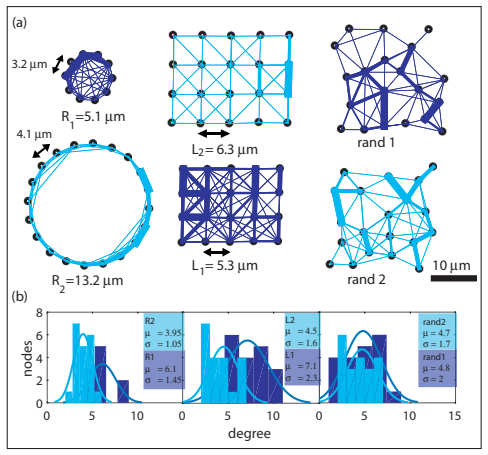
- [Fig. 2b and abstract ('localized like in the case of random networks')] The claim that the degree distributions are 'localized like in the case of random networks' is not supported by a null model. For the small systems studied (10 or 20 nodes), the degree histograms in Fig. 2b are noisy, and a comparison to a Poisson distribution with the same mean degree, or to the degree distribution of an Erdős–Rényi random graph with the same number of nodes and edges, would be needed to justify the statement. Without such a null model, the degree-distribution observation remains qualitative.
minor comments (6)
- [Title and abstract] The title contains a typo ('optica l' should be 'optical'), and the abstract uses 'commute times' for a quantity that is actually a partial cover time; this terminology should be clarified in both the abstract and the main text.
- [Introduction, first paragraph] There is a typo: 'swiming bacteria' should be 'swimming bacteria'.
- [Fig. 1 caption] The caption contains 'spaning' which should be 'spanning'.
- [Fig. 3] The axes of Fig. 3 appear to be logarithmic, but the axis labels do not indicate this; the caption should state that both axes are logarithmic.
- [Equation (1) and text following] The adjacency matrix is defined with entries A_ij, but the degree formula uses A_ij where the diagonal is not explicitly excluded. For consistency, either define the adjacency matrix with zero diagonal or specify that the sum is over i ≠ j.
- [References] Reference [26] spells 'Gershberg Saxon'; the correct spellings are 'Gerchberg' and 'Saxton'.
Circularity Check
No significant circularity: the n^2 scaling claim is compared against external random-walk theory, not derived from fitted parameters or self-citation.
full rationale
The paper's central quantitative claim is that measured times to visit n distinct traps scale as n^2, in agreement with random-walk theory on connected graphs. The measured observable is extracted directly from tracked trajectories and arrival times, and the theoretical benchmark is taken from the external mathematical results of Lovász and Feige (Refs. [22,23]). No parameter is fitted to a subset of the data and then renamed as a prediction, and no equation defining the measured quantity is equivalent to the claimed scaling by construction. The heuristic argument that distance is proportional to n and time is proportional to distance squared is a paraphrase of Brownian-motion scaling, not a circular reduction: it does not assume the n^2 conclusion in order to derive it. The author's self-citations ([18,24,25]) support the underlying vapor-explosion hopping mechanism and impulsive interactions, but they do not carry the burden of the n^2 claim, which is benchmarked against independent random-walk theory. Even if the application of the full-cover-time bounds to the measured partial-cover times is questionable, that is a correctness or interpretation concern rather than a circularity concern. The derivation chain is therefore self-contained with respect to the scaling claim.
Assumptions & free parameters
free parameters (1)
- Gaussian fit parameters (mean and std dev) for degree distributions =
R2: mu=3.95, sigma=1.05; R1: mu=6.1, sigma=1.45; L1: mu=7.1, sigma=2.3; L2: mu=4.5, sigma=1.6; rand1: mu=4.8, sigma=2…
assumptions (3)
- standard math Random walks on connected graphs have cover times and commute times bounded by O(n^3), and for regular graphs these scale as O(n^2).
- domain assumption The particle's hops between traps constitute a random walk on the trap graph (Markovian, memoryless transitions).
- domain assumption The vapor explosion ejects the particle from the trap, and the particle is subsequently captured by another trap in the array.
Cite this review
Pith. "Pith review of Microparticle transport networks with holographic optical tweezers and cavitation bubbles." pith.science (2026). https://pith.science/paper/NOHEYEDP
@misc{pith2026190805733,
  author       = {Pith},
  title        = {Pith review of: Microparticle transport networks with holographic optical tweezers and cavitation bubbles},
  year         = {2026},
  howpublished = {\url{https://pith.science/paper/NOHEYEDP}},
  note         = {Machine review of arXiv:1908.05733}
}
abstract
Optical transport networks for active absorbing microparticles are made with holographic optical tweezers. The particles are powered by the optical potentials that make the network and transport themselves via random vapor propelled hops to different traps without the requirement for external forces or microfabricated barriers. The geometries explored for the optical traps are square lattices, circular arrays and random arrays. The degree distribution for the connections or possible paths between the traps are localized like in the case of random networks. The commute times to travel across $n$ different traps scale as $n^2$, in agreement with random walks on connected networks. Once a particle travels the network, others are attracted as a result of the vapor explosions.
Figures


Figures from the paper (1 more)

Reference graph
Works this paper leans on
-
[1]
The rotary motor of bacterial flagella,
H.C. Berg, “The rotary motor of bacterial flagella,” Annu . Rev. Biochem. 72, 19-54 (2003)
work page 2003
-
[2]
Kinesin Motor Mechanics: Binding, Steppin g, Tracking, Gating, and Limping,
S.M. Block, “Kinesin Motor Mechanics: Binding, Steppin g, Tracking, Gating, and Limping,” Biophys. J. 92, 2986-2995 (2007)
work page 2007
-
[3]
Nonequilibrium En ergetics of Molecular Motor Kinesin,
T. Ariga, M. Tomishige and D. Mizuno, “Nonequilibrium En ergetics of Molecular Motor Kinesin,” Phys. Rev. Lett. 121, 218101 (2018)
work page 2018
-
[4]
Enzyme-powered hollow mesoporous janus nanomotors,
X. Ma, A. Jannasch, U.-R. Albrecht, K. Hahn, A. Miguel-L´ opez, E. Sch¨ affer and S. S´ anchez, “Enzyme-powered hollow mesoporous janus nanomotors,” Nan o Lett. 15, 7043 - 7050 (2015)
work page 2015
-
[5]
Tar geted delivery of colloids by swimming bacteria,
N. Koumakis, A. Lepore, C. Maggi, and R. Di Leonardo, “Tar geted delivery of colloids by swimming bacteria,” Nat. Commun. 4, 2588 (2013)
work page 2013
-
[6]
Active particles in complex and crowded environments,
C. Bechinger, R. Di Leonardo, H. L¨ owen, C. Reichhardt, G . Volpe, G. and G. Volpe, “Active particles in complex and crowded environments,” Rev. Mod. P hys. 88, 045006 (2016)
work page 2016
-
[7]
R. Di Leonardo, L. Angelani, D. DellArciprete, G. Ruocco , V. Iebba, S. Schippa, M.P. Conte, F. Mecarini, F. De Angelis and E. Di Fabrizio, “Bacterial rat chet motors,” Proc. Natl. Acad. Sci. 107, 9541-9545 (2010)
work page 2010
-
[8]
Directin g cell motions on micropatterned ratchets,
G. Mahmud, C.J. Campbell and B.A. Grzybowski, “Directin g cell motions on micropatterned ratchets,” Nat. Phys. 5, 606 -612 (2009)
work page 2009
Show all 26 references
-
[9]
Microswimmers in patterned environments,
G. Volpe, I. Buttinoni, D. Vogt, H.-J. K¨ ummerer and C. Be chinger, “Microswimmers in patterned environments,” Soft Matter 7, 88108815 (2011)
2011
-
[10]
Dynamics an d separation of circularly moving particles in asymmetrically patterned arrays,
C. Reichhardt and C.J. Olson-Reichhardt, “Dynamics an d separation of circularly moving particles in asymmetrically patterned arrays,” Phys. Rev. E 88, 042306 (2013)
2013
-
[11]
Active Motion of a Janus Particle by Self- Thermophoresis in a Defocused Laser Beam,
H.R. Jiang, N. Yoshinaga and M. Sano, “Active Motion of a Janus Particle by Self- Thermophoresis in a Defocused Laser Beam,” Phys.Rev.Lett. 105, 268302 (2010)
2010
-
[12]
Phoretic self propulsion,
J.L. Moran and J.D. Posner, “Phoretic self propulsion, ” Annu. Rev. Fluid Mech. 49, 511 (2017)
2017
-
[13]
Autonomous Nanomotor Based on Copp er -Platinum Segmented Nanobattery,
R. Liua, and A. Sen, “Autonomous Nanomotor Based on Copp er -Platinum Segmented Nanobattery,” J. Am. Chem. Soc. 133, 20064-20067 (2011)
2011
-
[14]
Non-Boltzmann stationary distribut ions and nonequilibrium relations in active baths,
A. Argun, et al., “Non-Boltzmann stationary distribut ions and nonequilibrium relations in active baths,” Phys. Rev. E 94, 062150 (2016) 9
2016
-
[15]
Optical Thermal Ratchet,
L.P. Facheux, L.S. Bourdieu, P.D. Kaplan, and A.J. Libc haber, “Optical Thermal Ratchet,” Phys. Rev. Lett. 74, 1504 (1995)
1995
-
[16]
Nanofluidic rocking Brownian motors,
M.J. Skaug, C. Schwemmer, S. Fringes, C.D. Rawlings and A.W. Knoll, “Nanofluidic rocking Brownian motors,” Science 359, 1505-1508 (2018)
2018
-
[17]
Omnidi- rectional Transport in Fully Reconfigurable Two Dimensiona l Optical Ratchets,
A.V. Arzola, M. Villasante-Barahona, K. Volke-Sepulv eda, P. Jakl and P. Zemanek, “Omnidi- rectional Transport in Fully Reconfigurable Two Dimensiona l Optical Ratchets,” Phys. Rev. Lett. 118, 138002 (2017)
2017
-
[18]
A microscopic steam engine implement ed in an optical tweezer,
P.A. Quinto-Su, “A microscopic steam engine implement ed in an optical tweezer,” Nat. Com- mun. 5, 5889 (2014)
2014
-
[19]
Environmental context explain s L´ evy and Brownian movement pat- terns of marine predators,
N.P. Humphries et al., “Environmental context explain s L´ evy and Brownian movement pat- terns of marine predators,” Nature 465, 1066-1069 (2010)
2010
-
[20]
Simulation of a Brownian particl e in an optical trap,
G. Volpe and G. Volpe, “Simulation of a Brownian particl e in an optical trap,” Am. J. Phys. 81, 222 -230 (2013)
2013
-
[21]
Scale-Free Networks,
A.L. Barab´ asi and E. Bonabeau, “Scale-Free Networks, ” Sci. Am. 288, 50-59 (2003)
2003
-
[22]
Combinatorics, Paul Erd¨ os is Eighty (Vol ume 2),
L. Lov´ asz, “Combinatorics, Paul Erd¨ os is Eighty (Vol ume 2),” (Keszthely, Hungary, 1-46 (1993)
1993
-
[23]
A tight upper bound on the cover time for rando m walks on graphs,
U. Feige, “A tight upper bound on the cover time for rando m walks on graphs,” Random Struct. Algor. 6, 51-54 (1995)
1995
-
[24]
Motion of micrometer sized spherical particles exposed to a transient radial flow : attraction, repulsion, and rotation,
S.R. Gonzalez-Avila, X. Huang, P.A. Quinto-Su, T. Wu an d C.D. Ohl, “Motion of micrometer sized spherical particles exposed to a transient radial flow : attraction, repulsion, and rotation,” Phys. Rev. Lett. 107, 074503 (2011)
2011
-
[25]
Transient trapp ing of two microparticles interacting with optical tweezers and cavitation bubbles,
V. Carmona-Sosa, and P.A. Quinto-Su, “Transient trapp ing of two microparticles interacting with optical tweezers and cavitation bubbles,” J. Opt. 18 105301 (2016)
2016
-
[26]
A practical algorith m for the determination of the phase from image and diffraction plane pictures,
R.W. Gerchberg. and W.O. Saxton, “A practical algorith m for the determination of the phase from image and diffraction plane pictures,” Optik 35, 237 (1972). 10
1972
Reviewed August 14, 2026 · model on record in the stance chip above.
Discussion (0). Continue with ORCID to comment.