REVIEW 3 major objections 3 minor 30 references
Quantum-Optical set-up for the Monty Hall problem
T0 review · 3 major / 3 minor · reviewed 2026-08-14 · deepseek-v4-flash
Pith's one-line read A quantum-optical set-up can realize the Monty Hall game, reproducing the classical 1/3 vs 2/3 odds in its semiclassical limit.
desk verdict The central claim that this optical setup verifies Monty Hall doesn't survive: the host's reveal is independent of the player's choice, and the 1/3 vs 2/3 numbers evaporate once you discard the impossible events. read the letter →
The pith
A machine-rendered reading of the paper's core claim, the machinery that carries it, and where it could break.
The reading
What carries the argument
The load-bearing device is the door-opening operator $\hat{D}_o=\cos(\phi_1)|1_b\rangle\langle 1_b|+\sin(\phi_2)|2_b\rangle\langle 2_b|+\sin(\phi_3)|3_b\rangle\langle 3_b|$, together with the two-doors-remained-closed condition $\cos^2\phi_1+\sin^2\phi_2+\sin^2\phi_3=2$. It acts on the prize subsystem alone, de-normalizes the state, and is renormalized before computing winning probabilities. In the optical set-up this operator is implemented by three polarizers in front of Bob's detectors, while polarization rotators and beam splitters set the amplitudes $a_i$ and $b_i$; coincidences between Alice and Bob detectors are normalized to obtain the probabilities of winning by switching and by not switching.
What would settle it
Run the proposed set-up with uniform amplitudes $a_i=b_i=1/\sqrt{3}$ and door-opening angles that select two doors, then compare the coincidence-normalized counts to $P_{\mathrm{ns}}=1/3$ and $P_{\mathrm{s}}=2/3$; a statistically significant deviation would refute the semi-classical claim.
Extended reading notes
Core claim
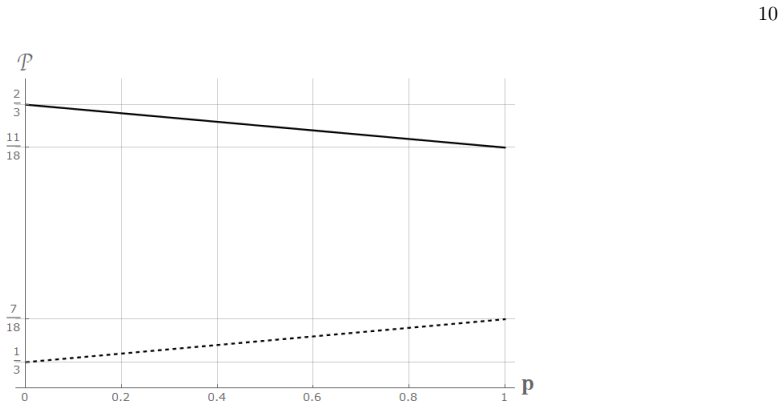
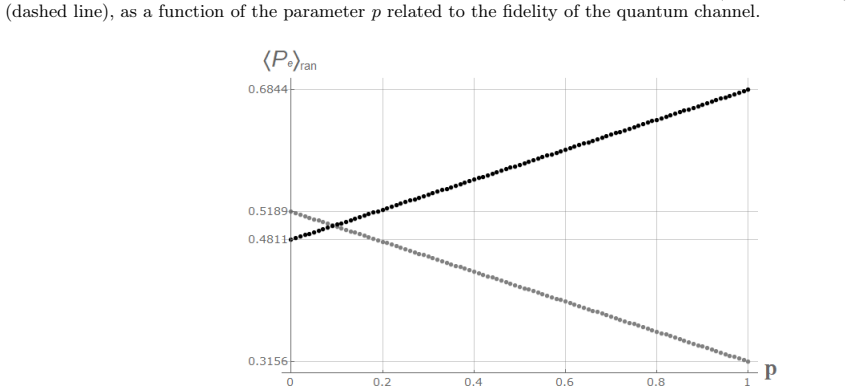
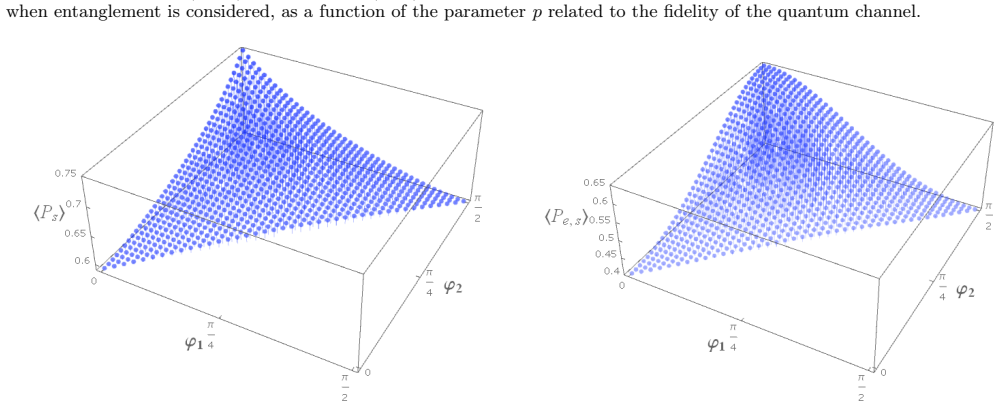
The central claim is that the Monty Hall paradox can be reproduced and extended in a concrete photon experiment. With Bob's prize state uniform, Alice's choice state uniform, and the door-opening operator projecting onto two of the three doors, equations (12) and (13) give exactly $P_{\mathrm{ns}}=1/3$ and $P_{\mathrm{s}}=2/3$. When the parameters are treated as random variables, the non-entangled protocol yields $\langle P_{\mathrm{ns}}\rangle_{\mathrm{ran}}\approx 0.3664$ and $\langle P_{\mathrm{s}}\rangle_{\mathrm{ran}}\approx 0.6336$, i.e. switching is about 1.73 times better. The entangled version inverts this, giving $\langle P_{\mathrm{e,ns}}\rangle_{\mathrm{ran}}\approx 0.5189$ and $\langle P_{\mathrm{e,s}}\rangle_{\mathrm{ran}}\approx 0.4811$. The paper further claims that in the strategy-based game the host can tune the door-opening to make switching three times better in the non-entangled case, or, with entanglement, can make the two choices equally good; and that Pauli noise on Alice's photon does not alter the non-entangled results but improves the switching odds in the entangled game.
Load-bearing premise
The argument rests on treating the polarizer-based operation as a faithful stand-in for the host's informed reveal, even though in the model it acts on the prize alone and is not conditioned on which door the player chose.
Editorial extensions
If this is right
- If the set-up is built as described, a university teaching lab can display the $1/3$ vs $2/3$ split by counting photon coincidences.
- The random-game average predicts a robust switching advantage near $1.73{:}1$ even without fine-tuning the angles.
- Entangling the player's and host's photons removes the switching advantage, so the same hardware can illustrate how correlations change a game.
- With a noisy channel, the entangled game's advantage tilts toward switching as noise increases, making the effect of decoherence visible.
- The host can tune the door-opening polarizers to either amplify the advantage to a $3{:}1$ ratio or, in the entangled case, erase it entirely.
Reading between the lines
- The classical Monty Hall reveal depends on which door the player picked; building a feed-forward from Alice's detected choice into the door-opening polarizer settings would turn the present set-up into a fully conditional version.
- A natural next step is to add a classical feed-forward that sets the polarizer angles based on Alice's detected choice, which would implement the conditional host rule and could restore exact $1/3$/$2/3$ probabilities outside the symmetric limit.
- The same coincidence-counting geometry could test whether a generalized $n$-door version retains $P_{\mathrm{ns}}=1/n$ and $P_{\mathrm{s}}=(n-1)/(n-m-1)\cdot 1/n$ once more spatial modes are added.
- In a remote-play configuration, the measured switching-versus-not-switching odds could serve as a diagnostic of the channel's Pauli noise parameter $p$.
Signed reviews
Editorial analysis
A structured set of objections, weighed in public.
Referee Report
Summary. The paper proposes a quantum-optical implementation of the Monty Hall problem. Two photonic qudits (or their polarization/spatial modes) represent Alice's initially chosen door and Bob's prize location; a 'door-opening operator' acting on Bob's subsystem is introduced, followed by renormalization, and the winning probabilities for switching and not switching are taken as sums of squared amplitudes over diagonal and off-diagonal coincidence events. The authors analyze a symmetric unentangled ('semi-classical') case, which yields the classical probabilities 1/3 and 2/3, and then study random and strategy-based settings, with and without entanglement, including the effect of a Pauli channel acting on Alice's photon.
Significance. The concrete optical construction is a strength: the paper gives an explicit map from beam-splitter, polarizer, and rotator settings to the amplitudes in Eqs. (26)-(31), and the algebraic steps in Sections III and IV are internally consistent. The inclusion of a separable/entangled comparison and a noise analysis via a Pauli channel is useful for a table-top pedagogical demonstration. If the mapping to the actual Monty Hall problem were faithful, the proposal would be a nice way to 'verify' the classical counter-intuitive result. That mapping, however, is the paper's central weakness: the host's operation does not depend on the player's initial choice, so the presented 1/3 versus 2/3 result is an unconditional average rather than the conditional probability that defines the Monty Hall problem. The paper therefore needs substantial reworking of its central claim before the contribution can be accepted.
major comments (3)
- [Section II, Eqs. (8)-(13)] The central claim that the semi-classical case reproduces the Monty Hall probabilities is not supported. Equation (8) acts only on Bob's prize subsystem, so the host's operation is independent of Alice's chosen door. In the classical game, as correctly described in Table I, the host opens a door k with k ≠ i,j; in particular, the host can never open the door the player chose. For the semi-classical choice D_o = |2_b><2_b| + |3_b><3_b| (door 1 opened), Eqs. (12)-(13) count the events A1-B2 and A1-B3 as winning by switching, even though those are runs where the host has opened the door that Alice selected. If those events are discarded and the remaining four events are renormalized, the four surviving events are equally weighted and P_ns = P_s = 1/2. Thus the claimed 1/3 versus 2/3 arises only because one averages over all three possible opened doors while keeping Alice's choice independent; it is not the conditional posterior produced by a knowledgeable host. This is the load-bearing point of the paper and must be fixed by either making the door-opening operator depend on Alice's choice or by explicitly reframing the model as a non-adaptive variant rather than a realization of the Monty Hall problem.
- [Section II, Eq. (9), and Section V, Eqs. (59)-(61)] The 'two-doors-remained-closed condition' does not encode the intended host action. For generic φ1, φ2, φ3 satisfying Eq. (9), all three β_i are nonzero, so no door is actually opened; the condition merely fixes the sum of the squared transmission factors. The special choices listed in the semi-classical case are projections, but the random-game region defined by Eqs. (59)-(61) includes non-projective attenuations. Consequently, the random-game expectation values in Eqs. (64)-(65) are averages over a process in which the host never opens a door, and the switching advantage ⟨P_s⟩ ≈ 0.6336 versus ⟨P_ns⟩ ≈ 0.3664 is largely a combinatorial effect of there being six off-diagonal versus three diagonal coincidence channels. This should be stated explicitly, or the model should be revised so that the host's operation genuinely removes one door.
- [Section II, 'semi-classical case' paragraph] The statement that the symmetric state a_i = b_i = 1/√3, together with the three special choices of φ, constitutes a case that 'actually resembles the classical problem' is not justified. In the classical Monty Hall game the host's choice of door carries information about the prize location conditioned on the player's initial choice; the likelihood ratio is 1:2 (two empty doors when the player's first choice hides the prize versus only one when it does not). The operator in Eq. (8) has no access to Alice's state and therefore cannot produce this likelihood ratio. The numbers 1/3 and 2/3 in Eqs. (12)-(13) follow from the uniform and independent distributions of Alice's choice and the door that is projected out, not from a conditional host strategy. The paper should either introduce a conditional operation or explicitly classify its scheme as a different game, such as an 'ignorant host' or a host who may reveal the player's door.
minor comments (3)
- [Section III, Fig. 1 caption] The caption says the BBO crystal produces photons entangled 'in both position and polarization', while the text and Eq. (17) describe only polarization entanglement; please align the two descriptions.
- [Section V, Eq. (62)] Defining the probability density ρ through its reciprocal is unconventional; it would be clearer to state the actual density and its support explicitly.
- [Section III, after Eq. (35)] The sentence explaining that renormalization is 'experimentally justified' by Eq. (35) would benefit from an explicit note that Eq. (35) is a conditional normalization on detected coincidences, not a proper quantum-state renormalization after a unitary evolution.
Circularity Check
No circularity: the semiclassical 1/3 vs 2/3 result is a transparent evaluation of the model's own definitions, and no fitted parameter, self-citation, or hidden reduction carries the argument.
full rationale
The derivation is self-contained. Equations (12) and (13) define the winning probabilities in the proposed quantum-optical model by direct analogy with the classical sample space of Table I; no parameter is fitted to external data and no prior result of the same authors is load-bearing. The semiclassical result is obtained by an explicit choice a_i = b_i = 1/sqrt(3) and a door-opening projection that annihilates one door; substituting these values into (12) and (13) gives exactly 1/3 and 2/3. This is a transparent modeling choice, not a hidden input masquerading as a prediction. The random-game and strategy-based results are computed from the model's probability distributions over the angles, and the noise section evaluates the model under a Pauli channel; none of these reduce by construction to the claimed classical output. The paper's substantive weakness—that the door-opening operator (8) acts on Bob's prize subsystem alone and does not implement the host's conditional dependence on Alice's initial choice—is a fidelity or correctness concern about whether the setup really implements the classical Monty Hall game, not a circularity in the derivation. There are no self-citations, no fitted inputs called predictions, and no imported uniqueness theorems. The central claim is therefore independent and non-circular.
Assumptions & free parameters
assumptions (5)
- ad hoc to paper Door-opening operator (Eq. 8) with the two-doors-remained-closed condition (Eq. 9) models the host's action.
- ad hoc to paper Probabilities of winning are identified with sums of squared amplitudes for matching and non-matching detector pairs (Eqs. 12-13, 15-16).
- ad hoc to paper The random-game analysis assumes all four player/host angles are independent and uniformly distributed over [0, pi/2] (Section V).
- domain assumption The noise is modeled as a Pauli channel acting only on Alice's photon (Eq. 48), with px=py=pz=p/3.
- domain assumption The SPDC source and the polarizing elements produce the states (17) and (18) and implement the operations in Section III.
Cite this review
Pith. "Pith review of Quantum-Optical set-up for the Monty Hall problem." pith.science (2026). https://pith.science/paper/EVJJY6JX
@misc{pith2026190805774,
  author       = {Pith},
  title        = {Pith review of: Quantum-Optical set-up for the Monty Hall problem},
  year         = {2026},
  howpublished = {\url{https://pith.science/paper/EVJJY6JX}},
  note         = {Machine review of arXiv:1908.05774}
}
read the original abstract
A quantum version of the Monty Hall problem is proposed inspired by an experimentally-feasible, quantum-optical set-up that resembles the classical game. The expected payoff of the player is studied by analyzing the classical expectation values of the obtained quantum probabilities. Results are examined by considering both entanglement and non-entanglement between player and host, and using two different approaches: random and strategy-based. We also discuss the influence of noise on the game outcome when the parties play through a noisy quantum channel. The experimental set-up can be used to quickly verify the counter-intuitive result of the Monty Hall problem, adding pedagogic value to the proposal.
Figures

Figures from the paper (3 more)


Reference graph
Works this paper leans on
-
[1]
Meyer D A 1999 Quantum StrategiesPhys. Rev. Lett. 82, 1052-1055
work page 1999
-
[2]
(2) The Monty Hall problem can be generalized to include an arbitrary number of boxes, more players (all win the prize if they choose the correct box) and more empty boxes to be opened by the host. In this case, using a similar analysis as before, the probabilities are found to be: Pns = 1 n, (3) Ps = ( n− 1 n−m− 1 ) 1 n, (4) where n is the total number o...
-
[3]
(1) Analogously, the probabilityPs of the player winning by switching her initial choice, is: Ps =P (1, 2) +P (1, 3) +P (2, 1) +P (2, 3) +P (3, 1) +P (3, 2) = 2
-
[4]
and (ϕ1 = 0,ϕ 2 = π 2,ϕ 3 = 0) respectively. The second is that the application ofˆDo on|ψb⟩ de-normalizes it. Thus, in order to maintain the interpretation of the inner product as a probability amplitude, the resulting state must be renormalized, leading to define 3∑ i=1 βi|ib⟩ = ˆDo|ψb⟩√ ⟨ψb| ˆD† o ˆDo|ψb⟩ , (10) for someβi∈ C such that|β1|2 +|β2|2 +|β3|...
-
[5]
or (ϕ1 = 0,ϕ 2 = 0,ϕ 3 = π
-
[6]
or (ϕ1 = 0,ϕ 2 = π 2,ϕ 3 = 0). In this case, equations (12) and (13) give respectively1 3 and 2 3. The semi-classical case discussed above points out to a classical interpretation of the amplitudesai and bi in our scheme, being|ai|2 the probability of Alice initially choosing boxi and|bi|2 the probability of the prize being placed in boxi. This means that...
-
[7]
Furthermore, since just Alice’s photon is sent through the quantum channel, it is the only one subject to the noise, thus, in our proposed experimental set-up, the state at the output of the channel is given by ˆρo = (1−p)ˆρ + p 3 [( ˆσx⊗ ˆI ) ˆρ ( ˆσx⊗ ˆI ) + ( ˆσy⊗ ˆI ) ˆρ ( ˆσy⊗ ˆI ) + ( ˆσz⊗ ˆI ) ˆρ ( ˆσz⊗ ˆI )] , (48) where ˆI is the identity operato...
-
[8]
Goldenberg L, Vaidman L and Wiesner S 1999 Quantum GamblingPhys. Rev. Lett. 82, 3356-3359
work page 1999
Show all 30 references
-
[9]
Eisert J, Wilkens M and Lewenstein M 1999 Quantum Games and Quantum StrategiesPhys. Rev. Lett. 83, 3077-3080
1999
-
[10]
Quantum Games and Quantum Strategies
Benjamin S C and Hayden P M 2001 Comment on “Quantum Games and Quantum Strategies”Phys. Rev. Lett. 87, 069801
2001
-
[11]
Eisert J, Wilkens M and Lewenstein M 2001 Eisert, Wilkens, and Lewenstein Reply:Phys. Rev. Lett. 87, 069802
2001
-
[12]
Benjamin S C and Hayden P M 2001 Multiplayer quantum gamesPhys. Rev. A 64, 030301(R)
2001
-
[13]
van Enk S J and Pike R 2002 Classical rules in quantum gamesPhys. Rev. A 66, 024306
2002
-
[14]
Chuan-Feng L, Yong-Sheng Z, Yun-Feng H and Guang-Can G 2001 Quantum strategies of quantum measurementsPhys. Lett. A 280, 257-260
2001
-
[15]
Pusey M F, Barrett J and Rudolph T 2012 On the reality of the quantum stateNat. Phys. 8, 475-478
2012
-
[16]
2, 39-48
Rajan D and Visser M 2020 Quantum PBR Theorem as a Monty Hall GameQuantum Rep. 2, 39-48
2020
-
[17]
Flitney A P and Abbott D 2002 Quantum version of the Monty Hall problemPhys. Rev. A 65, 062318
2002
-
[18]
D’Ariano G M, Gill R D, Keyl M, Kuemmerer B, Maassen H and Werner R F 2002 The Quantum Monty Hall Problem Quant. Inf. Comput. 2, 355-366. 15
2002
-
[19]
Zander C, Casas M, Plastino A and Plastino A R 2006 Positive Operator Valued Measures and the Quantum Monty Hall problem An. Acad. Bras. Cienc. 78, 417-422
2006
-
[20]
Gawron P 2010 Noisy quantum Monty Hall gameFluctuation and Noise Letters 09, 9-18
2010
-
[21]
Khan S, Ramzan M and Khan M K 2010 Quantum Monty Hall Problem under DecoherenceCommun. Theor. Phys. 54, 47-54
2010
-
[22]
Kurzyk D and Glos A 2019 Quantum inferring acausal structures and the Monty Hall problemQuantum Information Processing15, 4927-4937
2019
-
[23]
Paul S, Behera B K and Panigrahi P K 2019 Playing Quantum Monty Hall Game in a Quantum Computer arXiv:1901.01136v2
2019 arXiv
-
[24]
SelvinS , Bloxham M, Khuri A I, Moore M, Coleman R, Bryce G R, Hagans J A, Chalmers T C, Maxwell E A and Smith G N 1975 Letters to the EditorThe American Statistician 29, 67-71
1975
-
[25]
Dickey J, Gridgeman N T, Kingsley M C S, Good I J, Carlson J E, Gianola D, Kutner M H and Selvin S 1975 Letters to the Editor The American Statistician 29, 131-134
1975
-
[26]
vos Savant M, Morgan J P, Chaganty N R, Dahiga R C, Doviak M J, Farnum N R and Fong D K H 1991 Letters to the Editor The American Statistician 45, 347-348
1991
-
[27]
Chen L K, Ang H, Kiang D, Kwek L C and Lo C F 2003 Quantum prisoner dilemma under decoherencePhys. Lett. A 316, 317-323
2003
-
[28]
Johnson N F 2001 Playing a quantum game with a corrupted sourcePhys. Rev. A 63, 020302
2001
-
[29]
Flitney A P and Hollenberg L L C 2007 Multiplayer quantum minority game with decoherenceQuant. Inf. Comput. 7, 175-182
2007
-
[30]
Özdemir S K, Shimamura J and Imoto N 2004 Quantum advantage does not survive in the presence of a corrupt source: Optimal strategies in simultaneous move gamesPhys. Lett. A 325, 104-111
2004
Reviewed August 14, 2026 · model on record in the stance chip above.
Discussion (0). Continue with ORCID to comment.