REVIEW 2 major objections 3 minor 26 references
Immobilization of water drops on hydrophobic surfaces by contact line pinning at non-lithographically generated polymer microfiber rings
T0 review · 2 major / 3 minor · reviewed 2026-08-14 · deepseek-v4-flash
Pith's one-line read Rings of ruptured block-copolymer fibers protruding from perfluorinated macroporous silicon pin water drops in place, so the drops stay put even when the surface is tilted vertical.
desk verdict A nonlithographic polymer-ring trick that probably works as advertised, but the pinning mechanism is asserted, not shown — worth refereeing, not desk-rejecting. read the letter →
The pith
A machine-rendered reading of the paper's core claim, the machinery that carries it, and where it could break.
The reading
What carries the argument
The key object is the fiber ring itself: an annulus roughly 0.2 mm wide made of ruptured PS-b-P2VP fibers standing in the macropores of silicon whose surface is covered by perfluorinated chains. The ring forms only where selective swelling has expanded the polymer enough to wedge the fibers in the pore necks but not enough to push them out, so peeling the film breaks them there. The protruding fibers, with a P2VP-rich outer surface, present both a chemical contrast (P2VP is slightly hydrophilic on a hydrophobic background) and a topographic obstacle; together they pin the three-phase contact line, the line where water, air, and substrate meet, so the drop cannot move or dewet the area inside the ring.
What would settle it
Cool a pinned drop on a vertically held sample until it freezes, then cut through it and image the contact region by cryo-SEM. If the fiber stubs are flattened, pulled out, or not touching the drop while the drop is still held, the pinning mechanism is not the protruding fibers. Alternatively, measure the tilt angle at which progressively larger drops detach: if drops detach at the same angle with and without fiber rings, the rings are not doing the holding.
Extended reading notes
Core claim
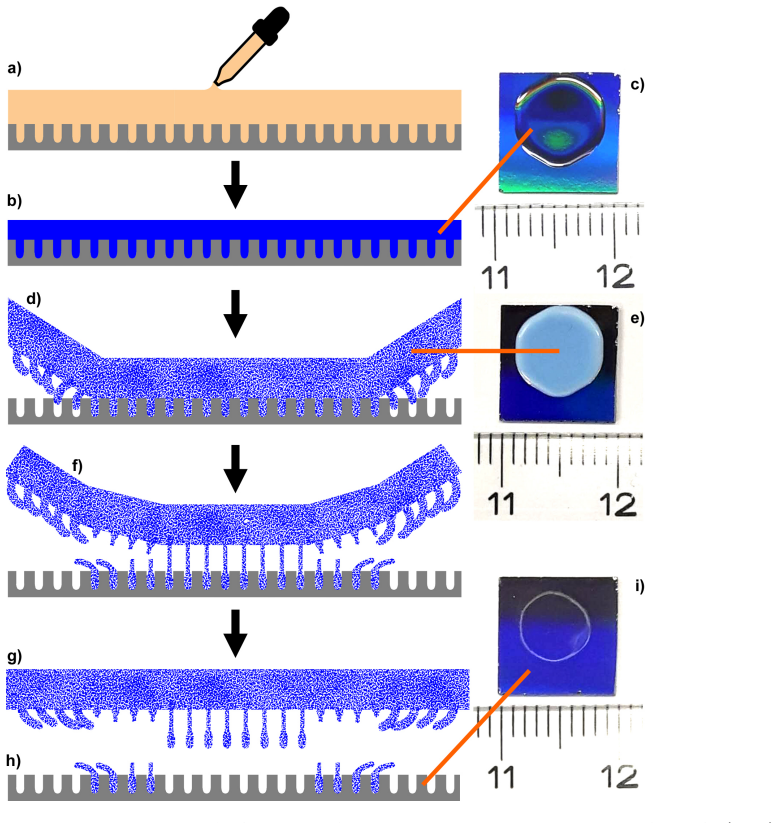
The paper's central claim is that contact line pinning at rings of ruptured PS-b-P2VP fibers protruding from perfluorinated macroporous silicon immobilizes water drops. The rings are made by dropping a solution of polystyrene-block-poly(2-vinylpyridine) onto hydrophobically modified macroporous silicon, letting the solvent evaporate so the pores fill with polymer rods, swelling the P2VP domains with hot ethanol, and then peeling off the film. In an annular zone between the outer rim and the center, the swollen fibers are wedged in the pore necks and break, leaving a ring of protruding fiber stubs. These stubs act as both chemical and topographic barriers: they are partly P2VP, which is slightly hydrophilic, and they likely pierce the drop. The paper shows that drops of 20 microliters are held by rings of about 4.1 mm diameter, and 50 microliter drops by rings of about 6.5 mm diameter, with the contact line coinciding with the ring; without rings the same drops roll off when the surface is tilted.
Load-bearing premise
The claim rests on the ruptured polymer fibers staying anchored in the pores and protruding far enough to touch and pin the water's edge; the paper infers this from electron microscopy and drop behavior but does not directly image the fiber–drop contact or test the fibers through repeated wetting cycles.
Editorial extensions
If this is right
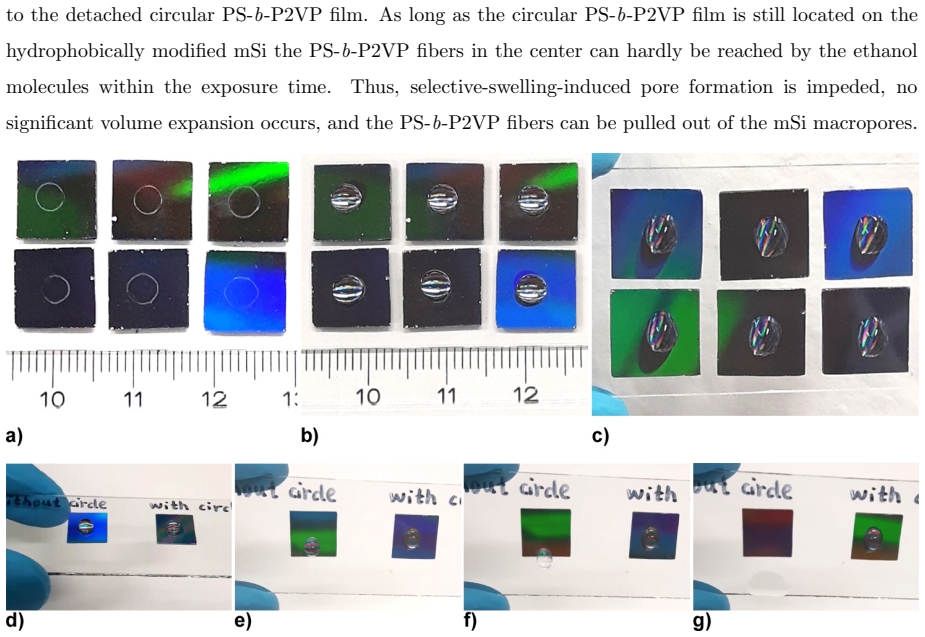
- On hydrophobized macroporous silicon with a fiber ring, water drops of 20 microliters (4.1 mm rings) and 50 microliters (6.5 mm rings) remain immobilized when the substrate is turned vertical, despite gravity and manual shaking.
- Drops must be large enough to reach the ring: 5 microliter drops inside a 4.1 mm ring do not touch it, and only drops whose contact line coincides with the ring are held; above a certain volume, such as 40 microliters for 4.1 mm rings, the drop is no longer confined.
- The ring diameter and width are set by the amount of polymer solution deposited and by the swelling step, so no lithography is needed; placement of drops into rings and ring fabrication can be automated.
- Because the ring is both chemical and topographic, the method extends drop immobilization to inert, perfluorinated surfaces that would otherwise shed water drops, opening the way to drop-based reaction compartments that repel adsorbates.
Reading between the lines
- The same swelling-and-peeling route should transfer to other porous substrates whose pore necks are narrower than the fiber cross-section, so the essential geometric requirement may be a pore shape that grips the fibers rather than silicon itself.
- If the topographic barrier dominates, rings made from a purely hydrophobic polymer might pin drops as well; comparing P2VP rings with such rings would separate chemical from geometric contributions.
- Repeated wetting-drying or tilting cycles would test whether the stubs stay anchored and protruding; the paper demonstrates holding in single-use trials without reporting cycling endurance.
- Since ring formation reflects a competition between swelling-driven ejection and wedging, tuning swelling time, temperature, or film thickness should control ring width and the maximum drop volume that can be held.
Signed reviews
Editorial analysis
A structured set of objections, weighed in public.
Referee Report
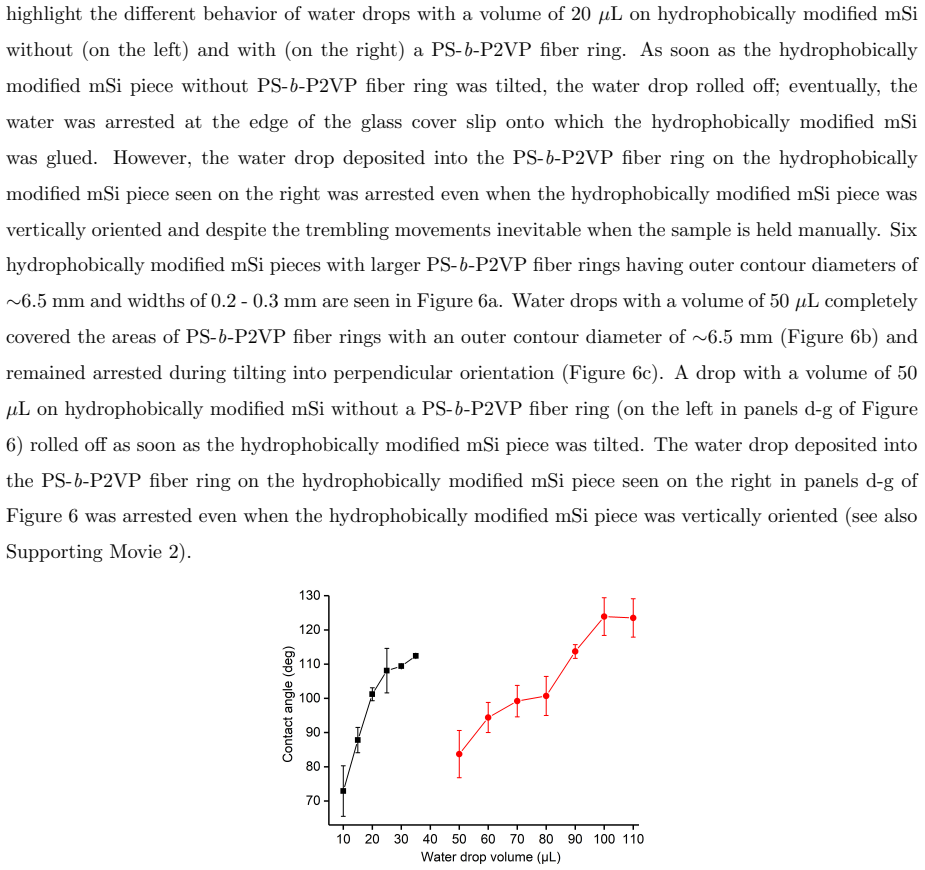
Summary. The paper reports a lithography-free route to immobilize water drops on perfluorinated macroporous silicon by pinning the contact line at rings of ruptured PS-b-P2VP fibers. The rings are formed by dropping a PS-b-P2VP/THF solution onto PFDTS-modified mSi, swelling the P2VP domains in hot ethanol, and detaching the circular film with tweezers, leaving protruding fiber fragments in an annular region. The authors show by SEM that fibers protrude from the macropores, and demonstrate with photographs and movies that drops of 20 µL (4.1 mm rings) and 50 µL (6.5 mm rings) remain attached when the substrate is tilted to vertical, while drops on unmodified mSi roll off. Apparent contact angles are reported as a function of drop volume for two ring sizes, with n=6 measurements per data point.
Significance. The fabrication method is simple and nonlithographic, and the matched control (with versus without rings) is a clear strength. If the mechanism is supported, the work offers a practical way to exploit hydrophobic, anti-fouling surfaces in droplet-based lab-on-chip devices. The drop-immobilization phenomenon itself is credible from the photographs and videos. However, the paper's central mechanism—that protruding fibers pierce the drop and pin the contact line—is not directly evidenced, and the contact-angle data suggest the ring-fabrication process alters the surface inside the rings, so the control is not perfectly clean. These gaps are fixable with additional characterization or careful rewording.
major comments (2)
- [§2.3, last paragraph] The sentence 'the PS-b-P2VP fibers protruding from the mSi macropores likely pierce into the water drops' is the only support for the specific protrusion/piercing mechanism, and it is explicitly speculative. No image, force measurement, or repeated-wetting test shows that protruding fibers contact the drop or remain anchored after water contact. Because the ring is also a chemical heterogeneity (P2VP is hydrophilic, 66°), the observed immobilization could be caused solely by a residual polymer boundary or by flattened fibers. The central claim in the abstract that contact line pinning occurs 'at rings of ... fibers protruding from mSi macropores' is therefore stronger than the evidence. Please provide direct evidence (e.g., cryo-SEM or confocal imaging of the contact line, or pinning-force/hysteresis measurements) or revise the mechanism statement to describe pinning at the polymer ring without asserting protrusion/piercing.
- [§2.3, Figure 7 and §2.1] The paper reports 108°±1° for 5 µL drops inside 4.1 mm rings and 123°±1° for 20 µL drops inside 6.5 mm rings that do not contact the ring, while bare PFDTS-mSi has a contact angle of 127°±4°. The 5 µL value in particular indicates that the area inside the rings is less hydrophobic than the bare control, implying that the ring-fabrication process leaves residual polymer or otherwise alters the surface inside the ring. Consequently, the 'without ring' roll-off control is not a clean counterfactual for the ring interior. Please characterize the interior surface (e.g., XPS or ToF-SIMS, or contact-angle measurements after removal of the polymer) and clarify whether the pinning requires protruding fibers or only a chemical pattern.
minor comments (3)
- [§2.1] The report of a standard deviation 'rounded to 0 µm' is not informative; please report the measurement resolution or the unrounded value.
- [Figure 6 caption] The word 'sustrate' should be 'substrate'.
- [Figure 7 caption] The phrase 'guides to the eyes' should be 'guides to the eye'.
Circularity Check
No significant circularity: the immobilization claim is an empirical, control-based demonstration, and the self-cited references supply background rather than the conclusion.
full rationale
This paper contains no analytic derivation, fitted parameter, or quantitative model whose output is fed back into its own inputs. The central claim that rings of ruptured PS-b-P2VP fibers pin the contact line and immobilize water drops is supported by direct wetting experiments: drops with and without rings are compared on identical hydrophobically modified macroporous silicon, and the without-ring control rolls off while the with-ring drop remains arrested upon tilting to vertical (Figures 5d-g and 6d-g, Supporting Movies 1 and 2). The paper's own caution that the fibers 'likely pierce into the water drops' (Section 2.3) is a mechanistic inference rather than a derived prediction, and its unverified status is a correctness or evidence concern, not circularity. Self-citations appear for established background steps: PFDTS grafting procedures (refs. 20, 21), selective-swelling-induced pore formation (refs. 18, 19), and the hydrophilicity of P2VP (refs. 25, 26). These are used to describe fabrication and materials properties, not to justify the drop-immobilization result itself. No equation or defined quantity reduces to another definition, and no fitted value is renamed as a prediction. Therefore the paper is self-contained against external benchmarks for its main empirical conclusion, and the appropriate circularity score is 0.
Assumptions & free parameters
free parameters (4)
- PS-b-P2VP solution concentration =
0.1 g/mL in THF
- Deposited solution volume =
20 µL and 60 µL; 5 and 10 µL fail
- Selective swelling conditions =
Ethanol at 60 °C for 1 h
- PFDTS grafting conditions =
5 h at 100 °C with 0.2 mL PFDTS
assumptions (4)
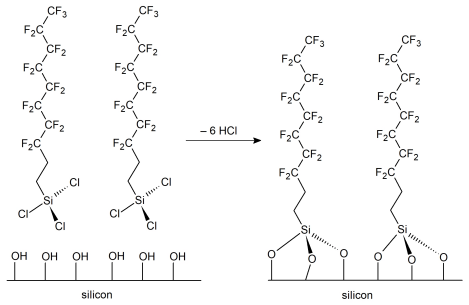
- domain assumption Macroporous silicon with the specified geometry (pore depth 1.8 µm, neck 530 nm, widening to 710 nm, lattice constant 1.5 µm) can be hydrophobized by PFDTS grafting and is a representative hydrophobic substrate.
- domain assumption Ethanol selectively swells P2VP minority domains in PS-b-P2VP, generating nanopores and volume expansion at 60 °C.
- domain assumption After swelling-induced pore formation, the protruding PS-b-P2VP fibers have a P2VP outer surface with a water contact angle of 66±1°, making them slightly hydrophilic.
- ad hoc to paper The protruding PS-b-P2VP fibers pierce into or contact the water drop surface at the contact line.
Cite this review
Pith. "Pith review of Immobilization of water drops on hydrophobic surfaces by contact line pinning at non-lithographically generated polymer microfiber rings." pith.science (2026). https://pith.science/paper/TVE53SDW
@misc{pith2026190805795,
  author       = {Pith},
  title        = {Pith review of: Immobilization of water drops on hydrophobic surfaces by contact line pinning at non-lithographically generated polymer microfiber rings},
  year         = {2026},
  howpublished = {\url{https://pith.science/paper/TVE53SDW}},
  note         = {Machine review of arXiv:1908.05795}
}
read the original abstract
Water drops used as reaction compartments are commonly immobilized on hydrophilic areas bordered by hydrophobic areas. For many applications, such as the trapping of non-adherent cells, it is desirable to exploit the inertness and the anti-fouling behavior of hydrophobic surfaces as well as their repulsive behavior towards adsorbates in lab-on-chip configurations. However, the immobilization of water drops on hydrophobic surfaces has remained challenging. We report a nonlithographic approach to arrest water drops on hydrophobically modified macroporous silicon (mSi) with per uorinated surface. Contact line pinning at rings of polystyrene-block-poly(2-vinylpyridine) (PS-b-P2VP) fibers protruding from the mSi macropores immobilizes water drops when the hydrophobically modified mSi is moved or tilted and prevents dewetting within the PS-b-P2VP fiber rings. Without PS-b-P2VP fiber rings, water drops readily roll off. The PS-b-P2VP fiber rings were prepared by dropping PS-b-P2VP solution onto hydrophobically modified mSi. Selective swelling of the P2VP in the thus-formed circular PS-b-P2VP films with hot ethanol followed by detachment of the latter yielded hydrophobically modified mSi exhibiting annular areas, in which ruptured PS-b-P2VP fibers protruded from the mSi macropores. For example, PS-b-P2VP fiber rings with diameters of 6.5 mm and widths of about 0.2 mm immobilize water drops with a volume of 50 microliters.
Figures

Figures from the paper (4 more)


Reference graph
Works this paper leans on
-
[1]
E. Ueda, F. L. Geyer, V. Nedashkivska, P. A. Levkin, Lab Chip 2012, 12, 5218
work page 2012
-
[2]
A. Huebner, D. Bratton, G. Whyte, M. Yang, A. J. deMello, C. Abell, F. Hollfelder, Lab Chip 2009, 9, 692
work page 2009
-
[3]
L. Mugherli, O. N. Burchak, L. A. Balakireva, A. Thomas, F. Chatelain, M. Y. Balakirev, Angew. Chem. Int. Ed. 2009, 48, 7639
work page 2009
-
[4]
O. N. Burchak, L. Mugherli, M. Ostuni, J. J. Lacapere, M. Y. Balakirev, J. Am. Chem. Soc. 2011, 133, 10058
work page 2011
-
[5]
T. Tronser, A. A. Popova, M. Jaggy, M. Bastmeyer, P. A. Levkin, Adv. Healthc. Mater. 2017, 6, 1700622
work page 2017
-
[6]
A. A. Popova, D. Marcato, R. Peravali, I. Wehl, U. Schepers, P. A. Levkin, Adv. Funct. Mater. 2018, 28, 1703486
work page 2018
-
[7]
A. N. Efremov, E. Stanganello, A. Welle, S. Scholpp, P. A. Levkin, Biomaterials 2013, 34, 1757
work page 2013
-
[8]
A. I. Neto, K. Demir, A. A. Popova, M. B. Oliveira, J. F. Mano, P. A. Levkin, Adv. Mater. 2016, 28, 7613
work page 2016
Show all 26 references
-
[9]
Tsotsalas, H
M. Tsotsalas, H. Maheshwari, S. Schmitt, S. Heissler, W. Feng, P. A. Levkin, Adv. Mater. Interfaces 2016, 3, 1500392
2016
-
[10]
J. H. Butler, M. Cronin, K. M. Anderson, G. M. Biddison, F. Chatelain, M. Cummer, D. J. Davi, L. Fisher, A. W. Frauendorf, F. W. Frueh, C. Gjerstad, T. F. Harper, S. D. Kernahan, D. Q. Long, M. Pho, J. A. Walker, T. M. Brennan, J. Am. Chem. Soc. 2001, 123, 8887. 14
2001
-
[11]
Zhang, X
G. Zhang, X. Yan, X. L. Hou, G. Lu, B. Yang, L. X. Wu, J. C. Shen, Langmuir 2003, 19, 9850
2003
-
[12]
Y. Y. Lee, K. Narayanan, S. J. Gao, J. Y. Ying, Nano Today 2012, 7, 29
2012
-
[13]
N. K. Mandsberg, R. Taboryski, Langmuir 2017, 33, 5197
2017
-
[14]
T. M. Yen, T. Zhang, P.-W. Chen, T.-H. Ku, Y.-J. Chiu, I. Lian, Y.-H. Lo, ACS Nano 2015, 9, 10655
2015
-
[15]
Qu´ er´ e,Rep
D. Qu´ er´ e,Rep. Prog. Phys. 2005, 68, 2495
2005
-
[16]
Lehmann, H
V. Lehmann, H. F¨ oll,J. Electrochem. Soc. 1990, 137, 653
1990
-
[17]
Birner, U
A. Birner, U. Gr¨ uning, S. Ottow, A. Schneider, F. M¨ uller, V. Lehmann, H. F¨ oll, U. G¨ osele,Phys. Stat. Sol. A Appl. Res. 1998, 165, 111
1998
-
[18]
Wang, Acc
Y. Wang, Acc. Chem. Res. 2016, 49, 1401
2016
-
[19]
Eichler-Volf, L
A. Eichler-Volf, L. Xue, G. Dornberg, H. Chen, A. Kovalev, D. Enke, Y. Wang, E. V. Gorb, S. N. Gorb, M. Steinhart, ACS Appl. Mater. Interfaces 2016, 8, 22593
2016
-
[20]
A. Y. Fadeev, T. J. McCarthy, Langmuir 2000, 16, 7268
2000
-
[21]
P. Hou, W. Han, M. Philippi, H. Sch¨ afer, M. Steinhart, ACS Appl. Nano Mater. 2018, 1, 1413
2018
-
[22]
Qu´ er´ e,Annu
D. Qu´ er´ e,Annu. Rev. Mater. Res. 2008, 38, 71
2008
-
[23]
M. N. MacGregor-Ramiasa, K. Vasilev, Adv. Mater. Interfaces 2017, 4, 1700381
2017
-
[24]
Extrand, Langmuir 2016, 32, 7697
C. Extrand, Langmuir 2016, 32, 7697
2016
-
[25]
Y. Wang, U. G¨ osele, M. Steinhart,Nano Lett. 2008, 8, 3548
2008
-
[26]
L. Xue, A. Kovalev, K. Dening, A. Eichler-Volf, H. Eickmeier, M. Haase, D. Enke, M. Steinhart, S. N. Gorb, Nano Lett. 2013, 13, 5541. 15
2013
Reviewed August 14, 2026 · model on record in the stance chip above.
Discussion (0). Continue with ORCID to comment.