REVIEW 2 major objections 4 minor 21 references
Efficient Flicker-Free FEC Codes using Knuth's Balancing Algorithm for VLC
T0 review · 2 major / 4 minor · reviewed 2026-08-14 · deepseek-v4-flash
Pith's one-line read By combining polar codes with Knuth's balancing algorithm, this paper constructs flicker-free forward error correction codes for visible light communication that need no lookup tables and report BER gains up to 1.8 dB over regular schemes…
desk verdict Clever combination of Knuth balancing with polar codes, but the flicker-free claim fails on the all-zero codeword, which yields a run of N/2 bits. read the letter →
The pith
A machine-rendered reading of the paper's core claim, the machinery that carries it, and where it could break.
The reading
What carries the argument
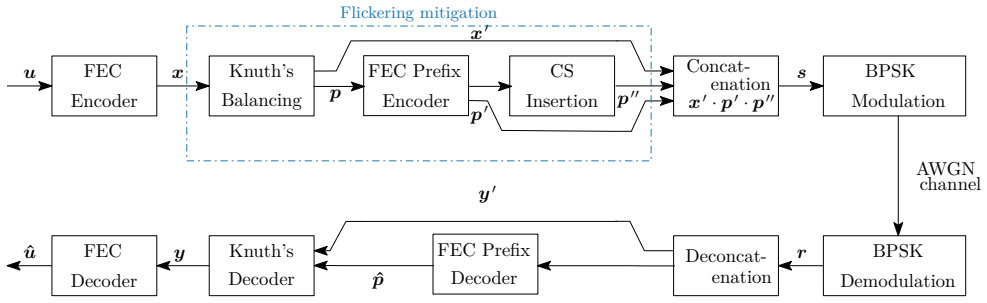
Knuth's balancing algorithm: given a binary word x mapped to bipolar values, flip the first e bits at the unique index where the running digital sum crosses zero, producing a balanced word x' with equal numbers of +1 and -1, then append a binary prefix p that encodes e. This is what enforces the 50% duty cycle that suppresses flicker, and the raw balancing metadata costs only log2 N bits, which keeps rates high compared with linear-redundancy RLL codes. The paper adds a second protective layer: the prefix p is itself polar-encoded into p', and p'' is the bitwise complement of p', so the whole transmitted frame remains balanced while the receiver obtains soft information about the prefix from the difference p'_i - p''_i.
What would settle it
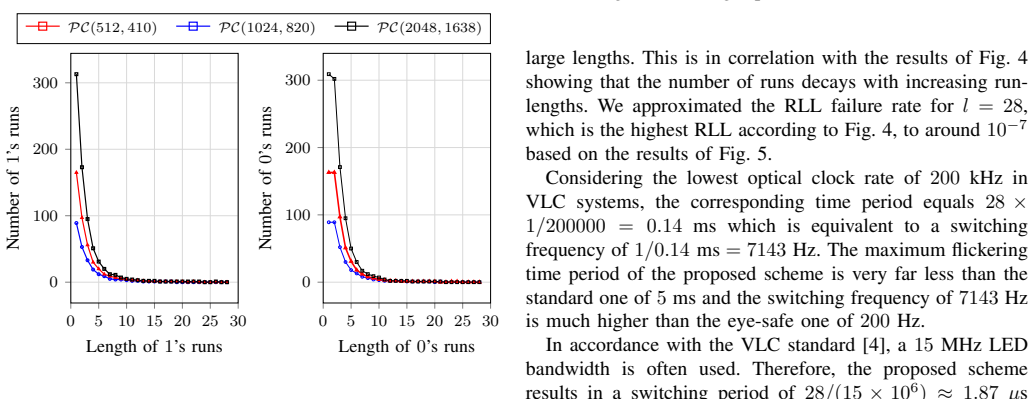
Generate more than ten million transmitted frames of PC(2048,1638) under the proposed scheme and record the longest run of identical bits; a run length clearly above the paper's reported maximum of 28, or a measured failure rate at run length 28 above about $10^{-7}$, would show that the empirical run-length tail is heavier than the extrapolation assumes.
Extended reading notes
Core claim
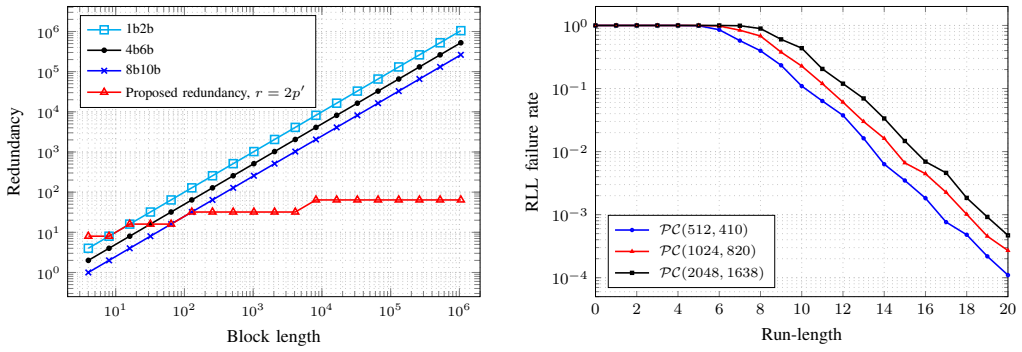
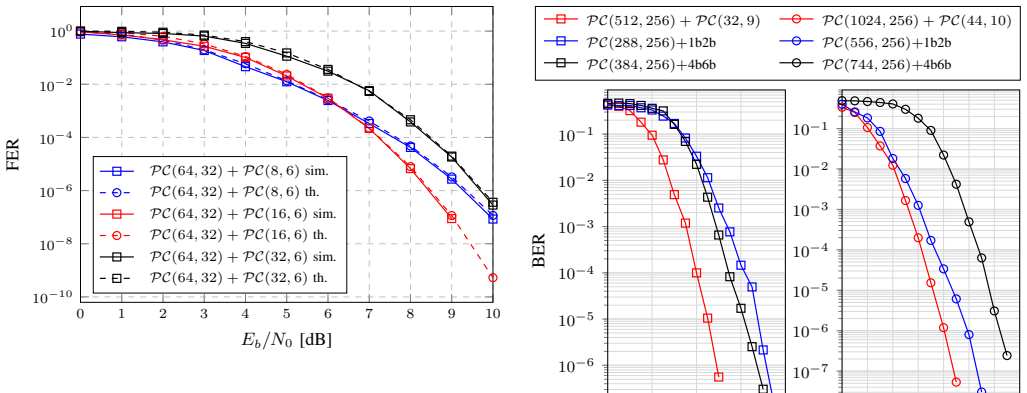
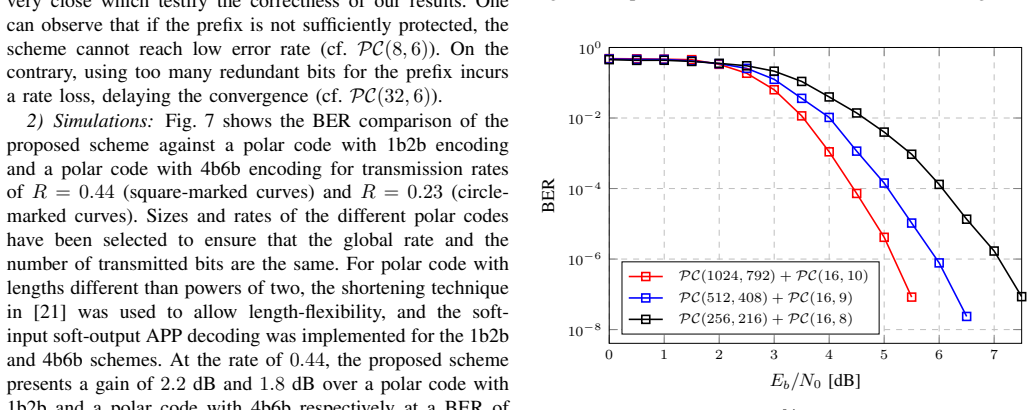
The central claim is that balancing a polar codeword after encoding can enforce the 50% duty cycle that prevents visible flicker, without the memory and rate cost of RLL codes. In the proposed scheme, the balancing index prefix is itself polar-encoded and balanced by appending its bitwise complement, so every transmitted frame s = x'·p'·p'' has equal numbers of ones and zeros, and the receiver can decode the prefix with soft decisions before undoing the outer balancing. The paper reports redundancy that grows logarithmically with block length, transmission rates up to 0.75 at 50% dimming, and BER gains over 1b2b and 4b6b based schemes, with the strongest stated gains being 1.8 dB and 0.9 dB over the regular schemes at $10^{-6}$ for rates 0.44 and 0.23. On its own terms, the discovery is that the balancing constraint and the FEC can be separated cleanly, with the balancing metadata treated as data and protected by its own polar code.
Load-bearing premise
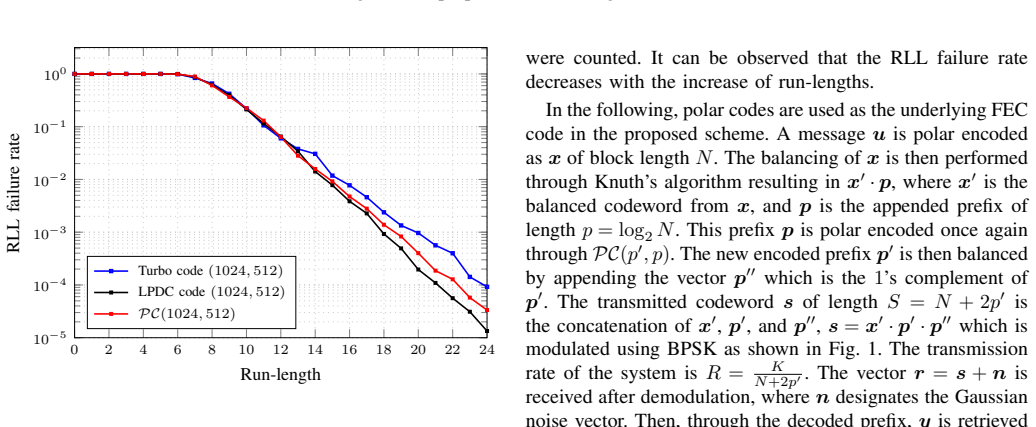
Flicker-freedom is asserted from observed run lengths in 10,000 trials rather than from a proven bound on the longest run; if any transmitted frame contains a run long enough to push the switching period toward or beyond the eye-safety limit, the guarantee breaks, and the paper does not bound that worst case.
Editorial extensions
If this is right
- VLC transmitters can drop memory-hungry RLL lookup tables, since balancing is computed arithmetically from each codeword.
- Redundancy scales as O(log N) instead of O(N), so longer blocks make the scheme increasingly rate-efficient relative to 1b2b, 4b6b, and 8b10b codes.
- Because the construction works with any FEC code, the same prefix-protected balancing can be applied to LDPC or turbo codes.
- The concatenated FER expression lets a designer choose the inner prefix code size to trade prefix protection against rate loss.
- For the simulated configurations, measured run lengths stay far below the 5 ms human-eye threshold, supporting the flicker-free label at those block lengths.
Reading between the lines
- The flicker-free guarantee is only as strong as the run-length tail: the paper extrapolates a failure rate near 10^-7 at run length 28 from 10,000 trials, so deployment would require an analytic bound or an explicit run-length limiter.
- Knuth balancing fixes the ones density at exactly 50%, so dimming levels other than 50% would need a different balancing target or compensation symbols, which the paper leaves to future work.
- The complement-pair trick used to protect the prefix is effectively a Manchester code for metadata; the same idea could protect frame headers or control fields in other constrained channels.
- A natural extension is to add a bounded run-length constraint after balancing and measure the extra redundancy it costs, which would convert the empirical flicker-free claim into a guarantee.
Signed reviews
Editorial analysis
A structured set of objections, weighed in public.
Referee Report
Summary. The paper proposes a concatenated coding scheme for visible light communication (VLC): an outer polar code, followed by Knuth's balancing algorithm, with the balancing prefix protected by a second polar code and a Manchester-coded complement appended. The authors claim that the transmitted sequence is flicker-free without lookup tables, with logarithmic redundancy, lower decoding complexity than RLL-based schemes, and BER gains of up to 1.8 dB over rate-matched polar+1b2b and polar+4b6b baselines. The BER and FER claims are supported by simulations and a Gaussian-approximation formula, and the complexity comparison is quantified. The flicker-free claim is supported only by an empirical run-length study over 10,000 uniformly random information words, with no worst-case bound.
Significance. The combination of polar codes with Knuth balancing is a natural idea, and the paper's rate-matched BER simulations (Fig. 7), the matching theoretical FER formula (4) and simulation (Fig. 6), and the complexity table (Table I) are credible and clearly presented. If flicker-free operation were guaranteed, the scheme would indeed offer an attractive alternative to RLL-based VLC codes in terms of redundancy and decoder complexity. However, the central advertised property, flicker-free communication, is not actually guaranteed by the construction. The run-length analysis of Section III-C is statistical and contains no deterministic bound, and a concrete valid input, the all-zero information word, produces a run of N/2 consecutive ones after balancing, which violates the paper's own VLC flicker criteria for the parameters used in the paper. Because the flicker-free claim is the main differentiator relative to RLL-based methods, this is a load-bearing failure.
major comments (2)
- [III-C and III-D2] The claim that the scheme generates flicker-free codes is false for a valid input. For any polar code PC(N,K), the all-zero information word u = 0^N encodes to the all-zero codeword x = 0^N. Knuth balancing then flips the first N/2 bits to achieve zero disparity, producing x' = 1^{N/2} 0^{N/2}, which contains a run of length N/2. For PC(2048,1638), the configuration studied in Section III-C, this run length is 1024, not the empirically reported maximum of 28. Using the paper's stated lowest optical clock rate of 200 kHz, a 1024-bit run corresponds to a period of 5.12 ms and a switching frequency of about 195 Hz, which is below the 200 Hz eye-safe threshold and above the 5 ms MFTP. The empirical study of Section III-C used only uniformly random information words and therefore missed this deterministic counterexample. Since FEC codes must operate on all information words, the abstract's and Section III-D2's statements that the proposed scheme generates flicker-free codes are not valid.
- [III-C] The RLL failure rate analysis is purely empirical and provides no worst-case guarantee. The paper counts run lengths over 10,000 trials and then extrapolates the failure rate at l = 28 to about 10^-7 without any analytic tail bound. VLC flicker mitigation requires a deterministic constraint on the maximum run length or on the maximum flickering time period, not a probabilistic statement. The counterexample of the all-zero word shows that a deterministic bound cannot be derived for the current scheme as is; the authors would need to add an explicit run-length limiter or modify the balancing process, which would change the redundancy and complexity claims of the paper. As written, the conclusion that the scheme 'guarantee[s] a flicker-free communication' is unsupported.
minor comments (4)
- [II-D] The example in (2) uses '101111' while the surrounding text refers to '1011111', and the phrase 'balanced state occurs at index 4 (100)' is unclear because the first four bits form 0100 after flipping. Please reconcile the example and explicitly define that the first e bits are the flipped segment.
- [Fig. 2 caption] The caption contains a typo: 'LPDC' should read 'LDPC'.
- [III-A] The symbol p is used both for the length of the Knuth prefix (p = log2 N) and for the encoded prefix (e.g., PC(p',p) and p''). Distinct notation for the prefix length and the encoded prefix would reduce ambiguity.
- [III-C] The sentence 'About 90% in each generated codeword have a run-length of l < 8' is imprecise; it should state whether this refers to 90% of all runs, or 90% of the transmitted bits, or another quantity.
Circularity Check
No circularity: the scheme's BER and run-length claims are evaluated by Monte Carlo simulation and Gaussian-approximation FER analysis against external benchmarks, with no fitted parameter renamed as a prediction.
full rationale
The paper's central claims are (i) that polar codes plus Knuth balancing yield a flicker-free VLC stream without lookup tables, and (ii) that the concatenated scheme outperforms RLL-based schemes in BER at matched rates. Neither claim reduces to its own inputs. The flicker-free assertion is supported by an empirical run-length distribution over 10,000 random information words (Section III-C) and by comparison with the IEEE 200 Hz / 5 ms threshold; this may be a correctness weakness because the all-zero codeword produces a run of N/2 after Knuth balancing, but that is a factual falsification concern, not a circularity. The BER analysis is performed by standard Monte Carlo simulation and by a theoretical FER expression (Eq. 4) that is a straightforward total-probability decomposition of prefix-error and main-code-error events; its component Q-functions come from Gaussian approximation per Eq. 1, an external method. The code dimensions are chosen to match comparison rates (R = 0.44, 0.23), not to force a precomputed gain. Self-citations appear only as background: [14] is cited for the general area of constrained sequence coding and [19] for length-flexibility techniques in polar codes, neither of which carries the load of the flicker-free or BER conclusions. There is no fitted parameter, no uniqueness theorem imported from the authors' prior work, and no ansatz smuggled in via self-citation. The derivation chain is therefore self-contained with respect to its stated simulation and analysis methodology, and no circular step can be exhibited from the paper's text.
Assumptions & free parameters
assumptions (4)
- standard math Knuth's balancing theorem: for every even-length binary word there exists a prefix whose complement yields a balanced word.
- domain assumption Gaussian approximation accurately predicts polar code FER under SC decoding and gives the reliability ordering for code construction.
- ad hoc to paper The concatenated balanced sequences satisfy the VLC flicker constraint with high probability because observed run-lengths are small; no deterministic maximum run-length is enforced.
- domain assumption BPSK modulation over an AWGN channel is a representative model for evaluating VLC line-coding schemes.
Cite this review
Pith. "Pith review of Efficient Flicker-Free FEC Codes using Knuth's Balancing Algorithm for VLC." pith.science (2026). https://pith.science/paper/J2PF55A4
@misc{pith2026190805798,
  author       = {Pith},
  title        = {Pith review of: Efficient Flicker-Free FEC Codes using Knuth's Balancing Algorithm for VLC},
  year         = {2026},
  howpublished = {\url{https://pith.science/paper/J2PF55A4}},
  note         = {Machine review of arXiv:1908.05798}
}
abstract
Visible light communication (VLC) provides a short-range optical wireless communication through light-emitting diode (LED) lighting. Light beam flickering and dimming are among the challenges to be addressed in VLC. Conventional methods for generating flicker-free codes in VLC are based on run-length limited codes that have poor error correction performance, use lookup tables which are memory consuming, and have low transmission rates. In this paper, we propose an efficient construction of flicker-free forward error correction codes to tackle the issue of flickering in VLC. Our simulation results show that by using polar codes and at a dimming ratio of 50%, the proposed system generates flicker-free codes without using lookup tables, while having lower complexity and higher transmission rates than the standard VLC methods. For an information block length of 256, the error correction performance of the proposed scheme is $1.8$ dB and $0.9$ dB better than that of the regular schemes at the bit error rate of $10^{-6}$ for a rate of 0.44 and 0.23, respectively.
Figures
Figures from the paper (3 more)
Reference graph
Works this paper leans on
-
[8]
J. Fang, Z. Che, and X. Yu, “An efficient flicker-free FEC coding scheme for dimmable visible light communication based on polar codes,” IEEE Photonics Journal, vol. 9, no. 3, Jun. 2017
work page 2017
-
[1]
A survey of 5G network: architecture and emerging technologies,
A. Gupta and R. K. Jha, “A survey of 5G network: architecture and emerging technologies,” IEEE Access, vol. 3, pp. 1206–1232, Jul. 2015
work page 2015
-
[2]
High-speed wireless networking using visible light,
H. Haas, “High-speed wireless networking using visible light,” The International Society for Optics and Photonics Newsroom , Apr. 2013
work page 2013
-
[3]
Visible light communication, networking and sensing: a survey, potential and challenges,
P. Pathak, X. Feng, and P. Mohapatra, “Visible light communication, networking and sensing: a survey, potential and challenges,” Commun. Surveys Tuts., vol. 17, no. 4, pp. 2047–2077, 2015
work page 2015
-
[4]
“IEEE standard for local and metropolitan area networks–part 15.7: Short-range wireless optical communication using visible light,” IEEE Std 802.15.7-2011 , pp. 1–309, Sept 2011
work page 2011
-
[5]
S. Kim and S.-Y . Jung, “Modified reed-muller coding scheme made from the bent function for dimmable visible light communication,” IEEE Photonics Technology Letters , vol. 25, no. 1, pp. 11–13, Jan. 2013
work page 2013
-
[6]
Adaptive FEC codes suitable for variable dimming values in visible light communication,
S. Kim, “Adaptive FEC codes suitable for variable dimming values in visible light communication,” IEEE Photonics Technology Letters , vol. 27, no. 9, pp. 967–969, May 2015
work page 2015
-
[7]
Turbo code-based error correction scheme for dimmable visible light communication systems,
S. H. Lee and J. K. Kwon, “Turbo code-based error correction scheme for dimmable visible light communication systems,” IEEE Photonics Technology Letters, vol. 24, no. 17, pp. 1463–1465, Sep. 2012
work page 2012
Show all 21 references
-
[9]
Dimming control systems with polar codes in visible light communication,
H. Wang and S. Kim, “Dimming control systems with polar codes in visible light communication,” IEEE Photonics Technology Letters , vol. 29, no. 19, pp. 1651–1654, Aug. 2017
2017
-
[10]
An advanced polar coding scheme,
C. Yao, J. Song, W. Zhang, and X. Zhou, “An advanced polar coding scheme,” in Proceedings of the 2017 9th International Conference on Wireless Communications and Signal Processing (WCSP) , Nanjing, China, Oct.11–13, 2017, pp. 1–6
2017
-
[11]
Design of polar codes for multicolor visible light communication systems,
M. Jiang, Q. Zhu, and C. Zhao, “Design of polar codes for multicolor visible light communication systems,” in Proceedings of the 2017 9th International Conference on Wireless Communications and Signal Processing (WCSP), Nanjing, China, Oct.11–13, 2017, pp. 1–5
2017
-
[12]
Efficient balanced codes,
D. E. Knuth, “Efficient balanced codes,” IEEE Transactions on Infor- mation Theory , vol. 32, no. 1, pp. 51–53, Jan. 1986
1986
-
[13]
K. A. Immink, Codes for Mass Data Storage Systems , 2nd ed. The Netherlands: Shannon Foundation Publishers, 2004
2004
-
[14]
A construction for balancing non- binary sequences based on gray code prefixes,
E. N. Mambou and T. G. Swart, “A construction for balancing non- binary sequences based on gray code prefixes,” IEEE Transactions on Information Theory , vol. 64, no. 8, pp. 5961–5969, Aug. 2018
2018
-
[15]
Visible light communications (VLC) technology,
A. R. Ndjiongue, H. C. Ferreira, and T. Ngatched, “Visible light communications (VLC) technology,” Wiley Encyclopedia of Electrical and Electronics Engineering , pp. 1–15, Jun. 2015
2015
-
[16]
IEEE recommended practices for modulating current in high brightness leds for mitigating health risks to viewers,
IEEE, “IEEE recommended practices for modulating current in high brightness leds for mitigating health risks to viewers,” IEEE Standards 179-2015, vol. 15, no. 8, pp. 1–80, Jun. 2015
2015
-
[17]
Channel polarization: a method for constructing capacity- achieving codes for symmetric binary-input memoryless channels,
E. Arıkan, “Channel polarization: a method for constructing capacity- achieving codes for symmetric binary-input memoryless channels,”IEEE Trans. Inf. Theory , vol. 55, no. 7, pp. 3051–3073, Jul. 2009
2009
-
[18]
Efficient design and decoding of polar codes,
P. Trifonov, “Efficient design and decoding of polar codes,” IEEE Trans. on Commun. , vol. 60, no. 11, pp. 3221–3227, Nov. 2012
2012
-
[19]
Length-compatible polar codes: a survey,
T. Tonnellier, A. Cavatassi, and W. J. Gross, “Length-compatible polar codes: a survey,” in 2019 53rd Annual Conference on Information Sciences and Systems (CISS) , 2019, pp. 1–6
2019
-
[20]
Construction and block error rate analysis of polar codes over awgn channel based on gaussian approximation,
D. Wu, Y . Li, and Y . Sun, “Construction and block error rate analysis of polar codes over awgn channel based on gaussian approximation,” IEEE Communications Letters , vol. 18, no. 7, pp. 1099–1102, 2014
2014
-
[21]
A novel puncturing scheme for polar codes,
R. Wang and R. Liu, “A novel puncturing scheme for polar codes,” IEEE Communications Letters , vol. 18, no. 12, pp. 2081–2084, 2014
2014
Reviewed August 14, 2026 · model on record in the stance chip above.
Discussion (0). Continue with ORCID to comment.