REVIEW 5 major objections 5 minor 60 references
Cross-Domain Adaptation for Animal Pose Estimation
T0 review · 5 major / 5 minor · reviewed 2026-08-14 · deepseek-v4-flash
Pith's one-line read This paper claims that animal pose estimation can be transferred to quadruped species never seen in training by combining human pose knowledge, a small labeled animal set, and adversarial cross-domain adaptation with self-paced…
desk verdict Worth engaging for the Animal-Pose dataset and a sensible domain-adaptation recipe, but the abstract and conclusion overstate what was actually measured. read the letter →
The pith
A machine-rendered reading of the paper's core claim, the machinery that carries it, and where it could break.
The reading
What carries the argument
The load-bearing machinery is adversarial domain confusion in feature space combined with confidence-filtered pseudo-labels. WS-CDA's feature extractor feeds a domain discriminator that tries to tell humans, labeled animals, and unlabeled target animals apart; the main pose estimator is trained against that discriminator, so the features it learns are shared rather than species-specific. A weight w2 > 1 on the animal pose loss prevents the huge human dataset from dominating. PPLO uses a self-paced threshold, starting at 0.9 and decaying, to admit pseudo-labels only when the current model is confident, and alternating training between source and pseudo-labeled target minibatches prevents the larger source from overwhelming the target. Together these pieces turn human joints into usable supervision for quadrupeds.
What would settle it
Measure per-joint mAP on a held-out species: the homology assumption predicts the model should succeed on all 17 corresponding keypoints. If accuracy is high only for eyes, nose, and ears and collapses for elbows, knees, or withers, then the cross-species keypoint correspondence, not the adaptation machinery, is the load-bearing part of the claim.
Extended reading notes
Core claim
On the paper's own terms, the discovery is that cross-domain adaptation can make pose estimators generalize across species and even from humans to quadrupeds. WS-CDA uses an adversarial domain discriminator to force the feature extractor to keep only domain-invariant features, while a reweighted pose loss keeps the small labeled animal set from being swamped by the much larger human set. PPLO then selects the model's own confident predictions on unlabeled target species as pseudo-labels, raising the confidence threshold in a self-paced way and alternating source and target training to avoid noise and volume imbalance. The key claim is the result: on each of the five mammal classes held out one at a time, the full method is the best among the compared frameworks and adaptation methods, with per-class mAP from 41.0 to 57.3 and an average above 50, all without pose labels for the held-out class. The paper further states that this constitutes human-level pose estimation accuracy on animal pose estimation.
Load-bearing premise
The entire transfer rests on the assumption that the 17-keypoint format puts anatomically equivalent joints on humans and every target quadruped, so human pose priors and cross-species alignment teach the model the same body landmarks.
Editorial extensions
If this is right
- A model trained on humans plus four labeled mammal classes can estimate pose on a fifth, unlabeled mammal class at above 50 mAP, with per-class results of 42.3, 41.0, 54.7, 57.3, and 53.1 mAP when that class is withheld.
- Adding the large human dataset improves animal pose accuracy over training on labeled animals alone, even though human-only training fails completely on animal images.
- Explicit adversarial domain adaptation beats GAN-based style transfer for this task, because image translation can move joint locations while leaving old pose labels attached.
- Introducing even 50 labeled instances per target species raises mAP by roughly 7 to 20 points depending on species, showing the fully unsupervised setting still leaves room for improvement.
- The same architecture, with the 17-keypoint COCO alignment, is a reusable starting point for other keypoint transfer tasks where skeletons are anatomically similar.
Reading between the lines
- The paper's seven bounding-box-only novel species provide a ready test of whether the transfer generalizes beyond the original five species; measuring mAP against a small manual keypoint labeling on those classes would settle it.
- The bone-length-ratio analysis implies a quantitative predictor: species whose average bone proportions lie closer to the human/animal manifold should transfer better, so ranking species by those ratios could forecast per-species mAP without training.
- The failure cases suggest appearance-specific confusions, such as spines, horns, clothing, and low contrast, rather than pose-geometry errors; a follow-up could add adversarial appearance augmentation or class-conditional feature normalization to target those failures.
- The self-paced pseudo-label schedule resembles curriculum learning and should transfer to other dense prediction tasks where source and target domains are imbalanced but structurally linked, such as hand or fish keypoint estimation.
Signed reviews
Editorial analysis
A structured set of objections, weighed in public.
Referee Report
Summary. The paper addresses animal pose estimation under limited labeled data. It introduces an Animal-Pose dataset of five quadruped classes (5,517 instances, 20 keypoints aligned to COCO format) and proposes a cross-domain adaptation framework combining (i) WS-CDA, an adversarial domain-confusion scheme trained on human pose data, a small labeled animal set, and box-labeled unlabeled animal images, and (ii) PPLO, a self-paced pseudo-label self-training procedure. Table 1 shows that adding human data and WS-CDA components improves mAP on a held-out animal test set; Table 2 reports leave-one-species-out results in which WS-CDA+PPLO outperforms several baselines and adapted methods; Appendix C gives a supervised upper bound. The authors claim '50+ mAP on unseen animal classes' and 'human-level pose estimation accuracy' in the Abstract and Conclusion.
Significance. If the quantitative claims held, the paper would make a useful contribution: a public dataset, a clearly described domain-adaptation recipe for keypoints, and evidence that human pose priors help quadruped pose estimation. The ablations are internally consistent, the dataset release is valuable, and the supervised upper-bound experiment in Appendix C is a thoughtful calibration of what is lost by unsupervised transfer. However, the headline claims are not supported by the reported numbers, and the evaluation currently lacks the robustness evidence needed to establish the method's advantages.
major comments (5)
- [Abstract; Section 6 Conclusion] The claim that the method 'can achieve 50+ mAP on unseen animal classes without any pose-labeled data for it' is contradicted by Table 2: per-class mAPs for WS-CDA+PPLO are 42.3 (cat), 41.0 (dog), 54.7 (sheep), 57.3 (cow), and 53.1 (horse), averaging 49.68, with only three of five classes above 50. The Conclusion's 'human-level pose estimation accuracy' is also unsupported because no human-accuracy baseline is defined or measured. Please report the average accurately, qualify the claim to the five quadruped classes, and either provide a human baseline or remove the phrase 'human-level accuracy.'
- [Section 5.3, Table 2] All comparisons are single runs without variance or significance testing. The margins over the strongest adaptation baselines are small (e.g., WS-CDA+PPLO vs dom confusion [49]: cat 42.3 vs 38.0, dog 41.0 vs 37.7, horse 53.1 vs 48.5). Without multiple seeds or a paired statistical test, the reported improvements may not be reproducible. Please add repeated runs with mean and standard deviation, or at least a sensitivity analysis over seeds, and state whether the reported numbers are the best or average of runs.
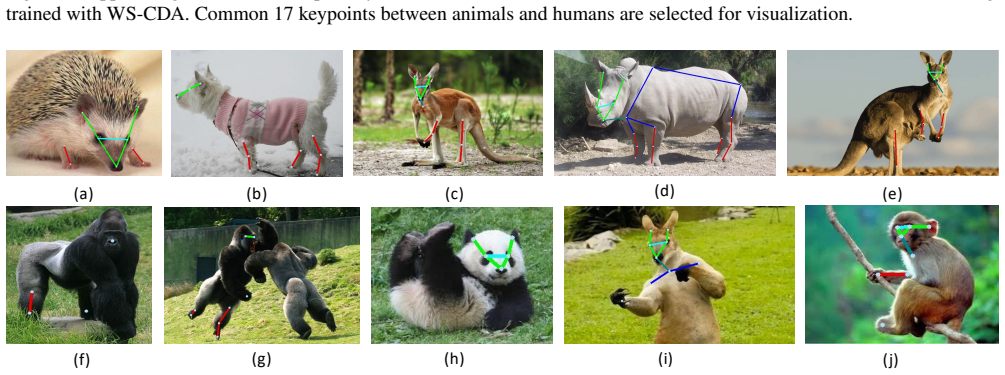
- [Section 5.3, Appendix A] The general claim of transfer to 'unseen animal classes' is only evaluated for the five domestic quadruped species that share the same keypoint template defined in Section 3.1. Appendix A lists seven more distant categories (otter, antelope, bear, chimpanzee, rhino, bobcat, hippopotamus) but provides only bounding boxes and qualitative examples, with no COCO-format keypoint evaluation. As a result, the external validity of the cross-species claim is limited to near-neighbor quadruped transfer. Please either add quantitative keypoint results for the Appendix A categories or restrict the claim to morphologically close quadruped species.
- [Section 4.2, Section 5.1] PPLO is a self-training loop in which the model's own confident predictions are used as labels, and the key hyperparameters (initial mu=0.9, the 0.01/10-epoch relaxation schedule, w2=10, and alpha=-1, beta=500) are reported without a validation-based selection procedure or sensitivity analysis. Since the pseudo-label threshold directly controls the amount of self-generated supervision, it is important to show that the reported peak mAP is not an artifact of a threshold chosen after seeing the test distribution. Please provide ablation or sensitivity results for mu and the schedule, and clarify how the hyperparameters were selected.
- [Section 3.1, Figure 2] The proposed transfer assumes that the 17 COCO human keypoints are anatomically homologous to the selected animal keypoints. The paper does not validate this correspondence for the five quadruped species, nor for the Appendix A categories. If, for example, elbow and knee indices on a quadruped correspond to different joints than in humans, both the human prior and the pseudo-labels in PPLO would be trained against inconsistent supervision. Please provide evidence for the alignment (e.g., per-keypoint annotation agreement, a human-annotation consistency study, or a dedicated analysis of the Figure 2 bone-length ratios), or explicitly discuss this as a limitation.
minor comments (5)
- [Table 1 caption] The abbreviation 'RB' is used in the table header and caption but is not defined; please spell it out.
- [Equations (8)-(9)] The symbol Y-hat is used for the binary pseudo-label selection variable in Eq. (8), while Section 3.2 uses Y-hat for latent ground truth; please use distinct notation to avoid ambiguity.
- [Section 5.1] Please state explicitly whether the pose-unlabeled animal images from COCO2017 train are disjoint from the 1,117-instance test set used in Tables 1 and 2; this is needed to rule out test-set contamination through PPLO.
- [Figure 2] Bone-length proportions are shown without error bars or sample sizes; please add them or state clearly that the values are class means.
- [Algorithm 1] Line 7 says 'if confidence of K_I > mu'; for consistency with Eq. (9), write 'if C(K_I) > mu'.
Circularity Check
No significant circularity: the adaptation scheme and PPLO self-training are evaluated against held-out ground-truth keypoints, and the paper's self-citations are not load-bearing.
full rationale
The paper's claims are empirical rather than derivational, and the load-bearing steps do not reduce, by the paper's own equations, to their inputs. WS-CDA optimizes an adversarial domain-discrimination loss and supervised pose losses (Eqs. 3-5) on human and labeled animal data; PPLO (Eqs. 7-9 and Algorithm 1) then trains on target-domain pseudo-labels generated by the current model. While PPLO is self-referential in the sense that the target-domain training targets are the model's own confident predictions, the reported mAP values (Table 2) are computed on a held-out test set with ground-truth annotations, so the final evaluation is not statistically forced by the pseudo-labels. The paper does not conceal that pseudo-labels are model outputs (Sec. 4.2, Algorithm 1), and it explicitly guards against noise via a self-paced confidence threshold, which is a design choice rather than a disguised input. No fitted parameter is renamed as a prediction: hyperparameters such as alpha, beta, w1, w2, and the mu schedule are stated as fixed settings, not fitted to the test classes. The self-citations ([13], [14]) appear as related work and baseline framework choices; they are not invoked as uniqueness theorems or as the sole justification for the central transfer claim. The abstract's '50+ mAP' overstates the Table 2 average (49.68), but that is an accuracy/validity issue, not circularity. Therefore no circular step meeting the required evidence standard can be exhibited.
Assumptions & free parameters
free parameters (4)
- w2 =
10
- mu initial value and schedule =
0.9, decreasing by 0.01 every 10 epochs if a pseudo-label is updated
- alpha and beta =
-1 and 500
- w1 =
1
assumptions (4)
- domain assumption The 17-keypoint COCO human pose format is anatomically alignable to a common set of body landmarks on quadruped mammals with consistent meaning across species.
- domain assumption The Animal-Pose dataset annotations, extended from existing Poselets keypoints with knees added by the authors, are accurate enough to serve as ground truth for evaluation.
- domain assumption The model's confidence score is a reliable proxy for the correctness of a predicted pseudo-label.
- domain assumption Adversarial domain confusion (Equation 3 with alpha times beta less than zero) forces the feature extractor to learn features that transfer to the pose estimation task across domains.
Cite this review
Pith. "Pith review of Cross-Domain Adaptation for Animal Pose Estimation." pith.science (2026). https://pith.science/paper/JRQCDGWT
@misc{pith2026190805806,
  author       = {Pith},
  title        = {Pith review of: Cross-Domain Adaptation for Animal Pose Estimation},
  year         = {2026},
  howpublished = {\url{https://pith.science/paper/JRQCDGWT}},
  note         = {Machine review of arXiv:1908.05806}
}
read the original abstract
In this paper, we are interested in pose estimation of animals. Animals usually exhibit a wide range of variations on poses and there is no available animal pose dataset for training and testing. To address this problem, we build an animal pose dataset to facilitate training and evaluation. Considering the heavy labor needed to label dataset and it is impossible to label data for all concerned animal species, we, therefore, proposed a novel cross-domain adaptation method to transform the animal pose knowledge from labeled animal classes to unlabeled animal classes. We use the modest animal pose dataset to adapt learned knowledge to multiple animals species. Moreover, humans also share skeleton similarities with some animals (especially four-footed mammals). Therefore, the easily available human pose dataset, which is of a much larger scale than our labeled animal dataset, provides important prior knowledge to boost up the performance on animal pose estimation. Experiments show that our proposed method leverages these pieces of prior knowledge well and achieves convincing results on animal pose estimation.
Figures


Figures from the paper (7 more)


Reference graph
Works this paper leans on
-
[49]
Simultaneous deep transfer across domains and tasks
Eric Tzeng, Judy Hoffman, Trevor Darrell, and Kate Saenko. Simultaneous deep transfer across domains and tasks. In ICCV, pages 4068–4076, 2015
work page 2015
-
[1]
2d human pose estimation: New benchmark and state of the art analysis
Mykhaylo Andriluka, Leonid Pishchulin, Peter Gehler, and Bernt Schiele. 2d human pose estimation: New benchmark and state of the art analysis. In CVPR, pages 3686–3693, 2014
work page 2014
-
[2]
Dataset of keypoints and foreground an- notations for all categories of pascal 2011, Feb 2012
Lubomir Bourdev. Dataset of keypoints and foreground an- notations for all categories of pascal 2011, Feb 2012
work page 2011
-
[3]
Poselets: Body part detectors trained using 3d human pose annotations
Lubomir Bourdev and Jitendra Malik. Poselets: Body part detectors trained using 3d human pose annotations. InICCV, pages 1365–1372, 2009
work page 2009
-
[4]
Unsupervised pixel- level domain adaptation with generative adversarial net- works
Konstantinos Bousmalis, Nathan Silberman, David Dohan, Dumitru Erhan, and Dilip Krishnan. Unsupervised pixel- level domain adaptation with generative adversarial net- works. In CVPR, volume 1, page 7, 2017
work page 2017
-
[5]
Partial Adversarial Domain Adaptation
Zhangjie Cao, Lijia Ma, Mingsheng Long, and Jianmin Wang. Partial adversarial domain adaptation. CoRR, abs/1808.04205, 2018
work page Pith review arXiv 2018
-
[6]
Realtime multi-person 2d pose estimation using part affinity fields
Zhe Cao, Tomas Simon, Shih-En Wei, and Yaser Sheikh. Realtime multi-person 2d pose estimation using part affinity fields. In CVPR, pages 7291–7299, 2017
work page 2017
-
[7]
Multisource do- main adaptation and its application to early detection of fa- tigue
Rita Chattopadhyay, Qian Sun, Wei Fan, Ian Davidson, Sethuraman Panchanathan, and Jieping Ye. Multisource do- main adaptation and its application to early detection of fa- tigue. ACM Transactions on Knowledge Discovery from Data (TKDD), 6:18, 2012
work page 2012
Show all 60 references
-
[8]
Cascaded pyramid network for multi-person pose estimation
Yilun Chen, Zhicheng Wang, Yuxiang Peng, Zhiqiang Zhang, Gang Yu, and Jian Sun. Cascaded pyramid network for multi-person pose estimation. In CVPR, pages 7103– 7112, 2018
2018
-
[9]
Self adversarial training for human pose estimation
Chia-Jung Chou, Jui-Ting Chien, and Hwann-Tzong Chen. Self adversarial training for human pose estimation. CoRR, abs/1707.02439, 2017
2017 arXiv
-
[10]
Vision-based hand pose estimation: A review
Ali Erol, George Bebis, Mircea Nicolescu, Richard D Boyle, and Xander Twombly. Vision-based hand pose estimation: A review. CVIU, 108:52–73, 2007
2007
-
[11]
Everingham, L
M. Everingham, L. Van Gool, C. K. I. Williams, J. Winn, and A. Zisserman. The PASCAL Visual Object Classes Challenge 2011 (VOC2011) Results. http://www.pascal- network.org/challenges/VOC/voc2011/workshop/index.html
2011
-
[12]
Real time head pose estimation with random regression forests
Gabriele Fanelli, Juergen Gall, and Luc Van Gool. Real time head pose estimation with random regression forests. In CVPR, pages 617–624, 2011
2011
-
[13]
Weakly and semi supervised human body part parsing via pose-guided knowledge trans- fer
Hao-Shu Fang, Guansong Lu, Xiaolin Fang, Jianwen Xie, Yu-Wing Tai, and Cewu Lu. Weakly and semi supervised human body part parsing via pose-guided knowledge trans- fer. In CVPR, pages 70–78. IEEE, 2018
2018
-
[14]
RMPE: Regional multi-person pose estimation
Hao-Shu Fang, Shuqin Xie, Yu-Wing Tai, and Cewu Lu. RMPE: Regional multi-person pose estimation. In ICCV, 2017
2017
-
[15]
Unsupervised domain adaptation by backpropagation
Yaroslav Ganin and Victor Lempitsky. Unsupervised domain adaptation by backpropagation. In ICML, pages 1180–1189, 2015
2015
-
[16]
Multi-evidence fil- tering and fusion for multi-label classification, object detec- tion and semantic segmentation based on weakly supervised learning
Weifeng Ge, Sibei Yang, and Yizhou Yu. Multi-evidence fil- tering and fusion for multi-label classification, object detec- tion and semantic segmentation based on weakly supervised learning. In CVPR, pages 1277–1286, 2018
2018
-
[17]
Fine-grained recognition in the wild: A multi-task domain adaptation ap- proach
Timnit Gebru, Judy Hoffman, and Li Fei-Fei. Fine-grained recognition in the wild: A multi-task domain adaptation ap- proach. In ICCV, pages 1358–1367, 2017
2017
-
[18]
Using k-poselets for detecting people and lo- calizing their keypoints
Georgia Gkioxari, Bharath Hariharan, Ross Girshick, and Ji- tendra Malik. Using k-poselets for detecting people and lo- calizing their keypoints. In CVPR, pages 3582–3589, 2014
2014
-
[19]
Domain adaptation for large-scale sentiment classification: A cdeep learning approach
Xavier Glorot, Antoine Bordes, and Yoshua Bengio. Domain adaptation for large-scale sentiment classification: A cdeep learning approach. In ICML, pages 513–520, 2011
2011
-
[20]
Generative adversarial nets
Ian Goodfellow, Jean Pouget-Abadie, Mehdi Mirza, Bing Xu, David Warde-Farley, Sherjil Ozair, Aaron Courville, and Yoshua Bengio. Generative adversarial nets. In NIPS, pages 2672–2680, 2014
2014
-
[21]
Do- main adaptation for object recognition: An unsupervised ap- proach
Raghuraman Gopalan, Ruonan Li, and Rama Chellappa. Do- main adaptation for object recognition: An unsupervised ap- proach. In ICCV, pages 999–1006, 2011
2011
-
[22]
Mask r-cnn
Kaiming He, Georgia Gkioxari, Piotr Doll ´ar, and Ross Gir- shick. Mask r-cnn. In CVPR, pages 2961–2969, 2017
2017
-
[23]
Deep residual learning for image recognition
Kaiming He, Xiangyu Zhang, Shaoqing Ren, and Jian Sun. Deep residual learning for image recognition. In CVPR, pages 770–778, 2016
2016
-
[24]
Squeeze-and-excitation net- works
Jie Hu, Li Shen, and Gang Sun. Squeeze-and-excitation net- works. 2018
2018
-
[25]
Auggan: Cross domain adaptation with gan-based data augmentation
Sheng-Wei Huang, Che-Tsung Lin, Shu-Ping Chen, Yen-Yi Wu, Po-Hao Hsu, and Shang-Hong Lai. Auggan: Cross domain adaptation with gan-based data augmentation. In ECCV, pages 718–731, 2018
2018
-
[26]
Cross-domain weakly-supervised object de- tection through progressive domain adaptation
Naoto Inoue, Ryosuke Furuta, Toshihiko Yamasaki, and Kiy- oharu Aizawa. Cross-domain weakly-supervised object de- tection through progressive domain adaptation. In CVPR, pages 5001–5009, 2018
2018
-
[27]
Self-paced curriculum learning
Lu Jiang, Deyu Meng, Qian Zhao, Shiguang Shan, and Alexander G Hauptmann. Self-paced curriculum learning. In AAAI, pages 2694–2700, 2015
2015
-
[28]
Deep adversarial attention alignment for unsupervised domain adaptation: the benefit of target expectation maximization
Guoliang Kang, Liang Zheng, Yan Yan, and Yi Yang. Deep adversarial attention alignment for unsupervised domain adaptation: the benefit of target expectation maximization. In ECCV, pages 401–416, 2018
2018
-
[29]
Hand pose estimation and hand shape classification using multi-layered randomized decision forests
Cem Keskin, Furkan Kırac ¸, Yunus Emre Kara, and Lale Akarun. Hand pose estimation and hand shape classification using multi-layered randomized decision forests. In ECCV, pages 852–863, 2012
2012
-
[30]
Self- paced learning for latent variable models
M Pawan Kumar, Benjamin Packer, and Daphne Koller. Self- paced learning for latent variable models. In NIPS, pages 1189–1197, 2010
2010
-
[31]
Backpropagation applied to handwrit- ten zip code recognition
Yann LeCun, Bernhard Boser, John S Denker, Donnie Henderson, Richard E Howard, Wayne Hubbard, and Lawrence D Jackel. Backpropagation applied to handwrit- ten zip code recognition. Neural Computation, 1:541–551, 1989
1989
-
[32]
Ap- paratus and methods for head pose estimation and head ges- ture detection, Aug 2008
Renxiang Li, Carl M Danielsen, and Cuneyt M Taskiran. Ap- paratus and methods for head pose estimation and head ges- ture detection, Aug 2008. US Patent 7,412,077
2008
-
[33]
Gen- erative semantic manipulation with mask-contrasting gan
Xiaodan Liang, Hao Zhang, Liang Lin, and Eric Xing. Gen- erative semantic manipulation with mask-contrasting gan. In ECCV, pages 558–573, 2018
2018
-
[34]
https://github.com/cocodataset/cocoapi
Tsung-Yi Lin. https://github.com/cocodataset/cocoapi
-
[35]
Microsoft coco: Common objects in context
Tsung-Yi Lin, Michael Maire, Serge Belongie, James Hays, Pietro Perona, Deva Ramanan, Piotr Doll´ar, and C Lawrence Zitnick. Microsoft coco: Common objects in context. In ECCV, pages 740–755. Springer, 2014
2014
-
[36]
Unsupervised domain adaptation with residual trans- fer networks
Mingsheng Long, Han Zhu, Jianmin Wang, and Michael I Jordan. Unsupervised domain adaptation with residual trans- fer networks. In NIPS, pages 136–144, 2016
2016
-
[37]
Instagan: Instance-aware image-to-image translation
Sangwoo Mo, Minsu Cho, and Jinwoo Shin. Instagan: Instance-aware image-to-image translation. In ICLR, 2019
2019
-
[38]
Head pose estimation in computer vision: A survey
Erik Murphy-Chutorian and Mohan Manubhai Trivedi. Head pose estimation in computer vision: A survey. IEEE Trans. Pattern Anal. Mach. Intell., 31:607–626, 2009
2009
-
[39]
O. M. Parkhi, A. Vedaldi, A. Zisserman, and C. V . Jawahar. Cats and dogs. In CVPR, 2012
2012
-
[40]
Automatic differentiation in pytorch
Adam Paszke, Sam Gross, Soumith Chintala, Gregory Chanan, Edward Yang, Zachary DeVito, Zeming Lin, Al- ban Desmaison, Luca Antiga, and Adam Lerer. Automatic differentiation in pytorch. In NIPS, 2017
2017
-
[41]
Articulated peo- ple detection and pose estimation: Reshaping the future
Leonid Pishchulin, Arjun Jain, Mykhaylo Andriluka, Thorsten Thorm ¨ahlen, and Bernt Schiele. Articulated peo- ple detection and pose estimation: Reshaping the future. In CVPR, pages 3178–3185, 2012
2012
-
[42]
Interspecies knowledge transfer for facial keypoint detection
Maheen Rashid, Xiuye Gu, and Yong Jae Lee. Interspecies knowledge transfer for facial keypoint detection. In CVPR, pages 6894–6903, 2017
2017
-
[43]
An overview of gradient descent optimiza- tion algorithms
Sebastian Ruder. An overview of gradient descent optimiza- tion algorithms. CoRR, abs/1609.04747, 2016
2016 arXiv
-
[44]
Prototypical networks for few-shot learning
Jake Snell, Kevin Swersky, and Richard Zemel. Prototypical networks for few-shot learning. In NIPS, pages 4077–4087, 2017
2017
-
[45]
Zero-shot learning through cross-modal transfer
Richard Socher, Milind Ganjoo, Christopher D Manning, and Andrew Ng. Zero-shot learning through cross-modal transfer. In NIPS, pages 935–943, 2013
2013
-
[46]
Cross-modal deep variational hand pose estimation
Adrian Spurr, Jie Song, Seonwook Park, and Otmar Hilliges. Cross-modal deep variational hand pose estimation. In CVPR, pages 89–98, 2018
2018
-
[47]
Unsu- pervised learning of object landmarks by factorized spatial embeddings
James Thewlis, Hakan Bilen, and Andrea Vedaldi. Unsu- pervised learning of object landmarks by factorized spatial embeddings. In ICCV, pages 5916–5925, 2017
2017
-
[48]
Deeppose: Human pose estimation via deep neural networks
Alexander Toshev and Christian Szegedy. Deeppose: Human pose estimation via deep neural networks. In CVPR, pages 1653–1660, 2014
2014
-
[50]
Adversarial discriminative domain adaptation
Eric Tzeng, Judy Hoffman, Kate Saenko, and Trevor Darrell. Adversarial discriminative domain adaptation. InCVPR, vol- ume 1, page 4, 2017
2017
-
[51]
Understanding convolution for semantic segmentation
Panqu Wang, Pengfei Chen, Ye Yuan, Ding Liu, Zehua Huang, Xiaodi Hou, and Garrison Cottrell. Understanding convolution for semantic segmentation. In WACV, pages 1451–1460, 2018
2018
-
[52]
Human and sheep facial landmarks localisation by triplet interpo- lated features
Heng Yang, Renqiao Zhang, and Peter Robinson. Human and sheep facial landmarks localisation by triplet interpo- lated features. In WACV, pages 1–8. IEEE, 2016
2016
-
[53]
3d human pose estima- tion in the wild by adversarial learning
Wei Yang, Wanli Ouyang, Xiaolong Wang, Jimmy Ren, Hongsheng Li, and Xiaogang Wang. 3d human pose estima- tion in the wild by adversarial learning. In CVPR, volume 1, 2018
2018
-
[54]
Curricu- lum domain adaptation for semantic segmentation of urban scenes
Yang Zhang, Philip David, and Boqing Gong. Curricu- lum domain adaptation for semantic segmentation of urban scenes. In ICCV, volume 2, page 6, 2017
2017
-
[55]
Zero-shot learning via semantic similarity embedding
Ziming Zhang and Venkatesh Saligrama. Zero-shot learning via semantic similarity embedding. In ICCV, pages 4166– 4174, 2015
2015
-
[56]
Towards 3d human pose estimation in the wild: a weakly-supervised approach
Xingyi Zhou, Qixing Huang, Xiao Sun, Xiangyang Xue, and Yichen Wei. Towards 3d human pose estimation in the wild: a weakly-supervised approach. In ICCV, 2017
2017
-
[57]
Unsupervised domain adaptation for 3d key- point estimation via view consistency
Xingyi Zhou, Arjun Karpur, Chuang Gan, Linjie Luo, and Qixing Huang. Unsupervised domain adaptation for 3d key- point estimation via view consistency. In ECCV, pages 137– 153, 2018
2018
-
[58]
Unpaired image-to-image translation using cycle- consistent adversarial networks
Jun-Yan Zhu, Taesung Park, Phillip Isola, and Alexei A Efros. Unpaired image-to-image translation using cycle- consistent adversarial networks. In ICCV, 2017
2017
-
[59]
Unsupervised domain adaptation for semantic seg- mentation via class-balanced self-training
Yang Zou, Zhiding Yu, BVK Vijaya Kumar, and Jinsong Wang. Unsupervised domain adaptation for semantic seg- mentation via class-balanced self-training. In ECCV, pages 289–305, 2018
2018
-
[60]
3d menagerie: Modeling the 3d shape and pose of animals
Silvia Zuffi, Angjoo Kanazawa, David W Jacobs, and Michael J Black. 3d menagerie: Modeling the 3d shape and pose of animals. In CVPR, pages 5524–5532, 2017. Appendix A. Proposed Dataset To bring convenience for the attempt to do domain adap- tation of animal pose estimation to ...
2017
Reviewed August 14, 2026 · model on record in the stance chip above.
Discussion (0). Continue with ORCID to comment.