REVIEW 3 major objections 3 minor 29 references
Autonomous navigation of shape-shifting microswimmers
T0 review · 3 major / 3 minor · reviewed 2026-08-14 · deepseek-v4-flash
Pith's one-line read This paper establishes a design principle for programming autonomous navigation by making a particle's shape respond to local stimulus and thereby redirect its self-propelled motion.
desk verdict A genuinely new design idea for autonomous colloids, with a real but fixable gap: deformation-induced swimming is dropped, not proven negligible. read the letter →
The pith
A machine-rendered reading of the paper's core claim, the machinery that carries it, and where it could break.
The reading
What carries the argument
The load-bearing identity is the drift-velocity formula V = −(1/2)GURα′e_x + (1/2)GUR′e_y + O(G²), derived by averaging the particle's circular motion over one orbit; it converts the design problem into two geometric requirements: constant signed orbit radius R (so R′ = 0) and a propulsion orientation that rotates steeply with the stimulus (large α′). The requirements are realized in silico through three components: a far-field method-of-reflections solution for the self-phoretic velocities of rigid sphere clusters, a set of 'standard shapes' (with the particle frame chosen so that shape change itself produces no swimming) that maps a shape parameter s onto cluster geometry, and a CMA-ES optimization (covariance matrix adaptation evolution strategy) over cluster geometry that minimizes the objective ⟨[R(s,d) − R0]²⟩ over all shape states s.
What would settle it
Measure the drift velocity of the optimized three-sphere cluster (a2 = 0.0985, a3 = 0.0958, L2 = 0.677) in a steady linear chemical gradient of known strength G; if the drift does not occur along the gradient at speed −(1/2)GURα′ (with U, R, α′ measured independently), the design criterion fails, and the failure would be even clearer if the shape response time is comparable to the orbital period.
Extended reading notes
Core claim
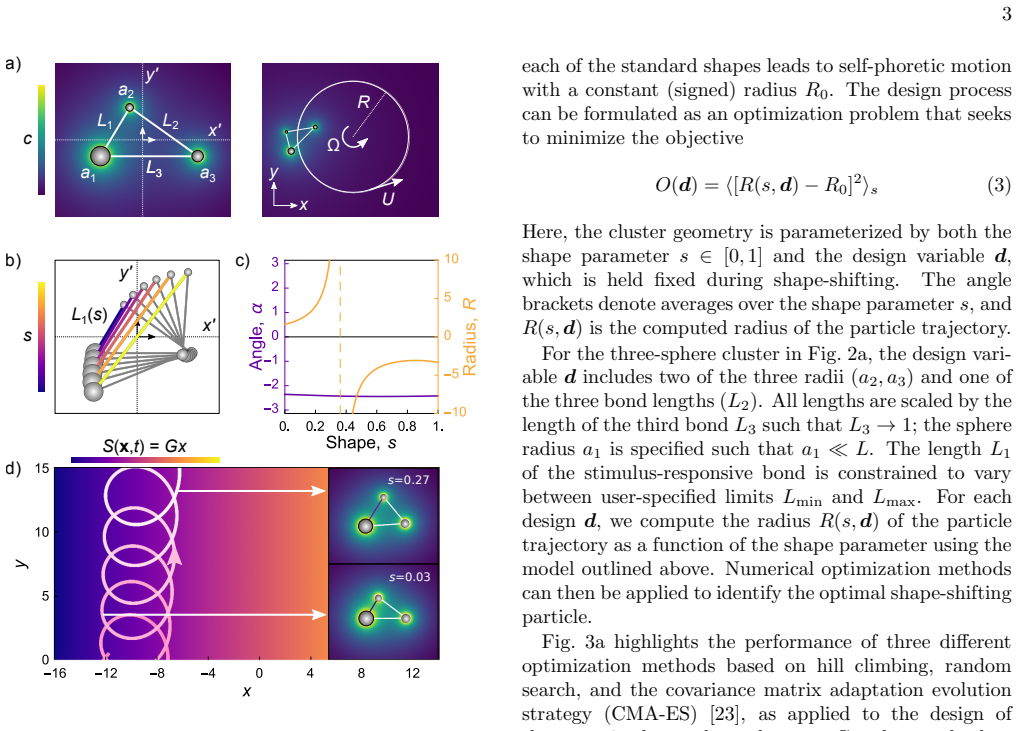
The paper's central claim is that shape is a programmable medium for autonomous navigation. For a self-propelled particle whose linear speed U, propulsion orientation α, and angular speed Ω depend only on the local stimulus S, motion in a weak uniform gradient S = Gx produces a drift velocity V = −(1/2)GURα′e_x + (1/2)GUR′e_y + O(G²), where R = U/Ω is the signed radius of the circular trajectory and primes denote derivatives with respect to S. If the geometry is designed so that R′ = 0, the cross-gradient drift vanishes, and a monotone α(S) that rotates the propulsion direction by up to 180° yields steady migration up or down the gradient. The authors implement this design for a three-sphere self-phoretic cluster with one stimulus-responsive bond, optimize the remaining bond length and sphere radii so that R varies by only about 2%, and compute trajectories that climb the gradient with the predicted drift speed. The same framework yields clusters that swim down the gradient or perpendicular to it by choosing different response functions or objectives.
Load-bearing premise
The particle's internal shape state is assumed to be a single-valued, instantaneous function of the stimulus magnitude at the particle center; if real responsive materials have delays, hysteresis, or sensitivity to the gradient across the particle, the derived drift velocities and the designed trajectories will not hold.
Editorial extensions
If this is right
- Autonomous chemotaxis can be encoded entirely in the particle's geometry and material response, removing the need for onboard sensing, memory, or external control.
- The same design framework produces negative chemotaxis, and with a modified objective function it produces motion perpendicular to the gradient, so a library of behaviors is accessible from one physical mechanism.
- Because the arguments depend only on shape-dependence of propulsion, the strategy should transfer to other shape-based propulsion mechanisms such as induced-charge electrophoresis or acoustic actuation.
- The noise analysis sets a concrete size scale—roughly a micrometer or larger for typical phoretic speeds in water—below which rotational diffusion erases the navigational signal, matching the scale of chemotactic bacteria.
- The comparison of optimization methods indicates that greedy searches fail while evolutionary strategies reliably find cluster geometries with the required constant-radius property, making the design step computationally feasible.
Reading between the lines
- The approach suggests that any stimuli-responsive material (e.g., hydrogels or liquid-crystal elastomers) that changes a cluster's bond lengths could be matched, via the same optimization, to a desired navigation behavior, turning 'shape' into a general programming language for active matter.
- The drift formula assumes the stimulus varies slowly across one orbit; an immediate extension would test steep or time-dependent gradients, where the O(G²) terms and finite shape-response time become important, potentially enabling navigation in fluctuating environments.
- Because the stimulus only sets an internal shape state, the mechanism is not limited to chemical cues: light, temperature, pH, or magnetic field strength could serve as the scalar stimulus, as long as the shape response is fast and single-valued.
- A finite response time in the shape state would introduce memory, which could be exploited to emulate bacterial run-and-tumble behavior; the model's assumption of an instantaneous unique mapping is the main obstacle to such an extension.
Signed reviews
Editorial analysis
A structured set of objections, weighed in public.
Referee Report
Summary. The paper proposes a design strategy for autonomous navigation of active colloidal particles in which the particle shape responds to a local scalar stimulus and thereby redirects self-propelled motion. For a particle whose speed U, propulsion orientation α, and angular velocity Ω depend on an internal shape state s=f(S(x_p,t)), the authors state that motion in a uniform gradient S=Gx produces a drift velocity V=−(1/2)GURα′e_x+(1/2)GUR′e_y+O(G^2), where R=U/Ω, and that chemotaxis along the gradient requires R to be independent of S. They apply this to rigid self-phoretic clusters of spheres, compute response functions with a far-field method of reflections, and formulate design as minimization of the objective O(d)=⟨[R(s,d)−R0]^2⟩. An optimized three-sphere cluster with one stimulus-responsive bond is shown in simulation to migrate up an applied gradient, and a rotational-noise estimate gives a minimum particle size of order 1 μm for effective navigation.
Significance. If the technical gaps are closed, this is a conceptually attractive design principle: it replaces direct gradient sensing with shape-mediated feedback, is not tied to a single propulsion mechanism, and leads to an explicit, testable prediction about particle size. The optimization framework and the noise analysis are constructive, and the paper clearly identifies the objective function needed to encode chemotaxis. The main weaknesses are that the central drift formula and the standard-shape construction are deferred to an unavailable supplemental, that the shape-change swimming contribution is not shown to be negligible, and that the demonstration is entirely in silico and is entangled with the same model used to produce the design. The strengths are the clean conceptual framing, the falsifiable design objective, and the concrete size estimate, rather than any empirical validation.
major comments (3)
- [Particle motion in stimulus gradients] The drift formula V=−(1/2)GURα′e_x+(1/2)GUR′e_y+O(G^2) is the mathematical core of the paper, but it is stated without derivation and deferred to supplemental material [17]. Moreover, the text immediately following the formula claims a maximum drift speed of Vmax=GUR and decay V≈GUR/S^2 for α(S)=−arctan(S); substituting α′=−1/(1+S^2) into the stated formula gives Vmax=GUR/2 and V≈GUR/(2S^2). This factor-of-two discrepancy must be fixed, and the derivation with all underlying assumptions must be included in the main text or an accessible supplement before the design claims can be evaluated.
- [Shape-shifting clusters] The claim that the standard shapes are chosen 'such that the particle frame does not translate or rotate within the viscous fluid as the particle changes its shape' is, as written, a statement about the body frame rather than about the physical flow. At zero Reynolds number, a non-closed sequence of shapes generally produces a net rigid-body displacement, and fixing a frame does not eliminate that effect. Because ds/dt = f′(S)(∇S·U) is O(GU), any omitted deformation-induced swimming velocity is of the same order as the designed drift V=−(1/2)GURα′. The paper must specify the deformation kinematics and demonstrate that the shape changes are swimming-neutral; otherwise the trajectories in Figs. 2d and 3d are not established to describe the actual shape-shifting particle.
- [Self-phoretic clusters and Design of chemotactic clusters] The response functions R(s) and α(s) that enter the design are computed with a far-field method of reflections [19], but no accuracy estimate or comparison with exact or boundary-element solutions is reported. For the optimized cluster of Fig. 3b, the 2% variation claimed for R(s) around R0=2 is used as evidence of successful design; if the far-field approximation carries errors of that size, the optimized geometry may not be robust. A convergence check or validation for at least the optimal geometry is needed.
minor comments (3)
- [References] Reference [8] spells 'viscosicty'; it should be 'viscosity'.
- [Figure captions] The phrase 'the shape parameter is assume to vary with the local stimulus' appears in both Fig. 2d and Fig. 3d captions; it should read 'is assumed to vary'.
- [Particle motion in stimulus gradients] The statement that setting Sl=0 and Ss=1 is 'without loss of generality' should be reconciled with the fact that these parameters carry physical units; the rescaling applies only after all stimuli are expressed in units of Ss.
Circularity Check
No significant circularity: the drift formula is a parameter-free expansion, and the optimized-cluster demonstration is a design validation rather than a fitted prediction.
full rationale
The paper's central derivation is the drift velocity V = -1/2 G U R alpha' for a particle whose response functions depend on the local stimulus. This is a small-parameter expansion of the orientation dynamics, and nothing in the main text or equations shows it being assumed into the response functions. The design step minimizes O(d)=<[R(s,d)-R0]^2> to enforce the R=constant condition that the drift theory identifies; this is an explicit design objective, not a hidden fit or a parameter tuned to a subset of data and then renamed as a prediction. The simulated up-gradient trajectory (Fig. 3d) uses the optimized response functions U(s), alpha(s), Omega(s) and the chosen sigmoidal coupling s=(1+e^{-S})^{-1}; the sign and magnitude of the resulting drift are emergent consequences of the optimized geometry (in particular of alpha(s)), so the demonstration is not equivalent to the input by construction. The main caveat is a model-completeness issue rather than a circular one: the paper defers to supplemental [17] the construction of 'standard shapes' that remove shape-change swimming, and the concern that deformation-induced swimming is of the same order as the designed drift is a legitimate physical check that is not addressed in the main text. This belongs to correctness risk, not to circularity. Self-citations [12-14] are contextual examples of shape-directed propulsion and are not load-bearing for the drift derivation or the optimization; the far-field cluster hydrodynamics is credited to external works [18,19]. Accordingly, no circular step can be exhibited with a quote and a specific reduction.
Assumptions & free parameters
free parameters (4)
- Prescribed cluster geometry parameters =
a1 = 0.1, L3 = 1, Lmin = 0.5, Lmax = 1.5, R0 = 2
- Response function location and scale =
Sl = 0, Ss = 1
- Stimulus-shape response function =
s = (1 + e^{-S})^{-1}
- Typical phoretic angular velocity for noise estimate =
Omega = 1 rad/s
assumptions (7)
- domain assumption The internal shape state s is a unique, instantaneous function of the local stimulus magnitude at the particle center: s = f(S(xp,t)).
- domain assumption The particle's linear and angular velocities depend only on the internal state s, not on orientation or position in the gradient: U=U(s), Omega=Omega(s).
- domain assumption The far-field method of reflections accurately captures self-phoretic cluster velocities.
- domain assumption Shape changes can be implemented kinematically without producing additional swimming (standard shapes chosen so the particle frame does not translate or rotate).
- domain assumption Low Péclet number and low Reynolds number limits, so diffusion is quasi-steady and Stokes flow applies.
- domain assumption Rotational diffusion can be modeled with a thin-disk friction coefficient for the noise analysis.
- ad hoc to paper The sigmoidal relationship s = (1 + e^{-S})^{-1} between stimulus and shape.
Cite this review
Pith. "Pith review of Autonomous navigation of shape-shifting microswimmers." pith.science (2026). https://pith.science/paper/URZSIIDX
@misc{pith2026190805808,
  author       = {Pith},
  title        = {Pith review of: Autonomous navigation of shape-shifting microswimmers},
  year         = {2026},
  howpublished = {\url{https://pith.science/paper/URZSIIDX}},
  note         = {Machine review of arXiv:1908.05808}
}
read the original abstract
We describe a method for programming the autonomous navigation of active colloidal particles in response to spatial gradients in a scalar stimulus. Functional behaviors such as positive or negative chemotaxis are encoded in the particle shape, which responds to the local stimulus and directs self-propelled particle motions. We demonstrate this approach using a physical model of stimuli-responsive clusters of self-phoretic spheres. We show how multiple autonomous behaviors can be achieved by designing the particle geometry and its stimulus response.
Figures


Reference graph
Works this paper leans on
-
[17]
See supplemental material at [url will be inserted by pub- lisher] for (1) derivation of the drift velocity in a uniform gradient, (2) model details on rigid self-phoretic clusters, (3) definition of standard shapes for shape-shifting parti- cles, (4) a designed cluster moving down the gradient, (5) a designed cluster moving perpendicular to the gradient, ...
- [19]
-
[1]
M. E. Cates, Diffusive transport without detailed bal- ance in motile bacteria: does microbiology need statisti- cal physics?, Rep. Prog. Phys. 75, 042601 (2012)
work page 2012
-
[2]
C. Bechinger, R. Di Leonardo, H. L¨ owen, C. Reichhardt, G. Volpe, and G. Volpe, Active particles in complex 5 and crowded environments, Rev. Mod. Phys. 88, 045006 (2016)
work page 2016
-
[3]
Y. Hong, N. M. Blackman, N. D. Kopp, A. Sen, and D. Velegol, Chemotaxis of nonbiological colloidal rods, Phys. Rev. Lett. 99, 178103 (2007)
work page 2007
-
[4]
M. N. Popescu, W. E. Uspal, C. Bechinger, and P. Fis- cher, Chemotaxis of active Janus nanoparticles, Nano Lett. 18, 5345 (2018)
work page 2018
-
[5]
T. R. Kline, W. F. Paxton, T. E. Mallouk, and A. Sen, Catalytic nanomotors: Remote-controlled autonomous movement of striped metallic nanorods, Angew. Chem. Int. Ed. 44, 744 (2005)
work page 2005
-
[6]
Lozano, B
C. Lozano, B. Ten Hagen, H. L¨ owen, and C. Bechinger, Phototaxis of synthetic microswimmers in optical land- scapes, Nat. Commun. 7, 12828 (2016)
2016
Show all 29 references
-
[7]
Palacci, S
J. Palacci, S. Sacanna, A. Abramian, J. Barral, K. Han- son, A. Y. Grosberg, D. J. Pine, and P. M. Chaikin, Artificial rheotaxis, Sci. Adv. 1, e1400214 (2015)
2015
-
[8]
Liebchen, P
B. Liebchen, P. Monderkamp, B. ten Hagen, and H. L¨ owen, Viscotaxis: microswimmer navigation in vis- cosity gradients, Phys. Rev. Lett. 120, 208002 (2018)
2018
-
[9]
Golestanian, T
R. Golestanian, T. Liverpool, and A. Ajdari, Designing phoretic micro-and nano-swimmers, New J. Phys. 9, 126 (2007)
2007
-
[10]
Palagiand P
S. Palagiand P. Fischer, Bioinspired microrobots, Nat. Rev. Mater. 3, 113 (2018)
2018
-
[11]
K. Han, C. W. Shields IV, and O. D. Velev, Engineering of self-propelling microbots and microdevices powered by magnetic and electric fields, Advanced Functional Mate- rials 28, 1705953 (2018)
2018
-
[12]
A. M. Brooks, S. Sabrina, and K. J. M. Bishop, Shape- directed dynamics of active colloids powered by induced- charge electrophoresis, Proc. Natl. Acad. Sci. USA 115, E1090 (2018)
2018
-
[13]
Sabrina, M
S. Sabrina, M. Tasinkevych, S. Ahmed, A. M. Brooks, M. Olvera de la Cruz, T. E. Mallouk, and K. J. M. Bishop, Shape-directed microspinners powered by ultra- sound, ACS Nano 12, 2939 (2018)
2018
-
[14]
A. M. Brooks, M. Tasinkevych, S. Sabrina, D. Vele- gol, A. Sen, and K. J. M. Bishop, Shape-directed ro- tation of homogeneous micromotors via catalytic self- electrophoresis, Nat. Commun. 10, 495 (2019)
2019
-
[15]
Magdanz, G
V. Magdanz, G. Stoychev, L. Ionov, S. Sanchez, and O. G. Schmidt, Stimuli-responsive microjets with recon- figurable shape, Angew. Chem. Int. Ed. 53, 2673 (2014)
2014
-
[16]
Palagi, A
S. Palagi, A. G. Mark, S. Y. Reigh, K. Melde, T. Qiu, H. Zeng, C. Parmeggiani, D. Martella, A. Sanchez- Castillo, N. Kapernaum, F. Giesselmann, D. S. Wiersma, E. Lauga, and P. Fischer, Structured light enables biomimetic swimming and versatile locomotion of pho- toresponsive s...
2016
-
[18]
Sotoand R
R. Sotoand R. Golestanian, Self-assembly of catalytically active colloidal molecules: Tailoring activity through sur- face chemistry, Phys. Rev. Lett. 112, 068301 (2014)
2014
-
[20]
R. Niu, A. Fischer, T. Palberg, and T. Speck, Dynamics of binary active clusters driven by ion-exchange particles, ACS Nano 12, 10932 (2018)
2018
-
[21]
Schmidt, B
F. Schmidt, B. Liebchen, H. L¨ owen, and G. Volpe, Light-controlled assembly of active colloidal molecules, J. Chem. Phys. 150, 094905 (2019)
2019
-
[22]
Shapereand F
A. Shapereand F. Wilczek, Geometry of self-propulsion at low reynolds number, J. Fluid Mech. 198, 557 (1989)
1989
-
[23]
Hansen, The cma evolution strategy: A tutorial, arXiv:1604.00772 (2016)
N. Hansen, The cma evolution strategy: A tutorial, arXiv:1604.00772 (2016)
2016 arXiv
-
[24]
M. Z. Miskinand H. M. Jaeger, Adapting granular ma- terials through artificial evolution, Nat. Mater. 12, 326 (2013)
2013
-
[25]
Kimand S
S. Kimand S. J. Karrila, Microhydrodynamics (Dover, New York, 2005)
2005
-
[26]
F. Ma, X. Yang, H. Zhao, and N. Wu, Inducing propul- sion of colloidal dimers by breaking the symmetry in electrohydrodynamic flow, Phys. Rev. Lett. 115, 208302 (2015)
2015
-
[27]
critters
M. Driscoll, B. Delmotte, M. Youssef, S. Sacanna, A. Donev, and P. Chaikin, Unstable fronts and stable “critters” formed by microrollers, Nat. Phys. 13, 375 (2017)
2017
-
[28]
Alvarez, M
L. Alvarez, M. A. Fernandez-Rodriguez, and L. Isa, Adaptable active colloids, in preparation (2019)
2019
-
[29]
Liebchenand H
B. Liebchenand H. L¨ owen, Optimal control strategies for active particle navigation, arXiv:1901.08382 (2019)
2019 arXiv
Reviewed August 14, 2026 · model on record in the stance chip above.
Discussion (0). Continue with ORCID to comment.