REVIEW 3 major objections 5 minor 47 references
Dynamics of Hot Bose-Einstein Condensates: stochastic Ehrenfest relations for number and energy damping
T0 review · 3 major / 5 minor · reviewed 2026-08-14 · deepseek-v4-flash
Pith's one-line read The paper derives exact stochastic Ehrenfest relations for the full damped SPGPE, giving closed stochastic equations for one-body observables of hot Bose–Einstein condensates.
desk verdict A careful and likely correct formal derivation of stochastic Ehrenfest relations for the full SPGPE, with a validation section that only tests a simplified limit of those equations. read the letter →
The pith
A machine-rendered reading of the paper's core claim, the machinery that carries it, and where it could break.
The reading
What carries the argument
The load-bearing machinery is the stochastic change-of-variables formula for functionals of the projected c-field, applied after rewriting the SPGPE so that fields and noises are independent at equal times. This converts the multiplicative noise of the field equation into explicit drift, diffusion, and projector-correction terms for any one-body observable; the projector terms describe mode mixing between the highest-energy coherent mode and the lowest-energy incoherent mode, and vanish as the cutoff is raised. For the centre-of-mass test, a Thomas–Fermi wavefunction ansatz evaluates the integrals, leaving a linear stochastic system with constant drift and diffusion matrices—an Ornstein–Uhlenbeck process—whose exact steady-state correlations and spectra are the objects compared with simulation.
What would settle it
Compute the projector corrections given in Appendix B for a cutoff chosen so that the population of the highest coherent mode is not small: if those corrections do not stay below a few percent during equilibration, the analytic Ornstein–Uhlenbeck solution is not the theory's prediction. Alternatively, measure the centre-of-mass position spectrum of a hot condensate in a non-harmonic trap and compare its line shape with Eq. (64a); disagreement beyond the computed projector corrections would show the static-reservoir assumption fails.
Extended reading notes
Core claim
The central claim is that the set of equations (50a)–(50e) are exact stochastic Ehrenfest relations for the full SPGPE: each one-body observable obeys a stochastic differential equation whose drift combines the ordinary Hamiltonian Ehrenfest forces with explicit damping drifts from number and energy exchange with the reservoir, and whose noise has the explicit correlations (46)–(49). All terms generated by the projector—the Hilbert-space cutoff separating system from reservoir—are kept, and the paper shows they are small in the centre-of-mass application. There, a Thomas–Fermi ansatz reduces the position and momentum equations to a two-dimensional Ornstein–Uhlenbeck process, and the steady-state correlation functions and spectra obtained analytically match c-field simulations.
Load-bearing premise
The load-bearing premise is the time-independent reservoir approximation—that the high-energy incoherent region can be treated as a static thermal reservoir—which the paper itself notes is not strictly valid for a scalar condensate in a purely harmonic trap, because the exact centre-of-mass mode should be protected by harmonicity.
Editorial extensions
If this is right
- Equations (50a)–(50e) provide closed stochastic equations for one-body observables of the full SPGPE, so collective-mode dynamics can be studied without simulating the full fluctuating field.
- For many one-body operators the multiplicative noise of the SPGPE becomes additive noise in the collective equations, opening these equations to linear-noise and Ornstein–Uhlenbeck techniques.
- At equilibrium the SERs yield fluctuation–dissipation relations, such as $\langle\langle L-\mu\rangle\rangle=k_B T N$ for pure number damping, that serve as ensemble-level consistency checks.
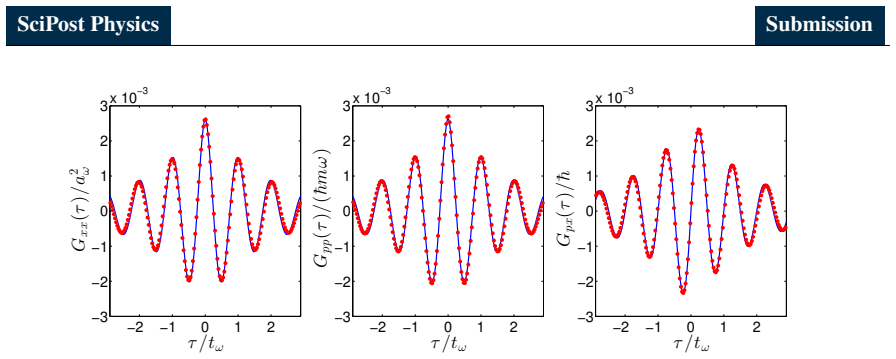
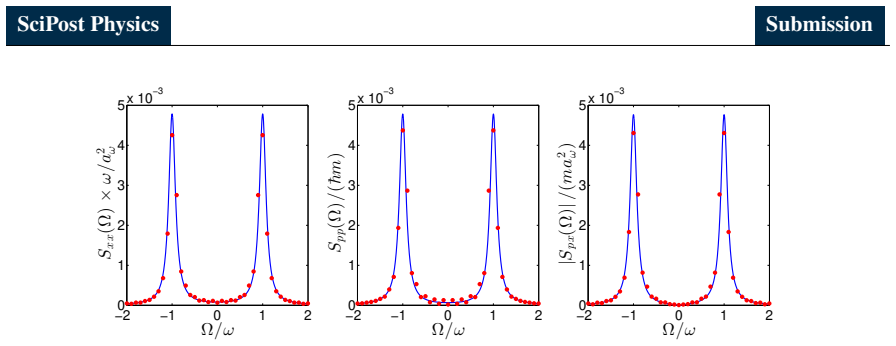
- In the centre-of-mass application, the analytic steady-state correlations and spectra agree with direct SPGPE simulations, validating both the neglect of projector corrections and the overall formalism in that regime.
Reading between the lines
- The same projection machinery could be used to derive cutoff-corrected equations for other collective modes, such as quadrupole or scissors modes, where the relevant projector overlaps may not be as small as they are for the centre of mass.
- If the additive-noise reduction holds more broadly, soliton and vortex Brownian motion could be treated analytically by reading effective damping and diffusion constants off the general noise correlations, without solving the full SPGPE.
- Because the paper's static-reservoir approximation is most questionable in exactly harmonic traps, the strongest physical tests of the theory are in non-harmonic, toroidal, or two-species systems, which the paper lists as future targets.
- The spectral linewidth formulas (64a)–(64c) offer an experimental route to measuring the reservoir damping rates $\Lambda_\gamma$ and $\Lambda_\varepsilon$ from equilibrium noise spectra alone, without preparing a non-equilibrium initial state.
Signed reviews
Editorial analysis
A structured set of objections, weighed in public.
Referee Report
Summary. The paper derives stochastic Ehrenfest relations (SERs) for the stochastic projected Gross-Pitaevskii equation (SPGPE) including both number-damping and energy-damping reservoir terms, retaining all projector corrections that arise from the energy cutoff. The main result is the set of equations (50a)-(50e) together with the noise correlations (46)-(49). The authors then apply this formalism to the centre-of-mass motion of a quasi-1D harmonically trapped condensate, using a Thomas-Fermi ansatz to reduce the SERs, after linearizing in the centre-of-mass displacement and neglecting all projector terms, to an Ornstein-Uhlenbeck system (57)-(58). Analytic steady-state correlation functions and spectra, Eqs. (63a)-(64c), are compared with direct 1D SPGPE simulations in Figs. 2 and 3 and reported to be in close agreement. The paper explicitly acknowledges that the harmonic-trap test system violates Kohn's theorem under the time-independent reservoir approximation (TIRA), while arguing that the formalism remains relevant for non-harmonic and multicomponent systems.
Significance. If the formal derivation is correct, the SERs provide a genuinely useful analytic tool: they extend the earlier number-damping-only Ehrenfest relations of Bradley, Blakie and Gardiner to the full SPGPE with energy damping, and they convert, in special ansatz-based cases, multiplicative field noise into additive noise in collective variables. The derivation is a genuine derivation rather than a fit; the analytic centre-of-mass solution is parameter-free given the simulation parameters, and the comparison against direct SPGPE simulations is an appropriate internal consistency check of the reduction. The manuscript is clear about several limitations, including the TIRA/Kohn-theorem caveat. The central weakness is that the validation exercises only the simplified, projector-free limit of the SERs, so the exact projector and noise-correlation structure that constitutes the paper's headline novelty is not numerically certified.
major comments (3)
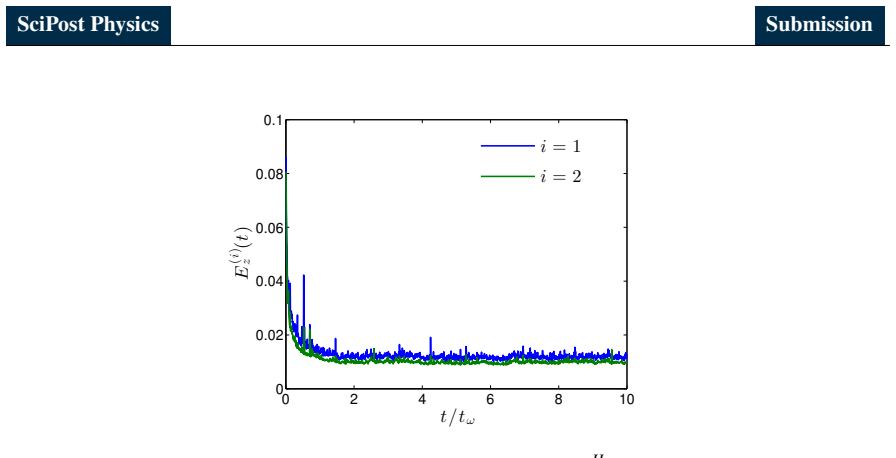
- [Sec. 4.1-4.2 and Appendix B.3] The reported validation does not actually test the exact SERs that are the paper's central claim. The analytic centre-of-mass model is obtained by imposing the Thomas-Fermi ansatz, linearizing in z(t), and explicitly neglecting all projector terms, as stated before Eq. (55) and again in the passage leading to Eq. (57). Appendix B.3 numerically monitors only two of the many projector contributions, qH_z and dz_epsilon, and argues that the remaining terms are smaller because they carry small damping rates. Consequently an algebraic error in, for example, q_gamma_z, d_gamma_z, or the diffusion-projector term D_epsilon_A in Eq. (70) would leave Figs. 2 and 3 essentially unchanged. The agreement in those figures therefore certifies the Thomas-Fermi/Ornstein-Uhlenbeck reduction against 1D SPGPE simulations, not the exact projector and noise-correlation structure claimed in the abstract and in Sec. 3.5.
- [Sec. 4, opening paragraphs] The chosen test system is one in which the underlying reservoir theory is acknowledged to be suspect: the paper states that the time-independent reservoir approximation violates Kohn's theorem for a harmonically trapped scalar BEC, and that c-field theory is currently best suited to systems with a time-independent high-energy reservoir. Since the 1D SPGPE simulation itself inherits the TIRA, the comparison in Figs. 2 and 3 is an internal consistency check between an approximate analytic reduction and the same approximate equation of motion, not a test of the SERs in a physically validated regime. This limitation is acknowledged in Sec. 5.2, but its consequences for the strength of the validation claim should be stated more prominently, and possible tests in a non-harmonic or two-component system where Kohn's theorem does not apply should be discussed.
- [Sec. 4.2, Figs. 2 and 3] The numerical comparison lacks error bars and a quantitative measure of agreement, yet the abstract and conclusions describe the agreement as 'close' and 'excellent.' The visible deviations at larger tau (Fig. 2) and the absence of statistical uncertainties from the 5000-trajectory ensemble make it difficult to assess whether the residual differences are consistent with projector-term neglect, finite averaging time, or an actual discrepancy in the reduced SERs. Reporting a quantitative fit statistic or confidence interval, especially for the tails of the correlation functions, would materially strengthen the validation claim.
minor comments (5)
- [Throughout] There are numerous typographical errors that should be corrected: 'analtyic' in the Introduction, 'interction' in Sec. 2.2.2, 'linterature' in Sec. 1, 'avarages' in Sec. 3.5(i), 'caonical' in Sec. 2.2.1, 'Futher' in Sec. 2.2, and 'to find the an SDE' in Sec. 3.2.
- [Sec. 3.1, Eq. (31)] The sentence describing the Stratonovich correction says 'the first term in the second line' but the term in question appears in the final term of Eq. (31) and in the second line of Eq. (32); please clarify the wording so the reader can identify which term is being named.
- [Sec. 4.2, footnote 7] The ergodic-averaging description is ambiguous: 'the remaining time interval t = 5t_omega' should specify the starting and ending times of the averaging window explicitly, for example 'from t = 5 t_omega to the end of the trajectory.'
- [Appendix B.3, Eq. (83)] The denominator |dz/dt| is said to be strictly non-zero for harmonic motion, but for the initial condition x(0)=p(0)=0 used in the simulations the centre-of-mass variable z(0)=0 and its initial rate of change is also zero; the reported relative magnitudes at early times should be interpreted with this in mind.
- [References] Reference [30] is missing the journal name and volume (it should be Phys. Rev. A 93, 063603), and reference [2] is incomplete as printed. Please check all references for completeness.
Circularity Check
No significant circularity: the SERs are derived from the stated SPGPE by Ito calculus, and the COM comparison is an internal-consistency check rather than a fitted prediction.
full rationale
The central derivation in Sec. 3 uses Ito's formula on the Ito-form SPGPE (Eq. (32)) to obtain the stochastic Ehrenfest relation for general functionals (Eq. (37)) and then the one-body reduction (Eq. (43)) and the main result Eqs. (50a)-(50e). This is a mathematical derivation from the stated SPGPE, not an assumption of the conclusion; no fitted parameter is renamed as a prediction. The COM application introduces the Thomas-Fermi ansatz (Eq. (53)), evaluates the SER integrals, and then neglects projector terms to obtain the Ornstein-Uhlenbeck system (57)-(58). The damping and diffusion coefficients (75) are computed from the SPGPE parameters, not matched to simulation data, and the simulation uses the same stated parameters. The comparison in Figs. 2-3 is therefore between an analytic solution of the reduced OU system and numerical solutions of the SPGPE from which the SERs were derived; this is an internal-consistency test. It does not independently certify the exact projector terms, and the paper itself only monitors qH_z and dz_epsilon in Appendix B.3 while arguing the remaining projector terms are smaller because they carry damping-rate prefactors. That is a validation-strength limitation, not circularity, because the exact SERs are not reconstructed from the OU fits and no prediction is equivalent to an input by construction. The paper also candidly acknowledges the Kohn's-theorem / time-independent-reservoir limitation in Sec. 4, which further limits external reach but does not make the derivation circular. Self-citations to [10], [18], [21] supply the underlying SPGPE framework, but the equations are restated in the paper, so the derivation chain is self-contained. No circular step can be exhibited.
Assumptions & free parameters
free parameters (1)
- Simulation and reservoir parameters =
gamma = 0.001, M = 0.0005 a_omega^2, T = 500 hbar omega/k_B, mu = 100 hbar omega, epsilon_c = 250 hbar omega
assumptions (5)
- domain assumption The SPGPE (Eq. 28) with Stratonovich interpretation is the correct equation of motion for the C-region field.
- domain assumption Truncated Wigner approximation: third-order functional derivatives in the Fokker-Planck equation are negligible.
- domain assumption Time-independent reservoir approximation (TIRA): the incoherent region is a static thermal reservoir.
- ad hoc to paper Thomas-Fermi ansatz, Eq. (53), captures the center-of-mass motion.
- ad hoc to paper Projector cutoff terms are small and can be neglected in the analytic solution.
Cite this review
Pith. "Pith review of Dynamics of Hot Bose-Einstein Condensates: stochastic Ehrenfest relations for number and energy damping." pith.science (2026). https://pith.science/paper/4IVZJYG7
@misc{pith2026190805809,
  author       = {Pith},
  title        = {Pith review of: Dynamics of Hot Bose-Einstein Condensates: stochastic Ehrenfest relations for number and energy damping},
  year         = {2026},
  howpublished = {\url{https://pith.science/paper/4IVZJYG7}},
  note         = {Machine review of arXiv:1908.05809}
}
read the original abstract
Describing partially-condensed Bose gases poses a long-standing theoretical challenge. We present exact stochastic Ehrenfest relations for the stochastic projected Gross-Pitaevskii equation, including both number and energy damping mechanisms, and all projector terms that arise from the energy cutoff separating system from reservoir. We test the theory by applying it to the centre of mass fluctuations of a harmonically trapped prolate system, finding close agreement between c-field simulations and analytical results. The formalism lays the foundation to analytically explore experimentally accessible hot Bose-Einstein condensates.
Figures

Figures from the paper (1 more)
Reference graph
Works this paper leans on
-
[1]
J. R. Anglin and W. Ketterle, Bose-Einstein condensation of atomic gases , Nature 416(6877), 211 (2002), doi:10.1038/416211a
doi:10.1038/416211a 2002
-
[2]
J. R. Anglin and W. H. Zurek, Vortices in the Wake of Rapid Bose-Einstein Condensation, Phys. Rev. Lett. 83(9), 1707 (1999), doi:10.1103/PhysRevLett.83.1707
-
[3]
C. N. Weiler, T. W. Neely, D. R. Scherer, A. S. Bradley, M. J. Davis and B. P. Anderson, Spon- taneous vortices in the formation of Bose–Einstein condensates, Nature 455(7215), 948 (2008), doi:10.1038/nature07334
-
[4]
E. Zaremba, T. Nikuni and A. Gri ffin, Dynamics of Trapped Bose Gases at Finite Temperatures, Journal of Low Temperature Physics 116(3-4), 277 (1999), doi:10.1023/A:1021846002995
-
[5]
B. Jackson and E. Zaremba, Quadrupole Collective Modes in Trapped Finite- Temperature Bose-Einstein Condensates , Physical Review Letters 88(18), 180402 (2002), doi:10.1103/PhysRevLett.88.180402
-
[6]
M. J. Steel, M. K. Olsen, L. I. Plimak, P. D. Drummond, S. M. Tan, M. J. Collett, D. F. Walls and R. Graham, Dynamical quantum noise in trapped Bose-Einstein condensates, Phys. Rev. A 58(6), 4824 (1998), doi:10.1103/PhysRevA.58.4824
-
[7]
C. W. Gardiner and P. Zoller, Quantum Noise, Springer, 2nd edn. (1999)
work page 1999
-
[8]
N. P. Proukakis and B. Jackson, Finite-temperature models of Bose–Einstein condensation, J. Phys. B: At. Mol. Opt. Phys. 41(20), 203002 (2008), doi:10.1088/0953-4075/41/20/203002
Show all 47 references
-
[9]
P. B. Blakie, A. S. Bradley, M. J. Davis, R. J. Ballagh and C. W. Gardiner, Dynamics and statistical mechanics of ultra-cold Bose gases using c-field techniques , Advances in Physics 57(5), 363 (2008), doi:10.1080/00018730802564254
2008 doi
-
[10]
C. W. Gardiner and M. J. Davis, The stochastic Gross–Pitaevskii equation: II , J. Phys. B: At. Mol. Opt. Phys. 36(23), 4731 (2003), doi:10.1088/0953-4075/36/23/010
2003 doi
-
[11]
A. S. Bradley, C. W. Gardiner and M. J. Davis, Bose-Einstein condensation from a rotating thermal cloud: Vortex nucleation and lattice formation , Phys. Rev. A 77(3), 033616 (2008), doi:10.1103/physreva.77.033616
2008 doi
-
[12]
S. J. Rooney, P. B. Blakie and A. S. Bradley, Numerical method for the stochastic projected Gross-Pitaevskii equation , Phys. Rev. E 89(1), 013302 (2014), doi:10.1103/PhysRevE.89.013302
2014 doi
-
[13]
S. J. Rooney, P. B. Blakie and A. S. Bradley, Stochastic projected Gross-Pitaevskii equation , Phys. Rev. A 86(5), 053634 (2012), doi:10.1103/PhysRevA.86.053634
2012 doi
-
[14]
A. S. Bradley and P. B. Blakie, Stochastic projected Gross-Pitaevskii equation for spinor and multicomponent condensates , Phys. Rev. A 90(2), 023631 (2014), doi:10.1103/PhysRevA.90.023631. 25 SciPost Physics Submission
2014 doi
-
[15]
C. W. Gardiner and P. Zoller, Quantum kinetic theory. III. Quantum kinetic mas- ter equation for strongly condensed trapped systems , Phys. Rev. A 58(1), 536 (1998), doi:10.1103/PhysRevA.58.536
1998 doi
-
[16]
M. J. Davis, S. A. Morgan and K. Burnett, Simulations of Bose Fields at Finite Temperature , Phys. Rev. Lett. 87(16), 160402 (2001), doi:10.1103/PhysRevLett.87.160402
2001 doi
-
[17]
S. J. Rooney, T. W. Neely, B. P. Anderson and A. S. Bradley, Persistent-current formation in a high-temperature Bose-Einstein condensate: An experimental test for classical-field theory , Phys. Rev. A 88(6), 063620 (2013), doi:10.1103/PhysRevA.88.063620
2013 doi
-
[18]
A. S. Bradley, S. J. Rooney and R. G. McDonald, Low-dimensional stochastic projected Gross- Pitaevskii equation, Phys. Rev. A 92(3), 033631 (2015), doi:10.1103/PhysRevA.92.033631
2015 doi
-
[19]
R. G. McDonald and A. S. Bradley, Reservoir interactions during Bose-Einstein condensation: Modified critical scaling in the Kibble-Zurek mechanism of defect formation, Phys. Rev. A92(3), 033616 (2015), doi:10.1103/PhysRevA.92.033616
2015 doi
-
[20]
Ehrenfest, Bemerkung ¨ uber die angen¨ aherte G¨ ultigkeit der klassischen Mechanik innerhalb der Quantenmechanik, Z
P. Ehrenfest, Bemerkung ¨ uber die angen¨ aherte G¨ ultigkeit der klassischen Mechanik innerhalb der Quantenmechanik, Z. Phys. 45(7-8), 455 (1927)
1927
-
[21]
A. S. Bradley, P. B. Blakie and C. W. Gardiner, Properties of the stochastic Gross–Pitaevskii equation: finite temperature Ehrenfest relations and the optimal plane wave representation , J. Phys. B: At. Mol. Opt. Phys. 38(23), 4259 (2005), doi:10.1088/0953-4075/38/23/008
2005 doi
-
[22]
Dalfovo, S
F. Dalfovo, S. Giorgini, L. P. Pitaevskii and S. Stringari, Theory of Bose-Einstein condensation in trapped gases, Rev. Mod. Phys. 71(3), 463 (1999), doi:10.1103/RevModPhys.71.463
1999 doi
-
[23]
B. M. Caradoc-Davies, Vortex Dynamics in Bose-Einstein Condensates, Ph.D. thesis, University of Otago (2000)
2000
-
[24]
Norrie, A Classical Field Treatment of Colliding Bose-Einstein Condensates , Ph.D
A. Norrie, A Classical Field Treatment of Colliding Bose-Einstein Condensates , Ph.D. thesis, University of Otago (2005)
2005
-
[25]
W. H. Zurek, Decoherence, chaos, quantum-classical correspondence, and the algorithmic ar- row of time, Physica Scripta T76(1), 186 (1998), doi:10.1238/physica.topical.076a00186
1998 doi
-
[26]
C. W. Gardiner, Stochastic Methods, Springer, 4th edition edn. (2009)
2009
-
[27]
Pietraszewicz, E
J. Pietraszewicz, E. Witkowska and P. Deuar, Continuum of classical-field ensembles in Bose gases from canonical to grand canonical and the onset of their equivalence, Physical Review A 96(3), 033612 (2017), doi:10.1103/PhysRevA.96.033612
2017 doi
-
[28]
Pietraszewicz and P
J. Pietraszewicz and P. Deuar, Classical fields in the one-dimensional Bose gas: Applica- bility and determination of the optimal cuto ff, Physical Review A 98(2), 023622 (2018), doi:10.1103/PhysRevA.98.023622
2018 doi
-
[29]
S. J. Rooney, A. S. Bradley and P. B. Blakie, Decay of a quantum vortex: Test of nonequi- librium theories for warm Bose-Einstein condensates , Phys. Rev. A 81(2), 023630 (2010), doi:10.1103/PhysRevA.81.023630. 26 SciPost Physics Submission
2010 doi
-
[30]
S. J. Rooney, A. J. Allen, U. Z ¨ulicke, N. P. Proukakis and A. S. Bradley, Reservoir interac- tions of a vortex in a trapped three-dimensional Bose-Einstein condensate93(6), 063603 (2016), doi:10.1103/PhysRevA.93.063603
2016 doi
-
[31]
Opanchuk and P
B. Opanchuk and P. D. Drummond, Functional Wigner representation of quantum dynam- ics of Bose-Einstein condensate , Journal of Mathematical Physics 54(4), 042107 (2013), doi:10.1063/1.4801781
2013 doi
-
[32]
H. T. C. Stoof, Coherent Versus Incoherent Dynamics During Bose-Einstein Conden- sation in Atomic Gases , Journal of Low Temperature Physics 114(1-2), 11 (1999), doi:10.1023/A:1021897703053
1999 doi
-
[33]
S. P. Cockburn and N. P. Proukakis, The stochastic Gross-Pitaevskii equation and some appli- cations, Laser Physics 19(4), 558 (2009), doi:10.1134/S1054660X09040057
2009 doi
-
[34]
S. P. Cockburn, H. E. Nistazakis, T. P. Horikis, P. G. Kevrekidis, N. P. Proukakis and D. J. Frantzeskakis, Matter-Wave Dark Solitons: Stochastic versus Analytical Results , Physical Re- view Letters 104(17), 174101 (2010), doi:10.1103/PhysRevLett.104.174101
2010 doi
-
[35]
S. P. Cockburn, A. Negretti, N. P. Proukakis and C. Henkel, Comparison between micro- scopic methods for finite-temperature Bose gases , Physical Review A 83(4), 043619 (2011), doi:10.1103/PhysRevA.83.043619
2011 doi
-
[36]
S. P. Cockburn, H. E. Nistazakis, T. P. Horikis, P. G Kevrekidis, N. P Proukakis and D. J Frantzeskakis, Fluctuating and dissipative dynamics of dark solitons in quasicondensates , Physical Review A 84(4), 043640 (2011), doi:10.1103/PhysRevA.84.043640
2011 doi
-
[37]
Gallucci, S
D. Gallucci, S. P. Cockburn and N. P. Proukakis, Phase coherence in quasicondensate exper- iments: An ab initio analysis via the stochastic Gross-Pitaevskii equation , Physical Review A 86(1), 013627 (2012), doi:10.1103/PhysRevA.86.013627
2012 doi
-
[38]
R. A. Duine and H. T. C. Stoof, Stochastic dynamics of a trapped Bose-Einstein condensate , Physical Review A 65(1), 25 (2001), doi:10.1103/PhysRevA.65.013603
2001 doi
-
[39]
R. G. McDonald and A. S. Bradley, Brownian motion of a matter-wave bright soliton moving through a thermal cloud of distinct atoms , Phys. Rev. A 93(6), 063604 (2016), doi:10.1103/PhysRevA.93.063604
2016 doi
-
[40]
Kumar, S
A. Kumar, S. Eckel, F. Jendrzejewski and G. K. Campbell, Temperature-induced decay of persistent currents in a superfluid ultracold gas , Physical Review A 95(2), 021602 (2017), doi:10.1103/PhysRevA.95.021602
2017 doi
-
[41]
M. J. Edmonds, K. L. Lee and N. P. Proukakis, Kinetic model of trapped finite-temperature bi- nary condensates, Physical Review A91(1), 011602 (2015), doi:10.1103/PhysRevA.91.011602
2015 doi
-
[42]
Jau ffred, R
F. Jau ffred, R. Onofrio and B. Sundaram, Simulating sympathetic cooling of atomic mixtures in nonlinear traps, Physics Letters A 381(34), 2783 (2017), doi:10.1016/j.physleta.2017.06.046
2017 doi
-
[43]
Y . Liu, E. Gomez, S. Maxwell, L. Turner, E. Tiesinga and P. Lett, Number Fluctuations and Energy Dissipation in Sodium Spinor Condensates , Physical Review Letters 102(22), 225301 (2009), doi:10.1103/PhysRevLett.102.225301. 27 SciPost Physics Submission
2009 doi
-
[44]
T. W. Neely, A. S. Bradley, E. C. Samson, S. J. Rooney, E. M. Wright, K. J. H. Law, R. Carretero- Gonz´alez, P. G. Kevrekidis, M. J. Davis and B. P. Anderson,Characteristics of Two-Dimensional Quantum Turbulence in a Compressible Superfluid , Phys. Rev. Lett. 111(23), 235301 (2...
2013 doi
-
[45]
Navon, A
N. Navon, A. L. Gaunt, R. P. Smith and Z. Hadzibabic, Emergence of a turbulent cascade in a quantum gas, Nature 539(7627), 72 (2016), doi:10.1038/nature20114
2016 doi
-
[46]
Gauthier, M
G. Gauthier, M. T. Reeves, X. Yu, A. S. Bradley, M. A. Baker, T. A. Bell, H. Rubinsztein-Dunlop, M. J. Davis and T. W. Neely,Giant vortex clusters in a two-dimensional quantum fluid, Science 364(6447), 1264 (2019), doi:10.1126/science.aat5718
2019 doi
-
[47]
S. P. Johnstone, A. J. Groszek, P. T. Starkey, C. J. Billington, T. P. Simula and K. Helmerson,Evo- lution of large-scale flow from turbulence in a two-dimensional superfluid , Science 364(6447), 1267 (2019), doi:10.1126/science.aat5793. 28
2019 doi
Reviewed August 14, 2026 · model on record in the stance chip above.
Discussion (0). Continue with ORCID to comment.