REVIEW 4 major objections 4 minor 50 references
Learning Deep Representations by Mutual Information for Person Re-identification
T0 review · 4 major / 4 minor · reviewed 2026-08-14 · deepseek-v4-flash
Pith's one-line read The paper claims that maximizing mutual information between the input image and the encoder output improves person re-identification features, and reports consistent gains on three benchmarks plus a label-free transfer model.
desk verdict Straightforward DIM-for-ReID extension with consistent small gains, but the implemented loss is feature-feature contrastive rather than input-output MI. read the letter →
The pith
A machine-rendered reading of the paper's core claim, the machinery that carries it, and where it could break.
The reading
What carries the argument
The carrying object is the Deep InfoMax (DIM) network, a four-layer fully connected critic with a sigmoid output that is trained to tell real input-feature pairs from fake ones; its loss is a variational Jensen-Shannon divergence between the joint distribution $p(z|x)\tilde{p}(x)$ and the product $p(z)\tilde{p}(x)$. In the paper's implementation, the raw input image is replaced by the encoder output, so the critic actually compares feature-feature pairs. Global-DIM applies one such critic to the whole-image feature; Local-DIM applies six shared critics to the PCB part features; TF-DIM reuses the Local-DIM setup for label-free fine-tuning on an unlabeled target dataset.
What would settle it
Implement the Global-DIM loss exactly as written and run a permutation check: encode a fixed set of images, then feed the discriminator pairs where the raw image on the positive side changes but the encoder output stays fixed. If the loss and critic scores are unchanged, the objective does not depend on the input image and cannot be the input-output mutual information in Eq. (1).
Extended reading notes
Core claim
The central claim is that maximizing mutual information between the input pedestrian image and the encoder's output yields more discriminative representations than optimizing classification or metric losses alone. The paper states this directly: the DIM network maximizes MI between input and encoder output, and the resulting Global-DIM and Local-DIM models achieve the paper's best results on the three benchmarks. In the paper's own formulation, the objective is a variational Jensen-Shannon divergence estimated by a four-layer fully connected critic, with random sampling of negative pairs; the full loss is $L_{cls} + \beta L_{DIM}$ for global features and $L_P + \lambda \sum_m L_{DIM}$ for the six PCB part features. The paper also asserts that the label-free nature of the DIM loss makes it a ready solution for cross-dataset unsupervised re-identification.
Load-bearing premise
The load-bearing premise is that the encoder's output $z$ can be used in place of the raw image $x$ in the mutual-information discriminator, so the loss actually optimized is still the input-output mutual information of Eq. (1) rather than a feature-feature contrastive objective.
Editorial extensions
If this is right
- If the central claim holds, any re-identification encoder trained with a classification loss could receive the DIM loss as a plug-in regularizer and gain accuracy without additional labels.
- Global-DIM's gains over IDE should transfer to stronger global baselines, since the loss targets a different signal than cross-entropy.
- Local-DIM's larger gains on part features suggest the mutual-information signal is most useful when feature resolution is high enough to preserve per-image details.
- TF-DIM provides a label-free fine-tuning step that can be layered on top of existing unsupervised domain-adaptation methods.
- The random-sampling result means the DIM loss does not require identity labels even in the supervised setting, so it naturally extends to settings where labels are noisy or incomplete.
Reading between the lines
- Reading: Section VII says the input pedestrians $x$ and $x'$ are reduced to $z$ and $z'$ through the encoder before forming pairs. If that is literal, the positive sample is $(z,z)$ and the objective is a feature-feature contrastive loss, not the input-output mutual information of Eq. (1); the reported gains would then be evidence for feature-level regularization, not for MI theory per se.
- Testable extension: compare the Global-DIM loss against a standard instance-discrimination loss (same-image positive, different-image negatives) at matched hyperparameters; matched accuracy would suggest the MI framing is not the active ingredient.
- Combination: since TF-DIM gains are small compared with style-transfer domain adaptation, the label-free DIM loss should combine with pseudo-label clustering; the two address complementary failure modes.
- Neighboring problem: the same DIM critic could be applied to video-based re-identification or general image retrieval, where per-instance uniqueness matters more than class-level commonality.
Signed reviews
Editorial analysis
A structured set of objections, weighed in public.
Referee Report
Summary. The paper proposes adding a Deep InfoMax (DIM) loss to person re-identification (ReID) networks, supposedly maximizing the mutual information between input images and encoder outputs. Three variants are presented: Global-DIM built on an IDE/ResNet-50 baseline, Local-DIM built on a PCB part-based baseline, and TF-DIM for unsupervised cross-dataset transfer. Experiments on Market-1501, DukeMTMC-reID, and CUHK03 report consistent but mostly small gains over the respective baselines, and the transfer experiments show modest improvements over direct transfer.
Significance. If the central claim were supported, the idea of adding a label-free mutual-information regularizer to ReID feature learning would be a useful contribution, and the TF-DIM variant would offer a simple, cheap complement to existing unsupervised domain adaptation methods. The paper also provides a reasonably broad experimental comparison on three standard benchmarks. However, the significance is heavily undermined by an internal inconsistency: the implemented loss is not the mutual information claimed in Eq. (1), and the empirical evaluation is weakened by test-set-based hyperparameter selection and the absence of error bars. The reported gains therefore cannot currently be attributed to mutual-information maximization.
major comments (4)
- [Section VII, Eq. (9)] The DIM loss in Eq. (9) is defined with positive and negative pairs (x,z) and (x',z), where x is the raw pedestrian image. Section VII states that 'the input pedestrians x and x' are reduced to z and z' in practice through the global encoder network.' Consequently, the discriminator actually receives (z,z) and (z',z), so the optimized objective is a function only of encoder outputs. This is not the I(X;Z) of Eq. (1), and the paper supplies no derivation or inequality connecting this feature-feature contrastive objective to mutual information. The central theoretical motivation is therefore unsupported by the implementation.
- [Table VI] Table VI lists for the IDE row the four numbers 74.8, 86.4, 90.2, 55.4 under the DukeMTMC-reID and CUHK03 columns; Table I identifies these as Duke rank-1, rank-5, rank-10, and mAP. The same misalignment occurs for the Global-DIM row. This makes the state-of-the-art comparison unreliable and does not support the claim of achieving state-of-the-art results on these datasets.
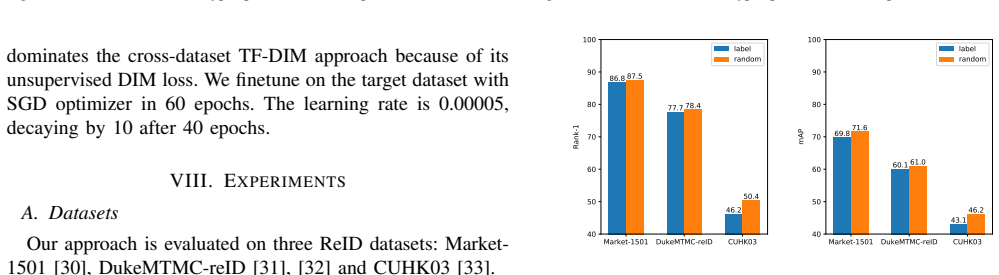
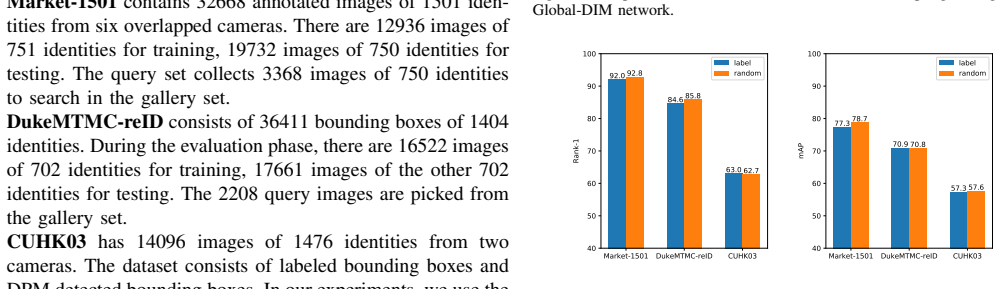
- [Section VIII-B, Figs. 5-6 and Tables I-II] The hyperparameters beta and lambda are selected by evaluating mAP and Rank-1 on the same datasets (Market-1501, DukeMTMC-reID, CUHK03) that are later used for the main results in Tables I and II. This is test-set-based model selection, and no held-out validation is provided. The reported gains, some as small as +0.4% in rank-1, are therefore not reliable evidence of the method's superiority.
- [Section VIII-B, Tables I-II] All experimental comparisons are reported as single numbers with no error bars, multiple runs, or significance tests. For example, the Market-1501 Local-DIM gain of +0.4% rank-1 in Table II is small relative to typical run-to-run variation for CNN-based ReID, so the statement that 'the experiments prove the superiority' is not statistically supported.
minor comments (4)
- [Eq. (4)] The reference for the Kullback-Leibler divergence is missing and appears as '[ ?]'.
- [Section III, paragraph after Eq. (9)] The sentence 'In order to perform the Deep InfoMax loss in eq.11' refers to Eq. (11), which is defined later in Section IV; the intended reference is likely Eq. (9).
- [Fig. 2] The caption and the text labels in Fig. 2 are cryptic (e.g., 'X Zm'); the structure of the DIM network would benefit from a clearer diagram and a description of the tensor shapes.
- [Table VII caption] The caption reads 'state-of-art' instead of 'state-of-the-art'.
Circularity Check
Section VII defines the DIM discriminator's input as the encoder output, so the loss actually trained is a feature-feature contrastive term, not the I(X;Z) of Eq. (1); the MI-theoretic claim is self-referential, while the empirical comparisons remain independent.
-
self definitional
[Section VII, 'Training for Global-DIM network'; cf. Eq. (9) and Section III]
"Because the input pedestrians and feature representations mismatch in size, the input pedestrians x and x′ are reduced to z and z′ in practice through the global encoder network. z′ is the output of the global encoder network corresponding to the input x′."
Equation (9) defines the DIM loss on positive pairs (x,z) and negative pairs (x′,z), where x is the raw pedestrian image. Section VII substitutes z for x and z′ for x′, so the discriminator actually receives (z,z) as the positive pair and (z′,z) as the negative pair. The variable called 'input pedestrian' is thereby defined as the encoder output, making the trained objective a function of Z alone rather than an estimator of I(X;Z) from Eq. (1). No data-processing inequality or other bound is supplied connecting this feature-feature contrastive loss to the stated mutual information, so the paper's central claim that the DIM network 'maximize[s] the mutual information between the input image and encoder output' holds only by renaming the output as the input.
full rationale
The paper is evaluated on standard external benchmarks (Market-1501, DukeMTMC-reID, CUHK03), and its accuracy gains are not derived by algebraic construction from the mutual-information formula; they are empirical results. Hyperparameters beta and lambda are tuned on the same datasets reported later, which weakens the out-of-sample force of the comparisons, but that is standard model selection rather than a circular reduction. The one genuine circularity is the Section VII implementation detail: the DIM discriminator's 'input' is replaced by the encoder output, so the loss actually optimized is a feature-feature contrastive objective, not the input-output mutual information defined in Eq. (1). Because the paper's headline theoretical statement and its interpretation of the experimental tables rest on this substitution, the MI claim is self-referential by construction. However, the state-of-the-art comparisons and the reported improvements are independent empirical evidence, so the paper is not wholly circular; hence a moderate score of 5 rather than 8-10.
Assumptions & free parameters
free parameters (3)
- beta =
0.02
- lambda =
0.01
- alpha =
not specified
assumptions (4)
- standard math The f-GAN variational lower bound in Eq. 7 correctly represents Jensen-Shannon divergence when optimized over D_w.
- domain assumption Maximizing the JSD surrogate in Eq. 6 is an adequate substitute for maximizing mutual information.
- domain assumption Random pairs (x', z) sampled from a batch are valid negative samples from the marginal p(z)p(x).
- ad hoc to paper The encoder output z can replace the raw input image x as the first argument to the DIM discriminator.
Cite this review
Pith. "Pith review of Learning Deep Representations by Mutual Information for Person Re-identification." pith.science (2026). https://pith.science/paper/U3PDVPYC
@misc{pith2026190805860,
  author       = {Pith},
  title        = {Pith review of: Learning Deep Representations by Mutual Information for Person Re-identification},
  year         = {2026},
  howpublished = {\url{https://pith.science/paper/U3PDVPYC}},
  note         = {Machine review of arXiv:1908.05860}
}
read the original abstract
Most existing person re-identification (ReID) methods have good feature representations to distinguish pedestrians with deep convolutional neural network (CNN) and metric learning methods. However, these works concentrate on the similarity between encoder output and ground-truth, ignoring the correlation between input and encoder output, which affects the performance of identifying different pedestrians. To address this limitation, We design a Deep InfoMax (DIM) network to maximize the mutual information (MI) between the input image and encoder output, which doesn't need any auxiliary labels. To evaluate the effectiveness of the DIM network, we propose end-to-end Global-DIM and Local-DIM models. Additionally, the DIM network provides a new solution for cross-dataset unsupervised ReID issue as it needs no extra labels. The experiments prove the superiority of MI theory on the ReID issue, which achieves the state-of-the-art results.
Figures


Figures from the paper (5 more)



Reference graph
Works this paper leans on
-
[1]
Person Re-identification: Past, Present and Future,
L. Zheng, Y . Yang, and A. G. Hauptmann, “Person Re-identification: Past, Present and Future,” 2016
work page 2016
-
[2]
Deep Representation Learning with Part Loss for Person Re-Identification,
H. Yao, S. Zhang, Y . Zhang, J. Li, and Q. Tian, “Deep Representation Learning with Part Loss for Person Re-Identification,” IEEE Transac- tions on Image Processing , 2017
work page 2017
-
[3]
A Siamese Long Short-Term Memory Architecture for Human Re-Identification
R. R. Varior, B. Shuai, J. Lu, D. Xu, and G. Wang, “A Siamese Long Short-Term Memory Architecture for Human Re-Identification,” jul 2016. [Online]. Available: http://arxiv.org/abs/1607.08381
work page Pith review arXiv 2016
-
[4]
Deep Feature Learning with Relative Distance Comparison for Person Re-identification
S. Ding, L. Lin, G. Wang, and H. Chao, “Deep Feature Learning with Relative Distance Comparison for Person Re-identification,” dec 2015. [Online]. Available: http://arxiv.org/abs/1512.03622
work page Pith review arXiv 2015
-
[5]
Beyond Part Models: Person Retrieval with Refined Part Pooling (and a Strong Convolutional Baseline)
Y . Sun, L. Zheng, Y . Yang, Q. Tian, and S. Wang, “Beyond Part Models: Person Retrieval with Refined Part Pooling (and a Strong Convolutional Baseline),” nov 2017. [Online]. Available: http://arxiv.org/abs/1711.09349
work page Pith review arXiv 2017
-
[6]
Unsupervised Person Re-identification: Clustering and Fine-tuning,
H. Fan, L. Zheng, and Y . Yang, “Unsupervised Person Re-identification: Clustering and Fine-tuning,” 2017
work page 2017
-
[7]
W. Deng, L. Zheng, Q. Ye, G. Kang, Y . Yang, and J. Jiao, “Image-Image Domain Adaptation with Preserved Self-Similarity and Domain-Dissimilarity for Person Re-identification,” nov 2017. [Online]. Available: http://arxiv.org/abs/1711.07027
work page Pith review arXiv 2017
-
[8]
Camera Style Adaptation for Person Re-identification,
Z. Zhong, L. Zheng, Z. Zheng, S. Li, and Y . Yang, “Camera Style Adaptation for Person Re-identification,” nov 2017. [Online]. Available: http://arxiv.org/abs/1711.10295 8
arXiv 2017
Show all 50 references
-
[9]
GLAD: Global-Local- Alignment Descriptor for Pedestrian Retrieval,
L. Wei, S. Zhang, H. Yao, W. Gao, and Q. Tian, “GLAD: Global-Local- Alignment Descriptor for Pedestrian Retrieval,” 2017
2017
-
[10]
Pose-driven Deep Convolutional Model for Person Re-identification,
C. Su, J. Li, S. Zhang, J. Xing, W. Gao, and Q. Tian, “Pose-driven Deep Convolutional Model for Person Re-identification,” sep 2017. [Online]. Available: http://arxiv.org/abs/1709.08325
2017 arXiv
-
[11]
Show, Attend and Tell: Neural Image Caption Generation with Visual Attention,
K. Xu, J. Ba, R. Kiros, K. Cho, A. Courville, R. Salakhutdinov, R. Zemel, and Y . Bengio, “Show, Attend and Tell: Neural Image Caption Generation with Visual Attention,” 2015
2015
-
[12]
HydraPlus-Net: Attentive Deep Features for Pedestrian Analysis,
X. Liu, H. Zhao, M. Tian, L. Sheng, J. Shao, S. Yi, J. Yan, and X. Wang, “HydraPlus-Net: Attentive Deep Features for Pedestrian Analysis,” sep
-
[13]
Deeply-Learned Part-Aligned Representations for Person Re-Identification,
L. Zhao, X. Li, J. Wang, and Y . Zhuang, “Deeply-Learned Part-Aligned Representations for Person Re-Identification,” jul 2017. [Online]. Available: http://arxiv.org/abs/1707.07256
2017 arXiv
-
[14]
Learning deep representations by mutual information estimation and maximization,
R. D. Hjelm, A. Fedorov, S. Lavoie-Marchildon, K. Grewal, P. Bachman, A. Trischler, and Y . Bengio, “Learning deep representations by mutual information estimation and maximization,” 2018
2018
-
[15]
Person Re-identification by Unsupervised 1 Graph Learning,
E. Kodirov, T. Xiang, Z. Fu, and S. Gong, “Person Re-identification by Unsupervised 1 Graph Learning,” Tech. Rep
-
[16]
Cross-view Asymmetric Metric Learning for Unsupervised Person Re-identification,
H.-X. Yu, A. Wu, and W.-S. Zheng, “Cross-view Asymmetric Metric Learning for Unsupervised Person Re-identification,” aug 2017. [Online]. Available: http://arxiv.org/abs/1708.08062
2017 arXiv
-
[17]
Unpaired Image-to-Image Translation using Cycle-Consistent Adversarial Networks,
J.-Y . Zhu, T. Park, P. Isola, and A. A. Efros, “Unpaired Image-to-Image Translation using Cycle-Consistent Adversarial Networks,” mar 2017. [Online]. Available: http://arxiv.org/abs/1703.10593
2017 arXiv
-
[18]
Self-Organization in a Perceptual Network,
R. Linsker, “Self-Organization in a Perceptual Network,” Tech. Rep
-
[19]
An information-maximisation approach t o blind separation and blind deconvolution,
A. J. Bell and T. J. Sejnowski, “An information-maximisation approach t o blind separation and blind deconvolution,” Tech. Rep
-
[20]
Invariant Information Clustering for Unsupervised Image Classification and Segmentation,
X. Ji, J. F. Henriques, and A. Vedaldi, “Invariant Information Clustering for Unsupervised Image Classification and Segmentation,” 2018
2018
-
[21]
Representation Learning with Contrastive Predictive Coding,
A. van den Oord, Y . Li, and O. Vinyals, “Representation Learning with Contrastive Predictive Coding,” 2018
2018
-
[22]
MINE: Mutual Information Neural Estimation,
M. I. Belghazi, A. Baratin, S. Rajeswar, S. Ozair, Y . Bengio, A. Courville, and R. D. Hjelm, “MINE: Mutual Information Neural Estimation,” 2018
2018
-
[23]
Jensen-Shannon divergence and Hilbert space embedding,
B. Fuglede and F. Topsoe, “Jensen-Shannon divergence and Hilbert space embedding,” 2004
2004
-
[24]
f-GAN: Training Generative Neural Samplers using Variational Divergence Minimization,
S. Nowozin, B. Cseke, and R. Tomioka, “f-GAN: Training Generative Neural Samplers using Variational Divergence Minimization,” 2016
2016
-
[25]
Deep residual learning for image recognition,
K. He, X. Zhang, S. Ren, and J. Sun, “Deep residual learning for image recognition,” in Proceedings of the IEEE Computer Society Conference on Computer Vision and Pattern Recognition , 2016
2016
-
[26]
ImageNet: A large-scale hierarchical image database,
R. Socher, J. Deng, W. Dong, R. Socher, L.-J. Li, K. Li, and L. Fei- Fei, “ImageNet: A large-scale hierarchical image database,” Tech. Rep., 2009
2009
-
[27]
Generalizing A Person Retrieval Model Hetero-and Homogeneously,
Z. Zhong, L. Zheng, S. Li, and Y . Yang, “Generalizing A Person Retrieval Model Hetero-and Homogeneously,” Tech. Rep. [Online]. Available: https://github.com/zhunzhong07/HHL
-
[28]
Batch Normalization: Accelerating Deep Network Training by Reducing Internal Covariate Shift,
S. Ioffe and C. Szegedy, “Batch Normalization: Accelerating Deep Network Training by Reducing Internal Covariate Shift,” 2015
2015
-
[29]
Dropout: A Simple Way to Prevent Neural Networks from Overfitting,
N. Srivastava, G. Hinton, A. Krizhevsky, and R. Salakhutdinov, “Dropout: A Simple Way to Prevent Neural Networks from Overfitting,” Tech. Rep., 2014
2014
-
[30]
Scalable Person Re-identification: A Benchmark,
L. Zheng, L. Shen, L. Tian, S. Wang, J. Wang, and Q. Tian, “Scalable Person Re-identification: A Benchmark,” Tech. Rep. [Online]. Available: http://www.liangzheng.com.cn
-
[31]
Unlabeled Samples Generated by GAN Improve the Person Re-identification Baseline in vitro,
Z. Zheng, L. Zheng, and Y . Yang, “Unlabeled Samples Generated by GAN Improve the Person Re-identification Baseline in vitro,” jan 2017. [Online]. Available: http://arxiv.org/abs/1701.07717
2017 arXiv
-
[32]
Performance Measures and a Data Set for Multi-Target, Multi-Camera Tracking,
E. Ristani, F. Solera, R. S. Zou, R. Cucchiara, and C. Tomasi, “Performance Measures and a Data Set for Multi-Target, Multi-Camera Tracking,” sep 2016. [Online]. Available: http://arxiv.org/abs/1609.01775
2016 arXiv
-
[33]
DeepReID: Deep Filter Pairing Neural Network for Person Re-Identification,
W. Li, R. Z. Tong, and X. X. Wang, “DeepReID: Deep Filter Pairing Neural Network for Person Re-Identification,” Tech. Rep
-
[34]
Re-ranking Person Re-identification with k-reciprocal Encoding,
Z. Zhong, L. Zheng, D. Cao, and S. Li, “Re-ranking Person Re-identification with k-reciprocal Encoding,” jan 2017. [Online]. Available: http://arxiv.org/abs/1701.08398
2017 arXiv
-
[35]
Scalable Metric Learning via Weighted Approximate Rank Component Analysis,
C. Jose and F. Fleuret, “Scalable Metric Learning via Weighted Approximate Rank Component Analysis,” mar 2016. [Online]. Available: http://arxiv.org/abs/1603.00370
2016 arXiv
-
[36]
A Systematic Evaluation and Benchmark for Person Re-Identification: Features, Metrics, and Datasets,
S. Karanam, M. Gou, Z. Wu, A. Rates-Borras, O. Camps, and R. J. Radke, “A Systematic Evaluation and Benchmark for Person Re-Identification: Features, Metrics, and Datasets,” may 2016. [Online]. Available: http://arxiv.org/abs/1605.09653
2016 arXiv
-
[37]
Looking beyond appearances: Synthetic training data for deep CNNs in re-identification,
I. B. Barbosa, M. Cristani, B. Caputo, A. Rognhaugen, and T. Theoharis, “Looking beyond appearances: Synthetic training data for deep CNNs in re-identification,” Computer Vision and Image Understanding , 2018
2018
-
[38]
SVDNet for Pedestrian Retrieval,
Y . Sun, L. Zheng, W. Deng, and S. Wang, “SVDNet for Pedestrian Retrieval,” mar 2017. [Online]. Available: http://arxiv.org/abs/1703. 05693
2017
-
[39]
Pedestrian Alignment Network for Large-scale Person Re-identification,
Z. Zheng, L. Zheng, and Y . Yang, “Pedestrian Alignment Network for Large-scale Person Re-identification,” 2018
2018
-
[40]
Deep Transfer Learning for Person Re-identification,
M. Geng, Y . Wang, T. Xiang, and Y . Tian, “Deep Transfer Learning for Person Re-identification,” nov 2016. [Online]. Available: http://arxiv.org/abs/1611.05244
2016 arXiv
-
[41]
Multiregion Bilinear Convolutional Neural Networks for Person Re-Identification,
E. Ustinova, Y . Ganin, and V . Lempitsky, “Multiregion Bilinear Convolutional Neural Networks for Person Re-Identification,” dec
-
[42]
Person Re-Identification by Deep Joint Learning of Multi-Loss Classification,
W. Li, X. Zhu, and S. Gong, “Person Re-Identification by Deep Joint Learning of Multi-Loss Classification,” may 2017. [Online]. Available: http://arxiv.org/abs/1705.04724
2017 arXiv
-
[43]
Person Re-Identification by Deep Learning Multi-Scale Representations,
Y . Chen, X. Zhu, and S. Gong, “Person Re-Identification by Deep Learning Multi-Scale Representations,” Tech. Rep
-
[44]
Person Re-identification by Local Maximal Occurrence Representation and Metric Learning,
S. Liao, Y . Hu, X. Zhu, and S. Z. Li, “Person Re-identification by Local Maximal Occurrence Representation and Metric Learning,” Tech. Rep
-
[45]
Random Erasing Data Augmentation,
Z. Zhong, L. Zheng, G. Kang, S. Li, and Y . Yang, “Random Erasing Data Augmentation,” 2017
2017
-
[46]
Person Transfer GAN to Bridge Domain Gap for Person Re-Identification,
L. Wei, S. Zhang, W. Gao, and Q. Tian, “Person Transfer GAN to Bridge Domain Gap for Person Re-Identification,” nov 2017. [Online]. Available: http://arxiv.org/abs/1711.08565
2017 arXiv
-
[47]
Unsupervised Cross-Dataset Transfer Learning for Person Re- identification,
P. Peng, T. Xiang, Y . Wang, M. Pontil, S. Gong, T. Huang, and Y . Tian, “Unsupervised Cross-Dataset Transfer Learning for Person Re- identification,” Tech. Rep
-
[48]
Transferable Joint Attribute- Identity Deep Learning for Unsupervised Person Re-Identification,
J. Wang, X. Zhu, S. Gong, and W. Li, “Transferable Joint Attribute- Identity Deep Learning for Unsupervised Person Re-Identification,” mar 2018. [Online]. Available: http://arxiv.org/abs/1803.09786
2018 arXiv
-
[2015]
Available: http://arxiv.org/abs/1512.05300
[Online]. Available: http://arxiv.org/abs/1512.05300
-
[2017]
Available: http://arxiv.org/abs/1709.09930
[Online]. Available: http://arxiv.org/abs/1709.09930
Reviewed August 14, 2026 · model on record in the stance chip above.
Discussion (0). Continue with ORCID to comment.