REVIEW 3 major objections 4 minor 26 references
Polar Codes: Analysis and Construction Based on Polar Spectrum
T0 review · 3 major / 4 minor · reviewed 2026-08-14 · deepseek-v4-flash
Pith's one-line read This paper claims that the block error probability of polar codes under successive cancellation decoding can be bounded by a weight spectrum of the code, and that this bound leads to explicit construction metrics.
desk verdict A genuinely new polar-spectrum framework with a sound enumeration algorithm, but the UBW/SUBW construction story leans on per-configuration SNR tuning that is not yet shown to be robust. read the letter →
The pith
A machine-rendered reading of the paper's core claim, the machinery that carries it, and where it could break.
The reading
What carries the argument
The load-bearing object is the polar subcode $D_N^{(i)}$, the set of codewords generated by input vectors whose first $i-1$ bits are $0$ and whose $i$-th bit is $1$; its weight distribution $A_N^{(i)}(d)$ is the polar spectrum. Each polarized channel corresponds to one such subcode, so the SC error bound becomes a spectrum calculation: the channel's contribution to BLER is a weighted count of codewords by Hamming weight. The computation uses two structural facts: the Plotkin decomposition of polar codes, and the duality $C_N^{(N+2-i)} = (C_N^{(i)})^\perp$ for $i \geq N/2+1$, which lets the algorithm obtain one subcode's weight distribution from its dual through the MacWilliams identities. This machinery converts a problem normally solved by iterative channel-tracking into an exact combinatorial count.
What would settle it
Find one code length and rate where every fixed $\alpha$ used in UBW/SUBW produces an information set whose simulated SC or SCL block error rate is worse than a standard iterative construction at the operating SNR, or show that the $\alpha$ reproducing the best information set changes with the channel, so that no channel-independent sequence exists.
Extended reading notes
Core claim
The central claim is Theorem 3: for a fixed length $N$, information set $A$, the block error probability under SC decoding satisfies $P_e(N,K,A) \leq \sum_{i\in A}\sum_d A_N^{(i)}(d)P_N^{(i)}(d)$, where $A_N^{(i)}(d)$ is the number of weight-$d$ codewords in the polar subcode $D_N^{(i)}$ and $P_N^{(i)}(d)$ is the pairwise error probability between the zero codeword and a weight-$d$ codeword. The paper derives $P_N^{(i)}(d)$ explicitly for the binary erasure, binary symmetric, and AWGN channels, and replaces it by $(Z(W))^d$ to obtain the looser union-Bhattacharyya bound. It then shows that the spectra can be enumerated exactly off-line: pairs of subcodes are dual, so their weight distributions are tied by the MacWilliams identities, and a recursive Plotkin-based algorithm computes all spectra for a fixed $N$ in $O(N^3)$ time. Taking logarithms of the UB bound gives the UBW metric, and retaining only the minimum-weight term gives SUBW; both are linear-time once the spectrum is known.
Load-bearing premise
The construction's claimed channel-independence rests on fixing one design signal-to-noise ratio $\alpha$ in the UBW/SUBW formulas; the simulations choose $\alpha$ separately for each code length and rate, so if no single $\alpha$ orders channels correctly across configurations the method's practical advantage over iterative construction is weakened.
Editorial extensions
If this is right
- Polar-code construction becomes a one-time combinatorial computation: enumerate spectra off-line, then select information bits by sorting UBW/SUBW values in linear time.
- The union-Bhattacharyya bound gives an analytical BLER estimate for SC decoding, so code performance can be predicted from the weight distribution without running density evolution or Monte Carlo simulation.
- Because the spectra for all information sets of a fixed length come from one enumeration, the same precomputation serves every code rate at that length.
- The reported SCL gains and the disappearance of the empirical construction's error floor imply that spectrum-based construction chooses information sets better matched to list decoding, not only SC decoding.
Reading between the lines
- The mechanism suggests a sharper, testable conjecture: information sets from UBW/SUBW are close to maximizing the minimum polar-subcode distance among early indices, and that property, not SNR tuning, drives the list-decoding gains.
- The same spectrum-bound framework should extend to polar codes with kernels other than the $2\times2$ matrix, since it needs only a Plotkin-type decomposition and subcode duality; a MacWilliams enumeration for generalized kernels would give explicit constructions there.
- If fixed-$\alpha$ ordering fails, a natural fallback is an $\alpha$-free partial order derived by comparing UBW curves as functions of SNR rather than at one design point.
Signed reviews
Editorial analysis
A structured set of objections, weighed in public.
Referee Report
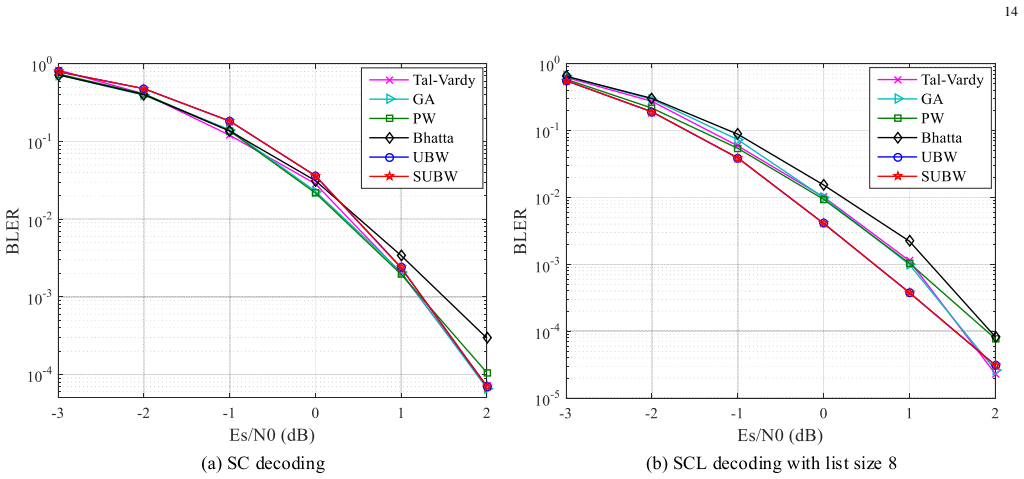
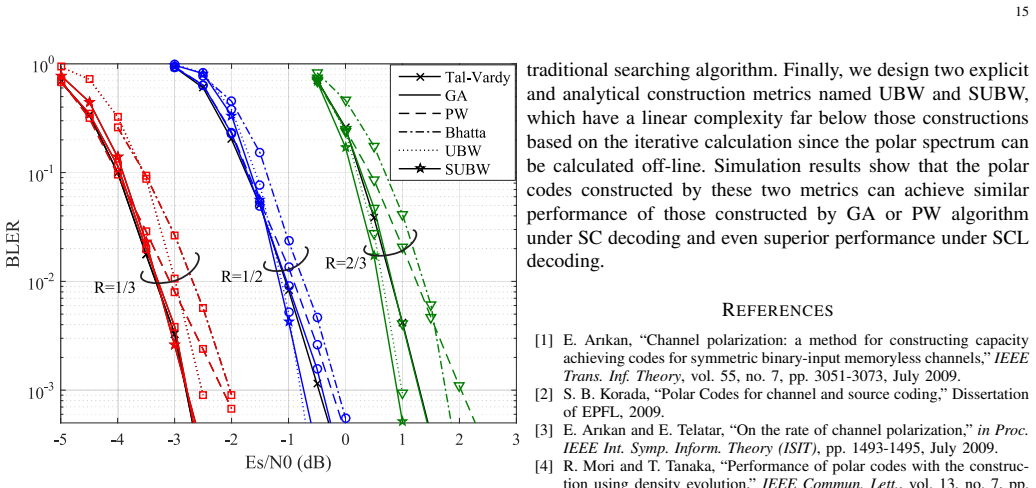
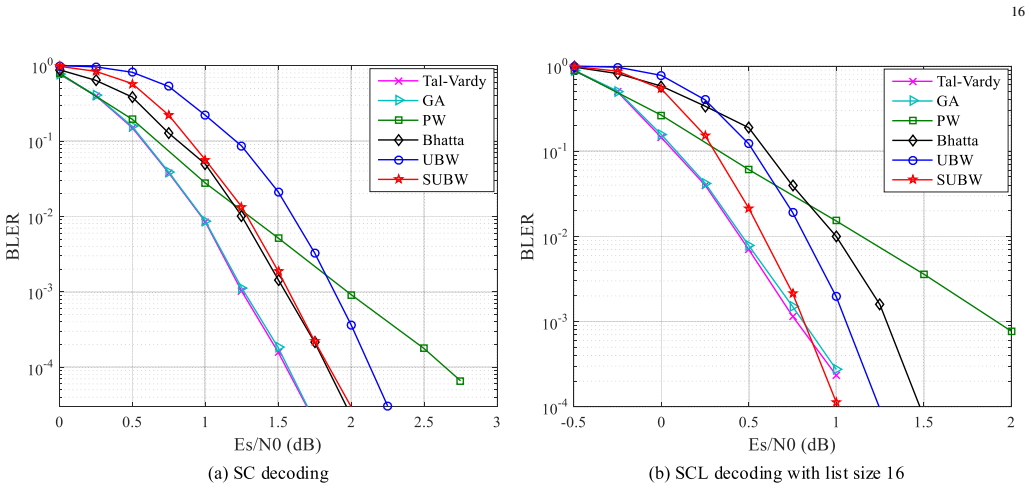
Summary. The paper introduces the polar spectrum, the weight distribution of a certain polar subcode associated with each polarized channel, and uses it as the basis for a framework to analyze and construct polar codes. The main theoretical results are a union bound (Theorem 3) and a union-Bhattacharyya (UB) bound (Theorem 6) on the block error probability under successive cancellation decoding, upper and lower bounds on the symmetric capacity of polarized channels (Theorem 7 and Eqs. (45)-(46)), and an iterative enumeration algorithm for the polar spectrum based on the MacWilliams identities (Algorithm 1). The paper then proposes two construction metrics, UBW and SUBW, derived from the UB bound, and reports simulations showing that these constructions achieve similar SC performance and superior SCL performance compared with Tal-Vardy, Gaussian approximation, and polarized-weight constructions for selected code lengths and rates.
Significance. If the polar-spectrum framework is accepted, it offers a useful analytic counterpart to iterative channel-reliability computations and a new way to interpret polarization through distance spectra. The paper has clear strengths: Theorem 3 is a genuine first-principles union bound with explicit PEP formulas for BEC, BSC, and AWGN (Theorems 4-5); Algorithm 1 is a concrete, polynomial-time enumeration procedure with an explicitly stated complexity; and the relation between polar subcodes and dual subcodes (Theorem 8, Proposition 6) is a clean algebraic observation. The contribution is conditional, however: the UBW/SUBW construction claims depend heavily on a design SNR that is tuned separately for each (N,R) configuration, and the passage from the UB bound to the construction metrics involves uncontrolled approximations. These issues do not invalidate the core bound framework but do undermine the paper's headline claim that UBW/SUBW are simple, channel-independent, and superior in SCL decoding.
major comments (3)
- [VI-B and Eqs. (54), (58)] The claimed channel-independence of the UBW and SUBW constructions is not supported by the reported experiments. In Section VI-B the design SNR α is set to 4 dB for N=128; to 1.5/4/4.5 dB for UBW and 1/3.5/4 dB for SUBW at N=1024 for R=1/3, 1/2, 2/3; and to 4.5/3.5 dB at N=4096, R=2/3. Because the term −d·α in (54) reweights the spectrum, changing α can change the argmax in UBW and the relative ordering in SUBW. Without a stability analysis over α, a single fixed α, or a demonstration that the reported gains are insensitive to α in a neighborhood, the SCL gains in Figs. 4-7 may be artifacts of per-configuration tuning rather than properties of the polar-spectrum metric. This is load-bearing for the paper's central construction claim and needs to be addressed directly.
- [III-D, Eq. (41)] The approximation Z(W_N^{(i)}) ≳ (Z(W))^{d_min^{(i)}} is stated without proof and is used as a lower bound to derive the symmetric-capacity upper bounds in Eqs. (44) and (46). As written, Eq. (41) is not a rigorous inequality: it is only asserted that the minimum-weight term 'can be intended to serve as' a lower bound. The subsequent capacity upper bounds are therefore not justified. The authors should either prove a valid lower bound on Z(W_N^{(i)}) in terms of the polar spectrum, or clearly mark the capacity upper bounds as heuristic rather than proven.
- [V-A, Eq. (50)] The definition of UBW rests on the approximation ln(Σ_d exp(L_N^{(i)}(d) + d ln Z(W))) ≈ max_d {L_N^{(i)}(d) + d ln Z(W)}. This log-sum-exp approximation has no stated error bound, and SUBW further truncates to the single minimum-weight term in Eq. (55). Consequently, the link from the exact UB bound of Theorem 6 to the ordering used for code construction is heuristic. The paper should quantify the approximation error or provide simulations showing that the UBW/SUBW ordering coincides with the UB-bound ordering in the parameter regimes of interest.
minor comments (4)
- [IV-A, Proof of Theorem 8] The word 'Poltkin' appears twice in the induction argument; it should be 'Plotkin'.
- [Algorithm 1, Eq. (49)] In the statement of MacWilliams identities for length 2N, the notation mixes indices (l, 2N+2−l) in a way that is easy to misread; a short derivation or a note that S_{2N}^{(2N+2−l)} is the dual of S_{2N}^{(l)} would improve readability.
- [Table I] The table would benefit from a column header that separates the index i, the weight d, and the multiplicity A_N^{(i)}(d) explicitly; currently the repeated vertical-pair formatting (e.g., '1 1(31) 32 32 32 1') is difficult to parse.
- [VI-B] No code or data files are mentioned, so the numerical comparisons, especially the tuned α values, are not independently auditable. A brief reproducibility statement would strengthen the paper.
Circularity Check
No significant circularity: the polar-spectrum bound and UBW/SUBW metrics are derived from first principles and external MacWilliams identities; per-configuration α-tuning is a parameter-dependence concern, not a circular step.
full rationale
This paper's derivation chain is self-contained. Theorems 1–3 obtain the union bound Pe(N,K,A) ≤ Σ_{i∈A} Σ_d A_N^{(i)}(d) P_N^{(i)}(d) from the single-bit error-event definition and the polar-subcode decomposition, without assuming the UBW/SUBW construction. Proposition 3 and Theorem 6 convert the PEP into the standard Bhattacharyya form (Z(W))^d, and Algorithm 1 computes the polar spectra using the Plotkin structure and the external MacWilliams identities, so the enumeration does not assume the paper's conclusions. UBW and SUBW in Eqs. (50)–(58) are explicit log-max and min-weight approximations of the UB bound, so the construction metric is an output of the analysis, not an input. The reported SC/SCL comparisons are independent simulations rather than quantities forced by the metric. The one substantive weakness is the design-SNR α: Section VI-B sets different α for each (N,R) (4 dB for N=128; 1.5/4/4.5 dB for UBW and 1/3.5/4 dB for SUBW at N=1024; 4.5/3.5 dB for N=4096), so the 'channel-independent' simplicity claim and the reported gains are contingent on per-configuration tuning. That is a parameter-dependence and reproducibility concern, not circularity: no key equation reduces to a fitted output, and the author self-citations (e.g., [7], [12]) are contextual rather than load-bearing.
Assumptions & free parameters
free parameters (1)
- Design SNR alpha for UBW/SUBW construction =
4 dB (N=128); 1.5/4/4.5 and 1/3.5/4 dB (N=1024); 4.5/3.5 dB (N=4096)
assumptions (5)
- domain assumption The B-DMC is symmetric and the channel polarization transform has the stated recursive structure.
- standard math MacWilliams identities are valid for the polar subcode C_N^{(i)} and its dual C_N^{(N+2-i)}.
- standard math The Plotkin structure of F_{2N} is used for subcode duality and weight enumeration.
- ad hoc to paper The minimum-weight term of the upper bound in Eq. (38) can serve as a lower bound on the Bhattacharyya parameter.
- ad hoc to paper A fixed design SNR alpha yields a valid channel-independent reliability ordering for UBW and SUBW.
invented entities (2)
-
Polar subcode D_N^{(i)}
-
Polar spectrum A_N^{(i)}(d)
Cite this review
Pith. "Pith review of Polar Codes: Analysis and Construction Based on Polar Spectrum." pith.science (2026). https://pith.science/paper/I4PZC3V5
@misc{pith2026190805889,
  author       = {Pith},
  title        = {Pith review of: Polar Codes: Analysis and Construction Based on Polar Spectrum},
  year         = {2026},
  howpublished = {\url{https://pith.science/paper/I4PZC3V5}},
  note         = {Machine review of arXiv:1908.05889}
}
read the original abstract
Polar codes are the first class of constructive channel codes achieving the symmetric capacity of the binary-input discrete memoryless channels. But the analysis and construction of polar codes involve the complex iterative-calculation. In this paper, by revisiting the error event of the polarized channel, a new concept, named polar spectrum, is introduced from the weight distribution of polar codes. Thus we establish a systematic framework in term of the polar spectrum to analyze and construct polar codes. By using polar spectrum, we derive the union bound and the union-Bhattacharyya (UB) bound of the error probability of polar codes and the upper/lower bound of the symmetric capacity of the polarized channel. The analysis based on the polar spectrum can intuitively interpret the performance of polar codes under successive cancellation (SC) decoding. Furthermore, we analyze the coding structure of polar codes and design an enumeration algorithm based on the MacWilliams identities to efficiently calculate the polar spectrum. In the end, two construction metrics named UB bound weight (UBW) and simplified UB bound weight (SUBW) respectively, are designed based on the UB bound and the polar spectrum. Not only are these two constructions simple and explicit for the practical polar coding, but they can also generate polar codes with similar (in SC decoding) or superior (in SC list decoding) performance over those based on the traditional methods.
Figures


Figures from the paper (4 more)

Reference graph
Works this paper leans on
-
[1]
E. Arıkan, “Channel polarization: a method for constructing capacity achieving codes for symmetric binary-input memoryless channels,”IEEE Trans. Inf. Theory, vol. 55, no. 7, pp. 3051-3073, July 2009
work page 2009
-
[2]
Polar Codes for channel and source coding,
S. B. Korada, “Polar Codes for channel and source coding,” Dissertation of EPFL, 2009
work page 2009
-
[3]
On the rate of channel polarization,
E. Arıkan and E. Telatar, “On the rate of channel polarization,” in Proc. IEEE Int. Symp. Inform. Theory (ISIT) , pp. 1493-1495, July 2009
work page 2009
-
[4]
Performance of polar codes with the construc- tion using density evolution,
R. Mori and T. Tanaka, “Performance of polar codes with the construc- tion using density evolution,” IEEE Commun. Lett. , vol. 13, no. 7, pp. 519-521, Jul. 2009
work page 2009
-
[5]
I. Tal and A. Vardy, “How to construct polar codes,” IEEE Trans. Inf. Theory., vol. 59, no. 10, pp. 6562-6582, 2013
work page 2013
-
[6]
Efficient design and decoding of polar codes,
P. Trifonov, “Efficient design and decoding of polar codes,” IEEE Trans. Commun., vol. 60, no. 11, pp. 3221-3227, Nov. 2012
work page 2012
-
[7]
Does Gaussian Approximation Work Well for the Long-Length Polar Code Construction?
Dai J. C., Niu K., et al., “Does Gaussian Approximation Work Well for the Long-Length Polar Code Construction?” IEEE Access, vol. 5, pp. 7950-7963, 2017
work page 2017
-
[8]
A partial order for the synthesized channels of a polar code,
C. Sch ¨ urch, “A partial order for the synthesized channels of a polar code,” IEEE International Symposium on Information Theory (ISIT) , pp. 220-224, July 2016
work page 2016
Show all 26 references
-
[9]
β-expansion: A Theoretical Framework for Fast and Recursive Construction of Polar Codes,
G. N. He, J. C. Belfiore , et al., “ β-expansion: A Theoretical Framework for Fast and Recursive Construction of Polar Codes,” IEEE GLOBE- COM, pp. 1-6, Dec. 2017
2017
-
[10]
Design of Polar Codes in 5G New Radio,
V . Bioglio, C. Condo, and I. Land, “Design of Polar Codes in 5G New Radio,” Arxiv 1804.04389v1, Apr. 2018
2018 arXiv
-
[11]
On probablistic weight distribution of polar codes,
M. Valipour and S. Yousefi, “On probablistic weight distribution of polar codes,” IEEE Commun. Lett. , vol. 17, no. 11, pp. 2120-2123, 2013
2013
-
[12]
Distance spectrum analysis of polar codes,
Z. Z. Liu, K. Chen, K. Niu, and Z. Q. He, “Distance spectrum analysis of polar codes,” in Proc. IEEE Wireless Commun. Networking Conf. (WCNC) , pp. 490-495, April 2014
2014
-
[13]
List decoding of polar codes,
I. Tal and A. Vardy, “List decoding of polar codes,” in Proc. IEEE Int. Symp. Inform. Theory (ISIT) , pp. 1-5, 2011
2011
-
[14]
CRC-aided decoding of polar codes,
K. Niu and K. Chen, “CRC-aided decoding of polar codes,” IEEE Commun. Lett., vol. 16, no. 10, pp. 1668-1671, Oct. 2012
2012
-
[15]
An adaptive successive cancellation list decoder for polar codes with cyclic redundancy check,
B. Li, H. Shen, and D. Tse, “An adaptive successive cancellation list decoder for polar codes with cyclic redundancy check,” IEEE Commun. Lett., V ol. 16, No. 12, pp. 2044-2047, 2012
2012
-
[16]
Polar codes: primary concepts and practical decoding algorithms,
K. Niu, K. Chen, J. R. Lin, and Q. T. Zhang, “Polar codes: primary concepts and practical decoding algorithms,” IEEE Commun. Mag. , pp. 192-203, July 2014
2014
-
[17]
Stack decoding of polar codes,
K. Niu and K. Chen, “Stack decoding of polar codes,” Electronics Letters, vol. 48, no. 12, pp. 695-697, 2012
2012
-
[18]
Improved successive cancellation decoding of polar codes,
K. Chen, K. Niu, and J. R. Lin, “Improved successive cancellation decoding of polar codes,” IEEE Trans. Commun. , vol. 61, no. 8, pp. 3100-3107, 2013
2013
-
[19]
Successive cancellation priority decoding of polar codes,
D. Guan, K. Niu, C. Dong, and P. Zhang, “Successive cancellation priority decoding of polar codes,” IEEE Access, vol. 7, pp. 9575-9585, 2019
2019
-
[20]
A theorem on the distributionof weights in a systematic code,
F. J. MacWilliams, “A theorem on the distributionof weights in a systematic code,” Bell System Tech., vol. 42, pp. 79-94, 1963
1963
-
[21]
Performance analysis of linear codes under maximum-likelihood decoding: a tutorial,
I. Sason and S. Shamai, “Performance analysis of linear codes under maximum-likelihood decoding: a tutorial,” Foundations and Trends Ⓡ in Communications and Information Theory , vol. 3, no. 1/2, pp. 1-225, 2006
2006
-
[22]
Lin and D
S. Lin and D. J. Costello Jr., Error Control Coding: Fundamentals and Applications (2nd ed.) , Pearson Education, 2004
2004
-
[23]
W. C. Huffman and V . Pless, Fundamentals of Error Correcting Codes , Cambridge, U.K.: Cambridge Univ. Press, 2003
2003
-
[24]
Multiplexing and channel coding,
3rd Generation Partnership Project (3GPP) TS 36.212, “Multiplexing and channel coding,” Release 8, 2009
2009
-
[25]
Multiplexing and channel coding,
3rd Generation Partnership Project (3GPP) TS 38.212, “Multiplexing and channel coding,” V .15.1.0, 2018. 16 Fig. 7. The BLER performances comparison among the polar codes constructed based on Tal and Vardy’s algorithm, GA, PW, Bhattacharyya parameter, UBW and SUBW under AWGN c...
2018
-
[26]
LDPC Rate Compatible Design Overview,
Qualcomm, “LDPC Rate Compatible Design Overview,” 3GPP TSG R1-1610137, Lisbon, Portugal, Oct. 2016
2016
Reviewed August 14, 2026 · model on record in the stance chip above.
Discussion (0). Continue with ORCID to comment.