REVIEW 2 major objections 6 minor 43 references
Occlusion-shared and Feature-separated Network for Occlusion Relationship Reasoning
T0 review · 2 major / 6 minor · reviewed 2026-08-14 · deepseek-v4-flash
Pith's one-line read Sharing the occlusion cue while separating semantic feature paths improves occlusion relationship reasoning on PIOD and BSDS ownership datasets.
desk verdict The OFNet two-path architecture is a sensible, well-ablated incremental contribution, but the headline SOTA gains are less solid than the prose suggests because the key hyperparameters were selected on the test set. read the letter →
The pith
A machine-rendered reading of the paper's core claim, the machinery that carries it, and where it could break.
The reading
What carries the argument
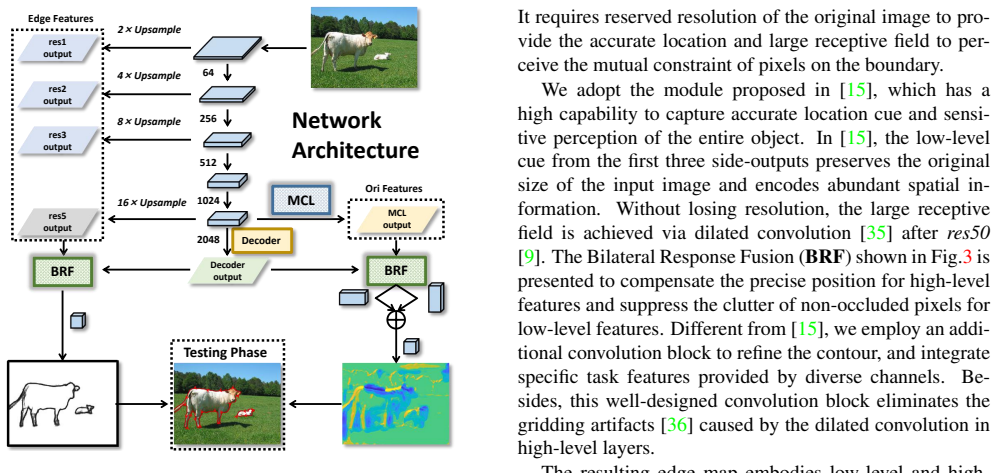
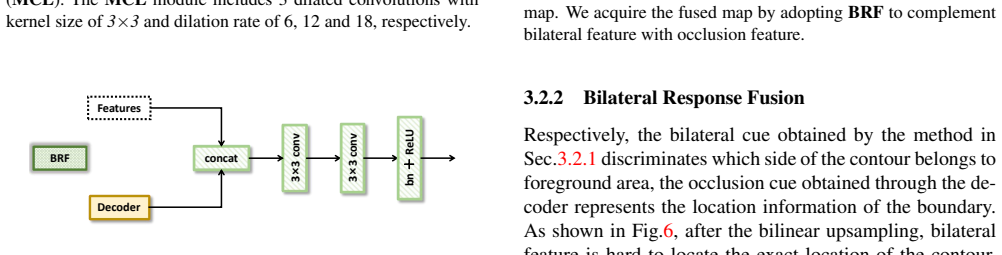
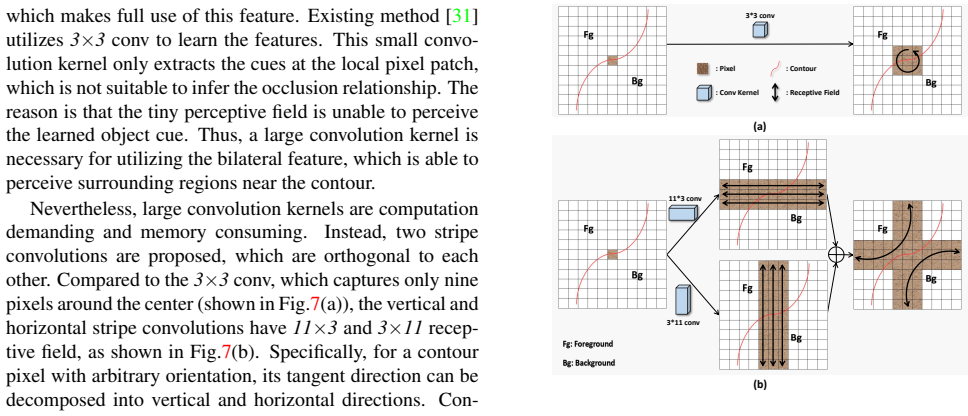
The load-bearing machinery is the bilateral feature, defined as the contextual information on both sides of an occlusion contour that indicates which side is foreground. The Multi-rate Context Learner (MCL) extracts it by applying dilated convolutions with rates 6, 12 and 18 together with a local 1x1 convolution branch, then fuses the branches with another 1x1 convolution; this gives an edge pixel a receptive field large enough to see both occluding and occluded objects. The Bilateral Response Fusion (BRF) module concatenates this bilateral feature with the shared occlusion cue from the decoder and passes the pair through two 3x3 convolutions, producing a fused orientation map. Finally, the Occlusion Relationship Reasoning module replaces a single 3x3 kernel with orthogonal stripe convolutions (11x3 and 3x11), which correspond to decomposing a contour's tangent direction into vertical and horizontal components, so the network perceives scene context on both sides of the edge without the memory cost of a full 11x11 kernel. Together these modules implement the paper's central design rule: share the location cue, separate the semantic features.
What would settle it
Retrain OFNet and DOOBNet from the same initializations, tune the fusion ratio and stripe size on a held-out portion of the training data, then evaluate on the untouched test split; if the 64:16 ratio and 3x11 kernel no longer beat smaller variants by comparable margins, the claimed advantage is benchmark-specific.
Extended reading notes
Core claim
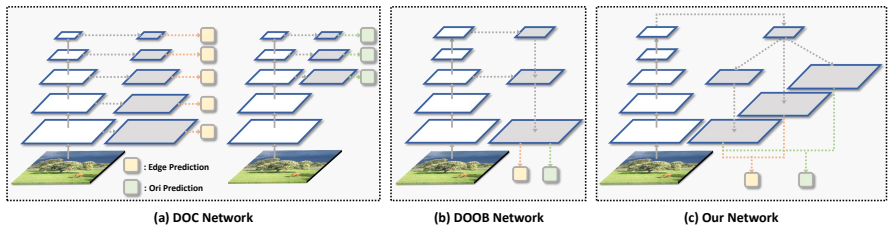
OFNet claims that a single-stream shared decoder is the wrong abstraction for occlusion relationship reasoning. The network keeps one occlusion cue—the decoder feature that locates the boundary—and feeds it to both the edge path and the orientation path, while the high-level features themselves are split so each path learns the semantics it needs. For orientation, OFNet introduces the bilateral feature: a Multi-rate Context Learner with parallel dilated convolutions (rates 6, 12, 18) plus a 1x1 local branch reads foreground and background regions at multiple scales, and a Bilateral Response Fusion module combines that bilateral feature with the occlusion cue at a 64:16 channel ratio. A pair of orthogonal stripe convolutions (11x3 and 3x11) then aggregates surrounding scene context along the contour's vertical and horizontal tendencies. The result is an occlusion edge map and orientation map whose joint accuracy exceeds prior systems; on PIOD the orientation AP is 0.773 versus 0.723 for DOOBNet, and on BSDS ownership it is 0.585 versus 0.501.
Load-bearing premise
The reported gains are the best of several fusion-ratio and stripe-kernel variants selected on the test set, so the load-bearing premise is that those choices (64:16 fusion ratio, 3x11 stripes) reflect a real advantage rather than overfitting the specific benchmarks.
Editorial extensions
If this is right
- Occlusion reasoning in natural images improves when the edge and orientation paths share only the boundary-location cue rather than all high-level features.
- Orientation prediction benefits from explicit bilateral context, which can be learned by multi-rate dilated convolution and fused with the occlusion cue.
- Stripe convolution gives a larger effective receptive field along contour directions at modest computational cost, replacing plain 3x3 convolution in this task.
- The architecture transfers to the small-data BSDS ownership dataset, gaining over DOOBNet, which suggests the design also helps when training data are scarce.
Reading between the lines
- The paper does not test learned or adaptive fusion ratios; a gating mechanism that lets the network decide how much bilateral context to trust per pixel could be tested against the fixed 64:16 ratio.
- The share-what-is-common, separate-what-is-specific principle could generalize to other joint prediction tasks, such as simultaneous semantic edge detection and instance segmentation, where boundary location and object identity have a similar structure.
- The MCL's explicit local 1x1 branch alongside dilated rates implies that pure multi-scale context loses nearby contour cues; a similar local-global split could benefit other boundary-based tasks such as border ownership from stereo cues.
- One could probe whether the 3x11 stripe advantage is tied to the image statistics of PIOD and BSDS by evaluating on rotated or scaled versions of the same images.
Signed reviews
Editorial analysis
A structured set of objections, weighed in public.
Referee Report
Summary. This paper proposes OFNet, a CNN for occlusion relationship reasoning that jointly outputs an occlusion edge map and per-pixel occlusion orientation. The architecture uses an encoder-decoder backbone with two paths: an edge path that aggregates low- and high-level cues, and an orientation path that extracts a new "bilateral feature" via a Multi-rate Context Learner (MCL), fuses it with the shared occlusion cue in a Bilateral Response Fusion (BRF) module, and reasons with orthogonal stripe convolutions. On the PIOD and BSDS ownership datasets, the authors report state-of-the-art results, exceeding the DOOBNet baseline by 4.6% and 6.1% AP respectively on the occlusion-relationship metric, and they provide ablations of the main components (Tables 3-6). The source code is released.
Significance. The paper makes a genuinely useful architectural contribution to occlusion relationship reasoning: the explicit separation of the edge and orientation paths with a shared occlusion cue addresses a design tension that single-stream methods (DOOBNet) and fully separate networks (DOC) did not resolve, and the MCL, BRF, and stripe-convolution modules are well motivated by the geometry of the task. The ablations in Tables 3-6 are systematic, and the monotonic trends (e.g., orientation AP rising from 0.703 to 0.729 as the bilateral-feature ratio increases in Table 5) give qualitative support for the design choices. The release of source code is a further strength. The central quantitative claim -- 4.6% AP gain on PIOD and 6.1% AP on BSDS ownership over DOOBNet -- is plausible but, as detailed in the major comments, its magnitude is not yet rigorously supported because of test-set hyperparameter selection, the absence of error bars, and the small BSDS test set.
major comments (2)
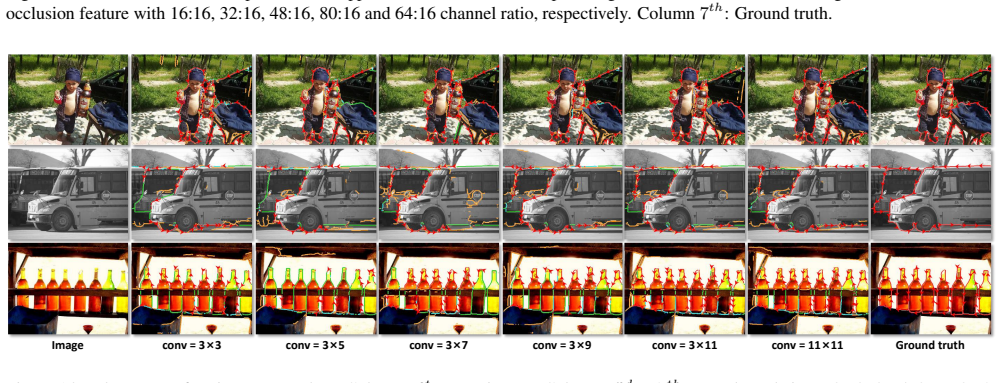
- [Sec. 4.3 (Tables 5 and 6); Sec. 4.2 (Tables 1 and 2)] The two key hyperparameters of the final model, the 64:16 fusion ratio in BRF and the 3x11 stripe kernel, are selected by comparing five variants on the PIOD test set (Tables 5 and 6), and the same test set is then used for the headline comparisons in Tables 1 and 2; no validation split, repeated-seed runs, or error bars are reported anywhere in the paper. The size of the selection effect is comparable to the headline gain: the 64:16 vs 80:16 difference is 0.007 AP (0.729 vs 0.722) and the 3x11 vs 3x9 difference is 0.017 AP (0.729 vs 0.712), against a reported 0.046 AP improvement over DOOBNet. The reported numbers are therefore the maximum of a small grid of configurations evaluated on the benchmark that was also used for model selection, so part of the claimed margin may reflect optimistic selection bias rather than the architecture itself. The authors should either choose hyperparameters on a held-out validation split and then report the corresponding test numbers, or report the mean and standard deviation over multiple random seeds for the final configuration and for DOOBNet, so that the magnitude of the improvement can be assessed.
- [Sec. 4.2 (Table 1, BSDS ownership)] The BSDS ownership dataset contains only 100 test images, and the claimed 6.1% AP gain over DOOBNet (0.440 to 0.501) is a point estimate from a single run. On a test set of this size, ODS/OIS/AP differences of a few points are within plausible sampling variation, and the paper gives no confidence intervals, bootstrap estimates, or per-image paired statistics. As it stands, the BSDS half of the "remarkably advances state-of-the-art" claim is not statistically assessable; the authors should add some variance estimate or a paired comparison over the 100 test images.
minor comments (6)
- [Sec. 3.3, Eq. (3); Sec. 4.1] Equation (3) contains a notation error: "SL(f(ai,a i))" has an undefined function f and duplicated arguments, and the value of the loss weight lambda is never given in Sec. 4.1 despite being a free parameter of the method; the authors should provide a correct expression (including, if used, the angular wrap-around in the smooth L1 term) and report lambda, along with the learning-rate schedule, batch size M, and number of iterations, which are also absent from Sec. 4.1.
- [Sec. 5 (Conclusion)] In the conclusion, the proposed module is referred to as "an MSL is proposed" while everywhere else it is called MCL; this typo should be corrected.
- [Table 3] In Table 3, the right-hand OPR columns of "Baseline(split decoder)" are numerically identical to those of "Baseline" (ODS .702, OIS .712, AP .683); if the split decoder leaves the orientation output unchanged by construction, this should be stated explicitly, otherwise the row looks like a copy-and-paste error.
- [Appendix A.4 (Table 7)] Table 7 shows that the 11x11 kernel slightly outperforms the selected 3x11 kernel (e.g., PIOD OPR AP 0.732 vs 0.729), and the main text should state this trade-off explicitly rather than only in the appendix, since it bears on the claim that the stripe kernel is the preferred design.
- [Fig. 3] Figure 3 is difficult to read: the block labels (res1 through res5, decoder output, BRF output, upsampling factors) are typeset in very small font, and the caption does not explain the meaning of different block widths and heights; a redrawn figure with a legend would substantially improve the clarity of the architecture description.
- [Sec. 4.2 (Tables 1 and 2)] The comparison set contains only methods published between 2015 and 2018 (SRF-OCC, DOC-HED, DOC-DMLFOV, DOOBNet); adding concurrent or more recent occlusion-reasoning methods to the comparison would make the "state-of-the-art" claim more robust.
Circularity Check
No circularity: OFNet's SOTA claim is an externally benchmarked empirical result, and the self-citation to the authors' prior edge module is architectural reuse, not a load-bearing derivation.
full rationale
The paper's central claim is empirical: OFNet is evaluated on external benchmarks (PIOD and BSDS ownership) against published baselines, and the improvements are measured by standard ODS/OIS/AP metrics on held-out test images. There is no equation in the paper that defines a predicted quantity in terms of the same quantity it is supposed to predict; Eq. (1) and Eq. (2) define feature transformations, and Eq. (3) is a supervised loss against ground-truth edge and orientation labels. The only self-citation, [15], supplies an edge-extraction module that the paper explicitly modifies ('Different from [15], we employ an additional convolution block...'), and the main quantitative comparisons (Tables 1-2) are against DOOBNet, not against [15], so the citation is not load-bearing as a proof of the central claim. The ablation analyses in Section 4.3 select the fusion ratio (64:16) and stripe kernel (3x11) by comparing test-set performance, which raises a legitimate concern about selection bias or overfitting of hyperparameters to the benchmark; however, that is a methodological/correctness risk, not a circular derivation. No fitted parameter is renamed as a prediction, and no self-defined quantity is used to justify itself. Therefore no pattern of circularity is exhibited, and the honest finding is no significant circularity.
Assumptions & free parameters
free parameters (4)
- fusion ratio of bilateral and occlusion features in BRF =
64:16
- stripe convolution kernel size =
3x11 and 11x3
- dilation rates in MCL =
6, 12, 18
- loss weight lambda =
not specified
assumptions (3)
- domain assumption The ground truth annotations in PIOD and BSDS ownership accurately represent occlusion edges and orientations.
- domain assumption The standard metrics ODS, OIS, and AP are appropriate for comparing occlusion reasoning performance.
- domain assumption The left-hand rule for defining occlusion orientation is a valid representation of depth order.
invented entities (2)
-
bilateral feature
-
occlusion cue
Cite this review
Pith. "Pith review of Occlusion-shared and Feature-separated Network for Occlusion Relationship Reasoning." pith.science (2026). https://pith.science/paper/MNYP7IC4
@misc{pith2026190805898,
  author       = {Pith},
  title        = {Pith review of: Occlusion-shared and Feature-separated Network for Occlusion Relationship Reasoning},
  year         = {2026},
  howpublished = {\url{https://pith.science/paper/MNYP7IC4}},
  note         = {Machine review of arXiv:1908.05898}
}
read the original abstract
Occlusion relationship reasoning demands closed contour to express the object, and orientation of each contour pixel to describe the order relationship between objects. Current CNN-based methods neglect two critical issues of the task: (1) simultaneous existence of the relevance and distinction for the two elements, i.e, occlusion edge and occlusion orientation; and (2) inadequate exploration to the orientation features. For the reasons above, we propose the Occlusion-shared and Feature-separated Network (OFNet). On one hand, considering the relevance between edge and orientation, two sub-networks are designed to share the occlusion cue. On the other hand, the whole network is split into two paths to learn the high-level semantic features separately. Moreover, a contextual feature for orientation prediction is extracted, which represents the bilateral cue of the foreground and background areas. The bilateral cue is then fused with the occlusion cue to precisely locate the object regions. Finally, a stripe convolution is designed to further aggregate features from surrounding scenes of the occlusion edge. The proposed OFNet remarkably advances the state-of-the-art approaches on PIOD and BSDS ownership dataset. The source code is available at https://github.com/buptlr/OFNet.
Figures

Figures from the paper (10 more)



Reference graph
Works this paper leans on
-
[1]
Detachable object detec- tion: segmentation and depth ordering from short-baseline video
Ayvaci Alper and Soatto Stefano. Detachable object detec- tion: segmentation and depth ordering from short-baseline video. TPAMI, 34(10):1942–1951, 2012. 1
work page 1942
-
[2]
Detachable object detec- tion with efficient model selection
Alper Ayvaci and Stefano Soatto. Detachable object detec- tion with efficient model selection. In CVPR, 2011. 1
work page 2011
-
[3]
Liang-Chieh Chen, George Papandreou, Iasonas Kokkinos, Kevin Murphy, and Alan Yuille. Deeplab: Semantic image segmentation with deep convolutional nets, atrous convolu- tion, and fully connected crfs. TPAMI, 40(4):834–848, 2018. 2, 4
work page 2018
-
[4]
Rethinking atrous convolution for semantic image segmentation
Liang-Chieh Chen, George Papandreou, Florian Schroff, and Hartwig Adam. Rethinking atrous convolution for semantic image segmentation. CoRR, abs/1706.05587, 2017. 2
arXiv 2017
-
[5]
Recovering occlusion boundaries from an image
Hoiem Derek, Efros Alexei, and Hebert Martial. Recovering occlusion boundaries from an image. In ICCV, 2007. 1
work page 2007
-
[6]
A segmentation-aware object detection model with occlusion handling
Tianshi Gao, Benjamin Packer, and Daphne Koller. A segmentation-aware object detection model with occlusion handling. In CVPR, 2011. 1
work page 2011
-
[7]
Kaiming He, Georgia Gkioxari, Piotr Doll ´ar, and Ross Gir- shick. Mask r-cnn. TPAMI, 2017. 1
work page 2017
-
[8]
Delving deep into rectifiers: Surpassing human-level perfor- mance on imagenet classification
Kaiming He, Xiangyu Zhang, Shaoqing Ren, and Jian Sun. Delving deep into rectifiers: Surpassing human-level perfor- mance on imagenet classification. In ICCV, 2015. 5
2015
Show all 43 references
-
[9]
Deep residual learning for image recognition
Kaiming He, Xiangyu Zhang, Shaoqing Ren, and Jian Sun. Deep residual learning for image recognition. In CVPR,
-
[10]
Recovering occlusion boundaries from an image
Derek Hoiem, Alexei Efros, and Martial Hebert. Recovering occlusion boundaries from an image. IJCV, 91(3):328–346,
-
[11]
An online learning approach to occlusion boundary detection
Natan Jacobson, Yoav Freund, and Truong Q Nguyen. An online learning approach to occlusion boundary detection. TIP, 2012. 1
2012
-
[12]
Caffe: Convolutional architecture for fast feature embedding
Yangqing Jia, Evan Shelhamer, Jeff Donahue, Sergey Karayev, Jonathan Long, Ross Girshick, Sergio Guadarrama, and Trevor Darrell. Caffe: Convolutional architecture for fast feature embedding. volume abs/1408.5093, 2014. 5
2014 arXiv
-
[13]
Wei Liu, Andrew Rabinovich, and Alexander C. Berg. Parsenet: Looking wider to see better. Computer Science ,
-
[14]
Fully convolutional networks for semantic segmentation
Jonathan Long, Evan Shelhamer, and Trevor Darrell. Fully convolutional networks for semantic segmentation. TPAMI, 39(4):640–651, 2014. 2
2014
-
[15]
Context-constrained accurate contour extraction for occlu- sion edge detection
Rui Lu, Menghan Zhou, Anlong Ming, and Yu Zhou. Context-constrained accurate contour extraction for occlu- sion edge detection. In ICME, volume abs/1903.08890,
1903 arXiv
-
[16]
Object-level proposals
Jianxiang Ma, Anlong Ming, Zilong Huang, Xinggang Wang, and Yu Zhou. Object-level proposals. InICCV, 2017. 1
2017
-
[17]
Occlusion edge blur: a cue to relative visual depth
Jonathan Marshall, Christina Burbeck, Dan Ariely, Jannick Rolland, and Kevin Martin. Occlusion edge blur: a cue to relative visual depth. Journal of the Optical Society of Amer- ica A Optics Image Science & Vision , 13(4):681–8, 1996. 1
1996
-
[18]
Monocular depth ordering reasoning with occlusion edge detection and couple layers inference
Anlong Ming, Tianfu Wu, Jianxiang Ma, Fang Sun, and Yu Zhou. Monocular depth ordering reasoning with occlusion edge detection and couple layers inference. IEEE Intelligent Systems, 31(2):54–65, 2016. 1
2016
-
[19]
Feedforward semantic segmentation with zoom-out features
Mohammadreza Mostajabi, Payman Yadollahpour, and Gre- gory Shakhnarovich. Feedforward semantic segmentation with zoom-out features. In CVPR, 2015. 2
2015
-
[20]
Large kernel matters – improve semantic segmen- tation by global convolutional network
Chao Peng, Xiangyu Zhang, Gang Yu, Guiming Luo, and Jian Sun. Large kernel matters – improve semantic segmen- tation by global convolutional network. In CVPR, 2017. 2
2017
-
[21]
Doc: Deep occlusion estimation from a single image
Wang Peng and Alan Yuille. Doc: Deep occlusion estimation from a single image. In ECCV, 2016. 1, 2, 5, 6
2016
-
[22]
Fig- ure/ground assignment in natural images
Xiaofeng Ren, Charless Fowlkes, and Jitendra Malik. Fig- ure/ground assignment in natural images. In ECCV, 2006. 1, 2, 5, 6
2006
-
[23]
U-net: Convolutional networks for biomedical image segmentation
Olaf Ronneberger, Philipp Fischer, and Thomas Brox. U-net: Convolutional networks for biomedical image segmentation. In International Conference on Medical Image Computing & Computer-assisted Intervention, 2015. 2
2015
-
[24]
Probabilistic occlusion boundary detec- tion on spatio-temporal lattices
Mehmet Emre Sargin, Luca Bertelli, Bangalore Manjunath, and Kenneth Rose. Probabilistic occlusion boundary detec- tion on spatio-temporal lattices. In ICCV, 2009. 1
2009
-
[25]
Learning depth from single monocular images
Ashutosh Saxena, Sung Chung, and Andrew Ng. Learning depth from single monocular images. In NIPS, 2005. 1
2005
-
[26]
Deepcontour: A deep convolutional feature learned by positive-sharing loss for contour detection
Wei Shen, Xinggang Wang, Yan Wang, Xiang Bai, and Zhi- jiang Zhang. Deepcontour: A deep convolutional feature learned by positive-sharing loss for contour detection. In CVPR, 2015. 1
2015
-
[27]
Object skeleton extraction in natural images by fusing scale-associated deep side outputs
Wei Shen, Kai Zhao, Yuan Jiang, Yan Wang, Zhijiang Zhang, and Xiang Bai. Object skeleton extraction in natural images by fusing scale-associated deep side outputs. InCVPR, 2016. 2
2016
-
[28]
Beyond skip connections: Top-down mod- ulation for object detection
Abhinav Shrivastava, Rahul Sukthankar, Jitendra Malik, and Abhinav Gupta. Beyond skip connections: Top-down mod- ulation for object detection. CoRR, abs/1612.06851, 2016. 2
2016 arXiv
-
[29]
Occlusion boundaries from motion: Low-level detection and mid-level reasoning
Andrew Stein and Martial Hebert. Occlusion boundaries from motion: Low-level detection and mid-level reasoning. IJCV, 82(3):325, 2009. 1
2009
-
[30]
Fast 2d border ownership assignment
Ching Teo, Cornelia Fermuller, and Yiannis Aloimonos. Fast 2d border ownership assignment. In CVPR, 2015. 2, 6
2015
-
[31]
Doobnet: Deep object occlusion boundary detection from an image
Guoxia Wang, Xiaohui Liang, and Frederick Li. Doobnet: Deep object occlusion boundary detection from an image. In ACCV, 2018. 1, 2, 4, 5, 6, 7, 8, 10
2018
-
[32]
Understanding convolution for semantic segmentation
Panqu Wang, Pengfei Chen, Ye Yuan, Ding Liu, Zehua Huang, Xiaodi Hou, and Garrison Cottrell. Understanding convolution for semantic segmentation. InIEEE Winter Con- ference on Applications of Computer Vision , 2018. 2
2018
-
[33]
Deepflux for skeletons in the wild
Yukang Wang, Yongchao Xu, Stavros Tsogkas, Xiang Bai, Sven Dickinson, and Kaleem Siddiqi. Deepflux for skeletons in the wild. In CVPR, 2019. 2
2019
-
[34]
A novel multi-layer framework for tiny obstacle discovery
Feng Xue, Anlong Ming, Menghan Zhou, and Yu Zhou. A novel multi-layer framework for tiny obstacle discovery. In ICRA, 2019. 1
2019
-
[35]
Multi-scale context aggrega- tion by dilated convolutions
Fisher Yu and Vladlen Koltun. Multi-scale context aggrega- tion by dilated convolutions. In ICLR, 2016. 3
2016
-
[36]
Dilated residual networks
Fisher Yu, Vladlen Koltun, and Thomas Funkhouser. Dilated residual networks. In CVPR, 2017. 3, 4
2017
-
[37]
Monocular object instance segmentation and depth ordering with cnns
Ziyu Zhang, Alexander Schwing, Sanja Fidler, and Raquel Urtasun. Monocular object instance segmentation and depth ordering with cnns. In ICCV, 2015. 1
2015
-
[38]
Objectness-aware tracking via double-layer model
Menghan Zhou, Jianxiang Ma, Anlong Ming, and Yu Zhou. Objectness-aware tracking via double-layer model. In ICIP,
-
[39]
Fusion with diffusion for robust visual tracking
Yu Zhou, Xiang Bai, Wenyu Liu, and Longin Jan Latecki. Fusion with diffusion for robust visual tracking. In NIPS
-
[40]
Similarity fusion for visual tracking
Yu Zhou, Xiang Bai, Wenyu Liu, and Longin Jan Latecki. Similarity fusion for visual tracking. IJCV, 118(3):337–363,
-
[41]
Learning training samples for occlusion edge detection and its application in depth ordering inference
Yu Zhou, Jianxiang Ma, Anlong Ming, and Xiang Bai. Learning training samples for occlusion edge detection and its application in depth ordering inference. In ICPR, 2018. 1
2018
-
[42]
Human action recognition with skeleton induced discriminative approximate rigid part model
Yu Zhou and Anlong Ming. Human action recognition with skeleton induced discriminative approximate rigid part model. PRL, 2016. 1
2016
-
[43]
Online multiple targets detection and tracking from mobile robot in cluttered indoor environments with depth camera
Yu Zhou, Yinfei Yang, Yi Meng, Xiang Bai, Wenyu Liu, and Longin Jan Latecki. Online multiple targets detection and tracking from mobile robot in cluttered indoor environments with depth camera. IJPRAI, 2014. 1 A. Appendix In this appendix material, we provide full qualitative ...
2014
Reviewed August 14, 2026 · model on record in the stance chip above.
Discussion (0). Continue with ORCID to comment.