REVIEW 4 major objections 5 minor 22 references
Inner Edge of Habitable Zones for Earth-sized Planets with Various Surface Water Distributions
T0 review · 4 major / 5 minor · reviewed 2026-08-14 · deepseek-v4-flash
Pith's one-line read A planet's surface water layout, not just stellar brightness, sets where its habitable zone begins.
desk verdict Runaway greenhouse threshold depends on surface water distribution; the new meridional and topography cases bracket the range, though the quantitative boundaries rest on bucket-hydrology choices that need sensitivity tests. read the letter →
The pith
A machine-rendered reading of the paper's core claim, the machinery that carries it, and where it could break.
The reading
What carries the argument
The central tool is a three-dimensional atmospheric general circulation model with a bucket hydrology scheme, where evaporation efficiency rises linearly with soil moisture up to a critical value of 10 cm and stays at unity beyond it. Prescribed 'water pool' regions remain always wet, while wetness elsewhere is computed from local precipitation minus evaporation, producing the land fraction that organizes the results. The runaway threshold is located by stepping up insolation until the climate can no longer reach a balanced radiation budget. The physical mechanism is the width of the wet tropical atmosphere: a moist equator caps outgoing longwave radiation at the Simpson-Nakajima limit, lowering the threshold, whereas dry tropical regions let the planet radiate more and push the threshold outward.
What would settle it
Run the same protocol with a model that includes lateral surface water transport—runoff, river flow, and ocean circulation—for a planet with about 10% of Earth's ocean at 140% S0; if it enters a runaway state like an aqua planet instead of remaining stable, or if the aqua/land boundary moves far from a land fraction of 0.4, the central claim would be contradicted.
Extended reading notes
Core claim
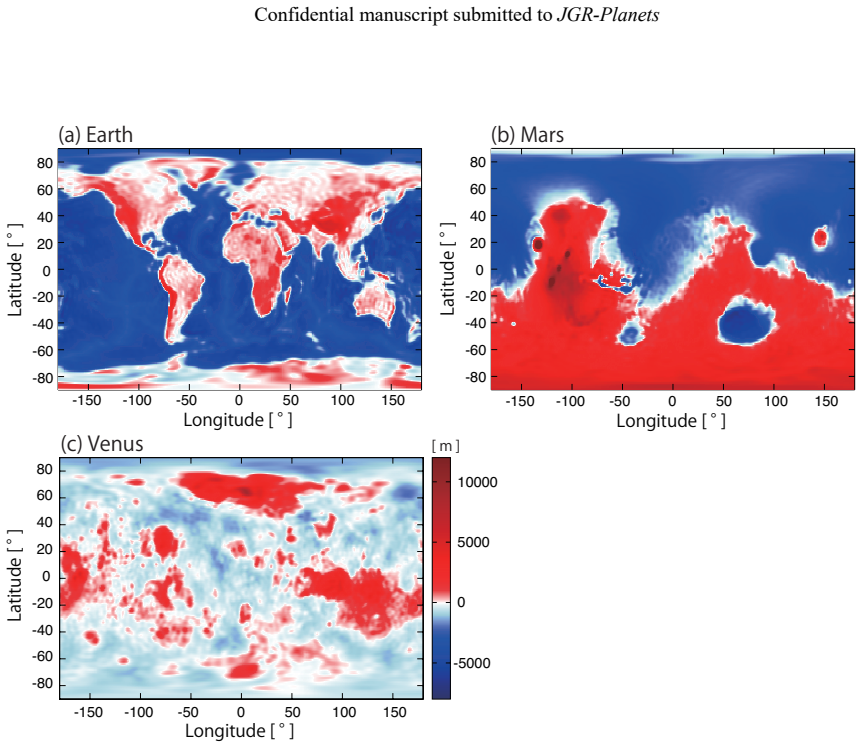
The runaway greenhouse threshold—the insolation beyond which a planet with liquid surface water can no longer maintain thermal equilibrium and all water evaporates—ranges from about 130% S0 for aqua planets to about 155% S0 for meridionally uniform land planets, and can be as high as about 180% S0 when the water distribution is zonally confined. The threshold is set by how much of the low-latitude atmosphere stays wet: dry tropical regions allow outgoing longwave radiation to exceed the Simpson-Nakajima limit, while wet tropics cap the radiation and force runaway at lower insolation. Across idealized and topography-based water distributions, a land fraction of about 0.4 marks the boundary between aqua-planet and land-planet climate regimes, corresponding to a surface water amount near 10% of Earth's ocean. Therefore the inner edge of the habitable zone is not uniquely determined by the central star's luminosity; it depends on the planet's own surface water distribution.
Load-bearing premise
The assumed rule for how wet the ground outside the prescribed water pools stays only uses local rain minus evaporation, with a fixed critical soil moisture of 10 cm and no sideways flow of surface water, so if real moisture recycling or runoff behaves differently the computed land fractions and threshold curves would shift.
Editorial extensions
If this is right
- A water-poor planet with a dry tropics region can remain stable at insolation levels up to roughly 155% S0 (meridional spread) or about 180% S0 (zonal confinement), while an aqua planet runs away near 130% S0.
- The aqua/land climate boundary sits at a land fraction near 0.4, which for realistic topography corresponds to about 10% of Earth's ocean, so small changes in water content produce large, observable changes in climate.
- For a Sun-like star, the inner edge of the habitable zone can extend inward to roughly 0.75 AU when the runaway threshold is 180% S0, meaning a low-water planet could stay habitable at Venus's orbit.
- When ocean albedo is set to a realistic low value (0.07), the runaway threshold for an Earth-like ocean is about 113% S0, and it rises to about 178% S0 at 1% of Earth's ocean, so surface reflectivity strongly influences the habitable edge.
- Because the climate boundary falls at a water amount that is difficult to measure from mass-radius relations, atmospheric observations could serve as a proxy for surface water inventory on exoplanets.
Reading between the lines
- If the land-fraction boundary near 0.4 holds across different models, then exoplanet mass-radius measurements—which cannot detect water inventories below roughly 1% of Earth's ocean—could be complemented by photometric or spectral signatures of a dry-tropics climate to estimate water amount.
- The meridionally dispersed case being the lower limit suggests that the commonly quoted 180% S0 land-planet threshold from zonal studies may be an upper bound; real planets with any tropical wet regions will likely have lower runaway thresholds.
- A natural next test is to include lateral surface water transport and a dynamic ocean in the same protocol; if the aqua/land boundary shifts significantly away from 0.4, the 10%-ocean threshold would need revision.
- The paper's idealized 1-bar N2 atmosphere omits CO2 and the moist greenhouse limit, so coupling the runaway threshold with atmospheric chemistry could alter the habitable-zone width, although the authors argue pCO2 has little effect on the runaway threshold itself.
Signed reviews
Editorial analysis
A structured set of objections, weighed in public.
Referee Report
Summary. This paper investigates how the surface water distribution of an Earth-sized planet affects the insolation threshold for the runaway greenhouse effect, using the CCSR/NIES AGCM5.4g three-dimensional general circulation model. The authors consider idealized meridionally uniform water distributions (dispersed and concentrated cases with 1-9 wet grid columns), distributions generated by pouring water into the topographies of Earth, Mars, and Venus, and a pseudo-Earth setup with an ocean-like surface albedo of 0.07 in water regions. They report that the runaway threshold rises from about 130% S0 for aqua planets to about 155% S0 for meridionally uniform land-planet cases, while prior zonally uniform cases reach about 180% S0. For the topographic cases, the threshold collapses onto a curve in terms of diagnosed land fraction, with an aqua/land climate boundary near a land fraction of 0.4 and a corresponding surface water amount around 10% of Earth's ocean. The paper concludes that the inner edge of the habitable zone is not uniquely determined by stellar luminosity but depends on the planet's surface water distribution.
Significance. If the quantitative results hold, the paper provides a useful mapping between surface water inventories and the inner edge of the habitable zone for terrestrial planets, with observational consequences: a planet with less than roughly 10% of an Earth ocean should behave climatically as a land planet, extending the habitable zone inward. The study's strengths include a systematic parameter sweep over water distributions, explicit comparisons between idealized and topographic cases, a pseudo-Earth benchmark that reproduces the previous 3-D runaway threshold near 113% S0 (comparable to Leconte et al. 2013b), and straightforward data availability via the Zenodo repository. The central qualitative conclusion, that the runaway threshold depends on the spatial arrangement of surface water and not only on insolation, is robust and consistent with prior work. The main weakness is that the quantitative boundary — the land fraction near 0.4 and the 10% ocean volume — is produced by a bucket hydrology scheme with a binary reset and a fixed critical soil moisture, with no sensitivity tests reported.
major comments (4)
- [Section 3.1, reset procedure] The reset procedure described in Section 3.1 is load-bearing for the quantitative claims, but its sensitivity is not assessed. After each insolation increment, all non-pool cells with beta=1 are reset to exactly 10 cm of water, while Wg,crit is set to 10 cm. This means that excess precipitation in non-pool regions is discarded at every reset, and the only memory retained by the bucket is the binary wet/dry state at the end of the previous step. The diagnosed land fraction (beta<1) in Figures 7 and 9, and the derived boundary of about 10% of Earth's ocean, are therefore outputs of this specific reset rule and the choice Wg,crit=10 cm. A different bucket capacity, a different critical soil moisture, or a scheme with lateral surface water transport could shift the threshold curves and the aqua/land boundary. The manuscript reports no sensitivity experiments for these parameters, so the central quantitative claims are not yet supported to the precision claimed.
- [Section 5.1, amount of water at the boundary] The claim that the aqua/land climate boundary lies at around 10% of Earth's ocean is based on a small number of discrete water amounts for each topography: for Earth, the boundary is bracketed between 5e16 m3 and 1e17 m3, and for Mars and Venus it lies in different ranges. The text in Section 5.1 generalizes this to 'a water planet with an amount of water less than 1e17 m3 should behave as if it has the climate of a land planet,' but this generalization rests on the same bucket-reset scheme criticized above and on only a few bracketing simulations. A quantitative statement of the uncertainty on this boundary, or an explicit statement that it is model-dependent, is needed.
- [Section 3.2 and Figure 6, runaway threshold definition] The runaway threshold is defined as the highest insolation for which a thermal equilibrium is maintained, with insolation incremented by 1% S0. The manuscript reports threshold values to integer precision but provides no estimate of the variability of the radiation budget or the sensitivity of the diagnosed threshold to the spin-up length or the 10-year equilibration time. Given that the differences between key cases are sometimes only 1-2% S0 (for example, the dispersed 9-grid case approaching the aqua value near 130% S0), a quantitative statement about the numerical uncertainty of the thresholds is necessary to support comparisons at this resolution.
- [Section 4.2, topographic water distributions] The topographic cases set all planetary radii to Earth's value and do not include altitude variations in the GCM, even though the water pool regions are derived from topography. This flattening removes any direct effect of elevated terrain on atmospheric temperature and circulation, and it implicitly assumes that topography only matters through the initial placement of water. The authors acknowledge this choice, and it is reasonable for isolating the effect of water distribution, but the implications for the Mars and Venus cases should be stated more explicitly: with real topography and different gravity, the diagnosed land fractions and thresholds could differ.
minor comments (5)
- [Throughout] There are several typographical and reference errors: 'Natute' should be 'Nature', 'Meterology' should be 'Meteorology', 'Jhon & Sons' should likely be 'John Wiley & Sons', and 'Radiant' in the Nakajima and Tanaka reference should be 'Radiative'. These should be corrected before publication.
- [Section 4.2] The abbreviation VOCE is used in the text and figures but is never defined explicitly; the paper should state that VOCE denotes the volume of the present Earth's ocean (1.37e18 m3).
- [Section 3.2, Figure 6] The phrase 'the water poor region' appears in the text near Figure 6; this should be 'water pool region' for consistency with the rest of the manuscript.
- [Supporting Information] The text in Section 4.2 refers to supporting Figures S1-S3, while Section 3.1 refers to Figure S1. The numbering should be checked so that the reader can locate the water distribution figures and the stability criterion figure unambiguously.
- [Section 5.2] The pseudo-Earth experiment with 1 VOCE gives a runaway threshold of 113% S0, which the authors compare with Leconte et al. 2013b. It would be helpful to state the nominal 1% S0 increment and any interannual variability for this benchmark case, since the comparison is used to validate the model's ocean-albedo setup.
Circularity Check
No significant circularity: runaway thresholds are simulated outputs, benchmarked against an independent GCM result, with self-citations used only as method antecedents and bracketing cases.
full rationale
The paper's central claims—that the runaway greenhouse threshold depends on the surface water distribution and that the aqua/land climate boundary lies near a land fraction of 0.4 and roughly 10% of Earth's ocean—are produced by GCM integrations, not derived from or fitted to those conclusions. The land fraction used in Figures 7 and 9 is diagnosed from the simulated evaporation efficiency (beta < 1), and the threshold is defined operationally as the highest insolation at which the climate reaches thermal equilibrium (Section 3.1). No parameter is fitted to a subset of the threshold data and then renamed as a prediction. Citations to Kodama et al. [2018] supply the model setup, the zonally uniform bracketing cases, and the water-flow-limit concept, but those results enter as independent simulation outcomes used for comparison, not as inputs that force the new thresholds. The pseudo-Earth comparison in Section 5.2 provides an external check: a simulated runaway threshold of 113% S0 is explicitly compared with Leconte et al. [2013b], an independent model result. The bucket reset procedure and the choice Wg,crit = 10 cm are model assumptions whose sensitivity is not tested, but this is a robustness/correctness concern, not a circular one: the claimed dependence of the threshold on surface water distribution would remain a model output even if those parameters shifted the quantitative boundary. Overall, the derivation chain is self-contained and the self-citations are not load-bearing in the sense of importing the conclusion.
Assumptions & free parameters
free parameters (5)
- Critical soil moisture Wg,crit =
10 cm
- Field capacity Wg,max =
1000 m
- Surface albedo in idealized setup =
0.3
- Ocean albedo in pseudo-Earth setup =
0.07
- Initial water depth reset =
100 m in pools, 10 cm in wet regions
assumptions (6)
- domain assumption Atmosphere is fixed 1 bar N2, no CO2, no ozone or vegetation; orbit circular, obliquity zero, and Earth's rotation, gravity, and radius are used.
- domain assumption Ocean heat transport is removed from the GCM.
- domain assumption Surface hydrology uses a bucket model with beta = Wg/Wg,crit and no surface runoff due to field capacity of 1000 m.
- domain assumption For topography cases, ocean basins are constructed by pouring water from the poles up to a water flow limit, following Kodama et al. 2018.
- domain assumption Runaway onset is diagnosed as the highest insolation at which the GCM can maintain a near-balanced top-of-atmosphere radiation budget within about 1 W/m2.
- domain assumption Spherical harmonic representations of Earth, Mars, and Venus topography are accurate at degree/order 84.
Cite this review
Pith. "Pith review of Inner Edge of Habitable Zones for Earth-sized Planets with Various Surface Water Distributions." pith.science (2026). https://pith.science/paper/AYA2KB4K
@misc{pith2026190805909,
  author       = {Pith},
  title        = {Pith review of: Inner Edge of Habitable Zones for Earth-sized Planets with Various Surface Water Distributions},
  year         = {2026},
  howpublished = {\url{https://pith.science/paper/AYA2KB4K}},
  note         = {Machine review of arXiv:1908.05909}
}
read the original abstract
When planets receive insolation above a certain critical value called the runaway threshold, liquid surface water vaporizes completely, which forms the inner edge of the habitable zone. Because land planets can emit a large amount of radiation from the dry tropics, they have a higher runaway threshold than aqua planets do. Here we systematically investigated the runaway threshold for various surface water distributions using a three-dimensional dynamic atmosphere model. The runaway threshold for the meridionally uniform surface water distribution increases from the typical value for the aqua-planet regime (~130% S0) to one for the land-planet regime (~155% S0) as the dry surface area increases, where S0 is the present Earth's insolation. Although this result is similar to the previous work considering zonally uniform surface water distributions, the runaway threshold for the land-planet regime is quite low compared to that of the previous work. This is because a part of the tropical atmosphere is always wet for the meridionally uniform case. We also considered the surface water distributions determined by the Earth's, Mars' and Venus' topographies. We found that their runaway thresholds are close to that for the meridionally uniform cases, and the amount of water at the boundary between an aqua- and land-planet regime is around 10% of the Earth's ocean. This clearly shows that the runaway threshold is not determined uniquely by the luminosity of the central star, but it has a wide range caused by the surface water distribution of the terrestrial water planet itself.
Figures


Figures from the paper (6 more)




Reference graph
Works this paper leans on
-
[1]
Confidential manuscript submitted to JGR-Planets 1 Inner Edge of Habitable Zones for Earth-sized Planets with Various Surface Water Distributions T. Kodama1,2, H. Genda3, R. O’ishi2, A. Abe-Ouchi2. 4, and Y. Abe5, * 1 Laboratoire d’astrophysique de Bordeaux, University of Bordeaux, Pessac, France. 2 Center for Earth surface system dynamics, Atmosphere and...
work page 2013
-
[2]
Kopparapu, R. K., R. M. Ramirez, J. S. Kotte, J. F. Kasting, S. Domagal-Goldman, and V. Eymet (2014), Habitable zones around main-sequence stars: Dependence on planetary mass, Astrophys, J. Lett., 787:L29. Leconte, J., F. Forget, B. Charnay, R. Wordsworth, F. Selsis, E. Millour, and A. Spiga (2013a), 3D climate modeling of close-in land planets: Circulati...
work page 2014
-
[3]
Climate variables for the meridionally equally dispersed case with 6 grids of the water pool region for 129% S0, which corresponds to the runaway threshold. Each panel shows (a) the initial depth of water; (b) the evaporation efficiency 𝛽 expressing the ground wetness; (c) the precipitable water; (d) the precipitation flux minus the evaporation flux; (e) ...
work page 2000
-
[4]
focused only on the zonally uniform surface water distribution. Thus, it is necessary to carefully consider the relationship between the runaway threshold and the water distribution on more realistic planets with oceans. The surface water distribution is determined by the planetary topography. First, in this study, we investigate the dependence of the run...
work page 2018
-
[5]
In Section 6, we summarize our findings
Then, in Section 5, we discuss the amount of water at the boundary between an aqua planet and a land planet and the effect of oceanic albedo on the runaway threshold. In Section 6, we summarize our findings. Confidential manuscript submitted to JGR-Planets 5 2 GCM description To understand the dependence of the runaway threshold on the surface water distr...
work page 2018
-
[6]
and Abe et al., [2011]. This GCM was developed for the modeling of the present Earth’s climate [Numaguchi, 1999] and was applied to the paleoclimate of Earth [Abe-Ouchi et al., 2013]. The resolution of GCM is about 5.6º in latitude and longitude, and the number of vertical layers is 20 layers with the sigma coordinate. The fundamental equations of dynamic...
work page 2011
-
[7]
except for considering the meridionally uniform surface water distribution. The planetary surface is divided into 64 grids in longitude in our GCM, and some of them are set as the water Confidential manuscript submitted to JGR-Planets 6 pool region, which is always wet, from the North Pole to the South Pole. As the initial condition for our simulations, w...
work page 1988
-
[9]
Climate in this case is still stable
As in Figure 3, climate variables for the meridionally concentrated case with 6 grids of the water pool region for 129% S0. Climate in this case is still stable. 0 20 40 60 80 100 120%FQUI < N > 0 30 60 90 120 150 180 210 240 270 300 330 360 -POHJUVEF < ˃ > 0 20 40 60 80 100 120 -90 -60 -30 0 30 60 90-BUJUVEF < ˃ > 0 30 60 90 120 150 180 210 240 270 300 3...
work page 2000
Show all 22 references
-
[10]
As in Figure 3, climate variables for the meridionally concentrated case with 6 grids of the water pool region, but for 142% S0, which corresponds to the runaway threshold. 0 20 40 60 80 100 120%FQUI < N > 0 30 60 90 120 150 180 210 240 270 300 330 360 -POHJUVEF < ˃ > B *OJUJB...
2000
-
[11]
The runaway threshold decreases with the increase in the number of grids of the water pool region
The runaway thresholds for the dispersed (filled square) and concentrated (opened square) cases as a function of the number of grids of water pool regions. The runaway threshold decreases with the increase in the number of grids of the water pool region. The runaway threshold ...
2018
-
[12]
The runaway thresholds for the meridionally uniform surface water distribution is quite a lot lower than that for the zonally uniform case
(black square) are also shown. The runaway thresholds for the meridionally uniform surface water distribution is quite a lot lower than that for the zonally uniform case. The dashed lines describe the runaway threshold for aqua planets which also depend on the water distributi...
2018
-
[15]
The runaway thresholds for various surface water distributions as a function of the land fraction. The runaway thresholds for water distributions determined by the Earth’s, Mars’ and Venus’ topographies are located between those for the zonally and meridionally uniform surface...
2018
-
[16]
43 0-3 C
The differences of climate variables around the boundary between an aqua planet (left column) and a land planet (right column) for the Earth’s topography. Each panel shows (a and b) the absorbed solar radiation (ASR) and the outgoing long-wave radiation (OLR); (c and d) the ev...
2018
-
[17]
The runaway threshold for the idealized-Earth setup (red line) and the pseudo-Earth setup (blue line) with different amounts of water. 110 120 130 140 150 160 170 180 190 1ʷ 1ʷ 1ʷ *OTPMBUJPO PG UIF SVOBXBZ UISFTIPME PG JOTPMBUJPO PG UIF QSFTFOU &BSUI "NPVOU PG XBUFS < N > 1TF...
1992
-
[18]
MCFEP 1ʷ 1ʷ 1ʷ
The planetary and surface albedos for the idealized-Earth setup and the pseudo-Earth setup for the different amounts of water. 0 0.1 0.2 0.3 0.4 0.5 Planetary albedo (idealized) Surface albedo (idealized) Planetary albedo (pseudo) Surface albedo (pseudo) "MCFEP 1ʷ 1ʷ 1ʷ "NPVOU...
2016
-
[20]
Therefore, we showed a range of possible runaway thresholds depending on the surface water distribution
showed, the runaway threshold for a zonally uniform surface water distribution Confidential manuscript submitted to JGR-Planets 26 corresponds with the upper limit of the runaway threshold because of the dry tropics. Therefore, we showed a range of possible runaway thresholds ...
2012
-
[24]
Wieczorek, M. A. (2007), The gravity and topography of the terrestrial planets, Treatise on Geophys., 10: 165-206. Wolf, E. T., and O. B. Toon (2014), Delayed onset of runaway and moist greenhouse climates for Earth, Geophys. Res. Lett., 41, 167-172. Wolf, E. T., and O. B. Too...
2007
-
[84]
We use those topography data with this resolution, which is high enough to be the spatial resolution of our GCM calculation. 4.2 Water pool regions as a function of water amount After the representation of the planetary topography, we evaluate the distribution of surface water...
2018
-
[1992]
investigated the relationship between the temperature on the planetary surface and the outgoing infrared radiation using a one-dimensional radiative-convective equilibrium model. In a case with an atmosphere completely saturated by water vapor, they found that the outgoing inf...
2013
-
[2006]
and Hirt et al. [2012]. The planetary topography can be written with the corresponding expansion coefficients as below: 𝑇𝑜𝑝𝑜(𝜃,𝜙)=∑∑(A,-cos𝑚𝜃+B,-sin𝑚𝜃)𝑃,-6666(sin𝜙),-789,78 , (1) where l is a degree, m is an order, 𝜃 is the longitude and 𝜙 is the latitude. The values of 𝜃 and ...
2012
-
[2015]
They assumed the typical amount of water on the surface of a land planet to be 5% of VOCE based on a result from Abe et al
investigated the evolution from an aqua planet to a land planet via rapid water loss. They assumed the typical amount of water on the surface of a land planet to be 5% of VOCE based on a result from Abe et al. [2011]. They found that an aqua planet with an initial amount of wa...
2011
-
[2018]
an aqua planet
showed a stable climate maintains up to at least 120% S0 for the Earth by using ROCKE-3D. These estimations of the runaway threshold in previous studies conventionally assumed a water planet with a large amount of water on the planetary surface, which implies that its surface ...
2005
Reviewed August 14, 2026 · model on record in the stance chip above.
Discussion (0). Continue with ORCID to comment.