REVIEW 4 major objections 5 minor 53 references
Context-Aware Emotion Recognition Networks
T0 review · 4 major / 5 minor · reviewed 2026-08-14 · deepseek-v4-flash
Pith's one-line read Hiding the face and attending to the scene improves emotion recognition accuracy over face-only models.
desk verdict A useful new context-aware emotion video dataset and a plausible context-boost result, but the paper's main table is compromised by a likely show-level train/test leak and an underspecified face-hiding step. read the letter →
The pith
A machine-rendered reading of the paper's core claim, the machinery that carries it, and where it could break.
The reading
What carries the argument
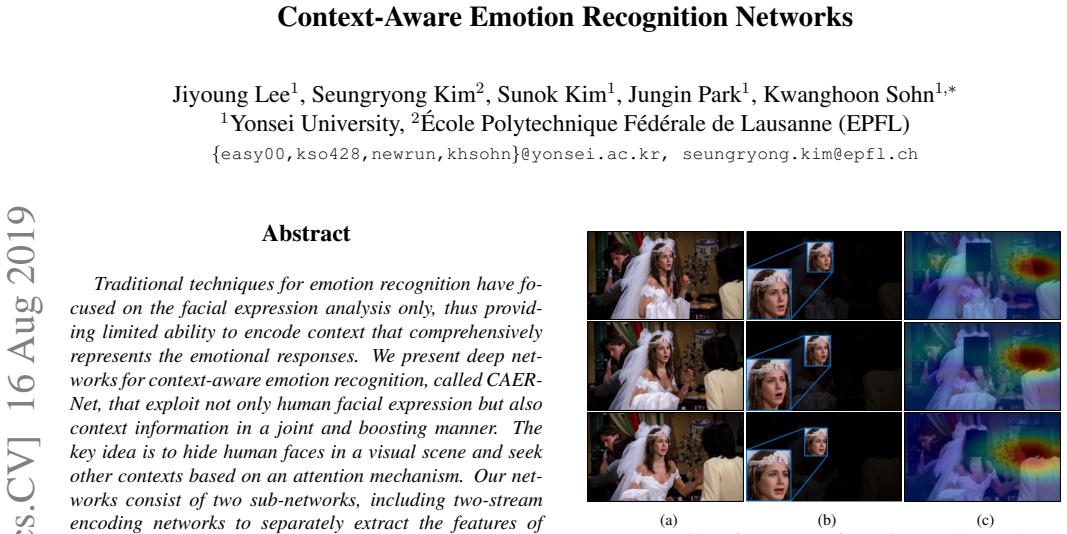
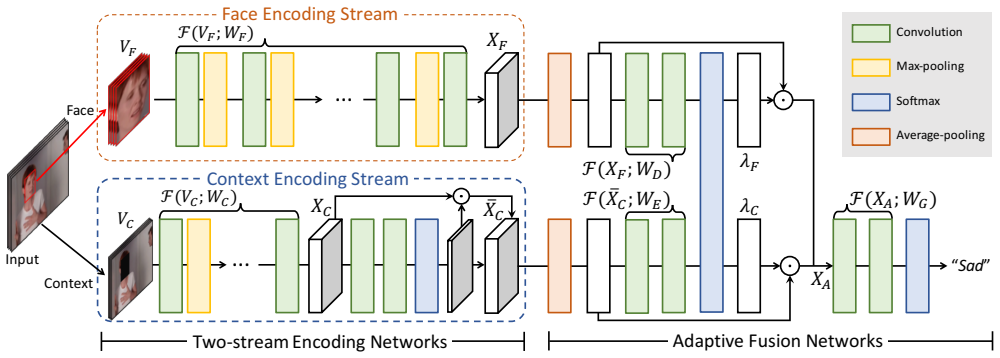
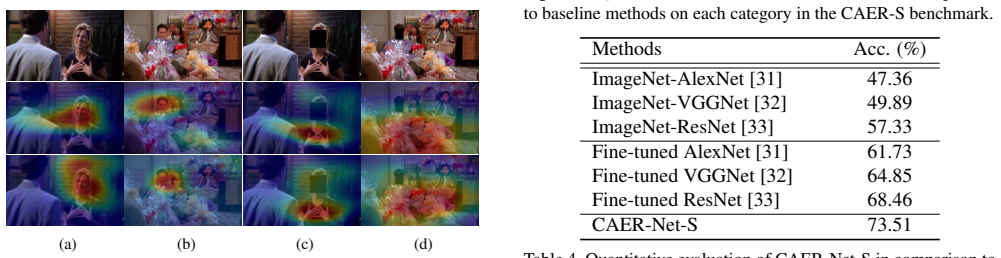
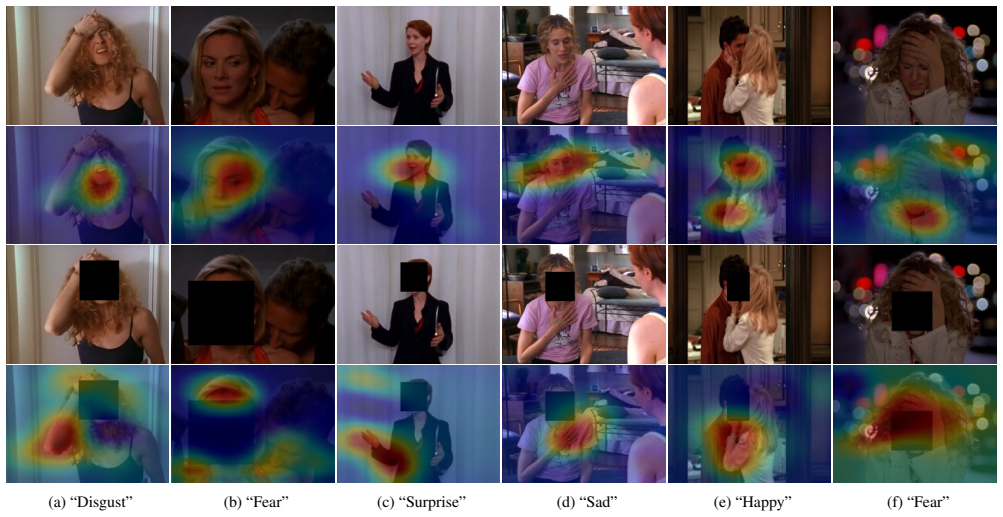
The load-bearing mechanism is CAER-Net's two-stream design with its two attention stages. The context stream receives face-hidden inputs $V_C$; an attention inference module converts an intermediate feature map into a spatially normalized attention map via spatial softmax, $\hat{A}_i = \exp(A_i)/\sum_j \exp(A_j)$, and applies it as $\bar{X}_C = \hat{A} \odot X_C$, so the network focuses on salient non-face regions. The adaptive fusion network then computes scalar weights $\lambda_F$ and $\lambda_C$ for the face and context features, concatenates the weighted features, and classifies them. The face-hiding step is what forces the context stream to discover scene signals instead of collapsing onto the face.
What would settle it
Train CAER-Net with a specified face-hiding step (black rectangle, blur, inpainting, or pixelation) and check whether the reported face-only-to-full accuracy gap of about 2.9 points on CAER holds across all variants; if the gap disappears under any transparent hiding method, or if the hidden inputs still contain detectable face pixels, the central claim that scene context drives the gain is not settled.
Extended reading notes
Core claim
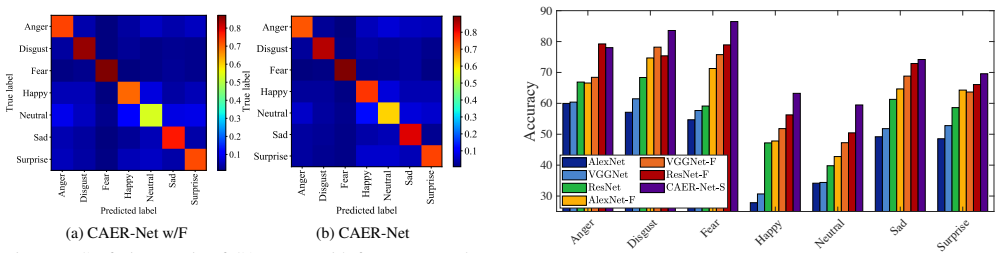
The central discovery is that scene context carries emotional signal that facial expression alone does not, and a network can capture it by deliberately hiding the face and asking an attention module where to look. The architecture has a face stream on cropped faces and a context stream on face-hidden frames; the context features are multiplied by a spatial softmax attention map, and another attention module produces per-sample fusion weights $\lambda_F$ and $\lambda_C$ with $\lambda_F+\lambda_C=1$. The decisive evidence is the ablation: face-only is 74.13%, and adding the context stream reaches 77.04% on CAER, with the context stream alone already at 71.94%. On AFEW, training on CAER+AFEW raises accuracy from 41.86% (face-only) to 51.68%.
Load-bearing premise
The context stream is trained on face-hidden inputs, but the paper never says how the faces are hidden; if that hidden preprocessing leaks face identity or removes needed scene structure, the entire claimed advantage of context attention could be an artifact of that choice.
Editorial extensions
If this is right
- Scene context should be treated as a first-class input for emotion recognition in the wild, not as a post-hoc score fusion, since the context stream alone (71.94%) nearly matches the face stream alone (74.13%) on CAER and the joint model beats both.
- Hiding the face during context training is an effective way to stop a context encoder from fixating on the most discriminative region, so it can discover secondary emotion cues.
- Adaptive fusion lets the model lean on context when the face is ambiguous: the paper shows cases where the context weight $\lambda_C$ is above 0.7 for sad and fear clips and below 0.1 for happy clips.
- Context-aware pretraining data transfers: training on CAER plus AFEW lifts AFEW accuracy from 41.86% (face-only) and 43.12% (AFEW only) to 51.68%.
Reading between the lines
- Beyond the paper: the face-hiding step is never specified, so varying it (blackout, blur, inpainting, pixelation) and re-measuring the face-only-to-full accuracy gap would show whether the context gain is tied to one preprocessing choice.
- Beyond the paper: the same hide-the-dominant-cue-and-attend scheme could transfer to other human-centric recognition tasks, such as group emotion or action recognition, whenever the face or body is the default discriminative feature and the scene is informative.
- Beyond the paper: comparing the learned attention maps with human gaze data on the same video clips would test whether the context regions the network selects match the regions people use to judge emotion.
Signed reviews
Editorial analysis
A structured set of objections, weighed in public.
Referee Report
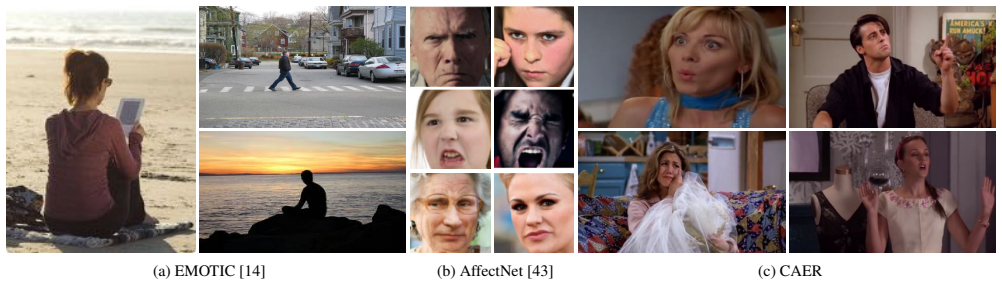
Summary. The paper proposes CAER-Net, a two-stream network for emotion recognition from images and videos that combines a face stream with a context stream. The context stream is trained on face-hidden inputs and uses a learned spatial attention map to weight scene regions, and an adaptive fusion module learns per-sample weights to combine face and context features. The authors introduce the CAER/CAER-S benchmark of 13,201 TV-show clips with seven emotion labels and report ablations on CAER plus an evaluation on AFEW. The central claim is that jointly encoding facial expression and attention-weighted scene context improves emotion recognition accuracy over face-only models (77.04% vs 74.13% on CAER; 51.68% vs 41.86% on AFEW).
Significance. If the reported gains are robust, the paper provides a useful demonstration that scene context carries signal beyond facial expression and contributes a new large-scale benchmark that includes such context. The architecture is simple, the ablation structure directly targets the two-stream hypothesis, and the external AFEW evaluation is a valuable independent check. However, the main evidence is currently fragile: the CAER train/test split is at clip level and likely places clips from the same TV shows in both sets, all accuracies are single runs without error bars, and the face-hiding preprocessing is not specified. These issues do not invalidate the idea, but they must be addressed before the central claim is established.
major comments (4)
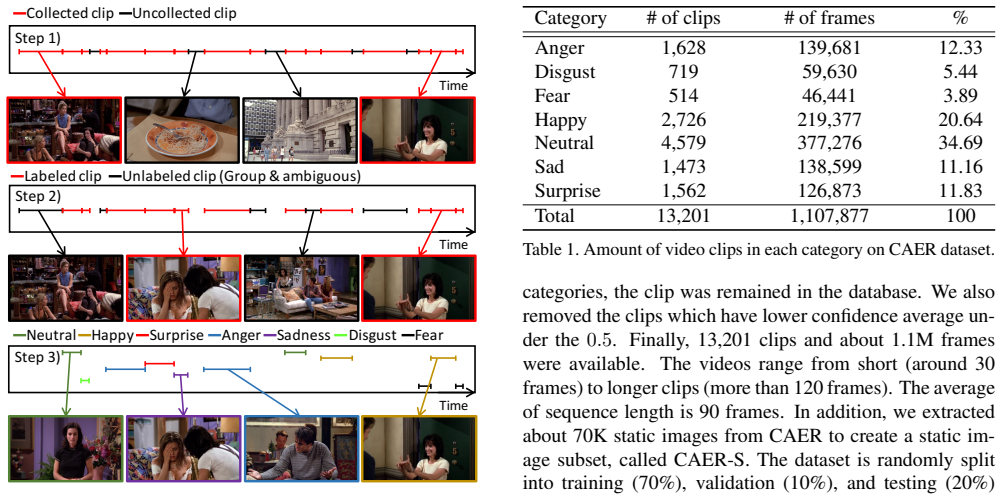
- [Section 4.1 and Table 3] The CAER benchmark is said to be 'randomly split into training (70%), validation (10%), and testing (20%) sets,' without any show-disjoint constraint. Because the 13,201 clips come from 79 TV shows, a clip-level random split likely places clips from the same shows into both train and test. The context stream sees full frames (Section 5.1), so it can exploit show-specific color grading, set design, and genre-typical environments that correlate with the annotated emotion, while the face stream cannot. The 2.91-point gap between CAER-Net w/F and full CAER-Net may therefore reflect dataset leakage rather than emotion-relevant context. Please report a show-disjoint split, or quantify the number of shows appearing in both train and test, and rerun the Table 3 ablations under that protocol.
- [Section 3.2.1] The paper repeatedly states that the context stream is trained on 'face-hidden inputs V_C' and that hiding faces is the key idea, but it never describes how faces are detected, masked, filled, or how the hiding is made temporally consistent across frames. It is also not stated whether the same hiding procedure is applied at test time. This is a load-bearing implementation detail: different hiding choices can leak facial information or remove scene structure, either of which changes the meaning of the reported ablation. Please specify the exact hiding algorithm and confirm that it is identical at train and test time.
- [Section 5.3, Tables 3 and 6] All reported accuracies are single point estimates with no standard deviations, number of seeds, or statistical significance tests. Several conclusions rest on small differences, such as the 74.94% vs 75.57% comparison for adding fusion attention and the 2.91-point gain of the full model on CAER. Given the stochasticity of training 3D CNNs from scratch, these differences may be within run-to-run variation. Please report mean and standard deviation over at least three training runs, or otherwise provide significance evidence, for the main comparisons.
- [Section 5.4, Table 6] The AFEW experiment confounds the effect of context with the effect of additional training data. 'CAER-Net AFEW' (43.12%) and 'CAER-Net w/F AFEW' (41.86%) are trained on AFEW only, while 'CAER-Net CAER+AFEW' (51.68%) is trained on both. The large gain therefore does not isolate the context stream's contribution. A controlled comparison needs at least a face-only CAER-Net trained on CAER+AFEW, and ideally a context-only model on AFEW alone, so that the training-data mix is held fixed when comparing face-only with face-plus-context.
minor comments (5)
- [Section 3.2.1] The text says 'the number of filters for five convolution layers are 32, 64, 128, and 256, respectively,' which lists only four values for five layers; this should be corrected.
- [Section 4.1] The filtering criteria for 'group-level and ambiguous shots' and the confidence scores used to remove clips are not defined operationally; please clarify how these were determined so that the benchmark construction is reproducible.
- [Section 5.1 and Figure 8] The paper mentions an ablation 'without hiding the face during training,' but Table 3 does not include a row for this condition; please add the corresponding quantitative result or remove the claim.
- [Section 3.2.1] The attention is said to be 'implicitly learned in an unsupervised manner,' but the attention module is trained end-to-end with emotion labels; 'learned implicitly from the classification loss' would be more accurate.
- [Section 5.1] No code or implementation of the face-hiding step is provided; since the dataset URL is given, please also release a reference implementation and evaluation script to improve reproducibility.
Circularity Check
No significant circularity: the central context-gain claim is grounded in direct ablations and external AFEW evaluation, with only a minor non-load-bearing self-citation.
full rationale
The paper's central claim is that adding an attention-weighted context stream to a face-expression stream improves emotion recognition. This claim is supported by Table 3, where CAER-Net with both streams reaches 77.04% versus 74.13% for the face-only stream on the newly introduced CAER benchmark, and by Table 6, where CAER-Net trained on CAER+AFEW reaches 51.68% on the external AFEW benchmark. The core comparison is an empirical ablation, not a derivation: the context stream is trained with a separate loss on face-hidden inputs, and the reported accuracy is measured on held-out test clips. No equation in the paper defines the predicted accuracy as equal to a fitted parameter or to an input constant. The only apparent self-citation is reference [20], an earlier ICASSP paper by overlapping authors, used when stating that the face encoding stream follows existing facial-expression-analysis approaches. That citation is architectural lineage and does not supply the central claim that scene context improves accuracy. The paper's evaluation on AFEW is external ground truth, and the internal ablation isolates the context and attention modules. The undocumented face-hiding preprocessing is a reproducibility gap and may affect results, but it is not a circularity: the model still learns to predict manually annotated emotion labels from visual inputs. Likewise, the possibility that the CAER train/test split is not show-disjoint is a data-leakage concern, not a case of the paper's conclusions being equivalent to its inputs by construction. The paper therefore exhibits no significant circularity.
Assumptions & free parameters
free parameters (5)
- Annotation confidence threshold =
0.5
- Temporal clip length =
16 frames
- Video sampling rate =
10 fps
- Learning rate schedule =
5e-3, drop 10x every 4 epochs
- Dropout ratio =
0.5
assumptions (4)
- domain assumption Seven discrete emotion categories (anger, disgust, fear, happy, sad, surprise, neutral) are mutually exclusive and exhaustive for the benchmark.
- domain assumption Facial expression and scene context together are sufficient to infer emotion from a video clip.
- domain assumption The face detector (dlib) and shot boundary detection/face tracking tools used to construct CAER are reliable enough for face cropping and hiding.
- domain assumption Spatial softmax attention over context features yields useful context localization.
Cite this review
Pith. "Pith review of Context-Aware Emotion Recognition Networks." pith.science (2026). https://pith.science/paper/2OVYUPSU
@misc{pith2026190805913,
  author       = {Pith},
  title        = {Pith review of: Context-Aware Emotion Recognition Networks},
  year         = {2026},
  howpublished = {\url{https://pith.science/paper/2OVYUPSU}},
  note         = {Machine review of arXiv:1908.05913}
}
read the original abstract
Traditional techniques for emotion recognition have focused on the facial expression analysis only, thus providing limited ability to encode context that comprehensively represents the emotional responses. We present deep networks for context-aware emotion recognition, called CAER-Net, that exploit not only human facial expression but also context information in a joint and boosting manner. The key idea is to hide human faces in a visual scene and seek other contexts based on an attention mechanism. Our networks consist of two sub-networks, including two-stream encoding networks to seperately extract the features of face and context regions, and adaptive fusion networks to fuse such features in an adaptive fashion. We also introduce a novel benchmark for context-aware emotion recognition, called CAER, that is more appropriate than existing benchmarks both qualitatively and quantitatively. On several benchmarks, CAER-Net proves the effect of context for emotion recognition. Our dataset is available at http://caer-dataset.github.io.
Figures

Figures from the paper (5 more)
Reference graph
Works this paper leans on
-
[1]
Toward an affect-sensitive autotutor
Sidney D’Mello, Rosalind W Picard, and Arthur Graesser. Toward an affect-sensitive autotutor. IEEE Int. Systems , 2007
work page 2007
-
[2]
Developing multimodal intelli- gent affective interfaces for tele-home health care
Christina Lisetti, Fatma Nasoz, Cynthia LeRouge, Onur Ozyer, and Kaye Alvarez. Developing multimodal intelli- gent affective interfaces for tele-home health care. Int. Jou. of Hum.-Comp. Stud., 2003
work page 2003
-
[3]
Experience- driven procedural content generation.IEEE Trans
Georgios N Yannakakis and Julian Togelius. Experience- driven procedural content generation.IEEE Trans. AC, 2011
work page 2011
-
[4]
Fa- cial expression recognition based on local binary patterns: A comprehensive study
Caifeng Shan, Shaogang Gong, and Peter W McOwan. Fa- cial expression recognition based on local binary patterns: A comprehensive study. Image and Vis. Comput., 2009
work page 2009
-
[5]
Learning active facial patches for expression analysis
Lin Zhong, Qingshan Liu, Peng Yang, Bo Liu, Junzhou Huang, and Dimitris N Metaxas. Learning active facial patches for expression analysis. In: CVPR, 2012
work page 2012
-
[6]
C Fabian Benitez-Quiroz, Ramprakash Srinivasan, and Aleix M Martinez. Emotionet: An accurate, real-time al- gorithm for the automatic annotation of a million facial ex- pressions in the wild. In: CVPR, 2016
work page 2016
-
[7]
Oc- clusion aware facial expression recognition using cnn with attention mechanism
Yong Li, Jiabei Zeng, Shiguang Shan, and Xilin Chen. Oc- clusion aware facial expression recognition using cnn with attention mechanism. IEEE Trans. IP, 2018
work page 2018
-
[8]
Shan Li, Weihong Deng, and JunPing Du. Reliable crowd- sourcing and deep locality-preserving learning for expres- sion recognition in the wild. 2017
work page 2017
Show all 53 references
-
[9]
Acted facial expressions in the wild database
Abhinav Dhall, Roland Goecke, Simon Lucey, and Tom Gedeon. Acted facial expressions in the wild database. Tech- nical Report TR-CS-11, 2011
2011
-
[10]
Chal- lenges in representation learning: A report on three machine learning contests
Ian J Goodfellow, Dumitru Erhan, Pierre Luc Carrier, Aaron Courville, Mehdi Mirza, Ben Hamner, Will Cukierski, Yichuan Tang, David Thaler, Dong-Hyun Lee, et al. Chal- lenges in representation learning: A report on three machine learning contests. In: ICONIP, 2013
2013
-
[11]
Context in emotion perception
Lisa Feldman Barrett, Batja Mesquita, and Maria Gendron. Context in emotion perception. Curr . Dir . in Psych. Science, 2011
2011
-
[12]
The role of the parahippocampal cortex in cognition
Elissa M Aminoff, Kestutis Kveraga, and Moshe Bar. The role of the parahippocampal cortex in cognition. Trends in cognitive sciences, 2013
2013
-
[13]
Emotion in context: Deep semantic feature fusion for video emotion recognition
Chen Chen, Zuxuan Wu, and Yu-Gang Jiang. Emotion in context: Deep semantic feature fusion for video emotion recognition. In: MM, 2016
2016
-
[14]
Emotion recognition in context
Ronak Kosti, Jose M Alvarez, Adria Recasens, and Agata Lapedriza. Emotion recognition in context. In: CVPR, 2017
2017
-
[15]
Context-aware affective images classification based on bi- layer sparse representation
Bing Li, Weihua Xiong, Weiming Hu, and Xinmiao Ding. Context-aware affective images classification based on bi- layer sparse representation. In: MM, 2012
2012
-
[16]
Weakly supervised coupled networks for visual sentiment analysis
Jufeng Yang, Dongyu She, Yu-Kun Lai, Paul L Rosin, and Ming-Hsuan Yang. Weakly supervised coupled networks for visual sentiment analysis. In: CVPR, 2018
2018
-
[17]
Facial action coding system: a technique for the measurement of facial movement
E Friesen and Paul Ekman. Facial action coding system: a technique for the measurement of facial movement. Palo Alto, 1978
1978
-
[18]
Discriminative shared gaussian processes for multiview and view-invariant facial expression recognition.IEEE Trans
Stefanos Eleftheriadis, Ognjen Rudovic, and Maja Pantic. Discriminative shared gaussian processes for multiview and view-invariant facial expression recognition.IEEE Trans. IP, 2015
2015
-
[19]
Video-based emotion recognition using cnn-rnn and c3d hybrid networks
Yin Fan, Xiangju Lu, Dian Li, and Yuanliu Liu. Video-based emotion recognition using cnn-rnn and c3d hybrid networks. In: ICMI, 2016
2016
-
[20]
Spatiotemporal attention based deep neural networks for emotion recognition
Jiyoung Lee, Sunok Kim, Seungryong Kim, and Kwanghoon Sohn. Spatiotemporal attention based deep neural networks for emotion recognition. In: ICASSP, 2018
2018
-
[21]
Con- tinuous prediction of spontaneous affect from multiple cues and modalities in valence-arousal space
Mihalis A Nicolaou, Hatice Gunes, and Maja Pantic. Con- tinuous prediction of spontaneous affect from multiple cues and modalities in valence-arousal space. IEEE Trans. AC , 2011
2011
-
[22]
Recognizing emotions expressed by body pose: A biologi- cally inspired neural model
Konrad Schindler, Luc Van Gool, and Beatrice de Gelder. Recognizing emotions expressed by body pose: A biologi- cally inspired neural model. Neur . Net., 2008
2008
-
[23]
The extended cohn- kanade dataset (ck+): A complete dataset for action unit and emotion-specified expression
Patrick Lucey, Jeffrey F Cohn, Takeo Kanade, Jason Saragih, Zara Ambadar, and Iain Matthews. The extended cohn- kanade dataset (ck+): A complete dataset for action unit and emotion-specified expression. In: CVPR Work., 2010
2010
-
[24]
Web-based database for facial expression analysis.In: ICME, 2005
Maja Pantic, Michel Valstar, Ron Rademaker, and Ludo Maat. Web-based database for facial expression analysis.In: ICME, 2005
2005
-
[25]
Static facial expression analysis in tough condi- tions: Data, evaluation protocol and benchmark
Abhinav Dhall, Roland Goecke, Simon Lucey, and Tom Gedeon. Static facial expression analysis in tough condi- tions: Data, evaluation protocol and benchmark. In: ICCV Work., 2011
2011
-
[26]
Fa- cial expression recognition from world wild web
Ali Mollahosseini, Behzad Hasani, Michelle J Salvador, Ho- jjat Abdollahi, David Chan, and Mohammad H Mahoor. Fa- cial expression recognition from world wild web. In: CVPR Work., 2016
2016
-
[27]
Emotiw 2016: Video and group-level emotion recognition challenges
Abhinav Dhall, Roland Goecke, Jyoti Joshi, Jesse Hoey, and Tom Gedeon. Emotiw 2016: Video and group-level emotion recognition challenges. In: ICMI, 2016
2016
-
[28]
Patterson and J
G. Patterson and J. Hays. Coco attributes: Attributes for people, animals, and objects. In: ECCV, 2016
2016
-
[29]
Recog- nizing affective dimensions from body posture
Andrea Kleinsmith and Nadia Bianchi-Berthouze. Recog- nizing affective dimensions from body posture. In: ACII , 2007
2007
-
[30]
Kleinsmith, N
A. Kleinsmith, N. Bianchi-Berthouze, and A. Steed. Au- tomatic recognition of non-acted affective postures. IEEE Trans. Systems, 2011
2011
-
[31]
Imagenet classification with deep convolutional neural net- works
Alex Krizhevsky, Ilya Sutskever, and Geoffrey E Hinton. Imagenet classification with deep convolutional neural net- works. In: NeurIPS, 2012
2012
-
[32]
Very deep convo- lutional networks for large-scale image recognition
Karen Simonyan and Andrew Zisserman. Very deep convo- lutional networks for large-scale image recognition. arXiv preprint arXiv:1409.1556, 2014
2014 arXiv
-
[33]
Deep residual learning for image recognition
Kaiming He, Xiangyu Zhang, Shaoqing Ren, and Jian Sun. Deep residual learning for image recognition. In: CVPR , 2016
2016
-
[34]
Learning deep features for discrimi- native localization
Bolei Zhou, Aditya Khosla, Agata Lapedriza, Aude Oliva, and Antonio Torralba. Learning deep features for discrimi- native localization. In: CVPR, 2016
2016
-
[35]
Grad-cam: Visual explanations from deep networks via gradient-based localization
Ramprasaath R Selvaraju, Michael Cogswell, Abhishek Das, Ramakrishna Vedantam, Devi Parikh, and Dhruv Batra. Grad-cam: Visual explanations from deep networks via gradient-based localization. In: ICCV, 2017
2017
-
[36]
Track and transfer: Watching videos to simulate strong human su- pervision for weakly-supervised object detection
Krishna Kumar Singh, Fanyi Xiao, and Yong Jae Lee. Track and transfer: Watching videos to simulate strong human su- pervision for weakly-supervised object detection. In: CVPR, 2016
2016
-
[37]
Cbam: Convolutional block attention module
Sanghyun Woo, Jongchan Park, Joon-Young Lee, and In So Kweon. Cbam: Convolutional block attention module. In: ECCV, 2018
2018
-
[38]
Squeeze-and-excitation net- works
Jie Hu, Li Shen, and Gang Sun. Squeeze-and-excitation net- works. In: CVPR, 2018
2018
-
[39]
Visual sentiment analysis by attending on local image regions
Quanzeng You, Hailin Jin, and Jiebo Luo. Visual sentiment analysis by attending on local image regions. In: AAAI , 2017
2017
-
[40]
Video- based emotion recognition using deeply-supervised neural networks
Yingruo Fan, Jacqueline CK Lam, and Victor OK Li. Video- based emotion recognition using deeply-supervised neural networks. In: ICMI, 2018
2018
-
[41]
Dlib-ml: A machine learning toolkit
Davis E King. Dlib-ml: A machine learning toolkit. Joul. of Mach. Learn. Res., 2009
2009
-
[42]
Ac- tion recognition using visual attention
Shikhar Sharma, Ryan Kiros, and Ruslan Salakhutdinov. Ac- tion recognition using visual attention. arXiv:1511.04119, 2015
2015 arXiv
-
[43]
Affectnet: A database for facial expression, valence, and arousal computing in the wild
Ali Mollahosseini, Behzad Hasani, and Mohammad H Ma- hoor. Affectnet: A database for facial expression, valence, and arousal computing in the wild. IEEE Trans. AC
-
[44]
Collecting large, richly annotated facial-expression databases from movies
Abhinav Dhall, Roland Goecke, Simon Lucey, Tom Gedeon, et al. Collecting large, richly annotated facial-expression databases from movies. IEEE Multi., 2012
2012
-
[45]
Predicting emotions in user-generated videos
Yu-Gang Jiang, Baohan Xu, and Xiangyang Xue. Predicting emotions in user-generated videos. In: AAAI, 2014
2014
-
[46]
Afew-va database for valence and arousal estimation in-the-wild
Jean Kossaifi, Georgios Tzimiropoulos, Sinisa Todorovic, and Maja Pantic. Afew-va database for valence and arousal estimation in-the-wild. Image and Vis. Comput., 2017
2017
-
[47]
Automatic differentiation in pytorch
Adam Paszke, Sam Gross, Soumith Chintala, Gregory Chanan, Edward Yang, Zachary DeVito, Zeming Lin, Al- ban Desmaison, Luca Antiga, and Adam Lerer. Automatic differentiation in pytorch. 2017
2017
-
[48]
Unified confidence estimation net- works for robust stereo matching
Sunok Kim, Dongbo Min, Seungryong Kim, and Kwanghoon Sohn. Unified confidence estimation net- works for robust stereo matching. IEEE Trans. IP, 2018
2018
-
[49]
Learning spatiotemporal features with 3d convolutional networks
Du Tran, Lubomir Bourdev, Rob Fergus, Lorenzo Torresani, and Manohar Paluri. Learning spatiotemporal features with 3d convolutional networks. In: ICCV, 2015
2015
-
[50]
Imagenet: A large-scale hierarchical image database
Jia Deng, Wei Dong, Richard Socher, Li-Jia Li, Kai Li, and Li Fei-Fei. Imagenet: A large-scale hierarchical image database. In: CVPR, 2009
2009
-
[51]
Large-scale video classification with convolutional neural networks.In: CVPR, 2014
Andrej Karpathy, George Toderici, Sanketh Shetty, Thomas Leung, Rahul Sukthankar, and Li Fei-Fei. Large-scale video classification with convolutional neural networks.In: CVPR, 2014
2014
-
[52]
Tem- poral multimodal fusion for video emotion classification in the wild
Valentin Vielzeuf, St´ephane Pateux, and Fr´ed´eric Jurie. Tem- poral multimodal fusion for video emotion classification in the wild. In: ICMI, 2017
2017
-
[53]
Learning supervised scoring ensemble for emotion recognition in the wild
Ping Hu, Dongqi Cai, Shandong Wang, Anbang Yao, and Yurong Chen. Learning supervised scoring ensemble for emotion recognition in the wild. In: ICMI, 2017
2017
Reviewed August 14, 2026 · model on record in the stance chip above.
Discussion (0). Continue with ORCID to comment.