REVIEW 3 major objections 4 minor 28 references
Electromagnetic proximity effect controlled by spin-triplet correlations in superconducting spin-valve structures
T0 review · 3 major / 4 minor · reviewed 2026-08-14 · deepseek-v4-flash
Pith's one-line read Perpendicular ferromagnet moments create long-ranged triplet pairs that strongly amplify the magnetic field leaking into the superconductor.
desk verdict Real extension of the S/F bilayer theory, with a credible triplet mechanism and an overclaimed experimental comparison. read the letter →
The pith
A machine-rendered reading of the paper's core claim, the machinery that carries it, and where it could break.
The reading
What carries the argument
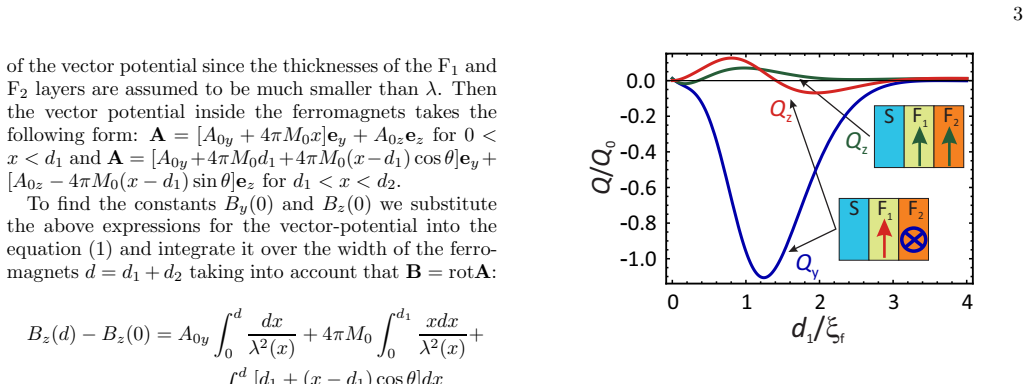
The central object is the electromagnetic kernel $\mathbf{Q}=(Q_y,Q_z)$, which converts the magnetization current at the F boundaries into the vector potential at the S/F interface through $\mathbf{B}=-4\pi M_0\mathbf{Q}\,e^{x/\lambda_0}/\lambda_0$ (the paper's Eq. 5). In the dirty limit each component is the integral of $\lambda^{-2}(x)$ over the ferromagnet, and $\lambda^{-2}(x)$ itself is controlled by the difference $|f_s|^2-|f_t|^2$ of the singlet and triplet parts of the anomalous Green function (Eq. 7). In the clean limit the same $\mathbf{Q}$ emerges from the non-local response kernel $R(x')$ of the Eilenberger equations. The mechanism that drives the enhancement is the conversion of singlet pairs into equal-spin triplet pairs at the non-collinear F1/F2 interface: the triplet component $f_{tz}$ generated in F1 is not averaged to zero by the exchange field in F2, so it propagates over $\xi_n$ and vastly extends the region where $\lambda^{-2}$ is non-negligible.
What would settle it
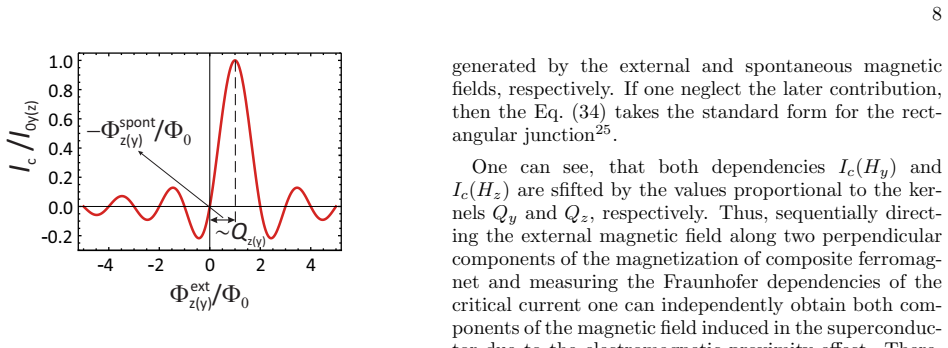
Measure the Fraunhofer shift of the critical current in an S1/I/S2/F junction with a non-collinear F1/F2 bilayer, sweeping the F1 thickness at fixed perpendicular moments. In the clean limit the theory predicts $Q^\perp_y$ and $Q^\perp_z$ oscillate and change sign with $d_1$, so the spontaneous-flux component extracted from the $I_c(H)$ shift should change sign as $d_1$ grows; a monotonic or absent shift would rule out the triplet-enhanced electromagnetic proximity effect.
Extended reading notes
Core claim
For an S/F1/F2 stack, the field induced in the superconductor is $\mathbf{B} = -4\pi M_0 \mathbf{Q} e^{x/\lambda_0}$, where $\mathbf{Q}$ is a vector kernel whose components are fixed by the singlet and triplet parts of the anomalous Green function. For perpendicular moments ($\theta=\pi/2$), a component $Q^\perp_y$ appears that is roughly $(\xi_n/\xi_f)^2$ larger than the parallel-configuration kernel $Q^\parallel_z$, because the equal-spin triplet component generated in F1 is insensitive to the exchange field of F2 and decays over the normal-metal coherence length $\xi_n$ rather than the short ferromagnetic coherence length $\xi_f$. This hierarchy is obtained both in the dirty (Usadel) and clean (Eilenberger) limits; in clean structures the kernel components oscillate with the ferromagnetic coherence length and the direction of the induced field can flip sign with the F1 thickness.
Load-bearing premise
The quantitative predictions rely on the rigid boundary condition at the S/F1 interface, $f_s=f_{s0}$ and $f_t=0$, which holds when the superconductor is much more conductive than the ferromagnet; a real interface with different transparency would change the injected triplet amplitude and hence the magnitude and sign trends of the predicted fields.
Editorial extensions
If this is right
- Perpendicular magnetization should produce a spontaneous field in the superconductor several times larger than parallel magnetization, matching the anomalous enhancement seen in muon-spin-rotation experiments.
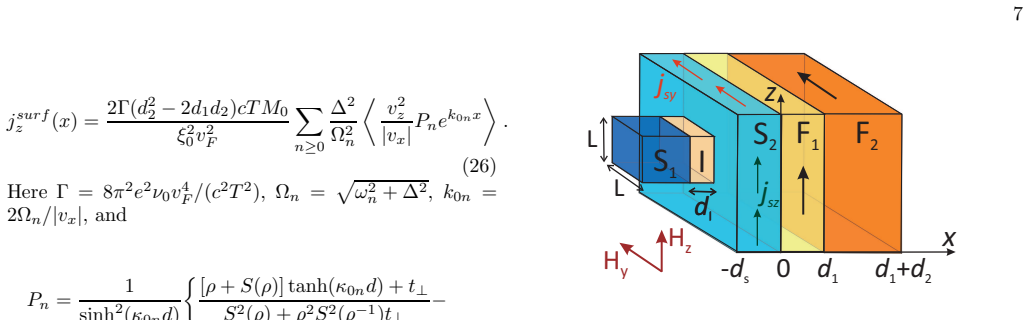
- In a Josephson junction with one electrode covered by the ferromagnetic bilayer, the critical-current Fraunhofer pattern shifts by amounts proportional to $Q_y$ and $Q_z$, so measuring $I_c(H_y)$ and $I_c(H_z)$ separately yields both the magnitude and the direction of the spontaneous field.
- The direction of the induced field at the S/F interface depends sensitively on the first ferromagnet's thickness, and in clean samples it oscillates and can flip sign as the thickness changes.
- In F1/S/F2 stacks the electromagnetic proximity effect makes the antiparallel magnetic configuration energetically favorable, and this coupling is long-ranged, dominating the exchange coupling once the superconducting layer is thicker than the coherence length.
Reading between the lines
- Because non-collinearity is the only ingredient needed, the same amplification should appear in a single ferromagnet containing a domain wall or a helical magnetization texture, not just in a two-layer stack.
- The Fraunhofer-shift measurement could serve as a quantitative probe of the triplet amplitude itself, since the extracted $Q$ components are set directly by $|f_s|^2-|f_t|^2$ in the ferromagnet.
- The predicted preference for antiparallel alignment suggests a superconductivity-based switching mechanism for spin-valve memories that remains effective for thicker superconducting layers than exchange-based switching.
Signed reviews
Editorial analysis
A structured set of objections, weighed in public.
Referee Report
Summary. This manuscript develops a microscopic theory of the electromagnetic proximity effect in S/F1/F2 spin-valve structures with noncollinear magnetizations. Using the Usadel equation in the dirty limit and the Eilenberger equation in the clean limit, the authors derive the magnetic kernel Q that sets the spontaneous magnetic field induced in the superconductor, and they show that the perpendicular magnetization configuration produces a much larger induced field than the parallel configuration because of long-ranged equal-spin triplet correlations. The results are applied to interpret the muon-spin-rotation enhancement observed in Ref. [7], a Josephson-junction measurement of the induced field through a Fraunhofer-pattern shift is proposed, and a long-ranged electromagnetic coupling between the ferromagnets in F1/S/F2 structures is discussed.
Significance. The qualitative mechanism is credible and the analytical derivations are substantial: the dirty-limit kernel is obtained from the full Usadel solution in Appendix A, and the clean-limit calculation is carried through the Eilenberger equations in Appendix B. The central prediction, that the perpendicular configuration generates a dominant Q_y component with an estimated ratio Q_y/Q_z ~ (xi_n/xi_f)^2, is physically transparent and does not involve fitting any parameter to the experimental field-enhancement factor. The proposed Josephson-shift experiment and the F/S/F magnetic-coupling prediction are falsifiable and would provide useful independent tests. However, as the authors' own numbers show, the quantitative agreement with experiment is at the factor-of-three level even under a favorably chosen thickness, so the experimental grounding is suggestive rather than confirmatory; this weakens but does not invalidate the central mechanism.
major comments (3)
- [V, Conclusion (p. 10)] The statement that the theory 'provides an adequate explanation of the experimental data in Ref. 7' is stronger than the presented comparison supports. The authors obtain a perpendicular-to-parallel enhancement of about 7 at d0 ~ 0.025 xi_0, while Ref. [7] reports an enhancement of about 20, and d0 is selected at a maximum of the strongly oscillating thickness dependencies shown in Figs. 2 and 5. The comparison is therefore not an independent free-parameter test, and the mismatch suggests that relevant physics (interface transparency, conductivity mismatch, or dirty/clean crossover) may be missing. I recommend either softening the claim to a semi-quantitative explanation or adding a sensitivity estimate over realistic parameters before the comparison is used as validation of the triplet mechanism.
- [II A, boundary condition after Eq. (8)] The magnitude of the predicted enhancement rests on the rigid boundary condition sigma_s >> sigma_f with f_s = f_s0 and f_t = 0 at the S/F1 interface, and the clean-limit calculation assumes ideal interfaces. This condition fixes the injected singlet amplitude and sets the triplet amplitude to zero at the S/F1 boundary, which is the main injection point for the long-ranged triplet component that controls Q_y. No calculation or estimate is given for how finite interface transparency changes the predicted ratio, even though the quantitative comparison with experiment is one of the paper's central claims. The authors should include an estimate of this sensitivity or clearly state that the quantitative comparison is limited to the rigid-interface idealization.
- [IV, Eqs. (36)-(37)] The prediction that the antiparallel configuration is favored in F1/S/F2 structures is derived in a model where the ferromagnets are described by effective London penetration depths lambda_1 and lambda_2, which are not computed from the microscopic theory used elsewhere in the paper. The authors themselves note that the sign of the electromagnetic kernel can change with ferromagnet thickness (Fig. 2), so the result should be presented as a model study for diamagnetic currents rather than as a general conclusion about the ground state. This limits the section's scope but does not affect the central triplet-enhancement mechanism.
minor comments (4)
- [p. 5, Sec. II] The phrase 'resent puzzling experiments' should be 'recent puzzling experiments'.
- [p. 10, Sec. III] In the sentence beginning 'both Fraunhofer dependencies', the second statement 'Ic(Hy)' should be 'Ic(Hz)'.
- [p. 3, Sec. II A] The word 'couterintuitive' should be 'counterintuitive'.
- [Acknowledgements and related work] Ref. [28] is mentioned only in the acknowledgements; a brief discussion of how the present results compare or overlap with that related work would help readers place the contribution.
Circularity Check
No significant circularity: kernels are computed from Usadel/Eilenberger equations with no fitted input, and the cited prior S/F bilayer result is an independent published derivation.
full rationale
The derivation chain is self-contained. For the dirty limit, the paper defines the material relation via Eq. (7), with 1/lambda^2 expressed through the anomalous Green functions fs and ft obtained from the Usadel equation (8), subject only to a rigid boundary condition at the S/F1 interface. The kernels Qy and Qz are then computed from those Green functions through Eqs. (6), (A11)-(A13); the enhanced field for non-collinear magnetizations is a derived consequence, not an input. In the clean limit, the kernels are obtained by solving the Eilenberger equations and matching the resulting current with the phenomenological surface-current form (15)-(18); again no experimental field value enters the calculation. The only imported ingredient is the parallel-orientation kernel, which is stated to coincide with the S/F bilayer result of Ref. [20] in both the dirty and clean limits. This is a self-citation, but it is not a circular step: Ref. [20] is an independent, parameter-free analytic derivation of the S/F bilayer electromagnetic proximity effect, published separately and based on the same microscopic equations; per the reviewing rules, such a citation is real evidence and does not raise the circularity score. The later comparison with the muon-spin experiment of Ref. [7] is made after the calculation, with the representative thickness d0 about 0.025 xi0 chosen at a maximum of the computed oscillations; the resulting ratio (about 7x versus the observed about 20x) is a quantitative limitation of the comparison, not a fitted input renamed as a prediction. No step in the paper reduces, by construction, to its own output, and the Fraunhofer-shift and spin-valve free-energy results follow algebraically from the same derived kernels. Accordingly, there is no significant circularity.
Assumptions & free parameters
free parameters (1)
- lambda_1, lambda_2 (effective London penetration depths in ferromagnetic layers)
assumptions (6)
- standard math Usadel equation for the dirty limit, Eq. (8)
- standard math Eilenberger equations for the clean limit, Eqs. (20)-(22)
- ad hoc to paper Rigid boundary condition at S/F1: sigma_s >> sigma_f, fs = fs0, ft = 0
- domain assumption Thin ferromagnet assumption d1, d2 << lambda, with Meissner screening inside F layers neglected
- standard math London local relation js = -(c/4pi lambda^2) A in the dirty limit
- ad hoc to paper Effective London model for F layers in Sec. IV, with penetration depths lambda_1 and lambda_2
Cite this review
Pith. "Pith review of Electromagnetic proximity effect controlled by spin-triplet correlations in superconducting spin-valve structures." pith.science (2026). https://pith.science/paper/4RP6TZJA
@misc{pith2026190805916,
  author       = {Pith},
  title        = {Pith review of: Electromagnetic proximity effect controlled by spin-triplet correlations in superconducting spin-valve structures},
  year         = {2026},
  howpublished = {\url{https://pith.science/paper/4RP6TZJA}},
  note         = {Machine review of arXiv:1908.05916}
}
abstract
The spin-triplet correlations in superconducting spin valve structures arising in the presence of noncollinear textures of magnetic moment are shown to enhance strongly the electromagnetic proximity effect, i. e. the long-range leakage of the magnetic field from the ferromagnet (F) to the superconducting (S) layer. Both the dirty and clean limits are studied on the basis of the Usadel and Eilenberger theory, correspondingly. Our results suggest a natural explanation for the puzzling enhancement of the spontaneous magnetic fields induced by the noncollinear magnetic structures observed by the muon spin rotation techniques in a wide class of layered S/F systems. We show that the electromagnetic proximity effect causes the shift of the Fraunhofer dependence of the critical current on the external magnetic field in the Josephson junction with one superconducting electrode covered by the ferromagnetic layer. This provides an alternative way to measure both the magnitude and the direction of the spontaneous magnetic field induced in the superconductor. We also demonstrate the possibility of the long ranged superconductivity control of the magnetic state in F$_1$/S/F$_2$ structures.
Figures


Figures from the paper (4 more)


Reference graph
Works this paper leans on
-
[7]
M.\ G.\ Flokstra, N.\ Satchell, J.\ Kim, G.\ Burnell, P.\ J.\ Curran, S.\ J.\ Bending, J.\ F.\ K.\ Cooper, C.\ J.\ Kinane, S.\ Langridge, A.\ Isidori, N.\ Pugach, M.\ Eschrig, H.\ Luetkens, A.\ Suter, T.\ Prokscha, and S. L. Lee, Nat. Phys. 12, 57 (2016)
work page 2016
-
[1]
A.\ I.\ Buzdin, Rev. Mod. Phys. 77, 935 (2005)
2005
-
[2]
A.\ A.\ Golubov, M.\ Yu.\ Kupriyanov, E.\ Ilichev, Rev. Mod. Phys. 76, 411 (2004)
work page 2004
-
[3]
F.\ S.\ Bergeret, A.\ F.\ Volkov and K.\ B.\ Efetov, Rev. Mod. Phys. 77, 1321 (2005)
work page 2005
-
[4]
R. I. Salikhov, I. A. Garifullin, N. N. Garif’yanov, L. R. Tagirov, K. Theis-Br\" o hl, K. Westerholt, and H. Zabel, Phys. Rev. Lett. 102, 087003 (2009)
work page 2009
-
[5]
J.\ Xia, V.\ Shelukhin, M.\ Karpovski, A.\ Kapitulnik, and A.\ Palevski, Phys. Rev. Lett. 102, 087004 (2009)
work page 2009
-
[6]
A. Di Bernardo, Z. Salman, X. L. Wang, M. Amado, M. Egilmez, M. G. Flokstra, A. Suter, S. L. Lee, J. H. Zhao, T. Prokscha, E. Morenzoni, M. G. Blamire, J. Linder, and J. W. A. Robinson, Phys. Rev. X 5, 041021 (2015)
work page 2015
-
[8]
Yu.\ N.\ Khaydukov, B.\ Nagy, J.-H.\ Kim, T.\ Keller, A.\ R\" u hm, Yu.\ V.\ Nikitenko, K.\ N.\ Zhernenkov, J.\ Stahn, L.\ F.\ Kiss, A.\ Csik, L.\ Botty\' a n, V.\ L.\ Aksenov, Zh. Eksp. Teor. Fiz. 98, 107 (2013)
work page 2013
Show all 28 references
-
[9]
M.\ G.\ Flokstra, R.\ Stewart, N.\ Satchell, G.\ Burnell, H.\ Luetkens, T.\ Prokscha, A.\ Suter, E.\ Morenzoni, S.\ Langridge, and S. L. Lee, Phys. Rev. Lett. 120, 247001 (2018)
2018
-
[10]
J.\ Stahn, J.\ Chakhalian, Ch.\ Niedermayer, J.\ Hoppler, T.\ Gutberlet, J.\ Voigt, F.\ Treubel, H-U.\ Habermeier, G.\ Cristiani, B.\ Keimer, and C.\ Bernhard, Phys. Rev. B 71, 140509 (R) (2005)
2005
-
[11]
Nagy, Yu
B. Nagy, Yu. Khaydukov, D. Efremov, A. S. Vasenko, L. Mustafa, J.-H. Kim, T. Keller, K. Zhernenkov, A. Devishvili, R. Steitz, B. Keimer and L. Bottyr\' a n, Europhys. Lett. 116, 17005 (2016)
2016
-
[12]
G. A. Ovsyannikov, V. V. Demidov, Yu. N. Khaydukov, L. Mustafa, K. Y. Constantinian, A. V. Kalabukhov, D. Winkler, JETP 122, 738 (2016)
2016
-
[13]
M. G. Flokstra, R. Stewart, N. Satchell, G. Burnell, H. Luetkens, T. Prokscha, A. Suter, E. Morenzoni, S. Langridge, and S. L. Lee, Phys. Rev. Lett. 120, 247001 (2018)
2018
-
[14]
A. Yu. Aladyshkin, A. V. Silhanek, W. Gillijns, V. V. Moshchalkov, Supercond. Sci. Tech. 22, 053001 (2009)
2009
-
[15]
V.\ N.\ Krivoruchko and E.\ A.\ Koshina, Phys. Rev. B 66, 014521 (2002)
2002
-
[16]
F.\ S.\ Bergeret, A.\ F.\ Volkov, and K.\ B.\ Efetov, Phys. Rev. B 69, 174504 (2004)
2004
-
[17]
F.\ S.\ Bergeret, A.\ Levy Yeyati, and A.\ Mart\' n-Rodero, Phys. Rev. B 72, 064524 (2005)
2005
-
[18]
Tomas L\" o fwander, Thierry Champel, Johannes Durst, and Matthias Eschrig, Phys. Rev. Lett. 95, 187003 (2005)
2005
-
[19]
M.\ Faure, A.\ Buzdin and D.\ Gusakova, Physica C 454, 61 (2007)
2007
-
[20]
Buzdin, Appl
S.\ V.\ Mironov, A.\ S.\ Mel'nikov, A.\ I. Buzdin, Appl. Phys.Lett. 113, 022601 (2018)
2018
-
[21]
F.\ S.\ Bergeret, A.\ F.\ Volkov, and K.\ B.\ Efetov, Europhys. Lett. 66(1), 111 (2004)
2004
-
[22]
M.\ Krawiec, B.\ L.\ Gyorffy, and J.\ F.\ Annett, Phys. Rev. B 66, 172505 (2002)
2002
-
[23]
Champel and M
T. Champel and M. Eschrig, Phys. Rev. B 72, 054523 (2005)
2005
-
[24]
Mironov, E
S. Mironov, E. Goldobin, D. Koelle, R. Kleiner, Ph. Tamarat, B. Lounis, and A. Buzdin, Phys. Rev. B 96, 214515 (2017)
2017
-
[25]
Barone, G
A. Barone, G. Paterno, Physics and Applications of the Josephson effect (A Wiley-Interscience Publication, New York, 1982)
1982
-
[26]
P.\ G.\ De Gennes, Phys. Lett. 23, 10 (1966)
1966
-
[27]
Y.\ Zhu, A.\ Pal, M.\ Blamire, and Z.\ Barber, Nat. Mat. 16, 195 (2017)
2017
-
[28]
A.\ F.\ Volkov, F.\ S.\ Bergeret and K.\ B.\ Efetov, arXiv:1901.04446
1901 arXiv
Reviewed August 14, 2026 · model on record in the stance chip above.
Discussion (0). Continue with ORCID to comment.