REVIEW 4 major objections 5 minor 16 references
Effects of fluctuations and color-neutrality in a finite volume
T0 review · 4 major / 5 minor · reviewed 2026-08-14 · deepseek-v4-flash
Pith's one-line read Small systems raise the deconfinement temperature by a V^{-0.75} law
desk verdict A useful small-system caveat from a schematic model, but the claimed universal exponent λ≈0.75 is an unsupported numerical fit and the abstract oversells it. read the letter →
The pith
A machine-rendered reading of the paper's core claim, the machinery that carries it, and where it could break.
The reading
What carries the argument
The load-bearing object is the fixed-volume-fraction grand potential $\Phi_\xi(T,\mu_B,V) = V[\xi\,\phi_h(\xi V) + (1-\xi)\,\phi_q((1-\xi)V)]$, with each macroscopic configuration weighted by $\exp[-\Phi_\xi/T]$. The hadronic phase $\phi_h$ is an ideal resonance gas with a Hagedorn correction, while the deconfined phase $\phi_q$ is an ideal gas of massless quarks and gluons inside a bag, modified by the color-neutrality and fixed-momentum constraints through the auxiliary quantities $C$, $D$, $X$, and $Y$. Taking expectation values of phase-dependent quantities with this weight is what converts the infinite-volume Gibbs condition $p_h = p_q$ into a finite-volume probability distribution over $\xi$, from which the effective critical temperature and the baryon-number susceptibilities are derived.
What would settle it
One concrete test is to measure the baryon-number susceptibility ratio $\chi_4^B/\chi_2^B$ as a function of collision-system size at fixed temperature and baryochemical potential: the model predicts a specific damping of the peak between $V = 25$ and $100$ fm$^3$ and an inversion of the finite-volume correction as $\mu_B$ crosses roughly $300$ MeV. Alternatively, a lattice QCD calculation of the finite-volume shift of the pseudo-critical temperature with physical quark masses would decide whether $\Delta T_C \propto V^{-0.75}$ is the right scaling or an artifact of the ideal-gas coexistence model.
Extended reading notes
Core claim
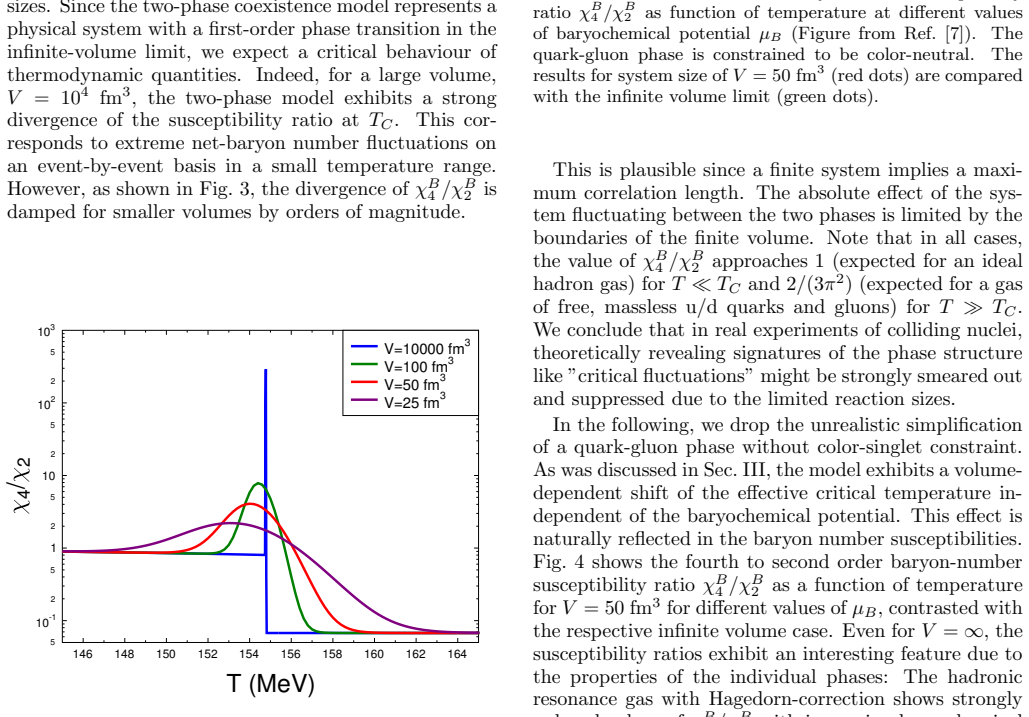
The central claim, stated on the model's own terms, is that the two-phase coexistence ansatz in a finite volume turns the first-order transition of infinite matter into a smooth crossover and produces a volume-dependent effective critical temperature defined by $\langle \xi(T_C^{\mathrm{eff}}(V)) \rangle = 1/2$, where $\xi$ is the hadronic volume fraction. The color-singlet constraint on the deconfined phase makes the quark-gluon phase thermodynamically less favorable in small droplets, so the crossover temperature rises above $T_C^\infty$; numerically the shift is $\Delta T_C(V) \sim V^{-0.75}$, with nearly identical absolute shifts for $\mu_B = 0$, $600$, and $1200$ MeV and for different values of the bag constant. Because both phases are always present in a finite volume, the susceptibility ratio $\chi_4^B/\chi_2^B$ no longer diverges: at $\mu_B = 0$ its peak is suppressed by orders of magnitude when the volume drops from $10^4$ fm$^3$ to $25$ fm$^3$, and at $V = 50$ fm$^3$ the ratio lies above or below the infinite-volume curve depending on whether $\mu_B$ is below or above roughly $300$ MeV.
Load-bearing premise
Everything rests on the coexistence ansatz that the hadronic and quark-gluon phases are independent, uncorrelated ideal gases that interact only through the volume fraction $\xi$, with the color-neutrality correction providing the finite-volume suppression; since lattice QCD at $\mu_B = 0$ has no first-order transition, the model at zero baryon density is known to be only schematic.
Editorial extensions
If this is right
- Central heavy-ion collisions should show a decrease in effective freeze-out temperature as system volume grows, with $\Delta T_C \approx 25$ MeV at $V = 50$ fm$^3$.
- The apparent divergence of $\chi_4^B/\chi_2^B$ at the infinite-volume critical point becomes a finite peak in small systems, so event-by-event kurtosis measurements lose sensitivity to a sharp phase boundary.
- The sign of the finite-volume correction to $\chi_4^B/\chi_2^B$ depends on $\mu_B$: at low baryon density the shifted transition keeps hadronic-type values, while above $\mu_B \approx 300$ MeV the ratio falls below the infinite-volume result, complicating direct small-versus-large system comparisons.
- Because the volume shift is nearly independent of $\mu_B$ and of the bag constant, the predicted $V^{-0.75}$ scaling can be checked across beam energies and system sizes without tuning model parameters.
Reading between the lines
- The same color-neutrality suppression should also appear in higher moments of the net-baryon distribution, such as $\chi_6^B$, which the paper does not compute but which would follow from the same expectation-value formalism.
- Replacing the ideal resonance gas with a strangeness-carrying or interacting hadron gas would test whether the $V^{-0.75}$ exponent is a generic property of the color-neutrality constraint or an artifact of the specific equation of state.
- The mismatch the paper notes between the model's $\lambda \approx 0.75$ and the hadrochemical fits' $\lambda \approx 0.5$ suggests that freeze-out temperatures are not set purely by equilibrium coexistence; dynamic effects such as cooling rates or partial chemical equilibrium may control the apparent volume dependence.
Signed reviews
Editorial analysis
A structured set of objections, weighed in public.
Referee Report
Summary. The paper studies a schematic two-phase model in which the grand canonical potential for a finite volume is obtained by Boltzmann-weighting configurations with a hadronic volume fraction ξ and a quark-gluon volume fraction 1-ξ. The quark-gluon phase is described by an ideal gas with the Elze-Greiner color-neutrality constraint. The authors define an effective critical temperature through ⟨ξ⟩=1/2 and report a volume scaling ΔT_C(V) = T_C^eff(V)-T_C^∞ ∼ V^{-λ} with λ≈0.75, claimed to be independent of baryochemical potential and, to the extent checked, of the bag constant. They compare this scaling with SU(3) lattice results and with hadrochemical freeze-out temperatures extracted from pp, pA, and AA collisions, and they study the baryon-number susceptibility ratio χ_4/χ_2, finding strong suppression in small volumes.
Significance. If the claimed universal scaling law were established, it would provide a simple finite-size correction for interpreting small collision systems and would connect the model to both lattice gauge theory and hadrochemical data. The paper also makes a falsifiable prediction that observable baryon-number fluctuations are strongly damped in systems of 25-100 fm^3. The model is transparent and the equations are sufficiently explicit to judge internal consistency. However, the central scaling-law claim is currently presented as an unsupported numerical observation, and the comparison with external data is only qualitative; these issues prevent the paper from being accepted in its present form.
major comments (4)
- [Section III, Fig. 1] The central claim that a universal scaling exponent λ≈0.75 has been extracted from the numerical analysis is not supported by the presentation. No fit function, fit range, or uncertainty is given, and the figure does not show the promised variation of the bag constant: the caption identifies B=275 MeV/fm^3 only for the μ_B=0 curve, and no curves with different B values are visible or labeled. Since this exponent is the main new result, the authors must provide the fitting procedure and show explicitly that the exponent is stable over a defined range of V and for several values of B.
- [Section III, Eqs. (4)-(7)] The claimed V^{-λ} behavior is not derived and is likely not an asymptotic power law. The finite-volume correction to φ_q contains competing terms: the surface term Y contributes a V^{-2/3} contribution after multiplication by -T/V, while the constraint logarithm -T/V ln(C^{-4}D^{-3/2}) produces V^{-1} ln V and V^{-1} terms once C and D are expanded. Over the plotted range V ∈ [5, 5×10^4] fm^3, a superposition a V^{-2/3} + b V^{-1} ln V can have a log-log slope near 0.75 without representing an asymptotic universal exponent. To establish universality, the authors should either derive the asymptotic scaling analytically or demonstrate that the local slope is stable over several decades of V and for a range of B.
- [Section IV, Fig. 2] The hadrochemical comparison does not quantitatively support the model's scaling law. The model curve in Fig. 2 is based on T_C^eff computed with the V^{-0.75} scaling, while the hadrochemical fits to experimental data give λ≈0.5. The paper describes this as qualitative support, but the discrepancy in exponents means the comparison does not discriminate the model from other explanations of an apparent system-size dependence. A quantitative statement of the agreement, such as a χ^2 or a direct comparison of temperature shifts at matched volumes, is needed.
- [Section V, Fig. 4 and conclusion] The prediction that χ_4/χ_2 is suppressed in small systems relies on the model's assumed first-order coexistence at μ_B=0, which the authors acknowledge is not realized in lattice QCD. The damping and the sign reversal in Fig. 4 are consequences of the two-phase ansatz together with the color-neutrality constraint, not of QCD itself. The paper should state this limitation more prominently in the abstract and conclusions, and it would strengthen the case to test whether the qualitative results survive a crossover-like equation of state.
minor comments (5)
- [Section V, Eq. (8)] Equation (8) is malformed as printed: "-∂i ˆϕ / ∂ˆµi_B" mixes index placements and is ambiguous. It should be written as χ_i^B = -∂^i \hatϕ / ∂(\hatμ_B)^i or an equivalent unambiguous notation.
- [Fig. 1] The vertical axis label appears to be "MeV/fm^3" but the plotted quantity ΔT_C has units of MeV; the units label should be corrected.
- [Throughout] There are several typographical errors, including "critical behviour" in the abstract, "microsopically" in Sec. II, "attenation" in Sec. III, and "suscptibility" in Sec. V; the manuscript should be carefully proofread.
- [Fig. 1 caption] The figure caption and legend do not specify which colored line corresponds to which value of the bag constant B, despite the text stating that calculations for different B are shown. Please make the B values explicit in the caption or legend.
- [Sec. IV, Fig. 2] The width of the model band is said to reflect the error bars of the freeze-out radii, but it is not stated whether any variation of B is included; if not, this should be clarified.
Circularity Check
No significant circularity: the scaling-law and susceptibility claims are derived from the paper's stated two-phase ansatz and compared with independent lattice and hadrochemical results.
full rationale
The central results are not obtained by fitting the claimed outputs. The model is defined explicitly in Eqs. (1)-(2) as a Boltzmann-weighted superposition of a hadronic phase and a quark-gluon phase. The finite-volume shift ΔT_C(V) is computed from this partition function, with T_C^eff defined by ⟨ξ⟩=1/2 and T_C^∞ fixed by choosing the bag constant so that the infinite-volume transition matches the lattice chiral transition temperature. The damping of χ_4/χ_2 is likewise an explicit model calculation from the same defined free energy. The paper does not fit λ≈0.75 to the SU(3) lattice CBC data; it compares the model's slope with that independent lattice result, and the hadrochemical comparison in Sec. IV uses freeze-out radii and thermal-fit temperatures from Ref. [16] as external inputs. Use of the authors' earlier papers [6,7] is not load-bearing because the model equations, including the Elze-Greiner color-neutrality approximation [10], are stated in the paper and the numerical results follow from those equations. The statement that the scaling law also holds for different bag constants is not demonstrated by Fig. 1, and the local log-log slope in the plotted volume window could be an effective mixture of V^{-2/3} and V^{-1}ln V terms rather than an asymptotic exponent; however, these are concerns about support and interpretation, not circular reductions of the predictions to their inputs. The derivation chain is self-contained relative to its clearly stated model assumptions.
Assumptions & free parameters
free parameters (1)
- Bag constant B =
B^{1/4}=215 MeV (B≈275 MeV/fm³)
assumptions (5)
- ad hoc to paper Two-phase coexistence ansatz: total potential is Φξ = V[ξ φ_h(ξV)+(1-ξ)φ_q((1-ξ)V)] and configurations are weighted by exp[-Φξ/T].
- domain assumption The deconfined phase is an ideal gas of massless quarks and gluons in a spherical cavity with bag pressure and the Elze-Greiner color-neutrality approximation (Eqs. 4-7).
- domain assumption The hadronic phase is an ideal gas of non-strange baryon and meson resonances up to 2 GeV with the Hagedorn correction 1/(1+ε/4B).
- domain assumption The chemical freeze-out temperature in collisions is identified with the effective critical temperature T_C^eff(V) of the model.
- domain assumption Finite-size shift is analyzed with the power-law ansatz ΔT_C ~ V^{-λ}.
Cite this review
Pith. "Pith review of Effects of fluctuations and color-neutrality in a finite volume." pith.science (2026). https://pith.science/paper/2T4B3X7K
@misc{pith2026190805927,
  author       = {Pith},
  title        = {Pith review of: Effects of fluctuations and color-neutrality in a finite volume},
  year         = {2026},
  howpublished = {\url{https://pith.science/paper/2T4B3X7K}},
  note         = {Machine review of arXiv:1908.05927}
}
abstract
We investigate properties of strongly interacting matter in a schematic model, based on the combined degrees of freedom of a non-interacting hadronic phase and a non-interacting deconfined phase. It is found that in a finite system both phases contribute to the thermodynamic state due to fluctuations and that signatures of critical behviour like the divergence of statistical quantities are damped. The constraint of color-neutrality leads to a volume-dependent shift of the effective critical temperature, which follows a scaling law, independent of the baryochemical potential. According to the model, observable baryon-number susceptibilities at a given $T$ and $\mu_B$ strongly depend on the system size. Finally, we compare hadronization conditions from the model with hadrochemical fits to experimental collider data, where a qualitatively similar system size dependence is extracted.
Figures


Figures from the paper (1 more)
Reference graph
Works this paper leans on
- [1]
-
[2]
A. e. a. Bazavov, Phys. Rev. D 95, 054504 (2017)
work page 2017
-
[3]
J. N. Guenther, R. Bellwied, S. Borsanyi, Z. Fodor, S. Katz, A. Pasztor, C. Ratti, and K. K. Szabo, PoS CPOD2017 , 032 (2018)
work page 2018
-
[4]
Luo and N
X. Luo and N. Xu, Nucl. Sci. Tech. 28, 112 (2017)
2017
-
[5]
M. Bleicher, L. Gerland, C. Spieles, A. Dumitru, S. Bass, M. Belkacem, M. Brandstetter, C. Ernst, L. Neise, S. Soff, H. Weber, H. St¨ ocker, and W. Greiner, Nucl. Phys. A 638, 391 (1998)
work page 1998
- [6]
-
[7]
C. Spieles, M. Bleicher, and C. Greiner, J. Phys. G: Nucl. Part. Phys. 46, 025101 (2019)
work page 2019
-
[8]
L. D. Landau, E. M. Lifshitz, and L. P. Pitaevskiy, Theoretical Physics, Vol. 5 Statistical Physics , Sec. 146 (Nauka, Moscow, 1976)
work page 1976
Show all 16 references
-
[9]
Hagedorn and J
R. Hagedorn and J. Rafelski, Phys. Lett. B 97, 136 (1980)
1980
-
[10]
H. T. Elze and W. Greiner, Phys. Lett. B179, 385 (1986)
1986
-
[11]
B. A. Berg and H. Wu, Phys. Rev. D 88, 074509 (2013)
2013
-
[12]
Binder and D
K. Binder and D. P. Landau, Phys. Rev. B 30, 1477 (1984)
1984
-
[13]
Ladrem and A
M. Ladrem and A. Ait-El-Djoudi, Eur. Phys. J. C 44, 257 (2005)
2005
-
[14]
Andronic, P
A. Andronic, P. Braun-Munzinger, K. Redlich, and J. Stachel, Nature 561, 321 (2018), arXiv:nucl- th/1710.09425
2018 arXiv
-
[15]
Stock, F
R. Stock, F. Becattini, M. Bleicher, and J. Steinheimer, Nucl. Phys. A 982, 827 (2019)
2019
-
[16]
Sharma, J
N. Sharma, J. Cleymans, B. Hippolyte, and M. Parazda, Phys. Rev. C 99, 044914 (2019). 3 Note that the critical temperatureT ∞ C itself depends on the bary- ochemical potential. However, this is qualitatively irrelevant for the effect discussed here
2019
Reviewed August 14, 2026 · model on record in the stance chip above.
Discussion (0). Continue with ORCID to comment.