REVIEW 3 major objections 5 minor 29 references
Toward an Attribute-Based Digital Identity Modeling for Privacy Preservation
T0 review · 3 major / 5 minor · reviewed 2026-08-14 · deepseek-v4-flash
Pith's one-line read The paper argues that digital identity should be modeled as user-controlled claims carried by Attribute-Based Credentials, which would make privacy, security, and identity-theft protection properties of the model itself.
desk verdict A clearly written conceptual position paper whose central privacy and identity-theft claims are asserted rather than demonstrated, and where the transfer of ABC unlinkability to the proposed model does not survive scrutiny. read the letter →
The pith
A machine-rendered reading of the paper's core claim, the machinery that carries it, and where it could break.
The reading
What carries the argument
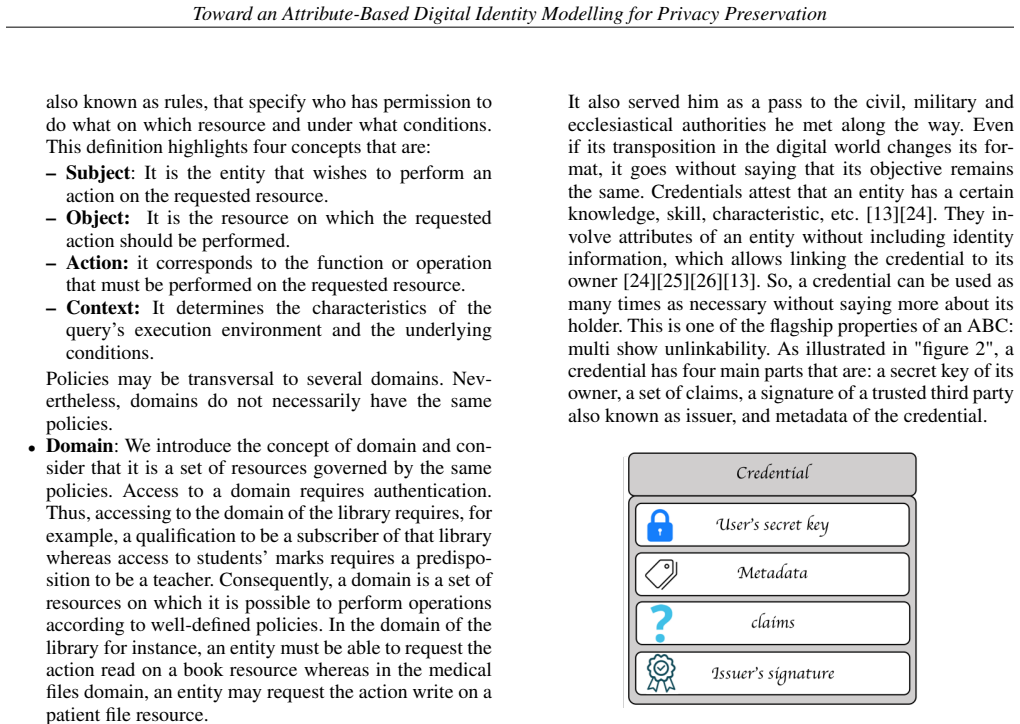
The carrying object is the attribute-credential-partial identity triad. An attribute is a named characteristic (name plus value) that becomes a claim when certified by a trusted party; a credential bundles a secret key, a set of claims, an issuer signature, and metadata; a partial identity is the subset of an entity's attributes that a given domain sees. The argument works by making attributes the only unit of disclosure and by letting one credential serve many domains, so that the ABC properties of multi-show unlinkability and user-controlled disclosure transfer directly to the identity model.
What would settle it
Run a linking attack on two partial identities within the model: a user presents attributes a3 and a6 to domain d2 and attributes a4 and a6 to domain d4. If an observer who sees both presentations can determine that both sets belong to the same entity (through shared attribute a6, timing, or credential metadata), then the model's privacy claim fails; if such linkage is impossible, the claim survives.
Extended reading notes
Core claim
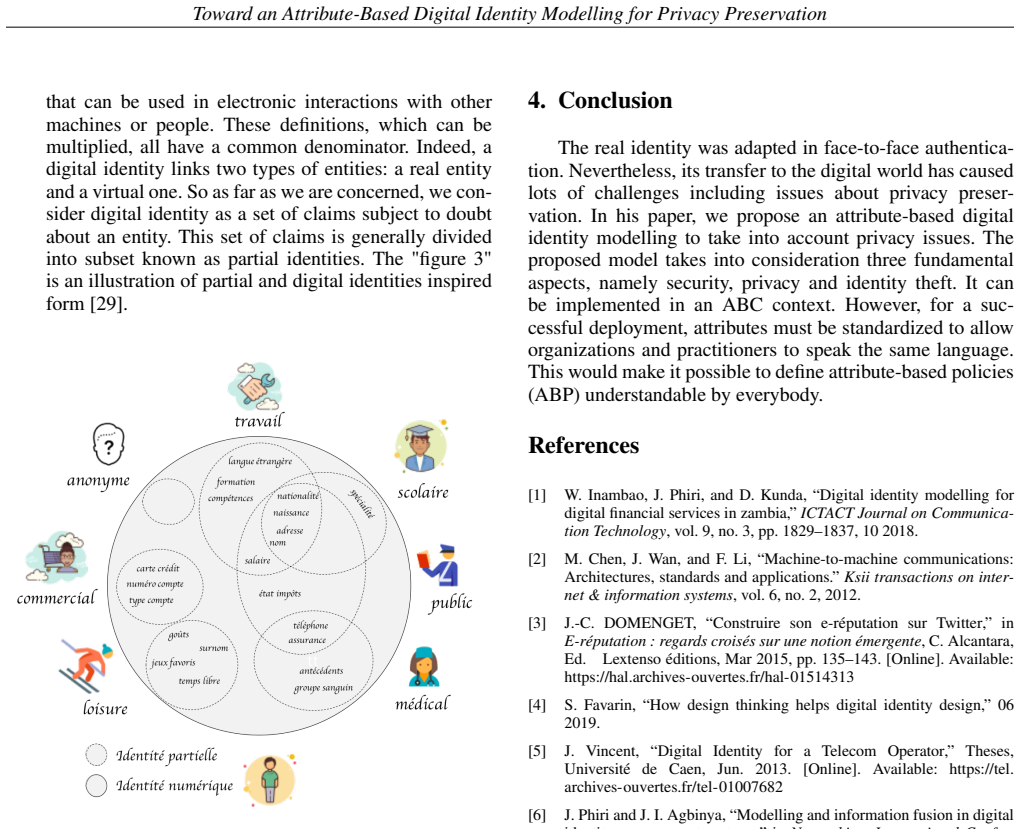
The central claim is that digital identity is a set of claims subject to doubt about an entity, and that this set naturally splits into partial identities, one per domain of interaction. Each partial identity is a subset of an entity's attributes, and attributes travel inside credentials that are transversal across domains. The model ties together policies, domains, entities, attributes, and credentials in a single picture, and then leans on ABC's secret key, non-transferability, and proof-of-ownership properties to argue that identity theft and security problems raised in earlier work can be solved, since attributes are never disclosed unless the user decides to disclose them.
Load-bearing premise
The model assumes that privacy is preserved simply because attributes are disclosed only at the user's discretion, and that ABC properties (secret key, non-transferability, proof of ownership) automatically rule out identity theft; it does not consider inference from partial identities, metadata, or the issuer's visibility.
Editorial extensions
If this is right
- If the model is implemented in an ABC system, users can authenticate to a domain by proving only the attributes that domain's policy requires, without revealing who they are.
- A single credential can span multiple domains, so partial identities remain separate and linkability is not forced by the model.
- Identity theft is countered by the ABC secret key and proof-of-ownership properties, since a stolen credential cannot be used by someone who lacks the key.
- Policies can be expressed purely in terms of attributes, giving a common language for organizations to specify access rules across domains.
- Standardizing attribute names and values becomes a prerequisite for wide deployment, as the conclusion notes.
Reading between the lines
- The privacy claim is conditional on the absence of cross-domain inference from the attributes themselves; the paper does not analyze whether disclosed attributes plus context can re-identify a user, so a stricter model would need to bound attribute correlation.
- The same triad could be turned into a testable protocol: implement a small ABC-based policy engine and measure whether access decisions leak more than the required attributes.
- The model implicitly supports data minimization and purpose limitation, and could be connected to legal frameworks such as GDPR's data minimization principle, though the paper does not make that link.
- A natural extension is to make the policy language machine-readable so that domains can advertise requirements and users can compute which credentials to present.
Signed reviews
Editorial analysis
A structured set of objections, weighed in public.
Referee Report
Summary. The paper proposes an attribute-based digital identity model intended for privacy preservation. The model is built from six concepts: policies, domains, entities, attributes, credentials, and partial identities, with a digital identity defined as a set of claims divided into partial identities. The authors claim that, thanks to Attribute-Based Credential (ABC) properties (secret key, non-transferability, and proof of ownership), the model preserves privacy and prevents identity theft. The paper provides informal definitions, a conceptual figure, and an illustrative policy example, but no concrete instantiation, formal semantics, or security analysis.
Significance. If the model were rigorously instantiated with a privacy-preserving ABC scheme, it could serve as a useful conceptual bridge between high-level identity notions and ABC implementations. The paper correctly identifies privacy as a key requirement for digital identity systems and builds on established ABC concepts. However, the central claims—that the model preserves privacy and prevents identity theft—are asserted rather than demonstrated. The paper offers no adversary model, no analysis of linkability or inference attacks, and no proof that ABC properties transfer to the described box-and-arrow model. Its contribution is therefore primarily terminological, and its significance is limited by the lack of validation.
major comments (3)
- [Section 3, Credential paragraph and Figure 2] The paper asserts that multi-show unlinkability is a property of the proposed model, stating that a credential 'can be used as many times as necessary without saying more about its holder.' This claim is not supported. In the model, a single credential is transversal to several domains (e.g., c5 grants access to d2 and d4) and contains a fixed issuer signature and credential metadata. If the same signed credential is presented in two domains, colluding verifiers can compare the signature and metadata to link the corresponding partial identities. The paper does not specify any mechanism—such as randomized presentations, pseudonyms, selective disclosure, or zero-knowledge predicates—that would preserve unlinkability under such cross-domain reuse. Thus the privacy claim rests on an unexamined transfer of ABC properties to the model.
- [Abstract and Section 3] The paper claims that ABC's secret-key, non-transferability, and proof-of-ownership properties solve identity theft. This is not established. Non-transferability is a property against sharing of credentials by honest users; it does not address theft of a secret key through malware, phishing, or coercion. The model defines a secret key as part of the credential but provides no mechanism or analysis showing that key exfiltration is prevented. Without an explicit adversary model and threat analysis, the identity-theft claim is unsupported.
- [Section 3, policy example] The model is defined only informally, through natural-language descriptions and a conceptual figure. The policy example (library access) is purely illustrative and does not demonstrate that the model enforces the policy or preserves privacy in any verifiable way. There is no formal syntax or semantics for attributes, credentials, domains, or partial identities, and no specification of how ABC protocols would be applied. Consequently, the central claim that the model 'takes into account privacy issues' cannot be validated from the presented material.
minor comments (5)
- [Section 3, Credential paragraph] The phrase 'which allows linking the credential to its owner' appears to be a typo; it should likely read 'without allowing linking,' given the following sentence about multi-show unlinkability.
- [Section 4, Conclusion] The sentence 'In his paper, we propose...' should read 'In this paper, we propose...'.
- [Abstract] The phrase 'Seeing how important privacy master is' should likely be 'Seeing how important privacy matters is' or 'Seeing how important privacy is.'
- [General] Figures 1, 2, and 3 are referenced in the text but not included in the manuscript; the final version must include them.
- [References] Several references have inconsistent formatting, such as duplicated page numbers and missing publisher locations; a careful editing pass is needed.
Circularity Check
No circularity: the privacy claim imports standard ABC properties from prior work and external sources; no derivation reduces to its own inputs.
full rationale
This is a conceptual modeling paper with no derivation chain whose output could equal an input. The strongest claim—that the model preserves privacy and counters identity theft because ABC credentials have a secret key, non-transferability, and proof-of-ownership properties (abstract; Section 1; Section 3, Credential)—is an import of standard ABC properties from the literature, not a result derived in the paper. The self-citation [13] (I2PA, by the same authors) is used as a reference for these ABC properties, but it is not the sole or load-bearing support: the surrounding text also cites external works [14], [24], [25], [26] for credential non-identifying linking and multi-show unlinkability. No parameter is fitted, no quantity is renamed as a prediction, and no uniqueness theorem from the authors' prior work is invoked to force the model's choice. The skeptical concern that reusing a credential across domains (Section 3: 'A credential can be transversal to several domains') could enable linking is a correctness/validity gap in the informal transfer of ABC guarantees, not a circularity: the paper asserts the transfer rather than defining the model's privacy as equivalent to a fitted value. The manuscript itself notes in Section 4 that attributes must be standardized for deployment, which is a practical dependency, not a circular one. Therefore no circular step can be exhibited, and the appropriate finding is no significant circularity.
Assumptions & free parameters
assumptions (5)
- domain assumption ABC properties (secret key, non-transferability, proof of ownership, multi-show unlinkability) are sufficient to prevent identity theft and preserve privacy in the modeled identity system.
- domain assumption Attributes are never disclosed unless the user decides to do so, and this user-mediated disclosure fully captures privacy.
- domain assumption The model focuses on entities of type subject (human), excluding device or machine identities.
- ad hoc to paper A domain is a set of resources governed by the same policies, and access to a domain requires authentication.
- domain assumption Digital identity is a set of claims subject to doubt about an entity, divided into partial identities.
invented entities (1)
-
Domain
Cite this review
Pith. "Pith review of Toward an Attribute-Based Digital Identity Modeling for Privacy Preservation." pith.science (2026). https://pith.science/paper/LGE7CHUQ
@misc{pith2026190805945,
  author       = {Pith},
  title        = {Pith review of: Toward an Attribute-Based Digital Identity Modeling for Privacy Preservation},
  year         = {2026},
  howpublished = {\url{https://pith.science/paper/LGE7CHUQ}},
  note         = {Machine review of arXiv:1908.05945}
}
read the original abstract
Digital identity is a multidimensional, multidisciplinary, and a complex concept. As a result, it is difficult to apprehend. Many contributions have proposed definitions and representations of digital identity. However, lots of them are either very generic and difficult to implement or do not take into account privacy issues. Seeing how important privacy master is, it becomes a necessity to rethink digital identity in order to take into account privacy issues. So, this paper aims at proposing an attribute-based digital identity vision for privacy preservation purposes. The proposed model takes into account identity theft, security, and privacy.
Figures

Reference graph
Works this paper leans on
-
[13]
I2pa: An efficient abc for iot,
I. Sene, A. Ciss, and O. Niang, “I2pa: An efficient abc for iot,” Cryp- tography, vol. 3, no. 2, p. 16, 06 2019
work page 2019
-
[1]
Digital identity modelling for digital financial services in zambia,
W. Inambao, J. Phiri, and D. Kunda, “Digital identity modelling for digital financial services in zambia,” ICTACT Journal on Communica- tion Technology, vol. 9, no. 3, pp. 1829–1837, 10 2018
work page 2018
-
[2]
Machine-to-machine communications: Architectures, standards and applications
M. Chen, J. Wan, and F. Li, “Machine-to-machine communications: Architectures, standards and applications.” Ksii transactions on inter- net & information systems, vol. 6, no. 2, 2012
work page 2012
-
[3]
Construire son e-réputation sur Twitter,
J.-C. DOMENGET, “Construire son e-réputation sur Twitter,” in E-réputation : regards croisés sur une notion émergente, C. Alcantara, Ed. Lextenso éditions, Mar 2015, pp. 135–143. [Online]. Available: https://hal.archives-ouvertes.fr/hal-01514313
work page 2015
-
[4]
How design thinking helps digital identity design,
S. Favarin, “How design thinking helps digital identity design,” 06 2019
work page 2019
-
[5]
Digital Identity for a Telecom Operator,
J. Vincent, “Digital Identity for a Telecom Operator,” Theses, Université de Caen, Jun. 2013. [Online]. Available: https://tel. archives-ouvertes.fr/tel-01007682
work page 2013
-
[6]
Modelling and information fusion in digital identity management systems,
J. Phiri and J. I. Agbinya, “Modelling and information fusion in digital identity management systems,” in Networking, International Confer- ence on Systems and International Conference on Mobile Commu- nications and Learning Technologies, 2006. ICN/ICONS/MCL 2006. International Conference on. IEEE, 2006, pp. 181–181
work page 2006
-
[7]
Représentation de soi et identité numérique,
F. Georges, “Représentation de soi et identité numérique,” Réseaux, vol. 154, pp. 165–193, 08 2009
work page 2009
Show all 29 references
-
[8]
L’identité numérique dans le web 2.0,
——, “L’identité numérique dans le web 2.0,” Mar 2008. [Online]. Available: https://hal.archives-ouvertes.fr/hal-01575199
2008
-
[9]
Les composantes de l’identité dans le web 2.0, une étude sémiotique et statistique. hypostase de l’immédiateté,
——, “Les composantes de l’identité dans le web 2.0, une étude sémiotique et statistique. hypostase de l’immédiateté,” in Communication au 76ème congrès de l’ACFAS: Web participatif: mutation de la communication ?, 6 et 7 mai 2008, Centre des congrès, Québec., Québec, Canada, M...
2008
-
[10]
Identité numérique des organisations : approche conceptuelle et analyse exploratoire de réception par la lexicométrie,
D. Pélissier, “Identité numérique des organisations : approche conceptuelle et analyse exploratoire de réception par la lexicométrie,” in Colloque Jeunes Chercheurs Praxiling 2015, Trace(s), Montpellier, France, Oct. 2015. [Online]. Available: https://hal.archives-ouvertes. fr...
2015
-
[11]
Digital identity,
J. Camp, “Digital identity,” IEEE Technology and society Magazine , vol. 23, no. 3, pp. 34–41, 2004
2004
-
[12]
Challenges of identity management systems and mechanisms: A review of mobile identity,
R. Banda and P. Phiri, “Challenges of identity management systems and mechanisms: A review of mobile identity,” 03 2019
2019
-
[14]
A secure channel for attribute-based credentials: [short paper],
G. Alpar and J.-H. Hoepman, “A secure channel for attribute-based credentials: [short paper],” 11 2013, pp. 13–18. 4 | 5 Toward an Attribute-Based Digital Identity Modelling for Privacy Preservation
2013
-
[15]
Digital identity,
M. N O Sadiku, A. Shadare, and S. M Musa, “Digital identity,” Inter- national Journal of Innovative Science, Engineering and Technology , vol. 3, p. 2016, 12 2016
2016
-
[16]
De l’identité numérique à l’individu transmédiatique,
J. Pierre, “De l’identité numérique à l’individu transmédiatique,” MEDIADOC, no. 13, Dec. 2014. [Online]. Available: https:// archivesic.ccsd.cnrs.fr/sic_01084772
2014
-
[17]
Establish- ing and protecting digital identity in federation systems,
A. Bhargav-Spantzel, A. C. Squicciarini, and E. Bertino, “Establish- ing and protecting digital identity in federation systems,” Journal of Computer Security, vol. 14, no. 3, pp. 269–300, 2006
2006
-
[18]
Federated identity architectures,
U. Fragoso-Rodriguez, M. Laurent-Maknavicius, and J. Incera- Dieguez, “Federated identity architectures,” inProc. 1st Mexican Con- ference on Informatics Security 2006 (MCIS’2006), 2006
2006
-
[19]
Privacy in digital identity systems: models, assessment and user adoption,
A. Khatchatourov, M. Laurent, and C. Levallois-Barth, “Privacy in digital identity systems: models, assessment and user adoption,” in 14th International Conference on Electronic Government (EGOV) , ser. Electric government, E. Tambouris, M. Janssen, H. J. Scholl, M. A. Wimmer,...
2015
-
[20]
Digital identity guide- lines,
P. A. Grassi, M. E. Garcia, and J. L. Fenton, “Digital identity guide- lines,”NIST special publication, vol. 800, pp. 63–3, 2017
2017
-
[21]
Development of digital environ- ment identity (deity) system for online access,
J. Agbinya, R. Islam, and C. Kwok, “Development of digital environ- ment identity (deity) system for online access,” 12 2008, pp. 1 – 8
2008
-
[22]
An attribute based access control framework for healthcare system,
M. Afshar, S. Samet, and T. Hu, “An attribute based access control framework for healthcare system,” in Journal of Physics: Conference Series, vol. 933, no. 1. IOP Publishing, 2018, p. 012020
2018
-
[23]
Iam-gestion des identités et des accès: concepts et états de l’art,
G. Harry, “Iam-gestion des identités et des accès: concepts et états de l’art,” 2013
2013
-
[24]
Assessment of attribute-based credentials for privacy-preserving road traffic services in smart cities,
J. De Fuentes, L. González-Manzano, J. Serna-Olvera, and F. Veseli, “Assessment of attribute-based credentials for privacy-preserving road traffic services in smart cities,” Personal and Ubiquitous Computing , vol. 21, no. 5, pp. 869–891, 2017
2017
-
[25]
Fast revocation of attribute-based credentials for both users and verifiers,
W. Lueks, G. Alpár, J.-H. Hoepman, and P. Vullers, “Fast revocation of attribute-based credentials for both users and verifiers,” Computers & Security, vol. 67, pp. 308–323, 2017
2017
-
[26]
Attribute-based credentials for privacy-aware smart health services in iot-based smart cities,
J. M. de Fuentes, L. Gonzalez-Manzano, A. Solanas, and F. Veseli, “Attribute-based credentials for privacy-aware smart health services in iot-based smart cities,”Computer, vol. 51, no. 7, pp. 44–53, 2018
2018
-
[27]
The laws of identity,
K. Cameron, “The laws of identity,” Microsoft Corp, vol. 12, pp. 8–11, 2005
2005
-
[28]
Digital identity modelling and management,
S. Subenthiran, “Digital identity modelling and management,” Ph.D. dissertation, 2005
2005
-
[29]
Identity management throughout one’s whole life,
M. Hansen, A. Pfitzmann, and S. Steinbrecher, “Identity management throughout one’s whole life,” Information security technical report , vol. 13, no. 2, pp. 83–94, 2008. 5 | 5
2008
Reviewed August 14, 2026 · model on record in the stance chip above.
Discussion (0). Continue with ORCID to comment.