REVIEW 3 major objections 5 minor 55 references
Densely Connected Graph Convolutional Networks for Graph-to-Sequence Learning
T0 review · 3 major / 5 minor · reviewed 2026-08-14 · deepseek-v4-flash
Pith's one-line read Dense connections let graph convolutional networks train deep enough to beat prior neural models on graph-to-sequence generation.
desk verdict A well-ablated practical architecture for deeper GCN encoders; the 'significantly outperforms' claim is undercut by missing significance tests and a few number inconsistencies, but the dense-connectivity idea is credible and the ablations are honest. read the letter →
The pith
A machine-rendered reading of the paper's core claim, the machinery that carries it, and where it could break.
The reading
What carries the argument
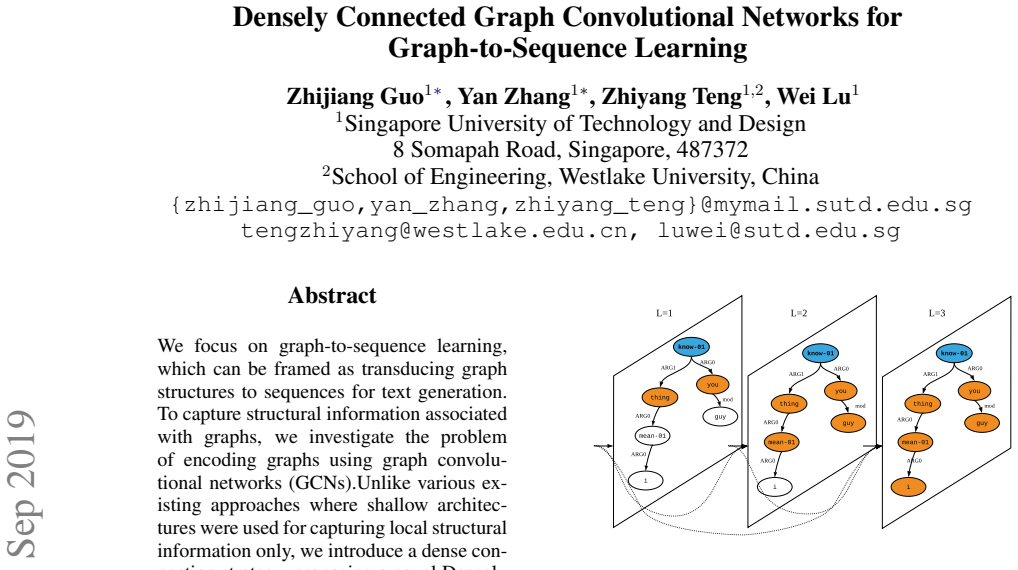
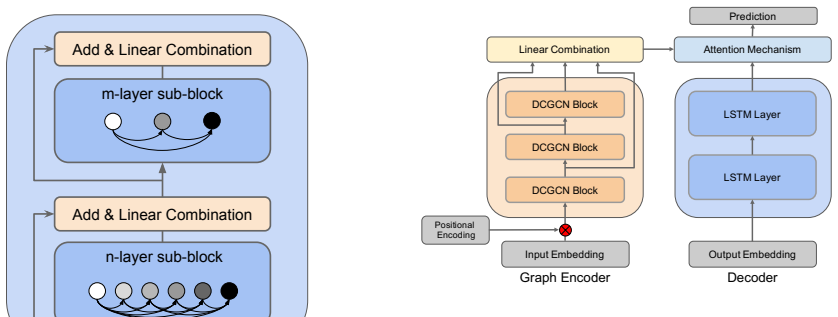
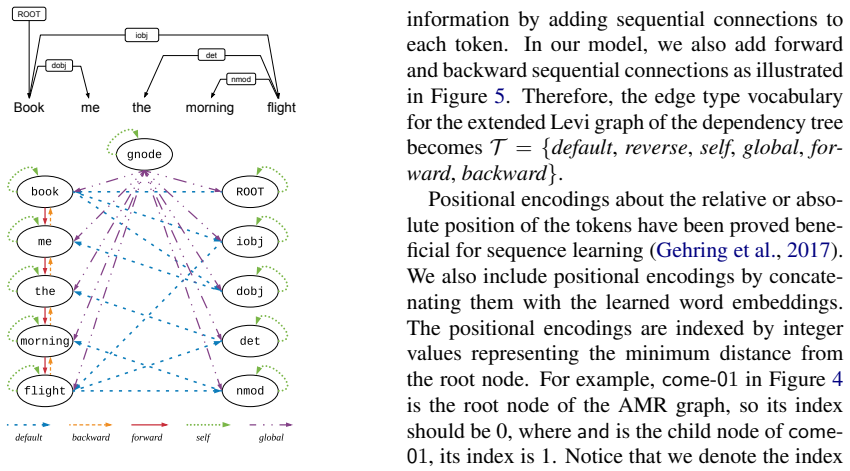
The load-bearing mechanism is dense connectivity in graph convolution layers. For each node $u$, layer $l$ consumes $g_u^{(l)} = [x_u; h_u^{(1)}; \dots; h_u^{(l-1)}]$, the concatenation of the initial node features and all previous layers' outputs, instead of only the previous layer's output; hidden dimensions shrink as depth grows ($d_{\mathrm{hidden}} = d/L$), so the growth in parameters stays modest. This is what lets the model train 36-layer encoders that capture neighborhood information many hops away. The surrounding components are named and defined in the paper: the extended Levi graph (edge labels promoted to nodes plus a global node linked to all nodes), direction aggregation with separate weight matrices per edge type, graph attention coefficients computed per neighborhood, and linear combination layers that merge all layer outputs into the final representation.
What would settle it
Retrain the single-model DCGCN and the strongest prior graph encoder on AMR17 with ten random seeds each, using identical hyperparameter search and the same preprocessing, and compare the distributions of BLEU scores; if the reported single-model advantage over the prior ensemble does not reproduce, the central claim of significant gains fails.
Extended reading notes
Core claim
On the paper's own terms, the central claim is that dense connectivity makes deep graph convolutional encoders not only trainable but better: a DCGCN block stacks $n$ and $m$ densely connected graph convolution layers, each layer receiving the concatenation of the initial node representation and all preceding layer outputs, and the final node representation is a linear combination of all layers' outputs. Around that core, the encoder transforms the input into an extended Levi graph whose edge labels become nodes and which adds a global node connected to every other node; the global node's learned representation initializes the decoder. Direction-specific weight matrices and graph attention coefficients control information flow along different edge types. In experiments on AMR15, AMR17, English-German, and English-Czech, the paper reports consistent BLEU and CHRF++ improvements over sequence-to-sequence baselines, recurrent graph encoders, and shallower GCN variants, with the largest margins on large graphs.
Load-bearing premise
The load-bearing premise is that the reported BLEU differences—some as small as 0.1–0.2 points—reflect a genuine architectural advantage rather than random variation or tuning imbalance, since the comparison takes baseline numbers from prior publications and gives no significance tests or per-seed variance.
Editorial extensions
If this is right
- The dense connectivity itself is what enables stable training at 36 layers: residual GCNs degrade after 10 layers and layer-aggregated GCNs fail to converge at 27 layers, while DCGCN performance keeps rising from 9 to 36 layers.
- Under a fixed parameter budget, deeper DCGCN variants beat shallower ones, and DCGCN beats equal-sized plain GCNs by margins that grow from 2.0 to 3.4 BLEU as the budget grows.
- The global node's representation serves as the decoder's initial state, and ablations show it is one of the two most influential encoder modules after dense connectivity.
- Ablations removing dense connections from successive blocks drop BLEU substantially and the model fails to converge without them, indicating that dense connectivity is the load-bearing component.
- On graph-size-binned analysis, the CHRF++ advantage over residual and layer-aggregated GCNs widens as graphs get larger, while all models are similar on small graphs.
Reading between the lines
- A testable extension not run in the paper: because the graph-size analysis shows the margin grows with graph size, DCGCN may show even larger gains on larger semantic graphs or knowledge graphs with hundreds of nodes.
- The paper does not test whether dense connectivity transfers to other node-level graph tasks such as relation extraction or semantic role labeling, which it names as future work; if the mechanism is general, similar depth gains should appear there.
- Because the encoder is fully convolutional and omits a recurrent layer, it is parallelizable in principle; deploying it in low-latency generation systems is a plausible but untested consequence of the architecture.
- The parameter-efficiency result suggests depth can substitute for width in graph encoders; probing this trade-off on other graph-to-sequence tasks would test whether the finding generalizes.
Signed reviews
Editorial analysis
A structured set of objections, weighed in public.
Referee Report
Summary. The paper proposes Densely Connected Graph Convolutional Networks (DCGCNs) for graph-to-sequence generation. The encoder stacks dense blocks in which each GCN layer receives the concatenated outputs of all preceding layers, with an attention-based graph convolution, direction-aware edge-type aggregation, a linear combination layer, and an "extended Levi graph" that adds a global node connected to all other nodes. The decoder is an attention-based LSTM initialized from the global node representation. Experiments target AMR-to-text generation on AMR15/AMR17 and syntax-based NMT on English-German and English-Czech, reporting BLEU and CHRF++. The paper claims state-of-the-art results, significant gains over prior neural models, and benefits from increased depth; additional experiments report ablations, parameter-budget comparisons, and analyses of graph size and example outputs.
Significance. If the results hold, the paper makes a useful contribution: it transfers dense connectivity from DenseNets to graph encoders, demonstrates that deep GCNs can be trained for graph-to-sequence tasks, and introduces a global node in the Levi graph that provides a decoder initialization and improves information flow. The manuscript includes several strengths: the code is publicly released, the ablations in Tables 8 and 9 isolate the contributions of dense connections, attention, the global node, and coverage, and the parameter-budget comparisons in Table 7 and Figure 6 address a confound between depth and model size. The analysis in Figure 7, showing larger gains on larger graphs, gives a concrete and falsifiable claim about when the architecture helps. However, the empirical evidence for the headline claim of 'significantly outperforming' the state of the art is weakened by the absence of statistical significance testing, by baselines taken from prior papers without rerunning, and by internal numeric inconsistencies. The central architectural idea remains plausible, but the paper's strongest claim is not currently supported to the standard required by the reported margins.
major comments (3)
- [§4.2, Table 2, abstract] The claim that DCGCN 'outperforms the state-of-the-art neural models significantly' is not supported by the statistical evidence reported. The key comparison on AMR17 is a single DCGCN model at 27.9 BLEU against a GGNN2Seq ensemble at 27.5 BLEU, a margin of 0.4 points, and no variance, confidence interval, or significance test is provided. Baselines are quoted from earlier publications (Beck et al. 2018; Damonte and Cohen 2019) rather than rerun under identical preprocessing, tokenization, beam size, and hyperparameter search, so tuning imbalance cannot be excluded. A revision should add repeated-seed experiments with standard deviations or a significance test, or should temper the 'significantly' wording to match the evidence.
- [§4.2, Table 2] There is a direct numeric inconsistency in the main results. The text states that the single DCGCN model 'achieves 27.6 BLEU points' and later says it 'gains 5.9 more BLEU points than the single models of Seq2SeqB on AMR17'; Table 2 reports 27.9 BLEU for DCGCN(ours) single and 21.7 for Seq2SeqB single, which would give a gain of 6.2 BLEU. Only 27.6 minus 21.7 equals the stated 5.9. This discrepancy affects the paper's headline number and must be resolved, as it casts doubt on the stability of the reported results.
- [§4.4, Table 6] Another internal inconsistency appears in the comparisons with baselines. The text in §4.4 says that with 9 layers, 'DCGCN1 is better than GCN+RC in term of B/C scores (21.7/51.5 v.s. 21.1/50.5)', but Table 6 lists DCGCN1 (9) as 22.9/53.0. The value 21.7/51.5 in the text matches the (n=6, m=3) row of Table 5, not the DCGCN1 row of Table 6. This makes it unclear which configuration the prose is describing and undermines the comparison with GCN+RC and GCN+RC+LA. The authors should correct the mismatch and ensure the prose reports exactly the tabulated values.
minor comments (5)
- [§3.3, Eq. (10)] The dimensions in Eq. (10) appear inconsistent: W_f is stated to be in R^{d′ × d_hidden} with d′ = T × d_hidden, but the input is a concatenation of T vectors each of dimension d_hidden, so the matrix should be in R^{d_hidden × d′}; otherwise the multiplication is not well defined.
- [§4.1] There are several typos in the experimental setup: 'tokenzie' should be 'tokenize', and 'preliminary' appears in various places; also in §4.4, 'sightly' should be 'slightly'.
- [§4.4, Table 8 discussion] The sentence 'If all the dense connections are not considered, the model does not coverage at all' should read 'does not converge at all'.
- [§4.4, Table 5] In Table 5, the block-2 row (n=6, m=6) lists the same BLEU/CHRF++ values (22.0/52.1) as the block-1 row (n=6, m=6), while neighboring block-2 rows show different values; this duplication looks like a copy-paste error and should be checked.
- [§3.2] The motivation sentence 'Our motivations are three-folds' should be 'threefold'.
Circularity Check
No circularity: the paper's claims are empirical benchmark comparisons, and its architectural components are taken from external prior work, not from a self-referential derivation.
full rationale
The paper's central contribution is a proposed architecture (DCGCN) and empirical evaluations on AMR-to-text generation and syntax-based NMT. There is no derivation chain in which a predicted quantity is defined in terms of the fitted quantity, no fitted parameter is relabeled as a prediction, and no load-bearing result is imported from the authors' own prior work. The dense connectivity strategy is explicitly attributed to DenseNets (Huang et al., 2017), an external source, and the graph encoder components such as the Levi graph, self-attention, and linear combination layers are attributed to other prior work. The one self-citation (Guo and Lu, 2018) appears only in a contextual remark about semantic parsing and plays no role in the model's construction or evaluation. Concerns that some BLEU gains are small, baselines are taken from prior publications, and no significance tests are reported are legitimate evidence-quality criticisms but do not constitute circularity. The model is trained and tested against external benchmarks, so the performance claims are empirical findings rather than self-referential reductions.
Assumptions & free parameters
free parameters (5)
- Number of DCGCN blocks =
4 for AMR, 2 for NMT
- Sub-block layer counts (n, m) =
n=6, m=3
- Feature dimension d =
360
- Hidden dimension per layer dhidden =
d/L (e.g., 360/36 for AMR)
- Learning rate, batch size, beam size =
0.0003, 16 or 24, 10
assumptions (4)
- domain assumption GCN message passing (Eq. 1) with first-order neighborhood aggregation is an appropriate encoder for labeled directed graphs.
- ad hoc to paper Converting a graph to an extended Levi graph, with edge labels as nodes and a global node connected to all nodes, preserves the information needed for text generation.
- domain assumption BLEU and CHRF++ scores on held-out test sets capture generation quality comparably across models.
- ad hoc to paper The global node's final representation is a sufficient decoder initial state.
invented entities (1)
-
Global node (gnode)
Cite this review
Pith. "Pith review of Densely Connected Graph Convolutional Networks for Graph-to-Sequence Learning." pith.science (2026). https://pith.science/paper/NSOELL74
@misc{pith2026190805957,
  author       = {Pith},
  title        = {Pith review of: Densely Connected Graph Convolutional Networks for Graph-to-Sequence Learning},
  year         = {2026},
  howpublished = {\url{https://pith.science/paper/NSOELL74}},
  note         = {Machine review of arXiv:1908.05957}
}
read the original abstract
We focus on graph-to-sequence learning, which can be framed as transducing graph structures to sequences for text generation. To capture structural information associated with graphs, we investigate the problem of encoding graphs using graph convolutional networks (GCNs). Unlike various existing approaches where shallow architectures were used for capturing local structural information only, we introduce a dense connection strategy, proposing a novel Densely Connected Graph Convolutional Networks (DCGCNs). Such a deep architecture is able to integrate both local and non-local features to learn a better structural representation of a graph. Our model outperforms the state-of-the-art neural models significantly on AMRto-text generation and syntax-based neural machine translation.
Figures

Figures from the paper (3 more)


Reference graph
Works this paper leans on
-
[1]
URL: " 'urlintro :=
ENTRY address author booktitle chapter edition editor howpublished institution journal key month note number organization pages publisher school series title type volume year eprint doi pubmed url lastchecked label extra.label sort.label short.list INTEGERS output.state before.all mid.sentence after.sentence after.block STRINGS urlintro eprinturl eprintpr...
-
[2]
write newline
" write newline "" before.all 'output.state := FUNCTION n.dashify 't := "" t empty not t #1 #1 substring "-" = t #1 #2 substring "--" = not "--" * t #2 global.max substring 't := t #1 #1 substring "-" = "-" * t #2 global.max substring 't := while if t #1 #1 substring * t #2 global.max substring 't := if while FUNCTION word.in bbl.in capitalize " " * FUNCT...
-
[3]
Chris Alberti, Daniel Andor, Ivan Bogatyy, Michael Collins, Daniel Gillick, Lingpeng Kong, Terry Koo, Ji Ma, Mark Omernick, Slav Petrov, Chayut Thanapirom, Zora Tung, and David Weiss. 2017. Syntaxnet models for the conll 2017 shared task. arXiv preprint
work page 2017
-
[4]
Dzmitry Bahdanau, Kyunghyun Cho, and Yoshua Bengio. 2015. Neural machine translation by jointly learning to align and translate. In Proc. of ICLR
work page 2015
-
[5]
Laura Banarescu, Claire Bonial, Shu Cai, Madalina Georgescu, Kira Griffitt, Ulf Hermjakob, Kevin Knight, Philipp Koehn, Martha Palmer, and Nathan Schneider. 2013. Abstract meaning representation for sembanking. In Proc. of LAW@ACL
work page 2013
-
[6]
Joost Bastings, Ivan Titov, Wilker Aziz, Diego Marcheggiani, and Khalil Sima'an. 2017. Graph convolutional encoders for syntax-aware neural machine translation. In Proc. of EMNLP
work page 2017
-
[7]
Daniel Beck, Gholamreza Haffari, and Trevor Cohn. 2018. Graph-to-sequence learning using gated graph neural networks. In Proc. of ACL
work page 2018
-
[8]
Joan Bruna. 2014. Spectral networks and deep locally connected networks on graphs. In Proc. of ICLR
work page 2014
Show all 55 references
-
[9]
Tianqi Chen, Mu Li, Yutian Li, Min Lin, Naiyan Wang, Minjie Wang, Tianjun Xiao, Bing Xu, Chiyuan Zhang, and Zheng Zhang. 2015. Mxnet: A flexible and efficient machine learning library for heterogeneous distributed systems. arXiv preprint
2015
-
[10]
Marco Damonte and Shay B. Cohen. 2019. Structural neural encoders for amr-to-text generation. In Proc. of NAACL-HLT
2019
-
[11]
Micha \"e l Defferrard, Xavier Bresson, and Pierre Vandergheynst. 2016. Convolutional neural networks on graphs with fast localized spectral filtering. In Proc. of NIPS
2016
-
[12]
Jeffrey L. Elman. 1990. Finding structure in time. Cognitive science, 14(2):179--211
1990
-
[13]
Hieber Felix, Domhan Tobias, Denkowski Michael, Vilar David, Sokolov Artem, Clifton Ann, and Post Matt. 2017. Sockeye: A toolkit for neural machine translation. arXiv preprint
2017
-
[14]
Smith, and Jaime G
Jeffrey Flanigan, Chris Dyer, Noah A. Smith, and Jaime G. Carbonell. 2016. Generation from abstract meaning representation using tree transducers. In Proc. of NAACL-HLT
2016
-
[15]
Jonas Gehring, Michael Auli, David Grangier, Denis Yarats, and Yann Dauphin. 2017. Convolutional sequence to sequence learning. In Proc. of ICML
2017
-
[16]
Ross Girshick, Jeff Donahue, Trevor Darrell, and Jitendra Malik. 2014. Rich feature hierarchies for accurate object detection and semantic segmentation. In Proc. of CVPR
2014
-
[17]
Michele Gori, Gabriele Monfardini, and Franco Scarselli. 2005. A new model for learning in graph domains. In Proc. of IJCNN
2005
-
[18]
Gross, Jay Yellen, and Ping Zhang
Jonathan L. Gross, Jay Yellen, and Ping Zhang. 2013. Handbook of Graph Theory, Second Edition. Chapman & Hall/CRC
2013
-
[19]
Zhijiang Guo and Wei Lu. 2018. Better transition-based amr parsing with a refined search space. In Proc. of EMNLP
2018
-
[20]
Hamilton, Rex Ying, and Jure Leskovec
William L. Hamilton, Rex Ying, and Jure Leskovec. 2017. Inductive representation learning on large graphs. In Proc. of NIPS
2017
-
[21]
Kaiming He, Xiangyu Zhang, Shaoqing Ren, and Jian Sun. 2016. Deep residual learning for image recognition. In Proc. of CVPR
2016
-
[22]
Mikael Henaff, Joan Bruna, and Yann LeCun. 2015. Deep convolutional networks on graph-structured data. arXiv preprint
2015
-
[23]
Sepp Hochreiter and J \"u rgen Schmidhuber. 1997. Long short-term memory. Neural computation, 9(8):1735--1780
1997
-
[24]
Weinberger
Gao Huang, Zhuang Liu, Laurens van der Maaten, and Kilian Q. Weinberger. 2017. Densely connected convolutional networks. In Proc. of CVPR
2017
-
[25]
Kingma and Jimmy Ba
Diederik P. Kingma and Jimmy Ba. 2015. Adam: A method for stochastic optimization. In Proc. of ICLR
2015
-
[26]
Kipf and Max Welling
Thomas N. Kipf and Max Welling. 2017. Semi-supervised classification with graph convolutional networks. In Proc. of ICLR
2017
-
[27]
Philipp Koehn, Hieu Hoang, Alexandra Birch, Chris Callison-Burch, Marcello Federico, Nicola Bertoldi, Brooke Cowan, Wade Shen, Christine Moran, Richard Zens, Chris Dyer, Ondrej Bojar, Alexandra Constantin, and Evan Herbst. 2007. Moses: Open source toolkit for statistical machi...
2007
-
[28]
Philipp Koehn, Franz Josef Och, and Daniel Marcu. 2003. Statistical phrase-based translation. In Proc. of NAACL-HLT
2003
-
[29]
Zettlemoyer
Ioannis Konstas, Srinivasan Iyer, Mark Yatskar, Yejin Choi, and Luke S. Zettlemoyer. 2017. Neural amr: Sequence-to-sequence models for parsing and generation. In Proc. of ACL
2017
-
[30]
Ioannis Konstas and Mirella Lapata. 2012. Unsupervised concept-to-text generation with hypergraphs. In Proc. of NAACL-HLT
2012
-
[31]
Ioannis Konstas and Mirella Lapata. 2013. Inducing document plans for concept-to-text generation. In Proc. of EMNLP
2013
-
[32]
Qimai Li, Zhichao Han, and Xiao-Ming Wu. 2018. Deeper insights into graph convolutional networks for semi-supervised learning. In Proc. of AAAI
2018
-
[33]
Yujia Li, Daniel Tarlow, Marc Brockschmidt, and Richard S. Zemel. 2016. Gated graph sequence neural networks. In Proc. of ICLR
2016
-
[34]
Wei Lu and Hwee Tou Ng. 2011. A probabilistic forest-to-string model for language generation from typed lambda calculus expressions. In Proc. of EMNLP
2011
-
[35]
Wei Lu, Hwee Tou Ng, and Wee Sun Lee. 2009. Natural language generation with tree conditional random fields. In Proc. of EMNLP
2009
-
[36]
Diego Marcheggiani and Laura Perez-Beltrachini. 2018. https://www.aclweb.org/anthology/W18-6501 Deep graph convolutional encoders for structured data to text generation . In Proceedings of the 11th International Conference on Natural Language Generation
2018
-
[37]
Diego Marcheggiani and Ivan Titov. 2017. Encoding sentences with graph convolutional networks for semantic role labeling. In Proc. of EMNLP
2017
-
[38]
Vinod Nair and Geoffrey E. Hinton. 2010. Rectified linear units improve restricted boltzmann machines. In Proc. of ICML
2010
-
[39]
Kishore Papineni, Salim Roukos, Todd Ward, and Wei-Jing Zhu. 2002. Bleu: a method for automatic evaluation of machine translation. In Proc. of ACL
2002
-
[40]
Peters, Mark Neumann, Mohit Iyyer, Matt Gardner, Christopher Clark, Kenton Lee, and Luke S
Matthew E. Peters, Mark Neumann, Mohit Iyyer, Matt Gardner, Christopher Clark, Kenton Lee, and Luke S. Zettlemoyer. 2018. Deep contextualized word representations. In Proc. of NAACL-HLT
2018
-
[41]
Maja Popovic. 2017. chrf++: words helping character n-grams. In Proc. of WMT@ACL
2017
-
[42]
Nima Pourdamghani, Kevin Knight, and Ulf Hermjakob. 2016. Generating english from abstract meaning representations. In Proc. of INLG
2016
-
[43]
Franco Scarselli, Marco Gori, Ah Chung Tsoi, Markus Hagenbuchner, and Gabriele Monfardini. 2009. The graph neural network model. IEEE Transactions on Neural Networks, 20(1)
2009
-
[44]
Rico Sennrich, Barry Haddow, and Alexandra Birch. 2016. Neural machine translation of rare words with subword units. In Proc. of ACL
2016
-
[45]
Linfeng Song, Xiaochang Peng, Yue Zhang, Zhiguo Wang, and Daniel Gildea. 2017. Amr-to-text generation with synchronous node replacement grammar. In Proc. of ACL
2017
-
[46]
Linfeng Song, Yue Zhang, Xiaochang Peng, Zhiguo Wang, and Daniel Gildea. 2016. Amr-to-text generation as a traveling salesman problem. In Proc. of EMNLP
2016
-
[47]
Linfeng Song, Yue Zhang, Zhiguo Wang, and Daniel Gildea. 2018. A graph-to-sequence model for amr-to-text generation. In Proc. of ACL
2018
-
[48]
Rupesh Kumar Srivastava, Klaus Greff, and J \"u rgen Schmidhuber. 2015. Training very deep networks. In Proc. of NIPS
2015
-
[49]
Ilya Sutskever, Oriol Vinyals, and Quoc V. Le. 2014. Sequence to sequence learning with neural networks. In Proc. of NIPS
2014
-
[50]
Zhaopeng Tu, Zhengdong Lu, Yang Liu, Xiaohua Liu, and Hang Li. 2016. Modeling coverage for neural machine translation. In Proc. of ACL
2016
-
[51]
Gomez, Lukasz Kaiser, and Illia Polosukhin
Ashish Vaswani, Noam Shazeer, Niki Parmar, Jakob Uszkoreit, Llion Jones, Aidan N. Gomez, Lukasz Kaiser, and Illia Polosukhin. 2017. Attention is all you need. In Proc. of NIPS
2017
-
[52]
Petar Velickovic, Guillem Cucurull, Arantxa Casanova, Adriana Romero, Pietro Li \`o , and Yoshua Bengio. 2018. Graph attention networks. In Proc. of ICLR
2018
-
[53]
Keyulu Xu, Chengtao Li, Yonglong Tian, Tomohiro Sonobe, Ken ichi Kawarabayashi, and Stefanie Jegelka. 2018. Representation learning on graphs with jumping knowledge networks. In Proc. of ICML
2018
-
[54]
Yue Zhang, Qi Liu, and Linfeng Song. 2018 a . Sentence-state lstm for text representation. In Proc. of ACL
2018
-
[55]
Yuhao Zhang, Peng Qi, and Christopher D. Manning. 2018 b . Graph convolution over pruned dependency trees improves relation extraction. In Proc. of EMNLP
2018
Reviewed August 14, 2026 · model on record in the stance chip above.
Discussion (0). Continue with ORCID to comment.