REVIEW 3 major objections 3 minor 41 references
Scaling Analysis of Anomalous Hall Resistivity in the Co$_{2}$TiAl Heusler Alloy
T0 review · 3 major / 3 minor · reviewed 2026-08-14 · deepseek-v4-flash
Pith's one-line read This paper reports that in Co2TiAl, a ferromagnetic Heusler alloy, the anomalous Hall effect is extrinsic: skew scattering dominates, and the side-jump portion is driven by electron-magnon scattering.
desk verdict New data on a barely studied Heusler and a likely-robust skew-scattering conclusion, but the electron-magnon side-jump claim rests on a decomposition that cannot separate side-jump from intrinsic temperature dependence. read the letter →
The pith
A machine-rendered reading of the paper's core claim, the machinery that carries it, and where it could break.
The reading
What carries the argument
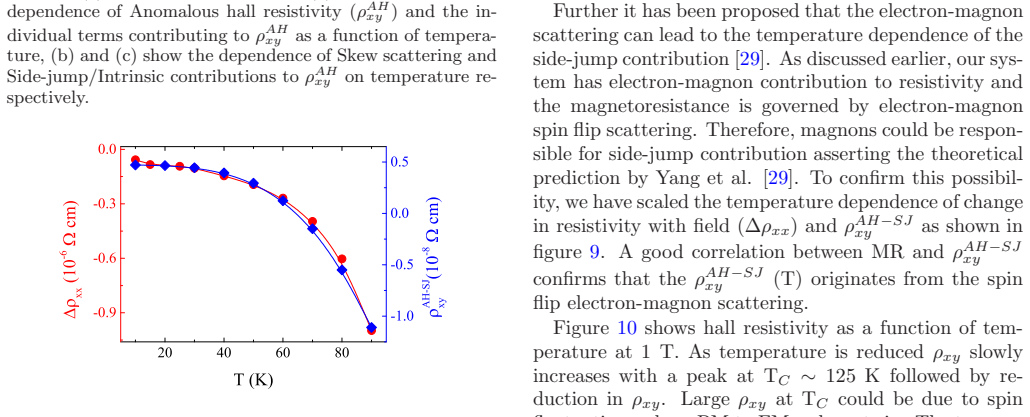
The load-bearing object is the refined scaling relation, Eq. (5): $\rho_{xy}^{AH}(T) = (\alpha_0\rho_{xx0}+\alpha_1\rho_{xxT}) + \beta_0\rho_{xx0}^2 + \gamma\rho_{xx0}\rho_{xxT} + \beta_1\rho_{xxT}^2$. This generalizes the simple $\rho_{xy}^{AH}=a\rho_{xx}+b\rho_{xx}^2$ by treating the temperature-independent residual resistivity and the temperature-dependent resistivity as separate scales. The terms in parentheses are the total skew-scattering contribution; the $\beta_1\rho_{xxT}^2$ term is the temperature-dependent piece of the quadratic channel, and the paper's move is to attribute that piece to side-jump scattering because the intrinsic band-structure contribution is assumed temperature-independent. The matching temperature profiles of this $\beta_1\rho_{xxT}^2$ piece and the field-induced resistivity change $\Delta\rho_{xx}$ carry the argument that spin-flip electron-magnon scattering is the microscopic source of the side-jump signal.
What would settle it
Compute the intrinsic anomalous Hall conductivity from the band structure of Co2TiAl and check whether it changes with temperature between 5 K and 125 K; if it varies, the temperature-dependent quadratic Hall term cannot be assigned entirely to side-jump scattering, and the electron-magnon conclusion would not follow.
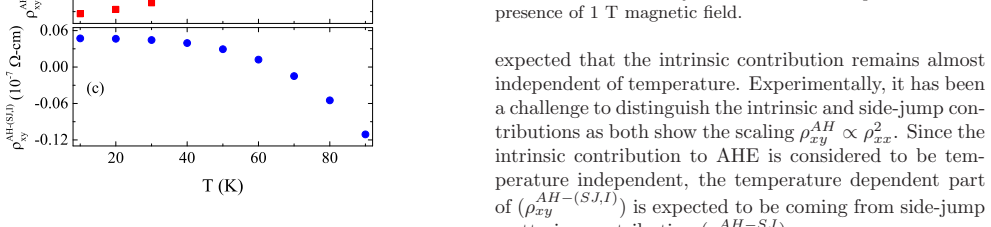
Extended reading notes
Core claim
On the paper's own terms, the central discovery is that the anomalous Hall resistivity $\rho_{xy}^{AH}$ in Co2TiAl obeys a two-channel scaling with longitudinal resistivity: a linear term from skew scattering that is about an order of magnitude larger than the quadratic term from side-jump or intrinsic mechanisms. Fitting the temperature dependence with the refined scaling relation that uses both the residual resistivity $\rho_{xx0}$ and the temperature-dependent resistivity $\rho_{xxT}$ separates the quadratic part into a temperature-independent piece and a temperature-dependent piece. Because the intrinsic contribution is assumed to be temperature independent, the temperature-dependent quadratic part is assigned to side-jump scattering. That side-jump part has the same temperature profile as the change in resistivity caused by a magnetic field, $\Delta\rho_{xx}$, and since $\Delta\rho_{xx}$ is already shown to come from spin-flip electron-magnon scattering, the paper concludes that electron-magnon scattering generates the side-jump contribution to the anomalous Hall resistivity.
Load-bearing premise
The reasoning depends on the assumption that the intrinsic, band-structure part of the anomalous Hall effect does not change with temperature; if it does, the temperature-dependent quadratic term is not purely side-jump scattering.
Editorial extensions
If this is right
- Below the magnetic transition, the anomalous Hall effect in Co2TiAl is dominated by skew scattering; the linear term in the scaling relation is roughly an order of magnitude larger than the quadratic term.
- The temperature-dependent part of the quadratic Hall term and the electron-magnon magnetoresistance share the same temperature profile, so side-jump scattering and spin-flip magnon scattering are coupled in this alloy.
- No temperature-dependent intrinsic band-structure contribution is required to explain the anomalous Hall resistivity in Co2TiAl; the varying part of the quadratic channel is accounted for by magnon-driven side-jump scattering.
- The same two-scale fitting procedure can separate extrinsic from intrinsic Hall channels in other ferromagnetic metals where the resistivity splits cleanly into a residual part and a temperature-dependent part.
Reading between the lines
- If the intrinsic Hall contribution later turns out to vary with temperature, the quadratic term labeled side-jump would be a mixture; a testable extension is to compute the intrinsic contribution from the band structure and check its temperature dependence in this alloy.
- A controlled disorder study could separate the channels further: adding impurities should change the skew-scattering coefficient linearly with residual resistivity while leaving the magnon-driven side-jump coefficient roughly unchanged.
- The same correlation with magnetoresistance could also be sought at fixed temperature as a function of magnetic field; if the side-jump Hall term is suppressed by fields in the same way as the negative magnetoresistance, the magnon mechanism would be confirmed directly rather than inferred from matching temperature profiles.
Signed reviews
Editorial analysis
A structured set of objections, weighed in public.
Referee Report
Summary. This manuscript presents a magnetotransport study of the Heusler alloy Co2TiAl, reporting resistivity at various fields, isothermal magnetoresistance, and Hall resistivity down to 2 K. The temperature-dependent resistivity is analyzed in terms of electron-magnon, electron-phonon, and electron-electron scattering, with the T^2 coefficient identified as electron-magnon by its magnetic field dependence. The anomalous Hall resistivity is analyzed using the scaling relation ρ_AH = aρ_xx + bρ_xx^2, extended in Eq. (5) to separate residual and temperature-dependent parts of ρ_xx. From this the authors conclude that skew scattering dominates the anomalous Hall effect and that the side-jump contribution, extracted as the temperature-dependent part of the quadratic terms, correlates with the magnetoresistance, implying an electron-magnon origin of the side-jump contribution.
Significance. The dataset is a useful addition to the sparse transport literature on Co2TiAl, and the identification of electron-magnon scattering in resistivity and magnetoresistance is reasonably supported by the field dependence of the T^2 coefficient. If the claimed separation of skew and side-jump contributions were valid, the electron-magnon side-jump result would be an important confirmation of the theoretical prediction by Yang et al. However, the core analysis is undermined by an unjustified assumption about the temperature independence of the intrinsic anomalous Hall contribution, and the final correlation test is circular. As presented, the central claim is not supported.
major comments (3)
- [Hall Resistivity, Eq. (5)] The statement that the intrinsic contribution to the anomalous Hall effect is temperature independent is inconsistent with the quadratic scaling relation ρ_AH^I ∝ ρ_xx^2 used in Eq. (4). With ρ_xx(T) = ρ_xx0 + ρ_xxT, the intrinsic term expands as bρ_xx0^2 + 2bρ_xx0ρ_xxT + bρ_xxT^2, which has exactly the same polynomial structure as the β0, γ, and β1 terms in Eq. (5). Therefore the temperature-dependent part of ρ_AH^{-(SJ,I)} cannot be assigned to side-jump without an independent determination of the intrinsic contribution, such as a band-structure Berry-curvature calculation or measurements on samples with controlled disorder. This assumption is load-bearing because Fig. 8(c) and Fig. 9 rely on it.
- [Hall Resistivity, Fig. 9] The claimed one-to-one correspondence between Δρ_xx and ρ_AH^{-SJ} is not an independent test. The side-jump term extracted from Eq. (5) is constructed from ρ_xxT, while Δρ_xx is governed by the same electron-magnon scattering that determines ρ_xxT. Hence the correlation is a post-fit consistency check, and the conclusion that electron-magnon scattering sources the side-jump contribution is circular. No quantitative correlation measure (e.g., Pearson coefficient) or a comparison against a model without the electron-magnon channel is provided.
- [Results and Discussion, Eq. (5) and Figs. 7-8] The fit to Eq. (5) involves five free parameters (α0, α1, β0, γ, β1), but their fitted values, standard errors, and goodness-of-fit statistics are not reported. Since the central claims about the relative magnitudes of skew versus side-jump contributions and about the temperature dependence of the side-jump term depend on these parameters, the analysis cannot be reproduced or assessed from the information given. The data in Figs. 7 and 8 are also shown without error bars, so it is unclear whether deviations from the fit are significant.
minor comments (3)
- [Resistivity and Magnetoresistance] The sentence 'the linear term is an order of magnitude larger than the square term which suggests that the electron-phonon scattering is the dominant contribution in the temperature range upto 50 K' appears to refer to the 50-110 K fit range, so the temperature range is stated inconsistently.
- [Abstract and throughout] The phrase 'anomalous hall resistivity' is capitalized inconsistently; 'anomalous Hall resistivity' should be used uniformly.
- [Abstract] The abstract states that scaling 'establishes' the extrinsic scattering process, which is stronger than what the analysis actually supports; 'suggests' would be more appropriate given the assumptions in Eq. (5).
Circularity Check
The side-jump term is defined as the temperature-dependent part of the Eq. (5) quadratic fit and then 'verified' against magnetoresistance that shares the same electron-magnon resistivity; the magnon-origin claim is a post-fit consistency check, not an independent prediction.
-
self definitional
[Hall Resistivity section, after Eq. (5), paragraph discussing Fig. 8(c)]
"Since the intrinsic contribution to AHE is considered to be temperature independent, the temperature dependent part of (ρ_AH−(SJ,I)) is expected to be coming from side-jump scattering contribution (ρ_AH−SJ)."
In Eq. (5), ρ_AH−(SJ,I) is fitted as β0ρxx0^2 + β1ρxxT^2, the quadratic part of the expansion of (ρxx0+ρxxT)^2. The paper's own Eq. (4) and the cited Karplus-Luttinger/Berry-curvature mechanism put the intrinsic AHE in the same ρxx^2 term. Since ρxx(T) varies with temperature, an intrinsic term σ_I ρxx^2 has a temperature-dependent part 2σ_I ρxx0ρxxT + σ_I ρxxT^2 of precisely the functional form of the γρxx0ρxxT and β1ρxxT^2 terms. Declaring the intrinsic contribution 'temperature independent' erases this part and defines 'side-jump' as, by construction, the remaining temperature-dependent quadratic contribution. The separation is therefore an assumption embedded in the analysis, not a result established by the fit.
-
fitted input called prediction
[Hall Resistivity section, paragraph before Fig. 9]
"To confirm this possibility, we have scaled the temperature dependence of change in resistivity with field (Δρxx) and ρ_AH−SJ xy ... A good correlation between MR and ρ_AH−SJ xy confirms that the ρ_AH−SJ xy(T) originates from the spin flip electron-magnon scattering."
The plotted ρ_AH−SJ is not an independent measurement: it is the fitted β1ρxxT^2 (temperature-dependent quadratic part of Eq. (5)) built from the same ρxx(T) whose T^2 part was already attributed to electron-magnon scattering. The companion quantity Δρxx is the field-induced change of that same ρxx(T), also governed by electron-magnon spin-flip scattering. Both curves therefore inherit the electron-magnon temperature dependence regardless of whether the AHE decomposition is physically correct. The Fig. 9 correlation is a consistency check between two functions of the same magnon-driven resistivity, not an independent confirmation that the extracted term is side-jump rather than intrinsic.
full rationale
The basic scaling decomposition in Eqs. (4)-(5) is a standard algebraic parameterization of ρ_AH(T) in terms of ρxx0 and ρxxT, and the dominance of the linear skew-scattering term is a fit outcome, not circular. The circularity arises at the identification step: the temperature-dependent part of the quadratic term is labelled side-jump solely because the intrinsic term is assumed to be temperature-independent, whereas in the ρ_AH representation an intrinsic ρxx^2 contribution has the same temperature-dependent structure as the extracted β1ρxxT^2 and γρxx0ρxxT terms. The subsequent comparison with magnetoresistance in Fig. 9 is a post-fit consistency check: both the extracted 'side-jump' component and Δρxx are functions of the same electron-magnon contribution to ρxx(T). Because the MR data are a distinct measured observable, the circularity is partial rather than total, and no load-bearing self-citation chain is present. Score 4.
Assumptions & free parameters
free parameters (3)
- alpha_0, alpha_1, beta_0, gamma, beta_1 (Eq. 5) =
not reported
- B (coefficient of T^2 resistivity term) =
field-dependent, plotted in Fig. 4 but absolute values not stated
- Magnon stiffness D(T) from Eq. (3) fit =
not reported
assumptions (4)
- standard math Matthiessen's rule and standard AHE scaling rho_AH = a rho_xx + b rho_xx^2
- domain assumption Intrinsic anomalous Hall contribution is temperature independent
- domain assumption T^2 resistivity term below 50 K is electron-magnon rather than electron-electron because it is suppressed by magnetic field
- domain assumption High-field linear Hall slope gives the ordinary Hall coefficient (single-band approximation)
Cite this review
Pith. "Pith review of Scaling Analysis of Anomalous Hall Resistivity in the Co$_{2}$TiAl Heusler Alloy." pith.science (2026). https://pith.science/paper/U2TJNORU
@misc{pith2026190805974,
  author       = {Pith},
  title        = {Pith review of: Scaling Analysis of Anomalous Hall Resistivity in the Co$_2$TiAl Heusler Alloy},
  year         = {2026},
  howpublished = {\url{https://pith.science/paper/U2TJNORU}},
  note         = {Machine review of arXiv:1908.05974}
}
abstract
A comprehensive magnetotransport study including resistivity ($\rho_{xx}$) at various fields, isothermal magnetoresistance and Hall resistivity ($\rho_{xy}$) has been carried out at different temperatures on the Co$_{2}$TiAl Heusler alloy. Co$_{2}$TiAl alloy shows a paramagnetic (PM) to ferromagnetic (FM) transition below the curie temperature (T$_{C}$) $\sim$ 125 K. In the FM region, resistivity and magnetoresistance reveals a spin flip electron-magnon scattering and the Hall resistivity unveils the anomalous Hall resistivity ($\rho_{xy}^{AH}$). Scaling of anomalous Hall resistivity with resistivity establishes the extrinsic scattering process responsible for the anomalous hall resistivity; however Skew scattering is the dominant mechanism compared to the side-jump contribution. A one to one correspondence between magnetoresistance and side-jump contribution to anomalous Hall resistivity verifies the electron-magnon scattering being the source of side-jump contribution to the anomalous hall resistivity.
Figures
Figures from the paper (6 more)



Reference graph
Works this paper leans on
-
[1]
C. Felser and A. Hirohata, Heusler Alloys Properties, Growth, Applications , Springer Series in Materials Sci- ence (Springer International Publishing, 2015)
work page 2015
-
[2]
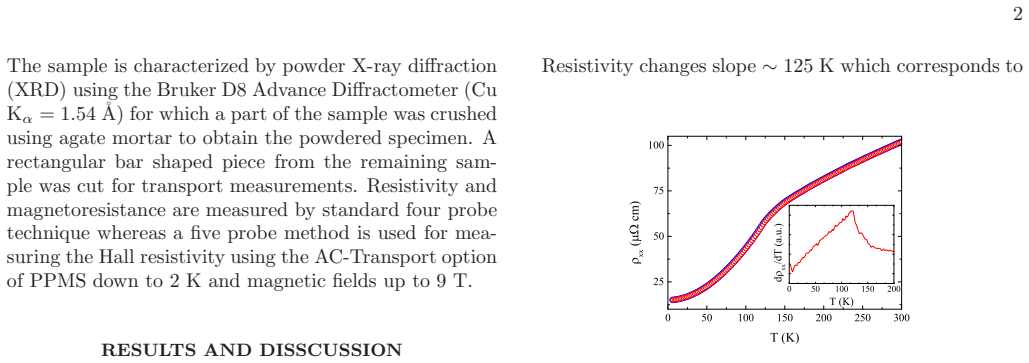
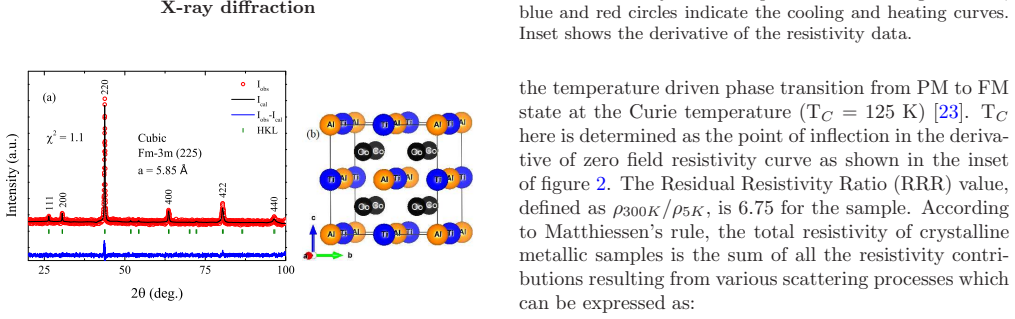
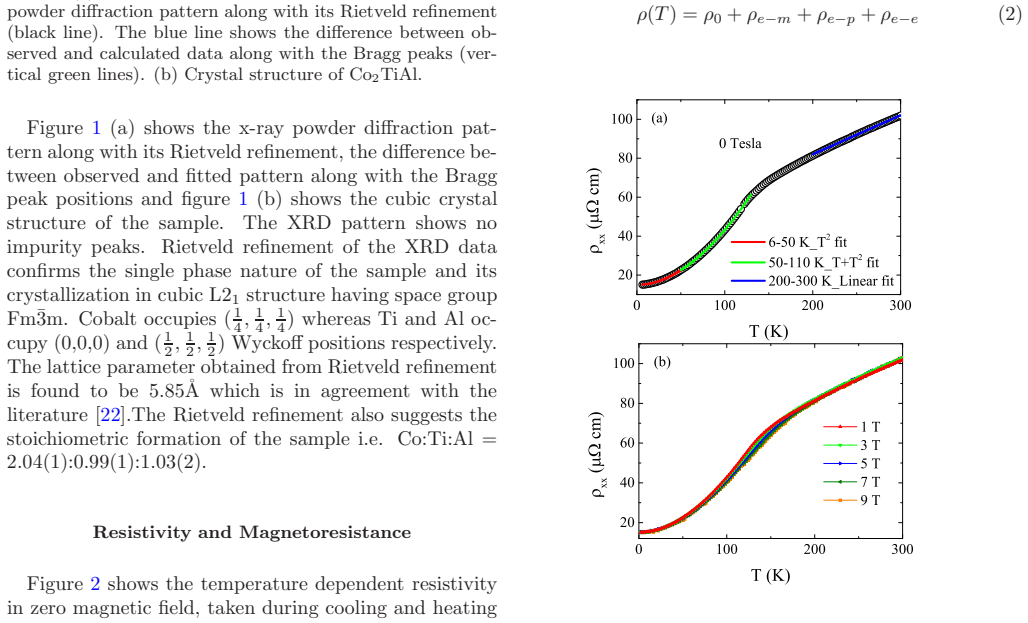
The Residual Resistivity Ratio (RRR) value, defined as ρ300K/ρ 5K, is 6.75 for the sample. According to Matthiessen’s rule, the total resistivity of crystalline metallic samples is the sum of all the resistivity contri- butions resulting from various scattering processes which can be expressed as: ρ(T ) = ρ0 + ρe− m + ρe− p + ρe− e (2) /s48 /s49/s48/s48 /s...
-
[3]
The data fits well with equation ( 3) confirming that electron-magnon scattering is responsible for the observed non saturated negative magnetoresistance. Below 10 K, the strength of electron magnon scattering is weak which gets further suppressed on increasing the magnetic field. At larger fields, the /s48 /s50 /s52 /s54 /s56 /s45/s52 /s45/s51 /s45/s50 /s45/...
-
[4]
Inset shows the enlarged view of ∆ ρxx at 10 K and 2 K
at 30 K and 50 K. Inset shows the enlarged view of ∆ ρxx at 10 K and 2 K. 4 scattering from Lorentz contribution starts dominating leading to an upturn in magnetoresistance. Hall Resistivity /s45/s48/s46/s56 /s45/s48/s46/s52 /s48/s46/s48 /s48/s46/s52 /s48/s46/s56 /s45/s48/s46/s49/s54 /s45/s48/s46/s48/s56 /s48/s46/s48/s48 /s48/s46/s48/s56 /s48/s46/s49/s54 ...
-
[5]
At large fields, above the technical saturation, the field dependence of isother- mal resistivity is mainly determined by electron-magnon scattering and scattering from Lorentz force. The spin flip scattering of conduction electrons with magnons gets suppressed on increasing the magnetic field which reduces the resistivity. On the other hand, the scattering f...
-
[6]
Above TC in the PM state, hall resistivity increases linearly with magnetic field which is the ordinary hall effect as shown in the inset of figure
-
[7]
This behaviour of hall resistivity in the FM state is the anomalous hall effect
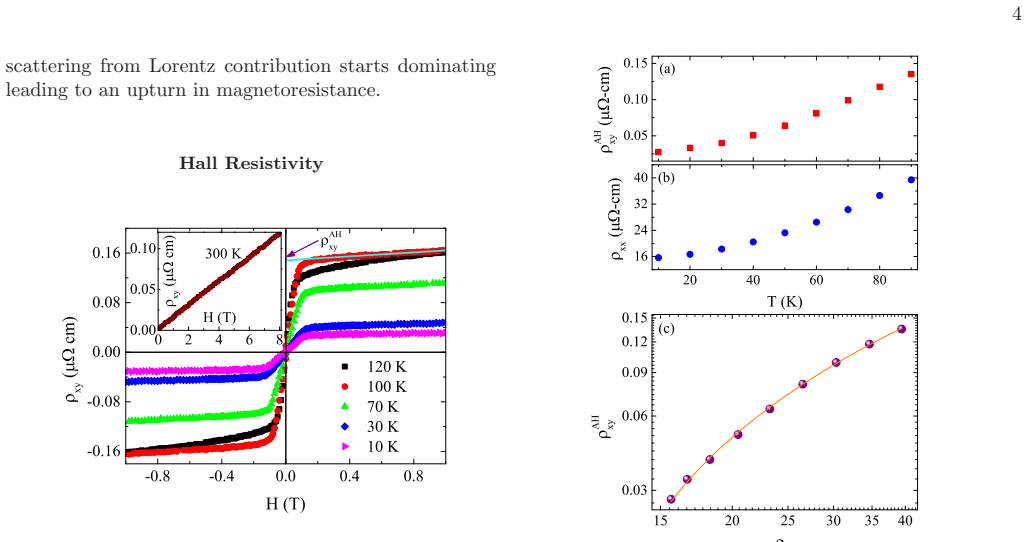
Below T C in the FM state, ρxy has two linear regions; first is the low field region where it increases steeply up to a certain field above which there is a change in slope which almost saturates. This behaviour of hall resistivity in the FM state is the anomalous hall effect. The slope of ρxy in the high field region renders the charge carrier density while t...
-
[8]
The temperature de- pendence of ρAH xy and ρxx is shown in figure 7 (a) and (b) respectively. It is observed that the anomalous hall resistivity increases with temperature similar to that of the longitudinal resistivity. The anomalous Hall resis- tivity (ρAH xy ) and the longitudinal resistivity ρxx follow a scaling relation based on the scattering mechani...
Show all 41 references
-
[9]
We have scaled ρAH xy with ρxx in order to extract the scattering contri- butions that drive the AHE in this system
depicts the temperature de- pendence of anomalous hall resistivity. We have scaled ρAH xy with ρxx in order to extract the scattering contri- butions that drive the AHE in this system. To begin, the general scaling for ρAH xy (T) defined in equation (
-
[10]
Individual linear and quadratic relation also does not provide the good fit
is used to scale AHE but it does not provide a good fit to the data suggesting that it does not completely address the inherent mechanism involved in the AHE of this sys- tem. Individual linear and quadratic relation also does not provide the good fit. In order to separate the t...
-
[11]
Figure 8(a) shows the dependency of each individual term used in equa- tion (
is used to fit the data and a good fit is ob- tained which is shown in figure 7(c). Figure 8(a) shows the dependency of each individual term used in equa- tion (
-
[12]
The terms α 0ρxx0 and β0ρxx0 are temperature independent, whereas the terms α 1ρxxT and β1ρ2 xxT are temperature dependent terms
on temperature, which are basically the different contributions to ρAH xy (T). The terms α 0ρxx0 and β0ρxx0 are temperature independent, whereas the terms α 1ρxxT and β1ρ2 xxT are temperature dependent terms. The term β1ρ2 xxT has a weak temperature dependence upto 50K and incr...
-
[13]
Figure 10 shows hall resistivity as a function of tem- perature at 1 T
A good correlation between MR and ρAH− SJ xy confirms that the ρAH− SJ xy (T) originates from the spin flip electron-magnon scattering. Figure 10 shows hall resistivity as a function of tem- perature at 1 T. As temperature is reduced ρxy slowly increases with a peak at T C ∼ 125...
-
[14]
T. Graf, J. Winterlik, L. Mchler, G. H. Fecher, C. Felser, and S. S. Parkin, Chapter One - Magnetic Heusler Com- pounds, edited by K. Buschow, Handbook of Magnetic Materials, Vol. 21 (Elsevier, 2013) pp. 1 – 75
2013
-
[15]
Wollmann, A
L. Wollmann, A. K. Nayak, S. S. Parkin, and C. Felser, Annual Review of Materials Research 47, 247 (2017)
2017
-
[16]
B. M. Ludbrook, G. Dubuis, A.-H. Puichaud, B. J. Ruck, and S. Granville, Scientific Reports 7, 13620 (2017)
2017
-
[17]
Sakuraba, J
Y. Sakuraba, J. Nakata, M. Oogane, H. Kubota, Y. Ando, A. Sakuma, and T. Miyazaki, Jpn. J. Appl. Phys. 44, L1100 (2005)
2005
-
[18]
Jourdan, J
M. Jourdan, J. Min´ ar, J. Braun, A. Kronenberg, S. Chadov, B. Balke, A. Gloskovskii, M. Kolbe, H. J. Elmers, G. Sch¨ onhense, H. Ebert, C. Felser, and M. Kl¨ aui, Nature Communications 5, 3974 (2014)
2014
-
[19]
Bainsla and K
L. Bainsla and K. G. Suresh, Appl. Phys. Rev. 3, 031101 (2016)
2016
-
[20]
B. S. D. C. S. Varaprasad, A. Srinivasan, Y. K. Taka- hashi, M. Hayashi, A. Rajanikanth, and K. Hono, Acta Materialia 60, 6257 (2012)
2012
-
[21]
Nagaosa, J
N. Nagaosa, J. Sinova, S. Onoda, A. H. MacDonald, and N. P. Ong, Rev. Mod. Phys. 82, 1539 (2010)
2010
-
[22]
Smit, Physica 21, 877 (1955)
J. Smit, Physica 21, 877 (1955)
1955
-
[23]
Smit, Physica 24, 39 (1958)
J. Smit, Physica 24, 39 (1958)
1958
- [24]
-
[25]
Karplus and J
R. Karplus and J. M. Luttinger, Phys. Rev. 95, 1154 (1954)
1954
-
[26]
J. M. Luttinger, Phys. Rev. 112, 739 (1958)
1958
-
[27]
Y. Yao, L. Kleinman, A. H. MacDonald, J. Sinova, T. Jungwirth, D.-s. Wang, E. Wang, and Q. Niu, Phys. Rev. Lett. 92, 037204 (2004)
2004
-
[28]
Xiao, M.-C
D. Xiao, M.-C. Chang, and Q. Niu, Rev. Mod. Phys. 82, 1959 (2010)
2010
-
[29]
K¨ ubler and C
J. K¨ ubler and C. Felser, Phys. Rev. B 85, 012405 (2012)
2012
-
[30]
Husmann and L
A. Husmann and L. J. Singh, Phys. Rev. B 73, 172417 (2006)
2006
-
[31]
Imort, P
I.-M. Imort, P. Thomas, G. Reiss, and A. Thomas, J. Appl. Phy. 111, 07D313 (2012)
2012
-
[32]
B. K. Hazra, S. N. Kaul, S. Srinath, M. M. Raja, R. Rawat, and A. Lakhani, Phys. Rev. B 96, 184434 (2017)
2017
-
[33]
J. C. Prestigiacomo, D. P. Young, P. W. Adams, and S. Stadler, J. Appl. Phy. 115, 043712 (2014)
2014
-
[34]
Webster and K
P. Webster and K. Ziebeck, Journal of Physics and Chem- istry of Solids 34, 1647 (1973)
1973
-
[35]
T. Graf, G. H. Fecher, J. Barth, J. Winterlik, and C. Felser, J. Phy. D: Appl. Phys. 42, 084003 (2009)
2009
-
[36]
Zhang, L
W. Zhang, L. Zhao, Z. Qian, Y. Sui, Y. Liu, W. Su, M. Zhang, Z. Liu, G. Liu, and G. Wu, Journal of Alloys and Compounds 431, 65 (2007)
2007
-
[37]
Zhang, Z
W. Zhang, Z. Qian, Y. Sui, Y. Liu, X. Huang, W. Su, M. Zhang, Z. Liu, G. Liu, and G. Wu, Physica B: Con- densed Matter 367, 205 (2005)
2005
-
[38]
Raquet, M
B. Raquet, M. Viret, E. Sondergard, O. Cespedes, and R. Mamy, Phys. Rev. B 66, 024433 (2002)
2002
-
[39]
Y. Tian, L. Ye, and X. Jin, Phys. Rev. Lett. 103, 087206 (2009)
2009
-
[40]
D. Hou, G. Su, Y. Tian, X. Jin, S. A. Yang, and Q. Niu, Phys. Rev. Lett. 114, 217203 (2015)
2015
-
[41]
S. A. Yang, H. Pan, Y. Yao, and Q. Niu, Phys. Rev. B 83, 125122 (2011)
2011
Reviewed August 14, 2026 · model on record in the stance chip above.
Discussion (0). Continue with ORCID to comment.