REVIEW 5 major objections 6 minor 80 references
The Next 700 Policy Miners: A Universal Method for Building Policy Miners
T0 review · 5 major / 6 minor · reviewed 2026-08-14 · deepseek-v4-flash
Pith's one-line read A single first-order template plus an objective function can build competitive policy miners for almost any access-control policy language.
desk verdict A real unifying recipe for policy mining, but 'universal' is overclaimed: the mean-field approximation is the key unproven step and the FPR numbers are partly self-imposed. read the letter →
The pith
A machine-rendered reading of the paper's core claim, the machinery that carries it, and where it could break.
The reading
What carries the argument
The load-bearing object is the template formula: a quantifier-free many-sorted first-order formula whose rigid symbols are fixed by the organization and whose flexible relation and function symbols range over the unknown policy choices. A template is correct when interpretation functions map surjectively onto the policies of the language and the formula's truth on a request matches the represented policy's decision. Alongside it, the central mechanism is Lemma 2's recursive expectation rules: for diverse formulas in which each atomic formula occurs exactly once, the mean-field updates needed by Algorithm 1 reduce to elementary product and negation rules, so implementing the miner does not require probabilistic expertise.
What would settle it
Construct a permission assignment from a spatio-temporal RBAC policy whose user-role assignments are strongly correlated, for example every user has exactly one role so role facts are mutually exclusive; run the Unicorn-built miner on it and check whether the mined policy keeps true positive rates above 75 percent with false positives below 5 percent. If the mean-field mode diverges from the best-fitting policy on such a simple correlated case, the universality claim does not survive.
Extended reading notes
Core claim
The central discovery is that policy mining reduces to a single search problem: mining a policy is finding an interpretation function for the flexible symbols of a template formula that maximizes a posterior distribution built from an objective function. Using maximum entropy, the paper defines P(I|Auth) proportional to exp(-βL(Auth,I;ϕ)); because optimizing this directly is intractable, it approximates the posterior by a mean-field distribution q(I)=∏q_f(f^I) over the random facts of the formula, then drives β upward by deterministic annealing. The resulting Algorithm 1 produces the policy whose per-fact marginals are individually most likely. The paper claims this recipe yields miners competitive with specialized state-of-the-art miners and, for spatio-temporal RBAC and XACML, the first miners for those languages.
Load-bearing premise
The load-bearing premise is that treating every unknown policy fact as independent of every other, the mean-field assumption, still yields a policy nearly as good as the true best fit; the paper offers experiments, not a proof, for this.
Editorial extensions
If this is right
- A designer of a miner for a new or modified policy language needs only a template formula and an objective function; no dedicated combinatorial or machine-learning algorithm is required.
- Languages that previously had no miners, including XACML and RBAC with spatio-temporal constraints, can now be mined, making those policies auditable and maintainable in practice.
- Because the objective function is pluggable, the same generic miner can optimize different criteria: fit, complexity, business-meaningfulness, or precision on logs.
- For established languages such as RBAC and ABAC, the generic miners match specialized miners within five percentage points of true positive rate while keeping false positives below five percent.
Reading between the lines
- Beyond the paper: extending the same recipe to policy languages not considered here, such as relationship-based access control or role hierarchies, is plausible whenever those languages admit finite first-order templates; the main unknown is whether the mean-field approximation stays accurate for their correlated facts.
- Beyond the paper: the template-formula view suggests a testable scaling pattern: miner quality should degrade smoothly as templates grow and as flexible facts become more strongly correlated, so one could benchmark the method on synthetic policies engineered to contain such dependencies.
- Beyond the paper: because the method only needs a permission assignment and an objective, it could be repurposed for other Boolean-model search settings, such as learning rule lists or decision trees, whenever the target class has a finite first-order description.
Signed reviews
Editorial analysis
A structured set of objections, weighed in public.
Referee Report
Summary. The paper proposes Unicorn, a universal recipe for building policy miners. The designer supplies a template formula in a quantifier-free many-sorted first-order logic fragment and an objective function; Unicorn then defines a posterior distribution over policies, approximates it with a mean-field distribution, and uses deterministic annealing with iterative mean-field updates (Algorithm 1) to extract a policy. The framework is instantiated for RBAC, ABAC, RBAC with user attributes, business-meaningful RBAC, spatio-temporal RBAC, and an XACML fragment. The authors report experiments on publicly available datasets and one synthetic spatio-temporal dataset, claiming that the resulting miners are competitive with specialized state-of-the-art miners, achieve TPRs within 5% of existing miners, keep FPRs below 5%, and provide the first miners for spatio-temporal RBAC and XACML. The paper does not release code or data, and several load-bearing formal and experimental details need correction or clarification.
Significance. If the central claims hold, Unicorn is a significant methodological contribution: it reduces miner construction to writing a template and an objective function, provides a uniform algorithm, produces the first miners for two previously unsupported language families, and evaluates on real-world access-control data. The formal framing, the diversity/unrelatedness lemmas for expectation computation, and the breadth of instantiations are genuine strengths. However, the universality claim rests on an unvalidated mean-field approximation and on a restricted class of template formulas, and the headline FPR claim is entangled with the experimental selection procedure. The XACML template formula and complexity definition also contain material errors. These issues do not appear irreparable, but they are load-bearing for the paper's main assertions and must be addressed before the claims can be accepted.
major comments (5)
- [Section 6.2, Eq. (11), Observation 2] The approximation q(I)=∏_{f∈F(ϕ)} q_f(f^I) is the load-bearing step in Algorithm 1, but the paper supplies no argument, error bound, or diagnostic that argmax_I q(I) tracks argmax_I h(I). The text itself concedes that the independence assumption is false in general, and mean-field approximations are known to fail on multimodal or strongly correlated posteriors; the XACML tree template induces exactly such dependencies. The experiments of Section 10 are the only evidence offered. Please provide at least a small-scale exact comparison or a correlation/divergence diagnostic, and state the conditions under which the approximation is expected to hold; otherwise the 'universal' claim is not supported.
- [Section 10.2, Appendix B.2] The abstract's claim that false positive rates 'are always below 5%' is not independently established. Appendix B.2 states that grid search selects hyperparameters by maximizing TPR subject to FPR≤0.05, and Section 10.2 states that only mined policies with FPR below 5% were considered. As written, the reported TPRs and FPRs are conditional on this selection, so the FPR claim is true by construction rather than by demonstration. Please report the number of discarded configurations, report results on independent test folds before such filtering, or weaken the corresponding abstract and Section 10.3 statements.
- [Section E.3, formula for allowsPol (DenyOv branch)] The DenyOv branch of allowsPol contains the term ⋀_{i<k}¬denies(y_{σ⊿k}, z), in which k is not bound by the preceding ⋀_{i<j} or by any other quantifier, and the subscript of y_{σ⊿k} does not match the index i. The intended condition 'no child denies z' is therefore not expressed, and the template formula ϕXACML_{M,N} is not well formed as written. This must be corrected and Lemma 8 re-verified, since the XACML miner is one of the paper's headline new contributions.
- [Section 7.1, Definition 10, Lemma 2] The claim that Unicorn applies to 'any policy language expressible as a finite first-order-logic template' is not matched by the algorithmic machinery. The polynomial-time expectation computation in Lemma 2 requires the random variable ϕ^X(u,p) to be diverse, and the XACML extension additionally requires decomposition into unrelated formulas. For a general quantifier-free template, E_{f↦b}[L] can be #P-hard to compute under the mean-field distribution. Please state explicitly that the method is limited to template formulas that are diverse or admit a decomposition into unrelated formula sets, and discuss what 'universal' means under that restriction.
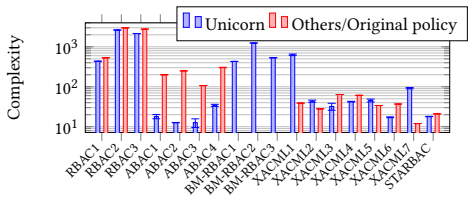
- [Section E.3, complexity definition compl(π)] The inductive definition of compl(π) is degenerate: both the rule case and the policy case are written as |α|, and α is undefined in the policy case. Since this complexity measure is used both in the objective function λ‖I‖+L(Auth,I;ϕXACML) and in the reported complexity comparisons, the XACML experiments are not reproducible as specified. Please supply the intended recursive definition and confirm that the reported complexity values in Figure 3 follow from it.
minor comments (6)
- [Section 5, Theorem 1] The proof of Theorem 1 is only one sentence; given that the monotonicity constraint is nontrivial, the proof should state why the maximum-entropy solution automatically satisfies the second constraint or justify dropping it.
- [Sections 10.2 and 11.1.2] The ABAC comparator [18] is an earlier miner by the same research group; the statements 'outperforms the state of the art' should be qualified accordingly to avoid overstating the independence of the comparison.
- [Section 10.2] For BM-RBAC, no state-of-the-art comparison is available because the authors could not obtain implementations; the conclusions drawn from these datasets should be described as feasibility results rather than competitiveness results.
- [Section 10.1, STARBAC] The spatio-temporal RBAC evaluation uses a single synthetic policy and a uniformly sampled log; the claim of TPR 'above 75% in all cases' for this language should be stated with the caveat that it is based on one synthetic scenario.
- [Section 9.1] The grammar ⟨cstr⟩ includes (¬?) isWithin(...); please clarify how negated spatial constraints are represented in the template formula and whether such negations preserve the diversity condition required by Lemma 2.
- [General] The manuscript does not state whether code or datasets will be released; making an artifact available would substantially strengthen reproducibility, especially given the number of moving parts in Algorithm 1 and its instantiations.
Circularity Check
Core Unicorn derivation is self-contained; the only by-construction result is the FPR<5% claim, which is enforced by an explicit filter.
-
fitted input called prediction
[Section 10.2 (Methodology); cf. Abstract]
"We considered only those mined policies whose FPR was below 5%. ... the false positive rates are always below 5%."
The 5% FPR bound is an input selection threshold, not a measured outcome. The paper explicitly filters or selects only policies satisfying FPR<5% (and, in Appendix B.2, grid search chooses hyperparameters subject to FPR<=0.05), then reports 'false positive rates are always below 5%' as if it were an empirical result. That claim is therefore true by construction: policies with FPR at or above the threshold were excluded before reporting. Consequently, this particular headline FPR result cannot serve as independent evidence for the universal method, and the reported TPRs are conditional on the same filter. The central derivation from template formula to P to q to Algorithm 1 does not reduce to this filter, so the circularity is confined to the reporting of this secondary empirical claim.
full rationale
Unicorn's derivation chain is largely self-contained: the posterior P(I|Auth) is defined from the template formula and objective function via maximum entropy (Eqs. 5-6), the mean-field q is an explicit approximation (Eq. 11), and Algorithm 1 optimizes q. No reported TPR or FPR value is fed back into the definitions of P or q, so the main 'prediction' is not fitted to the reported results. The comparisons against state-of-the-art miners are genuine external benchmarks, although the RBAC and ABAC baselines ([30] and [18]) are the authors' own prior work, a minor self-citation that is not load-bearing for the universal claim. The paper itself concedes that the mean-field independence assumption is false in general, but that is a stated limitation rather than a circular step, because the target policy is defined by maximizing the true P, not by q. The only concrete circularity is the abstract's FPR<5% claim, which is guaranteed by the explicit filter 'We considered only those mined policies whose FPR was below 5%' and the grid-search constraint in Appendix B.2. That is a self-definitional empirical statement, but it does not undermine the independence of the core derivation. Overall, the method has independent content, with partial circularity confined to a secondary reported metric.
Assumptions & free parameters
free parameters (6)
- β_init =
not reported (grid-searched)
- α =
not reported (grid-searched)
- T =
not reported
- λ =
not reported (grid-searched)
- N (max roles/rules/breadth) =
fixed per language; values not reported
- M (max attribute values/depth) =
fixed per language; values not reported
assumptions (5)
- domain assumption All carrier sets (users, permissions, attribute values, time instants) are finite.
- domain assumption The maximum-entropy principle is the correct way to choose a posterior distribution over policies.
- ad hoc to paper Random facts in a policy are mutually independent under the approximating distribution q.
- ad hoc to paper Template formulas must be diverse or decomposable into unrelated formula sets for expectation computation to be tractable.
- ad hoc to paper Deterministic annealing with β multiplied by α improves convergence to a good local maximum.
Cite this review
Pith. "Pith review of The Next 700 Policy Miners: A Universal Method for Building Policy Miners." pith.science (2026). https://pith.science/paper/WT4MSC77
@misc{pith2026190805994,
  author       = {Pith},
  title        = {Pith review of: The Next 700 Policy Miners: A Universal Method for Building Policy Miners},
  year         = {2026},
  howpublished = {\url{https://pith.science/paper/WT4MSC77}},
  note         = {Machine review of arXiv:1908.05994}
}
read the original abstract
A myriad of access control policy languages have been and continue to be proposed. The design of policy miners for each such language is a challenging task that has required specialized machine learning and combinatorial algorithms. We present an alternative method, universal access control policy mining (Unicorn). We show how this method streamlines the design of policy miners for a wide variety of policy languages including ABAC, RBAC, RBAC with user-attribute constraints, RBAC with spatio-temporal constraints, and an expressive fragment of XACML. For the latter two, there were no known policy miners until now. To design a policy miner using Unicorn, one needs a policy language and a metric quantifying how well a policy fits an assignment of permissions to users. From these, one builds the policy miner as a search algorithm that computes a policy that best fits the given permission assignment. We experimentally evaluate the policy miners built with Unicorn on logs from Amazon and access control matrices from other companies. Despite the genericity of our method, our policy miners are competitive with and sometimes even better than specialized state-of-the-art policy miners. The true positive rates of policies we mined differ by only 5% from the policies mined by the state of the art and the false positive rates are always below 5%. In the case of ABAC, it even outperforms the state of the art.
Figures


Figures from the paper (1 more)

Reference graph
Works this paper leans on
-
[1]
STARBAC: Spatiotemporal role based access control
Subhendu Aich, Shamik Sural, and Arun K Majumdar. STARBAC: Spatiotemporal role based access control. In OTM Confederated International Conferences” On the Move to Meaningful Internet Systems” , pages 1567–1582. Springer, 2007
work page 2007
-
[2]
Learning certi/f_iably optimal rule lists
Elaine Angelino, Nicholas Larus-Stone, Daniel Alabi, Margo Seltzer, and Cynthia Rudin. Learning certi/f_iably optimal rule lists. In Proceedings of the 23rd ACM SIGKDD International Conference on Knowledge Discovery and Data Mining , pages 35–44. ACM, 2017
work page 2017
-
[3]
Sophisticated access control via smt and logical frameworks
Konstantine Arkoudas, Ritu Chadha, and Jason Chiang. Sophisticated access control via smt and logical frameworks. ACM Transactions on Information and System Security (TISSEC) , 16(4):17, 2014
work page 2014
-
[4]
GemRBAC-DSL: a high-level speci/f_ication language for role- based access control policies
Ameni Ben Fadhel, Domenico Bianculli, and Lionel Briand. GemRBAC-DSL: a high-level speci/f_ication language for role- based access control policies. In Proceedings of the 21st ACM on Symposium on Access Control Models and Technologies , pages 179–190. ACM, 2016
work page 2016
-
[5]
A model-driven approach to representing and checking RBAC contextual policies
Ameni Ben Fadhel, Domenico Bianculli, Lionel Briand, and Benjamin Hourte. A model-driven approach to representing and checking RBAC contextual policies. In Proceedings of the Sixth ACM Conference on Data and Application Security and Privacy, pages 243–253. ACM, 2016
work page 2016
-
[6]
Trbac: A temporal role-based access control model
Elisa Bertino, Piero Andrea Bona/t_ti, and Elena Ferrari. Trbac: A temporal role-based access control model. ACM Transactions on Information and System Security (TISSEC) , 4(3):191–233, 2001
work page 2001
-
[7]
ABAC with group a/t_tributes and a/t_tribute hierarchies utilizing the policy machine
Smriti Bha/t_t, Farhan Patwa, and Ravi Sandhu. ABAC with group a/t_tributes and a/t_tribute hierarchies utilizing the policy machine. In Proceedings of the 2nd ACM Workshop on A/t_tribute-Based Access Control, pages 17–28. ACM, 2017
work page 2017
-
[8]
Rafae Bha/t_ti, Arif Ghafoor, Elisa Bertino, and James BD Joshi. X-GTRBAC: an XML-based policy speci/f_ication framework and architecture for enterprise-wide access control. ACM Transactions on Information and System Security (TISSEC) , 8(2):187–227, 2005
work page 2005
Show all 80 references
-
[9]
Pa/t_tern recognition and machine learning
Christopher M Bishop. Pa/t_tern recognition and machine learning. springer, 2006. 15
2006
-
[10]
Label-based access control: an ABAC model with enumerated authorization policy
Prosunjit Biswas, Ravi Sandhu, and Ram Krishnan. Label-based access control: an ABAC model with enumerated authorization policy. In Proceedings of the 2016 ACM International Workshop on A/t_tribute Based Access Control , pages 1–12. ACM, 2016
2016
-
[11]
Variational inference: A review for statisticians
David M Blei, Alp Kucukelbir, and Jon D McAuliffe. Variational inference: A review for statisticians. Journal of the American Statistical Association, 112(518):859–877, 2017
2017
-
[12]
Stoller, and Jiajie Li
/T_hang Bui, Sco/t_t D. Stoller, and Jiajie Li. Greedy and evolutionary algorithms for mining relationship-based access control policies. Computers & Security, 80:317–333, Jan 2019. Also available at http://arxiv.org/abs/1708.04749
2019 arXiv
-
[13]
LoT-RBAC: a location and time-based RBAC model
Suroop Mohan Chandran and James BD Joshi. LoT-RBAC: a location and time-based RBAC model. In International Conference on Web Information Systems Engineering , pages 361–375. Springer, 2005
2005
-
[14]
Generation of a/t_tribute based access control policy from existing authorization system, February 16 2016
Suresh N Chari and Ian M Molloy. Generation of a/t_tribute based access control policy from existing authorization system, February 16 2016. US Patent 9,264,451
2016
-
[15]
On spatio-temporal constraints and inheritance in role-based access control
Liang Chen and Jason Crampton. On spatio-temporal constraints and inheritance in role-based access control. In Proceedings of the 2008 ACM Symposium on Information, Computer and Communications Security , pages 205–216. ACM, 2008
2008
-
[16]
Extended ReBAC administrative models with cascading revocation and provenance support
Yuan Cheng, Khalid Bijon, and Ravi Sandhu. Extended ReBAC administrative models with cascading revocation and provenance support. In Proceedings of the 21st ACM on Symposium on Access Control Models and Technologies , SACMAT ’16, pages 161–170, New York, NY, USA, 2016. ACM
2016
-
[17]
Rule induction with CN2: Some recent improvements
Peter Clark and Robin Boswell. Rule induction with CN2: Some recent improvements. In European Working Session on Learning, pages 151–163. Springer, 1991
1991
-
[18]
Mining ABAC rules from sparse logs
Carlos Cotrini, /T_hilo Weghorn, and David Basin. Mining ABAC rules from sparse logs. In2018 IEEE European Symposium on Security and Privacy (EuroS&P) . IEEE, 2018
2018
-
[19]
Analyzing /f_irst-order role based access control
Carlos Cotrini, /T_hilo Weghorn, David Basin, and Manuel Clavel. Analyzing /f_irst-order role based access control. In Computer Security Foundations Symposium (CSF), 2015 IEEE 28th , pages 3–17. IEEE, 2015
2015
-
[20]
Ex-RBAC: an extended role based access control model for location-aware mobile collaboration system
Xiutao Cui, Yuliang Chen, and Junzhong Gu. Ex-RBAC: an extended role based access control model for location-aware mobile collaboration system. In Internet Monitoring and Protection, 2007. ICIMP 2007. Second International Conference on , pages 36–36. IEEE, 2007
2007
-
[21]
Data-aware process mining: Discovering decisions in processes using alignments
Massimiliano de Leoni and Wil MP van der Aalst. Data-aware process mining: Discovering decisions in processes using alignments. In Proceedings of the 28th annual ACM Symposium on Applied Computing , pages 1454–1461. ACM, 2013
2013
-
[22]
Solution methods for classi/f_ication problems with categorical a/t_tributes.Computational Mathematics and Modeling, 26(3):408–428, 2015
AG D’yakonov. Solution methods for classi/f_ication problems with categorical a/t_tributes.Computational Mathematics and Modeling, 26(3):408–428, 2015
2015
-
[23]
Springer Science & Business Media, 2013
H-D Ebbinghaus, J ¨org Flum, and Wolfgang /T_homas.Mathematical logic. Springer Science & Business Media, 2013
2013
-
[24]
A mathematical introduction to logic
Herbert Enderton and Herbert B Enderton. A mathematical introduction to logic . Elsevier, 2001
2001
-
[25]
Fast exact and heuristic methods for role minimization problems
Alina Ene, William Horne, Nikola Milosavljevic, Prasad Rao, Robert Schreiber, and Robert E Tarjan. Fast exact and heuristic methods for role minimization problems. In Proceedings of the 13th ACM symposium on Access control models and technologies, pages 1–10. ACM, 2008
-
[26]
Proposed NIST standard for role-based access control
David F Ferraiolo, Ravi Sandhu, Serban Gavrila, D Richard Kuhn, and Ramaswamy Chandramouli. Proposed NIST standard for role-based access control. ACM Transactions on Information and System Security (TISSEC) , 4(3):224–274, 2001
2001
-
[27]
Veri/f_ication and change-impact analysis of access-control policies
Kathi Fisler, Shriram Krishnamurthi, Leo A Meyerovich, and Michael Carl Tschantz. Veri/f_ication and change-impact analysis of access-control policies. In Proceedings of the 27th International Conference on So/f_tware Engineering , pages 196–205. ACM, 2005
2005
-
[28]
Relationship-based access control: protection model and policy language
Philip WL Fong. Relationship-based access control: protection model and policy language. In Proceedings of the /f_irst ACM conference on Data and application security and privacy , pages 191–202. ACM, 2011
2011
-
[29]
On the de/f_inition of role mining
Mario Frank, Joachim M Buhmann, and David Basin. On the de/f_inition of role mining. In Proceedings of the 15th ACM symposium on Access control models and technologies , pages 35–44. ACM, 2010
2010
-
[30]
Role mining with probabilistic models
Mario Frank, Joachim M Buhmann, and David Basin. Role mining with probabilistic models. ACM Transactions on Information and System Security (TISSEC) , 15(4):15, 2013
2013
-
[31]
A probabilistic approach to hybrid role mining
Mario Frank, Andreas P Streich, David Basin, and Joachim M Buhmann. A probabilistic approach to hybrid role mining. In Proceedings of the 16th ACM conference on Computer and communications security , pages 101–111. ACM, 2009. 16
2009
-
[32]
/T_he elements of statistical learning, volume 1
Jerome Friedman, Trevor Hastie, and Robert Tibshirani. /T_he elements of statistical learning, volume 1. Springer series in statistics New York, NY, USA:, 2001
2001
-
[33]
Poster: Constrained policy mining in a/t_tribute based access control
Mayank Gautam, Sadhana Jha, Shamik Sural, Jaideep Vaidya, and Vijayalakshmi Atluri. Poster: Constrained policy mining in a/t_tribute based access control. In Proceedings of the 22nd ACM on Symposium on Access Control Models and Technologies, pages 121–123. ACM, 2017
2017
-
[34]
Oasis extensible access control markup language (XACML)
Simon Godik and Tim Moses. Oasis extensible access control markup language (XACML). OASIS Commi/t_tee Seci/f_ication CS-XACML-speci/f_ication-1.0, 2002
2002
-
[35]
/T_he role hierarchy mining problem: Discovery of optimal role hier- archies
Qi Guo, Jaideep Vaidya, and Vijayalakshmi Atluri. /T_he role hierarchy mining problem: Discovery of optimal role hier- archies. In Computer Security Applications Conference, 2008. ACSAC 2008. Annual , pages 237–246. IEEE, 2008
2008
-
[36]
Pairwise data clustering by deterministic annealing
/T_homas Hofmann and Joachim M Buhmann. Pairwise data clustering by deterministic annealing. IEEE transactions on pa/t_tern analysis and machine intelligence, 19(1):1–14, 1997
1997
-
[37]
Guide to a/t_tribute based access control (ABAC) de/f_inition and considerations (dra/f_t).NIST special publication, 800(162), 2013
Vincent C Hu, David Ferraiolo, Rick Kuhn, Arthur R Friedman, Alan J Lang, Margaret M Cogdell, Adam Schnitzer, Kenneth Sandlin, Robert Miller, Karen Scarfone, et al. Guide to a/t_tribute based access control (ABAC) de/f_inition and considerations (dra/f_t).NIST special publicat...
2013
-
[38]
2012 IEEE International workshop on machine learning for signal processing
IEEE. 2012 IEEE International workshop on machine learning for signal processing. Amazon data science competition, 2012
2012
-
[39]
Information theory and statistical mechanics
Edwin T Jaynes. Information theory and statistical mechanics. Physical review, 106(4):620, 1957
1957
-
[40]
Security analysis of temporal rbac under an administrative model
Sadhana Jha, Shamik Sural, Jaideep Vaidya, and Vijayalakshmi Atluri. Security analysis of temporal rbac under an administrative model. Computers & Security, 46:154–172, 2014
2014
-
[41]
Access-control language for multidomain environments
James BD Joshi. Access-control language for multidomain environments. IEEE Internet Computing, 8(6):40–50, 2004
2004
-
[42]
Classi/f_ication rule learning with APRIORI-C
Viktor Jovanoski and Nada Lavra ˇc. Classi/f_ication rule learning with APRIORI-C. InPortuguese Conference on Arti/f_icial Intelligence, pages 44–51. Springer, 2001
2001
-
[43]
Amazon.com – Employee access challenge, 2013
Kaggle. Amazon.com – Employee access challenge, 2013
2013
-
[44]
APRIORI-SD: Adapting association rule learning to subgroup discovery
Branko Kav ˇsek and Nada Lavra ˇc. APRIORI-SD: Adapting association rule learning to subgroup discovery. Applied Arti/f_icial Intelligence, 20(7):543–583, 2006
2006
-
[45]
Maximum entropy and minimum cross-entropy principles: Need for a broader perspective
HK Kesavan and JN Kapur. Maximum entropy and minimum cross-entropy principles: Need for a broader perspective. In Maximum Entropy and Bayesian Methods , pages 419–432. Springer, 1990
1990
-
[46]
Optimization by simulated annealing.science, 220(4598):671–680, 1983
Sco/t_t Kirkpatrick, C Daniel Gela/t_t, and Mario P Vecchi. Optimization by simulated annealing.science, 220(4598):671–680, 1983
1983
-
[47]
/T_he CONTINUE server (or, How I administered PADL 2002 and 2003)
Shriram Krishnamurthi. /T_he CONTINUE server (or, How I administered PADL 2002 and 2003). In Practical aspects of declarative languages, pages 2–16. Springer, 2003
2002
-
[48]
Role mining-revealing business roles for security administration using data mining technology
Martin Kuhlmann, Dalia Shohat, and Gerhard Schimpf. Role mining-revealing business roles for security administration using data mining technology. In Proceedings of the eighth ACM symposium on Access control models and technologies , pages 179–186. ACM, 2003
2003
-
[49]
STRBAC–an approach towards spatio-temporal role-based access control
Mahendra Kumar and Richard E Newman. STRBAC–an approach towards spatio-temporal role-based access control. In Communication, Network, and Information Security , pages 150–155, 2006
2006
-
[50]
M. Lichman. UCI machine learning repository. amazon access samples data set, 2013
2013
-
[51]
Optimal boolean matrix decomposition: Application to role engineering
Haibing Lu, Jaideep Vaidya, and Vijayalakshmi Atluri. Optimal boolean matrix decomposition: Application to role engineering. In Data Engineering, 2008. ICDE 2008. IEEE 24th International Conference on , pages 297–306. IEEE, 2008
2008
-
[52]
Towards mining of temporal roles
Barsha Mitra, Shamik Sural, Vijayalakshmi Atluri, and Jaideep Vaidya. Towards mining of temporal roles. InIFIP Annual Conference on Data and Applications Security and Privacy , pages 65–80. Springer, 2013
2013
-
[53]
/T_he generalized temporal role mining problem
Barsha Mitra, Shamik Sural, Vijayalakshmi Atluri, and Jaideep Vaidya. /T_he generalized temporal role mining problem. Journal of Computer Security , 23(1):31–58, 2015
2015
-
[54]
Mining temporal roles using many-valued con- cepts
Barsha Mitra, Shamik Sural, Jaideep Vaidya, and Vijayalakshmi Atluri. Mining temporal roles using many-valued con- cepts. Computers & Security, 60:79–94, 2016
2016
-
[55]
A survey of role mining.ACM Computing Surveys (CSUR), 48(4):50, 2016
Barsha Mitra, Shamik Sural, Jaideep Vaidya, and Vijayalakshmi Atluri. A survey of role mining.ACM Computing Surveys (CSUR), 48(4):50, 2016. 17
2016
-
[56]
Generative models for access control policies: applications to role mining over logs with a/t_tribution
Ian Molloy, Youngja Park, and Suresh Chari. Generative models for access control policies: applications to role mining over logs with a/t_tribution. InProceedings of the 17th ACM symposium on Access Control Models and Technologies , pages 45–56. ACM, 2012
2012
-
[57]
Subhojeet Mukherjee, Indrakshi Ray, Indrajit Ray, Hossein Shirazi, Toan Ong, and Michael G. Kahn. A/t_tribute based access control for healthcare resources. In Proceedings of the 2Nd ACM Workshop on A/t_tribute-Based Access Control , ABAC ’17, pages 29–40, New York, NY, USA, 2017. ACM
2017
-
[58]
Automatic differentiation in pytorch
Adam Paszke, Sam Gross, Soumith Chintala, Gregory Chanan, Edward Yang, Zachary DeVito, Zeming Lin, Alban Des- maison, Luca Antiga, and Adam Lerer. Automatic differentiation in pytorch. 2017
2017
-
[59]
Evaluation: from precision, recall and F-measure to ROC, informedness, markedness and corre- lation
David Martin Powers. Evaluation: from precision, recall and F-measure to ROC, informedness, markedness and corre- lation. 2011
2011
-
[60]
A spatio-temporal role-based access control model
Indrakshi Ray and Manachai Toahchoodee. A spatio-temporal role-based access control model. InIFIP Annual Conference on Data and Applications Security and Privacy , pages 211–226. Springer, 2007
2007
-
[61]
Deterministic annealing for clustering, compression, classi/f_ication, regression, and related optimization problems
Kenneth Rose. Deterministic annealing for clustering, compression, classi/f_ication, regression, and related optimization problems. Proceedings of the IEEE , 86(11):2210–2239, 1998
1998
-
[62]
Vector quantization by deterministic annealing
Kenneth Rose, Eitan Gurewitz, and Geoffrey C Fox. Vector quantization by deterministic annealing. IEEE Transactions on Information theory, 38(4):1249–1257, 1992
1992
-
[63]
Role mining with ORCA
J ¨urgen Schlegelmilch and Ulrike Steffens. Role mining with ORCA. InProceedings of the tenth ACM symposium on Access control models and technologies , pages 168–176. ACM, 2005
2005
-
[64]
Tuning the hyper-parameters of an estimator, 2007–2017
Scikit-learn. Tuning the hyper-parameters of an estimator, 2007–2017
2007
-
[65]
Cart: classi/f_ication and regression trees
Dan Steinberg and Phillip Colla. Cart: classi/f_ication and regression trees. /T_he top ten algorithms in data mining, 9:179, 2009
2009
-
[66]
Mining hierarchical temporal roles with multiple metrics
Sco/t_t D Stoller and /T_hang Bui. Mining hierarchical temporal roles with multiple metrics. InIFIP Annual Conference on Data and Applications Security and Privacy , pages 79–95. Springer, 2016
2016
-
[67]
Multi-assignment clustering for boolean data
Andreas P Streich, Mario Frank, David Basin, and Joachim M Buhmann. Multi-assignment clustering for boolean data. In Proceedings of the 26th annual international conference on machine learning , pages 969–976. ACM, 2009
2009
-
[68]
Alternative approach to maximum-entropy inference
Y Tikochinsky, NZ Tishby, and Raphael David Levine. Alternative approach to maximum-entropy inference. Physical Review A, 30(5):2638, 1984
1984
-
[69]
Ensuring spatio- temporal access control for real-world applications
Manachai Toahchoodee, Indrakshi Ray, Kyriakos Anastasakis, Geri Georg, and Behzad Bordbar. Ensuring spatio- temporal access control for real-world applications. In Proceedings of the 14th ACM symposium on Access control models and technologies, pages 13–22. ACM, 2009
2009
-
[70]
Decentralized composite access control
Petar Tsankov, Srdjan Marinovic, Mohammad Torabi Dashti, and David Basin. Decentralized composite access control. In International Conference on Principles of Security and Trust , pages 245–264. Springer, 2014
2014
-
[71]
Analysis of xacml policies with smt
Fatih Turkmen, Jerry den Hartog, Silvio Ranise, and Nicola Zannone. Analysis of xacml policies with smt. InInternational Conference on Principles of Security and Trust , pages 115–134. Springer, 2015
2015
-
[72]
/T_he role mining problem: /f_inding a minimal descriptive set of roles
Jaideep Vaidya, Vijayalakshmi Atluri, and Qi Guo. /T_he role mining problem: /f_inding a minimal descriptive set of roles. In Proceedings of the 12th ACM symposium on Access control models and technologies , pages 175–184. ACM, 2007
2007
-
[73]
/T_he role mining problem: A formal perspective
Jaideep Vaidya, Vijayalakshmi Atluri, and Qi Guo. /T_he role mining problem: A formal perspective. ACM Transactions on Information and System Security (TISSEC) , 13(3):27, 2010
2010
-
[74]
Roleminer: mining roles using subset enumeration
Jaideep Vaidya, Vijayalakshmi Atluri, and Janice Warner. Roleminer: mining roles using subset enumeration. In Pro- ceedings of the 13th ACM conference on Computer and communications security , pages 144–153. ACM, 2006
2006
-
[75]
Algorithms for mining meaningful roles
Zhongyuan Xu and Sco/t_t D Stoller. Algorithms for mining meaningful roles. InProceedings of the 17th ACM symposium on Access Control Models and Technologies , pages 57–66. ACM, 2012
2012
-
[76]
Mining a/t_tribute-based access control policies from logs
Zhongyuan Xu and Sco/t_t D Stoller. Mining a/t_tribute-based access control policies from logs. InData and Applications Security and Privacy XXVIII , pages 276–291. Springer, 2014
2014
-
[77]
Mining a/t_tribute-based access control policies.IEEE Transactions on Dependable and Secure Computing, 12(5):533–545, 2015
Zhongyuan Xu and Sco/t_t D Stoller. Mining a/t_tribute-based access control policies.IEEE Transactions on Dependable and Secure Computing, 12(5):533–545, 2015
2015
-
[78]
Time-domain a/t_tribute-based access control for cloud- based video content sharing: A cryptographic approach
Kan Yang, Zhen Liu, Xiaohua Jia, and Xuemin Sherman Shen. Time-domain a/t_tribute-based access control for cloud- based video content sharing: A cryptographic approach. IEEE Transactions on Multimedia , 18(5):940–950, 2016. 18
2016
-
[79]
Mining web logs for prediction models in WWW caching and prefetching
Qiang Yang, Haining Henry Zhang, and Tianyi Li. Mining web logs for prediction models in WWW caching and prefetching. In Proceedings of the seventh ACM SIGKDD international conference on Knowledge discovery and data mining, pages 473–478. ACM, 2001
2001
-
[80]
HOST”, “PERMGROUP
Dana Zhang, Kotagiri Ramamohanarao, and Tim Ebringer. Role engineering using graph optimisation. In Proceedings of the 12th ACM Symposium on Access Control Models and Technologies , pages 139–144. ACM, 2007. A Proof of Lemma 1 Lemma 1. For a policy languageϕ∈L , P (I| Auth) = ...
2007
Reviewed August 14, 2026 · model on record in the stance chip above.
Discussion (0). Continue with ORCID to comment.