REVIEW 4 major objections 5 minor 51 references
Regularizing CNN Transfer Learning with Randomised Regression
T0 review · 4 major / 5 minor · reviewed 2026-08-14 · deepseek-v4-flash
Pith's one-line read A random regression target, dynamically weighted by gradient norms, regularizes a fine-tuned CNN as effectively as concrete auxiliary tasks.
desk verdict PtR is a simple, cheap regularizer with consistent gains over its own fine-tuning baseline, but the 'on par with SOTA' claim is weaker than presented because comparisons mix architectures and baselines. read the letter →
The pith
A machine-rendered reading of the paper's core claim, the machinery that carries it, and where it could break.
The reading
What carries the argument
The central object is the pseudo-task regression loss $L_{\mathrm{PtR}} = f_{\mathrm{reg}}(\mathrm{rep}, t)$, where rep is the feature-layer activation and $t$ is a vector of independent uniform random targets in $[0, 2m)$. The mechanism that controls it is gradient-norm balancing: before back-propagation, the paper computes $\|\partial L_{\mathrm{ce}}/\partial \mathrm{rep}\|_2$ and $\|\partial L_{\mathrm{PtR}}/\partial \mathrm{rep}\|_2$ averaged over the batch, sets $w = \bar{G}_{\mathrm{ce}} / (\bar{G}_{\mathrm{PtR}} R)$, and minimizes $L_{\mathrm{ce}} + w L_{\mathrm{PtR}}$. This gives a controlled distraction: the pseudo-task contributes a prescribed share $R$ of the target-task gradient norm, and because $t$ changes every batch, the gradient noise has variance increased by $\mathrm{Var}(t)$. That randomness is what distinguishes PtR from feature-norm penalization and is what the paper credits for helping the optimizer explore flatter or better minima.
What would settle it
On a fixed dataset and layer, multiply all feature activations by a constant before the regression head while keeping every other setting fixed. If accuracy gains are unchanged across several constants, the method is scale-invariant; if the gain shrinks or becomes negative, the fixed-$m$/fixed-$R$ premise fails and a scale-normalized regularizer would be required.
Extended reading notes
Core claim
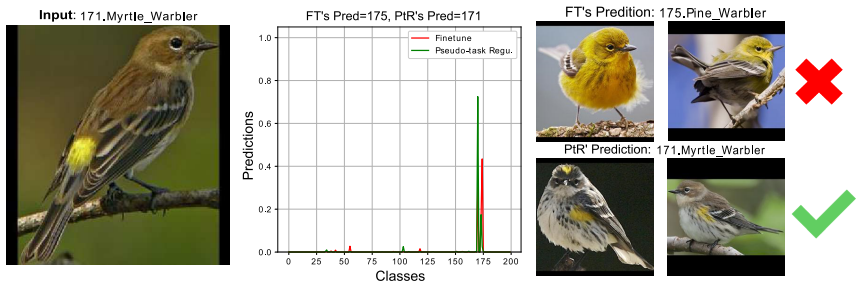
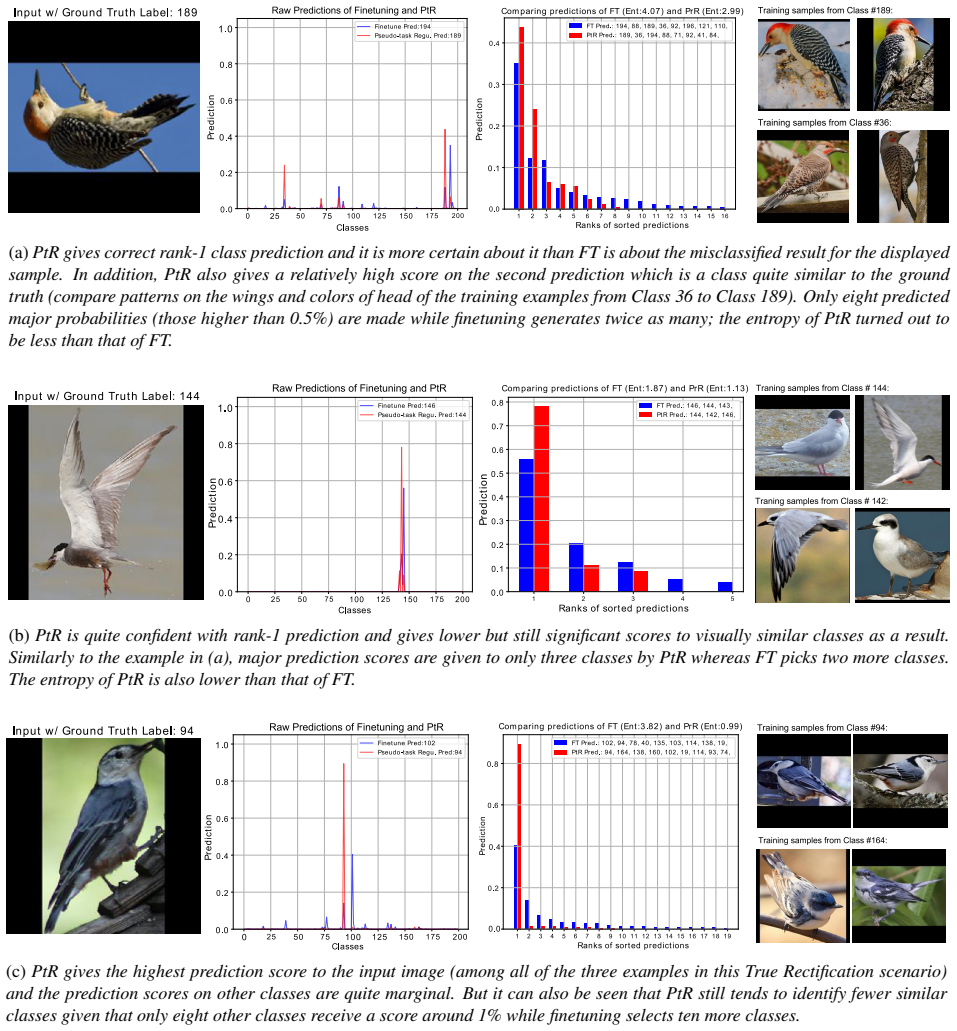
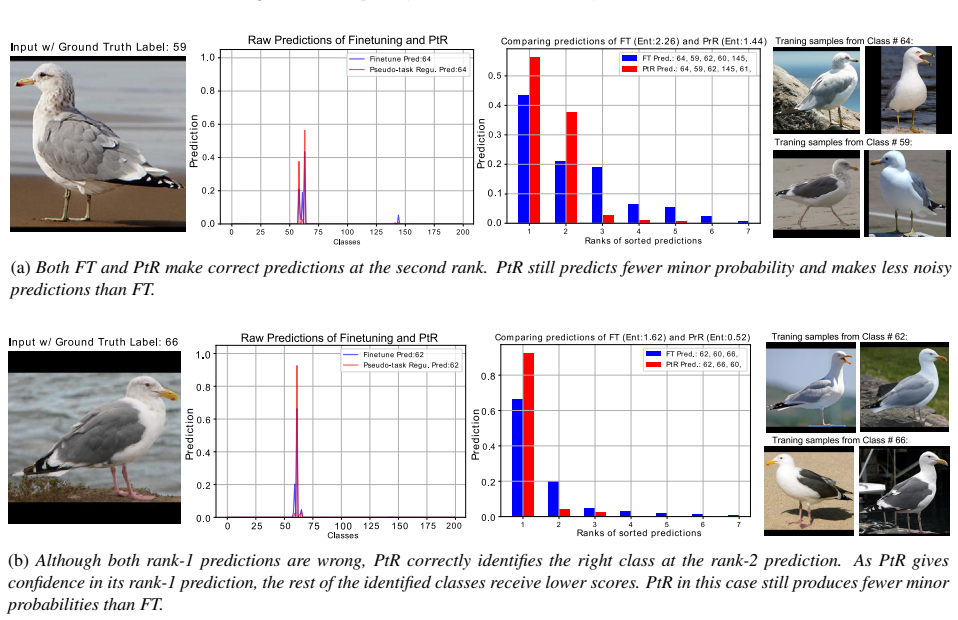
PtR is a regularization method for transfer learning with limited target data. During fine-tuning, once the target cross-entropy loss falls below a threshold, the network is simultaneously trained to regress its feature representation at a chosen layer to uniformly random targets. The regularization weight is recomputed per batch as $w = \bar{G}_{\mathrm{ce}} / (\bar{G}_{\mathrm{PtR}} R)$, so the norm of the pseudo-task gradient is a fixed ratio $R$ of the target-task gradient norm. On five small datasets with VGG-16 and ResNet-50/101, PtR raised accuracy over vanilla fine-tuning by roughly 0.4 to 3.1 percentage points depending on dataset and architecture, delivered double-digit percentage error-rate reductions on the sparsest datasets, and performed on par with or better than JointTrain, LwF, BTfW, Inductive Bias, and FNP, with Pairwise Confusion sometimes ahead by a small margin. The paper also gives a variance argument: with a random target $t$, the gradient variance with respect to a neuron contains $\mathrm{Var}(t)$, so random targets inject more gradient noise than fixed-zero feature-norm penalties. On a CUB200 validation set, PtR lowered average prediction entropy from 1.33 to 1.15 bits, meaning predictions became more concentrated on the correct and visually similar classes.
Load-bearing premise
The load-bearing premise is that a single fixed choice of the pseudo-target range $m$ and the gradient-ratio $R$ creates the right amount of distraction across datasets and architectures, because PtR does not normalize the scale of the feature representations before computing the regression loss.
Editorial extensions
If this is right
- PtR improves accuracy over vanilla fine-tuning on every dataset tested, with the largest relative error-rate reductions on the sparsest fine-grained sets, more than 10% on Flower102 and CUB200 with VGG-16.
- The dynamic gradient-norm weighting makes the regularization strength self-adjusting during training, so the practitioner sets one gradient-ratio $R$ and one target scale $m$ instead of tuning a loss-weight schedule.
- PtR reaches or exceeds the accuracy gain of JointTrain, LwF, BTfW, Inductive Bias, and FNP, and comes within about half a percentage point of Pairwise Confusion on CUB200, while needing none of the extra resources those methods use.
- On a CUB200 validation set, PtR lowers average prediction entropy from 1.33 to 1.15 bits and reduces minor off-diagonal probabilities, so predictions become concentrated on the true class and visually similar ones.
- Training from scratch with PtR produced larger relative gains than fine-tuning from ImageNet, suggesting the regularizer is not tied to a particular pre-trained initialization.
Reading between the lines
- Because $R$ and $m$ are not scale-normalized, PtR is likely to need retuning whenever feature magnitudes change; the paper's own supplementary numbers, with VGG-16 plus BatchNorm gaining 4.03% against roughly 3% without, suggest the interaction with normalization is not neutral.
- If the mechanism is purely gradient-noise variance, then injecting matched noise directly into the back-propagated gradients without any regression head should reproduce the gains; this experiment would separate the pseudo-task formulation from the noisy-gradient explanation.
- PtR's success implies that concrete auxiliary tasks may be valuable mainly as well-calibrated distractors; if so, random-noise regularizers could replace auxiliary tasks in other low-data regimes such as semi-supervised learning or domain adaptation.
Signed reviews
Editorial analysis
A structured set of objections, weighed in public.
Referee Report
Summary. The paper proposes Pseudo-task Regularization (PtR), an auxiliary loss that regresses a CNN's representation layer to random pseudo-targets during fine-tuning, with the loss weight adjusted on-line by balancing gradient norms against the cross-entropy loss. The method is evaluated on Flower102, CUB200, MIT67, Stanford40, WebFace500, and Caltech256, using VGG-16 and ResNet backbones, and is compared with vanilla fine-tuning and several prior regularization methods. The authors report consistent gains over their own fine-tuning baselines and argue that these gains are greater than or on a par with recent state-of-the-art regularization methods, while requiring no extra data, annotations, or concrete auxiliary tasks.
Significance. If the central claim holds, PtR is an attractive regularization scheme: it is simple, architecture-agnostic in principle, requires no auxiliary data, and can be implemented by adding one regression head. The paper includes genuinely useful empirical evidence: the algorithm is clearly specified, all experiments average over five runs, standard deviations are reported, and the supplementary material contains ablations on the start threshold T, weight decay, batch normalization, and training from scratch. These internal comparisons constitute a strength. The main weakness is that the headline comparative claim is not supported by controlled comparisons, because the baselines for prior methods are taken from different papers with different architectures, splits, and training schedules. The method's value as a regularizer is plausible, but its claimed superiority over existing methods is not established by the current evidence.
major comments (4)
- [Abstract; §3.2, Tables 2–5] The claim that PtR's improvements are 'greater or on a par' with state-of-the-art methods is not supported by the reported evidence. The comparisons in Tables 2–5 are of accuracy gains, but each gain is measured relative to a different fine-tuning baseline coming from a different paper. For example, on CUB200 the JointTrain/LwF baseline is 72.1 while the PtR baseline is 75.1; on Flower102 the PC baseline is 85.2 while the PtR baseline is 83.9; and on Caltech256 BTfW uses ResNet-152 while PtR uses ResNet-101. A gain over a weaker baseline is not comparable to a gain over a stronger baseline, since the room for improvement differs. The statement in §3.1 that learning-rate schedules were 'slightly different' for PtR than for the fine-tuning baseline further complicates the internal baseline comparison. To support the comparative claim, the authors would need either to re-run the competing methods under the same protocol (same architecture, splits, augmentation, schedules) or to temper the claim to one about consistent improvement over vanilla fine-tuning. This is load-bearing for the abstract.
- [§3.1, Algorithm 1] The hyperparameter settings are not fully specified for reproducibility. For ResNet the paper reports R=3 and m=1, but for VGG-16 it states only that 'R varies in the range between 3 and 5, and m around 10 to 15'. Since the regularization strength depends directly on R and on the scale of the pseudo-targets, the per-dataset values should be listed. Without them, and without released code, the experiments cannot be reproduced. In addition, the sensitivity of the results to these values is not reported beyond the statement that hold-out sets were used; a figure showing accuracy versus R and m across datasets would substantiate the claim that the method does not require careful tuning.
- [§3.1, Algorithm 1] The 'plug-and-play' generality claim rests on an unstated scale assumption. The pseudo-target mean m is fixed at 1 for ResNet but 10–15 for VGG, and the gradient-norm balancing via w = G_ce / (G_PtR * R) normalizes the gradient norm but not the scale of the representation. If applied to a different architecture, normalization, or feature layer, the effective regularization strength will change because the magnitude of the regression loss gradients depends on the representation scale. The paper does not provide a scale-invariant choice of m or an automatic calibration mechanism, so the claim that PtR is an efficient alternative across arbitrary CNN transfer settings needs to be qualified or supported by experiments varying the representation layer and normalization.
- [§2.3, Eq. (6)–(7)] The toy variance derivation contains a mathematical slip. In Eq. (6), the gradient of the L2 regression loss through a ReLU is proportional to |f(o) − t|·x (when the unit is active), not to (f(o) − t)·x. The subsequent variance decomposition Var(∂E_reg/∂a) = Var(f(o)) + Var(t) holds for the signed difference f(o) − t, not for its absolute value, and it also ignores the dependence on whether the ReLU is active. This derivation is heuristic and not used to predict experimental outcomes, but as written it is not a valid explanation for why random targets increase gradient variance. It should be corrected or explicitly labeled as an informal intuition.
minor comments (5)
- [§1, Introduction] There is a typo: 'we aim to device a regularizer' should be 'we aim to devise a regularizer'.
- [Supplementary §7] The section title 'Case studies on the effect of the Psudo-task Regularization' contains a typo: 'Psudo' should be 'Pseudo'.
- [§5, Related Work] The abbreviation 'FPN' appears in the related-work paragraph on feature norm penalty, while the experiments and tables consistently use 'FNP'. The terminology should be unified.
- [§2.3, Eq. (7)] The statement 'Var(∂E_reg/∂a) = Var(f(o)) + Var(t)' assumes independence of t and f(o), but the pseudo-target t is drawn independently, so the independence assumption is fine; the issue is the absolute value, as noted in my major comment.
- [§3.1, Experimental Setup] When describing the validation split, the paper says '10% of the training images were randomly separated' but does not state whether the same split was used across the five runs. Clarifying this would help readers assess the reported standard deviations.
Circularity Check
No circularity: PtR is an empirical regularization method whose reported gains come from external benchmark comparisons, not from fitting or self-citation.
full rationale
The paper's derivation chain is self-contained. The PtR total loss in Eq. (2) and the dynamic weight in Algorithm 1 / Eq. (5) are definitions: w is computed so that the gradient-norm ratio equals the chosen R; this is construction, not a prediction. Section 2.3's variance identity Var(dEreg/da)=Var(f(o))+Var(t) is a direct algebraic consequence of the toy model and the independence of t, and it is used only as motivation for why random targets add gradient variance relative to zero-target feature-norm penalties; it does not predict the experimental accuracies. The central evidence is the accuracy comparison in Tables 1-5 against the vanilla fine-tuning baseline and published methods (JointTrain, LwF, BTfW, Ind.Bias, PC, FNP), with hold-out selection of R and m described in Sec. 3.1. Tuning two hyperparameters on validation splits and then applying them to test sets is standard model selection, not fitting the reported test metric. The paper does cite work by the second author ([1], [19], [25]), but these citations appear in related-work and contextual comparisons (feature contraction, factors of transferability) and are not load-bearing for the claim that randomized regression targets regularize transfer learning. The skeptical concern about uncontrolled baselines across papers is a comparison-validity weakness, not a circularity; it is not a case where an equation reduces to its input or a fitted parameter is renamed a prediction. Therefore no circular step is present.
Assumptions & free parameters
free parameters (3)
- R (target gradient norm ratio) =
3 for ResNet; 3-5 for VGG-16
- m (mean of uniform pseudo-target distribution) =
1 for ResNet; 10-15 for VGG-16
- T (start threshold for PtR loss) =
1
assumptions (3)
- domain assumption ImageNet-pretrained weights provide a good initialization for transfer learning to the target datasets.
- domain assumption The 'distraction' gradient from the pseudo-task does not corrupt target-task optimization; gradient-norm balancing yields a proper regularization strength.
- domain assumption Comparison numbers from prior methods (JointTrain, LwF, PC, BTfW, Ind.Bias, FNP) are produced under comparable settings and are reliable.
Cite this review
Pith. "Pith review of Regularizing CNN Transfer Learning with Randomised Regression." pith.science (2026). https://pith.science/paper/M5MXJ7FT
@misc{pith2026190805997,
  author       = {Pith},
  title        = {Pith review of: Regularizing CNN Transfer Learning with Randomised Regression},
  year         = {2026},
  howpublished = {\url{https://pith.science/paper/M5MXJ7FT}},
  note         = {Machine review of arXiv:1908.05997}
}
read the original abstract
This paper is about regularizing deep convolutional networks (CNNs) based on an adaptive framework for transfer learning with limited training data in the target domain. Recent advances of CNN regularization in this context are commonly due to the use of additional regularization objectives. They guide the training away from the target task using some forms of concrete tasks. Unlike those related approaches, we suggest that an objective without a concrete goal can still serve well as a regularized. In particular, we demonstrate Pseudo-task Regularization (PtR) which dynamically regularizes a network by simply attempting to regress image representations to pseudo-regression targets during fine-tuning. That is, a CNN is efficiently regularized without additional resources of data or prior domain expertise. In sum, the proposed PtR provides: a) an alternative for network regularization without dependence on the design of concrete regularization objectives or extra annotations; b) a dynamically adjusted and maintained strength of regularization effect by balancing the gradient norms between objectives on-line. Through numerous experiments, surprisingly, the improvements on classification accuracy by PtR are shown greater or on a par to the recent state-of-the-art methods.
Figures


Figures from the paper (6 more)




Reference graph
Works this paper leans on
-
[1]
Factors of transferability for a generic convnet representation
Hossein Azizpour, Ali Sharif Razavian, Josephine Sullivan, Atsuto Maki, and Stefan Carlsson. Factors of transferability for a generic convnet representation. IEEE Transactions on Pattern Analysis and Machine Intelligence , 2016
work page 2016
-
[2]
Gradnorm: Gradient normalization for adaptive loss balancing in deep multitask networks
Zhao Chen, Vijay Badrinarayanan, Chen-Yu Lee, and Andrew Rabinovich. Gradnorm: Gradient normalization for adaptive loss balancing in deep multitask networks. In International Conference on Machine Learning (ICML) , 2018
work page 2018
-
[3]
Imagenet: A large-scale hierarchical image database
Jia Deng, Wei Dong, Richard Socher, Li-Jia Li, Kai Li, and Fei-Fei Li. Imagenet: A large-scale hierarchical image database. In The IEEE Conference on Computer Vision and Pattern Recognition (CVPR) , 2009
work page 2009
-
[4]
Decaf: A deep convolutional activation feature for generic visual recognition
Jeff Donahue, Yangqing Jia, Oriol Vinyals, Judy Hoffman, Ning Zhang, Eric Tzeng, and Trevor Darrell. Decaf: A deep convolutional activation feature for generic visual recognition. In International Conference on Machine Learning (ICML) , 2014
work page 2014
-
[5]
Pairwise confusion for fine-grained visual classification
Abhimanyu Dubey, Otkrist Gupta, Pei Guo, Ramesh Raskar, Ryan Farrell, and Nikhil Naik. Pairwise confusion for fine-grained visual classification. In European Conference on Computer Vision (ECCV) , 2018
work page 2018
-
[6]
Borrowing treasures from the wealthy: Deep transfer learning through selective joint fine-tuning
Weifeng Ge and Yizhou Yu. Borrowing treasures from the wealthy: Deep transfer learning through selective joint fine-tuning. In IEEE Conference on Computer Vision and Pattern Recognition (CVPR) , 2017
work page 2017
-
[7]
Priya Goyal, Piotr Doll \' a r, Ross B. Girshick, Pieter Noordhuis, Lukasz Wesolowski, Aapo Kyrola, Andrew Tulloch, Yangqing Jia, and Kaiming He. Accurate, large minibatch SGD: training imagenet in 1 hour. Arxiv preprint 1706.02677 , 2017
arXiv 2017
-
[8]
Caltech-256 object category dataset
Gregory Griffin, Alex Holub, and Pietro Perona. Caltech-256 object category dataset. Technical report, California Institute of Technology, 2007
2007
Show all 51 references
-
[9]
Weinberger
Chuan Guo, Geoff Pleiss, Yu Sun, and Kilian Q. Weinberger. On calibration of modern neural networks. In International Conference on Machine Learning (ICML) , 2017
2017
-
[10]
Low-shot visual recognition by shrinking and hallucinating features
Bharath Hariharan and Ross Girshick. Low-shot visual recognition by shrinking and hallucinating features. In The IEEE International Conference on Computer Vision (ICCV) , 2017
2017
-
[11]
Deep residual learning for image recognition
Kaiming He, Xiangyu Zhang, Shaoqing Ren, and Jian Sun. Deep residual learning for image recognition. In The IEEE Conference on Computer Vision and Pattern Recognition (CVPR) , 2016
2016
-
[12]
Weinberger
Gao Huang, Zhuang Liu, Laurens van der Maaten, and Kilian Q. Weinberger. Densely connected convolutional networks. In IEEE Conference on Computer Vision and Pattern Recognition (CVPR) , 2017
2017
-
[13]
Batch normalization: Accelerating deep network training by reducing internal covariate shift
Sergey Ioffe and Christian Szegedy. Batch normalization: Accelerating deep network training by reducing internal covariate shift. arXiv preprint 1502.03167 , 2015
2015 arXiv
-
[14]
Three factors influencing minima in SGD
Stanislaw Jastrzebski, Zachary Kenton, Devansh Arpit, Nicolas Ballas, Asja Fischer, Yoshua Bengio, and Amos Storkey. Three factors influencing minima in SGD . Arxiv 1711.04623 , 2018
2018 arXiv
-
[15]
One millisecond face alignment with an ensemble of regression trees
Vahdat Kazemi and Josephine Sullivan. One millisecond face alignment with an ensemble of regression trees. In The IEEE Conference on Computer Vision and Pattern Recognition (CVPR) , 2014
2014
-
[16]
Pose N et: A convolutional network for real-time 6-dof camera relocalization
Alex Kendall, Matthew Grimes, and Roberto Cipolla. Pose N et: A convolutional network for real-time 6-dof camera relocalization. In Proc. of the International Conference on Computer Vision ( ICCV ) . 2015
2015
-
[17]
On large-batch training for deep learning: Generalization gap and sharp minima
Nitish Shirish Keskar, Dheevatsa Mudigere, Jorge Nocedal, Mikhail Smelyanskiy, and Ping Tak Peter Tang. On large-batch training for deep learning: Generalization gap and sharp minima. In Proc. of the International Conference on Learning Representations (ICLR) , 2017
2017
-
[18]
Alex Krizhevsky, Ilya Sutskever, and Geoffrey E. Hinton. Imagenet classification with deep convolutional neural networks. In Advances in Neural Information Processing Systems . 2012
2012
-
[19]
Feature contraction: New convnet regularization in image classification
Vladimir Li and Atsuto Maki. Feature contraction: New convnet regularization in image classification. In British Machine Vision Conference (BMVC) , 2018
2018
-
[20]
Explicit inductive bias for transfer learning with convolutional networks
Xuhong Li, Yves Grandvalet, and Franck Davoine. Explicit inductive bias for transfer learning with convolutional networks. In International Conference on Machine Learning (ICML) , 2018
2018
-
[21]
Learning without forgetting
Zhizhong Li and Derek Hoiem. Learning without forgetting. In European Conference on Computer Vision (ECCV) , 2016
2016
-
[22]
Lawrence Zitnick
Tsung-Yi Lin, Michael Maire, Serge Belongie, James Hays, Pietro Perona, Deva Ramanan, Piotr Doll \'a r, and C. Lawrence Zitnick. Microsoft COCO : Common objects in context. In European Conference on Computer Vision (ECCV) , 2014
2014
-
[23]
Deep learning face attributes in the wild
Ziwei Liu, Ping Luo, Xiaogang Wang, and Xiaoou Tang. Deep learning face attributes in the wild. In The IEEE International Conference on Computer Vision (ICCV) , 2015
2015
-
[24]
Learning transferable features with deep adaptation networks
Mingsheng Long, Yue Cao, Jianmin Wang, and Michael Jordan. Learning transferable features with deep adaptation networks. In International Conference on Machine Learning (ICML) , 2015
2015
-
[25]
Toward principled regularization of deep networks—from weight decay to feature contraction
Atsuto Maki. Toward principled regularization of deep networks—from weight decay to feature contraction. Science Robotics , 4(30), 2019
2019
-
[26]
Curriculum dropout
Pietro Morerio, Jacopo Cavazza, Riccardo Volpi, Rene Vidal, and Vittorio Murino. Curriculum dropout. In IEEE International Conference on Computer Vision (ICCV) , 2017
2017
-
[27]
Automated flower classification over a large number of classes
Maria-Elena Nilsback and Andrew Zisserman. Automated flower classification over a large number of classes. In Proc. of the Indian Conference on Computer Vision, Graphics and Image Processing , 2008
2008
-
[28]
Learning and transferring mid-level image representations using convolutional neural networks
Maxime Oquab, Leon Bottou, Ivan Laptev, and Josef Sivic. Learning and transferring mid-level image representations using convolutional neural networks. In The IEEE Conference on Computer Vision and Pattern Recognition (CVPR) , 2014
2014
-
[29]
Automatic differentiation in pytorch
Adam Paszke, Sam Gross, Soumith Chintala, Gregory Chanan, Edward Yang, Zachary DeVito, Zeming Lin, Alban Desmaison, Luca Antiga, and Adam Lerer. Automatic differentiation in pytorch. In NIPS-W , 2017
2017
-
[30]
Recognizing indoor scenes
Ariadna Quattoni and Antonio Torralba. Recognizing indoor scenes. 2009 IEEE Computer Society Conference on Computer Vision and Pattern Recognition Workshops (CVPR Workshops) , 2009
2009
-
[31]
Very deep convolutional networks for large-scale image recognition
Karen Simonyan and Andrew Zisserman. Very deep convolutional networks for large-scale image recognition. Arxiv preprint 1409.1556 , 2014
2014 arXiv
-
[32]
Dropout: A simple way to prevent neural networks from overfitting
Nitish Srivastava, Geoffrey Hinton, Alex Krizhevsky, Ilya Sutskever, and Ruslan Salakhutdinov. Dropout: A simple way to prevent neural networks from overfitting. Journal of Machine Learning Research , 2014
2014
-
[33]
Going deeper with convolutions
Christian Szegedy, Wei Liu, Yangqing Jia, Pierre Sermanet, Scott Reed, Dragomir Anguelov, Dumitru Erhan, Vincent Vanhoucke, and Andrew Rabinovich. Going deeper with convolutions. In The IEEE International Conference on Computer Vision (ICCV) , 2014
2014
-
[34]
Simultaneous deep transfer across domains and tasks
Eric Tzeng, Judy Hoffman, Trevor Darrell, and Kate Saenko. Simultaneous deep transfer across domains and tasks. In The IEEE International Conference on Computer Vision (ICCV) , 2015
2015
-
[35]
The Caltech-UCSD Birds-200-2011 Dataset
Catherine Wah, Steve Branson, Peter Welinder, Pietro Perona, and Serge Belongie. The Caltech-UCSD Birds-200-2011 Dataset . Technical Report CNS-TR-2011-001, California Institute of Technology, 2011
2011
-
[36]
Disturblabel: Regularizing cnn on the loss layer
Lingxi Xie, Jingdong Wang, Zhen Wei, Meng Wang, and Qi Tian. Disturblabel: Regularizing cnn on the loss layer. In The IEEE Conference on Computer Vision and Pattern Recognition (CVPR) , 2016
2016
-
[37]
Human action recognition by learning bases of action attributes and parts
Bangpeng Yao, Xiaoye Jiang, Aditya Khosla, Andy Lai Lin, Leonidas Guibas, and Li Fei-Fei. Human action recognition by learning bases of action attributes and parts. In The IEEE International Conference on Computer Vision (ICCV) , 2011
2011
-
[38]
Learning face representation from scratch
Dong Yi, Zhen Lei, Shengcai Liao, and Stan Z Li. Learning face representation from scratch. Arxiv preprint 1411.7923 , 2014
2014 arXiv
-
[39]
How transferable are features in deep neural networks? In Advances in Neural Information Processing Systems 27
Jason Yosinski, Jeff Clune, Yoshua Bengio, and Hod Lipson. How transferable are features in deep neural networks? In Advances in Neural Information Processing Systems 27 . 2014
2014
-
[40]
Zeiler and Rob Fergus
Matthew D. Zeiler and Rob Fergus. Visualizing and understanding convolutional networks. In European Conference on Computer Vision (ECCV) , 2014
2014
-
[41]
A modulation module for multi-task learning with applications in image retrieval
Xiangyun Zhao, Haoxiang Li, Xiaohui Shen, Xiaodan Liang, and Ying Wu. A modulation module for multi-task learning with applications in image retrieval. In Proceedings of the European Conference on Computer Vision (ECCV) , 2018
2018
-
[42]
The anisotropic noise in stochastic gradient descent: Its behavior of escaping from sharp minima and regularization effects
Zhanxing Zhu, Jingfeng Wu, Bing Yu, Lei Wu, and Jinwen Ma. The anisotropic noise in stochastic gradient descent: Its behavior of escaping from sharp minima and regularization effects. In Proc. of the Interational Conference on Machine Learning (ICML) , 2019
2019
-
[43]
write newline
" write newline "" before.all 'output.state := FUNCTION fin.entry add.period write newline FUNCTION new.block output.state before.all = 'skip after.block 'output.state := if FUNCTION new.sentence output.state after.block = 'skip output.state before.all = 'skip after.sentence '...
-
[44]
J. Deng, W. Dong, R. Socher, L.-J. Li, K. Li, and F.-F. Li. Imagenet: A large-scale hierarchical image database. In The IEEE Conference on Computer Vision and Pattern Recognition (CVPR) , 2009
2009
-
[45]
Dubey, O
A. Dubey, O. Gupta, P. Guo, R. Raskar, R. Farrell, and N. Naik. Pairwise confusion for fine-grained visual classification. In European Conference on Computer Vision (ECCV) , 2018
2018
-
[46]
Ge and Y
W. Ge and Y. Yu. Borrowing treasures from the wealthy: Deep transfer learning through selective joint fine-tuning. In IEEE Conference on Computer Vision and Pattern Recognition (CVPR) , 2017
2017
-
[47]
Krizhevsky
A. Krizhevsky. Learning multiple layers of features from tiny images. 2009
2009
-
[48]
LeCun and C
Y. LeCun and C. Cortes. MNIST handwritten digit database. 2010
2010
-
[49]
X. Li, Y. Grandvalet, and F. Davoine. Explicit inductive bias for transfer learning with convolutional networks. In International Conference on Machine Learning (ICML) , 2018
2018
-
[50]
Li and D
Z. Li and D. Hoiem. Learning without forgetting. In European Conference on Computer Vision (ECCV) , 2016
2016
-
[51]
Z. Liu, P. Luo, X. Wang, and X. Tang. Deep learning face attributes in the wild. In The IEEE International Conference on Computer Vision (ICCV) , 2015
2015
Reviewed August 14, 2026 · model on record in the stance chip above.
Discussion (0). Continue with ORCID to comment.