REVIEW 3 major objections 6 minor 34 references
A Shift Selection Strategy for Parallel Shift-Invert Spectrum Slicing in Symmetric Self-Consistent Eigenvalue Computation
T0 review · 3 major / 6 minor · reviewed 2026-08-14 · deepseek-v4-flash
Pith's one-line read The SISLICE method claims that symmetric self-consistent eigenvalue problems can be solved by shift-invert spectrum slicing with all spectral shifts chosen at once from a density-of-states estimate, shift positions tracked by k-means…
desk verdict A useful algorithmic integration for parallel shift-invert slicing, but the validation step as written miscounts inertia under Bunch-Kaufman factorizations and needs correction before the robustness claim holds. read the letter →
The pith
A machine-rendered reading of the paper's core claim, the machinery that carries it, and where it could break.
The reading
What carries the argument
The load-bearing objects are the spectral probe and the validated spectral slice. A spectral probe SP($\sigma$) runs shift-invert subspace iteration at shift $\sigma$ and returns approximate eigenpairs (Ritz pairs); the slice between adjacent shifts is validated by taking, from each bounding probe, only Ritz values on that probe's half of the slice, split at the midpoint, an assignment justified by the assumption that values closer to a shift converge faster. The exact eigenvalue count for the slice comes from the difference in negative diagonal entries of the LDL^T factors at the two shifts (Sylvester's inertia theorem), and when candidates outnumber the exact count the excess is discarded by residual norm. The machinery also includes the Lanczos-Gaussian density-of-states estimate, with cluster refinement by recursive local-maximum search, and the k-means/k-means++ clustering that computes new shift positions and drives probe insertion and deletion while keeping the number of probes fixed. These pieces together let the method localize all communication to scalar Ritz values and residuals, never eigenvectors.
What would settle it
Run SISLICE on a symmetric pencil whose spectrum contains a tight pair of eigenvalues straddling the midpoint between two shifts, with the pair separated by less than the Ritz error of the probes; if the validated set for the slice does not match the exact inertia count, or if the smaller-residual candidate is the eigenvalue that is actually farther from its probe's shift, the midpoint partition has failed.
Extended reading notes
Core claim
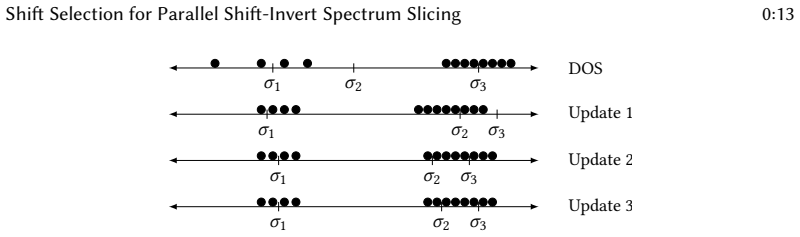
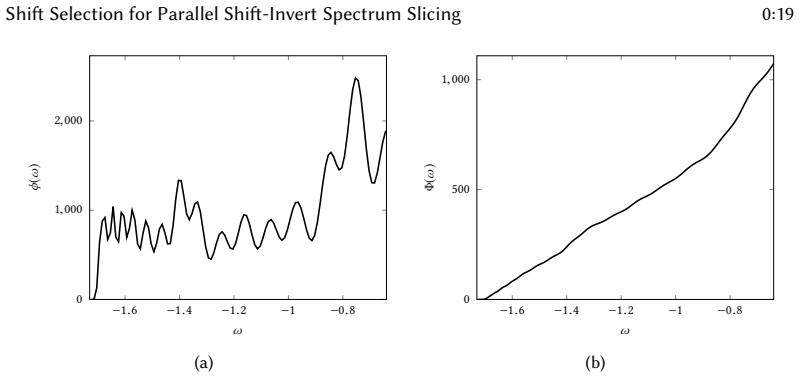
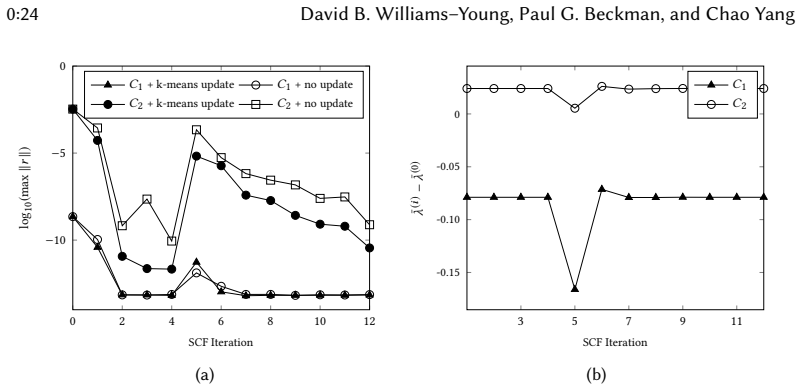
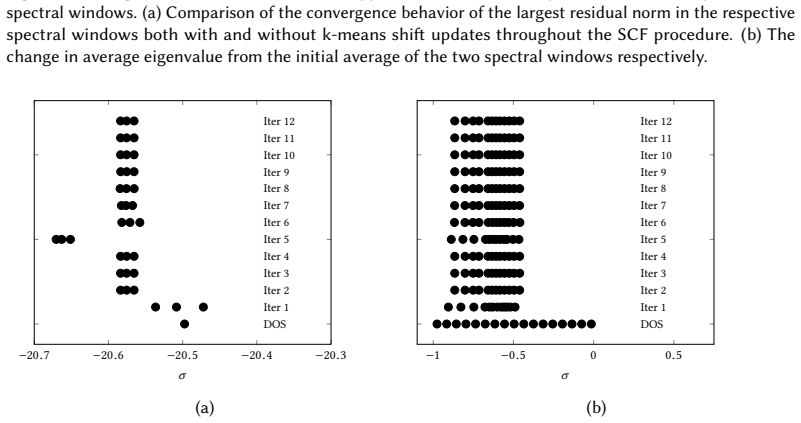
The paper's central discovery is a shift-selection and validation protocol that turns shift-invert spectrum slicing into a communication-light, load-balanced parallel method. For the first SCF iteration, a short Lanczos run produces an approximate density of states; the spectral region is partitioned into slices either by solving cumulative-density root equations for equal-count intervals or by locating local maxima to isolate tight clusters, placing one shift per slice. In later iterations the validated Ritz values from the previous iteration are clustered with k-means (seeded by k-means++), and each cluster's centroid becomes the new shift of the probe with which it overlaps most; probes left without a cluster are deleted and new probes inserted into the largest clusters to keep the probe count fixed. Missing eigenvalues are caught because the LDL^T factorization at each shift yields an exact eigenvalue count by Sylvester's inertia theorem, and residual norms, not inter-node vector exchange, select the validated eigenpairs. Numerical experiments on clustered (silane) and uniform (graphene) spectra show convergence of validated residuals below machine tolerance within 2-6 SCF iterations, with the k-means migration reducing iteration counts in irregular regions and never degrading uniform ones; strong-scaling tests to 1280 eigenvalues of a 113,081-dimensional matrix show linear scaling to one shift per MPI rank and a two-fold speed advantage over a contour-integral solver because SISLICE works in real arithmetic.
Load-bearing premise
The method assumes that a Ritz value computed from the shift closer to the eigenvalue it approximates is always the more accurate one, so that the midpoint rule assigns every eigenvalue to exactly one slice and residual-based selection keeps the right eigenpair.
Editorial extensions
If this is right
- Large sparse symmetric generalized eigenproblems with dimension well above 100,000 can be partially diagonalized by factorization plus subspace iteration, avoiding the Rayleigh-Ritz bottleneck of Krylov methods and the dense diagonalization bottleneck of full eigensolvers.
- In an SCF loop, eigenvectors from the previous iteration can be reused as initial guesses, so the cost of each successive partial diagonalization drops as the sequence converges.
- The method's communication is limited to Ritz values and residual norms, so scaling is bounded by the cost of sparse LDL^T factorizations per shift, not by data movement, down to one shift per MPI rank.
- The k-means shift migration can correct initial density-of-states misplacements, including deleting probes in empty spectral regions and splitting overloaded clusters, without ever exceeding a fixed probe count.
- Because all shifts are chosen before the first subspace iteration, the initial slicing can be load-balanced across processor groups in a single pass.
Reading between the lines
- Beyond the paper, the same two-stage protocol, one-shot density-of-states partitioning followed by cluster-centroid tracking, could be dropped into other spectrum-slicing eigensolvers, such as contour-integral or polynomial-filtering methods, whenever those methods' inner iterations would benefit from better shift or interval placement.
- The midpoint validation heuristic is only as safe as the convergence-rate assumption; a natural testable extension is an adaptive validation boundary that tightens near dense clusters or uses estimated local eigenvalue density to set a confidence interval around the midpoint.
- The trace-difference monitor for detecting spectral change could be generalized to other cheap observables, such as subspace angles or partial traces of B^{-1}A, to trigger density-of-states recomputation only when the spectrum actually moves, reducing the risk of missing eigenvalues in early SCF iterations.
- Since the method never exchanges Ritz vectors across nodes, its communication pattern is well matched to accelerator-heavy machines where vector movement is the dominant cost, suggesting the reported linear scaling could persist on GPU clusters with replicated matrices.
Signed reviews
Editorial analysis
A structured set of objections, weighed in public.
Referee Report
Summary. The paper introduces SISLICE, a parallel shift-invert spectrum slicing eigensolver for symmetric generalized eigenproblems arising in self-consistent field (SCF) calculations. The method selects all spectral shifts simultaneously using a Lanczos-based density-of-states (DOS) estimate, refines and migrates shifts between SCF iterations via k-means clustering of validated Ritz values, validates spectral slices by comparing candidate counts with an inertia-based eigenvalue count from LDL^T factorizations, and reuses previously computed eigenvectors as initial guesses for the shift-invert subspace iteration. Numerical experiments on Silane (N=1109), Graphene (N=9360), and the Ga10As10 matrix (N=113,081) demonstrate convergence of the SCF sequences and strong scaling of the method, with a performance comparison to PFEAST.
Significance. If the central claims hold, SISLICE is a useful contribution: it attacks a real bottleneck in SCF eigensolvers, avoids communication-intensive orthogonality checks between slices, and shows good strong scaling on a large sparse problem. The paper's strengths include clearly specified algorithms and pseudocode, experiments on two qualitatively different spectra (clustered and uniform) plus a large sparse matrix, a sensible comparison with PFEAST, and an honest accounting of limitations such as the cost of rare probe insertions and the lack of integration into production SCF codes. However, the correctness of the slice-validation step is load-bearing and is not established as written, and several performance claims go beyond what the experiments actually compare against.
major comments (3)
- [Sec. 2.2 (validation count; n_exact)] The exact slice count n_exact is defined as the difference of the numbers of negative diagonal entries of the LDL^T factors D_j and D_{j+1}, and this count drives all three validation outcomes. However, Sec. 2.1 specifies the Bunch-Kaufman LDL^T factorization, whose D factor contains 2x2 blocks, and for such blocks the signs of the two diagonal entries do not determine the inertia. For example, the block [[0,1],[1,0]] has two zero diagonal entries but inertia (1,1). Since A - sigma B is indefinite, 2x2 pivots can occur in the reported experiments, and both LAPACK and PARDISO routinely use such pivots for indefinite systems. An incorrect n_exact can therefore accept spurious candidates, fail to detect missing eigenvalues, or discard genuine eigenpairs, so the central robustness claim is not supported as written. The fix is to sum the inertias of the 1x1 and 2x2 diagonal blocks (or to use a factorization with only 1x1 pivots) and to verify in the experiments which pivot structure actually occurred.
- [Sec. 5.5 (Figs. 16a and 16c)] The abstract and conclusion claim that SISLICE 'drastically reduces' the communication requirement of current parallel shift-invert eigenvalue algorithms, but the only quantitative comparison in the paper is to PFEAST. The closest prior shift-invert spectrum slicing methods, SIPs and SIESTA-SIPs, are described in Sec. 1 but are never benchmarked. Without a comparison to these methods, the communication and scalability advantage over the specifically targeted class of algorithms is not established. Please add such a comparison or revise the claims to refer only to the PFEAST comparison.
- [Sec. 2.2 (candidate selection; Sec. 5 robustness)] The validation logic also assumes that Ritz values closer to a shift converge faster, so the midpoint rule assigns each eigenpair to the correct probe. The paper states that this is demonstrated numerically, but the experiments in Sec. 5 do not provide a direct quantitative check, such as a plot of residual norm as a function of distance to the nearest shift across many slices. If this heuristic fails for some eigenvalue distributions, n_cand will be wrong and the method may miss or duplicate eigenpairs. Since the robustness claim depends on exact validation, please provide a quantitative study of this assumption or explicitly state its failure modes as a limitation.
minor comments (6)
- [Sec. 5.5, Fig. 16] The timing data appear to be single runs without repeated measurements or error bars; adding a few repetitions would make the strong-scaling claim more robust.
- [Eq. (4)] Equation (4) contains a corrupted font token ('/afii10069.italj') in place of the first Lanczos vector component; the notation should be cleaned up.
- [Sec. 2.2] The symbol for the exact count is typeset inconsistently as 'nex act j'; it should be a single symbol such as n_exact^{(j)}.
- [Fig. 16c] The x-axis label of Fig. 16c is ambiguous: it should state clearly whether the horizontal axis is the number of shifts per MPI rank or the total processor count.
- [Sec. 5.4, Fig. 15a] The text says that a 10-fold increase in basis dimension has a negligible effect on timing, but Fig. 15a shows a visible increase; please quantify the percentage increase and discuss its relevance.
- [Sec. 1 and Sec. 5.5] The claim that PFEAST 'requires considerable tuning' is only partially supported, since the experiments use the default elliptic contour and the same DOS-based intervals; consider tempering this statement.
Circularity Check
No circular derivation: SISLICE's claims are supported by independent numerical experiments and standard external components; no fit is relabeled as a prediction.
full rationale
This paper is an algorithmic and numerical study rather than a derivation of a target quantity from fitted inputs, so the main circularity patterns do not apply. The central claims—robustness on SCF problems and linear strong scaling—are supported by direct experiments in Sec. 5, including comparisons of SISLICE with and without the k-means shift update and against PFEAST. Nothing in the paper fits a parameter to a subset of data and then presents a closely related quantity as a prediction; the shift selection and migration schemes are heuristics whose effects are explicitly measured, not assumed. The DOS-based shift selection in Sec. 3.1 is a published, independent component (Lin et al. 2016; Li et al. 2016; Xi et al. 2018), and even though some of those references include the present authors, they do not function as a self-citation chain forcing the conclusion. The slice validation count in Sec. 2.2 is based on Sylvester's inertia theorem, an external mathematical result, and not on the algorithm's own output. The k-means migration uses validated eigenpairs from previous SCF iterations as warm starts, but this is a standard algorithmic reuse, and the paper tests its benefit rather than defining success in terms of it. The LD L^T / Bunch-Kaufman inertia-counting issue raised by the reviewer is a possible numerical correctness concern, not a circularity: it concerns whether the stated validation count is exact, not whether the argument reduces to its inputs. No load-bearing step was found in which a 'prediction' is equivalent by construction to a fitted input or to a self-cited assertion.
Assumptions & free parameters
free parameters (7)
- probe basis dimension k =
k ≈ 10 ne/ns (100-200 in experiments)
- number of shift-invert subspace iterations per SCF iteration =
4
- number of Lanczos iterations for DOS estimation =
100
- DOS discretization points nω =
10k initially, doubled on refinement
- Gaussian width νj in DOS =
chosen so each Gaussian vanishes at distance dj from θj, with safeguard against small gaps
- merge and refine tolerances in DOSCluster =
2 and 50 estimated eigenvalues
- number of shifts ns =
100 for Silane and Graphene, 128 for Ga10As10
assumptions (6)
- standard math Sylvester's law of inertia: the number of negative pivots in LDLT of A - σB gives the number of eigenvalues below σ.
- domain assumption Shift-invert subspace iteration converges linearly with rate depending on the distance of eigenvalues to the shift.
- domain assumption Ritz values approximating eigenvalues closer to a shift have smaller residuals when obtained from that shift's probe.
- domain assumption The SCF matrix sequence (A(i), B) converges non-chaotically and the desired eigenpairs are contiguous in a fixed spectral interval [λmin, λmax].
- domain assumption Lanczos-based DOS from 100 iterations with random starting vectors approximates the spectral density well enough for shift placement.
- domain assumption k-means centroids of validated Ritz values from the previous SCF iteration are good shifts for the current iteration.
Cite this review
Pith. "Pith review of A Shift Selection Strategy for Parallel Shift-Invert Spectrum Slicing in Symmetric Self-Consistent Eigenvalue Computation." pith.science (2026). https://pith.science/paper/AORDCO5P
@misc{pith2026190806043,
  author       = {Pith},
  title        = {Pith review of: A Shift Selection Strategy for Parallel Shift-Invert Spectrum Slicing in Symmetric Self-Consistent Eigenvalue Computation},
  year         = {2026},
  howpublished = {\url{https://pith.science/paper/AORDCO5P}},
  note         = {Machine review of arXiv:1908.06043}
}
read the original abstract
The central importance of large scale eigenvalue problems in scientific computation necessitates the development of massively parallel algorithms for their solution. Recent advances in dense numerical linear algebra have enabled the routine treatment of eigenvalue problems with dimensions on the order of hundreds of thousands on the world's largest supercomputers. In cases where dense treatments are not feasible, Krylov subspace methods offer an attractive alternative due to the fact that they do not require storage of the problem matrices. However, demonstration of scalability of either of these classes of eigenvalue algorithms on computing architectures capable of expressing massive parallelism is non-trivial due to communication requirements and serial bottlenecks, respectively. In this work, we introduce the SISLICE method: a parallel shift-invert algorithm for the solution of the symmetric self-consistent field (SCF) eigenvalue problem. The SISLICE method drastically reduces the communication requirement of current parallel shift-invert eigenvalue algorithms through various shift selection and migration techniques based on density of states estimation and k-means clustering, respectively. This work demonstrates the robustness and parallel performance of the SISLICE method on a representative set of SCF eigenvalue problems and outlines research directions which will be explored in future work.
Figures



Figures from the paper (13 more)






Reference graph
Works this paper leans on
-
[7]
2000.Templates for the solution of algebraic eigenvalue problems: a practical guide
Zhaojun Bai, James Demmel, Jack Dongarra, Axel Ruhe, and Henk van der Vorst. 2000.Templates for the solution of algebraic eigenvalue problems: a practical guide . SIAM. Amartya S. Banerjee, Lin Lin, Wei Hu, Chao Yang, and John E. Pask
work page 2000
-
[13]
Computer Physics Communications 118, 1 (1999), 21 –
Electronic structure calculations for plane-wave codes without diagonalization. Computer Physics Communications 118, 1 (1999), 21 –
work page 1999
-
[14]
Journal of Computational Chemistry 39, 22 (2018), 1806–1814
SIESTA-SIPs: Massively parallel spectrum-slicing eigensolver for an ab initio molecular dynamics package. Journal of Computational Chemistry 39, 22 (2018), 1806–1814. h/t_tps://doi.org/10.1002/jcc.25350 arXiv:h/t_tps://onlinelibrary.wiley.com/doi/pdf/10.1002/jcc.25350 Murat Ke c ¸eli, Hong Zhang, Peter Zapol, David A. Dixon, and Albert F. Wagner
-
[15]
Journal of Computational Chemistry 37, 4 (2016), 448–459
Shi/f_t-and-invert par- allel spectral transformation eigensolver: Massively parallel performance for density-functional based tight- binding. Journal of Computational Chemistry 37, 4 (2016), 448–459. h/t_tps://doi.org/10.1002/jcc.24254 arXiv:h/t_tps://onlinelibrary.wiley.com/doi/pdf/10.1002/jcc.24254 J. Kestyn, V. Kalantzis, E. Polizzi, and Y. Saad
-
[16]
SIAM Journal on Scienti/f_ic Computing23, 2 (2001), 517–541
Toward the Optimal Preconditioned Eigensolver: Locally Optimal Block Preconditioned Conjugate Gradient Method. SIAM Journal on Scienti/f_ic Computing23, 2 (2001), 517–541. h/t_tps://doi.org/10.1137/S1064827500366124 arXiv:h/t_tps://doi.org/10.1137/S1064827500366124 Karol Kowalski, Edoardo Apra, Ray Bair, Colleen Bertoni, Jeffery S. Boschen, Eric J. Bylaska...
-
[18]
Lin Lin, Yousef Saad, and Chao Yang
A /T_hick-Restart Lanczos algorithm with polynomial /f_iltering for Hermitian eigenvalue problems.SIAM Journal on Scienti/f_ic Computing38, 4 (2016), A2512–A2534. Lin Lin, Yousef Saad, and Chao Yang
work page 2016
-
[19]
SIAM review 58, 1 (2016), 34–65
Approximating spectral densities of large matrices. SIAM review 58, 1 (2016), 34–65. Stuart Lloyd
work page 2016
-
[21]
Journal of Physics: Condensed Ma/t_ter26, 21 (2014), 213201
/T_he ELPA library: scalable parallel eigenvalue solutions for electronic structure theory and computational science. Journal of Physics: Condensed Ma/t_ter26, 21 (2014), 213201. E. Polizzi
work page 2014
Show all 34 references
-
[25]
Electronic Transactions on Numerical Analysis 23, 1 (2006), 158–179
On fast factorization pivoting methods for sparse symmetric inde/f_inite systems. Electronic Transactions on Numerical Analysis 23, 1 (2006), 158–179. Olaf Schenk, Klaus G¨artner, and Wolfgang Fichtner
2006
-
[28]
SIAM review 42, 2 (2000), 267–293
A Jacobi–Davidson iteration method for linear eigenvalue problems. SIAM review 42, 2 (2000), 267–293. Jos´e M Soler, Emilio Artacho, Julian D Gale, Alberto Garc´ıa, Javier Junquera, Pablo Ordej´on, and Daniel S´anchez-Portal
2000
-
[29]
/T_he SIESTA method for ab initio order-N materials simulation.Journal of Physics: Condensed Ma/t_ter14, 11 (2002),
2002
-
[30]
Part II: Seeking many eigenvalues
Nearly optimal preconditioned methods for Hermitian eigenproblems under limited memory. Part II: Seeking many eigenvalues. SIAM J. Sci. Comput. 29, 5 (2007), 2162–2188. James Joseph Sylvester
2007
-
[31]
FEAST as a subspace iteration eigensolver accelerated by approximate spectral projection. SIAM J. Matrix Anal. Appl. 35 (2014), 354–390. Yuanzhe Xi, Ruipeng Li, and Yousef Saad
2014
-
[32]
SIAM Journal on Scienti/f_ic Computing 40, 4 (2018), A2749–A2773
Fast Computation of Spectral Densities for Generalized Eigenvalue Problems. SIAM Journal on Scienti/f_ic Computing 40, 4 (2018), A2749–A2773. h/t_tps://doi.org/10.1137/17M1135542 arXiv:h/t_tps://doi.org/10.1137/17M1135542 Chao Yang
2018 doi
-
[34]
ACM Transactions on Mathematical So/f_tware (TOMS)33, 2 (2007),
SIPs: Shi/f_t-and-invert parallel spectral transformations. ACM Transactions on Mathematical So/f_tware (TOMS)33, 2 (2007),
2007
-
[1982]
IEEE transactions on information theory 28, 2 (1982), 129–137
Least squares quantization in PCM. IEEE transactions on information theory 28, 2 (1982), 129–137. Andreas Marek, Volker Blum, Rainer Johanni, Ville Havu, Bruno Lang, /T_homas Auckenthaler, Alexander Heinecke, Hans- Joachim Bungartz, and Hermann Lederer
1982
-
[1993]
h/t_tps://doi.org/10.1007/BF01113273 Gerard LG Sleijpen and Henk A Van der Vorst
Elimination of the Diagonalization Bo/t_tleneck in Parallel Direct-SCF Methods./T_heoretica Chimica Acta 84, 4 (01 Jan 1993), 343–351. h/t_tps://doi.org/10.1007/BF01113273 Gerard LG Sleijpen and Henk A Van der Vorst
1993 doi
-
[1994]
A shi/f_ted block Lanczos algorithm for solving sparse symmetric generalized eigenproblems. SIAM J. Matrix Anal. Appl. 15, 1 (1994), 228–272. Laurent O. Jay, Hanchul Kim, Yousef Saad, and James R. Chelikowsky
1994
-
[1997]
Society for Industrial and Applied Mathematics
ScaLAPACK Users’ Guide. Society for Industrial and Applied Mathematics. h/t_tps://doi.org/10.1137/1.9780898719642 arXiv:h/t_tps://epubs.siam.org/doi/pdf/10.1137/1.9780898719642 Carmen Campos and Jose E Roman
-
[1999]
Society for Industrial and Applied Mathematics, Philadelphia, PA
LAPACK Users’ Guide(third ed.). Society for Industrial and Applied Mathematics, Philadelphia, PA. h/t_tps://doi.org/10.1137/1.9780898719604 David Arthur and Sergei Vassilvitskii
-
[2000]
BIT Numerical Mathematics 40, 1 (2000), 158–176
Efficient sparse LU factorization with le/f_t-right looking strategy on shared memory multiprocessors. BIT Numerical Mathematics 40, 1 (2000), 158–176. Ron Shepard
2000
-
[2001]
A Fully Asynchronous Multifrontal Solver Using Distributed Dynamic Scheduling. SIAM J. Matrix Anal. Appl. 23, 1 (2001), 15–41. P. R. Amestoy, A. Guermouche, J.-Y. L’Excellent, and S. Pralet
2001
-
[2002]
Parallel Comput
Two-level dynamic scheduling in PARDISO: Improved scalability on shared memory multiprocessing systems. Parallel Comput. 28, 2 (2002), 187–197. Olaf Schenk and Klaus G ¨artner
2002
-
[2003]
A projection method for generalized eigenvalue problems using numerical integration. J. Comput. Appl. Math. 159 (2003), 119–128. Olaf Schenk and Klaus G¨artner
2003
-
[2005]
Journal of Physics: Conference Series 16 (jan 2005), 425–434
Solving large-scale eigenvalue problems in SciDAC applications. Journal of Physics: Conference Series 16 (jan 2005), 425–434. h/t_tps://doi.org/10.1088/1742-6596/16/1/058 Hong Zhang, Barry Smith, Michael Sternberg, and Peter Zapol
2005 doi
-
[2006]
Parallel Comput
Hybrid scheduling for the parallel solution of linear systems. Parallel Comput. 32, 2 (2006), 136–156. E. Anderson, Z. Bai, C. Bischof, S. Blackford, J. Demmel, J. Dongarra, J. Du Croz, A. Greenbaum, S. Hammarling, A. McKenney, and D. Sorensen
2006
-
[2007]
InProceedings of the Eighteenth Annual ACM-SIAM Symposium on Discrete Algorithms (SODA ’07)
K-means++: /T_he Advantages of Careful Seeding. InProceedings of the Eighteenth Annual ACM-SIAM Symposium on Discrete Algorithms (SODA ’07) . Society for Industrial and Applied Mathematics, Philadelphia, PA, USA, 1027–1035. h/t_tp://dl.acm.org/citation.cfm?id=1283383.1283494 J...
-
[2008]
Density-matrix-based algorithm for solving eigenvalue problems. Phys. Rev. B 79 (2008), 115112. Yousef Saad
2008
-
[2011]
/T_he University of Florida Sparse Matrix Collection.ACM Trans. Math. So/f_tw.38, 1, Article 1 (Dec. 2011), 25 pages. h/t_tps://doi.org/10.1145/2049662.2049663 Roger G Grimes, John G Lewis, and Horst D Simon
2011
-
[2012]
Numerical Algorithms 60, 2 (2012), 279–295
Strategies for spectrum slicing based on restarted Lanczos methods. Numerical Algorithms 60, 2 (2012), 279–295. Timothy A. Davis and Yifan Hu
2012
-
[2014]
Parallel Comput
Parallel Eigenvalue Calculation based on Multiple Shi/f_t-invert Lanczos and Contour Integral based Spectral Projection Method. Parallel Comput. 40, 7 (2014),
2014
-
[2016]
/T_he Journal of Chemical Physics 145, 15 (2016), 154101
Chebyshev polynomial /f_iltered subspace iteration in the discontinuous Galerkin method for large-scale electronic structure calculations. /T_he Journal of Chemical Physics 145, 15 (2016), 154101. h/t_tps://doi.org/10.1063/1.4964861 arXiv:h/t_tps://doi.org/10.1063/1.4964861 Am...
2016 doi
-
[2018]
Journal of Chemical /T_heory and Computation14, 6 (2018), 2930–2946
Two-Level Chebyshev Filter Based Complementary Subspace Method: Pushing the Envelope of Large-Scale Electronic Structure Calcula- tions. Journal of Chemical /T_heory and Computation14, 6 (2018), 2930–2946. h/t_tps://doi.org/10.1021/acs.jctc.7b01243 arXiv:h/t_tps://doi.org/10.1...
2018 doi
-
[2019]
h/t_tps://doi.org/10.1137/ 18M1170935 arXiv:h/t_tps://doi.org/10.1137/18M1170935 Ruipeng Li, Yuanzhe Xi, Eugene Vecharynski, Chao Yang, and Yousef Saad
/T_he Eigenvalues Slicing Library (EVSL): Algorithms, Implementation, and So/f_tware.SIAM Journal on Scienti/f_ic Computing41, 4 (2019), C393–C415. h/t_tps://doi.org/10.1137/ 18M1170935 arXiv:h/t_tps://doi.org/10.1137/18M1170935 Ruipeng Li, Yuanzhe Xi, Eugene Vecharynski, Chao...
2019 doi
Reviewed August 14, 2026 · model on record in the stance chip above.
Discussion (0). Continue with ORCID to comment.