REVIEW 5 major objections 5 minor 58 references
ZeroER: Entity Resolution using Zero Labeled Examples
T0 review · 5 major / 5 minor · reviewed 2026-08-14 · deepseek-v4-flash
Pith's one-line read ZeroER claims entity resolution can match supervised accuracy using zero labeled examples, by fitting a two-component Gaussian mixture over similarity vectors.
desk verdict A genuinely useful zero-label ER method with strong empirical results, but the transitivity constraint in Section 4 rests on an independence assumption that doesn't hold, and the ablation credits it with most of the gain. read the letter →
The pith
A machine-rendered reading of the paper's core claim, the machinery that carries it, and where it could break.
The reading
What carries the argument
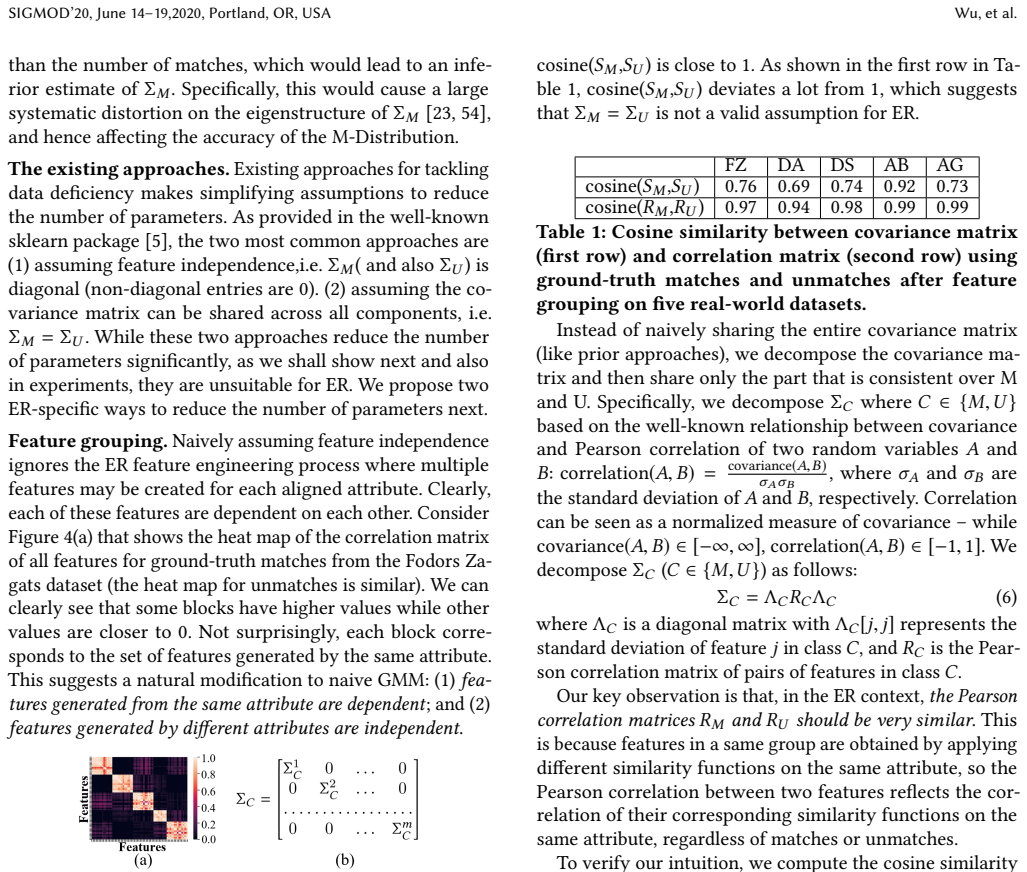
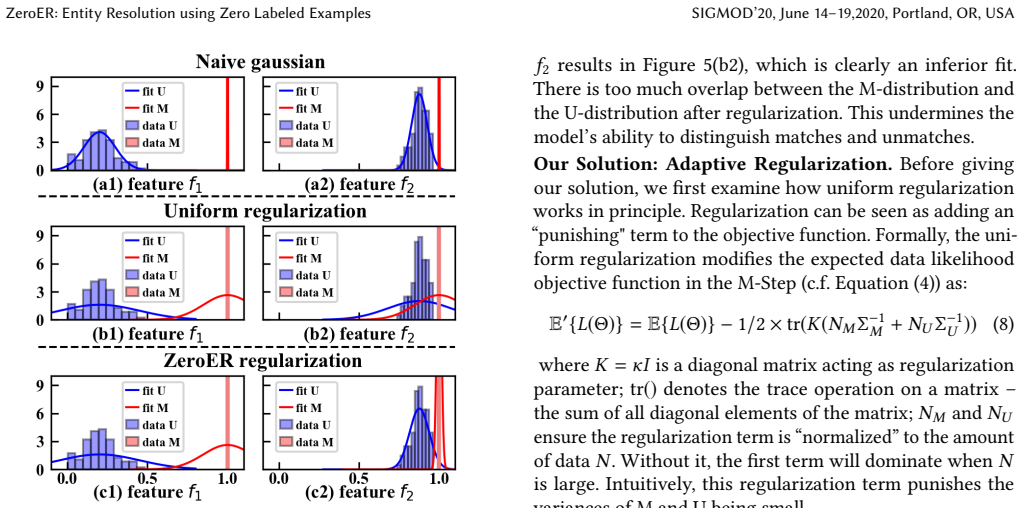
The load-bearing object is the generative model of ZeroER: a two-component Gaussian mixture in which the match component and unmatch component have covariance matrices $\Sigma_M = \Lambda_M R \Lambda_M$ and $\Sigma_U = \Lambda_U R \Lambda_U$, with $R$ a shared Pearson correlation matrix estimated from all unlabeled pairs and $\Lambda_C$ diagonal per class. The parameters $\{\pi_M, \Lambda_M, \Lambda_U, \mu_M, \mu_U\}$ are learned by an EM algorithm where the E-step is a constrained optimization: the free-energy objective is maximized subject to transitivity inequalities on posterior probabilities. A per-feature regularization term $\kappa_j$ is chosen by solving $BC'_j - BC_j = \kappa'$ with the Bhattacharyya coefficient, equalizing the overlap increase across features. This machinery lets the model be fit with only $4d+1$ parameters, avoiding the covariance estimation failure that a naive GMM suffers when matches are scarcer than the number of covariance parameters.
What would settle it
Take an entity-resolution dataset whose ground-truth matches form two well-separated similarity modes (for example, because one naming convention yields two distinct written forms for the same entity). A single two-component Gaussian mixture cannot represent both modes, so ZeroER's F-score should fall well below a supervised classifier trained on the same features; computing the empirical density of match similarity vectors would flag this failure without needing labels.
Extended reading notes
Core claim
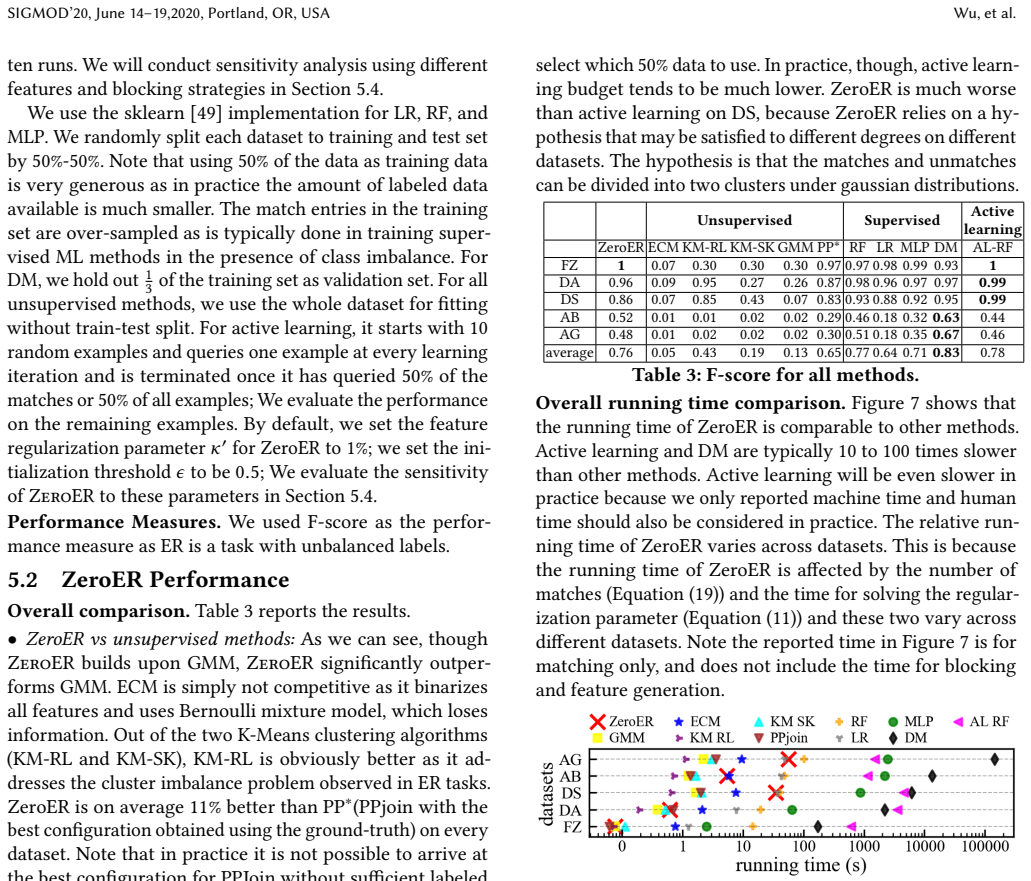
ZeroER's central claim is that a Gaussian mixture model with two components, customized for entity resolution, separates matches from unmatches with no labeled data. The customization has three parts: covariance matrices that are block-diagonal by source attribute and share a common Pearson correlation matrix across the two classes, shrinking the parameter count from $O(d^2)$ to $4d+1$; adaptive regularization that gives each feature the same increase in Bhattacharyya overlap between the match and unmatch distributions, so no single feature dominates; and transitivity enforced as probabilistic posterior constraints ($\gamma_{1,2,M}\gamma_{1,3,M}\le \gamma_{2,3,M}$) solved inside the EM loop rather than as postprocessing. On five benchmark ER datasets the resulting system averages F-score 0.76, against 0.77 for random forest, 0.64 for logistic regression, and 0.83 for a deep-learning matcher, while the unsupervised baselines range from 0.05 to 0.65.
Load-bearing premise
The load-bearing premise is that match pairs and non-match pairs each cluster like a single Gaussian blob in similarity space, with the same within-attribute correlation pattern for both classes; where real data is not shaped like two Gaussian blobs, the paper's own results show the F-score degrading.
Editorial extensions
If this is right
- Entity resolution pipelines can be run in match-finding mode without a labeling campaign, so organizations facing many tables to deduplicate can triage all of them with zero annotation effort.
- On five benchmark datasets, the zero-label method lands within a few F-score points of supervised classifiers, implying that labels matter mainly for the residual cases rather than for the basic match/unmatch separation.
- Because transitivity is enforced inside learning, the model can flag and correct specific false-positive triples without assuming either input table is duplicate-free, which is why the improvement over postprocessing is largest on datasets with duplicates inside tables.
- The reduction from $O(d^2)$ to $4d+1$ parameters makes the generative approach feasible in high-dimensional feature spaces where the number of true matches is smaller than the number of covariance parameters.
- Adaptive regularization, by equalizing overlap increases across features, is asserted to be the reason the model does not collapse onto one dominant feature, and the ablation results attribute the largest average loss (0.76 to 0.38) to replacing it with uniform regularization.
Reading between the lines
- We infer that the same two-component Gaussian recipe could transfer to other extreme-class-imbalance binary tasks built on engineered similarity features, provided the two-cluster assumption is checked before deployment.
- As an editorial extension, the transitivity-constraint step is the least portable component: it assumes the target relation is an equivalence relation, so directed or many-to-many matching would need different structural constraints.
- We propose a pre-deployment diagnostic that the paper's sensitivity analysis suggests: compute per-feature class-overlap measures on a small self-labeled sample, and expect ZeroER to approach supervised accuracy only where at least some features separate the two clusters.
- If the shared-correlation assumption is the bottleneck, an extension would be to estimate separate correlation matrices when the match sample is large enough, trading parameter count for a better fit.
Signed reviews
Editorial analysis
A structured set of objections, weighed in public.
Referee Report
Summary. ZeroER proposes an unsupervised generative model for entity resolution. The model assumes that similarity vectors of matches and unmatches are drawn from two Gaussian components; to handle data scarcity it uses block-diagonal covariance per attribute group and shares the Pearson correlation matrix across the two classes; to handle feature overfitting it regularizes each feature by equalizing increases in Bhattacharyya coefficients; and to exploit transitivity it imposes a posterior constraint γ_1,2 γ_1,3 ≤ γ_2,3 within an EM/free-energy framework. The paper reports experiments on five benchmark datasets showing an average F-score of 0.76, outperforming several unsupervised baselines and approaching supervised methods, with ablations attributing gains to each of the three components.
Significance. The problem is practically important, and the paper targets it directly: zero-label entity resolution, standard benchmarks, comparisons against strong supervised baselines, and an analysis of labeling effort saved. The parameter reduction to O(d) parameters and the adaptive regularization scheme are reasonable contributions that, if valid, would be useful in practice. However, the headline package includes a transitivity constraint whose derivation is flawed: Eq. (12) assumes independence of two match events that share a tuple, and the ablation in Table 5 credits this constraint with a large fraction of the reported improvement. As submitted, the empirical significance of the claimed transitivity benefit is not established. The core unsupervised GMM approach is sound enough to warrant a major revision: the transitivity component can be corrected or re-framed as a heuristic, and the experiments can be rerun under the corrected constraint.
major comments (5)
- [Section 4.1, Eq. (12)] The derivation of the probabilistic transitivity constraint is invalid. The text computes P((t1,t2) and (t1,t3) are both matches) as 0.7 × 0.6 = 0.42, which is only correct under independence of the two events. In an equivalence relation these events are not independent because both involve t1; transitivity alone implies only γ2,3,M ≥ P(A∧B), and without independence the universal lower bound is γ2,3,M ≥ γ1,2,M + γ1,3,M − 1 (Fréchet inequality), not γ2,3,M ≥ γ1,2,M γ1,3,M. The product constraint is strictly stronger: a valid distribution with γ1,2,M = 0.7, γ1,3,M = 0.6, γ2,3,M = 0.35 satisfies transitivity but violates Eq. (12). Since Table 5 attributes an average gain from 0.65 to 0.76 to this posterior constraint, the paper's central claim of a transitivity benefit rests on an invalid probabilistic step.
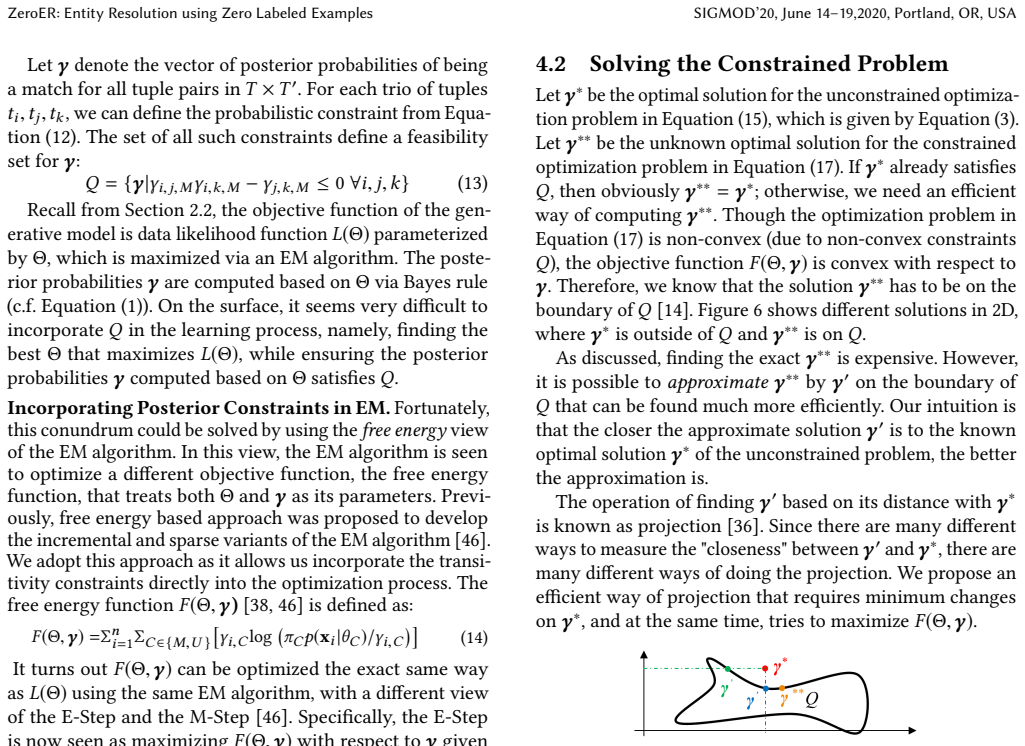
- [Section 4.2, Eq. (18)] The direction of the repair is stated backwards. When γi,j,M γi,k,M > γj,k,M, the formulas γ′i,j,M = γj,k,M / γi,k,M and γ′i,k,M = γj,k,M / γi,j,M decrease the two left-hand probabilities, while the text says one should 'increase γi,j or increase γi,k'; the third formula increases γj,k,M, while the text says to 'decrease γj,k'. This suggests the inequality direction was not checked and makes the proposed projection rules hard to interpret.
- [Table 3 and Section 5.1] The paper states that all methods that need a seed are run ten times and averaged, but Table 3 reports only point estimates, with no standard deviation, variance, or significance test. The headline comparison, that ZeroER greatly outperforms all five unsupervised methods, is therefore not statistically substantiated. This is especially important on datasets where margins are small, such as AG (0.48 vs 0.30 for PP*).
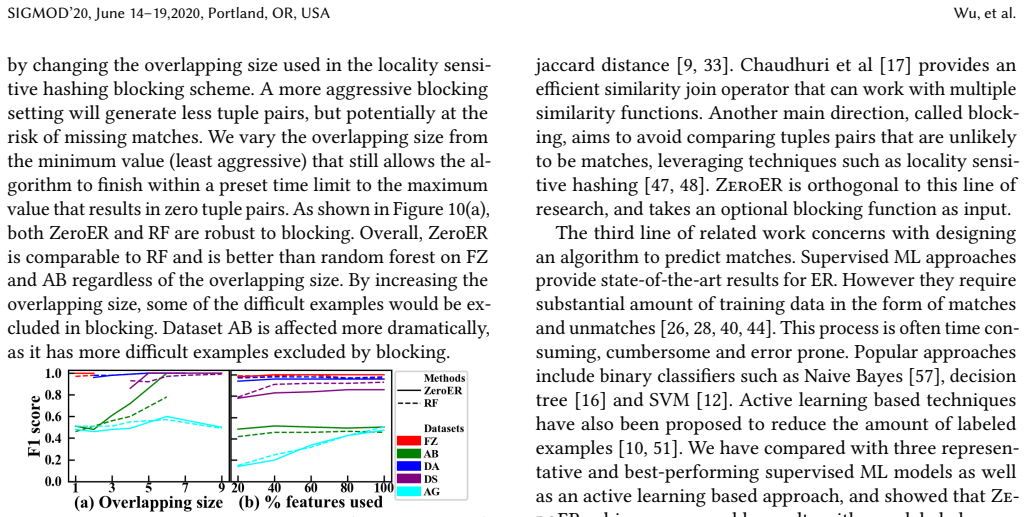
- [Section 3.1 (Table 1) and Section 5.2] The model structure, namely feature grouping and correlation sharing, is selected and validated using ground-truth match and unmatch labels, and the final F-scores are reported on the same five datasets. Since the structural choices are not fixed before seeing the test labels, the evaluation is subject to selection on the test tasks. Please report results with a model structure chosen without consulting these labels (for example, a fixed default grouping or leave-one-dataset-out selection), or quantify how much the final F-scores depend on these structural choices.
- [Section 5.3, Table 5] The post-processing baseline is run under the assumption that both input tables are duplicate-free, while ZeroER explicitly does not make this assumption; on DS the left and right tables are not duplicate-free. The large apparent gain on DS (0.41 with post-processing vs 0.86 with the posterior constraint) is therefore confounded with the baseline's extra assumption and does not cleanly demonstrate the value of the constraint.
minor comments (5)
- [Lemma 4.1] The proof of non-convexity is deferred to an external technical report [7]; since the boundary-optimality heuristic in Section 4.2 depends on this claim, please include the proof in the paper or state the claim as a conjecture.
- [Section 4.1] The notation γ_i,M and γ_i,j,M is used for different objects with visually similar forms; define the two-subscript convention explicitly and use it consistently in Eqs. (12)–(19).
- [Eq. (14)] The summation index n should be N, or the summation bounds should be stated explicitly, to match the N tuple pairs defined in Section 2.
- [Section 5.1] The stopping rule for active learning, 'queried 50% of the matches or 50% of all examples', appears to require knowledge of which examples are matches; please clarify how this budget is implemented in the experiments.
- [Algorithm 2, line 7] The conflict-resolution procedure for multiple constraints is described only in prose; a short pseudocode block or a precise description of the greedy rule would improve reproducibility.
Circularity Check
No significant circularity: ZeroER's unsupervised EM derivation is self-contained; the flagged concerns are correctness and evaluation-design issues, not constructional circularity.
full rationale
ZeroER's central derivation is an unsupervised EM fit of a two-component GMM with a block-diagonal shared correlation structure. The posterior probabilities used for matching are computed by Bayes rule (Eq. 1) from parameters learned by maximizing likelihood on unlabeled data, so the headline F-scores are not fitted to ground-truth labels. The model structure is motivated by empirical observations of feature correlations, but those observations are not used as parameters in the derivation; they motivate a structural choice that is then evaluated on the same datasets. That is a legitimate concern about using test data for model selection, but it is not a circular reduction of the prediction to the labels. The transitivity constraint in Eq. 12 is presented as a probabilistic inequality derived from transitivity, and the accompanying 70% x 60% calculation assumes independence of the two match events; this is a substantive correctness issue (the valid Fréchet-type bound is additive, not multiplicative), but it is not an example of the paper predicting something already contained in its inputs by construction. The proof of Lemma 4.1 is deferred to the authors' own technical report [7], but that lemma only establishes non-convexity and is not load-bearing for the main empirical claim; the algorithm then uses a heuristic projection. The paper's self-citations are therefore not used to prove the central result, and no step in the derivation chain reduces to a fitted parameter renamed as a prediction or to a self-citation chain. Overall, the derivation is self-contained with respect to the circularity patterns defined for this review.
Assumptions & free parameters
free parameters (2)
- kappa' (regularization target BC increase) =
0.01 (default), robust in [0, 0.1] per Figure 8a
- epsilon (initialization threshold) =
0.5 (default)
assumptions (4)
- domain assumption Similarity vectors of matches and unmatches follow two multivariate Gaussian distributions with a block-diagonal covariance per attribute and a shared Pearson correlation matrix R (Section 3.1, Eqs. 6-7).
- ad hoc to paper Probabilistic transitivity inequality gamma_1,2 * gamma_1,3 <= gamma_2,3 (Eq. 12).
- ad hoc to paper The constrained E-step optimum gamma** lies on the boundary of feasible set Q (Section 4.2, after Eq. 17).
- standard math Gaussian PDF and EM closed-form updates (Section 2.2, Eq. 5).
Cite this review
Pith. "Pith review of ZeroER: Entity Resolution using Zero Labeled Examples." pith.science (2026). https://pith.science/paper/5MZYIHKK
@misc{pith2026190806049,
  author       = {Pith},
  title        = {Pith review of: ZeroER: Entity Resolution using Zero Labeled Examples},
  year         = {2026},
  howpublished = {\url{https://pith.science/paper/5MZYIHKK}},
  note         = {Machine review of arXiv:1908.06049}
}
read the original abstract
Entity resolution (ER) refers to the problem of matching records in one or more relations that refer to the same real-world entity. While supervised machine learning (ML) approaches achieve the state-of-the-art results, they require a large amount of labeled examples that are expensive to obtain and often times infeasible. We investigate an important problem that vexes practitioners: is it possible to design an effective algorithm for ER that requires Zero labeled examples, yet can achieve performance comparable to supervised approaches? In this paper, we answer in the affirmative through our proposed approach dubbed ZeroER. Our approach is based on a simple observation -- the similarity vectors for matches should look different from that of unmatches. Operationalizing this insight requires a number of technical innovations. First, we propose a simple yet powerful generative model based on Gaussian Mixture Models for learning the match and unmatch distributions. Second, we propose an adaptive regularization technique customized for ER that ameliorates the issue of feature overfitting. Finally, we incorporate the transitivity property into the generative model in a novel way resulting in improved accuracy. On five benchmark ER datasets, we show that ZeroER greatly outperforms existing unsupervised approaches and achieves comparable performance to supervised approaches.
Figures

Figures from the paper (7 more)


Reference graph
Works this paper leans on
-
[1]
Benchmark datasets for entity resolution. https://dbs.uni- leipzig.de/en/research/projects/object_matching/fever/benchmark_ datasets_for_entity_resolution
-
[2]
http://www.cs.utexas.edu/users/ml/riddle/data.html
Duplicate detection, record linkage, and identity uncertainty: Datasets. http://www.cs.utexas.edu/users/ml/riddle/data.html
-
[3]
https://en.wikipedia.org/wiki/ Bhattacharyya_distance#Bhattacharyya_coefficient, Oct 2019
Bhattacharyya distance - Wikipedia. https://en.wikipedia.org/wiki/ Bhattacharyya_distance#Bhattacharyya_coefficient, Oct 2019. [Online; accessed 14. Oct. 2019]
work page 2019
-
[4]
[Online; accessed 28 Jun 2019]
How to understand the drawbacks of k-means? https: //stats.stackexchange.com/questions/133656/how-to-understand- the-drawbacks-of-k-means, Jun 2019. [Online; accessed 28 Jun 2019]
work page 2019
-
[5]
sklearn.mixture.GaussianMixture — scikit-learn 0.21.2 documentation, May 2019. [Online; accessed 31. May 2019]
work page 2019
-
[6]
User Manual for py_entitymatching — py_entitymatching 0.3.0 docu- mentation, Jun 2019. [Online; accessed 9. Oct. 2019]
work page 2019
-
[7]
https://www.dropbox.com/s/ aersjnp0gjmy5pz/ZeroER_technical_report.pdf?dl=0, April 2020
ZeroER technical report. https://www.dropbox.com/s/ aersjnp0gjmy5pz/ZeroER_technical_report.pdf?dl=0, April 2020
work page 2020
- [8]
Show all 58 references
-
[9]
Arasu, V
A. Arasu, V. Ganti, and R. Kaushik. Efficient exact set-similarity joins. In Proceedings of the 32nd international conference on Very large data bases, pages 918–929. VLDB Endowment, 2006
2006
-
[10]
Arasu, M
A. Arasu, M. Götz, and R. Kaushik. On active learning of record matching packages. In SIGMOD, pages 783–794, 2010
2010
-
[11]
Berisha, A
V. Berisha, A. Wisler, A. O. Hero, and A. Spanias. Empirically estimable classification bounds based on a nonparametric divergence measure. IEEE Transactions on Signal Processing , 64(3):580–591, 2015
2015
-
[12]
Bilenko and R
M. Bilenko and R. J. Mooney. Adaptive duplicate detection using learnable string similarity measures. In KDD, 2003
2003
-
[13]
C. M. Bishop. Pattern recognition and machine learning . springer, 2006
2006
-
[14]
Boyd and L
S. Boyd and L. Vandenberghe. Convex optimization. Cambridge uni- versity press, 2004
2004
-
[15]
Chandel, O
A. Chandel, O. Hassanzadeh, N. Koudas, M. Sadoghi, and D. Srivas- tava. Benchmarking declarative approximate selection predicates. In Proceedings of the 2007 ACM SIGMOD international conference on Management of data, pages 353–364. ACM, 2007
2007
-
[16]
Chaudhuri, B
S. Chaudhuri, B. Chen, V. Ganti, and R. Kaushik. Example-driven design of efficient record matching queries. In VLDB07, pages 327–338, 2007
2007
-
[17]
Chaudhuri, V
S. Chaudhuri, V. Ganti, and R. Kaushik. A primitive operator for similarity joins in data cleaning. In 22nd International Conference on Data Engineering (ICDE’06), pages 5–5. IEEE, 2006
2006
-
[18]
D. E. Clark. Practical introduction to record linkage for injury research. Injury Prevention, 10(3):186–191, 2004
2004
-
[19]
Cryer, S
P. Cryer, S. Westrup, A. Cook, V. Ashwell, P. Bridger, and C. Clarke. Investigation of bias after data linkage of hospital admissions data to police road traffic crash reports. Injury prevention, 7(3):234–241, 2001
2001
-
[20]
Danka and P
T. Danka and P. Horvath. modAL: A modular active learning frame- work for Python. available on arXiv at https://arxiv.org/abs/1805.00979
-
[21]
De Bruin
J. De Bruin. Probabilistic record linkage with the fellegi and sunter framework: Using probabilistic record linkage to link privacy pre- served police and hospital road accident records. 2015
2015
-
[22]
de Bruin
J. de Bruin. Python record linkage toolkit. https://github.com/ J535D165/recordlinkage, 2018
2018
-
[23]
A. P. Dempster. Covariance Selection. Biometrics, 28(1):157–175, Mar 1972
1972
-
[24]
A. P. Dempster, N. M. Laird, and D. B. Rubin. Maximum likelihood from incomplete data via the em algorithm. Journal of the Royal Statistical Society: Series B (Methodological) , 39(1):1–22, 1977
1977
-
[25]
X. L. Dong and F. Naumann. Data fusion: resolving data conflicts for integration. PVLDB, 2(2):1654–1655, 2009
2009
-
[26]
X. L. Dong and T. Rekatsinas. Data integration and machine learning: A natural synergy. In Proceedings of the 2018 International Conference on Management of Data , pages 1645–1650. ACM, 2018
2018
-
[27]
Duchi, S
J. Duchi, S. Gould, and D. Koller. Projected subgradient methods for learning sparse gaussians. In Proceedings of the Twenty-Fourth Conference on Uncertainty in Artificial Intelligence , UAI’08, pages 153– 160, Arlington, Virginia, United States, 2008. AUAI Press
2008
-
[28]
Ebraheem, S
M. Ebraheem, S. Thirumuruganathan, S. Joty, M. Ouzzani, and N. Tang. Distributed representations of tuples for entity resolution. In PVLDB, 2018
2018
-
[29]
A. K. Elmagarmid, P. G. Ipeirotis, and V. S. Verykios. Duplicate record detection: A survey. IEEETKDE, 19(1):1–16, 2007
2007
-
[30]
I. P. Fellegi and A. B. Sunter. A theory for record linkage. Journal of the American Statistical Association, 64(328):1183–1210, 1969
1969
-
[31]
Getoor and A
L. Getoor and A. Machanavajjhala. Entity resolution: theory, practice & open challenges. PVLDB, 5(12):2018–2019, 2012
2018
-
[32]
Gravano, P
L. Gravano, P. G. Ipeirotis, H. V. Jagadish, N. Koudas, S. Muthukrishnan, D. Srivastava, et al. Approximate string joins in a database (almost) for free. In VLDB, volume 1, pages 491–500, 2001
2001
-
[33]
Hadjieleftheriou, A
M. Hadjieleftheriou, A. Chandel, N. Koudas, and D. Srivastava. Fast indexes and algorithms for set similarity selection queries. In 2008 IEEE 24th International Conference on Data Engineering , pages 267–276. IEEE, 2008
2008
-
[34]
T. N. Herzog, F. J. Scheuren, and W. E. Winkler. Data Quality and Record Linkage Techniques. Springer Science & Business Media, 2007
2007
-
[35]
Honorio and T
J. Honorio and T. Jaakkola. Inverse Covariance Estimation for High- Dimensional Data in Linear Time and Space: Spectral Methods for Riccati and Sparse Models. Association for Uncertainty in Artificial Intelligence (AUAI), Jul 2013
2013
-
[36]
P. Jain, P. Kar, et al. Non-convex optimization for machine learning. Foundations and Trends® in Machine Learning, 10(3-4):142–336, 2017
2017
-
[37]
M. A. Jaro. Unimatch: A record linkage system: User’s manual. U.S. Bureau of the Census , 1976
1976
-
[38]
M. I. Jordan and C. Bishop. An introduction to graphical models, 2004
2004
-
[39]
Konda, S
P. Konda, S. Das, P. Suganthan GC, A. Doan, A. Ardalan, J. R. Ballard, H. Li, F. Panahi, H. Zhang, J. Naughton, et al. Magellan: Toward building entity matching management systems. PVLDB, 9(12):1197– 1208, 2016
2016
-
[40]
Köpcke, A
H. Köpcke, A. Thor, and E. Rahm. Evaluation of entity resolution approaches on real-world match problems. Proceedings of the VLDB Endowment, 3(1-2):484–493, 2010
2010
-
[41]
Koudas, S
N. Koudas, S. Sarawagi, and D. Srivastava. Record linkage: similarity measures and algorithms. In SIGMOD, pages 802–803, 2006
2006
-
[42]
A. Lyon. Why are normal distributions normal? The British Journal for the Philosophy of Science , 65(3):621–649, 2013
2013
-
[43]
F. Maggi. A survey of probabilistic record matching models, techniques and tools. Scienti_c Report TR-2008, 2008
2008
-
[44]
Mudgal, H
S. Mudgal, H. Li, T. Rekatsinas, A. Doan, Y. Park, G. Krishnan, R. Deep, E. Arcaute, and V. Raghavendra. Deep learning for entity matching: A design space exploration. In SIGMOD, 2018
2018
-
[45]
Naumann and M
F. Naumann and M. Herschel. An Introduction to Duplicate Detection . Synthesis Lectures on Data Management. 2010
2010
-
[46]
R. M. Neal and G. E. Hinton. A view of the em algorithm that justifies incremental, sparse, and other variants. InLearning in graphical models, pages 355–368. Springer, 1998
1998
-
[47]
Papadakis, G
G. Papadakis, G. Koutrika, T. Palpanas, and W. Nejdl. Meta-blocking: Taking entity resolutionto the next level. IEEE Transactions on Knowl- edge and Data Engineering , 26(8):1946–1960, 2013
1946
-
[48]
Papadakis, J
G. Papadakis, J. Svirsky, A. Gal, and T. Palpanas. Comparative analysis of approximate blocking techniques for entity resolution. Proceedings of the VLDB Endowment , 9(9):684–695, 2016. 15 SIGMOD’20, June 14–19,2020, Portland, OR, USA Wu, et al
2016
-
[49]
Pedregosa, G
F. Pedregosa, G. Varoquaux, A. Gramfort, V. Michel, B. Thirion, O. Grisel, M. Blondel, P. Prettenhofer, R. Weiss, V. Dubourg, J. Vander- plas, A. Passos, D. Cournapeau, M. Brucher, M. Perrot, and E. Duch- esnay. Scikit-learn: Machine learning in Python. Journal of Machine Lear...
2011
-
[50]
Sadinle and S
M. Sadinle and S. E. Fienberg. A generalized fellegi–sunter framework for multiple record linkage with application to homicide record sys- tems. Journal of the American Statistical Association , 108(502):385–397, 2013
2013
-
[51]
Sarawagi and A
S. Sarawagi and A. Bhamidipaty. Interactive deduplication using active learning. In KDD, 2002
2002
-
[52]
Stonebraker and I
M. Stonebraker and I. F. Ilyas. Data integration: The current status and the way forward. IEEE Data Eng. Bull. , 41(2):3–9, 2018
2018
-
[53]
Tuy and N
H. Tuy and N. Van Thuong. On the global minimization of a convex function under general nonconvex constraints. Applied Mathematics and Optimization, 18(1):119–142, 1988
1988
-
[54]
Velasco-Forero, M
S. Velasco-Forero, M. Chen, A. Goh, and S. K. Pang. Comparative Analysis of Covariance Matrix Estimation for Anomaly Detection in Hyperspectral Images. IEEE J. Sel. Top. Signal Process. , 9(6):1061–1073, Sep 2015
2015
-
[55]
E. W. Weisstein. Newton’s Method, Oct 2019. [Online; accessed 11. Oct. 2019]
2019
-
[56]
S. E. Whang, D. Menestrina, G. Koutrika, M. Theobald, and H. Garcia- Molina. Entity resolution with iterative blocking. In Proceedings of the 2009 ACM SIGMOD International Conference on Management of data , pages 219–232. ACM, 2009
2009
-
[57]
W. E. Winkler. The state of record linkage and current research prob- lems. In Statistical Research Division, U.S. Census Bureau , 1999
1999
-
[58]
C. Xiao, W. Wang, X. Lin, J. X. Yu, and G. Wang. Efficient similarity joins for near-duplicate detection. ACM Transactions on Database Systems (TODS), 36(3):1–41, 2011. 16
2011
Reviewed August 14, 2026 · model on record in the stance chip above.
Discussion (0). Continue with ORCID to comment.