REVIEW 3 major objections 5 minor 34 references
An Exploratory Analysis of the Latent Structure of Process Data via Action Sequence Autoencoder
T0 review · 3 major / 5 minor · reviewed 2026-08-14 · deepseek-v4-flash
Pith's one-line read A sequence-to-sequence autoencoder trained only on raw action logs—no item-specific coding, no expert features—extracts latent vectors from problem-solving process data that carry more predictive information about test takers than their…
desk verdict A solid exploratory use of sequence autoencoders for assessment process data, with a real transductive-evaluation flaw that likely inflates the headline prediction gains. read the letter →
The pith
A machine-rendered reading of the paper's core claim, the machinery that carries it, and where it could break.
The reading
What carries the argument
The action sequence autoencoder: an encoder that maps the binary action matrix $S$ through learned action embeddings $E$ and an RNN to a single $K$-vector $\theta=\theta_T$ (the last hidden state), paired with a decoder that feeds $\theta$ into a second RNN and a multinomial logit to reconstruct per-step action probabilities; training minimizes the average cross-entropy loss $L(S,\hat{S})$ by stochastic gradient descent with early stopping, and PCA is applied to the raw features for interpretation. The latent vector plays the role of an IRT latent variable, with the decoder acting as the item response function, though the paper notes there is no coherence guarantee between encoder and decoder.
What would settle it
Generate action sequences from two latent classes that share identical first-order transition counts but differ only in third-order or longer dependencies; if the autoencoder's features cannot separate the classes above chance while n-gram or higher-order features can, the last-hidden-state compression is discarding the long-range structure the method claims to preserve.
Extended reading notes
Core claim
The central claim is that the latent representation produced by an action sequence autoencoder is a useful estimator of respondents' latent traits, comparable in role to the latent variable in item response theory. The paper demonstrates this by extracting K-dimensional features from each of 14 PIAAC PSTRE items and showing that, after PCA, the first principal feature usually aligns with attentiveness as measured by sequence length, that the features reconstruct 75 of 93 process-derived indicators with over 90% accuracy, and that including them in generalized linear models beats a model using only the binary final score: for every item, literacy and numeracy prediction gains, and multi-item prediction of age reaches roughly twice the baseline out-of-sample R-squared while gender accuracy rises from about 0.55 to 0.63. The paper reads these results as evidence that response processes contain substantially more information about respondents than traditional dichotomous item responses, and that the proposed method makes that information accessible without item-specific knowledge.
Load-bearing premise
The load-bearing premise is that a single fixed-size vector, the encoder RNN's last hidden state, is a sufficient summary of an entire variable-length action sequence; the paper offers no theorem for this, only the hope that flexible networks approximate it with large samples.
Editorial extensions
If this is right
- Process features extracted from one item improve prediction of other items' outcomes over the final-score baseline, with the largest gains among respondents who answered incorrectly.
- The process model reaches the same literacy and numeracy prediction quality with two items that the outcome-only model needs four items to reach, implying process data use test information more efficiently.
- Age prediction roughly doubles in out-of-sample R-squared and gender prediction rises from near chance to about 0.63 accuracy, so behavioral differences such as search and sort usage are encoded in the features.
- The same pipeline, requiring no item-specific coding, is directly applicable to any log-file process data from interactive assessments.
Reading between the lines
- A natural extension, not tested in the paper, is whether attention or pooling over all hidden states replaces the last-state summary and recovers order information that $\theta=\theta_T$ may drop; comparing these variants on the PIAAC data would separate the value of process data from the value of this compression choice.
- The unsupervised features are learned without outcome labels, so they may encode interface habits as much as cognitive skill; checking whether the feature-outcome associations survive an interface redesign would clarify which dimensions are trait-like.
- The finding that incorrect responders benefit most from process features suggests these features could support diagnostic feedback or adaptive follow-up questions that target the specific misconception visible in the log.
- Because the decoder predicts each action from the latent vector alone, the method could be turned into a process simulator that generates plausible action sequences for a given feature vector, offering a way to visualize typical and atypical problem-solving paths.
Signed reviews
Editorial analysis
A structured set of objections, weighed in public.
Referee Report
Summary. The paper proposes an action sequence autoencoder that compresses variable-length categorical action sequences into K-dimensional latent features without requiring item-specific knowledge. The encoder is an RNN whose last hidden state serves as the latent representation; the decoder is an RNN followed by a multinomial logistic layer; the loss is the average cross-entropy over time steps. The extracted raw features are then transformed by PCA. The method is evaluated on simulated Markov-chain data with two latent groups and on PIAAC PSTRE process data. The central empirical claim is that adding the extracted process features to a baseline that uses only binary item outcomes improves out-of-sample prediction of other items' outcomes, literacy and numeracy scores, age, and gender.
Significance. If the central claim holds, the method offers a generic and scalable tool for exploiting process data in educational and psychological assessment, which is a practically important problem. The paper's strengths include the use of a large real dataset, a simulation study with 100 replications and reported standard deviations, and a thoughtful interpretability analysis of the principal features. The proposed procedure is clearly described and does not rely on item-specific feature engineering. However, the current evidence for the central claim is weakened by a transductive feature-extraction scheme: features are computed after fitting the autoencoder and PCA on the full dataset, including respondents who later appear in the prediction test sets. This affects both the simulation and the case study. The reconstruction results in Section 4.3 are expected by construction and do not by themselves support the external-prediction claim. The central claim is plausible but is not yet established by the presented evidence.
major comments (3)
- [Section 4.2 and Procedure 2, Step 2] The features used in the downstream prediction comparisons are not honestly out-of-sample. Procedure 2 trains the autoencoder on the full set of sequences (with a validation split used only for early stopping) and then computes features for all i = 1,...,n. In Section 4.2, features are extracted for each of the 14 items before any downstream train/validation/test split is made, and in Section 4.3 the paper states that features are extracted from the response processes before the 80/20 split. Consequently, the action sequences of respondents who later appear in the prediction test sets are used to train the encoder and the PCA projection, while the baseline model, which uses only the binary outcome, cannot benefit from such transduction. The reported gains of the process model over the baseline may therefore overstate the generalizable advantage of process features. I recommend a nested evaluation in which the autoencoder, the PCA projection, and any hyperparameter selection (including K) are computed only on the training fold of each split, and then applied to the validation and test folds.
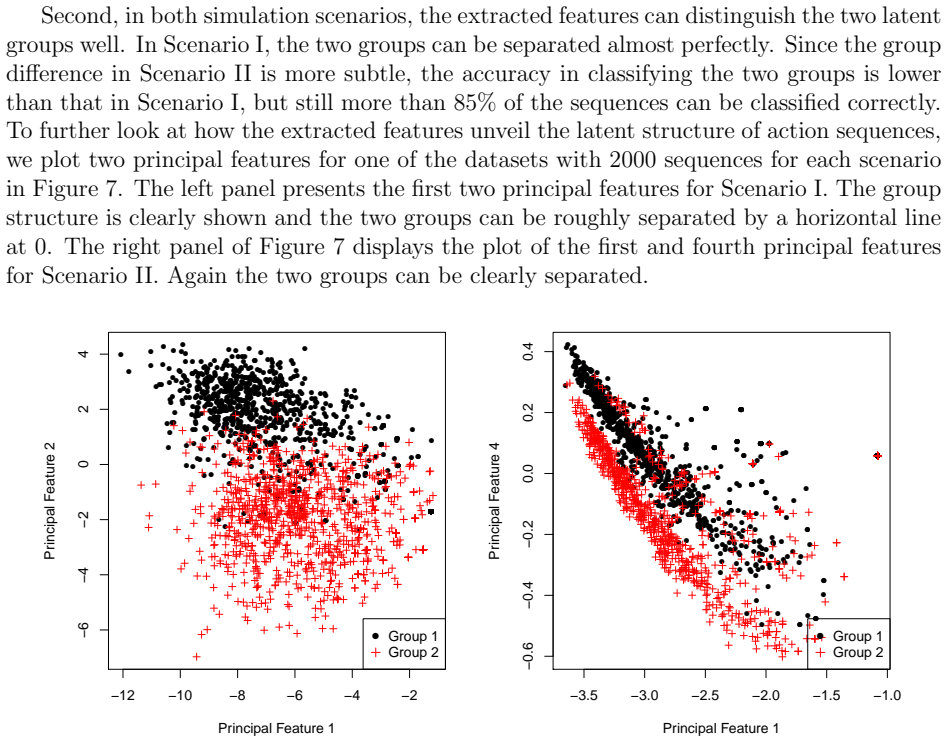
- [Section 3.1 and Table 1] The simulation study has the same structural issue as the case study. Procedure 2 is applied to each complete dataset before the sequences are split into 80% training and 20% test for the logistic-regression evaluation. Thus the test sequences are used to estimate the autoencoder and the PCA features, and the high reconstruction and group-classification accuracies reported in Table 1 may partly reflect transductive feature learning rather than a generalizable property of the extracted features. The simulation should be repeated with feature extraction performed only on the training part of each split, with the fitted encoder and PCA then applied to the test part.
- [Section 4.3 and Table 4] The reconstruction of derived variables (indicators of actions and action pairs) is expected by construction because the autoencoder is trained to minimize the reconstruction loss on the same action sequences from which those derived variables are computed. Reporting prediction accuracies above 0.80 for these variables therefore does not provide independent evidence that the features capture useful information beyond what was already used in training. The load-bearing evidence for the paper's central claim must come from the external prediction comparisons in Sections 4.4 and 4.5, which are affected by the transductive feature-extraction problem noted above.
minor comments (5)
- [Section 2.3, text near Eq. (5)] The sentence 'the encoder uses the same MLM to compute the probability distribution' should read 'the decoder uses the same MLM', since the multinomial logistic model is part of the decoder.
- [Figure 9 caption] The caption refers to the 'response model' when describing the baseline; this should be 'baseline model' for consistency with Section 4.4.
- [Section 4.5.1] There is a typo: 'the the number of available items' should read 'the number of available items'.
- [Section 4.4, definition of OSR2] The out-of-sample R2 is defined as the square of the Pearson correlation between predicted and true values; this is not the conventional out-of-sample R2 and will always be nonnegative. Please clarify the definition or consider using a standard R2 measure.
- [Sections 4.4 and 4.5, Figures 9-12] The accuracy improvements and OSR2 differences are reported without standard errors or confidence intervals. Given the transductive feature issue, the authors should report measures of uncertainty in the revised analysis.
Circularity Check
No significant circularity: the central predictive claims use external targets, and the reconstruction sanity check is not load-bearing.
full rationale
The paper's central claim is that features extracted by an action-sequence autoencoder improve prediction of other item outcomes, literacy and numeracy scores, age, and gender relative to binary outcomes alone. That evidence (Sections 4.4-4.5) uses external variables that do not appear in the autoencoder's reconstruction loss, so it is not forced by construction. The autoencoder is a standard sequence-to-sequence model (Section 2.3) with no imported uniqueness theorem or ansatz smuggled via self-citation; the references are standard ML/statistics citations, and no load-bearing self-citation chain appears. The reconstruction check in Section 4.3 is a self-consistency exercise: since the features are trained to minimize the categorical reconstruction loss (7) over the same action sequences, high accuracy on action-derived indicators is expected and does not independently establish usefulness; however, the paper does not rest its main conclusion on that check alone. The acknowledged lack of coherence guarantee between encoder and decoder (Section 2.1) is a stated limitation, not a circular step. The transductive feature computation (features extracted on the full sample before downstream splits) is a potential evaluation-integrity concern, but it is a leakage/validation issue rather than a circularity of the derivation, and under the required standard (quote a specific reduction of the claim to its inputs) it is not counted here.
Assumptions & free parameters
free parameters (4)
- K, number of latent features =
not reported per item; chosen by five-fold cross-validation from {10,20,...,100}
- Number of principal features kept per item =
20
- L2 penalty parameter in process model =
chosen on validation set
- Optimization hyperparameters =
Adam, 100 epochs, early stopping, batch unspecified
assumptions (4)
- domain assumption The last hidden state of the encoder RNN is a sufficient summary of the whole action sequence.
- ad hoc to paper The parametric encoder and decoder families are flexible enough to approximately invert each other with large samples.
- domain assumption The PIAAC log files and action coding correctly reflect respondent behavior.
- standard math Stochastic gradient descent with early stopping finds a good minimizer of the reconstruction loss.
Cite this review
Pith. "Pith review of An Exploratory Analysis of the Latent Structure of Process Data via Action Sequence Autoencoder." pith.science (2026). https://pith.science/paper/XYWAKXB3
@misc{pith2026190806075,
  author       = {Pith},
  title        = {Pith review of: An Exploratory Analysis of the Latent Structure of Process Data via Action Sequence Autoencoder},
  year         = {2026},
  howpublished = {\url{https://pith.science/paper/XYWAKXB3}},
  note         = {Machine review of arXiv:1908.06075}
}
read the original abstract
Computer simulations have become a popular tool of assessing complex skills such as problem-solving skills. Log files of computer-based items record the entire human-computer interactive processes for each respondent. The response processes are very diverse, noisy, and of nonstandard formats. Few generic methods have been developed for exploiting the information contained in process data. In this article, we propose a method to extract latent variables from process data. The method utilizes a sequence-to-sequence autoencoder to compress response processes into standard numerical vectors. It does not require prior knowledge of the specific items and human-computers interaction patterns. The proposed method is applied to both simulated and real process data to demonstrate that the resulting latent variables extract useful information from the response processes.
Figures


Figures from the paper (10 more)




Reference graph
Works this paper leans on
-
[1]
write newline
" write newline " cite write " FUNCTION editor.postfix editor num.names #1 > "( )" "( )" if FUNCTION editor.trans.postfix editor num.names #1 > "( )" "( )" if FUNCTION trans.postfix translator num.names #1 > "( )" "( )" if FUNCTION authors.editors.reflist.apa5 'field := 'dot := field num.names 'numnames := numnames 'format.num.names := format.num.names na...
-
[2]
bengio2003neural APACrefauthors Bengio, Y. , Ducharme, R. , Vincent, P. \ Jauvin, C. APACrefauthors \ 2003 . A neural probabilistic language model A neural probabilistic language model . Journal of Machine Learning Research 3 Feb 1137--1155
work page 2003
-
[3]
bengio1994learning APACrefauthors Bengio, Y. , Simard, P. \ Frasconi, P. APACrefauthors \ 1994 . Learning long-term dependencies with gradient descent is difficult Learning long-term dependencies with gradient descent is difficult . IEEE Transactions on Neural Networks 5 2 157--166
work page 1994
-
[4]
bosch2017unsupervised APACrefauthors Bosch, N. \ Paquette, L. APACrefauthors \ 2017 . Unsupervised deep autoencoders for feature extraction with educational data Unsupervised deep autoencoders for feature extraction with educational data . Deep Learning with Educational Data Workshop at the 10th International Conference on Educational Data Mining. Deep le...
work page 2017
-
[5]
, Van Merri \"e nboer, B
cho2014learning APACrefauthors Cho, K. , Van Merri \"e nboer, B. , Gulcehre, C. , Bahdanau, D. , Bougares, F. , Schwenk, H. \ Bengio, Y. APACrefauthors \ 2014 . Learning phrase representations using RNN encoder-decoder for statistical machine translation Learning phrase representations using rnn encoder-decoder for statistical machine translation . Procee...
2014
-
[6]
deng2010binary APACrefauthors Deng, L. , Seltzer, M L. , Yu, D. , Acero, A. , Mohamed, A. \ Hinton, G. APACrefauthors \ 2010 . Binary coding of speech spectrograms using a deep auto-encoder Binary coding of speech spectrograms using a deep auto-encoder . Interspeech 2010. Interspeech 2010. International Speech Communication Association . APACrefDOI doi:10...
work page 2010
-
[7]
ding2019effective APACrefauthors Ding, M. , Yang, K. , Yeung, D Y. \ Pong, T C. APACrefauthors \ 2019 . Effective Feature Learning with Unsupervised Learning for Improving the Predictive Models in Massive Open Online Courses Effective feature learning with unsupervised learning for improving the predictive models in massive open online courses . Proceedin...
arXiv 2019
-
[8]
duchi2011adaptive APACrefauthors Duchi, J. , Hazan, E. \ Singer, Y. APACrefauthors \ 2011 . Adaptive subgradient methods for online learning and stochastic optimization Adaptive subgradient methods for online learning and stochastic optimization . Journal of Machine Learning Research 12 Jul 2121--2159
work page 2011
Show all 34 references
-
[9]
, Bengio, Y
Goodfellow-et-al-2016 APACrefauthors Goodfellow, I. , Bengio, Y. \ Courville, A. APACrefauthors \ 2016 . Deep Learning Deep learning . MIT Press
2016
-
[10]
, Niepel, C
greiff2016understanding APACrefauthors Greiff, S. , Niepel, C. , Scherer, R. \ Martin, R. APACrefauthors \ 2016 . Understanding students' performance in a computer-based assessment of complex problem solving: An analysis of behavioral data from computer-generated log files Und...
2016 doi
-
[11]
\ von Davier, M
he2016analyzing APACrefauthors He, Q. \ von Davier, M. APACrefauthors \ 2016 . Analyzing process data from problem-solving items with n-grams: Insights from a computer-based large-scale assessment Analyzing process data from problem-solving items with n-grams: Insights from a ...
2016
-
[12]
\ Salakhutdinov, R R
hinton2006reducing APACrefauthors Hinton, G E. \ Salakhutdinov, R R. APACrefauthors \ 2006 . Reducing the dimensionality of data with neural networks Reducing the dimensionality of data with neural networks . Science 313 5786 504--507 . APACrefDOI doi:10.1126/science.1127647 A...
2006 doi
-
[13]
\ Schmidhuber, J
hochreiter1997long APACrefauthors Hochreiter, S. \ Schmidhuber, J. APACrefauthors \ 1997 . Long short-term memory Long short-term memory . Neural Computation 9 8 1735--1780 . APACrefDOI doi:10.1162/neco.1997.9.8.1735 APACrefDOI
1997 doi
-
[14]
kingma2014adam APACrefauthors Kingma, D P. \ Ba, J. APACrefauthors \ 2014 . Adam: A method for stochastic optimization Adam: A method for stochastic optimization . arXiv preprint arXiv:1412.6980
2014 arXiv
-
[15]
, Fox, J P
entink2009multivariate APACrefauthors Klein Entink, R H. , Fox, J P. \ van der Linden, W J. APACrefauthors \ 2009 . A multivariate multilevel approach to the modeling of accuracy and speed of test takers A multivariate multilevel approach to the modeling of accuracy and speed ...
2009 doi
-
[16]
, Jain, H
kraft2016embedding APACrefauthors Kraft, P. , Jain, H. \ Rush, A M. APACrefauthors \ 2016 . An Embedding Model for Predicting Roll-Call Votes An embedding model for predicting roll-call votes . Proceedings of the 2016 Conference on Empirical Methods in Natural Language Process...
2016 doi
-
[17]
\ Goldhammer, F
kroehne2018conceptualize APACrefauthors Kroehne, U. \ Goldhammer, F. APACrefauthors \ 2018 . How to conceptualize, represent, and analyze log data from technology-based assessments? A generic framework and an application to questionnaire items How to conceptualize, represent, ...
2018 doi
-
[18]
, Luong, T
li2015hierarchical APACrefauthors Li, J. , Luong, T. \ Jurafsky, D. APACrefauthors \ 2015 . A Hierarchical Neural Autoencoder for Paragraphs and Documents A hierarchical neural autoencoder for paragraphs and documents . Proceedings of the 53rd Annual Meeting of the Association...
2015
-
[19]
APACrefauthors \ 1980
lord1980applications APACrefauthors Lord, F M. APACrefauthors \ 1980 . Applications of Item Response Theory to Practical Testing Problems Applications of item response theory to practical testing problems . New York, NY Routledge
1980
-
[20]
\ Novick, M R
lord1968statistical APACrefauthors Lord, F M. \ Novick, M R. APACrefauthors \ 1968 . Statistical theories of mental test scores. Statistical theories of mental test scores. Reading, MA Addison-Wesley
1968
-
[21]
, Tsao, Y
lu2013speech APACrefauthors Lu, X. , Tsao, Y. , Matsuda, S. \ Hori, C. APACrefauthors \ 2013 . Speech enhancement based on deep denoising autoencoder. Speech enhancement based on deep denoising autoencoder. Interspeech Interspeech \ ( \ 436--440)
2013
-
[22]
, Sutskever, I
NIPS2013_5021 APACrefauthors Mikolov, T. , Sutskever, I. , Chen, K. , Corrado, G S. \ Dean, J. APACrefauthors \ 2013 . Distributed Representations of Words and Phrases and their Compositionality Distributed representations of words and phrases and their compositionality . C J ...
2013
-
[23]
APACrefauthors \ 2017
OECD2017problem APACrefauthors OECD. APACrefauthors \ 2017 . The Nature of Problem Solving The nature of problem solving . APACrefDOI doi:10.1787/9789264273955-en APACrefDOI
2017 doi
-
[24]
O'Reilly Media, Inc
patterson2017deep APACrefauthors Patterson, J. \ Gibson, A. APACrefauthors \ 2017 . Deep Learning: A Practitioner's Approach Deep learning: A practitioner's approach . " O'Reilly Media, Inc."
2017
-
[25]
, Bassen, J
NIPS2015_5654 APACrefauthors Piech, C. , Bassen, J. , Huang, J. , Ganguli, S. , Sahami, M. , Guibas, L J. \ Sohl-Dickstein, J. APACrefauthors \ 2015 . Deep Knowledge Tracing Deep knowledge tracing . C. Cortes, N D. Lawrence, D D. Lee, M. Sugiyama \ R. Garnett\ ( ), Advances in...
2015
-
[26]
APACrefauthors \ 2012
Prechelt2012 APACrefauthors Prechelt, L. APACrefauthors \ 2012 . Early Stopping --- But When? Early stopping --- but when? G. Montavon, G B. Orr \ K R. M \"u ller\ ( ), Neural Networks: Tricks of the Trade: Second Edition Neural networks: Tricks of the trade: Second edition \ ...
2012 doi
-
[27]
\ Monro, S
robbins1951stochastic APACrefauthors Robbins, H. \ Monro, S. APACrefauthors \ 1951 . A stochastic approximation method A stochastic approximation method . The Annals of Mathematical Statistics 22 3 400--407 . APACrefDOI doi:10.1214/aoms/1177729586 APACrefDOI
1951
-
[28]
APACrefauthors \ 1974
stone1974cross APACrefauthors Stone, M. APACrefauthors \ 1974 . Cross-validatory choice and assessment of statistical predictions Cross-validatory choice and assessment of statistical predictions . Journal of the Royal Statistical Society, Series B 36 2 111--133
1974
-
[29]
, Larochelle, H
vincent2008extracting APACrefauthors Vincent, P. , Larochelle, H. , Bengio, Y. \ Manzagol, P A. APACrefauthors \ 2008 . Extracting and composing robust features with denoising autoencoders Extracting and composing robust features with denoising autoencoders . Proceedings of th...
2008
-
[30]
wang2017deep APACrefauthors Wang, L. , Sy, A. , Liu, L. \ Piech, C. APACrefauthors \ 2017 . Deep Knowledge Tracing On Programming Exercises Deep knowledge tracing on programming exercises . Proceedings of the Fourth (2017) ACM Conference on Learning @ Scale Proceedings of the ...
2017
-
[31]
, Zhang, S
wang2018using APACrefauthors Wang, S. , Zhang, S. , Douglas, J. \ Culpepper, S. APACrefauthors \ 2018 . Using Response Times to Assess Learning Progress: A Joint Model for Responses and Response Times Using response times to assess learning progress: A joint model for response...
2018
-
[32]
, Varadharajan, V
yousefi2017autoencoder APACrefauthors Yousefi-Azar, M. , Varadharajan, V. , Hamey, L. \ Tupakula, U. APACrefauthors \ 2017 . Autoencoder-based feature learning for cyber security applications Autoencoder-based feature learning for cyber security applications . 2017 Internation...
2017
-
[33]
APACrefauthors \ 2012
zeiler2012adadelta APACrefauthors Zeiler, M D. APACrefauthors \ 2012 . ADADELTA: an adaptive learning rate method Adadelta: an adaptive learning rate method . arXiv preprint arXiv:1212.5701
2012 arXiv
-
[34]
, Jiao, H
zhan2018cognitive APACrefauthors Zhan, P. , Jiao, H. \ Liao, D. APACrefauthors \ 2018 . Cognitive diagnosis modelling incorporating item response times Cognitive diagnosis modelling incorporating item response times . British Journal of Mathematical and Statistical Psychology ...
2018 doi
Reviewed August 14, 2026 · model on record in the stance chip above.
Discussion (0). Continue with ORCID to comment.