REVIEW 4 major objections 5 minor 69 references
Driving white dwarf metal pollution through unstable eccentric periodic orbits
T0 review · 4 major / 5 minor · reviewed 2026-08-14 · deepseek-v4-flash
Pith's one-line read Using unstable periodic orbits in the restricted three-body problem, this paper shows that chaotic regions identified by dynamical stability maps predict asteroid collisions with white dwarfs in one-planet systems, offering a fast…
desk verdict Useful extension of periodic-orbit stability maps to eccentric and inclined WD-planet systems, but the validation samples only chaotic ICs and the 250 kyr DFLI cutoff is unproven. read the letter →
The pith
A machine-rendered reading of the paper's core claim, the machinery that carries it, and where it could break.
The reading
What carries the argument
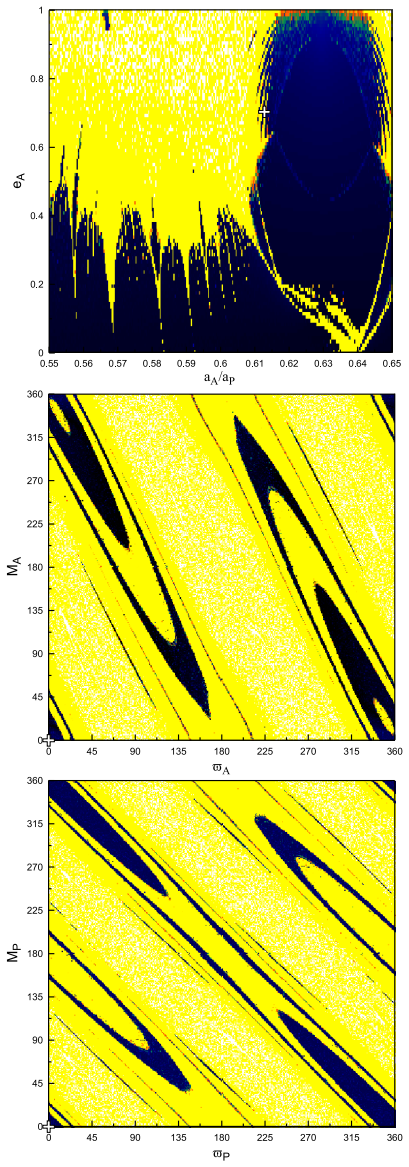
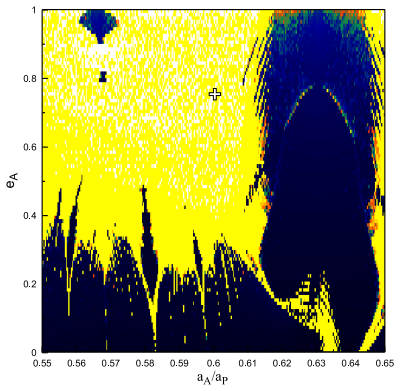
The central objects are the periodic orbits of the restricted three-body problem in the 2:1 interior mean-motion resonance, continued in eccentricity and inclination, together with their linear (horizontal) and vertical stability. Stable periodic orbits organise regular regions; unstable ones seed chaos. The DFLI (detrended fast Lyapunov indicator, the finite-time Lyapunov indicator divided by integration time) is computed on grids of initial conditions to build dynamical stability maps, with pale regions marking chaos and white marking close-encounter integration failure. The map is computed in dimensionless RTBP units over $t_{\max}=250$ kyr and then rescaled to physical units through the scaling $a^{(N)}_P = a_P \zeta^{1/3}$, keeping time and angles fixed, so that the same chaotic structures can be overlaid on $N$-body outcomes.
What would settle it
Take an initial condition that the DS maps mark chaotic and that was not included in the paper's Section 5 comparison, for example an asteroid with $e_A$ near 0.9 and $e_P$ near 0.2 in the $(\theta_1,\theta_2)=(\pi,\pi)$ configuration, integrate it with the same Bulirsch-Stoer integrator for 10 Gyr, and check whether the fraction of white-dwarf collisions matches the map's chaotic fraction; a systematic mismatch would falsify the map's predictive power. A second check: rerun the DFLI computations with $t_{\max}$ increased from 250 kyr to, say, 1 Myr and see if orbits currently classified regular become chaotic.
Extended reading notes
Core claim
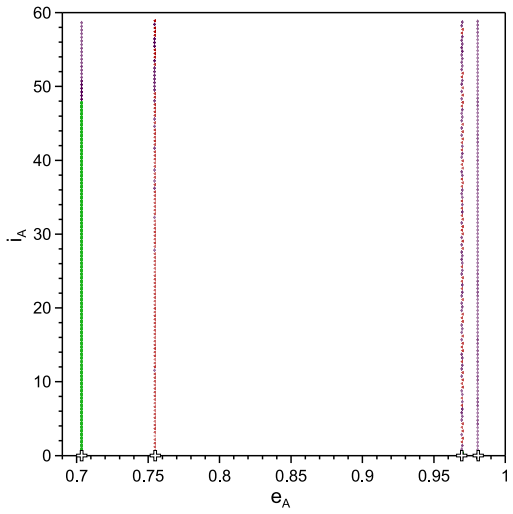
The central claim is that the chaotic domains traced by unstable periodic orbits in the 2D-ERTBP, 3D-CRTBP, and 3D-ERTBP accurately predict long-term instability in white dwarf systems with one major and one minor planet, and classify that instability as ejection, planet collision, or white dwarf collision. In the planar elliptic case with $e_P = 0.048$ (Jupiter-like), the 2:1 resonant periodic orbits organise the $(e_A,e_P)$ plane into stable islands (1:1 secondary resonance) and chaotic seas; the authors find that white dwarf collisions concentrate in the chaotic regions, especially for the configurations $(\theta_1,\theta_2)=(\pi,0)$ and $(\pi,\pi)$, and that for $(\pi,\pi)$ pollution can occur for any asteroid eccentricity once $e_P > 0.1$. In the 3D-CRTBP, the unstable spatial family is surrounded by only a small chaotic region for prograde inclinations, so low-inclination circular-planet systems should not produce pollution; in the 3D-ERTBP, vertically unstable planar periodic orbits yield instability events even at low inclination. The paper concludes that the DFLI-based dynamical stability maps, computed for only 250 kyr in normalized units, agree well with the outcomes of expensive 10-Gyr $N$-body simulations in the tested region of phase space.
Load-bearing premise
The prediction rests on the assumption that chaotic behavior detected by the DFLI indicator over 250 kyr in normalized units, then rescaled to a real white dwarf system, correctly identifies orbits that will actually collide, be ejected, or survive over billions of years.
Editorial extensions
If this is right
- The DFLI-based dynamical stability maps can be used to estimate pollution prospects and timescales for one-planet white dwarf architectures without running 10-Gyr $N$-body simulations.
- For the 2:1 resonance, the configuration $(\theta_1,\theta_2)=(\pi,0)$ with $\Delta\varpi=\pi$ produces white dwarf collisions near the resonance, while $(\pi,\pi)$ with $\Delta\varpi=0$ yields collisions for any asteroid eccentricity once $e_P > 0.1$.
- In the 3D-CRTBP, small prograde asteroid inclinations have only a tiny surrounding chaotic region, so circular-planet, low-inclination systems are unlikely to pollute the white dwarf.
- For the 3D-ERTBP, vertically unstable planar periodic orbits generate instability events even at low inclination, so vertical stability is a useful additional diagnostic.
- Asymmetric unstable periodic orbits, when used as $N$-body initial conditions, lead predominantly to white dwarf collisions or ejections rather than stable evolution.
Reading between the lines
- The same periodic-orbit-plus-DFLI strategy could be carried to other interior mean-motion resonances (for example the 3:1 or 4:1) to see whether the map-to-collision correspondence holds there, extending the diagnostic beyond the 2:1 case studied here.
- Because the maps are scale-free and cheap, an ensemble-level use suggests itself: match the observed incidence of metal-polluted white dwarfs against the chaotic fractions of one-planet architectures with different planet eccentricities.
- The 250-kyr DFLI threshold is a practical calibration choice; increasing it might expose weakly chaotic orbits currently classified regular, so the maps' reliability at Gyr timescales could be tested by recomputing a few maps at longer $t_{\max}$.
Signed reviews
Editorial analysis
A structured set of objections, weighed in public.
Referee Report
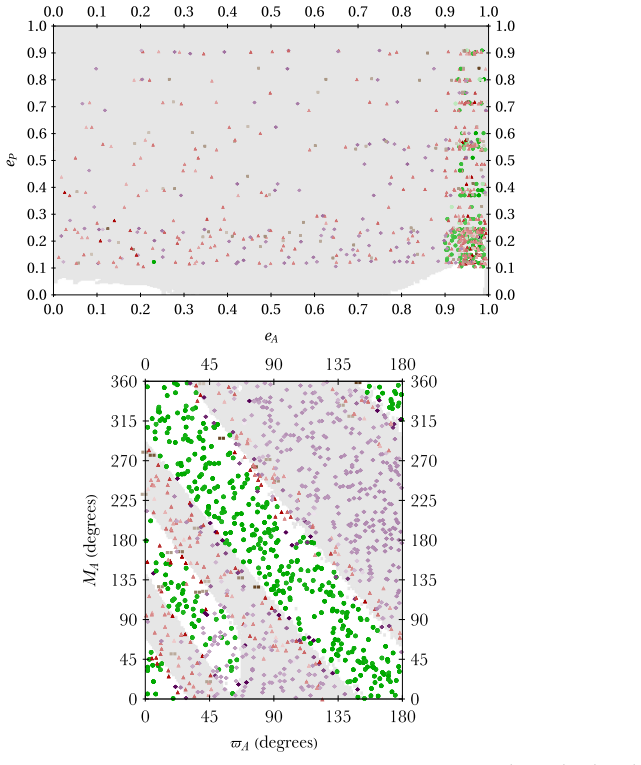
Summary. The paper proposes unstable periodic orbits and DFLI-based dynamical stability maps in the planar and spatial circular/elliptic restricted three-body problems as fast diagnostic tools for white dwarf metal pollution in one-planet architectures. It generalizes Antoniadou & Veras (2016) to eccentric planets (eP = 0.048) and inclined asteroids, concentrating on the 2:1 interior mean-motion resonance. The authors compute DS maps on several planes of initial conditions (Figs. 1–6), then run Bulirsch-Stoer N-body integrations for up to 14 Gyr in a limited phase-space region, and compare outcomes (stable, ejected, planet-collision, WD-collision) with the DFLI>15 chaotic regions (Figs. 7–10). They conclude that the maps agree well with N-body outcomes and can be used to estimate pollution prospects and timescales for one-planet white dwarf systems.
Significance. If the claimed agreement holds, the work provides a computationally cheap, non-circular prior for N-body explorations and for interpreting the growing sample of polluted white dwarfs. The central validation is not circular: the periodic orbits and DS maps are computed first, and the N-body simulations are used as an independent comparison; this is a genuine strength. The extension to the ERTBP and to inclined orbits via vertical stability is also a useful step beyond the previous circular coplanar treatment. However, the predictive claim is currently stronger than the evidence: the paper itself limits the N-body comparison to a small region of phase space, the finite-time DFLI cutoff is asserted without convergence support, and only chaotic (DFLI>15) initial conditions are tested, leaving the false-negative rate in stable regions unquantified. The maps may well be useful diagnostics, but the quantitative basis for their use as a global tool needs to be established.
major comments (4)
- [§2.2] The assertion that a DFLI integration time of tmax = 250 kyr is 'adequate for revealing chaos in the RTBP with the masses we use' is load-bearing for every DS map in the paper, yet no derivation, citation, or convergence test is provided. Since the maps are subsequently used to make statements about evolution over ~10 Gyr, the authors should either supply a quantitative justification for this time window (e.g., DFLI maps computed for several tmax values and shown to be stable) or restrict the conclusions to the chaotic-tracing capability on that particular timescale.
- [§4.2, Eq. (2)] The scaling between the normalized RTBP units and the physical white dwarf system is not adequately specified. The sentence 'The rest of the orbital elements and the time remained the same' is not sufficient: rescaling the semimajor axis by ζ^(1/3) changes the orbital period unless a compensating time-unit transformation is applied, and the physical masses used in the N-body runs are not stated. The authors need to demonstrate that a fixed 250 kyr normalized integration corresponds to a well-defined, architecture-independent physical time window for aP = 10 au and mWD = 0.6 M⊙, or explain the convention under which the time coordinate is unchanged.
- [§5] The N-body validation is not an unbiased external test of the maps because the initial conditions are selected from the chaotic regions: Section 5 states that 'we chose the initial conditions for which the DFLI traced chaoticity (DFLI>15)'. Stable or regular regions are therefore never sampled, so the false-negative rate over Gyr timescales is unknown. The abstract's claim that the maps 'can be used as tools' to estimate pollution prospects requires both chaotic and stable regions to be tested; at minimum, the authors should run N-body simulations for a sample of DFLI<10 initial conditions and report the resulting classification rates.
- [§5.1, Fig. 7] The agreement between the DS maps and N-body outcomes is assessed only qualitatively, by visual inspection of where purple diamonds concentrate. With only 10–50 asteroids per simulation set and no reported run counts per panel, the statistical weight behind the claim is unclear. The authors should quantify the comparison, for example by giving the fraction of WD-collision outcomes that fall inside the DFLI>15 region and the number of initial conditions in each class, to support the predictive-power statement.
minor comments (5)
- [§5.1] The text refers to the bottom panel of Fig. 7 as the (θ1,θ2) = (0,0) configuration, but the figure caption lists the bottom panel as (θ1,θ2) = (π,π); this inconsistency should be fixed.
- [§4.2] The phrase 'aP = 10 au (or scaled as aP(N) = 8.439009789 au)' is confusing: if the physical planet semimajor axis is 10 au, it is unclear why the simulation uses 8.439 au, and the physical masses mWD and mP used in the integrator are not explicitly given. The authors should state the exact unit conventions and masses used in Mercury.
- [§2.2] The text says the integration stops when the DFLI reaches the threshold 10^30, while Section 5 uses DFLI>15 as the chaos criterion; the relationship between these two thresholds (linear versus logarithmic DFLI) should be clarified.
- [§3.1] The sign convention for eA and eP in Figs. 1 and 6 is explained in words, but the plots would be easier to read if the positive/negative branches were labeled directly on the eccentricity axes.
- [§5.2] In Fig. 10, the white crosses mark the four planar periodic orbits, but the caption does not state which of the four are horizontally stable or unstable; adding this information would help connect the 3D-ERTBP results to the stability discussion in Fig. 1.
Circularity Check
No circularity found: the DS-map predictions and the N-body validation are independent, though the validation samples only chaotic regions.
full rationale
The claimed derivation chain is not circular. The periodic orbits and DFLI-based dynamical stability maps in Sections 2 and 3 are computed from the standard restricted three-body equations and the DFLI chaos indicator, with no parameter fitted to the N-body outcomes. The N-body integrations in Sections 4 and 5 are independent numerical experiments, and the paper explicitly distinguishes DFLI chaos from physical stability in Section 4.3, noting that weakly chaotic orbits can be classified as stable. The Section 5 comparison does select only initial conditions with DFLI>15, so it tests agreement only inside chaotic regions and does not establish the false-negative rate over 10 Gyr; this is a completeness or correctness limitation, not a circular reduction, because the N-body outcomes are not used to set the DFLI threshold or to define the maps. Likewise, the statement in Section 2.2 that tmax=250 kyr 'has been proved to be adequate' is an unproved and load-bearing modeling assumption, but it is not a statement that equates a prediction with its input by construction. The self-citations to Antoniadou and Libert (2018a, 2019) and Antoniadou and Veras (2016) supply prior periodic-orbit families and numerical methods; those are parameter-free computations with stated assumptions that do not include the white-dwarf pollution conclusion, so they constitute independent support rather than a circularity chain. No equation in the paper is equivalent by construction to the quantity it is claimed to predict.
Assumptions & free parameters
free parameters (5)
- Planet mass mP =
0.001 solar masses (Jupiter mass)
- Planet eccentricity eP =
0.048
- DFLI threshold tmax =
250 kyr for DS maps
- Scaling factor zeta =
zeta = (mWD + mP) / 1 solar mass
- WD radius for collision =
1e6 km
assumptions (4)
- domain assumption The restricted three-body problem with a massless asteroid is an adequate model for a WD, a giant planet, and an asteroid.
- domain assumption The instability predicted by DFLI chaos in the normalized RTBP, with tmax = 250 kyr, corresponds to physical instability on 10 Gyr timescales.
- ad hoc to paper The planar periodic orbits and their vertical stability in the 2D-ERTBP govern the behavior of inclined systems in the 3D-ERTBP.
- domain assumption Mercury's Bulirsch-Stoer integrator conserves energy and angular momentum sufficiently well (1e-8 to 1e-12) over 10 Gyr for the outcomes to be reliable.
Cite this review
Pith. "Pith review of Driving white dwarf metal pollution through unstable eccentric periodic orbits." pith.science (2026). https://pith.science/paper/3TYUPIIX
@misc{pith2026190806108,
  author       = {Pith},
  title        = {Pith review of: Driving white dwarf metal pollution through unstable eccentric periodic orbits},
  year         = {2026},
  howpublished = {\url{https://pith.science/paper/3TYUPIIX}},
  note         = {Machine review of arXiv:1908.06108}
}
abstract
Planetary debris is observed in the atmospheres of over 1,000 white dwarfs, and two white dwarfs are now observed to contain orbiting minor planets. Exoasteroids and planetary core fragments achieve orbits close to the white dwarf through scattering with major planets. However, the architectures that allow for this scattering to take place are time-consuming to explore with $N$-body simulations lasting $\sim 10^{10}$ yr; these long-running simulations restrict the amount of phase space that can be investigated. Here we use planar and three-dimensional (spatial) elliptic periodic orbits, as well as chaotic indicators through dynamical stability maps, as quick scale-free analytic alternatives to $N$-body simulations in order to locate and predict instability in white dwarf planetary systems that consist of one major and one minor planet on very long timescales. We then classify the instability according to ejection versus collisional events. We generalized our previous work by allowing eccentricity and inclination of the periodic orbits to increase, thereby adding more realism but also significantly more degrees of freedom to our architectures. We also carried out a suite of computationally expensive 10 Gyr $N$-body simulations to provide comparisons with chaotic indicators in a limited region of phase space. We compute dynamical stability maps that are specific to white dwarf planetary systems and that can be used as tools in future studies to quickly estimate pollution prospects and timescales for one-planet architectures. We find that these maps also agree well with the outcomes of our $N$-body simulations. As observations of metal-polluted white dwarfs mount exponentially, particularly in the era of Gaia, tools such as periodic orbits can help infer dynamical histories for ensembles of systems.
Figures

Figures from the paper (7 more)



Reference graph
Works this paper leans on
-
[1]
I., & Libert, A.-S.\ 2018a, A&A, 615, A60
Antoniadou, K. I., & Libert, A.-S.\ 2018a, A&A, 615, A60
-
[2]
I., & Libert, A.-S.\ 2018b, CeMDA, 130, 41
Antoniadou, K. I., & Libert, A.-S.\ 2018b, CeMDA, 130, 41
-
[3]
I., & Libert, A.-S.\ 2019, MNRAS, 483, 2923
Antoniadou, K. I., & Libert, A.-S.\ 2019, MNRAS, 483, 2923
work page 2019
-
[4]
I., Veras D., 2016, MNRAS, 463, 4108
Antoniadou K. I., Veras D., 2016, MNRAS, 463, 4108
work page 2016
-
[5]
Bear, E., & Soker, N.\ 2013, New Astronomy, 19, 56
work page 2013
- [6]
-
[7]
Broucke, R.\ 1969, AIAA Journal, 7, 1003
work page 1969
-
[8]
C., Veras, D., & G \"a nsicke, B
Brown, J. C., Veras, D., & G \"a nsicke, B. T.\ 2017, MNRAS, 468, 1575
work page 2017
Show all 69 references
-
[9]
R., & Davies, M
Carrera, D., Raymond, S. R., & Davies, M. B.\ 2019, Submitted to MNRAS Letters, arXiv:1903.02564
2019 arXiv
-
[10]
E.\ 1999, MNRAS, 304, 793
Chambers, J. E.\ 1999, MNRAS, 304, 793
1999
-
[11]
M., 2018, submitted to MNRAS, arXiv:1810.00776
Cortes J., Kipping D. M., 2018, submitted to MNRAS, arXiv:1810.00776
2018 arXiv
-
[12]
H., & Sigurdsson, S.\ 2002, ApJ, 572, 556
Debes, J. H., & Sigurdsson, S.\ 2002, ApJ, 572, 556
2002
-
[13]
H., Walsh, K
Debes, J. H., Walsh, K. J., & Stark, C.\ 2012, ApJ, 747, 148
2012
-
[14]
Dosopoulou, F., & Kalogera, V.\ 2016a, ApJ, 825, 70
-
[15]
Dosopoulou, F., & Kalogera, V.\ 2016b, ApJ, 825, 71
-
[16]
Farihi, J.\ 2016, New Astronomy Reviews, 71, 9
2016
-
[17]
Frewen, S. F. N., & Hansen, B. M. S.\ 2014, MNRAS, 439, 2442
2014
-
[18]
Froeschl \'e , C., Lega, E., & Gonczi, R.\ 1997, CeMDA, 67, 41
1997
-
[19]
T., Marsh, T
G \"a nsicke, B. T., Marsh, T. R., Southworth, J., & Rebassa-Mansergas, A.\ 2006, Science, 314, 1908
2006
-
[20]
P., Tremblay, P.-E., G \"a nsicke, B
Gentile Fusillo, N. P., Tremblay, P.-E., G \"a nsicke, B. T., et al.\ 2019, MNRAS, 482, 4570
2019
-
[21]
R., Matthews, K., Neugebauer, G., & Soifer, B
Graham, J. R., Matthews, K., Neugebauer, G., & Soifer, B. T.\ 1990, ApJ, 357, 216
1990
-
[22]
Hadjidemetriou, J. D. & Christides, T., \ 1975, Celestial Mechanics, 12, 175
1975
-
[23]
D.\ 1963, Icarus, 2, 440
Hadjidemetriou, J. D.\ 1963, Icarus, 2, 440
1963
-
[24]
Hadjidemetriou J., Voyatzis G., 2000, CeMDA, 78, 137
2000
-
[25]
Harrison, J. H. D., Bonsor, A., & Madhusudhan, N.\ 2018, MNRAS, 479, 3814
2018
-
[26]
H \'e non, M.\ 1973, A&A, 28, 415
1973
-
[27]
A., G \"a nsicke, B
Hollands, M. A., G \"a nsicke, B. T., & Koester, D.\ 2018, MNRAS, 477, 93
2018
-
[28]
Jura, M.\ 2003, ApJL, 584, L91
2003
-
[29]
T., & Farihi, J.\ 2014, A&A, 566, A34
Koester, D., G \"a nsicke, B. T., & Farihi, J.\ 2014, A&A, 566, A34
2014
-
[30]
B., Pepper J
Lund M. B., Pepper J. A., Shporer A., Stassun K. G., 2018, Submitted to AAS Journals, arXiv:1809.10900
2018 arXiv
-
[31]
J., et al
Manser, C. J., et al. \ 2019, Science, 364, 66
2019
-
[32]
Marchal, C.\ 1990, The three-body problem, Elsevier, Amsterdam
1990
-
[33]
A., Ferraz-Mello S.\ 1995, A&A, 303, 945
Michtchenko T. A., Ferraz-Mello S.\ 1995, A&A, 303, 945
1995
-
[34]
A., Beaug \'e , C., & Ferraz-Mello, S.\ 2008, MNRAS, 387, 747
Michtchenko, T. A., Beaug \'e , C., & Ferraz-Mello, S.\ 2008, MNRAS, 387, 747
2008
-
[35]
Moons, M., & Morbidelli, A.\ 1993, CeMDA, 56, 273
1993
-
[36]
\ 1993, Icarus, 102, 316
Morbidelli, A., & Moons, M. \ 1993, Icarus, 102, 316
1993
-
[37]
London: Taylor & Francis, 2002, ISBN 0415279399
Morbidelli, A.\ 2002a, Modern celestial mechanics : aspects of solar system dynamics, by Alessandro Morbidelli. London: Taylor & Francis, 2002, ISBN 0415279399
2002
-
[38]
D., & Dermott, S
Murray, C. D., & Dermott, S. F.\ 1999, Solar system dynamics, Cambridge University Press
1999
-
[39]
J., Veras, D., & Villaver, E.\ 2014, MNRAS, 437, 1404
Mustill, A. J., Veras, D., & Villaver, E.\ 2014, MNRAS, 437, 1404
2014
-
[40]
J., Villaver, E., Veras, D., G \"a nsicke, B
Mustill, A. J., Villaver, E., Veras, D., G \"a nsicke, B. T., Bonsor, A. \ 2018, MNRAS, 476, 3939
2018
-
[41]
& Ferraz-Mello, S.\ 1997, A&A, 320, 672
Nesvorn \'y , D. & Ferraz-Mello, S.\ 1997, A&A, 320, 672
1997
-
[42]
Pichierri, G., Morbidelli, A., & Lai, D.\ 2017, A&A, 605, A23
2017
-
[43]
Omarov, T. B. 1962, Izv. Astrofiz. Inst. Acad. Nauk. KazSSR, 14, 66
1962
-
[44]
\'A ., Lindegren, L.\ 2014, ApJ, 797, 14
Perryman, M., Hartman, J., Bakos, G. \'A ., Lindegren, L.\ 2014, ApJ, 797, 14
2014
-
[45]
\ 1899, Les m \'e thodes nouvelles de la m \'e chanique c \'e leste
Poincar \'e , H. \ 1899, Les m \'e thodes nouvelles de la m \'e chanique c \'e leste. Vol. III, Gauthier-Villars, Paris
-
[46]
Schr \"o der, K.-P., & Smith, R.\ 2008, MNRAS, 386, 155
2008
-
[47]
L., Martin, R
Smallwood, J. L., Martin, R. G., Livio, M., & Lubow, S. H.\ 2018, MNRAS, 480, 57
2018
-
[48]
L., Martin, R
Smallwood, J. L., Martin, R. G. In Preparation
-
[49]
H., Wu D.-H., Larson S
Steffen J. H., Wu D.-H., Larson S. L., 2018, arXiv e-prints, arXiv:1812.03438
2018 arXiv
-
[50]
\ 1967, Theory of orbits
Szebehely , V. \ 1967, Theory of orbits. The restricted problem of three bodies, Academic Press, New York
1967
-
[51]
Tamanini N., Danielski C., 2018, Submitted, arXiv:1812.04330
2018 arXiv
-
[52]
A., Rappaport, S., et al.\ 2015, Nature, 526, 546
Vanderburg, A., Johnson, J. A., Rappaport, S., et al.\ 2015, Nature, 526, 546
2015
-
[53]
C., Mustill, A
Veras, D., Wyatt, M. C., Mustill, A. J., Bonsor, A., & Eldridge, J. J.\ 2011, MNRAS, 417, 2104
2011
-
[54]
D., & Tout, C
Veras, D., Hadjidemetriou, J. D., & Tout, C. A.\ 2013a, MNRAS, 435, 2416
-
[55]
J., Bonsor, A., & Wyatt, M
Veras, D., Mustill, A. J., Bonsor, A., & Wyatt, M. C.\ 2013b, MNRAS, 431, 1686
-
[56]
M., Bonsor, A., G\" a nsicke, B
Veras, D., Leinhardt, Z. M., Bonsor, A., G\" a nsicke, B. T.\ 2014, MNRAS, 445, 2244
2014
-
[57]
T.\ 2015, MNRAS, 451, 2814
Veras, D., Eggl, S., G \"a nsicke, B. T.\ 2015, MNRAS, 451, 2814
2015
-
[58]
T.\ 2015, MNRAS, 447, 1049
Veras, D., G\" a nsicke, B. T.\ 2015, MNRAS, 447, 1049
2015
-
[59]
Veras, D.\ 2016a, MNRAS, 463, 2958
-
[60]
Veras, D.\ 2016b, Royal Society Open Science, 3, 150571
-
[61]
J., G \"a nsicke, B
Veras, D., Mustill, A. J., G \"a nsicke, B. T., et al.\ 2016, MNRAS, 458, 3942
2016
-
[62]
J., Leinhardt, Z
Veras, D., Carter, P. J., Leinhardt, Z. M., & G \"a nsicke, B. T.\ 2017, MNRAS, 465, 1008
2017
-
[63]
T., Dobbs-Dixon I., 2018, MNRAS, 481, 2180
Veras D., Georgakarakos N., G \"a nsicke B. T., Dobbs-Dixon I., 2018, MNRAS, 481, 2180
2018
-
[64]
\ 2019, MNRAS, 485, 708
Veras, D., Higuchi, A., Ida, S. \ 2019, MNRAS, 485, 708
2019
-
[65]
Voyatzis, G.\ 2008, ApJ, 675, 802
2008
-
[66]
D., Veras, D., & Varvoglis, H.\ 2013, MNRAS, 430, 3383
Voyatzis, G., Hadjidemetriou, J. D., Veras, D., & Varvoglis, H.\ 2013, MNRAS, 430, 3383
2013
-
[67]
E.\ 1987, Nature, 330, 138
Zuckerman, B., & Becklin, E. E.\ 1987, Nature, 330, 138
1987
-
[68]
N., H \"u nsch, M.\ 2003, ApJ, 596, 477
Zuckerman, B., Koester, D., Reid, I. N., H \"u nsch, M.\ 2003, ApJ, 596, 477
2003
-
[69]
Zuckerman, B., Melis, C., Klein, B., Koester, D., & Jura, M.\ 2010, ApJ, 722, 725
2010
Reviewed August 14, 2026 · model on record in the stance chip above.
Discussion (0). Continue with ORCID to comment.