REVIEW 3 major objections 5 minor 5 cited by
Abundance ratios in GALAH DR2 and their implications for nucleosynthesis
T0 review · 3 major / 5 minor · reviewed 2026-08-14 · deepseek-v4-flash
Pith's one-line read Median abundance sequences of high- and low-Ia stars in 70,924 GALAH observations measure the prompt versus delayed nucleosynthetic origin of 21 elements.
desk verdict Worth refereeing, but the headline core-collapse fractions are hostage to the ad hoc zero-point offsets; the qualitative sequence separations are the real result. read the letter →
The pith
A machine-rendered reading of the paper's core claim, the machinery that carries it, and where it could break.
The reading
What carries the argument
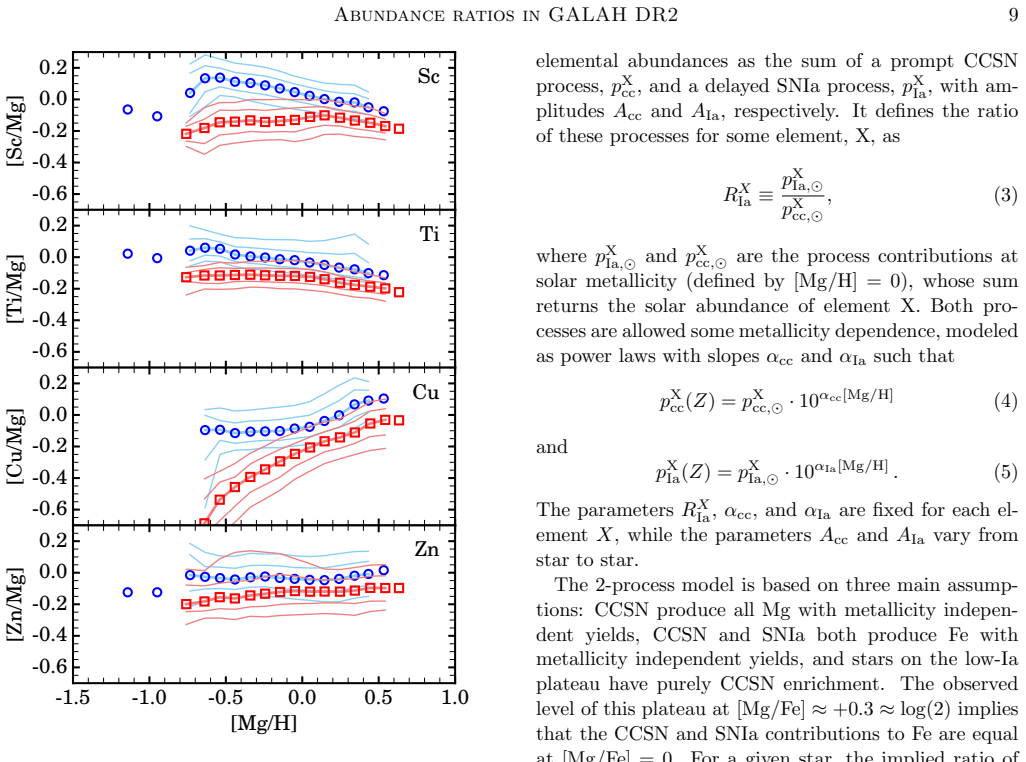
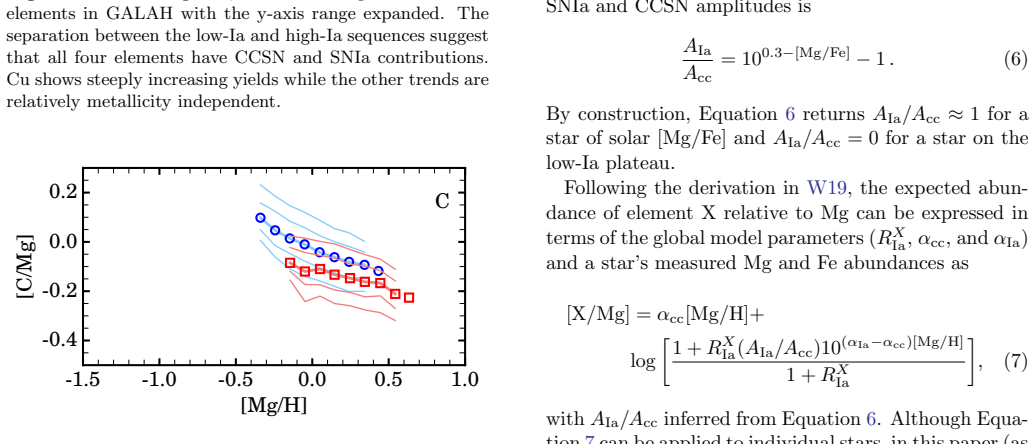
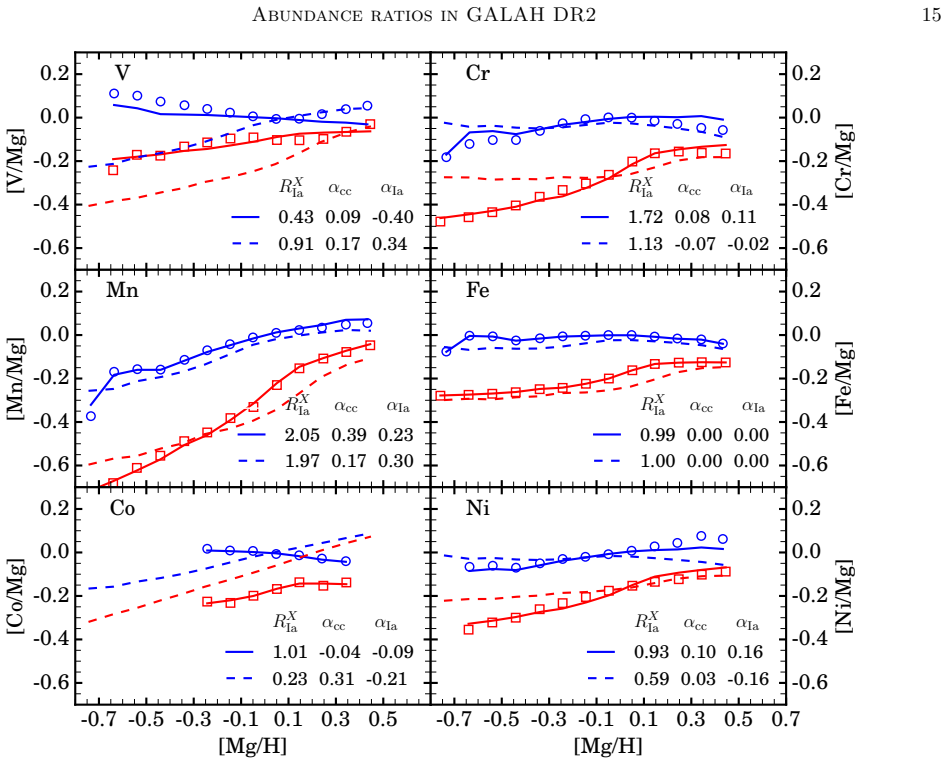
The 2-process model: every star's [X/Mg] is the sum of a prompt core-collapse process with amplitude $A_\mathrm{cc}$ and a delayed Type-Ia process with amplitude $A_\mathrm{Ia}$, with the ratio $A_\mathrm{Ia}/A_\mathrm{cc}$ fixed by [Mg/Fe] (the low-Ia plateau at [Mg/Fe] $\approx +0.3$ means equal CCSN and SNIa contributions to Fe at solar). For each element, the model fits a solar ratio $R_\mathrm{Ia} = p_\mathrm{Ia}/p_\mathrm{cc}$ and two power-law slopes $\alpha_\mathrm{cc}$ and $\alpha_\mathrm{Ia}$; the separation between the high-Ia and low-Ia median sequences carries $R_\mathrm{Ia}$, while the slopes carry the metallicity dependence of the yields. The paper applies this model to both median sequences simultaneously, after applying small zero-point offsets, and converts $R_\mathrm{Ia}$ into $f_\mathrm{cc}$.
What would settle it
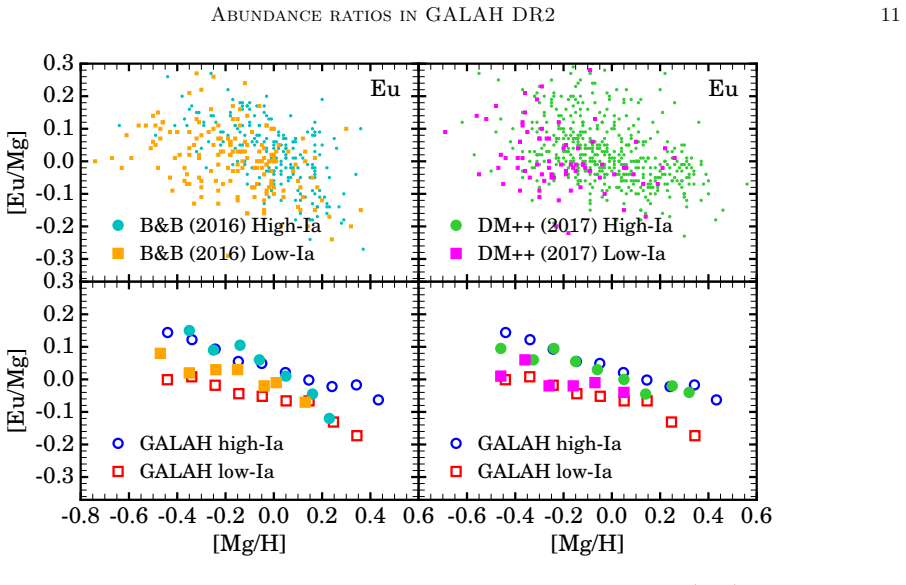
If overlapping elements measured in GALAH dwarfs and in a larger sample of giants spanning the disk show median [X/Mg] versus [Mg/H] sequences that shift with Galactocentric radius at fixed [Mg/H] by more than the scatter, the universality premise fails and with it the yield interpretation. More sharply, a high-signal measurement of [Eu/Mg] in several thousand high-Ia and low-Ia dwarfs that shows no sequence separation would disprove the delayed-Eu inference.
Extended reading notes
Core claim
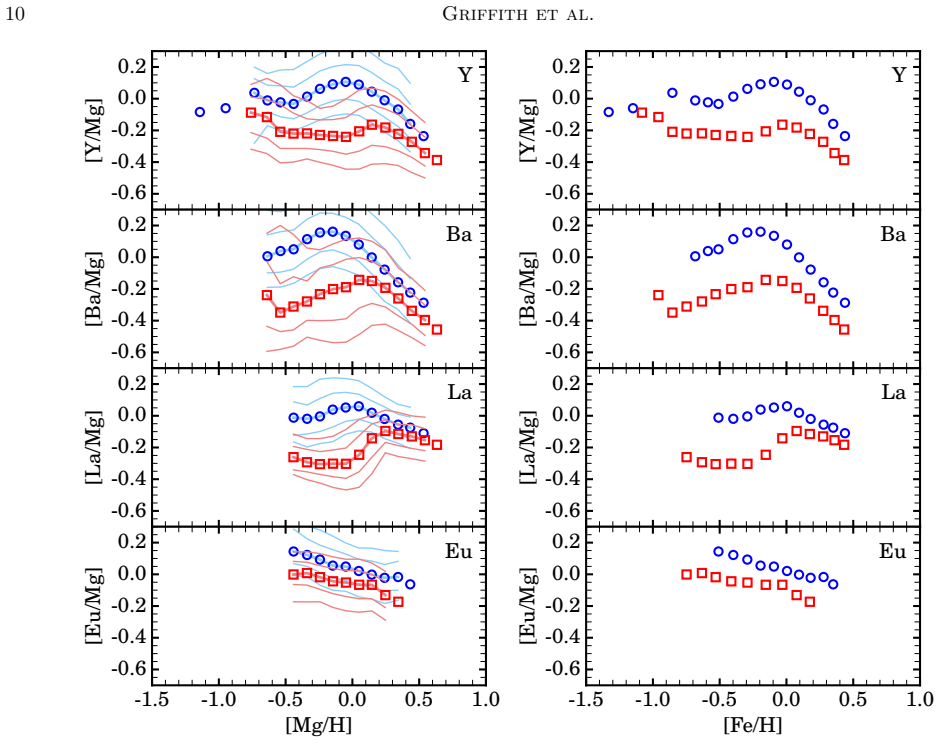
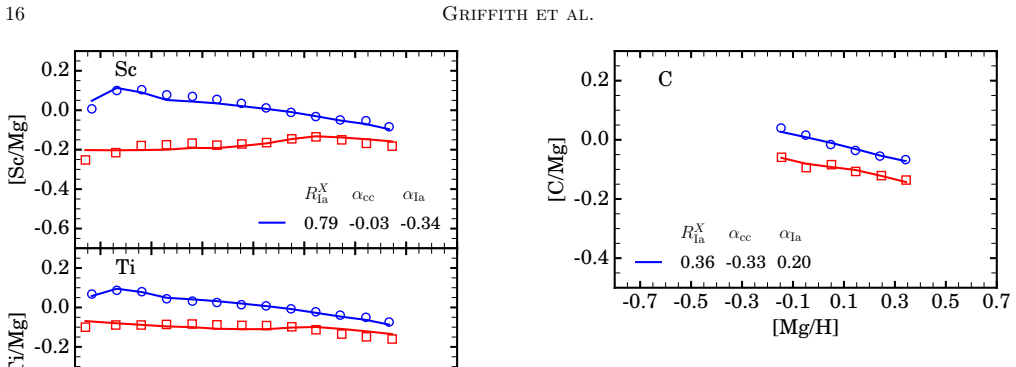
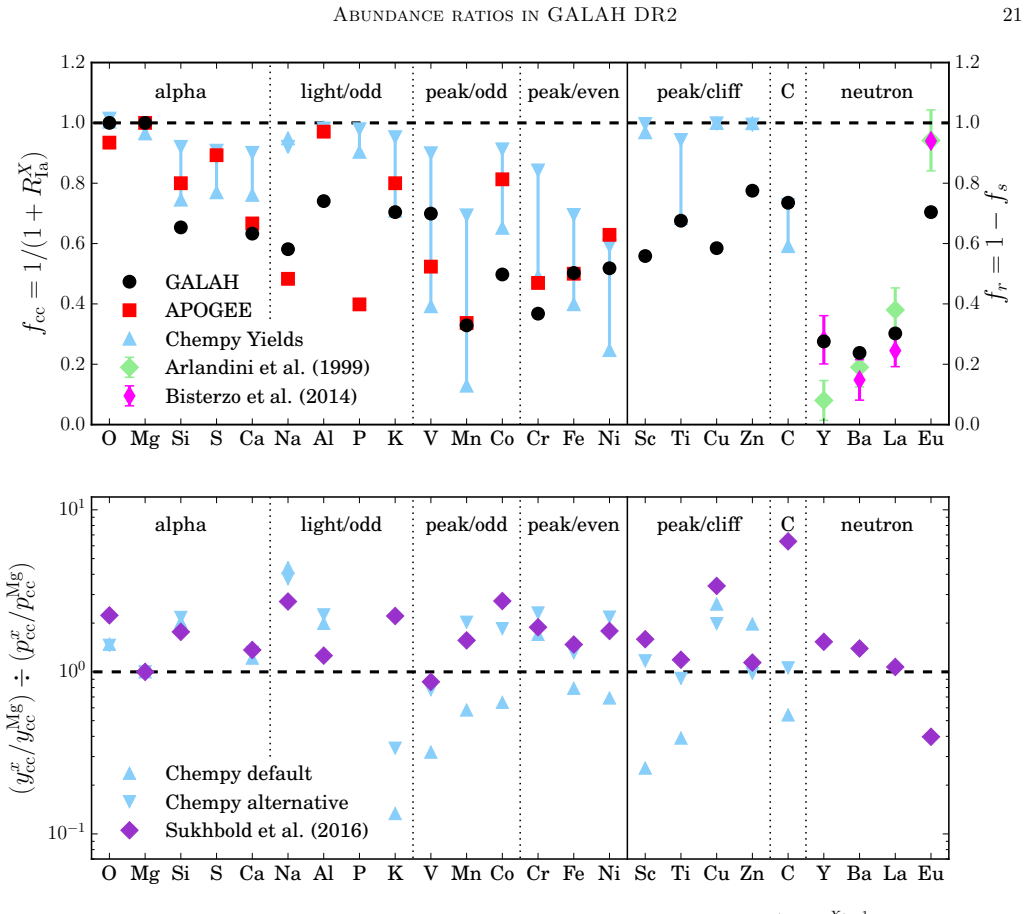
The central claim is that the median [X/Mg] versus [Mg/H] sequences of the low-Ia (high-[Mg/Fe]) and high-Ia (low-[Mg/Fe]) populations are nearly universal across the disk, so their separation is set by the ratio of delayed to prompt production of element X. Applying the 2-process model, which writes each abundance as a CCSN process plus an SNIa process with power-law metallicity dependence, the paper infers per-element ratios $R_\mathrm{Ia}$ and the solar core-collapse fraction $f_\mathrm{cc} = 1/(1+R_\mathrm{Ia})$. The inferred fractions include $f_\mathrm{cc} \approx 0.74$ for C, $\approx 0.56$–$0.78$ for Sc, Ti, Cu, and Zn, $\approx 0.70$ for Eu, and $\approx 0.24$–$0.30$ for Y, Ba, and La. The discovery is that optical GALAH data, including nine elements not in the earlier near-infrared study, produce these nucleosynthesis constraints from median trends alone.
Load-bearing premise
The load-bearing premise, inherited from the earlier infrared study and conjectured to extend to the GALAH main-sequence sample and to new elements, is that median [X/Mg] versus [Mg/H] sequences are nearly independent of a star's birthplace or age, so that their separation reflects nucleosynthesis yields rather than Galactic history.
Editorial extensions
If this is right
- The inferred $f_\mathrm{cc}$ values become empirical, IMF-averaged yield constraints at solar metallicity for 21 elements, enabling direct tests of supernova and AGB yield grids.
- The low prompt fractions ($\approx 0.24$–$0.30$) for Y, Ba, and La imply that the s-process dominates their solar abundances, and the alignment of their sequence peaks in [Fe/H] supports Fe-peak nuclei as neutron-capture seeds.
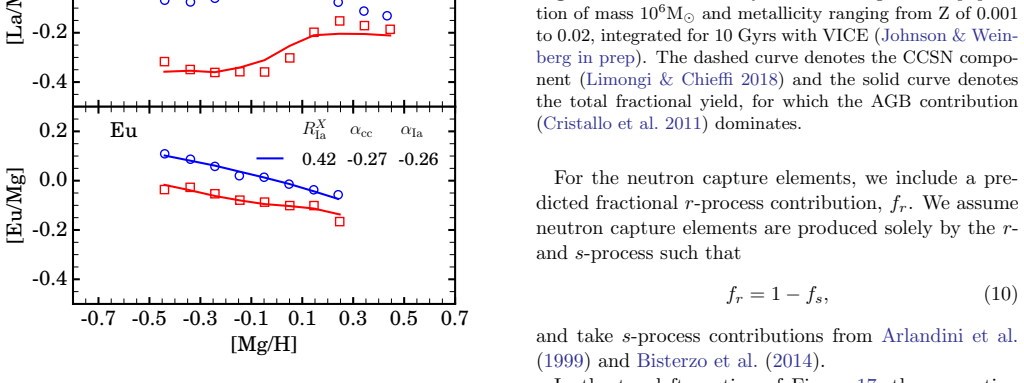
- The clear separation of the Eu sequences means at least $\sim 30\%$ of solar Eu enrichment is delayed relative to star formation, requiring a time-delayed r-process channel in addition to prompt production.
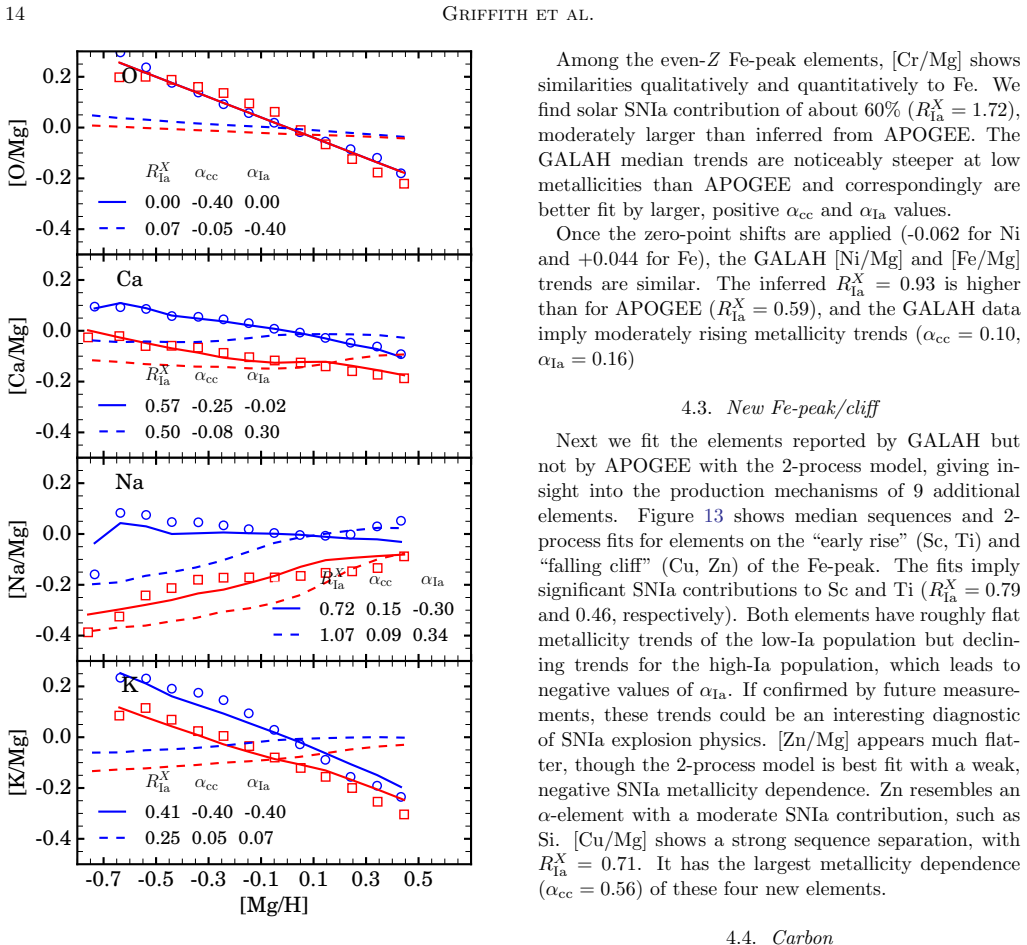
- The discrepancies for Na, K, Cu, and C identify these elements as useful diagnostics for massive-star evolution and supernova explosion physics.
- If the universality of the median sequences holds, comparing median trends across surveys becomes a stringent test of abundance-scale consistency, since full-population [X/Fe] versus [Fe/H] trends can mask systematic offsets.
Reading between the lines
- A testable extension would be to apply the same high-Ia/low-Ia decomposition to Eu in a much larger sample; if the separation follows the SNIa delay-time distribution rather than being constant, the timing of the delayed r-process channel could be constrained.
- Because the method assumes Mg is purely CCSN, an internal check would be to recompute $A_\mathrm{Ia}/A_\mathrm{cc}$ from an independent pure-CCSN element such as O; disagreement would signal metallicity-dependent Mg yields.
- The zero-point offsets (average roughly 0.08 dex) that force [X/Mg] = 0 at [Mg/H] = 0 on the high-Ia sequence are effectively predictions for GALAH's absolute abundance scale that independent high-resolution measurements could verify.
Editorial analysis
A structured set of objections, weighed in public.
Referee Report
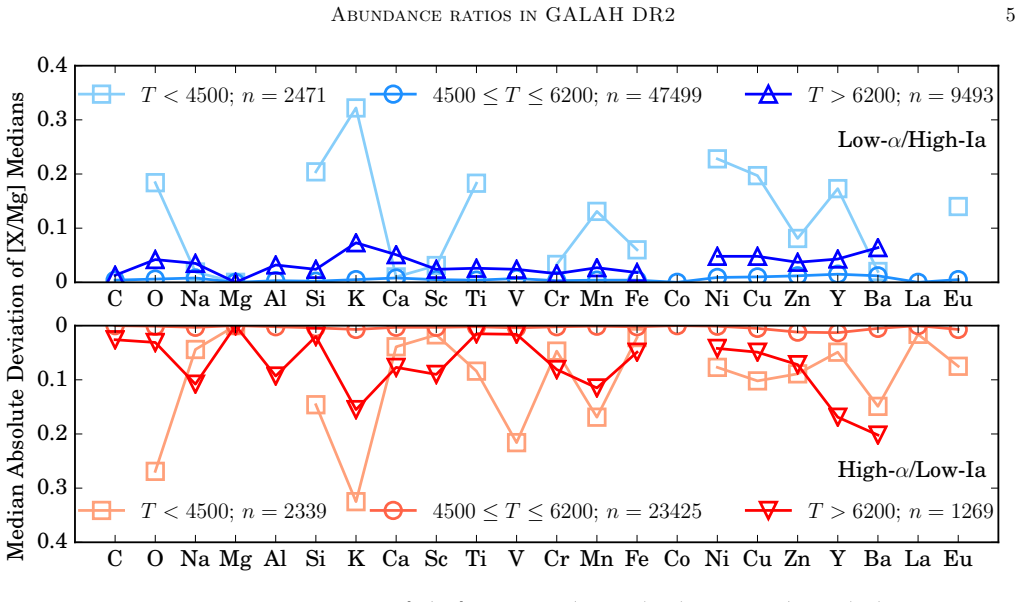
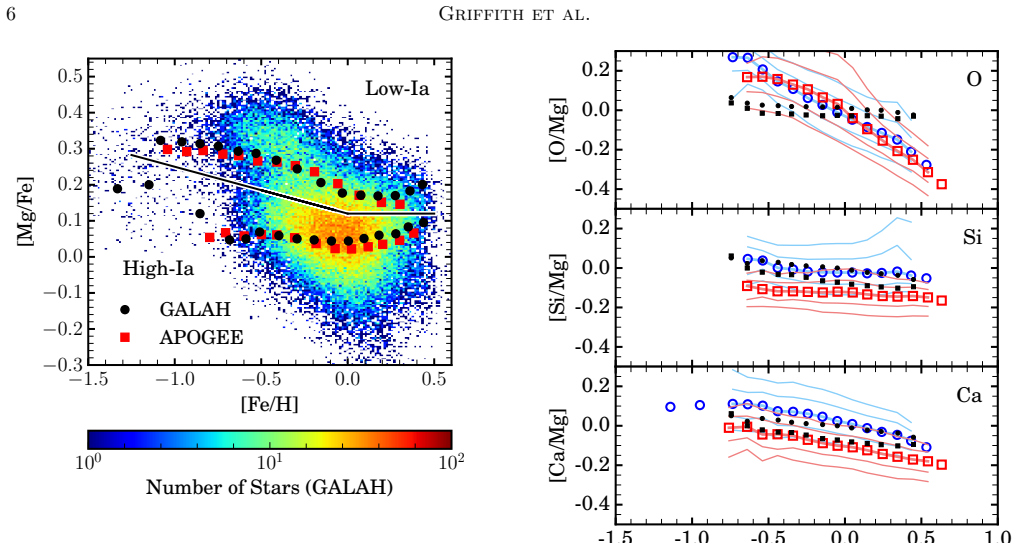
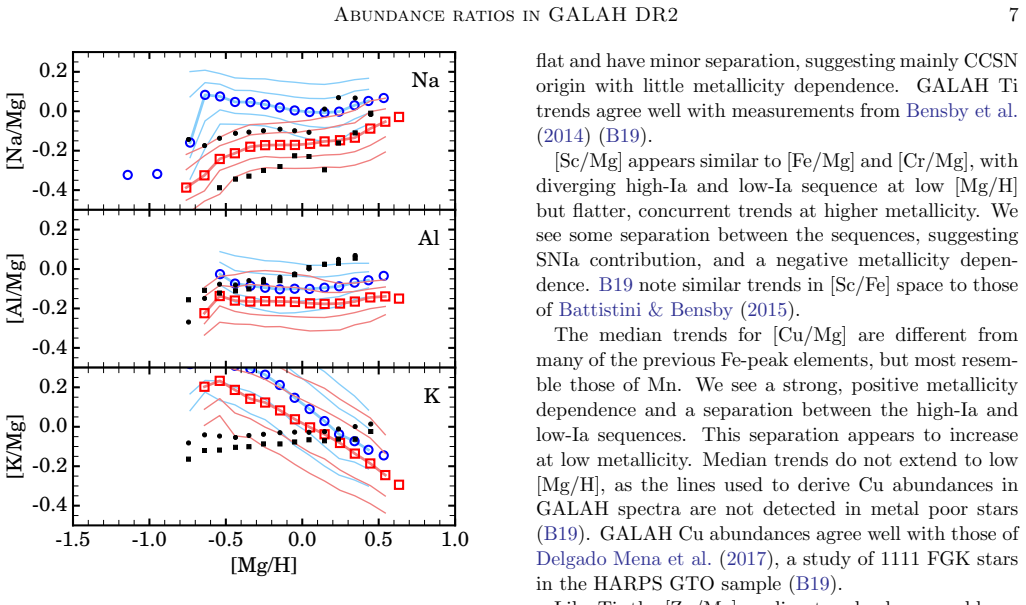
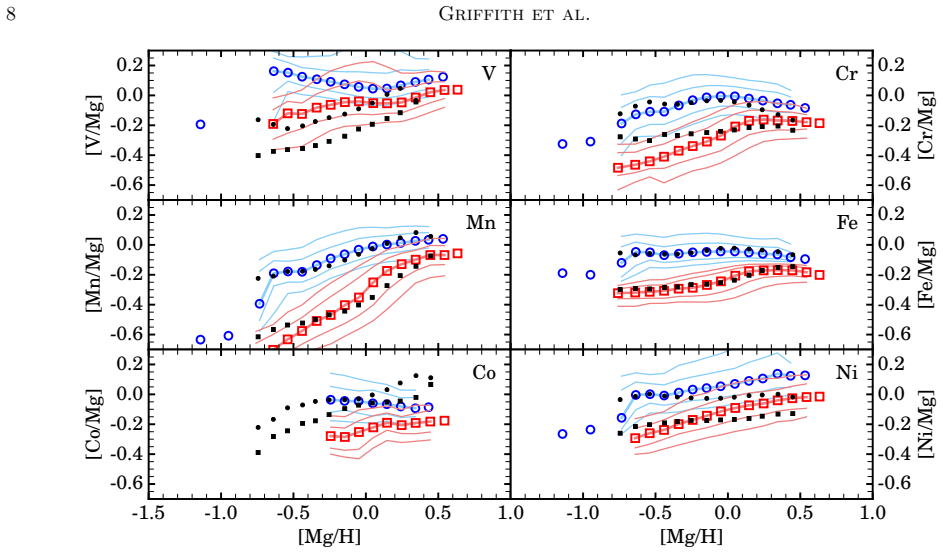
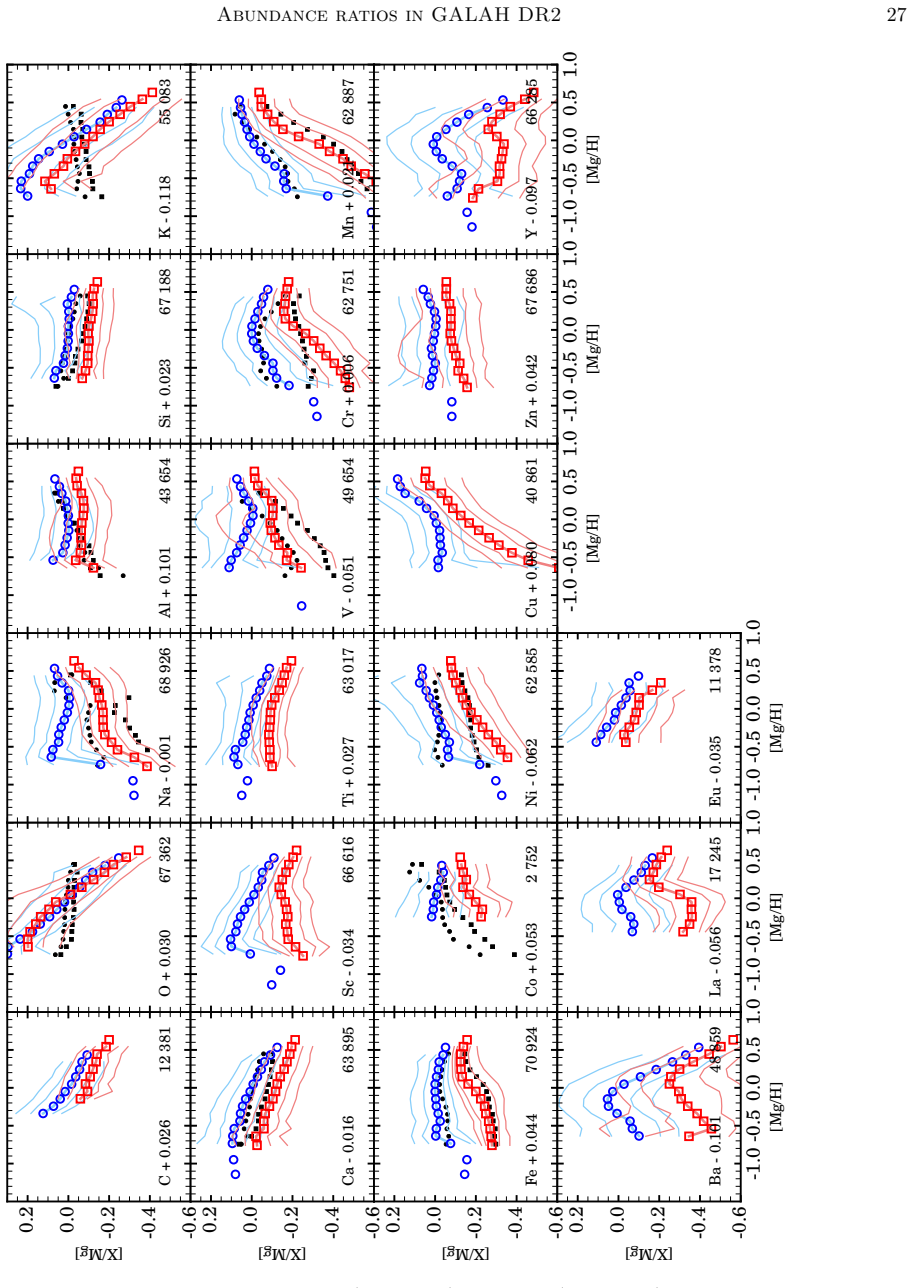
Summary. Using 70,924 GALAH DR2 stars selected by SNR, quality-flag, and effective-temperature cuts, the paper constructs median [X/Mg] versus [Mg/H] sequences for 21 elements, separated into low-Ia and high-Ia populations by the W19 boundary in the [Mg/Fe]-[Fe/H] plane. It then fits the W19 two-process model (Eqs. 3-7) after applying per-element zero-point offsets that force the high-Ia sequence through [X/Mg]=0 at [Mg/H]=0, and reports best-fit values of R_Ia, alpha_cc, alpha_Ia, and fcc=1/(1+R_Ia) in Table 1. The headline quantitative results are fcc=0.74 for C, fcc=0.56-0.78 for Sc, Ti, Cu, and Zn, fcc=0.70 for Eu, and fcc=0.24-0.30 for Y, Ba, and La. The paper compares GALAH trends with APOGEE/W19, finding agreement for several elements and discrepancies for O, Al, K, V, Co, and Ni, and it compares the inferred fcc values and CCSN amplitudes with Chempy and Sukhbold et al. (2016) yield models, identifying C, Na, K, Mn, Ca, Sc, Cu, and Zn as useful diagnostics.
Significance. If its assumptions hold, the paper provides a valuable empirical route to IMF-averaged nucleosynthesis constraints that are nearly independent of detailed Galactic chemical evolution modeling, and it exploits GALAH elements not available in APOGEE. The manuscript is transparent about sample construction, tests temperature and population-boundary systematics, gives full median-sequence tables, and makes explicit comparisons with independent literature samples and yield models. The raw median-sequence separations are already useful observables. However, the quantitative fcc values do not yet carry the weight the abstract gives them: they depend on ad hoc zero-point offsets, they are derived with an unweighted fit without propagated uncertainties, and for C, Y, Ba, La, and Eu they assume that the delayed process follows the SNIa delay-time profile, an assumption the text itself calls qualitative. The disk-universality premise, measured only for APOGEE giants, is conjectured for the GALAH main-sequence sample and the nine new elements.
major comments (3)
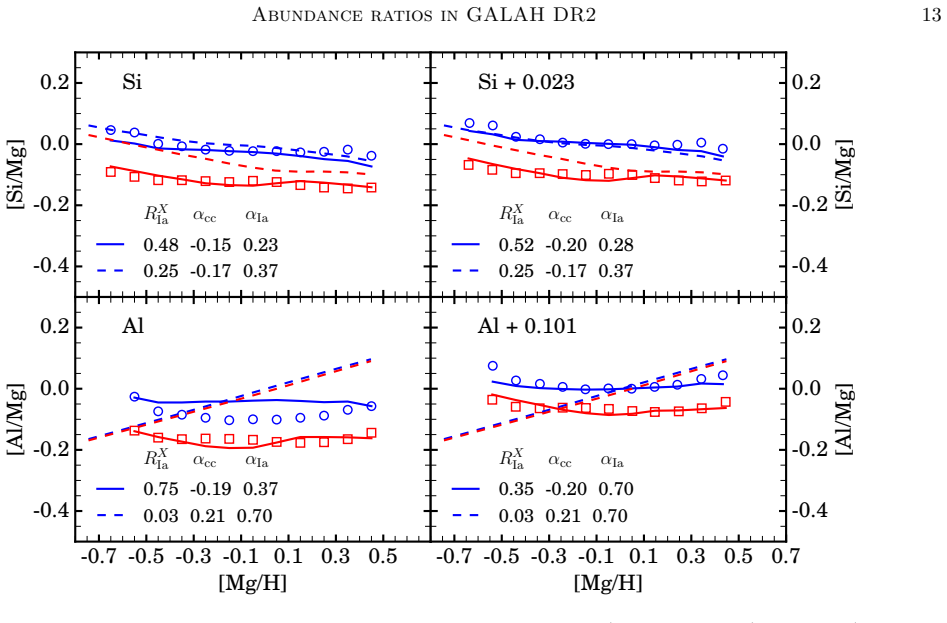
- [§4 and Table 1, Figure 10, Eq. (8)] The headline fcc values are conditioned on per-element zero-point offsets that are chosen, not independently calibrated, to force the high-Ia sequence through [X/Mg]=0 at [Mg/H]=0. The paper's own example shows the load-bearing sensitivity: for Al, the same data without the +0.101 dex offset give R_Ia=0.75 and fcc=0.57, while with the offset R_Ia=0.35 and fcc=0.74 (Figure 10). The offsets are as large as 0.118 dex, and the text reports an average of 0.08 dex, comparable to known GALAH/APOGEE abundance-scale differences. Because Eq. (8) makes fcc depend directly on the zero-point position relative to the low-Ia sequence, a plausible ±0.05 dex calibration uncertainty shifts several fcc values by more than 0.1. The paper should provide a robustness table (e.g., refitting with offsets varied by ±0.05 dex) or an independent cross-calibration of the offsets before the abstract's quantitative fcc statements can be considered secure.
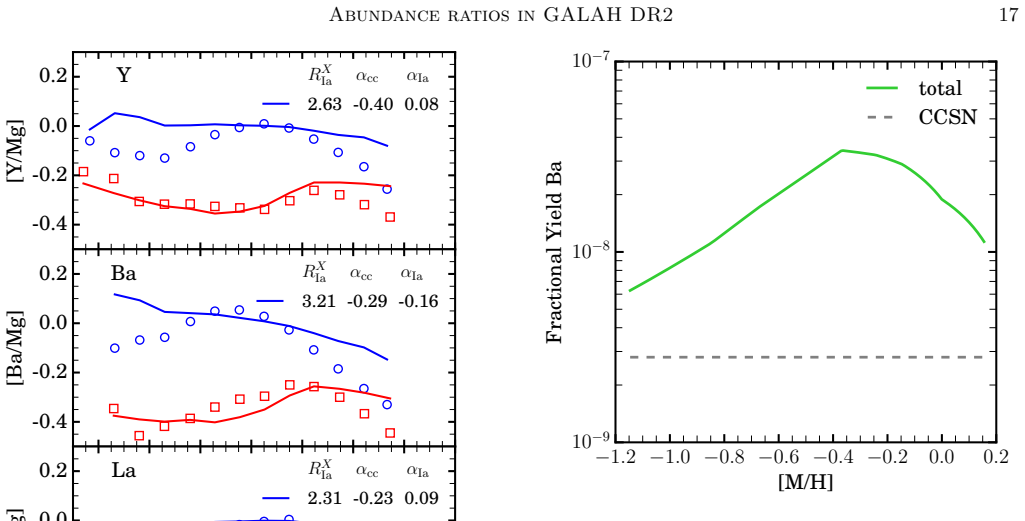
- [§4 after Eq. (7), §4.4, §4.5, §5, Eq. (9)] The paper states that for elements whose delayed source is AGB stars rather than SNIa, the R_Ia values and fcc values are 'qualitative indications' because the AGB time profile differs from the SNIa delay-time distribution. This applies to C, Y, Ba, and La, and the text makes a similar caution for Eu. Yet Table 1 and the abstract report fcc=0.74 for C, fcc=0.24-0.30 for Y/Ba/La, and fcc=0.70 for Eu as if these were CCSN fractions, and Figure 17 plots them on the same quantitative scale as elements with genuine SNIa channels. Equation (9) defines fcc from an R_Ia fitted with an SNIa DTD, so these numbers are not 'fraction of solar X from CCSN' unless the DTD equivalence is demonstrated. The headline claims should be downgraded to match the internal caveats, or the model should be extended with an explicit AGB/merger channel and DTD.
- [§1 and §6] The interpretation of sequence separation as a nucleosynthesis diagnostic rests on W19's APOGEE result that median [X/Mg]-[Mg/H] sequences are nearly universal across the disk. That result was measured for luminous giants and for the APOGEE element set; the paper explicitly conjectures that it extends to the GALAH main-sequence/subgiant sample and to the new elements C, Sc, Ti, Cu, Zn, Y, Ba, La, and Eu. No test of this conjecture is presented for the new elements, and if sequence shape depends on birth radius or age, the fitted R_Ia values would mix nucleosynthesis information with Galactic history. Because the GALAH sample is large, a consistency check of the median sequences across, for example, |Z| or metallicity-distribution sub-samples should be feasible and would directly support or refute the universality assumption for the GALAH sample; at minimum, the new-element fcc values should be clearly labeled as conditional on this untested conjecture.
minor comments (5)
- [References] Sukhbold et al. (2016) is called S16 throughout the text but the reference entry is labeled '(S18)'; the labels should be made consistent.
- [§2] The spectrograph is spelled 'HERMES' elsewhere but appears as 'HerES' in one sentence in Section 2.
- [§4.5] The comparison to VICE in Figure 16 uses results from a paper 'in prep'; if this model is central to the Ba discussion, a citation or public code reference should be provided.
- [Figure 17] The lower panel's normalization to Mg causes constant vertical offsets when normalized to O instead; the text explains this, but the caption could state the normalization choice explicitly to prevent misreading.
- [§4.1] The paragraph beginning 'It may seem surprising...' is important but reads as a lengthy aside; moving the discussion of survey differences in [Fe/Mg] sequences to a short subsection would improve readability.
Circularity Check
No load-bearing circularity: the central fcc values are fitted inferences from observed GALAH sequences; the only explicitly 'by construction' result (Fe fcc = 0.5) is an acknowledged model assumption, not a hidden prediction.
-
self definitional
[Section 4.2, Fe-peak elements, discussion of Figure 12]
"The fits for both [Fe/Mg] sequences are perfect by construction, as the 2-process model uses [Fe/Mg] to infer AIa/Acc, and the fit parameters are the assumed values, RX Ia = 1 and αcc = αIa = 0."
The Fe fcc = 0.50 entry in Table 1 is not inferred from the GALAH data; it follows from the model's defining assumption that CCSN and SNIa contribute equally to solar Fe (R_Ia = 1), together with the adopted +0.044 dex Fe zero-point offset that forces [Fe/Mg] = 0 at [Mg/H] = 0. The paper is fully transparent that this fit is by construction, and Fe serves as a calibration element rather than a headline claim, so this is a minor, admitted self-definitional step rather than a central circularity.
full rationale
The main derivation is self-contained and not circular in the sense prohibited here. The paper's central quantities are the median [X/Mg] versus [Mg/H] sequences for GALAH stars, which are direct observables; the 2-process model is then fitted to both the high-Ia and low-Ia sequences simultaneously, and the reported fcc = 1/(1+R_Ia) is a monotone transformation of the fitted amplitude ratio R_Ia. That is standard parameter inference, not a prediction forced by construction. The universality premise is imported from W19, an independent APOGEE-based empirical study by overlapping authors; the present paper explicitly labels the extension to GALAH and to new elements as a conjecture, and W19's sequence universality is externally falsifiable observational evidence rather than an unverified self-citation. The per-element zero-point offsets are calibration choices made to enforce a solar anchor, and the paper openly reports their values and demonstrates their sensitivity for Al (R_Ia changing from 0.75 to 0.35 for an offset of +0.101 dex); this is a robustness limitation, not a circular reduction, because the sequence separations and shapes remain observed inputs. The only literal 'by construction' statement is the Fe fit, which the paper itself flags and which is not one of the paper's headline nucleosynthesis inferences. External comparisons to Chempy, Sukhbold et al. (2016), and r-/s-process fractions from Arlandini et al. (1999) and Bisterzo et al. (2014) provide independent grounding. Overall, the paper contains no load-bearing circularity, only a minor, explicitly acknowledged definitional element for Fe.
Assumptions & free parameters
free parameters (3)
- R_Ia per element (21 values: C 0.36, O 0.00, Na 0.72, Al 0.35, Si 0.52, K 0.41, Ca 0.57, Sc 0.79, Ti 0.46, V 0.43, Cr… =
Table 1
- alpha_cc and alpha_Ia per element (metallicity power-law slopes for the CCSN and SNIa processes) =
Table 1, for example Cu alpha_cc = 0.56 and Mn alpha_Ia = 0.23
- Per-element zero-point offsets (21 values, range -0.118 to +0.101 dex) =
Table 1
assumptions (4)
- domain assumption All Mg is produced by CCSN with a metallicity-independent IMF-averaged yield; CCSN and SNIa produce Fe with metallicity-independent yields; stars on the low-Ia plateau have purely CCSN enrichment.
- domain assumption The median [X/Mg] versus [Mg/H] sequences are nearly universal within the Galactic disk, so they reflect IMF-averaged yields rather than star formation history or gas flows.
- ad hoc to paper For elements whose delayed source is AGB stars rather than SNIa, the AGB enrichment time profile can be approximated by the SNIa delay-time profile for the purpose of the decomposition.
- ad hoc to paper Zero-point offsets applied to GALAH abundances are plausible calibration corrections rather than arbitrary shifts.
Cite this review
Pith. "Pith review of Abundance ratios in GALAH DR2 and their implications for nucleosynthesis." pith.science (2026). https://pith.science/paper/YX5A3ONG
@misc{pith2026190806113,
  author       = {Pith},
  title        = {Pith review of: Abundance ratios in GALAH DR2 and their implications for nucleosynthesis},
  year         = {2026},
  howpublished = {\url{https://pith.science/paper/YX5A3ONG}},
  note         = {Machine review of arXiv:1908.06113}
}
abstract
Using a sample of 70 924 stars from the second data release of the GALAH optical spectroscopic survey, we construct median sequences of [X/Mg] vs. [Mg/H] for 21 elements, separating the high-$\alpha$/``low-Ia'' and low-$\alpha$/``high-Ia'' stellar populations through cuts in [Mg/Fe]. Previous work with the near-IR APOGEE survey has shown that such sequences are nearly independent of location in the Galactic disk, implying that they are determined by stellar nucleosynthesis yields with little sensitivity to other chemical evolution aspects. The separation between the two [X/Mg] sequences indicates the relative importance of prompt and delayed enrichment mechanisms, while the sequences' slopes indicate metallicity dependence of the yields. GALAH and APOGEE measurements agree for some of their common elements, but differ in sequence separation or metallicity trends for others. GALAH offers access to nine new elements. We infer that about $75\%$ of solar C comes from core collapse supernovae and $25\%$ from delayed mechanisms. We find core collapse fractions of $60-80\%$ for the Fe-peak elements Sc, Ti, Cu, and Zn, with strong metallicity dependence of the core collapse Cu yield. For the neutron capture elements Y, Ba, and La, we infer large delayed contributions with non-monotonic metallicity dependence. The separation of the [Eu/Mg] sequences implies that at least $\sim30\%$ of Eu enrichment is delayed with respect to star formation. We compare our results to predictions of several supernova and AGB yield models; C, Na, K, Mn, and Ca all show discrepancies with models that could make them useful diagnostics of nucleosynthesis physics.
Figures
Figures from the paper (14 more)

Forward citations
Cited by 5 Pith papers
-
Magnesium isotope ratios in Milky Way and dwarf galaxy stars
Magnesium isotope ratios in Milky Way and accreted dwarf galaxy stars trace a single universal enrichment track when plotted against [Mg/H], despite differences at fixed [Fe/H].
-
Inferring Galactic Parameters from Chemical Abundances: A Multi-Star Approach
The method recovers the IMF high-mass slope and Type Ia supernova rate to sub-percent precision from the chemical abundances of up to 200 simulated stars using a neural-network emulator and Hamiltonian Monte Carlo.
-
The complex stellar system M 22: constraining the chemical enrichment from AGB stars using magnesium isotope ratios
First Mg isotope measurements at [Fe/H]≈-2 in a globular cluster show no difference tied to s-process enrichment, favoring ~2.75 M_sun AGB polluters and a 280–480 Myr age gap.
-
The complex stellar system M 22: confirming abundance variations with high precision differential measurements
High-precision differential abundances confirm M 22 hosts a >0.24 dex iron spread and ~0.65 dex s-process spread, and reveal new internal abundance variations within each population.
-
Abundance Estimates for 16 Elements in 6 Million Stars from LAMOST DR5 Low-Resolution Spectra
A new public catalog gives temperatures, gravities, and 16 elemental abundances for 6 million LAMOST DR5 stars, with internal precision of 0.03 to 0.1 dex for most elements at S/N above 50.
Reference graph
Works this paper leans on
-
[1]
Z., Sousa, S
Adibekyan, V. Z., Sousa, S. G., Santos, N. C., et al. 2012, A&A, 545, A32
2012
-
[2]
M., Asplund, M., Collet, R., & Leenaarts, J
Amarsi, A. M., Asplund, M., Collet, R., & Leenaarts, J. 2015, MNRAS, 454, L11
work page 2015
-
[3]
M., Asplund, M., Collet, R., & Leenaarts, J
Amarsi, A. M., Asplund, M., Collet, R., & Leenaarts, J. 2016, MNRAS, 455, 3735
work page 2016
-
[4]
Johnson, J. A. 2017, ApJ, 835, 224
work page 2017
-
[5]
Arlandini, C., K¨ appeler, F., Wisshak, K., et al. 1999, ApJ, 525, 886
work page 1999
-
[6]
Asplund, M., Grevesse, N., Sauval, A. J., & Scott, P. 2009, ARA&A, 47, 481 Astropy Collaboration, Robitaille, T. P., Tollerud, E. J., et al. 2013, A&A, 558, A33 Astropy Collaboration, Price-Whelan, A. M., Sip˝ ocz, B. M., et al. 2018, AJ, 156, 123
work page 2009
- [7]
- [8]
Show all 63 references
-
[9]
2003, A&A, 410, 527
Bensby, T., Feltzing, S., & Lundstr¨ om, I. 2003, A&A, 410, 527
2003
-
[10]
Bensby, T., Feltzing, S., & Oey, M. S. 2014, A&A, 562, A71
2014
-
[11]
2006, MNRAS, 367, 1181
Bensby, T., & Feltzing, S. 2006, MNRAS, 367, 1181
2006
-
[12]
2014, ApJ, 787, 10
Bisterzo, S., Travaglio, C., Gallino, R., Wiescher, M., & K¨ appeler, F. 2014, ApJ, 787, 10
2014
-
[13]
R., Bershady, M
Blanton, M. R., Bershady, M. A., Abolfathi, B., et al. 2017, AJ, 154, 28
2017
-
[14]
Bovy, J., Rix, H.-W., & Hogg, D. W. 2012, ApJ, 751, 131
2012
-
[15]
2018, MNRAS, 478, 4513 (B18)
Buder, S., Asplund, M., Duong, L., et al. 2018, MNRAS, 478, 4513 (B18)
2018
-
[16]
K., et al
Buder, S., Lind, K., Ness, M. K., et al. 2019, A&A, 624, A19 (B19)
2019
-
[17]
2009, A&A, 505, 605
Cescutti, G., Matteucci, F., McWilliam, A., & Chiappini, C. 2009, A&A, 505, 605
2009
-
[18]
2001, ApJ, 554, 1274
Chabrier, G. 2001, ApJ, 554, 1274
2001
-
[19]
1997, ApJ, 477, 765
Chiappini, C., Matteucci, F., & Gratton, R. 1997, ApJ, 477, 765
1997
-
[20]
2003, MNRAS, 339, 63 Chieffi, A., & Limongi, M
Chiappini, C., Romano, D., & Matteucci, F. 2003, MNRAS, 339, 63 Chieffi, A., & Limongi, M. 2004, ApJ, 608, 405
2003
-
[21]
2007, A&A, 469, 687 Cˆ ot´ e, B., Eichler, M., Arcones, A., et al
Collet, R., Asplund, M., & Trampedach, R. 2007, A&A, 469, 687 Cˆ ot´ e, B., Eichler, M., Arcones, A., et al. 2019, ApJ, 875, 106
2007
-
[22]
2011, ApJS, 197, 17 4 http://www.astropy.org De Silva, G
Cristallo, S., Piersanti, L., Straniero, O., et al. 2011, ApJS, 197, 17 4 http://www.astropy.org De Silva, G. M., Freeman, K. C., Bland-Hawthorn, J., et al. 2015, MNRAS, 449, 2604 Delgado Mena, E., Tsantaki, M., Adibekyan, V. Z., et al. 2017, A&A, 606, A94
2011
-
[23]
J., Weinberg, D
Eisenstein, D. J., Weinberg, D. H., Agol, E., et al. 2011, AJ, 142, 72
2011
-
[24]
E., Timmes, F
Fields, C. E., Timmes, F. X., Farmer, R., et al. 2018, ApJS, 234, 19
2018
-
[25]
1998, ApJ, 497, 388
Gallino, R., Arlandini, C., Busso, M., et al. 1998, ApJ, 497, 388
1998
-
[26]
2012, The Messenger, 147, 25
Gilmore, G., Randich, S., Asplund, M., et al. 2012, The Messenger, 147, 25
2012
-
[27]
R., Bovy, J., Holtzman, J
Hayden, M. R., Bovy, J., Holtzman, J. A., et al. 2015, ApJ, 808, 132
2015
-
[28]
2011, A&A, 529, A158
Hayek, W., Asplund, M., Collet, R., & Nordlund, ˚A. 2011, A&A, 529, A158
2011
-
[29]
2015, PhyS, 90, 054010
Heiter, U., Lind, K., Asplund, M., et al. 2015, PhyS, 90, 054010
2015
-
[30]
A., Hasselquist, S., Shetrone, M., et al
Holtzman, J. A., Hasselquist, S., Shetrone, M., et al. 2018, AJ, 156, 125
2018
-
[31]
2018, International Journal of Modern Physics D, 27, 1842005
Hotokezaka, K., Beniamini, P., & Piran, T. 2018, International Journal of Modern Physics D, 27, 1842005
2018
-
[32]
1999, ApJS, 125, 439
Iwamoto, K., Brachwitz, F., Nomoto, K., et al. 1999, ApJS, 125, 439
1999
-
[33]
Johnson, J., Weinberg, D. in prep. de Jong, J. T. A., Yanny, B., Rix, H.-W., et al. 2010, ApJ, 714, 663 J¨ onsson, H., Allende Prieto, C., Holtzman, J. A., et al. 2018, AJ, 156, 126 K¨ appeler, F., Gallino, R., Bisterzo, S., & Aoki, W. 2011, Reviews of Modern Physics, 83, 157
2010
-
[34]
Karakas, A. I. 2010, MNRAS, 403, 1413
2010
-
[35]
Kraft, R. P. 1967, ApJ, 150, 551
1967
-
[36]
2006, ApJ, 647, 483
Limongi, M., & Chieffi, A. 2006, ApJ, 647, 483
2006
-
[37]
2018, ApJS, 237, 13
Limongi, M., & Chieffi, A. 2018, ApJS, 237, 13
2018
-
[38]
R., Schiavon, R
Majewski, S. R., Schiavon, R. P., Frinchaboy, P. M., et al. 2017, AJ, 154, 94
2017
-
[39]
2017, ApJ, 848, 25
Maoz, D., & Graur, O. 2017, ApJ, 848, 25
2017
-
[40]
L., Sharma, S., Buder, S., et al
Martell, S. L., Sharma, S., Buder, S., et al. 2017, MNRAS, 465, 3203
2017
-
[41]
2010, A&A, 515, A68
Mattsson, L. 2010, A&A, 515, A68
2010
-
[42]
2002, A&A, 390, 561
Meynet, G., & Maeder, A. 2002, A&A, 390, 561
2002
-
[43]
2015, ApJ, 808, 16
Zasowski, G. 2015, ApJ, 808, 16
2015
-
[44]
2014, A&A, 568, A25 24 Griffith et al
Zhao, G. 2014, A&A, 568, A25 24 Griffith et al
2014
-
[45]
E., & Schuster, W
Nissen, P. E., & Schuster, W. J. 2010, A&A, 511, L10
2010
-
[46]
2013, ARA&A, 51, 457
Nomoto, K., Kobayashi, C., & Tominaga, N. 2013, ARA&A, 51, 457
2013
-
[47]
Piskunov, N., & Valenti, J. A. 2017, A&A, 597, A16
2017
-
[48]
2018, MNRAS, 476, 3432
Cristallo, S. 2018, MNRAS, 476, 3432
2018
-
[49]
2018, MNRAS, 480, 538
Ritter, C., Herwig, F., Jones, S., et al. 2018, MNRAS, 480, 538
2018
-
[50]
2017, A&A, 605, A59
Rybizki, J., Just, A., & Rix, H.-W. 2017, A&A, 605, A59
2017
-
[51]
Salpeter, E. E. 1952, ApJ, 115, 326
1952
-
[52]
Salpeter, E. E. 1955, ApJ, 121, 161 Sch¨ onrich, R., & Binney, J. 2009a, MNRAS, 396, 203 Sch¨ onrich, R., & Binney, J. 2009b, MNRAS, 399, 1145 Sch¨ onrich, R. A., & Weinberg, D. H. 2019, MNRAS, 487, 580
1955
-
[53]
R., Ciaraldi-Schoolmann, F., R¨ opke, F
Seitenzahl, I. R., Ciaraldi-Schoolmann, F., R¨ opke, F. K., et al. 2013, MNRAS, 429, 1156
2013
-
[54]
2015, Journal of Astronomical Telescopes, Instruments, and Systems, 1, 035002
Sheinis, A., Anguiano, B., Asplund, M., et al. 2015, Journal of Astronomical Telescopes, Instruments, and Systems, 1, 035002
2015
-
[55]
M., Barnes, J., & Metzger, B
Siegel, D. M., Barnes, J., & Metzger, B. D. 2019, Nature, 569, 241
2019
-
[56]
J., Chen, T.-W., Jerkstrand, A., et al
Smartt, S. J., Chen, T.-W., Jerkstrand, A., et al. 2017, Nature, 551, 75
2017
-
[57]
2019, Astronomy and Astrophysics, 623, A60
Spitoni, E., Silva Aguirre, V., Matteucci, F., et al. 2019, Astronomy and Astrophysics, 623, A60
2019
-
[58]
2016, ApJ, 821, 38 (S18)
Janka, H.-T. 2016, ApJ, 821, 38 (S18)
2016
-
[59]
2003, Nuclear Physics A, 718, 139
Thielemann, F.-K., Argast, D., Brachwitz, F., et al. 2003, Nuclear Physics A, 718, 139
2003
-
[60]
2004, ApJ, 601, 864 Tucci Maia, M., Ram´ ırez, I., Mel´ endez, J., et al
Travaglio, C., Gallino, R., Arnone, E., et al. 2004, ApJ, 601, 864 Tucci Maia, M., Ram´ ırez, I., Mel´ endez, J., et al. 2016, A&A, 590, A32
2004
-
[61]
2013, MNRAS, 431, 3642
Ventura, P., Di Criscienzo, M., Carini, R., & D’Antona, F. 2013, MNRAS, 431, 3642
2013
-
[62]
H., Holtzman, J
Weinberg, D. H., Holtzman, J. A., Hasselquist, S., et al. 2019, ApJ, 874, 102 (W19)
2019
-
[63]
C., Sneden, C., & Truran, J
Wheeler, J. C., Sneden, C., & Truran, J. W., Jr. 1989, ARA&A, 27, 279 Abundance ratios in GALAH DR2 25 APPENDIX We include tables of all GALAH median abundance trends (Tables 2- 3), ordered by elemental number, and a plot of all median sequences (Figure 18) for reference. All ...
1989
Reviewed August 14, 2026 · model on record in the stance chip above.
Discussion (0). Continue with ORCID to comment.