REVIEW 4 major objections 4 minor 295 references
Measuring magnesium isotopes in six red giants of M 22, this paper finds no difference between the cluster's two s-process groups — ruling out AGB polluters above ~3 solar masses and implying an age gap of at least ~280-480 million years.
Reviewed by Pith at T0; open to challenge. T0 means a machine referee read the full paper against a public rubric. the ladder, T0–T4 →
T0 review · deepseek-v4-flash
2026-08-02 02:52 UTC pith:LKSPVN2S
load-bearing objection First Mg isotope ratios in a metal-poor GC-like system—solid measurement, but the AGB mass exclusion is weaker than advertised. the 4 major comments →
The complex stellar system M 22: constraining the chemical enrichment from AGB stars using magnesium isotope ratios
The pith
A machine-rendered reading of the paper's core claim, the machinery that carries it, and where it could break.
Core claim
The paper claims that M 22's s-process-rich population was enriched by low-mass asymptotic giant branch (AGB) stars of roughly 1-3 solar masses — best fit near 2.75 M⊙ — and that the absence of any measured difference in magnesium isotope ratios between the two groups rules out AGBs above ~3 M⊙. The reasoning: at [Fe/H] ≈ -1.8, only AGBs above ~3 M⊙ reach the ~300 MK temperatures needed to synthesize the heavy isotopes 25Mg and 26Mg; a 3 M⊙ polluter matching the observed s-process spread would shift the ratios by ~0.15, five times the measured differences (~0.03). The authors also find that 26Mg/24Mg correlates with O, Na, and Al — driven by two Na-rich, O-poor stars — but not with s-process
What carries the argument
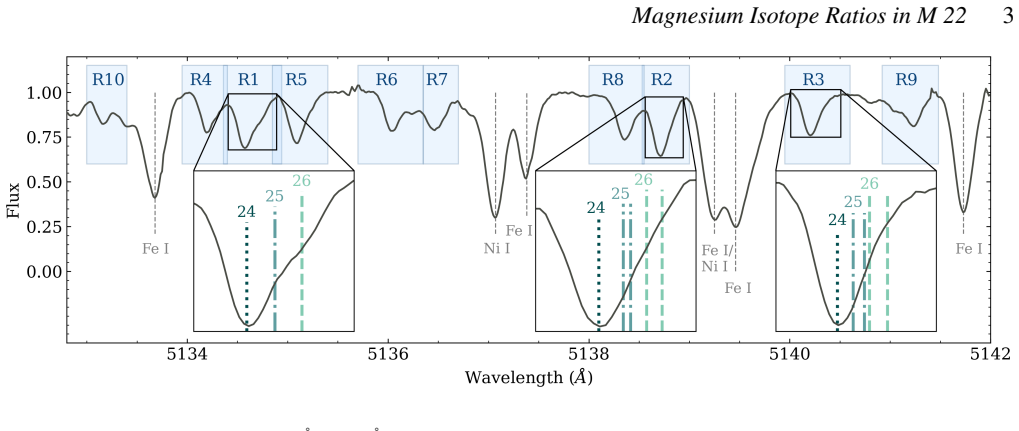
Two ingredients carry the argument. First, the spectroscopic lever arm: the molecular MgH lines near 5130-5142 Å are asymmetric because the heavy isotopologues 25MgH and 26MgH sit redward of 24MgH, and the paper extracts the isotope ratios by fitting up to eight line regions at once with a Markov-chain Monte Carlo wrapper around a standard spectrum-synthesis code, validated on synthetic spectra to ~2-3%. Second, a custom grid of AGB nucleosynthesis yields at [Fe/H] ≈ -1.82 spanning 0.9-6.5 M⊙, including a partially mixed proton zone that seeds the s-process; the authors dilute model ejecta with pristine gas to match the observed s-process spread and read off the predicted isotope shifts. The
Load-bearing premise
The load-bearing premise is that the measured magnesium isotope ratios are accurate to their quoted errors in these red-giant-tip stars — that the one-dimensional, local-thermodynamic-equilibrium analysis of the MgH lines recovers the true 25Mg/24Mg and 26Mg/24Mg, with three-dimensional and non-LTE effects smaller than about 1% as estimated from a single published model — so that the null difference between the s-process groups is a real absence rather than an artifact of the
What would settle it
Re-measuring isotope ratios in a larger sample (ten or more stars per group): if the two s-process groups then differ in 26Mg/24Mg by more than ~0.05 — the level a 3 M⊙ polluter would imprint according to the models — the mass exclusion collapses. The companion calculation is a 3D non-LTE synthesis of the MgH lines at Teff ≈ 3900-4100 K, log g ≈ 0.1-0.5: if the 26Mg/24Mg line-formation corrections exceed ~1-2%, the null result can no longer be trusted as a mass diagnostic.
If this is right
- The previously favored 3-6 M⊙ AGB pollution scenario for M 22's s-process groups is excluded; the polluter must be a ~1-3 M⊙ AGB, most likely near 2.75 M⊙.
- The two stellar groups are separated by at least ~280-480 Myr in age, an enrichment-timescale measurement that does not depend on isochrone fitting and is larger than earlier isochrone-based estimates of ~300 Myr.
- A ~3 M⊙ polluter would have shifted the Mg isotope ratios by ~0.15, about five times the measured difference, so the null result is a genuine mass diagnostic rather than a sensitivity failure.
- Because 26Mg/24Mg tracks O, Na, and Al rather than s-process elements, the light-element anti-correlations and the s-process split in M 22 must have been produced by two separate enrichment channels.
- Only about 5% dilution of pristine gas by 2.75 M⊙ AGB ejecta is needed to reproduce the s-process spread, an efficiency with direct bearing on the globular-cluster mass-budget problem.
Where Pith is reading between the lines
- If the ~280-480 Myr minimum age gap is right, M 22's two populations formed sequentially rather than in one burst — a constraint that favors formation scenarios in which the second generation condenses from gas accumulated over hundreds of millions of years, and that could discriminate among the merger, dwarf-remnant, and clumpy-substructure origin stories discussed in the paper.
- The paper's own numbers imply a chronological order: the Na-enriching AGBs (3.5-4.5 M⊙, lifetimes ~100-200 Myr) must have died out before the ~2.75 M⊙ s-process polluter (lifetime ~350 Myr) finished its work. A testable prediction is that the Na-rich/O-poor stars in both groups should be among the oldest stars in the cluster.
- The two stars excluded from the group averages (C and III-15) are a natural lever for the next test: if the 26Mg-Na correlation persists in a larger sample, the heavy-isotope production belongs to the hot-bottom-burning channel; if it is confined to these two stars, it could be a rare, higher-mass contaminant rather than a systematic channel.
- A generalizable method emerges: for any cluster with two populations of known s-process contrast, a null Mg isotope difference is a direct upper bound on the polluter mass. Applying the same dilution analysis to other metal-complex clusters would show whether low-mass AGB enrichment is a universal mechanism or particular to M 22.
Editorial analysis
A structured set of objections, weighed in public.
Referee Report
Summary. The paper reports the first measurements of Mg isotope ratios in a globular-cluster-like system at [Fe/H] ~ −2. Six RGB-tip stars in M 22, three in each of the s-process rich and poor groups, were observed with VLT/UVES at R = 110,000 and S/N ≥ 300. A new MCMC wrapper (RAtIO) is used to fit 24Mg/25Mg/26Mg from multiple MgH features, with two line lists and validation on synthetic spectra, Arcturus, and NGC 6752. The authors find no significant group difference in Mg isotope ratios after excluding the two Na-rich/O-poor stars C and III-15, identify correlations between 26Mg/24Mg and O/Na/Al, and compare the observations to a custom AGB yield grid at [Fe/H] = −1.82. They conclude that the s-process-rich population was enriched by low-mass (~1–3 M⊙, best ~2.75 M⊙) AGB stars and that AGBs above ~3 M⊙ are precluded, implying an age difference of ~280–480 Myr between the two populations.
Significance. If the central inference holds, this would be a powerful new isotopic constraint on the polluter mass in a Type II globular cluster, added to the existing s-process and light-element abundance evidence. The technical contribution is genuinely valuable: the paper increases the number of usable MgH features, introduces a transparent Bayesian fitting method with realistic uncertainties, and tests the pipeline on independent benchmarks. The code and synthetic tests strengthen the credibility of the measurements themselves. However, the headline astrophysical claim is considerably more fragile than the abstract states: the null result rests on four stars after removing two outliers, and the mass exclusion is tied to one custom AGB yield grid with hand-set 13C-pocket sizes and mass-loss switches. The paper is a useful advance in measurement technique and in framing the question, but the conclusion that AGBs above ~3 M⊙ are precluded needs substantial qualification.
major comments (4)
- [§3.1, Fig. 9, Table 5] The central null result depends on the post hoc removal of C and III-15 from the group averages. Using the Table 5 values for all six stars, the s-rich minus s-poor difference in 25Mg/24Mg is ~0.061, not ~0.033; the 26Mg/24Mg difference also changes. The removal is justified by the Na-O anticorrelation, but it is precisely these two stars that carry the light-element signature, and after removal only two stars remain per group. No significance test is reported for the remaining difference. The paper should report the group-difference significance with and without the exclusions, and ideally model the light-element contamination rather than simply discarding the affected stars.
- [§2.5, Fig. 10, Fig. 11] The exclusion of masses above ~3 M⊙ is model-dependent. The predicted 3 M⊙ shifts in 25Mg/24Mg and 26Mg/24Mg (~0.15 and ~0.17) come from a single custom grid with hand-set PMZ sizes (e.g., 1e-4 M⊙ for 3–4 M⊙, none above 4 M⊙) and an abrupt mass-loss switch from Vassiliadis & Wood to Bloecker at ~3 M⊙. The paper itself notes in §4.4 that AGB modelling carries considerable systematic uncertainties, and Fig. 10 shows that the s-process data alone only exclude masses above ~3.5 M⊙. The isotope null is therefore being asked to distinguish between ~2.75 M⊙ and ~3–3.5 M⊙ using one yield family. Comparison with independent published yield sets (e.g., Ventura et al. 2011/2018, Fishlock et al. 2014) is needed to support a hard upper mass limit.
- [§4.2] The measurement systematics are not yet quantified at the level required for a null claim. The interpreted group differences are ~0.02–0.05 in 25Mg/24Mg, but 3D/NLTE effects are dismissed on the basis of one red-giant model with <1% effects. The rejection of regions R6, R9 and R10 due to unknown blends shows that line-list and continuum-placementsystematics can be comparable to the signal being interpreted. A quantitative error budget separating statistical, line-list, continuum, model-atmosphere, and 3D/NLTE contributions is needed before an absence of a difference can be used to preclude any AGB mass.
- [§3.2, §5] The wording 'precludes AGBs above ~3 M⊙' and 'only low-mass AGB models (~2.75 M⊙) are capable' overstates what the data support. The observed group difference is consistent with zero within the quoted errors, and the model comparison is one grid with no formal goodness-of-fit or model-selection statistic. The conclusions should be softened to 'consistent with' or 'tentatively favors' low-mass AGB enrichment, with the upper mass limit presented as conditional on the adopted yield grid and on the accuracy of the isotope measurements.
minor comments (4)
- [§2.5, Fig. 10/11] The text repeatedly cites ~2.75 M⊙ as the best match, but the model masses listed in Fig. 10 and Fig. 11 are 1, 2, 2.5, 3, 3.5 and 4 M⊙. Please clarify whether a 2.75 M⊙ model was computed, or whether this is an interpolation; if the latter, an explicit statement is needed.
- [§2.4.5] The reference star is called NGC6751-mg9 in the header of §2.4.5; this should be NGC6752-mg9.
- [§3.1] The sentence 'The stars C and III-15, originating from the s-process rich and poor populations respectively' appears inconsistent with Table 1, where III-15 has negative ΔY and ΔLa values. Please make the group assignments unambiguous in the text and figure captions.
- [§4.4] The inferred age difference of ~280–480 Myr is presented in the abstract as an important result, but it is directly tied to the adopted AGB mass and mass-loss/PMZ assumptions. This model dependence should be stated in the abstract and conclusions, not only in §4.4.
Circularity Check
No significant circularity: the Mg-isotope measurement is independent of the AGB modelling, and the isotope comparison is a genuine cross-check, not a fitted input.
full rationale
The paper's derivation chain is not circular. The Mg isotope ratios are measured directly from VLT/UVES spectra using an MCMC fitting code (RAITO) that is validated against synthetic spectra, Arcturus, and NGC 6752-mg9; these measurements are independent of the AGB yields. The s-process group differences (Delta Y, Delta La, Delta Nd) from Paper I are used in Fig. 10 only to set the dilution level of AGB ejecta. The same AGB models then predict the corresponding 25Mg/24Mg and 26Mg/24Mg shifts, and those predictions are compared with the independently measured isotope ratios. The isotope data are not used to calibrate the AGB models or the PMZ prescriptions, which are adopted from prior modelling literature (Karakas & Lugaro 2016; Karakas et al. 2018). Thus the 'prediction' of large Mg-isotope shifts from a ~3 Msun AGB is not equivalent to the input; it is a model-based prediction that could be falsified by the data. The central mass exclusion is model-dependent, given the acknowledged systematic uncertainties in AGB yields, but model dependence is a correctness concern, not circularity. Self-citations to Paper I and Karakas et al. (2018) supply observational abundances and a published model grid with stated assumptions, so they do not constitute a load-bearing circular chain.
Axiom & Free-Parameter Ledger
free parameters (3)
- PMZ mass (13C pocket) per mass range =
2e-3, 1e-3, 1e-4 M_sun for M<=2.5, 2.5-3.0, 3.0-4.0 M_sun
- Dilution fraction of AGB ejecta =
~5% for the preferred 2.75 M_sun model; varies per model
- Mass-loss prescription switch =
Vassiliadis & Wood for ≤3 M_sun; Bloecker η_B=0.02 for >3 M_sun
axioms (5)
- domain assumption 1D plane-parallel LTE model atmospheres and local broadening adequately predict MgH line profiles in RGB-tip stars; 3D/NLTE effects are <1%.
- domain assumption The adopted MgH line lists (G&L and linemake) give correct isotopologue wavelengths and line strengths; the G&L list, tuned on dwarf Gm 1830, applies to giants.
- domain assumption Mg surface abundances are not altered by internal mixing on the RGB, so measured ratios reflect the natal gas.
- domain assumption The two M22 populations were enriched by AGB ejecta plus supernova dilution, with SNe contributing neither s-process elements nor heavy Mg isotopes.
- ad hoc to paper AGB models without rotation and with the adopted PMZ and mass-loss prescriptions capture s-process and Mg isotope yields at [Fe/H]=-1.82.
read the original abstract
The complex star cluster M 22 (NGC 6656) provides a unique opportunity for studying slow neutron-capture (s-process) nucleosynthesis at low metallicity due to its two stellar groups with distinct iron-peak and neutron-capture element abundances. Previous studies attribute these abundance differences to pollution from 3-6 solar-mass asymptotic giant branch (AGB) stars, which produce significant quantities of the neutron-rich Mg isotopes 25Mg and 26Mg. We report the first-ever measurements of Mg isotopic abundance ratios at [Fe/H] approximately -2 in a globular-cluster-like system using very high-resolution and high signal-to-noise spectra (R = 110000, S/N = 300 per pixel at 514 nm) from the VLT/UVES spectrograph for six stars, three in each s-process group. Despite the presence of star-to-star variations in 24Mg, 25Mg, and 26Mg, we find no correlation with heavy-element abundances, implying that the nucleosynthetic source of s-process enrichment must not influence Mg isotope ratios. Instead, a key result of this work is that we identify correlations between 26Mg/24Mg and some light elements. Using a custom suite of AGB nucleosynthesis yields tailored to the metallicity of M 22, we find that low-mass AGB stars of approximately 1-3 solar masses are capable of reproducing the observed s-process abundances of M 22 and that the absence of any difference in Mg isotope ratios between the two s-process groups precludes AGBs with masses above approximately 3 solar masses. This places tighter constraints on possible formation scenarios and suggests an age difference of at least approximately 280-480 Myr between the two populations that is independent of isochrone fitting.
Figures


Reference graph
Works this paper leans on
-
[1]
Mg isotopic ratios in giant stars of the globular cluster NGC 6752. , keywords =. doi:10.1051/0004-6361:20030296 , archivePrefix =. astro-ph/0303057 , primaryClass =
-
[2]
Heavy Elements in Globular Clusters: The Role of Asymptotic Giant Branch Stars. , keywords =. doi:10.1088/0004-637X/785/1/77 , archivePrefix =. 1403.0819 , primaryClass =
-
[3]
The s-Process Enrichment of the Globular Clusters M4 and M22. , keywords =. doi:10.1088/0004-637X/795/1/34 , archivePrefix =. 1409.1227 , primaryClass =
-
[5]
High precision differential abundance measurements in globular clusters: chemical inhomogeneities in NGC 6752. , keywords =. doi:10.1093/mnras/stt1276 , archivePrefix =. 1307.4486 , primaryClass =
-
[6]
Two stellar groups with different iron and s-process element abundances
A double stellar generation in the globular cluster NGC 6656 (M 22). Two stellar groups with different iron and s-process element abundances. , keywords =. doi:10.1051/0004-6361/200911827 , archivePrefix =. 0905.4058 , primaryClass =
-
[7]
The two metallicity groups of the globular cluster M 22: a chemical perspective. , keywords =. doi:10.1051/0004-6361/201116546 , archivePrefix =. 1105.1523 , primaryClass =
-
[8]
arXiv e-prints , keywords =
How Many Elements Matter?. arXiv e-prints , keywords =
-
[9]
Metallicity fluctuation statistics in the interstellar medium and young stars - I. Variance and correlation. , keywords =. doi:10.1093/mnras/stx3286 , archivePrefix =. 1708.06853 , primaryClass =
-
[10]
SLUG IV: a novel forward-modelling method to derive the demographics of star clusters. , keywords =. doi:10.1093/mnras/sty2896 , archivePrefix =. 1810.10173 , primaryClass =
-
[11]
SLUG - stochastically lighting up galaxies - III. A suite of tools for simulated photometry, spectroscopy, and Bayesian inference with stochastic stellar populations. , keywords =. doi:10.1093/mnras/stv1374 , archivePrefix =. 1502.05408 , primaryClass =
-
[12]
Quantifying the effects of stochasticity on star formation rate indicators
SLUG - Stochastically Lighting Up Galaxies - II. Quantifying the effects of stochasticity on star formation rate indicators. , keywords =. doi:10.1093/mnras/stu1688 , archivePrefix =. 1403.4605 , primaryClass =
-
[13]
SLUG Stochastically Lighting Up Galaxies. I. Methods and Validating Tests. , keywords =. doi:10.1088/0004-637X/745/2/145 , archivePrefix =. 1106.3072 , primaryClass =
-
[14]
Characterizing the Heavy Elements in Globular Cluster M22 and an Empirical s-process Abundance Distribution Derived from the Two Stellar Groups. , keywords =. doi:10.1088/0004-637X/742/1/37 , archivePrefix =. 1108.3868 , primaryClass =
-
[15]
Proper Motions and Radial Velocities in the Globular Cluster M22 and the Cluster Distance. , keywords =. doi:10.1086/173590 , adsurl =
-
[16]
CNO and F abundances in the globular cluster M 22 (NGC 6656). , keywords =. doi:10.1051/0004-6361/201118623 , archivePrefix =. 1202.0797 , primaryClass =
-
[17]
Core-collapse Supernovae from 9 to 120 Solar Masses Based on Neutrino-powered Explosions. , keywords =. doi:10.3847/0004-637X/821/1/38 , archivePrefix =. 1510.04643 , primaryClass =
-
[18]
Nucleosynthesis and yields - Z = 0.02, 0.008 and 0.004
Super and massive AGB stars - II. Nucleosynthesis and yields - Z = 0.02, 0.008 and 0.004. , keywords =. doi:10.1093/mnras/stt1877 , archivePrefix =. 1310.2614 , primaryClass =
-
[19]
Stellar Yields from Metal-rich Asymptotic Giant Branch Models. , keywords =. doi:10.3847/0004-637X/825/1/26 , archivePrefix =. 1604.02178 , primaryClass =
-
[20]
The impact of starbursts on element abundance ratios. , keywords =. doi:10.1093/mnras/staa2431 , archivePrefix =. 1911.02598 , primaryClass =
Pith/arXiv arXiv 1911
-
[21]
arXiv e-prints , keywords =
Stellar Migration and Chemical Enrichment in the Milky Way Disc: A Hybrid Model. arXiv e-prints , keywords =
-
[22]
The Similarity of Abundance Ratio Trends and Nucleosynthetic Patterns in the Milky Way Disk and Bulge. , keywords =. doi:10.3847/1538-4357/abd6be , archivePrefix =. 2009.05063 , primaryClass =
Pith/arXiv arXiv 2009
-
[23]
Abundance Ratios in GALAH DR2 and Their Implications for Nucleosynthesis. , keywords =. doi:10.3847/1538-4357/ab4b5d , archivePrefix =. 1908.06113 , primaryClass =
Pith/arXiv arXiv 1908
-
[24]
The Origin of Elements from Carbon to Uranium. , keywords =. doi:10.3847/1538-4357/abae65 , archivePrefix =. 2008.04660 , primaryClass =
Pith/arXiv arXiv 2008
-
[25]
arXiv e-prints , keywords =
Origin of metals in old Milky Way halo stars based on GALAH and Gaia. arXiv e-prints , keywords =
-
[26]
Chemical Cartography with APOGEE: Multi-element Abundance Ratios. , keywords =. doi:10.3847/1538-4357/ab07c7 , archivePrefix =. 1810.12325 , primaryClass =
-
[27]
arXiv e-prints , keywords =
The GALAH Survey: Dependence of elemental abundances on age and metallicity for stars in the Galactic disc. arXiv e-prints , keywords =
-
[28]
Simulating Metal Mixing of Both Common and Rare Enrichment Sources in a Low-mass Dwarf Galaxy. , keywords =. doi:10.3847/1538-4357/ab6efc , archivePrefix =. 1909.04695 , primaryClass =
Pith/arXiv arXiv 1909
-
[29]
Mixing of metals during star cluster formation: statistics and implications for chemical tagging. , keywords =. doi:10.1093/mnras/sty2625 , archivePrefix =. 1807.01712 , primaryClass =
-
[30]
LYRA - I. Simulating the multiphase ISM of a dwarf galaxy with variable energy supernovae from individual stars. , keywords =. doi:10.1093/mnras/staa3875 , archivePrefix =. 2010.07311 , primaryClass =
Pith/arXiv arXiv 2010
-
[31]
Dust-regulated galaxy formation and evolution: a new chemodynamical model with live dust particles. , keywords =. doi:10.1093/mnras/stv165 , archivePrefix =. 1501.05459 , primaryClass =
-
[32]
The New Galaxy: Signatures of Its Formation. , keywords =. doi:10.1146/annurev.astro.40.060401.093840 , archivePrefix =. astro-ph/0208106 , primaryClass =
-
[33]
Detection of metallicity correlations in 100 nearby galaxies. , keywords =. doi:10.1093/mnras/stab1263 , archivePrefix =. 2104.14807 , primaryClass =
-
[34]
Measuring the mixing scale of the ISM within nearby spiral galaxies. , keywords =. doi:10.1093/mnras/staa2743 , archivePrefix =. 2009.02342 , primaryClass =
Pith/arXiv arXiv 2009
-
[35]
Mapping Metallicity Variations across Nearby Galaxy Disks. , keywords =. doi:10.3847/1538-4357/ab5115 , archivePrefix =. 1910.07190 , primaryClass =
Pith/arXiv arXiv 1910
-
[36]
3D gas-phase elemental abundances across the formation histories of Milky Way-mass galaxies in the FIRE simulations: initial conditions for chemical tagging. , keywords =. doi:10.1093/mnras/stab1606 , archivePrefix =. 2102.06220 , primaryClass =
-
[37]
Numerical convergence of hydrodynamical simulations of galaxy formation: the abundance and internal structure of galaxies and their cold dark matter haloes. , keywords =. doi:10.1093/mnras/staa316 , archivePrefix =. 1908.05019 , primaryClass =
Pith/arXiv arXiv 1908
-
[38]
The Solar Twin Planet Search. I. Fundamental parameters of the stellar sample. , keywords =. doi:10.1051/0004-6361/201424244 , archivePrefix =. 1408.4130 , primaryClass =
-
[39]
, year = 1973, month = sep, volume =
The nitrogen abundance of the very metal-poor star HD 122563. , year = 1973, month = sep, volume =. doi:10.1086/152374 , adsurl =
doi:10.1086/152374 1973
-
[40]
The chemical composition of red giants in 47 Tucanae. II. Magnesium isotopes and pollution scenarios. , keywords =. doi:10.1051/0004-6361/201526643 , archivePrefix =. 1602.00058 , primaryClass =
-
[41]
An Investigation of the Formation and Line Properties of MgH in 3D Hydrodynamical Model Stellar Atmospheres. , keywords =. doi:10.3847/1538-4357/aa79a0 , archivePrefix =. 1706.04218 , primaryClass =
-
[42]
Magnesium Isotope Ratios in Centauri Red Giants. , keywords =. doi:10.1088/0004-637X/769/1/8 , archivePrefix =. 1304.0523 , primaryClass =
-
[43]
DAOSPEC: An Automatic Code for Measuring Equivalent Widths in High-Resolution Stellar Spectra. , keywords =. doi:10.1086/596126 , archivePrefix =. 0811.2932 , primaryClass =
-
[44]
Magnesium Isotope Ratios in Hyades Stars. , keywords =. doi:10.1086/381701 , archivePrefix =. astro-ph/0312054 , primaryClass =
-
[45]
Abundances in globular cluster red giants. IV. M 22 and omega Centauri. , keywords =. doi:10.1086/159097 , adsurl =
-
[46]
Gaia and Hubble Unveil the Kinematics of Stellar Populations in the Type II Globular Clusters Centauri and M22. , keywords =. doi:10.3847/1538-4357/aba04b , archivePrefix =. 2006.16355 , primaryClass =
Pith/arXiv arXiv 2006
-
[47]
M22: An [Fe/H] Abundance Range Revealed. , keywords =. doi:10.1088/0004-637X/705/2/1481 , archivePrefix =. 0909.5265 , primaryClass =
-
[48]
Star Clusters , year = 1980, editor =
Evidence for primordial inhomogeneities from abundance of giants in M 5, M 13, and M 22. Star Clusters , year = 1980, editor =
1980
-
[49]
Further spectroscopic evidence bearing on the M22-omega Centauri comparison. , keywords =. doi:10.1086/157524 , adsurl =
-
[50]
, year = 1977, month = apr, volume =
Cyanogen strengths and ultraviolet excesses of evolved stars in 17 globular clusters from DDO photometry. , year = 1977, month = apr, volume =. doi:10.1086/190438 , adsurl =
doi:10.1086/190438 1977
-
[51]
Cyanogen strengths of globular cluster post-main-sequence stars. , keywords =. doi:10.1086/182192 , adsurl =
-
[52]
, year = 1975, month = oct, volume =
The Chemical Inhomogeneity of Omega Centauri. , year = 1975, month = oct, volume =. doi:10.1086/181945 , adsurl =
doi:10.1086/181945 1975
-
[53]
, year = 1975, month = oct, volume =
Abundance variations on the lower giant branch of Omega Centauri. , year = 1975, month = oct, volume =. doi:10.1086/181946 , adsurl =
doi:10.1086/181946 1975
-
[54]
The anomalous giant branch of omega Centauri
Near infrared photometry of globular clusters - VIII. The anomalous giant branch of omega Centauri. , keywords =. doi:10.1093/mnras/181.3.591 , adsurl =
-
[55]
Membership and other problems of the globular cluster M22. , keywords =. doi:10.1093/mnras/182.2.293 , adsurl =
-
[56]
, year = 1976, month = oct, volume =
Barium stars in the globular cluster NGC 6656. , year = 1976, month = oct, volume =. doi:10.1093/mnras/177.1.73 , adsurl =
-
[57]
, year = 1976, month = apr, volume =
Evidence for Abundance Differences amongh Giant Branch Stars in the Globular Cluster Omega Centauri. , year = 1976, month = apr, volume =
1976
-
[58]
The Observatory , year = 1962, month = oct, volume =
A CH star in omega Centauri. The Observatory , year = 1962, month = oct, volume =
1962
-
[59]
A new CH star in the globular cluster Omega Centauri. , keywords =. doi:10.1086/181977 , adsurl =
-
[60]
Royal Observatory Annals , keywords =
Studies of the globular cluster [omega] Centauri I,. Royal Observatory Annals , keywords =
-
[61]
Photometry of Southern globular clusters. I. Bright stars in OME Cen. , year = 1973, month = jan, volume =. doi:10.1093/mnras/162.3.207 , adsurl =
-
[62]
The Giant Branch of Omega Centauri. I. Abundance Variations due to Mixing. , year = 1976, month = sep, volume =. doi:10.1086/154616 , adsurl =
doi:10.1086/154616 1976
-
[63]
Wide-field photometry of the Galactic globular cluster M22. , keywords =. doi:10.1111/j.1365-2966.2004.07599.x , archivePrefix =. astro-ph/0401392 , primaryClass =
arXiv 2004
-
[64]
, keywords =
Faint nebulosity near OME Cen. , keywords =
-
[65]
, keywords =
Str \"o mgren photometry in globular clusters: M55 & M22. , keywords =
-
[66]
The chemical inhomogeneity of M 22. , keywords =. doi:10.1086/160764 , adsurl =
-
[67]
Vistas in Astronomy , year = 1956, month = jan, volume =
The dimensions of omega centauri. Vistas in Astronomy , year = 1956, month = jan, volume =. doi:10.1016/0083-6656(56)90032-0 , adsurl =
-
[68]
, year = 1961, month = mar, volume =
The shape of a rotating star cluster. , year = 1961, month = mar, volume =. doi:10.1086/108376 , adsurl =
doi:10.1086/108376 1961
-
[69]
Rotating Globular Clusters. , keywords =. doi:10.1088/0004-637X/772/1/67 , archivePrefix =. 1305.6025 , primaryClass =
-
[70]
The internal rotation of globular clusters revealed by Gaia DR2. , keywords =. doi:10.1093/mnras/sty2365 , archivePrefix =. 1806.02580 , primaryClass =
-
[71]
A stellar census in globular clusters with MUSE: The contribution of rotation to cluster dynamics studied with 200 000 stars. , keywords =. doi:10.1093/mnras/stx2719 , archivePrefix =. 1710.07257 , primaryClass =
-
[72]
Three-component Kinematics of Multiple Stellar Populations in Globular Clusters with Gaia and VLT. , keywords =. doi:10.3847/1538-4357/ab5aee , archivePrefix =. 1905.09908 , primaryClass =
Pith/arXiv arXiv 1905
-
[73]
Iron and s-elements abundance variations in NGC 5286: comparison with `anomalous' globular clusters and Milky Way satellites. , keywords =. doi:10.1093/mnras/stv420 , archivePrefix =. 1502.07438 , primaryClass =
-
[74]
An Abundance Analysis of Bright Giants in the Globular Cluster NGC 1851. , keywords =. doi:10.1086/525850 , archivePrefix =. 0711.1394 , primaryClass =
-
[75]
Iron and neutron-capture element abundance variations in the globular cluster M2 (NGC 7089) ^ ★. , keywords =. doi:10.1093/mnras/stu806 , archivePrefix =. 1404.6873 , primaryClass =
-
[76]
Formation of Centauri from an ancient nucleated dwarf galaxy in the young Galactic disc. , keywords =. doi:10.1046/j.1365-2966.2003.07275.x , archivePrefix =. astro-ph/0310348 , primaryClass =
arXiv 2003
-
[77]
A catalogue of masses, structural parameters, and velocity dispersion profiles of 112 Milky Way globular clusters. , keywords =. doi:10.1093/mnras/sty1057 , archivePrefix =. 1804.08359 , primaryClass =
-
[78]
The Gaia-ESO Survey: Kinematics of seven Galactic globular clusters. , keywords =. doi:10.1051/0004-6361/201425036 , archivePrefix =. 1411.4886 , primaryClass =
-
[79]
Catalogue des N \'e buleuses et des Amas d' \'E toiles (Catalog of Nebulae and Star Clusters)
-
[80]
The Globular Cluster Messier 22 (N. G. C. 6656). Publications of the American Astronomical Society , year = 1922, series =
1922
-
[81]
, year = 1959, month = feb, volume =
Color-magnitude diagram for the globular cluster M 22. , year = 1959, month = feb, volume =. doi:10.1086/107848 , adsurl =
doi:10.1086/107848 1959
discussion (0)
Sign in with ORCID, Apple, or X to comment. Anyone can read and Pith papers without signing in.