REVIEW 2 major objections 5 minor 55 references
Relaxation of electrons in quantum-confined states in Pb/Si(111) thin films from master equation with first-principles-derived rates
T0 review · 2 major / 5 minor · reviewed 2026-08-14 · deepseek-v4-flash
Pith's one-line read In atomically thin lead films on silicon, hot electrons near 0.3 eV above the Fermi level relax through a phonon bottleneck, while one surface phonon mode absorbs most of the energy.
desk verdict A credible DFT-informed master-equation study of hot-electron relaxation in Pb/Si(111) films; the new dynamical results are the 0.3 eV phonon bottleneck and mode-selective phonon heating, but the bottleneck position rests on a bulk-Pb e-e rate that gets no sensitivity analysis. read the letter →
The pith
A machine-rendered reading of the paper's core claim, the machinery that carries it, and where it could break.
The reading
What carries the argument
The load-bearing object is a kinetic master equation for the electronic occupation numbers, $\frac{d}{dt} f_{nk} = \Gamma^{\mathrm{in}}_{nk}(1-f_{nk}) - \Gamma^{\mathrm{out}}_{nk} f_{nk}$, with each rate split into electron-electron and electron-phonon parts. The electron-phonon rates are computed by Fermi's golden rule using deformation potentials from density functional theory, with a deformation potential that is taken independent of phonon wave vector $\mathbf{Q}$ and overlap integrals between confined wave functions. The electron-electron scattering-out rate is obtained from a GW self-energy calculation for bulk lead, fitted to the Fermi-liquid form $\Gamma^{\mathrm{out,(ee)}}_{nk} = (\varepsilon_{nk}-E_F)^2 / [30\,\mathrm{fs}\,(\mathrm{eV})^2]$, while the scattering-in term uses a stationary secondary-electron distribution $\Phi(x)=x/\cosh^2(x/2)$. The phonons are described as heat baths, with a separate bath for each high-frequency surface mode and a common bath for lower-frequency modes, coupled on a 30 ps mode-conversion time scale. This combination turns the atomistic input into directly comparable lifetimes and per-mode phonon excitation curves.
What would settle it
Compute the electron-electron self-energy for the confined Pb/Si(111) slab directly instead of using bulk lead, then rerun the master equation; if the pile-up near 0.3 eV disappears or a different phonon mode dominates, the bottleneck claim fails. Alternatively, a time-resolved two-photon photoemission experiment with sensitivity down to 0.3 eV could look directly for the predicted delayed population.
Extended reading notes
Core claim
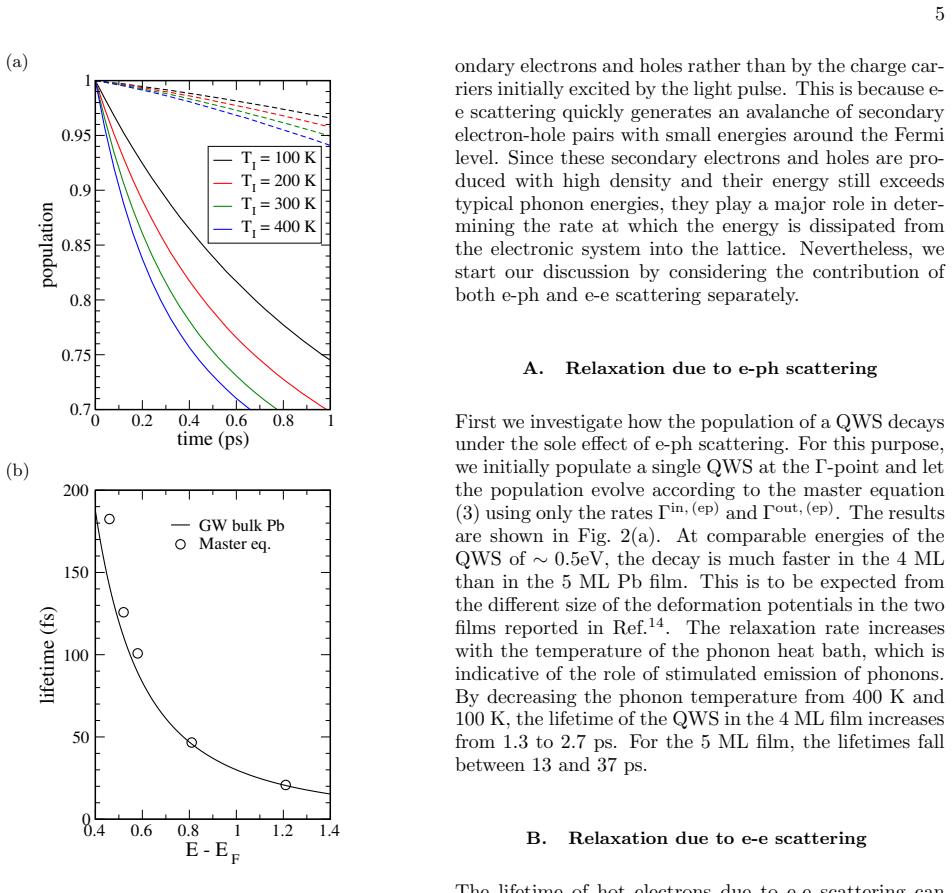
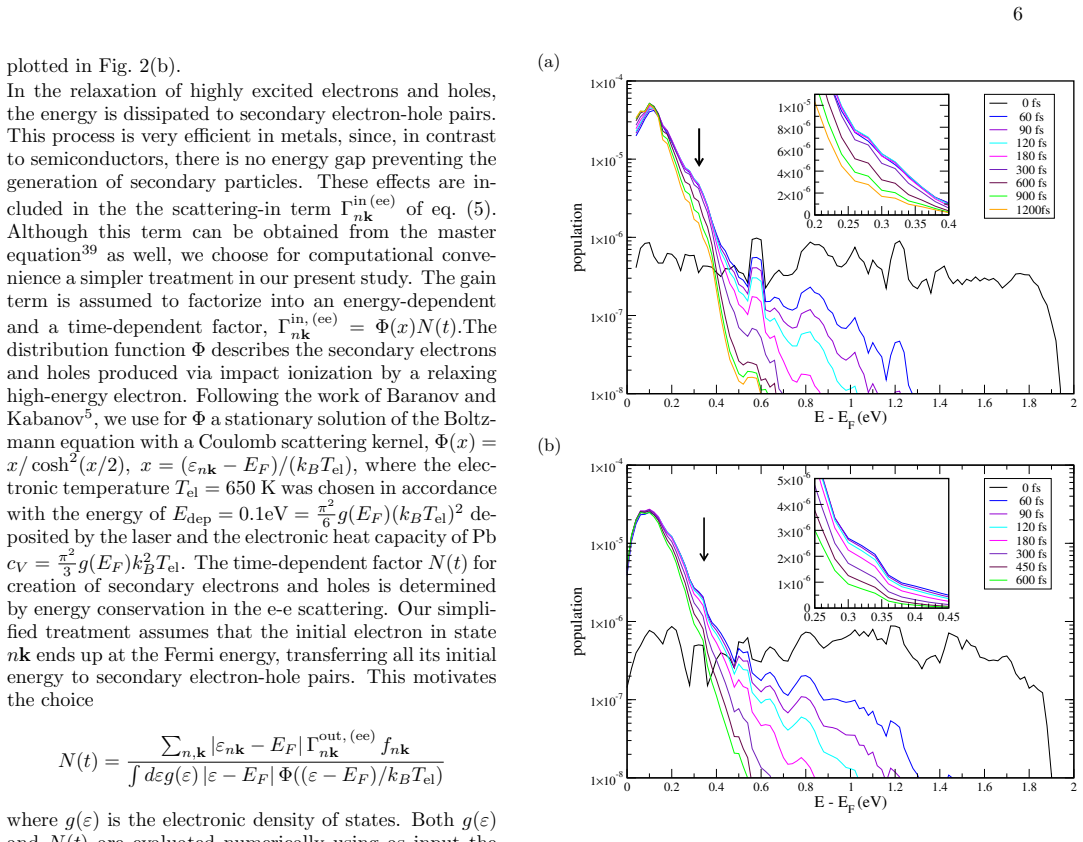
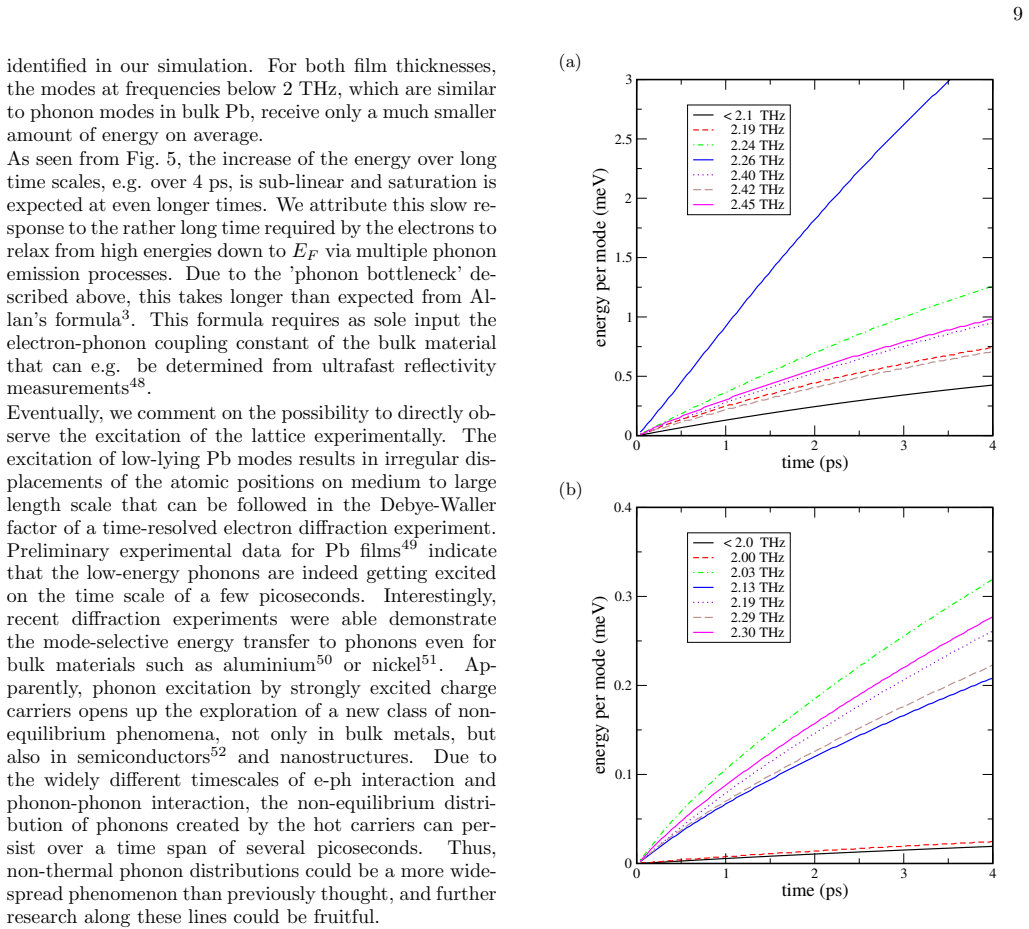
The paper's central discovery is that electron-phonon scattering, although weak compared to electron-electron scattering for highly excited electrons, becomes the controlling relaxation channel near 0.3 eV above the Fermi level and is strongly phonon-mode-specific. In both 4- and 5-monolayer Pb films on Si(111), the master-equation simulation produces a pile-up of electrons around 0.3 eV, interpreted as a phonon bottleneck caused by the discrete, well-separated quantum-well states. The energy deposited into the lattice goes mainly into one high-frequency surface phonon mode, at 2.26 THz in the 4 ML film and at 2.03 THz in the 5 ML film, the latter matching a measured 2.0 THz oscillation of the quantum-well energy. Simulated lifetimes of 101 fs and 21 fs for the 0.58 and 1.21 eV peaks are in reasonable agreement with the experimentally observed 115 and 10 fs values. The paper concludes that the usual neglect of electron-phonon scattering in analyzing these experiments is justified at high energy but not at low energy, and that non-thermal phonon distributions can persist for several picoseconds.
Load-bearing premise
The electron-electron scattering rate used in the simulation is carried over from a calculation for bulk lead, not for the confined film itself; if the film's confinement or its contact with the silicon substrate changes how electrons screen each other, the high-energy part of the result would need to be revised.
Editorial extensions
If this is right
- Above roughly 0.5 eV, electron-electron scattering sets the relaxation times and electron-phonon scattering can be neglected, so two-temperature models that ignore the phonon channel remain valid for highly excited electrons.
- Below roughly 0.3 eV the phonon channel dominates, so relaxation in these films cannot be described by a single electron-phonon coupling constant from bulk Eliashberg theory; the discrete level structure creates a bottleneck.
- The phonon system itself stays out of thermal equilibrium for several picoseconds, with non-thermal occupation concentrated in surface modes; this should be observable in time-resolved diffraction and reflects a general feature of hot-carrier relaxation in nanostructures.
- The simulated lifetimes for the main quantum-well states match experimental values within the expected errors, indicating that the parameter-free DFT-based master-equation route can predict lifetime trends across film thicknesses.
- Mode selectivity is stronger for even-layer (4 ML) films than odd-layer (5 ML) films, correlating with larger deformation potentials and faster electron-phonon decay in the thinner film.
Reading between the lines
- The paper does not test capping or substrate substitution; a layer that suppresses the 2.0-2.3 THz surface modes should lengthen the low-energy lifetimes, which would isolate the mode-specificity claim.
- The implicit bottleneck criterion is that the electronic level spacing exceeds the largest phonon energy; the same master-equation machinery applied to other confined metals with wider or narrower spacings would predict where pile-ups should form.
- Since the 0.3 eV pile-up lies below the probe window of the original photoemission experiments, a dedicated low-energy two-photon photoemission measurement is the cleanest independent check.
- The persistent non-thermal phonon population suggests that repetitive optical pumping could selectively heat individual surface modes, making phonon-mode engineering in ultrathin films a testable prospect.
Signed reviews
Editorial analysis
A structured set of objections, weighed in public.
Referee Report
Summary. The paper presents a master-equation model for the relaxation of excited electrons in 4 and 5 monolayer Pb films on Si(111), combining first-principles DFT-derived electron-phonon rates (deformation-potential approximation) with an electron-electron scattering rate fitted to a GW calculation of bulk Pb. The model reproduces the experimentally observed peak energies and lifetimes of quantum well states, predicts a phonon bottleneck (population pile-up around 0.3 eV) where electron-phonon scattering becomes comparable to electron-electron scattering, and identifies a strongly mode-selective energy transfer to a specific surface phonon mode (2.26 THz for 4 ML, 2.03 THz for 5 ML, the latter matching a measured 2.0±0.1 THz coherent phonon). The dynamics are followed by numerically integrating the rate equations on a fine k-grid.
Significance. The work is a valuable attempt to disentangle e-e and e-ph contributions to ultrafast relaxation in a confined metal with a realistic band structure. Its main strengths are the first-principles derivation of e-ph matrix elements, the careful Brillouin-zone integration scheme, and the quantitative comparison with time-resolved two-photon photoemission lifetimes. The predicted phonon bottleneck at ~0.3 eV and the mode-selective phonon emission are falsifiable predictions. However, the e-e channel is imported from bulk Pb without uncertainty quantification, and the e-ph rates rest on approximations (constant deformation potential, no hole-phonon scattering) that are not quantified. If the bulk-derived e-e rate is significantly modified by confinement, the 0.3 eV crossover could shift or disappear, so the central claim is not yet robust.
major comments (2)
- [Section III B, Eq. (9)] The e-e scattering rate is fitted to a GW self-energy of bulk Pb (α=0.022 eV^-1) and inserted into the master equation for a 4–5 ML Pb/Si(111) film. The 0.3 eV 'phonon bottleneck' is defined by the crossover between this rate and the e-ph rates (Section III D). A confinement-induced enhancement of the e-e rate by a factor of about two—not implausible for quasi-2D screening in a 5–10 Å film—would reduce the e-e lifetime at 0.3 eV from ~300 fs to ~150–170 fs, making e-e dominate and erasing the pile-up in Fig. 3. Since no error bar is given for α and no sensitivity analysis is performed, the headline bottleneck claim is not yet distinguished from a consequence of the bulk-Pb approximation. Please add a robustness analysis (varying α, or computing the e-e rate for the confined slab) and state explicitly how the crossover energy depends on α.
- [Section II, Eq. (8) and hole treatment] The e-ph matrix elements neglect the Q-dependence of the deformation potential and retain only the constant term D_{nk,I}, and the paper excludes e-ph scattering for holes (Section II: 'only Coulomb scattering ... will be considered among the holes'). Both approximations affect the absolute e-ph rates and the energy transfer to phonon modes shown in Fig. 5, and hence also the precise location of the e-e/e-ph crossover. The paper should quantify the sensitivity of the 0.3 eV pile-up and the mode-selective phonon distribution to these approximations, e.g., by evaluating a few Q-dependent matrix elements or by adding a representative hole-phonon coupling. Without such quantification, the robustness of the central predictions remains unclear.
minor comments (5)
- [Section II and Conclusion] The approach is described as 'parameter-free' in several places (e.g., Section II and Conclusion), but the e-e rate α (Eq. 9), the electronic temperature T_el, and the bath time constants τ_conv and τ_sub (Appendix B) are empirical inputs. Please rephrase to 'first-principles-derived e-ph rates' and list the external parameters explicitly.
- [Figure 2(b) caption] The caption states that circles show lifetimes for 4 ML and 5 ML films without distinguishing the two thicknesses; please add separate symbols or a legend.
- [Section III A and Introduction] There are typos: 'under the sole effect' should be 'under the sole effect', and 'detailled' in the Introduction should be 'detailed'.
- [Figure 3] The 'phonon bottleneck' pile-up is very small and only visible in the inset; consider enlarging the inset or plotting the low-energy region on a linear y-scale to better display the shoulder.
- [Appendix B] The value τ_conv = 30 ps is taken from a simulation of a monolayer Pb/Si(111) (Ref. 54) but is applied to 4–5 ML films; please justify the transfer or discuss its sensitivity.
Circularity Check
No significant circularity: the phonon bottleneck and mode-selective heating emerge from a master-equation calculation using independently fitted and DFT-derived rates.
full rationale
The paper's central claims, the 0.3 eV phonon bottleneck and the mode-selective excitation of specific surface phonon modes, are emergent results of numerically solving a master equation, not restatements of the input rates. The electron-phonon rates are obtained from first-principles DFT deformation potentials, band structures, and phonon modes (from the authors' earlier Ref. 14), which are parameter-free and do not presuppose the bottleneck phenomenon. The electron-electron rate in Eq. (9) is independently fitted to a GW calculation of bulk Pb, with the fitted coefficient alpha = 0.022 eV^-1 in agreement with earlier independent GW work (Ref. 41); it is an input modeling the e-e channel, not a fitted surrogate for the predicted bottleneck. The bottleneck appears because the e-e lifetime grows above 300 fs below about 0.33 eV while the computed e-ph lifetime is about 350 fs near 0.46 eV, leading to a crossover; this crossover is a quantitative consequence of combining a fitted bulk-derived e-e rate with computed e-ph rates, not a circular reduction. The mode-selective phonon heating is compared with an external experimental frequency (2.0 +/- 0.1 THz from Ref. 47), and the QWS lifetimes are compared with independent two-photon photoemission data (Ref. 11), providing external checks. The authors' statement that the approach is 'parameter-free' is an overstatement because Eq. (9) contains a fitted coefficient and the electronic temperature Tel = 650 K is chosen, but this is a correctness/characterization issue, not a circularity. No equation or claim reduces by construction to its own input, and no load-bearing uniqueness or ansatz is imported solely from the authors' prior work.
Assumptions & free parameters
free parameters (7)
- α (e-e rate coefficient) =
0.022 (eV)^-1
- Tel (electronic temperature) =
650 K
- τconv (optical to acoustic phonon conversion time) =
30 ps
- τsub (Pb film to Si substrate equilibration time) =
160 ps
- t_ee_off (time when e-e scattering is disabled) =
6 fs
- Phonon bath cutoff frequency =
2 THz
- Deposited excitation energy Edep =
0.1 eV per supercell (3.7 µJ/cm^2)
assumptions (6)
- domain assumption Kohn-Sham eigenvalues from GGA-PBE are used as the quasiparticle energies εnk in the master equation.
- domain assumption Electron-electron scattering in the thin film is the same as in bulk Pb.
- domain assumption Deformation potentials are independent of phonon wave vector Q and optical phonon dispersion is negligible.
- standard math Markov and second-order Born approximations are valid for the electron dynamics.
- ad hoc to paper The scattering-in term for e-e interaction factorizes as Γ_in = Φ(x)N(t) with Φ from a stationary Boltzmann solution.
- ad hoc to paper Holes do not scatter via electron-phonon interaction.
Cite this review
Pith. "Pith review of Relaxation of electrons in quantum-confined states in Pb/Si(111) thin films from master equation with first-principles-derived rates." pith.science (2026). https://pith.science/paper/HDEDDROZ
@misc{pith2026190806119,
  author       = {Pith},
  title        = {Pith review of: Relaxation of electrons in quantum-confined states in Pb/Si(111) thin films from master equation with first-principles-derived rates},
  year         = {2026},
  howpublished = {\url{https://pith.science/paper/HDEDDROZ}},
  note         = {Machine review of arXiv:1908.06119}
}
read the original abstract
Atomically thin films of Pb on Si(111) provide an experimentally tunable system comprising a highly structured electronic density of states. The lifetime of excited electrons in these states is limited by both electron-electron (e-e) and electron-phonon (e-ph) scattering. We employ the description by a master equation for the electronic occupation numbers to analyze the relative importance of both scattering mechanisms. The electronic and phononic band structures, as well as the matrix elements for electron-phonon coupling within deformation potential theory were obtained from density functional calculations, thus taking into account quantum confinement effects. For the relaxation dynamics, the contribution of impact ionization processes to the lifetime is estimated from the imaginary part of the electronic self-energy calculated in the GW approximation. By numerically solving rate equations for the occupations of the Pb-derived electronic states coupled to a phononic heat bath, we are able to follow the distribution of the electronic excitation energy to the various modes of Pb lattice vibrations. While e-e scattering is the dominant relaxation mechanism, we demonstrate that the e-ph scattering is highly phonon-mode-specific, with a large contribution from surface phonons. At electron energies of about 0.3 eV above the Fermi surface, a 'phonon bottleneck' characteristic of relaxation in nanostructures with well-separated electronic states is observed. The time scales extracted from the simulations are compared to data from pump-probe experiments using time-resolved two-photon photoemission.
Figures

Figures from the paper (3 more)


Reference graph
Works this paper leans on
-
[1]
author author W. S. \ Fann , author R. Storz , author H. W. K. \ Tom , \ and\ author J. Bokor ,\ @noop journal journal Phys. Rev. B \ volume 46 ,\ pages 13592 ( year 1992 ) NoStop
work page 1992
-
[2]
author author R. H. M. \ Groeneveld , author R. Sprik , \ and\ author A. Lagendijk ,\ @noop journal journal Phys. Rev. B \ volume 51 ,\ pages 11433 ( year 1995 ) NoStop
work page 1995
-
[3]
author author P. B. \ Allen ,\ @noop journal journal Phys. Rev. Lett. \ volume 59 ,\ pages 1460 ( year 1987 ) NoStop
work page 1987
-
[4]
author author M. Lisowski , author P. A. \ Loukakos , author U. Bovensiepen , author J. St \"a hler , author G. Gahl , \ and\ author M. Wolf ,\ DOI: 10.1007/s00339-003-2301-7 journal journal Appl. Phys. A \ volume 78 ,\ pages 165 ( year 2004 ) NoStop
-
[5]
author author V. V. \ Baranov \ and\ author V. V. \ Kabanov ,\ @noop journal journal Phys. Rev. B \ volume 89 ,\ pages 125102 ( year 2014 ) NoStop
work page 2014
-
[6]
u kermann , author P. Zhou , author I. Avigo , author H. Pfn \
author author A. S. \ Syed , author V. M. \ Trontl , author M. Ligges , author S. Sakong , author P. Kratzer , author D. L \"u kermann , author P. Zhou , author I. Avigo , author H. Pfn \"u r , author C. Tegenkamp , \ and\ author U. Bovensiepen ,\ 10.1103/PhysRevB.92.134301 journal journal Phys. Rev. B \ volume 92 ,\ pages 134301 ( year 2015 ) NoStop
-
[7]
author author T. Zhang , author P. Chen , author W.-J. \ Li , author Y.-J. \ Sun , author G. Wang , author X.-G. \ Zhu , author K. He , author L. Wang , author X. Ma , author X. Chen , author Y. Wang , author Y. Liu , author H.-Q. \ Lin , author J.-F. \ Jia , \ and\ author Q.-K. \ Xue ,\ @noop journal journal Nature Physics \ volume 6 ,\ pages 104 ( year ...
work page 2010
-
[8]
author author P. Hofmann , author I. Y. \ Sklyadneva , author E. D. L. \ Rienks , \ and\ author E. V. \ Chulkov ,\ @noop journal journal New J. Phys. \ volume 11 ,\ pages 125005 ( year 2009 ) NoStop
work page 2009
Show all 55 references
-
[9]
\ Zhang , author J.-F
author author Y.-F. \ Zhang , author J.-F. \ Jia , author T.-Z. \ Han , author Z. Tang , author Q.-T. \ Shen , author Y. Guo , author Z. Q. \ Qiu , \ and\ author Q.-K. \ Xue ,\ @noop journal journal Phys. Rev. Lett. \ volume 95 ,\ pages 096802 ( year 2005 ) NoStop
2005
-
[10]
author author M. H. \ Upton , author C. M. \ Wei , author M. Y. \ Chou , author T. Miller , \ and\ author T.-C. \ Chiang ,\ @noop journal journal Phys. Rev. Lett. \ volume 93 ,\ pages 026802 ( year 2004 ) NoStop
2004
-
[11]
author author P. S. \ Kirchmann , author L. Rettig , author X. Zubizarreta , author V. M. \ Silkin , author E. V. \ Chulkov , \ and\ author U. Bovensiepen ,\ 10.1038/nphys1735 journal journal Nature Physics \ volume 6 ,\ pages 782 ( year 2010 ) NoStop
-
[12]
author author P. M. \ Echenique , author R. Berndt , author E. V. \ Chulkov , author T. Fauster , author A. Goldmann , \ and\ author U. H\"ofer ,\ https://doi.org/10.1016/j.surfrep.2004.02.002 journal journal Surf. Sci. Rep. \ volume 52 ,\ pages 219 ( year 2004 ) NoStop
2004 doi
-
[13]
author author E. V. \ Chulkov , author A. G. \ Borisov , author J. P. \ Gauyacq , author D. S\'anchez , author V. M. \ Silkin , author V. P. \ Zhukov , \ and\ author P. M. \ Echenique ,\ 10.1021/cr050166o journal journal Chemical Reviews \ volume 106 ,\ pages 4160 ( year 2006 ) NoStop
-
[14]
Zahedifar \ and\ author P
author author M. Zahedifar \ and\ author P. Kratzer ,\ 10.1103/PhysRevB.96.115442 journal journal Phys. Rev. B \ volume 96 ,\ pages 115442 ( year 2017 ) NoStop
2017 doi
-
[15]
Giustino ,\ @noop journal journal Rev
author author F. Giustino ,\ @noop journal journal Rev. Mod. Phys. \ volume 89 ,\ pages 015003 ( year 2017 ) NoStop
2017
-
[16]
Bernardi , author D
author author M. Bernardi , author D. Vigil-Fowler , author J. Lischner , author J. B. \ Neaton , \ and\ author S. G. \ Louie ,\ @noop journal journal Phys. Rev. Lett. \ volume 112 ,\ pages 257402 ( year 2014 ) NoStop
2014
-
[17]
author author V. A. \ Jhalani , author J.-J. \ Zhou , \ and\ author M. Bernardi ,\ 10.1021/acs.nanolett.7b02212 journal journal Nano Lett. \ volume 17 ,\ pages 5012 ( year 2017 ) NoStop
2017 doi
-
[18]
Maldonado , author K
author author P. Maldonado , author K. Carva , author M. Flammer , \ and\ author P. M. \ Oppeneer ,\ @noop journal journal Phys. Rev. B \ volume 96 ,\ pages 174439 ( year 2017 ) NoStop
2017
-
[19]
\ Chan , author C
author author T.-L. \ Chan , author C. Z. \ Wang , author M. Hupalo , author M. C. \ Tringides , author Z.-Y. \ Lu , \ and\ author K. M. \ Ho ,\ @noop journal journal Phys. Rev. B \ volume 68 ,\ pages 045410 ( year 2003 ) NoStop
2003
-
[20]
Yakes , author V
author author M. Yakes , author V. Yeh , author M. Hupalo , \ and\ author M. C. \ Tringides ,\ 10.1063/1.2724910 journal journal Phys. Rev. B \ volume 69 ,\ pages 224103 ( year 2004 ) NoStop
2004 doi
-
[21]
Souto-Casares , author T.-L
author author J. Souto-Casares , author T.-L. \ Chan , author J. R. \ Chelikowsky , author K.-M. \ Ho , author C.-Z. \ Wang , \ and\ author S. B. \ Zhang ,\ @noop journal journal Phys. Rev. B \ volume 92 ,\ pages 094103 ( year 2015 ) NoStop
2015
-
[22]
author author A. V. \ Akimov \ and\ author O. V. \ Prezhdo ,\ 10.1021/ct400641n journal journal J. Chem. Theory Comput. \ volume 9 ,\ pages 4959 ( year 2013 ) NoStop
2013 doi
-
[23]
author author A. V. \ Akimov \ and\ author O. V. \ Prezhdo ,\ 10.1021/ct400934c journal journal J. Chem. Theory Comput. \ volume 10 ,\ pages 789 ( year 2014 ) NoStop
2014 doi
-
[24]
Zheng , author W
author author Q. Zheng , author W. A. \ Saidi , author Y. Xie , author Z. Lan , author O. V. \ Prezhdo , author H. Petek , \ and\ author J. Zhao ,\ 10.1021/acs.nanolett.7b03429 journal journal Nano Lett. \ volume 17 ,\ pages 6435 ( year 2017 ) NoStop
-
[25]
Kira , author F
author author M. Kira , author F. Jahnke , author W. Hoyer , \ and\ author S. W. \ Koch ,\ @noop journal journal Prog. Quantum Electronics \ volume 23 ,\ pages 189 ( year 1999 ) NoStop
1999
-
[26]
Haug \ and\ author S
author author H. Haug \ and\ author S. W. \ Koch ,\ @noop title Quantum Theory of the Optical and Electronic Properties of Semiconductors ,\ edition 5th \ ed.\ ( publisher World Scientific ,\ address Singapore ,\ year 2009 ) NoStop
2009
-
[27]
Malic , author T
author author E. Malic , author T. Winzer , author E. Bobkin , \ and\ author A. Knorr ,\ @noop journal journal Phys. Rev. B \ volume 84 ,\ pages 205406 ( year 2011 ) NoStop
2011
-
[28]
Kresse \ and\ author J
author author G. Kresse \ and\ author J. Furthm \"u ller ,\ @noop journal journal Phys. Rev. B \ volume 54 ,\ pages 11169 ( year 1996 ) NoStop
1996
-
[29]
author author J. P. \ Perdew , author K. Burke , \ and\ author M. Ernzerhof ,\ @noop journal journal Phys. Rev. Lett. \ volume 77 ,\ pages 3865 ( year 1996 ) NoStop
1996
-
[30]
Togo \ and\ author I
author author A. Togo \ and\ author I. Tanaka ,\ @noop journal journal Scr. Mater. \ volume 108 ,\ pages 1 ( year 2015 ) NoStop
2015
-
[31]
Sandhofer , author I
author author M. Sandhofer , author I. Sklyadneva , author V. Sharma , author V. M. \ Trontl , author P. Zhou , author M. Ligges , author R. Heid , author K.-P. \ Bohnen , author E. Chulkov , \ and\ author U. Bovensiepen ,\ @noop journal journal J. Elec. Spec. Relat. Phen. \ v...
2014
-
[32]
Rossi \ and\ author T
author author F. Rossi \ and\ author T. Kuhn ,\ @noop journal journal Rev. Mod. Phys. \ volume 74 ,\ pages 895 ( year 2002 ) NoStop
2002
-
[33]
B\"ucking , author P
author author N. B\"ucking , author P. Kratzer , author M. Scheffler , \ and\ author A. Knorr ,\ 10.1103/PhysRevB.77.233305 journal journal Phys. Rev. B \ volume 77 ,\ pages 233305 ( year 2008 ) NoStop
2008 doi
-
[34]
Richter , author A
author author M. Richter , author A. Carmele , author S. Butscher , author N. B\"ucking , author F. Milde , author P. Kratzer , author M. Scheffler , \ and\ author A. Knorr ,\ 10.1063/1.3117236 journal journal Journal of Applied Physics \ volume 105 ,\ pages 122409 ( year 2009...
-
[35]
Richter , author S
author author M. Richter , author S. Butscher , author N. B\"ucking , author F. Milde , author C. Weber , author P. Kratzer , author M. Scheffler , \ and\ author A. Knorr ,\ title Theory of ultrafast dynamics of electron-phonon interactions in two dimensional electron gases: S...
-
[36]
Ueba \ and\ author B
author author H. Ueba \ and\ author B. Gumhalter ,\ 10.1016/j.progsurf.200703.002 journal journal Prog. Surf. Sci. \ volume 82 ,\ pages 193 ( year 2007 ) NoStop
2007 doi
-
[37]
author author T. Kuhn ,\ title Density matrix theory of coherent ultrafast dynamics , \ in\ @noop booktitle Theory of transport properties of semiconductor nanostructures ,\ series and number Electronic Materials 4 ,\ editor edited by\ editor E. Sch \"o ll \ ( publisher Chapma...
1998
-
[38]
Resta ,\ 10.1103/PhysRevB.44.11035 journal journal Phys
author author R. Resta ,\ 10.1103/PhysRevB.44.11035 journal journal Phys. Rev. B \ volume 44 ,\ pages 11035 ( year 1991 ) NoStop
1991 doi
-
[39]
Ladst \"a dter , author U
author author F. Ladst \"a dter , author U. Hohenester , author P. Puschnig , \ and\ author C. Ambrosch-Draxl ,\ @noop journal journal Phys. Rev. B \ volume 70 ,\ pages 235125 ( year 2004 ) NoStop
2004
-
[40]
Shishkin \ and\ author G
author author M. Shishkin \ and\ author G. Kresse ,\ @noop journal journal Phys. Rev. B \ volume 74 ,\ pages 035101 ( year 2006 ) NoStop
2006
-
[41]
author author I. P. \ Hong , author C. Brun , author F. Patthey , author I. Y. \ Sklyadneva , author X. Zubizarreta , author R. Heid , author V. M. \ Silkin , author P. M. \ Echenique , author K. P. \ Bohnen , author E. V. \ Chulkov , \ and\ author W.-D. \ Schneider ,\ @noop j...
2009
-
[42]
Gajdo s s , author K
author author M. Gajdo s s , author K. Hummer , author G. Kresse , author J. Furthm \"u ller , \ and\ author F. Bechstedt ,\ 10.1103/PhysRevB.73.045112 journal journal Phys. Rev. B \ volume 73 ,\ pages 045112 ( year 2006 ) NoStop
2006 doi
-
[43]
note The dipole matrix elements are delivered by the VASP code using the keyword LOPTICS NoStop
-
[44]
Heitz , author H
author author T. Heitz , author H. Born , author F. Guffarth , author O. Stier , author A. Schliwa , author A. Hoffmann , \ and\ author D. Bimberg ,\ @noop journal journal Phys. Rev. B \ volume 64 ,\ pages 241305(R) ( year 2001 ) NoStop
2001
-
[45]
Jia , author J
author author X. Jia , author J. Jiang , author Y. Zhang , author J. Qiu , author S. Wang , author Z. Chen , author N. Yuan , \ and\ author J. Ding ,\ 10.1063/1.5021679 journal journal Appl. Phys. Lett. \ volume 112 ,\ pages 143903 ( year 2018 ) ,\ http://arxiv.org/abs/https:/...
-
[46]
fig:esume
note In our simulations, we explicitly allowed for the possibility of conversion between different vibrational modes (see appendix), but it should be noted that vibrational coupling takes place on a much longer time scale of at least 30 ps and is hardly relevant for the observ...
-
[47]
Rettig , author P
author author L. Rettig , author P. S. \ Kirchmann , \ and\ author U. Bovensiepen ,\ 10.1088/1367-2630/14/2/023047 journal journal New J. Phys. \ volume 14 ,\ pages 023047 ( year 2012 ) NoStop
2012 doi
-
[48]
author author S. D. \ Brorson , author A. Kazeroonian , author J. S. \ Moodera , author D. W. \ Face , author T. K. \ Cheng , author E. P. \ Ippen , author M. S. \ Dresselhaus , \ and\ author G. Dresselhaus ,\ @noop journal journal Phys. Rev. Lett. \ volume 64 ,\ pages 2172 ( ...
1990
-
[49]
Zhou , author C
author author P. Zhou , author C. Streub \"u hr , author A. Kalus , author T. Frigge , author S. Wall , author A. Hanisch-Blicharski , author M. Kammler , author M. Ligges , author U. Bovensiepen , author D. von der Linde , \ and\ author M. Horn-von Hoegen ,\ 10.105/epjconf/20...
-
[50]
Waldecker , author R
author author L. Waldecker , author R. Bertoni , , author R. Ernstorfer , \ and\ author J. Vorberger ,\ @noop journal journal Phys. Rev. X \ volume 6 ,\ pages 021003 ( year 2016 ) NoStop
2016
-
[51]
Maldonado , author T
author author P. Maldonado , author T. Chase , author A. H. \ Reid , author X. Shen , author R. K. \ Li , author K. Carva , author T. Payer , author M. Horn von Hoegen , author K. Sokolowski-Tinten , author X. J. \ Wang , author P. M. \ Oppeneer , \ and\ author H. A. \ D \"u r...
2019 arXiv
-
[52]
Sadasivam , author M
author author S. Sadasivam , author M. K. Y. \ Chan , \ and\ author P. Darancet ,\ @noop journal journal Phys. Rev. Lett. \ volume 119 ,\ pages 136602 ( year 2017 ) NoStop
2017
-
[53]
author author E. B. \ Ramayya , author D. Vasileska , author S. M. \ Goodnick , \ and\ author I. Knezevic ,\ @noop journal journal J. Appl. Phys. \ volume 104 ,\ pages 063711 ( year 2008 ) NoStop
2008
-
[54]
Sakong , author P
author author S. Sakong , author P. Kratzer , author S. Wall , author A. Kalus , \ and\ author M. Horn-von Hoegen ,\ 10.1103/PhysRevB.88.115419 journal journal Phys. Rev. B \ volume 88 ,\ pages 115419 ( year 2013 ) NoStop
2013 doi
-
[55]
Witte , author T
author author T. Witte , author T. Frigge , author B. Hafke , author B. Krenzer , \ and\ author M. Horn-von Hoegen ,\ 10.1063/1.4986509 journal journal Appl. Phys. Lett. \ volume 110 ,\ pages 243103 ( year 2017 ) NoStop
2017 doi
Reviewed August 14, 2026 · model on record in the stance chip above.
Discussion (0). Continue with ORCID to comment.