REVIEW 4 major objections 6 minor 22 references
CFO: A Framework for Building Production NLP Systems
T0 review · 4 major / 6 minor · reviewed 2026-08-14 · deepseek-v4-flash
Pith's one-line read CFO compiles data-flow definitions into deployable NLP systems
desk verdict Useful orchestration framework and training recipe, but the end-to-end QA claim rests on oracle retrieval and is not actually measured. read the letter →
The pith
A machine-rendered reading of the paper's core claim, the machinery that carries it, and where it could break.
The reading
What carries the argument
The load-bearing mechanism is the CFO computation-flow graph. Each node declares its service name, input message fields, and output message fields using Protocol Buffers, and a custom orchestration specification lists the nodes, designates entry points, maps data elements between the interfaces, and records deployment settings such as ports and container registry locations. A compiler consumes these two specifications to generate an orchestrator node that wires the containerized gRPC microservices together, automatically producing serialization and connectivity code, timeouts, error propagation, latency logging, and asynchronous parallelization, as well as a REST interface and deployment scripts for docker-compose and Kubernetes.
What would settle it
Run GAAMA's real retrieval node and reading node together on a random sample of Natural Questions dev questions without any preselection of retrieved passages, and compare end-to-end F1 and latency percentiles with the reported numbers; if retrieval misses are frequent, the end-to-end numbers will fall short of the simulated results.
Extended reading notes
Core claim
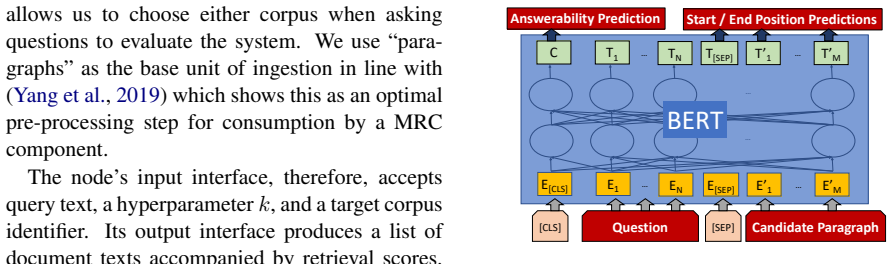
The central claim is that CFO separates the definition of a computation flow from its execution: developers describe a pipeline as a graph of typed message-passing nodes, and a compiler turns that description into a deployable system with auto-generated orchestration logic, connectivity and serialization code, REST entry points, and containerized launch scripts. In GAAMA, four nodes are stitched together — retrieval, BERT-based reading comprehension, answer deduplication, and answer combination — and the framework automatically maps the retrieval node's list of documents into repeated asynchronous calls of the single-document reading node. The paper further claims that the resulting system produces high-quality end-to-end answers in academic and industry settings, and that a BERT-for-QA model trained with span-selection pre-training plus SQuAD augmentation achieves strong F1 on the Natural Questions dev set.
Load-bearing premise
The production-ready claim assumes that the retrieval simulation used in latency experiments approximates real retrieval: the tests hand the reading model the first correct top-level candidate when one exists, so genuine retrieval failures do not enter the measured accuracy or latency, and the system may look better than it will in real use.
Editorial extensions
If this is right
- Components in a CFO graph can be swapped without rewriting orchestration logic: a new retrieval or MRC implementation only has to respect the declared interface, and the same generated wiring continues to work.
- CFO-generated systems receive distributed-system boilerplate automatically, which the paper illustrates by noting that GAAMA's auto-generated orchestrator is about 2,800 lines of C++ code.
- A single flow specification deploys both locally and to cloud infrastructure because the compiler emits docker-compose and Kubernetes configuration along with launch scripts.
- The reported training recipe — span-selection pre-training on Wikipedia-style cloze queries followed by fine-tuning with SQuAD augmentation — improves BERT QA F1 on Natural Questions, and the paper also reports gains on SQuAD 2.0 dev.
- Latency measurements indicate that the base BERT model can serve GAAMA at under one second for the 95th percentile on a GPU, while the more accurate large model costs 1.3x to 2.8x more latency and effectively requires GPU deployment.
Reading between the lines
- If CFO's compilation approach works as described, it should transfer beyond question answering: any NLP or IR flow expressible as typed message-passing nodes, such as summarization, dialogue, or information-extraction pipelines, could receive the same generated deployment plumbing.
- The reported production-readiness is not yet tested end-to-end: latency evaluation feeds the reading model the first correct retrieved passage whenever one exists, so actual retrieval misses are not represented in the numbers; an end-to-end run with the real retrieval node would show whether the headline latency and accuracy survive real retrieval behavior.
- The span-selection pre-training result suggests that an unsupervised task aligned with the target extraction problem may substitute for some labeled training data; a direct test would sweep the amount of SQuAD fine-tuning data while holding the pre-training recipe fixed.
- A useful empirical extension would be to measure operational properties of generated systems, such as upgrade behavior and failure isolation, to see whether the graph specification itself supports reliable production operation.
Signed reviews
Editorial analysis
A structured set of objections, weighed in public.
Referee Report
Summary. The paper introduces CFO, a framework for defining computation flow graphs through Protocol Buffer service interfaces and a custom orchestration specification, and for compiling those definitions into deployable containerized gRPC microservices with auto-generated orchestrator, REST, GUI, and deployment artifacts. As a case study, the authors build GAAMA, a question answering system that combines Elasticsearch/BM25 retrieval, a BERT-based machine reading comprehension component, a deduplication module, and a combiner. The experimental sections report improved F1 on the Natural Questions development set from U-MRC pre-training and SQuAD data augmentation, and compare BERT-base versus BERT-large in terms of F1 and latency on a 500-question subset of the NQ dev set. The paper concludes with best practices for adapting BERT-based MRC models to production QA systems.
Significance. If validated, CFO would be a useful contribution to building modular NLP/IR pipelines: the auto-generation of orchestration, serialization, REST interfaces, and deployment scripts addresses a real engineering burden, and the authors are explicit that the toolkit is intended for open-source release. The MRC pre-training recipes, especially the combination of U-MRC with SQuAD augmentation, are concrete and reproducible in their main ingredients, and the reported leaderboard position at the time of submission is a verifiable external anchor. However, the central production-QA claims are not supported by the measurements as presented: the latency and accuracy results in Table 3 condition on an oracle retrieval step, the industry evaluation is qualitative, and the CFO framework itself is not evaluated beyond an anecdotal code-generation example. The paper is therefore best read as a systems description with useful training recipes, rather than as a validated demonstration of production-grade end-to-end QA.
major comments (4)
- [Section 4.2, Table 3] The headline latency and F1 measurements simulate passage retrieval by selecting the first correct top-level candidate if one exists and the first incorrect candidate otherwise. This removes real retrieval failures and retrieval latency from the measured system, so Table 3 describes the MRC component conditioned on a supplied relevant passage, not the end-to-end GAAMA system. Because the abstract claims 'end-to-end answer retrieval' and the introduction claims a production-grade QA system, the central empirical claim is not substantiated. Please report end-to-end results using the actual Elasticsearch/BM25 node, including cases where no correct passage is retrieved, and report retrieval recall, end-to-end latency, and accuracy jointly.
- [Section 4, paragraph beginning 'We use the F-score'] The paper states that the F-score is computed at an 'optimal' threshold selected on the dev set and then reports F1 on that same dev set. Selecting the threshold on the evaluation set is a form of fitting to the data, and the reported numbers are likely optimistically biased. In addition, Table 3 is based on only 500 examples with no confidence intervals or significance tests. Please select thresholds on a validation split, report the threshold values used, and provide variance estimates or significance tests for the reported F1 and latency comparisons.
- [Abstract and Section 4, industry evaluation] The abstract claims results are 'high quality in both academic and industry domain specific settings,' but the only industry evaluation described is a manual assessment on an internal corpus, with no protocol, no number of questions, no quantitative results, and no comparison baseline. This claim is therefore unsupported as written. Please provide a concrete evaluation on the IBM Technical Support corpus, including retrieval and answer accuracy numbers, or explicitly scope the contribution to the academic benchmark and the framework description.
- [Section 2, CFO framework evaluation] The paper's first contribution is the CFO framework, yet there is no experimental or user-based evaluation of the framework itself: no measurement of development effort, no correctness tests of the auto-generated orchestration, no scalability or overhead benchmarks, and no comparison against alternative orchestration approaches. The only evidence is the anecdotal statement that 2,800 lines of C++ orchestration code were auto-generated for GAAMA. Please either add a systematic evaluation of the framework's claims or explicitly reframe the contribution as a framework proposal with a case-study demonstration rather than a validated production framework.
minor comments (6)
- [Section 4, first paragraph] The phrase 'see 5 for more on these data sets' is ambiguous; it should be 'see Section 5' or a specific reference to the relevant paragraphs in the paper.
- [Figure 1] The figure caption area contains the fragment 'Elastic ServerPre-Ingest Document Corpus', which appears to be a formatting or text-flow error and should be corrected.
- [Table 3] The column headers T G50, T G95, T C50, and T C95 are not self-explanatory in the table; the notation T_D^K should be defined in the caption or directly below the table, as it is only described in the surrounding text.
- [Section 4.2] The sentence describing the simulated passage retrieval is dense and should be rewritten to state explicitly that retrieval is not measured and that the reported numbers are conditional on an oracle selection.
- [References] There are minor reference formatting issues, including 'S C. Robertson' and '327348' missing a space between pages; these should be corrected for consistency.
- [Section 4, footnote 12] The footnote referring to 'choosing business specific thresholds' relies on an external URL; the threshold selection procedure should be described in the paper itself so that the results are reproducible.
Circularity Check
No significant circularity: CFO is a systems/orchestration contribution; no prediction reduces to its inputs.
full rationale
The paper's central claims are architectural: CFO compiles declarative computation-flow specifications into containerized gRPC orchestration, demonstrated by GAAMA. There is no mathematical derivation whose output is an input by construction. The U-MRC pre-training is attributed to Glass et al. (2019), a prior paper with overlapping authors, but it is used as a published, externally measured building block and does not bootstrap the CFO claim. The main evaluation weakness is in Section 4.2, where passage retrieval is simulated by selecting the first correct top-level candidate if one exists and the first incorrect candidate otherwise; the reported F1 and latency therefore characterize the MRC node with oracle retrieval rather than the full Elasticsearch-to-BERT pipeline. That is an evaluation limitation and a correctness risk for the 'end-to-end answer retrieval' claim, but it is not circularity: no fitted parameter or defined quantity is renamed as a prediction, and no equation reduces to itself. The use of an optimal dev-set threshold is a standard tuning choice, not a circular step. Overall, the framework and demo are self-contained systems contributions, and no load-bearing step reduces to its own input.
Assumptions & free parameters
free parameters (2)
- F-score confidence threshold =
not reported (chosen as optimal on dev set)
- learning rate and batch size =
not reported
assumptions (4)
- domain assumption A flow graph defined via protobuf/gRPC microservices can express production NLP/IR systems effectively.
- domain assumption Dev-set selected threshold and hyperparameters generalize to production/test conditions.
- ad hoc to paper The simulated passage retrieval in latency experiments preserves the distribution of the true system.
- domain assumption Results from Glass et al. (2019) U-MRC pre-training are valid.
Cite this review
Pith. "Pith review of CFO: A Framework for Building Production NLP Systems." pith.science (2026). https://pith.science/paper/CPFXO2ZK
@misc{pith2026190806121,
  author       = {Pith},
  title        = {Pith review of: CFO: A Framework for Building Production NLP Systems},
  year         = {2026},
  howpublished = {\url{https://pith.science/paper/CPFXO2ZK}},
  note         = {Machine review of arXiv:1908.06121}
}
read the original abstract
This paper introduces a novel orchestration framework, called CFO (COMPUTATION FLOW ORCHESTRATOR), for building, experimenting with, and deploying interactive NLP (Natural Language Processing) and IR (Information Retrieval) systems to production environments. We then demonstrate a question answering system built using this framework which incorporates state-of-the-art BERT based MRC (Machine Reading Comprehension) with IR components to enable end-to-end answer retrieval. Results from the demo system are shown to be high quality in both academic and industry domain specific settings. Finally, we discuss best practices when (pre-)training BERT based MRC models for production systems.
Figures

Reference graph
Works this paper leans on
-
[1]
URL: " 'urlintro :=
ENTRY address author booktitle chapter edition editor howpublished institution journal key month note number organization pages publisher school series title type volume year eprint doi pubmed url lastchecked label extra.label sort.label short.list INTEGERS output.state before.all mid.sentence after.sentence after.block STRINGS urlintro eprinturl eprintpr...
-
[2]
write newline
" write newline "" before.all 'output.state := FUNCTION n.dashify 't := "" t empty not t #1 #1 substring "-" = t #1 #2 substring "--" = not "--" * t #2 global.max substring 't := t #1 #1 substring "-" = "-" * t #2 global.max substring 't := while if t #1 #1 substring * t #2 global.max substring 't := if while FUNCTION word.in bbl.in capitalize " " * FUNCT...
-
[3]
David A. Ferrucci, Eric Brown, Jennifer Chu-Carroll, James Fan, David Gondek, Aditya Kalyanpur, Adam Lally, J William Murdock, Eric Nyberg, John Prager, Nico Schlaefer, and Christopher Welty. 2010. Building Watson : An overview of the DeepQA project. AI Magazine, 31:59--79
work page 2010
-
[4]
Chris Alberti, Kenton Lee, and Michael Collins. 2019. http://arxiv.org/abs/1901.08634 A bert baseline for the natural questions
arXiv 2019
-
[5]
Apache UIMA Community . 2018. https://uima.apache.org/d/uima-as-2.10.3/uima_async_scaleout.pdf UIMA Asynchronous Scaleout : Version 2.10.3
work page 2018
- [6]
-
[7]
Jacob Devlin, Ming-Wei Chang, Kenton Lee, and Kristina Toutanova. 2018. Bert: Pre-training of deep bidirectional transformers for language understanding. In NAACL-HLT
2018
- [8]
Show all 22 references
-
[9]
David Ferrucci and Adam Lally. 2004. https://doi.org/10.1017/S1351324904003523 UIMA : an architectural approach to unstructured information processing in the corporate research environment . Natural Language Engineering, 10(3-4):327–348
2004 doi
-
[10]
Michael Glass, Alfio Gliozzo, Rishav Chakravarti, Anthony Ferritto, Lin Pan, Bhargav GP Shrivatsa, Dinesh Garg, and Avirup Sil. 2019. http://ibm.biz/sspt_for_qa Span selection pre-training for question answering
2019
-
[11]
Jeremy Howard and Sebastian Ruder. 2018. http://arxiv.org/abs/1801.06146 Universal language model fine-tuning for text classification
2018 arXiv
-
[12]
Toutanova, Llion Jones, Ming-Wei Chang, Andrew Dai, Jakob Uszkoreit, Quoc Le, and Slav Petrov
Tom Kwiatkowski, Jennimaria Palomaki, Olivia Redfield, Michael Collins, Ankur Parikh, Chris Alberti, Danielle Epstein, Illia Polosukhin, Matthew Kelcey, Jacob Devlin, Kenton Lee, Kristina N. Toutanova, Llion Jones, Ming-Wei Chang, Andrew Dai, Jakob Uszkoreit, Quoc Le, and Slav...
2019
-
[13]
Ankur Parikh, Oscar Täckström, Dipanjan Das, and Jakob Uszkoreit. 2016. https://doi.org/10.18653/v1/d16-1244 A decomposable attention model for natural language inference . EMNLP
2016 doi
-
[14]
Matthew Peters, Mark Neumann, Mohit Iyyer, Matt Gardner, Christopher Clark, Kenton Lee, and Luke Zettlemoyer. 2018. https://doi.org/10.18653/v1/n18-1202 Deep contextualized word representations . NAACL
2018 doi
-
[15]
Peng Qi, Timothy Dozat, Yuhao Zhang, and Christopher D. Manning. 2018. https://nlp.stanford.edu/pubs/qi2018universal.pdf Universal dependency parsing from scratch . CoNLL. ACL
2018
-
[16]
Alec Radford, Karthik Narasimhan, Tim Salimans, and Ilya Sutskever. 2019. https://s3-us-west-2.amazonaws.com/openai-assets/research-covers/language-unsupervised/language_understanding_paper.pdf Improving language understanding by generative pre-training
2019
-
[17]
Pranav Rajpurkar, Robin Jia, and Percy Liang. 2018. Know what you don't know: Unanswerable questions for squad. arXiv preprint arXiv:1806.03822
2018 arXiv
-
[18]
Pranav Rajpurkar, Jian Zhang, Konstantin Lopyrev, and Percy Liang. 2016. https://doi.org/10.18653/v1/d16-1264 Squad: 100,000+ questions for machine comprehension of text . EMNLP
2016 doi
-
[19]
Robertson, H
C S. Robertson, H. Zaragoza, Stephen Robertson, and Hugo Zaragoza. 1976. The probabilistic relevance framework: Bm25 and beyond
1976
-
[20]
Leslie N. Smith. 2018. http://arxiv.org/abs/1803.09820 A disciplined approach to neural network hyper-parameters: Part 1 -- learning rate, batch size, momentum, and weight decay
2018 arXiv
-
[21]
Peilin Yang, Hui Fang, and Jimmy Lin. 2017. https://doi.org/10.1145/3077136.3080721 Anserini: Enabling the use of lucene for information retrieval research . SIGIR. ACM
2017
-
[22]
Wei Yang, Yuqing Xie, Aileen Lin, Xingyu Li, Luchen Tan, Kun Xiong, Ming Li, and Jimmy Lin. 2019. http://arxiv.org/abs/1902.01718 End-to-end open-domain question answering with bertserini
2019 arXiv
Reviewed August 14, 2026 · model on record in the stance chip above.
Discussion (0). Continue with ORCID to comment.