REVIEW 4 major objections 6 minor 56 references
Neural Re-Simulation for Generating Bounces in Single Images
T0 review · 4 major / 6 minor · reviewed 2026-08-14 · deepseek-v4-flash
Pith's one-line read A neural network can take a forward-simulated ball trajectory computed from noisy single-image depth and correct it into a visually plausible multi-bounce animation, a process the paper calls neural re-simulation.
desk verdict Solid applied paper with a real contribution and honest user studies; the main caveat is that 'plausible' is defined by one narrowly tuned PyBullet configuration, and the abstract overclaims the NYUv2 result. read the letter →
The pith
A machine-rendered reading of the paper's core claim, the machinery that carries it, and where it could break.
The reading
What carries the argument
The load-bearing component is the trajectory update network $G_z$, a generative network that maps a forward-simulated trajectory $X$, conditioned on a scene-image encoding and a noise sample $z$, to a corrected trajectory $X'$. It is trained with a GAN-style adversarial loss that pits it against a discriminator, which must tell corrected trajectories apart from physically simulated reference trajectories. Two supporting mechanisms carry the argument: a depth correction network $H$ that rescales the estimated depth range before re-simulation, and a pre-trained deep image encoder that lets both $G_z$ and the discriminator condition on scene context. The paper's name for the overall correction process is neural re-simulation.
What would settle it
A decisive test: capture a real indoor scene with a depth camera, simulate the ball forward from the measured depth, run the network's correction, and then throw a real ball into the same scene while recording with synchronized cameras. The paper's claim predicts that human raters will prefer the corrected virtual trajectory over the uncorrected forward simulation, and that this preference will persist even when the correction diverges from the real ball's path. If instead the uncorrected simulation is preferred whenever its geometry is accurate, the correction is only masking training-distribution artifacts rather than producing broadly plausible bounces.
Extended reading notes
Core claim
The central claim is that the mapping from a noisy, single-image depth prediction to a believable multi-bounce trajectory is a learnable correction. The paper proposes a Dynamic Object Generation Network that takes the input image, an initial depth map, and an initial forward-simulated trajectory, and outputs a corrected trajectory together with a corrected depth calibration. The trajectory update network is trained adversarially so that its outputs are judged plausible by a discriminator conditioned on the scene image, with a small L2 anchor that fades out over training. The depth correction network rescales the estimated depth range so that simulated contacts line up with depicted surfaces. On the paper's synthetic test set, the full system reduces the time-averaged 3D L2 error from 255.1 (forward simulation on predicted depth) to 2.1, and in paired user studies on real images, viewers preferred the corrected trajectories over the forward-simulation baseline 71% of the time and over the depth-correction-only ablation 59% of the time.
Load-bearing premise
The training target, what the network learns to imitate, is the set of trajectories produced by the physics simulator on synthetic indoor scenes with one fixed material setting (friction 0.5, restitution 0.5) and one initial ball speed (0.6 m/s away from the camera); if human viewers do not actually find that synthetic distribution visually plausible, the network is being trained to produce the wrong kind of bounce.
Editorial extensions
If this is right
- Animators and augmented-reality tools could composite a virtual ball into a single photo and obtain a plausible bounce animation without reconstructing accurate 3D geometry.
- The depth-correction component suggests that global depth-scale errors, a common failure of single-image depth predictors, can be repaired implicitly from the trajectory itself rather than from extra sensors.
- The adversarial training result implies that visual plausibility can be deliberately traded for physical accuracy, so the same pipeline could be retrained with a different objective if physical accuracy becomes the goal.
- The reported synthetic metrics, with 3D L2 error dropping from 255.1 to 2.1 and perceptual loss from 4.9 to 1.3, are presented as consistent improvements over all baselines and ablations tested.
- Beating a baseline that had access to ground-truth bounce timing suggests that multi-bounce rollout is possible even when the first-contact information is imperfect.
Reading between the lines
- The same neural re-simulation idea could be applied to other virtual objects and interaction types, such as rolling, sliding, or toppling, by retraining with trajectories from a richer simulator; the paper's architecture does not appear to encode ball-specific knowledge beyond the trajectory representation.
- A natural testable extension is to probe the network with depth noise far outside its training distribution, such as outdoor scenes, transparent surfaces, or extreme lighting; the paper's real-image tests are limited to indoor royalty-free photos and one RGB-D benchmark.
- The user-study preference numbers may understate the improvement on the specific failure modes the paper identifies (mid-air bounces, wrong bounce directions) because the study averages over all scenes; a targeted perceptual study on known failure cases would quantify how often the correction resolves them.
- Because the training distribution fixes material coefficients and initial velocity, the set of trajectories the network regards as plausible is bounded by that distribution; adding more varied friction, restitution, and launch speeds would likely broaden what the network accepts as a convincing bounce.
Signed reviews
Editorial analysis
A structured set of objections, weighed in public.
Referee Report
Summary. The paper introduces 'neural re-simulation': from a single input image, the system estimates depth, runs a forward physics simulation (PyBullet) of a virtual ball with given initial conditions, and then uses a neural network to correct the resulting trajectory so that it is visually plausible. A second network corrects the global depth scale. Training uses 50k synthetic trajectories simulated in SUNCG scenes, with an adversarial loss (Eq. 4) whose target distribution is the simulator's own ground-truth output on clean geometry. Evaluation on synthetic scenes compares corrected trajectories against ground-truth simulation using L2 and perceptual losses, and evaluation on real images uses pairwise user studies of visual plausibility against several baselines, including forward simulation on predicted depth, an ablation without the trajectory update, and an augmented version of a prior method. The paper reports consistent improvement over baselines in the abstract, but the detailed results include a null result on NYUv2 active-sensing depths.
Significance. If the claims hold, the paper makes a useful contribution to dynamic object compositing in still images, with potential applications in animation and augmented reality. The strengths are the large-scale synthetic training set (50k trajectories), the clear system design with two learnable components, the inclusion of multiple baselines and ablations, and the two user studies with substantial numbers of votes. The comparison against a ground-truth-augmented version of prior work [38] is a thoughtful evaluation step. The main limitation is that the notion of 'visual plausibility' is operationalized by a single PyBullet configuration (fixed initial velocity, friction, restitution, ball shape), so the empirical evidence supports a narrower claim than the paper's abstract suggests. The paper does not provide code or data, but the project page and supplemental videos support qualitative inspection.
major comments (4)
- [Section 4 and Eq. (4)] The training distribution p_plausible is generated by PyBullet on SUNCG scenes with a spherical ball, one fixed initial velocity (0.6 m/s away from the camera), and fixed material coefficients (friction = 0.5, restitution = 0.5). All quantitative metrics in Section 5.1 therefore measure agreement with this same generator, not with human visual plausibility. This is a load-bearing gap: the paper's stated goal in Section 1 is to correct a 'given starting trajectory' in general, and Section 6 even suggests future work on 'objects with different geometry and physical properties,' yet no experiment varies initial speed, object shape, mass, or material parameters. The network may only learn to undo depth-prediction noise at this one operating point; at other speeds or on surfaces with different restitution, the corrected trajectories could be implausible or penetrate geometry. Please add experiments with varied initial velocities and material coefficients, or substantially qualify the claims about generality.
- [Table 1, Section 5.1] Table 1 reports a single scalar value for each metric without error bars, confidence intervals, or significance tests across the 5k test scenes. The text states that the proposed method 'outperforms all baselines and ablations across all criteria,' but without uncertainty estimates the reader cannot assess whether the margins are systematic or driven by outliers. Because the margins between Ours and TrajNet are large, this may be a presentation issue, but it should be fixed by reporting means with standard deviations or paired significance tests.
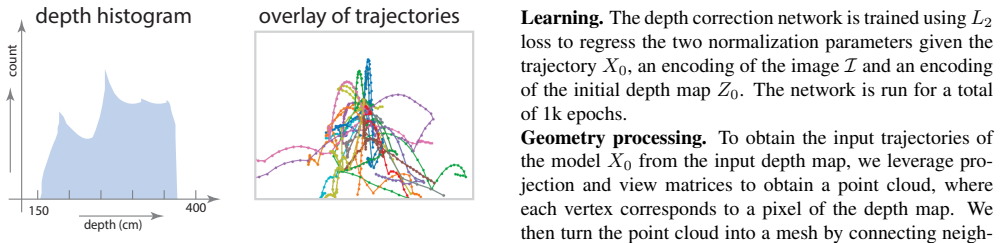
- [Section 3.2] The supervision target for the depth correction network H is not specified. The text says H is 'trained using L2 loss to regress the two normalization parameters' but does not state what ground-truth (Zmin, Zmax) values are used per training example. If they are derived from the ground-truth depth map of each SUNCG scene, that should be stated explicitly; if they are computed another way, the definition is needed. This omission prevents reproduction and makes the DepNet ablation in Table 1 difficult to interpret.
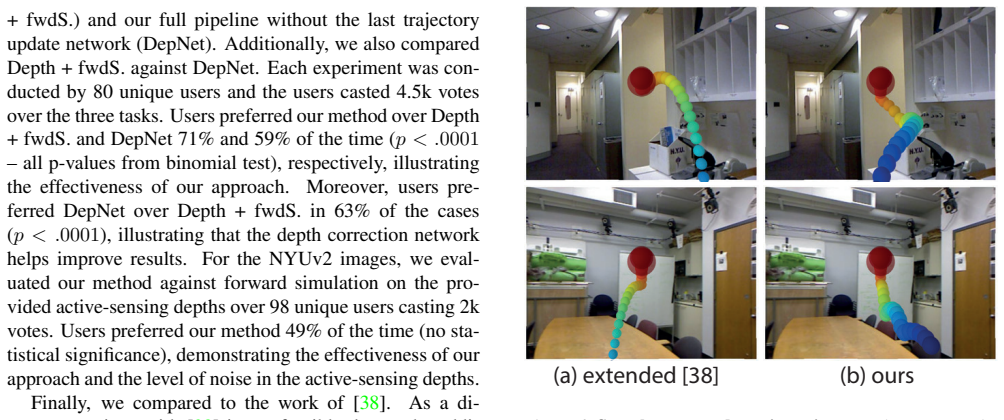
- [Section 5.2, NYUv2 user study] On the NYUv2 active-sensing-depth set, users preferred the proposed method over forward simulation on the provided depths 49% of the time with no statistical significance, yet the abstract and Section 1 claim 'consistent improvement over baseline alternatives throughout.' This is an overstatement: the NYUv2 comparison is the most external test in the paper (it uses provided depth rather than predicted depth), and the null result should be honestly reported as a limitation. The global claim in the abstract, conclusion, and Section 1 should be qualified accordingly.
minor comments (6)
- [Section 5.2, Figure 5] The last row of Figure 5 shows a failure example, but the text does not describe or analyze this failure mode; please add a short discussion of when the method produces implausible outputs.
- [Section 3.1] The sentence 'The network is run for a total 1k epochs' should read 'The network is trained for a total of 1k epochs.'
- [Section 4] The sentence 'the majority of the rooms have less than two sampled viewpoints out of maximum five' is confusing and should be rephrased or removed.
- [References] Reference [51] contains a typo in the author list: 'Joshua B. Tenenbaum, , and William T. Freeman' has a double comma.
- [Section 2] The phrase 'prior work that disentangles underlying structure and from the generation step [46]' appears to have a missing word after 'and'.
- [Section 5.2] The phrase 'users casted 4.5k votes' should be 'users cast 4.5k votes.'
Circularity Check
No significant circularity; training target is simulator-based but externally validated by user study, with only a minor non-load-bearing self-citation in the baseline comparison.
full rationale
The paper's central claim is that a trajectory-update network can correct forward-simulated trajectories from noisy predicted depth into visually plausible bounces. The adversarial training in Eq. (4) uses p_plausible trajectories generated by PyBullet on SUNCG ground-truth geometry, while p_initial trajectories come from PyBullet on the same scenes with predicted depth. This is a domain-adaptation setup between two versions of the same physics simulator, not a self-definitional loop: the target distribution is not derived from the predicted trajectories, and the geometry inputs differ. The quantitative metrics in Table 1 compare against ground-truth PyBullet trajectories, which the paper explicitly states measures physical accuracy, not visual plausibility. The real-image user study provides an external, human-judgment check and shows relative preference over baselines. The only self-citation is the comparison with [38] (Purushwalkam et al., ICLR 2019), whose authors include two of this paper's authors; this comparison is disclosed, is used as a baseline rather than a justification, and is not load-bearing for the method's validity. No fitted parameter is renamed as a prediction, and no uniqueness theorem is imported from prior work. The main correctness risk is generalization to different velocities/material parameters, but that is a robustness concern, not circularity.
Assumptions & free parameters
free parameters (1)
- Simulation conditions for dataset generation =
v0=0.6 m/s (away from camera); mu=0.5; restitution=0.5; T=1.5 s; 20 Hz
assumptions (3)
- domain assumption PyBullet simulations of SUNCG scenes with friction=0.5 and restitution=0.5 define the ground-truth distribution of visually plausible trajectories.
- domain assumption A single-image depth estimate (Chakrabarti et al.) is accurate enough that a point-cloud mesh is usable collision geometry for simulation.
- ad hoc to paper All training and evaluation trajectories are generated with a spherical ball and one fixed initial velocity; no variation in object shape, mass, or initial speed.
Cite this review
Pith. "Pith review of Neural Re-Simulation for Generating Bounces in Single Images." pith.science (2026). https://pith.science/paper/NFCUOI6D
@misc{pith2026190806217,
  author       = {Pith},
  title        = {Pith review of: Neural Re-Simulation for Generating Bounces in Single Images},
  year         = {2026},
  howpublished = {\url{https://pith.science/paper/NFCUOI6D}},
  note         = {Machine review of arXiv:1908.06217}
}
read the original abstract
We introduce a method to generate videos of dynamic virtual objects plausibly interacting via collisions with a still image's environment. Given a starting trajectory, physically simulated with the estimated geometry of a single, static input image, we learn to 'correct' this trajectory to a visually plausible one via a neural network. The neural network can then be seen as learning to 'correct' traditional simulation output, generated with incomplete and imprecise world information, to obtain context-specific, visually plausible re-simulated output, a process we call neural re-simulation. We train our system on a set of 50k synthetic scenes where a virtual moving object (ball) has been physically simulated. We demonstrate our approach on both our synthetic dataset and a collection of real-life images depicting everyday scenes, obtaining consistent improvement over baseline alternatives throughout.
Figures


Figures from the paper (3 more)

Reference graph
Works this paper leans on
-
[38]
Bounce and learn: Modeling scene dy- namics with real-world bounces
Senthil Purushwalkam, Abhinav Gupta, Danny Kaufman, and Bryan Russell. Bounce and learn: Modeling scene dy- namics with real-world bounces. In International Confer- ence on Learning Representations (ICLR), 2019. 3, 5, 6, 8
work page 2019
-
[1]
Learning to poke by poking: Experi- ential learning of intuitive physics
Pulkit Agrawal, Ashvin Nair, Pieter Abbeel, Jitendra Malik, and Sergey Levine. Learning to poke by poking: Experi- ential learning of intuitive physics. In Advances in Neural Information Processing Systems (NIPS), 2016. 3
work page 2016
-
[2]
Interaction net- works for learning about objects, relations and physics
Peter Battaglia, Razvan Pascanu, Matthew Lai, Danilo Jimenez Rezende, and Koray Kavukcuoglu. Interaction net- works for learning about objects, relations and physics. In Advances in Neural Information Processing Systems (NIPS),
-
[3]
Leveraging contextual cues for generating basketball high- lights
Vinay Bettadapura, Caroline Pantofaru, and Irfan Essa. Leveraging contextual cues for generating basketball high- lights. In Proceedings of ACM International Conference on Multimedia (ACM-MM). ACM, October 2016. 2 8
work page 2016
-
[4]
Seitz, Jovan Popovi ´c, and Pradeep Khosla
Kiran Bhat, Steven M. Seitz, Jovan Popovi ´c, and Pradeep Khosla. Computing the physical parameters of rigid-body motion from video. In Proceedings of European Conference on Computer Vision (ECCV), 2002. 3
work page 2002
-
[5]
Marcus A. Brubaker and David J. Fleet. The kneed walker for human pose tracking. InProceedings of IEEE Conference on Computer Vision and Pattern Recognition (CVPR), 2008. 3
work page 2008
-
[6]
Marcus A. Brubaker, David J. Fleet, and Aaron Hertzmann. Physics-based person tracking using the anthropomorphic walker. International Journal of Computer Vision, 87(140),
-
[7]
Brubaker, Leonid Sigal, and David J
Marcus A. Brubaker, Leonid Sigal, and David J. Fleet. Esti- mating contact dynamics. In Proceedings of IEEE Interna- tional Conference on Computer Vision (ICCV), 2009. 3
work page 2009
Show all 56 references
-
[8]
Depth from a single image by harmonizing overcomplete lo- cal network predictions
Ayan Chakrabarti, Jingyu Shao, and Gregory Shakhnarovich. Depth from a single image by harmonizing overcomplete lo- cal network predictions. In NIPS, 2016. 3, 6
2016
-
[9]
Chang, Tomer Ullman, Antonio Torralba, and Joshua B
Michael B. Chang, Tomer Ullman, Antonio Torralba, and Joshua B. Tenenbaum. A compositional object-based ap- proach to learning physical dynamics. In Proceedings of the International Conference on Learning Representations (ICLR), 2017. 3
2017
-
[10]
Forecasting human dynamics from static images
Yu-Wei Chao, Jimei Yang, Brian Price, Scott Cohen, and Jia Deng. Forecasting human dynamics from static images. In Proceedings of IEEE Conference on Computer Vision and Pattern Recognition (CVPR), 2017. 3
2017
-
[11]
pybullet, a Python mod- ule for physics simulation for games, robotics and machine learning
Erwin Coumans and Yunfei Bai. pybullet, a Python mod- ule for physics simulation for games, robotics and machine learning. http://pybullet.org/, 2016–2017. 2, 3, 5
2016
-
[12]
Chen, and Fr ´edo Durand
Abe Davis, Justin G. Chen, and Fr ´edo Durand. Image-space modal bases for plausible manipulation of objects in video. ACM Trans. Graph., 34:239:1–239:7, 2015. 1, 3
2015
-
[13]
Dynamic textures
Gianfranco Doretto, Alessandro Chiuso, Ying Nian Wu, and Stefano Soatto. Dynamic textures. International Journal of Computer Vision (IJCV), 51(2):91–109, 2003. 2
2003
-
[14]
Mitra, and Andrea Vedaldi
S ´ebastien Ehrhardt, Aron Monszpart, Niloy J. Mitra, and Andrea Vedaldi. Learning a physical long-term predictor. CoRR, abs/1703.00247, 2017. 3
2017 arXiv
-
[15]
S ´ebastien Ehrhardt, Aron Monszpart, Andrea Vedaldi, and Niloy J. Mitra. Learning to represent mechanics via long-term extrapolation and interpolation. CoRR, abs/1706.02179, 2017. 3
2017 arXiv
-
[16]
Learning predictive visual models of physics for playing billiards
Katerina Fragkiadaki, Pulkit Agrawal, Sergey Levine, and Jitendra Malik. Learning predictive visual models of physics for playing billiards. In Proceedings of the International Conference on Learning Representations (ICLR), 2016. 3
2016
-
[17]
Learning to fly by crashing
Dhiraj Gandhi, Lerrel Pinto, and Abhinav Gupta. Learning to fly by crashing. In Proceedings of the International Con- ference On Intelligent Robots and Systems (IROS), 2017. 3
2017
-
[18]
Generative adversarial nets
Ian Goodfellow, Jean Pouget-Abadie, Mehdi Mirza, Bing Xu, David Warde-Farley, Sherjil Ozair, Aaron Courville, and Yoshua Bengio. Generative adversarial nets. In Z. Ghahra- mani, M. Welling, C. Cortes, N. D. Lawrence, and K. Q. Weinberger, editors, Advances in Neural Informatio...
2014
-
[19]
Efros, and Martial Hebert
Abhinav Gupta, Alexei A. Efros, and Martial Hebert. Blocks world revisited: Image understanding using qualitative ge- ometry and mechanics. In ECCV, 2010. 3
2010
-
[20]
3d object manipulation in a single photograph using stock 3d models
Natasha Kholgade, Tomas Simon, Alexei Efros, and Yaser Sheikh. 3d object manipulation in a single photograph using stock 3d models. ACM Trans. Graph., 33(4):127:1–127:12,
-
[21]
Deep video portraits
Hyeongwoo Kim, Pablo Garrido, Ayush Tewari, Weipeng Xu, Justus Thies, Matthias Niessner, Patrick P´erez, Christian Richardt, Michael Zollh ¨ofer, and Christian Theobalt. Deep video portraits. ACM Trans. Graph. , 37(4):163:1–163:14, July 2018. 2
2018
-
[22]
Subspace fluid re- simulation
Theodore Kim and John Delaney. Subspace fluid re- simulation. ACM Trans. Graph., 32(4), 2013. 1
2013
-
[23]
Binding vision to physics based simulation: The case study of a bouncing ball
Nikolaos Kyriazis, Iason Oikonomidis, and Antonis Argyros. Binding vision to physics based simulation: The case study of a bouncing ball. In Proceedings of the British Machine Vision Conference (BMVC), 2011. 3
2011
-
[24]
Learning physical intuition of block towers by example
Adam Lerer, Sam Gross, and Rob Fergus. Learning physical intuition of block towers by example. In Proceedings of the 33rd International Conference on International Conference on Machine Learning - Volume 48 , ICML’16, pages 430–
-
[25]
End-to-end training of deep visuomotor policies
Sergey Levine, Chelsea Finn, Trevor Darrell, and Pieter Abbeel. End-to-end training of deep visuomotor policies. Journal of Machine Learning Research (JMLR), 2016. 3
2016
-
[26]
The com- putational perception of scene dynamics
Richard Mann, Allan Jepson, and Jeffrey Siskind. The com- putational perception of scene dynamics. In CVIU, 1997. 3
1997
-
[27]
Lookingood: Enhancing performance capture with real-time neural re-rendering
Ricardo Martin-Brualla, Rohit Pandey, Shuoran Yang, Pavel Pidlypenskyi, Jonathan Taylor, Julien Valentin, Sameh Khamis, Philip Davidson, Anastasia Tkach, Peter Lincoln, Adarsh Kowdle, Christoph Rhemann, Dan B Goldman, Cem Keskin, Steve Seitz, Shahram Izadi, and Sean Fanello. L...
2018
-
[28]
Deep multi-scale video prediction beyond mean square error
Michael Mathieu, Camille Couprie, and Yann LeCun. Deep multi-scale video prediction beyond mean square error. In Proceedings of the International Conference on Learning Representations (ICLR), 2016. 3
2016
-
[29]
Goldman, Sameh Khamis, Hugues Hoppe, Rohit Pandey, Noah Snavely, and Ricardo Martin- Brualla
Moustafa Meshry, Dan B. Goldman, Sameh Khamis, Hugues Hoppe, Rohit Pandey, Noah Snavely, and Ricardo Martin- Brualla. Neural rerendering in the wild. In Proceedings of IEEE Conference on Computer Vision and Pattern Recogni- tion (CVPR), 2019. 2
2019
-
[30]
Aron Monszpart, Nils Thuerey, and Niloy J. Mitra. SMASH: Physics-guided reconstruction of collisions from videos. ACM Transactions on Graphics (SIGGRAPH Asia), 2016. 3
2016
-
[31]
Newtonian image understand- ing: Unfolding the dynamics of objects in static images
Roozbeh Mottaghi, Hessam Bagherinezhad, Mohammad Rastegari, and Ali Farhadi. Newtonian image understand- ing: Unfolding the dynamics of objects in static images. In Proceedings of IEEE Conference on Computer Vision and Pattern Recognition (CVPR), 2016. 3
2016
-
[32]
What happens if
Roozbeh Mottaghi, Mohammad Rastegari, Abhinav Gupta, and Ali Farhadi. “What happens if...” Learning to predict the effect of forces in images. In Proceedings of European Conference on Computer Vision (ECCV), 2016. 3 9
2016
-
[33]
Newcombe, Shahram Izadi, Otmar Hilliges, David Molyneaux, David Kim, Andrew J
Richard A. Newcombe, Shahram Izadi, Otmar Hilliges, David Molyneaux, David Kim, Andrew J. Davison, Push- meet Kohli, Jamie Shotton, Steve Hodges, and Andrew W. Fitzgibbon. Kinectfusion: Real-time dense surface mapping and tracking. 2011 10th IEEE International Symposium on Mix...
2011
-
[34]
Newcombe, Steven Lovegrove, and Andrew J
Richard A. Newcombe, Steven Lovegrove, and Andrew J. Davison. Dtam: Dense tracking and mapping in real-time. 2011 International Conference on Computer Vision , pages 2320–2327, 2011. 1
2011
-
[35]
Visually indi- cated sounds
Andrew Owens, Phillip Isola, Josh McDermott, Antonio Tor- ralba, Edward Adelson, and William Freeman. Visually indi- cated sounds. In Proceedings of IEEE Conference on Com- puter Vision and Pattern Recognition (CVPR), 2016. 3
2016
-
[36]
The curious robot: Learning visual rep- resentations via physical interactions
Lerrel Pinto, Dhiraj Gandhi, Yuanfeng Han, Yong-Lae Park, and Abhinav Gupta. The curious robot: Learning visual rep- resentations via physical interactions. In Proceedings of Eu- ropean Conference on Computer Vision (ECCV), 2016. 3
2016
-
[37]
Supersizing self- supervision: Learning to grasp from 50K tries and 700 robot hours
Lerrel Pinto and Abhinav Gupta. Supersizing self- supervision: Learning to grasp from 50K tries and 700 robot hours. In Proceedings of the International Conference On Robotics and Automation (ICRA), 2016. 3
2016
-
[39]
Editing fluid animation using flow interpolation.ACM Trans
Syuhei Sato, Yoshinori Dobashi, and Tomoyuki Nishita. Editing fluid animation using flow interpolation.ACM Trans. Graph., 37(5), 2018. 1
2018
-
[40]
Arno Sch ¨odl, Richard Szeliski, David Salesin, and Irfan A. Essa. Video textures. In SIGGRAPH, 2000. 2
2000
-
[41]
Indoor segmentation and support inference from rgbd images
Nathan Silberman, Derek Hoiem, Pushmeet Kohli, and Rob Fergus. Indoor segmentation and support inference from rgbd images. In ECCV, 2012. 3, 6
2012
-
[42]
Semantic scene comple- tion from a single depth image
Shuran Song, Fisher Yu, Andy Zeng, Angel X Chang, Mano- lis Savva, and Thomas Funkhouser. Semantic scene comple- tion from a single depth image. Proceedings of 29th IEEE Conference on Computer Vision and Pattern Recognition ,
-
[43]
Christian Szegedy, Sergey Ioffe, Vincent Vanhoucke, and Alexander A. Alemi. Inception-v4, inception-resnet and the impact of residual connections on learning. In Proceed- ings of the Thirty-First AAAI Conference on Artificial Intelli- gence, February 4-9, 2017, San Francisco, C...
2017
-
[44]
IGNOR: image-guided neural object rendering
Justus Thies, Michael Zollh ¨ofer, Christian Theobalt, Marc Stamminger, and Matthias Nießner. IGNOR: image-guided neural object rendering. CoRR, abs/1811.10720, 2018. 2
2018 arXiv
-
[45]
Interpolations of smoke and liquid simula- tions
Nils Thuerey. Interpolations of smoke and liquid simula- tions. ACM Trans. Graph., 36(1), 2016. 1
2016
-
[46]
Learning to Generate Long- term Future via Hierarchical Prediction
Ruben Villegas, Jimei Yang, Yuliang Zou, Sungryull Sohn, Xunyu Lin, and Honglak Lee. Learning to Generate Long- term Future via Hierarchical Prediction. In Proceedings of the International Conference on Machine Learning (ICML),
-
[47]
Generating the fu- ture with adversarial transformers
Carl V ondrick and Antonio Torralba. Generating the fu- ture with adversarial transformers. In Proceedings of IEEE Conference on Computer Vision and Pattern Recognition (CVPR), 2017. 3
2017
-
[48]
An uncertain future: Forecasting from variational autoencoders
Jacob Walker, Carl Doersch, Abhinav Gupta, and Martial Hebert. An uncertain future: Forecasting from variational autoencoders. In Proceedings of European Conference on Computer Vision (ECCV), 2016. 3
2016
-
[49]
Pai, and Doug L
Jui-Hsien Wang, Rajsekhar Setaluri, Dinesh K. Pai, and Doug L. James. Bounce maps: An improved restitution model for real-time rigid-body impact. ACM Transactions on Graphics (Proceedings of SIGGRAPH 2017), 36(4), July
2017
-
[50]
Visual in- teraction networks
Nicholas Watters, Andrea Tacchetti, Theophane Weber, Raz- van Pascanu, Peter Battaglia, and Daniel Zoran. Visual in- teraction networks. CoRR, abs/1706.01433, 2017. 3
2017 arXiv
-
[51]
Lim, Hongyi Zhang, Joshua B
Jiajun Wu, Joseph J. Lim, Hongyi Zhang, Joshua B. Tenen- baum, , and William T. Freeman. Physics 101: Learning physical object properties from unlabeled videos. In Pro- ceedings of the British Machine Vision Conference (BMVC),
-
[52]
Lim, William T
Jiajun Wu, Ilker Yildirim, Joseph J. Lim, William T. Free- man, and Joshua B. Tenenbaum. Galileo: Perceiving phys- ical object properties by integrating a physics engine with deep learning. In Advances in Neural Information Process- ing Systems (NIPS), 2015. 3
2015
-
[53]
Visual dynamics: Probabilistic future frame synthesis via cross convolutional networks
Tianfan Xue, Jiajun Wu, Katherine L Bouman, and William T Freeman. Visual dynamics: Probabilistic future frame synthesis via cross convolutional networks. In Ad- vances in Neural Information Processing Systems (NIPS) ,
-
[54]
McDermott, Joshua B
Zhoutong Zhang, Jiajun Wu, Qiujia Li, Zhengjia Huang, James Traer, Josh H. McDermott, Joshua B. Tenenbaum, and William T. Freeman. Generative modeling of audible shapes for object perception. In Proceedings of IEEE International Conference on Computer Vision (ICCV), 2017. 3
2017
-
[55]
Inferring forces and learning human utilities from videos
Yixin Zhu, Chenfanfu Jiang, Yibiao Zhao, Demetri Ter- zopoulos, and Song-Chun Zhu. Inferring forces and learning human utilities from videos. In Proceedings of IEEE Confer- ence on Computer Vision and Pattern Recognition (CVPR) ,
-
[56]
Under- standing tools: Task-oriented object modeling, learning and recognition
Yixin Zhu, Yibiao Zhao, and Song-Chun Zhu. Under- standing tools: Task-oriented object modeling, learning and recognition. In Proceedings of IEEE Conference on Com- puter Vision and Pattern Recognition (CVPR), 2015. 3 10
2015
Reviewed August 14, 2026 · model on record in the stance chip above.
Discussion (0). Continue with ORCID to comment.