REVIEW 3 major objections 6 minor 51 references
Carbon-related Bilayers: Nanoscale Building Blocks for Self-Assembly Nanomanufacturing
T0 review · 3 major / 6 minor · reviewed 2026-08-14 · deepseek-v4-flash
Pith's one-line read The paper argues that boron- and nitrogen-doped carbon bilayers are stable two-dimensional building blocks that can self-assemble into bulk crystals, one hard and covalent, the other graphite-like and layered.
desk verdict A competent DFT paper with new stable bilayer predictions, but the self-assembly framing oversells and the 3D crystals lack a phonon check. read the letter →
The pith
A machine-rendered reading of the paper's core claim, the machinery that carries it, and where it could break.
The reading
What carries the argument
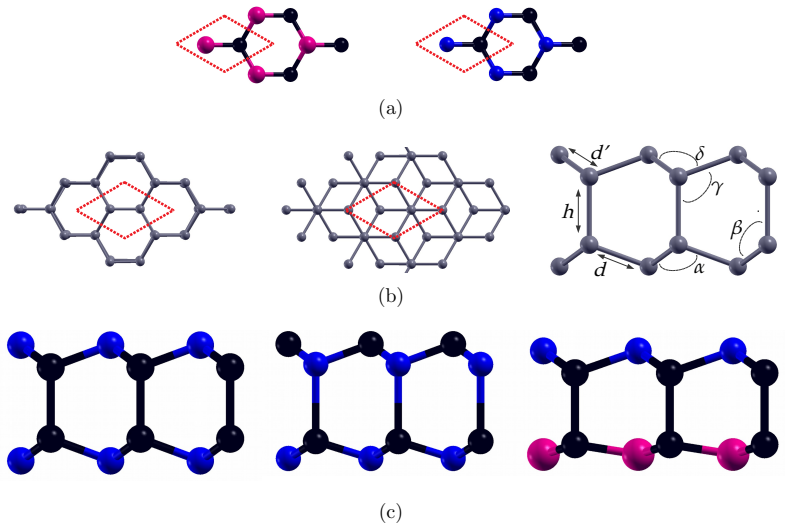
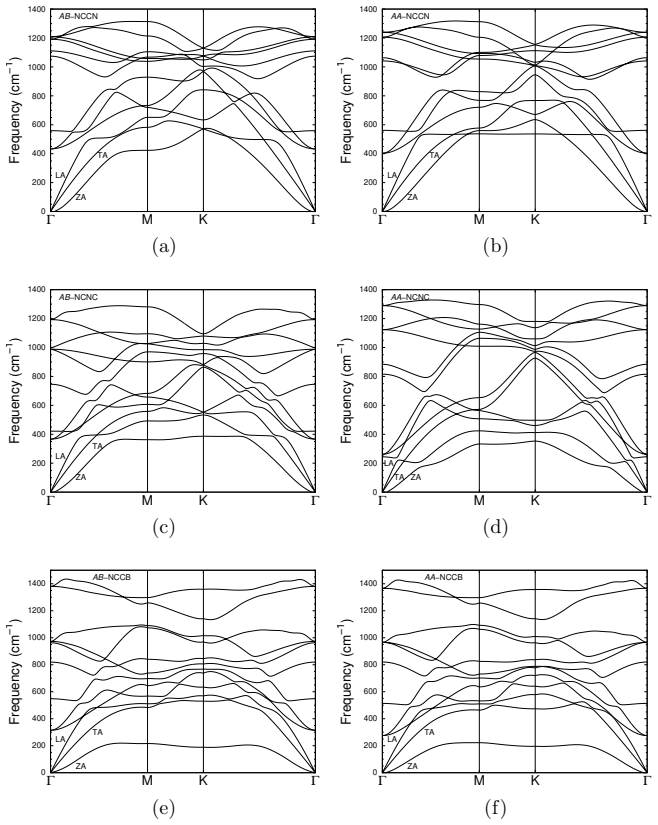
The central object is the NCCB bilayer, a graphene-like two-layer sheet in which one layer is a 1:1 carbon-nitrogen network and the other is a 1:1 carbon-boron network, stacked so that interlayer carbon-carbon bonds of about 1.44 to 1.67 Å form. It carries the argument because its mixed faces give it both a strong covalent interior and complementary donor-acceptor faces: nitrogen-rich faces can bind to boron-rich faces of neighboring bilayers, providing the inter-bilayer driving force that pure graphene or homogeneous bilayers lack. The paper uses phonon spectra with no imaginary frequencies as the criterion for dynamical stability, and validates its total-energy methods by reproducing the known lattice parameters and exfoliation energy of graphene and graphite.
What would settle it
Compute the full phonon spectrum and the energy-versus-interlayer-separation curve for the two proposed NCCB bulk crystals using a method that treats covalent and dispersion bonding without relying on the same functional approximation; if either crystal shows imaginary phonon modes at its reported lattice parameters, or if the interlayer minimum disappears, the central stability claim is falsified. An experimental route would be to search for the predicted interlayer carbon-carbon distance of 1.44 to 1.66 Å and the boron-nitrogen distance of 1.645 Å in a synthesized sample using diffraction or spectroscopy.
Extended reading notes
Core claim
Using first-principles density functional calculations with van der Waals corrections, the paper finds that 50% nitrogen-doped graphene monolayers and 50% boron-doped monolayers are dynamically unstable, but stacking such monolayers into bilayers stabilizes them. Among the stable bilayers, NCCB is singled out because its two layers are bonded by short carbon-carbon links, about 1.66 to 1.67 Å, which the paper interprets as covalent, and because its two faces are chemically complementary: nitrogen on one face acts as an electron donor and boron on the other as an acceptor. This pairing provides a natural driving force between neighboring NCCB bilayers, so the bilayer can serve as a self-assembling nanoscale building block. Stacking NCCB bilayers in two different registries yields two distinct 3D crystals: a rigid covalent solid and a weakly bound layered solid. The paper claims both are energetically stable and that their properties make the NCCB bilayer a promising building block for self-assembly nanomanufacturing.
Load-bearing premise
The predictions stand or fall on whether the approximate quantum-mechanical treatment of electrons, including its van der Waals correction, correctly describes the short bonds between stacked layers; if it overbinds the layers, the predicted stability and the 328.9 GPa bulk modulus would not survive.
Editorial extensions
If this is right
- The same NCCB building block can assemble into two thermodynamically distinct solids, so the stacking registry alone switches the material between hard, covalent behavior and soft, layered behavior.
- A stable 1:1 carbon-nitride bilayer would exceed the previously claimed 37.5% nitrogen stability limit for hexagonal carbon nitride monolayers, opening a new stoichiometry for carbon nitride materials.
- The hard NCCB crystal has a bulk modulus of 328.9 GPa, placing it in the range of hard materials and suggesting possible use in wear-resistant or protective applications if synthesis is achieved.
- The graphite-like NCCB crystal has weak inter-bilayer binding near 70 meV/atom, comparable to graphite, so it could plausibly be exfoliated or intercalated while retaining a semiconducting gap of 1.246 eV.
- The fact that stable bilayers exist where monolayers are unstable suggests that other multilayer stacks, such as trilayers or sandwich heterostructures, may also serve as viable self-assembly building blocks.
Reading between the lines
- The donor-acceptor B-N face pairing suggests a broader design rule for two-dimensional building blocks: bilayers with chemically complementary faces should stack more strongly than homogeneous pairs, a rule that could be tested with other donor-acceptor substitutions such as phosphorus or oxygen.
- Because density functional theory typically underestimates band gaps, the true gaps of the two NCCB crystals are likely larger than the reported 0.65 eV and 1.246 eV; if so, the practical utility of the small-gap crystal as a semiconductor could be better or worse depending on the actual value.
- The predicted interlayer boron-nitrogen distance of 1.645 Å is much longer than the covalent B-N bond in hexagonal boron nitride, so measuring vibrational modes or pair distribution functions in a synthesized sample would directly test whether this is a genuine dative bond or an artifact of the computational functional.
- The two stackings differ only by registry, suggesting a twist-angle engineering route not explored in the paper: controlled rotation between NCCB bilayers could continuously tune electronic and mechanical properties beyond the two computed cases.
Signed reviews
Editorial analysis
A structured set of objections, weighed in public.
Referee Report
Summary. The paper reports DFT calculations (optB88-vdW) on nitrogen- and boron-functionalized graphene-like monolayers and bilayers. It finds that h-CN and h-CB monolayers are dynamically unstable, while among the bilayers the NCCN, NCNC, and NCCB configurations in AA and AB stackings are dynamically stable and BCCB is not. The authors then stack the NCCB bilayer to construct two hexagonal 3D crystals: a covalent crystal with lattice parameters a=2.590 Å and c=8.417 Å, an interlayer C–C distance of 1.439 Å, a B–N inter-bilayer distance of 1.645 Å, binding energy 0.16 eV/atom, bulk modulus 328.9 GPa, and an indirect gap of 0.65 eV; and a graphite-like crystal with a=2.563 Å and c=5.090 Å, an inter-bilayer distance of 2.685 Å, bulk modulus 79.3 GPa, binding energy 70 meV/atom, and an indirect gap of 1.246 eV. On this basis the paper concludes that the NCCB bilayer is the best 2D building block for self-assembly nanomanufacturing.
Significance. If the central predictions hold, the paper offers a conceptually interesting route to 2D building blocks with covalent interlayer bonding, and the two predicted NCCB crystals are new candidate materials with potentially useful mechanical and electronic properties. The authors do several things well: they state convergence criteria, benchmark the methodology against graphene and graphite, perform phonon calculations for the bilayers, and reproduce the independent structural data of ref 39 for the NCCN/NCNC systems. The value of the paper lies in concrete, falsifiable predictions of specific structures and properties. However, the significance is currently capped by the lack of validation of the exchange–correlation functional in the short-interlayer-bond regime, which is precisely the regime that determines whether the proposed materials exist at all.
major comments (3)
- [Computational Details; Functionalized graphene-like bilayer crystals] The principal claims of the paper—dynamically stable NCCB bilayers, two energetically stable 3D crystals, the bulk modulus of 328.9 GPa, and the viability of NCCB as a self-assembly building block—are computed with the optB88-vdW functional at interlayer C–C distances of 1.439–1.672 Å and a B–N interlayer distance of 1.645 Å. These distances are in the covalent/dative bonding regime, not the van der Waals regime for which optB88-vdW is normally validated. The only benchmarks presented (graphene and graphite, with interlayer spacings near 3.3 Å) do not exercise this regime, and the agreement with ref 39 concerns in-plane structural parameters and gaps, not interlayer bonding. Please provide a cross-check of the binding energetics and equilibrium interlayer distances of at least one central structure (for example, AB-NCCB or the covalent NCCB crystal) with an independent method, such as SCAN/rVV10, RPA, or a CCSD(T) cluster model. Without this, the load-bearing predictions are conditional on an unvalidated functional extrapolation.
- [Results, Table 1; Discussion] The suitability of the NCCB bilayer as a building block is argued from its small energy of formation, but the paper reports only formation energies relative to AB-NCCN (ΔEf = 0.486 eV for AB-NCCB and 0.687 eV for AA-NCCB in Table 1), not the absolute values from Eq. (1). Since Eq. (1) references elemental C, N2, and β-B, the absolute formation energies are presumably positive; the reader therefore cannot assess whether 'small' means thermodynamically accessible, especially in comparison with competing bulk phases. Please report the absolute Ef values and, if necessary, a brief discussion of kinetic accessibility or of why a positive formation energy does not preclude synthesis.
- [Functionalized graphene-like bilayer crystals] The two 3D crystals are characterized as energetically stable based on geometry optimization from one stacking arrangement per crystal. No phonon spectra, elastic-constant calculation, or search over stacking variants (for example, translations or rotations of adjacent bilayers) is reported. Given the abstract's broader claim that these crystals are stable and that NCCB could guarantee stability and rigidity, the stability assessment should be strengthened with at least a vibrational analysis of the 3D structures, or the paper should explicitly state that only local energetic stability under the chosen stacking is being claimed.
minor comments (6)
- [Computational Details] The k-point grid for the 3D crystal calculations is not specified; the stated 16×16×1 grid applies to the 2D systems. Please provide the 3D sampling and the details of the Birch–Murnaghan fits (for example, whether all ionic positions were relaxed at each volume).
- [Computational Details, Eq. (2)] The binding energy is defined as a total-energy difference but is quoted per atom (70 meV/atom and 0.16 eV/atom). Please state explicitly how the per-atom normalization is applied, including for the bilayer building-block unit.
- [Figure 5 caption] The caption calls h the 'intra-bilayer distance,' while in Figure 1 h is defined as the inter-layer distance within the bilayer. Please use one consistent notation throughout.
- [Throughout] The text contains several typographical errors: 'iteractions' (Computational Details), 'Monkhorst-Packk' (Computational Details), 'struture' (Table 1 header), 'rigth' (Figure 1 caption), and 'caried' (Discussion).
- [Functionalized graphene-like bilayer crystals] The assignment of the B–N interlayer contact as 'dative' is interpretive. A Bader charge or electron-localization-function analysis, or at least an explicit computational criterion for dative bonding, would make the assignment more transparent.
- [Reproducibility] Please provide the atomic coordinates of the six stable bilayers and the two 3D crystals, or deposit them in an open repository, since the structures are not fully recoverable from the schematic figures alone.
Circularity Check
No circular steps: central claims are computed first-principles results benchmarked against external data, and the paper's self-citations are not load-bearing.
full rationale
The derivation chain is not circular. Bilayer stability, phonon spectra, formation energies, and the stabilities of the two stacked NCCB crystals are computed by DFT/vdW total-energy minimizations rather than constructed from the quantities they predict. The only numerical fit, the Birch-Murnaghan equation of state used to obtain K0 = 328.9 GPa, is a standard reduction of independently computed energy-versus-volume data and is not an input to the physics. The paper benchmarks its methodology against external graphene/graphite data and against an independent GGA calculation (ref 39) for NCCN/NCNC; these are external comparison points, not outputs of the present fit. The self-citations (refs 6, 14, 32, 33) concern the general building-block concept, dative-bond examples, and formation-energy methodology; none is invoked as a uniqueness theorem or as the justification that NCCB stacking forms stable crystals. The choice of NCCB as a building block is justified by computed energies of formation and interaction character, and the 3D stability is then recomputed from scratch. The skeptic's concern about optB88-vdW accuracy at short interlayer distances is a physical and functional-validity risk, not a circularity, because the paper's predictions do not reduce by construction to its inputs. Accordingly, no circular step is present.
Assumptions & free parameters
assumptions (4)
- domain assumption The optB88-vdW functional adequately describes the electronic structure and interlayer interactions of B/N-doped carbon bilayers.
- domain assumption A structure is dynamically stable if its phonon dispersion has no imaginary frequencies.
- domain assumption The energy of formation reference states (C in graphene, N in N2, B in beta-boron) provide a valid basis for comparing stability.
- domain assumption The two NCCB stacking arrangements considered are representative of self-assembled products.
Cite this review
Pith. "Pith review of Carbon-related Bilayers: Nanoscale Building Blocks for Self-Assembly Nanomanufacturing." pith.science (2026). https://pith.science/paper/3NLVBV43
@misc{pith2026190806218,
  author       = {Pith},
  title        = {Pith review of: Carbon-related Bilayers: Nanoscale Building Blocks for Self-Assembly Nanomanufacturing},
  year         = {2026},
  howpublished = {\url{https://pith.science/paper/3NLVBV43}},
  note         = {Machine review of arXiv:1908.06218}
}
read the original abstract
Using a first-principles total energy methodology, we investigated the properties of graphene-like carbon mono and bilayers, functionalized with nitrogen and boron atoms. The resulting stable structures were explored in terms of their potential use as nanoscale two-dimensional building blocks for self-assembly of macroscopic structures. We initially considered graphene monolayers functionalized with nitrogen and boron, but none of them was dynamically stable, in terms of the respective layer phonon spectra. Then, we considered the functionalized graphene-like bilayers (labeled as NCCN, NCNC, BCCB, and NCCB), analyzing their stability, electronic and mechanical properties, and chemical reactivity. We found that while the NCCN, NCNC, and NCCB bilayers were stable, the BCCB one was not. Additionally, the NCCN and NCCB bilayers were explored as potential two-dimensional building blocks for nanostructure self-assembly, which could form stable bulk structures. Particularly, the NCCB bilayer seemed the best choice as a building block, since the resulting 3D crystals, formed by stacking NCCB bilayers, were energetically stable.
Figures

Figures from the paper (2 more)


Reference graph
Works this paper leans on
-
[1]
Nanostructures and nanotechnology; Cambridge University Press, 2015
Natelson, D. Nanostructures and nanotechnology; Cambridge University Press, 2015
work page 2015
-
[2]
Springer handbook of nanotechnology; Springer, 2017
Bhushan, B. Springer handbook of nanotechnology; Springer, 2017
work page 2017
-
[3]
Graphene-based materials: synthesis, characterization, properties, and applications
Huang, X.; Yin, Z.; Wu, S.; Qi, X.; He, Q.; Zhang, Q.; Yan, Q.; Boey, F.; Zhang, H. Graphene-based materials: synthesis, characterization, properties, and applications. Small 2011, 7, 1876--1902
work page 2011
-
[4]
Merkle, R. C. Molecular building blocks and development strategies for molecular nanotechnology. Nanotechnology 2000, 11, 89--99
work page 2000
-
[5]
J.; Mearns, F.; Yang, W.; Liu, J
Gooding, J. J.; Mearns, F.; Yang, W.; Liu, J. Self-assembled monolayers into the 21st century: recent advances and applications. Electroanalysis 2003, 15, 81--96
work page 2003
-
[6]
Garcia, J. C.; Justo, J. F.; Machado, W. V. M.; Assali, L. V. C. Functionalized adamantane: building blocks for nanostructure self-assembly. Physical Review B 2009, 80, 125421
work page 2009
-
[7]
Lu, W.; Lieber, C. M. Nanoelectronics from the bottom up. Nature Materials 2007, 6, 841--850
work page 2007
-
[8]
Liu, J.; Wickramaratne, N. P.; Qiao, S. Z.; Jaroniec, M. Molecular-based design and emerging applications of nanoporous carbon spheres. Nature Materials 2015, 14, 763--774
work page 2015
Show all 51 references
-
[9]
Self-assembly: from surfactants to nanoparticles, 1st ed.; Wiley: New Jersey, 2019
Nagarajan, R., Ed. Self-assembly: from surfactants to nanoparticles, 1st ed.; Wiley: New Jersey, 2019
2019
-
[10]
M.; Liz-Marzan, L
Grzelczak, M.; Vermant, J.; Furst, E. M.; Liz-Marzan, L. M. Directed self-assembly of nanoparticles. ACS Nano 2010, 4, 3591--3605
2010
-
[11]
J.; Werner, P.; Zacharias, M
Fan, H. J.; Werner, P.; Zacharias, M. Semiconductor nanowires: from self-organization to patterned growth. Small 2006, 2, 700--717
2006
-
[12]
M.; Park, M.-S.; Jiang, L.; Kim, J
Sun, Z.; Liao, T.; Dou, Y.; Hwang, S. M.; Park, M.-S.; Jiang, L.; Kim, J. H.; Dou, S. X. Generalized self-assembly of scalable two-dimensional transition metal oxide nanosheets. Nature Communications 2014, 5, 3813
2014
-
[13]
An atlas of two-dimensional materials
Mir \'o , P.; Audiffred, M.; Heine, T. An atlas of two-dimensional materials. Chemical Society Reviews 2014, 43, 6537--6554
2014
-
[14]
C.; de Lima, D
Garcia, J. C.; de Lima, D. B.; Assali, L. V. C.; Justo, J. F. Group IV graphene- and graphane-like nanosheets. The Journal of Physical Chemistry C 2011, 115, 13242--13246
2011
-
[15]
J.; Bunch, J
Akinwande, D.; Brennan, C. J.; Bunch, J. S.; Egberts, P.; Felts, J. R.; Gao, H.; Huang, R.; Kim, J.-S.; Li, T.; Li, Y. et al. A review on mechanics and mechanical properties of 2D materials - graphene and beyond. Extreme Mechanics Letters 2017, 13, 42--77
2017
-
[16]
S.; Bechtel, H
Fang, H.; Battaglia, C.; Carraro, C.; Nemsak, S.; Ozdol, B.; Kang, J. S.; Bechtel, H. A.; Desai, S. B.; Kronast, F.; Unal, A. A. et al. Strong interlayer coupling in van der Waals heterostructures built from single-layer chalcogenides. Proceedings of the National Academy of Sc...
2014
-
[17]
S.; Mishchenko, A.; Carvalho, A.; Castro Neto, A
Novoselov, K. S.; Mishchenko, A.; Carvalho, A.; Castro Neto, A. H. 2D materials and van der Waals heterostructures. Science 2016, 353, aac9439
2016
-
[18]
K.; Grigorieva, I
Geim, A. K.; Grigorieva, I. V. Van der Waals heterostructures. Nature 2013, 499, 419--425
2013
-
[19]
V.; Jalil, R.; Belle, B
Britnell, L.; Gorbachev, R. V.; Jalil, R.; Belle, B. D.; Schedin, F.; Mishchenko, A.; Georgiou, T.; Katsnelson, M. I.; Eaves, L.; Morozov, S. V. et al. Field-effect tunneling transistor based on vertical graphene heterostructures. Science 2012, 335, 947--950
2012
-
[20]
J.; Gholinia, A.; Jalil, R.; Romani, S.; Britnell, L.; Elias, D
Haigh, S. J.; Gholinia, A.; Jalil, R.; Romani, S.; Britnell, L.; Elias, D. C.; Novoselov, K. S.; Ponomarenko, L. A.; Geim, A. K.; Gorbachev, R. Cross-sectional imaging of individual layers and buried interfaces of graphene-based heterostructures and superlattices . Nature Mate...
2012
-
[21]
Tunable band structures of heterostructured bilayers with transition-metal dichalcogenide and MXene monolayer
Ma, Z.; Hu, Z.; Zhao, X.; Tang, Q.; Wu, D.; Zhou, Z.; Zhang, L. Tunable band structures of heterostructured bilayers with transition-metal dichalcogenide and MXene monolayer. The Journal of Physical Chemistry C 2014, 118, 5593--5599
2014
-
[22]
Journal of Physics: Condensed Matter 2009, 21, 395502
Giannozzi, P.; et al., QUANTUM ESPRESSO: a modular and open-source software project for quantum simulations of materials . Journal of Physics: Condensed Matter 2009, 21, 395502
2009
-
[23]
C.; Lundqvist, B
Dion, M.; Rydberg, H.; Schr \"o der, E.; Langreth, D. C.; Lundqvist, B. I. Van der Waals density functional for general geometries. Physical Review Letters 2004, 92, 246401
2004
-
[24]
R.; Michaelides, A
Klime s , J.; Bowler, D. R.; Michaelides, A. Chemical accuracy for the van der Waals density functional. Journal of Physics: Condensed Matter 2009, 22, 022201
2009
-
[25]
From ultrasoft pseudopotentials to the projector augmented-wave method
Kresse, G.; Joubert, D. From ultrasoft pseudopotentials to the projector augmented-wave method. Physical Review B 1999, 59, 1758--1775
1999
-
[26]
J.; Pack, J
Monkhorst, H. J.; Pack, J. D. Special points for Brillouin-zone integrations. Physical Review B 1976, 13, 5188--5192
1976
-
[27]
Phonons and related crystal properties from density-functional perturbation theory
Baroni, S.; De Gironcoli, S.; Dal Corso, A.; Giannozzi, P. Phonons and related crystal properties from density-functional perturbation theory. Reviews of Modern Physics 2001, 73, 515--562
2001
-
[28]
R.; Michaelides, A
Klime s , J.; Bowler, D. R.; Michaelides, A. Van der Waals density functionals applied to solids. Physical Review B 2011, 83, 195131
2011
-
[29]
Structure of graphite by neutron-diffraction
Trucano, P.; Chen, R. Structure of graphite by neutron-diffraction. Nature 1975, 258, 136--137
1975
-
[30]
Tight-binding description of graphene
Reich, S.; Maultzsch, J.; Thomsen, C.; Ordej\'on, P. Tight-binding description of graphene. Physical Review B 2002, 66, 035412
2002
-
[31]
H.; Guinea, F.; Peres, N
Castro Neto, A. H.; Guinea, F.; Peres, N. M. R.; Novoselov, K. S.; Geim, A. K. The electronic properties of graphene. Reviews of Modern Physics 2009, 81, 109--162
2009
-
[32]
Ayres, F.; Assali, L. V. C.; Machado, W. V. M.; Justo, J. F. Role of intrinsic defects in the electronic and optical properties of - HgI2 . Applied Physics Letters 2006, 88, 011918
2006
-
[33]
F.; Machado, W
Larico, R.; Justo, J. F.; Machado, W. V. M.; Assali, L. V. C. Electronic properties and hyperfine fields of nickel-related complexes in diamond. Physical Review B 2009, 79, 115202
2009
-
[34]
V.; Knizhnik, A
Lebedeva, I. V.; Knizhnik, A. A.; Popov, A. M.; Lozovik, Y. E.; Potapkin, B. V. Interlayer interaction and relative vibrations of bilayer graphene. Physical Chemistry Chemical Physics 2011, 13, 5687--5695
2011
-
[35]
Shi, Z.; Kutana, A.; Yakobson, B. I. How much N-doping can graphene sustain? Journal of Physical Chemistry Letters 2015, 6, 106--112
2015
-
[36]
High-temperature superconductivity in heavily N- or B-doped graphene
Zhou, J.; Sun, Q.; Wang, Q.; Jena, P. High-temperature superconductivity in heavily N- or B-doped graphene. Physical Review B 2015, 92, 064505
2015
-
[37]
First-principles determination of the structural, vibrational and thermodynamic properties of diamond, graphite, and derivatives
Mounet, N.; Marzari, N. First-principles determination of the structural, vibrational and thermodynamic properties of diamond, graphite, and derivatives. Physical Review B 2005, 71, 205214
2005
-
[38]
Phonon dispersion of graphite by inelastic x-ray scattering
Mohr, M.; Maultzsch, J.; Dobard z i \'c , E.; Reich, S.; Milo s evi \'c , I.; Damnjanovi \'c , M.; Bosak, A.; Krisch, M.; Thomsen, C. Phonon dispersion of graphite by inelastic x-ray scattering. Physical Review B 2007, 76, 035439
2007
-
[39]
V.; Minaev, B
Bondarchuk, S. V.; Minaev, B. F. Two isomeric solid carbon nitrides with 1:1 stoichiometry which exhibit strong mechanical anisotropy. New Journal of Chemistry 2017, 41, 13140--13148
2017
-
[40]
First-principle calculation study of tri-s-triazine-based g- C3N4 : a review
Zhu, B.; Zhang, L.; Cheng, B.; Yu, J. First-principle calculation study of tri-s-triazine-based g- C3N4 : a review. Applied Catalysis B: Environmental 2018, 224, 983--999
2018
-
[41]
Covalently coupled hybrid of graphitic carbon nitride with reduced graphene oxide as a superior performance lithium-ion battery anode
Fu, Y.; Zhu, J.; Hu, C.; Wu, X.; Wang, X. Covalently coupled hybrid of graphitic carbon nitride with reduced graphene oxide as a superior performance lithium-ion battery anode. Nanoscale 2014, 6, 12555--12564
2014
-
[42]
Reddy, A. L. M.; Srivastava, A.; Gowda, S. R.; Gullapalli, H.; Dubey, M.; Ajayan, P. M. Synthesis of nitrogen-doped graphene films for lithium battery application. ACS Nano 2010, 4, 6337--6342
2010
-
[43]
M.; Lee, J
Jeong, H. M.; Lee, J. W.; Shin, W. H.; Choi, Y. J.; Shin, H. J.; Kang, J. K.; Choi, J. W. Nitrogen-doped graphene for high-performance ultracapacitors and the importance of nitrogen-doped sites at basal planes. Nano Letters 2011, 11, 2472--2477
2011
-
[44]
K.; Wang, H.; Guo, J.; Dai, H
Wang, X.; Li, X.; Zhang, L.; Yoon, Y.; Weber, P. K.; Wang, H.; Guo, J.; Dai, H. N-doping of graphene through electrothermal reactions with ammonia. Science 2009, 324, 768--771
2009
-
[45]
Metal-free catalysis of ammonia--borane dehydrogenation/regeneration for a highly efficient and facilely recyclable hydrogen-storage material
Tang, Z.; Chen, X.; Chen, H.; Wu, L.; Yu, X. Metal-free catalysis of ammonia--borane dehydrogenation/regeneration for a highly efficient and facilely recyclable hydrogen-storage material. Angewandte Chemie International Edition 2013, 52, 5832--5835
2013
-
[46]
Graphene, hexagonal boron nitride, and their heterostructures: properties and applications
Wang, J.; Ma, F.; Sun, M. Graphene, hexagonal boron nitride, and their heterostructures: properties and applications. RSC Advances 2017, 7, 16801--16822
2017
-
[47]
L.; Louie, S
Sun, H.; Jhi, S.-H.; Roundy, D.; Cohen, M. L.; Louie, S. G. Structural forms of cubic BC2N . Physical Review B 2001, 64, 094108
2001
-
[48]
Hexagonal BC2N with remarkably high hardness
Liu, L.; Zhao, Z.; Yu, T.; Zhang, S.; Lin, J.; Yang, G. Hexagonal BC2N with remarkably high hardness. The Journal of Physical Chemistry C 2018, 122, 6801--6807
2018
-
[49]
S.; Politzer, P
Brinck, T.; Murray, J. S.; Politzer, P. A computational analysis of the bonding in boron trifluoride and boron trichloride and their complexes with ammonia. Inorganic Chemistry 1993, 32, 2622--2625
1993
-
[50]
Finite elastic strain of cubic crystals
Birch, F. Finite elastic strain of cubic crystals. Physical Review 1947, 71, 809
1947
-
[51]
Elastic constants of boron nitride
Grimsditch, M.; Zouboulis, E.; Polian, A. Elastic constants of boron nitride. Journal of Applied Physics 1994, 76, 832--834 mcitethebibliography document methodology.tex0000664000000000000000000001225313525576130012644 0ustar rootroot Computational Details The calculations wer...
1994
Reviewed August 14, 2026 · model on record in the stance chip above.
Discussion (0). Continue with ORCID to comment.